Introduction to
Language & Linguistics
PRESENTED BY:
SHERILYN E. NUESCA, PHD
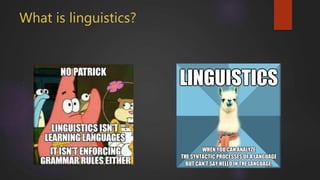
What is linguistics?
Language & Linguistics
 What is linguistics?
Oxford’s “Lexico”: The scientific study of language and its structure, including the
study of grammar, syntax, and phonetics. Specific branches of linguistics include
sociolinguistics, dialectology, psycholinguistics, computational linguistics,
comparative linguistics, and structural linguistics. (link:
https://www.lexico.com/en/definition/linguistics)
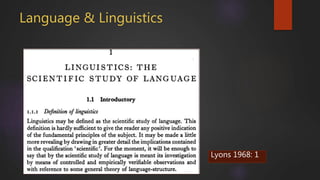
Lyons 1968: 1
Language & Linguistics
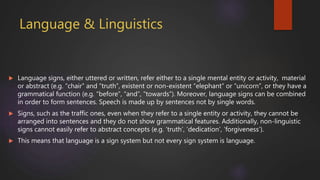
 Language signs, either uttered or written, refer either to a single mental entity or activity, material
or abstract (e.g. “chair” and “truth”, existent or non-existent “elephant” or “unicorn”, or they have a
grammatical function (e.g. “before”, “and”, “towards”). Moreover, language signs can be combined
in order to form sentences. Speech is made up by sentences not by single words.
 Signs, such as the traffic ones, even when they refer to a single entity or activity, they cannot be
arranged into sentences and they do not show grammatical features. Additionally, non-linguistic
signs cannot easily refer to abstract concepts (e.g. ‘truth’, ‘dedication’, ‘forgiveness’).
 This means that language is a sign system but not every sign system is language.
Knowledge of Language
 To speak a language as a native speaker means to know what is right or
wrong in a particular language.
 This knowledge is acquired at the age of 5. A child may ignore several words
but its ability to construct grammatically right sentences is already available.
Obviously, this is not a result of education.
 Children learn to speak unconsciously, similar to the way they learn to stand
or walk. This means that language is an innate ability of the human brain.
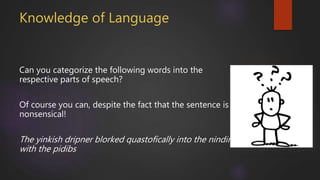
Knowledge of Language
Can you categorize the following words into the
respective parts of speech?
Of course you can, despite the fact that the sentence is
nonsensical!
The yinkish dripner blorked quastofically into the nindin
with the pidibs
Knowledge of the Sound System
 When we know a language, we know what sounds (or signs)
are used in the language and which sounds (or signs) are
not
 This also includes knowing how the sounds of the language
can be combined
 Which sounds may start a word
 Which sounds may end a word
 Which sounds may follow each other within a word
What Is Grammar?
 Grammar = a. the knowledge (competence) speakers have about the units and rules
of their language, b. a theory describing and explaining this competence.
 Rules for combining sounds into words, word formation, making sentences,
assigning meaning
 When a sentence is ungrammatical in a linguistic sense, it means that it breaks the
rules of the shared mental grammar of the language

Introduction to Linguistics

  • 1.
    Introduction to Language &Linguistics PRESENTED BY: SHERILYN E. NUESCA, PHD
  • 2.
  • 3.
    Language & Linguistics What is linguistics? Oxford’s “Lexico”: The scientific study of language and its structure, including the study of grammar, syntax, and phonetics. Specific branches of linguistics include sociolinguistics, dialectology, psycholinguistics, computational linguistics, comparative linguistics, and structural linguistics. (link: https://www.lexico.com/en/definition/linguistics)
  • 4.
  • 5.
    Language & Linguistics Language signs, either uttered or written, refer either to a single mental entity or activity, material or abstract (e.g. “chair” and “truth”, existent or non-existent “elephant” or “unicorn”, or they have a grammatical function (e.g. “before”, “and”, “towards”). Moreover, language signs can be combined in order to form sentences. Speech is made up by sentences not by single words.  Signs, such as the traffic ones, even when they refer to a single entity or activity, they cannot be arranged into sentences and they do not show grammatical features. Additionally, non-linguistic signs cannot easily refer to abstract concepts (e.g. ‘truth’, ‘dedication’, ‘forgiveness’).  This means that language is a sign system but not every sign system is language.
  • 14.
    Knowledge of Language To speak a language as a native speaker means to know what is right or wrong in a particular language.  This knowledge is acquired at the age of 5. A child may ignore several words but its ability to construct grammatically right sentences is already available. Obviously, this is not a result of education.  Children learn to speak unconsciously, similar to the way they learn to stand or walk. This means that language is an innate ability of the human brain.
  • 15.
    Knowledge of Language Canyou categorize the following words into the respective parts of speech? Of course you can, despite the fact that the sentence is nonsensical! The yinkish dripner blorked quastofically into the nindin with the pidibs
  • 16.
    Knowledge of theSound System  When we know a language, we know what sounds (or signs) are used in the language and which sounds (or signs) are not  This also includes knowing how the sounds of the language can be combined  Which sounds may start a word  Which sounds may end a word  Which sounds may follow each other within a word
  • 17.
    What Is Grammar? Grammar = a. the knowledge (competence) speakers have about the units and rules of their language, b. a theory describing and explaining this competence.  Rules for combining sounds into words, word formation, making sentences, assigning meaning  When a sentence is ungrammatical in a linguistic sense, it means that it breaks the rules of the shared mental grammar of the language