

IMPACT OF STOCK
SPLIT ON MARKET
PRICES OF SHARES
                          Amity Business School


    Submitted By:
Kaustubh Gupta    (E31)
  Vibhor Pahwa    (E33)
  Jasdeep Kohli   (E34)
  Palash Verma    (E35)
    Mohit Garg    (E36)
Introduction& Overview:

In today's financial markets, the distinction between stocks and shares has been
somewhat blurred. Generally, these words are used interchangeably to refer to
the pieces of paper that denote ownership in a particular company, called stock
certificates. However, the difference between the two words comes from the
context in which they are used.

For example, "stock" is a general term used to describe the ownership
certificates of any company, in general, and "shares" refers to a the ownership
certificates of a particular company. So, if investors say they own stocks, they
are generally referring to their overall ownership in one or more companies.
Technically, if someone says that they own shares - the question then becomes -
shares in what company?

Bottom line, stocks and shares are the same thing. The minor distinction
between stocks and shares is usually overlooked, and it has more to do with
syntax than financial or legal accuracy.


A stock split or stock divide increases the number of shares in a public
company. The price is adjusted such that the before and after market
capitalization of the company remains the same and dilution does not
occur. Options and warrants are included.


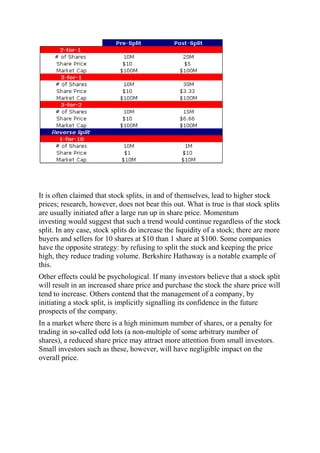
Take, for example, a company with 100 shares of stock priced at $50 per share.
The market capitalization is 100 × $50, or $5000. The company splits its stock
2-for-1. There are now 200 shares of stock and each shareholder holds twice as
many shares. The price of each share is adjusted to $25. The market
capitalization is 200 × $25 = $5000, the same as before the split.
Ratios of 2-for-1, 3-for-1, and 3-for-2 splits are the most common, but any ratio
is possible. Splits of 4-for-3, 5-for-2, and 5-for-4 are used, though less
frequently. Investors will sometimes receive cash payments in lieu of fractional
shares.
It is often claimed that stock splits, in and of themselves, lead to higher stock
prices; research, however, does not bear this out. What is true is that stock splits
are usually initiated after a large run up in share price. Momentum
investing would suggest that such a trend would continue regardless of the stock
split. In any case, stock splits do increase the liquidity of a stock; there are more
buyers and sellers for 10 shares at $10 than 1 share at $100. Some companies
have the opposite strategy: by refusing to split the stock and keeping the price
high, they reduce trading volume. Berkshire Hathaway is a notable example of
this.
Other effects could be psychological. If many investors believe that a stock split
will result in an increased share price and purchase the stock the share price will
tend to increase. Others contend that the management of a company, by
initiating a stock split, is implicitly signalling its confidence in the future
prospects of the company.
In a market where there is a high minimum number of shares, or a penalty for
trading in so-called odd lots (a non-multiple of some arbitrary number of
shares), a reduced share price may attract more attention from small investors.
Small investors such as these, however, will have negligible impact on the
overall price.
What is a stock split?

A stock split is an action by which a company lowers the face value of its
stocks, simultaneously increasing the number of outstanding shares, but keeping
the company's total capital base intact. Suppose that the face value of an XYZ
company's share is Rs 10 and the outstanding shares that have been issued are
10,000.
If XYZ declares a 2:1 stock split, it means that its shareholders will own two
shares for every one held by them previously, but at half the face value. So the
company's outstanding shares will double to 20,000, while the face value per
share will halve to Rs 5.
So if you owned 50 shares worth Rs 500 before the split, you will now have 100
shares worth Rs 500 after the split. This split ratio may vary for different
companies. So while one may go for a 3:1 split, another company may opt for a
5:1 or 4:3 split. The day that the split is carried out is known as the record date.
Only those shareholders whose names appear on the company's records on this
date are eligible for the additional shares. Subsequently, the shares start trading
at the new price on the stock exchanges.

Why is this done?
As is obvious from the above example, the split does not affect the value of
your holdings. It is similar to splitting a Rs 10 note into two notes of Rs 5 each.
Similarly, the company's fundamentals don't change, with its earnings and
equity capital base remaining the same.
So why does the company go for a stock split? It does so in order to make the
shares more affordable for a larger group of investors and, thereby, stimulate
enhanced trading in the scrip. A stock split is a play on the psyche of the
investor. When a share's price runs up too high, smaller investors find it difficult
to buy it. To make it attractive for such people, the company carries out the
split, which brings down the share price. So, while some investors may be
unwilling to pay Rs 1,000 for a certain stock, they may be more inclined to buy
it at Rs 250, following a 4:1 split.
Such a move is thus initiated when there is a huge spike in the share price.
When shares are trading at abnormal prices, it also affects the scrip's trading
volumes on the exchange. By splitting the shares and increasing the outstanding
shares available for trading, the company can ensure better liquidity.


Can you benefit from this move?

Does a stock split affect you? Some investors believe that such a move has no
impact as it is a mere accounting procedure and that it doesn't affect the share's
intrinsic value. This is true at the exact moment that the stock is split, but the
price movement it triggers before and after the split date (even the
announcement date) can interest investors. The most widely accepted view is
that a stock split results in a spike in the share price as the demand for the shares
increases after the move. There is enough evidence to prove that trading activity
usually improves after a split (see table).


We considered eight Nifty stocks that have witnessed a split in the past three
years. Take Bharti Airtel, which split the face value of its stock from Rs 10 to
Rs 5 in a 2:1 split on 24 July 2009.
This sent its stock price spiralling from around Rs 800 before the split to Rs 400
after the move. This made a sizeable impact on the scrip's volume on the NSE,
with average daily traded volume rising 153% in the month after the split,
compared with that in the previous month. Consequently, the average daily
turnover rose 26%, while the average trades per day rose by 58%. But what
about its share price? On the day of the split, it surged by 3.2%, while the
Sensex rose by 1.2%.
This means that the stock value, instead of falling by half, actually fell by a
lesser amount as more investors bought the stock at the cheaper price. In fact, as
can be seen from the table, this has been true in all but one instance; the stock
has outperformed the broader index by an average 2.1% on the split date itself.
"Although stock splits seem to be purely cosmetic measures, there exists ample
empirical evidence that these are associated with abnormal returns on both the
announcement and the execution days, bringing a change in the shareholders'
holding value," state Bangalore-based professors Suresha B and Gajendra Naidu
in a May 2011 report published in the International Journal of Research in
Commerce and Management.
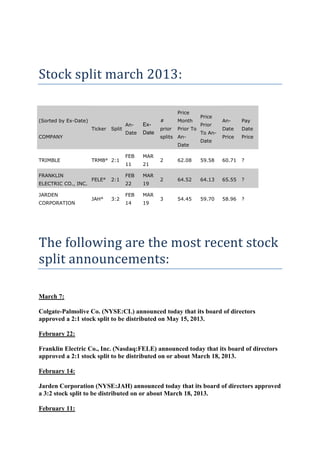
Stock split march 2013:

                                                             Price
                                                                        Price
(Sorted by Ex-Date)                                  #       Month               An-     Pay
                                       An-    Ex-                       Prior
                      Ticker   Split                 prior   Prior To            Date    Date
                                       Date   Date                      To An-
COMPANY                                              splits An-                  Price   Price
                                                                        Date
                                                             Date

                                       FEB    MAR
TRIMBLE               TRMB° 2:1                      2       62.08      59.58    60.71   ?
                                       11     21

FRANKLIN                               FEB    MAR
                      FELE°    2:1                   2       64.52      64.13    65.55   ?
ELECTRIC CO., INC.                     22     19

JARDEN                                 FEB    MAR
                      JAH°     3:2                   3       54.45      59.70    58.96   ?
CORPORATION                            14     19


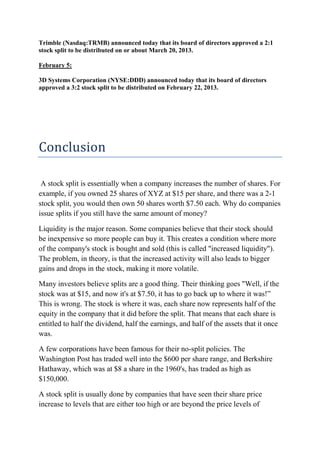
The following are the most recent stock
split announcements:

March 7:

Colgate-Palmolive Co. (NYSE:CL) announced today that its board of directors
approved a 2:1 stock split to be distributed on May 15, 2013.

February 22:

Franklin Electric Co., Inc. (Nasdaq:FELE) announced today that its board of directors
approved a 2:1 stock split to be distributed on or about March 18, 2013.

February 14:

Jarden Corporation (NYSE:JAH) announced today that its board of directors approved
a 3:2 stock split to be distributed on or about March 18, 2013.

February 11:
Trimble (Nasdaq:TRMB) announced today that its board of directors approved a 2:1
stock split to be distributed on or about March 20, 2013.

February 5:

3D Systems Corporation (NYSE:DDD) announced today that its board of directors
approved a 3:2 stock split to be distributed on February 22, 2013.


Conclusion

 A stock split is essentially when a company increases the number of shares. For
example, if you owned 25 shares of XYZ at $15 per share, and there was a 2-1
stock split, you would then own 50 shares worth $7.50 each. Why do companies
issue splits if you still have the same amount of money?

Liquidity is the major reason. Some companies believe that their stock should
be inexpensive so more people can buy it. This creates a condition where more
of the company's stock is bought and sold (this is called "increased liquidity").
The problem, in theory, is that the increased activity will also leads to bigger
gains and drops in the stock, making it more volatile.

Many investors believe splits are a good thing. Their thinking goes "Well, if the
stock was at $15, and now it's at $7.50, it has to go back up to where it was!”
This is wrong. The stock is where it was, each share now represents half of the
equity in the company that it did before the split. That means that each share is
entitled to half the dividend, half the earnings, and half of the assets that it once
was.

A few corporations have been famous for their no-split policies. The
Washington Post has traded well into the $600 per share range, and Berkshire
Hathaway, which was at $8 a share in the 1960's, has traded as high as
$150,000.

A stock split is usually done by companies that have seen their share price
increase to levels that are either too high or are beyond the price levels of
similar companies in their sector. The primary motive is to make shares seem
more affordable to small investors even though the underlying value of the
company has not changed.

A stock split can also result in a stock price increase following the decrease
immediately after the split. Since many small investors think the stock is now
more affordable and buy the stock, they end up boosting demand and drive up
prices. Another reason for the price increase is that a stock split provides a
signal to the market that the company's share price has been increasing and
people assume this growth will continue in the future, and again, lift demand
and prices.

Another version of a stock split is the‘reverse split’. This procedure is typically
used by companies with low share prices that would like to increase these prices
to either gain more respectability in the market or to prevent the company from
being delisted (many stock exchanges will delist stocks if they fall below a
certain price per share). For example, in a reverse 5-for-1 split, 10 million
outstanding shares at 50 cents each would now become two million shares
outstanding at $2.50 per share. In both cases, the company is worth $5 million.

The bottom line is a stock split is used primarily by companies that have seen
their share prices increase substantially and although the number of outstanding
shares increases and price per share decreases, the market capitalization (and the
value of the company) does not change.
As a result, stock splits help make shares more affordable to small investors and
providegreater marketability and liquidity in the market.

Stock split

  • 1.
    IMPACT OF STOCK SPLITON MARKET PRICES OF SHARES Amity Business School Submitted By: Kaustubh Gupta (E31) Vibhor Pahwa (E33) Jasdeep Kohli (E34) Palash Verma (E35) Mohit Garg (E36)
  • 2.
    Introduction& Overview: In today'sfinancial markets, the distinction between stocks and shares has been somewhat blurred. Generally, these words are used interchangeably to refer to the pieces of paper that denote ownership in a particular company, called stock certificates. However, the difference between the two words comes from the context in which they are used. For example, "stock" is a general term used to describe the ownership certificates of any company, in general, and "shares" refers to a the ownership certificates of a particular company. So, if investors say they own stocks, they are generally referring to their overall ownership in one or more companies. Technically, if someone says that they own shares - the question then becomes - shares in what company? Bottom line, stocks and shares are the same thing. The minor distinction between stocks and shares is usually overlooked, and it has more to do with syntax than financial or legal accuracy. A stock split or stock divide increases the number of shares in a public company. The price is adjusted such that the before and after market capitalization of the company remains the same and dilution does not occur. Options and warrants are included. Take, for example, a company with 100 shares of stock priced at $50 per share. The market capitalization is 100 × $50, or $5000. The company splits its stock 2-for-1. There are now 200 shares of stock and each shareholder holds twice as many shares. The price of each share is adjusted to $25. The market capitalization is 200 × $25 = $5000, the same as before the split. Ratios of 2-for-1, 3-for-1, and 3-for-2 splits are the most common, but any ratio is possible. Splits of 4-for-3, 5-for-2, and 5-for-4 are used, though less frequently. Investors will sometimes receive cash payments in lieu of fractional shares.
  • 3.
    It is oftenclaimed that stock splits, in and of themselves, lead to higher stock prices; research, however, does not bear this out. What is true is that stock splits are usually initiated after a large run up in share price. Momentum investing would suggest that such a trend would continue regardless of the stock split. In any case, stock splits do increase the liquidity of a stock; there are more buyers and sellers for 10 shares at $10 than 1 share at $100. Some companies have the opposite strategy: by refusing to split the stock and keeping the price high, they reduce trading volume. Berkshire Hathaway is a notable example of this. Other effects could be psychological. If many investors believe that a stock split will result in an increased share price and purchase the stock the share price will tend to increase. Others contend that the management of a company, by initiating a stock split, is implicitly signalling its confidence in the future prospects of the company. In a market where there is a high minimum number of shares, or a penalty for trading in so-called odd lots (a non-multiple of some arbitrary number of shares), a reduced share price may attract more attention from small investors. Small investors such as these, however, will have negligible impact on the overall price.
  • 4.
    What is astock split? A stock split is an action by which a company lowers the face value of its stocks, simultaneously increasing the number of outstanding shares, but keeping the company's total capital base intact. Suppose that the face value of an XYZ company's share is Rs 10 and the outstanding shares that have been issued are 10,000. If XYZ declares a 2:1 stock split, it means that its shareholders will own two shares for every one held by them previously, but at half the face value. So the company's outstanding shares will double to 20,000, while the face value per share will halve to Rs 5. So if you owned 50 shares worth Rs 500 before the split, you will now have 100 shares worth Rs 500 after the split. This split ratio may vary for different companies. So while one may go for a 3:1 split, another company may opt for a 5:1 or 4:3 split. The day that the split is carried out is known as the record date. Only those shareholders whose names appear on the company's records on this date are eligible for the additional shares. Subsequently, the shares start trading at the new price on the stock exchanges. Why is this done? As is obvious from the above example, the split does not affect the value of your holdings. It is similar to splitting a Rs 10 note into two notes of Rs 5 each. Similarly, the company's fundamentals don't change, with its earnings and equity capital base remaining the same. So why does the company go for a stock split? It does so in order to make the shares more affordable for a larger group of investors and, thereby, stimulate enhanced trading in the scrip. A stock split is a play on the psyche of the investor. When a share's price runs up too high, smaller investors find it difficult to buy it. To make it attractive for such people, the company carries out the split, which brings down the share price. So, while some investors may be unwilling to pay Rs 1,000 for a certain stock, they may be more inclined to buy it at Rs 250, following a 4:1 split. Such a move is thus initiated when there is a huge spike in the share price. When shares are trading at abnormal prices, it also affects the scrip's trading
  • 5.
    volumes on theexchange. By splitting the shares and increasing the outstanding shares available for trading, the company can ensure better liquidity. Can you benefit from this move? Does a stock split affect you? Some investors believe that such a move has no impact as it is a mere accounting procedure and that it doesn't affect the share's intrinsic value. This is true at the exact moment that the stock is split, but the price movement it triggers before and after the split date (even the announcement date) can interest investors. The most widely accepted view is that a stock split results in a spike in the share price as the demand for the shares increases after the move. There is enough evidence to prove that trading activity usually improves after a split (see table). We considered eight Nifty stocks that have witnessed a split in the past three years. Take Bharti Airtel, which split the face value of its stock from Rs 10 to Rs 5 in a 2:1 split on 24 July 2009. This sent its stock price spiralling from around Rs 800 before the split to Rs 400 after the move. This made a sizeable impact on the scrip's volume on the NSE, with average daily traded volume rising 153% in the month after the split, compared with that in the previous month. Consequently, the average daily turnover rose 26%, while the average trades per day rose by 58%. But what about its share price? On the day of the split, it surged by 3.2%, while the Sensex rose by 1.2%. This means that the stock value, instead of falling by half, actually fell by a lesser amount as more investors bought the stock at the cheaper price. In fact, as can be seen from the table, this has been true in all but one instance; the stock has outperformed the broader index by an average 2.1% on the split date itself. "Although stock splits seem to be purely cosmetic measures, there exists ample empirical evidence that these are associated with abnormal returns on both the announcement and the execution days, bringing a change in the shareholders' holding value," state Bangalore-based professors Suresha B and Gajendra Naidu in a May 2011 report published in the International Journal of Research in Commerce and Management.
  • 6.
    Stock split march2013: Price Price (Sorted by Ex-Date) # Month An- Pay An- Ex- Prior Ticker Split prior Prior To Date Date Date Date To An- COMPANY splits An- Price Price Date Date FEB MAR TRIMBLE TRMB° 2:1 2 62.08 59.58 60.71 ? 11 21 FRANKLIN FEB MAR FELE° 2:1 2 64.52 64.13 65.55 ? ELECTRIC CO., INC. 22 19 JARDEN FEB MAR JAH° 3:2 3 54.45 59.70 58.96 ? CORPORATION 14 19 The following are the most recent stock split announcements: March 7: Colgate-Palmolive Co. (NYSE:CL) announced today that its board of directors approved a 2:1 stock split to be distributed on May 15, 2013. February 22: Franklin Electric Co., Inc. (Nasdaq:FELE) announced today that its board of directors approved a 2:1 stock split to be distributed on or about March 18, 2013. February 14: Jarden Corporation (NYSE:JAH) announced today that its board of directors approved a 3:2 stock split to be distributed on or about March 18, 2013. February 11:
  • 7.
    Trimble (Nasdaq:TRMB) announcedtoday that its board of directors approved a 2:1 stock split to be distributed on or about March 20, 2013. February 5: 3D Systems Corporation (NYSE:DDD) announced today that its board of directors approved a 3:2 stock split to be distributed on February 22, 2013. Conclusion A stock split is essentially when a company increases the number of shares. For example, if you owned 25 shares of XYZ at $15 per share, and there was a 2-1 stock split, you would then own 50 shares worth $7.50 each. Why do companies issue splits if you still have the same amount of money? Liquidity is the major reason. Some companies believe that their stock should be inexpensive so more people can buy it. This creates a condition where more of the company's stock is bought and sold (this is called "increased liquidity"). The problem, in theory, is that the increased activity will also leads to bigger gains and drops in the stock, making it more volatile. Many investors believe splits are a good thing. Their thinking goes "Well, if the stock was at $15, and now it's at $7.50, it has to go back up to where it was!” This is wrong. The stock is where it was, each share now represents half of the equity in the company that it did before the split. That means that each share is entitled to half the dividend, half the earnings, and half of the assets that it once was. A few corporations have been famous for their no-split policies. The Washington Post has traded well into the $600 per share range, and Berkshire Hathaway, which was at $8 a share in the 1960's, has traded as high as $150,000. A stock split is usually done by companies that have seen their share price increase to levels that are either too high or are beyond the price levels of
  • 8.
    similar companies intheir sector. The primary motive is to make shares seem more affordable to small investors even though the underlying value of the company has not changed. A stock split can also result in a stock price increase following the decrease immediately after the split. Since many small investors think the stock is now more affordable and buy the stock, they end up boosting demand and drive up prices. Another reason for the price increase is that a stock split provides a signal to the market that the company's share price has been increasing and people assume this growth will continue in the future, and again, lift demand and prices. Another version of a stock split is the‘reverse split’. This procedure is typically used by companies with low share prices that would like to increase these prices to either gain more respectability in the market or to prevent the company from being delisted (many stock exchanges will delist stocks if they fall below a certain price per share). For example, in a reverse 5-for-1 split, 10 million outstanding shares at 50 cents each would now become two million shares outstanding at $2.50 per share. In both cases, the company is worth $5 million. The bottom line is a stock split is used primarily by companies that have seen their share prices increase substantially and although the number of outstanding shares increases and price per share decreases, the market capitalization (and the value of the company) does not change. As a result, stock splits help make shares more affordable to small investors and providegreater marketability and liquidity in the market.