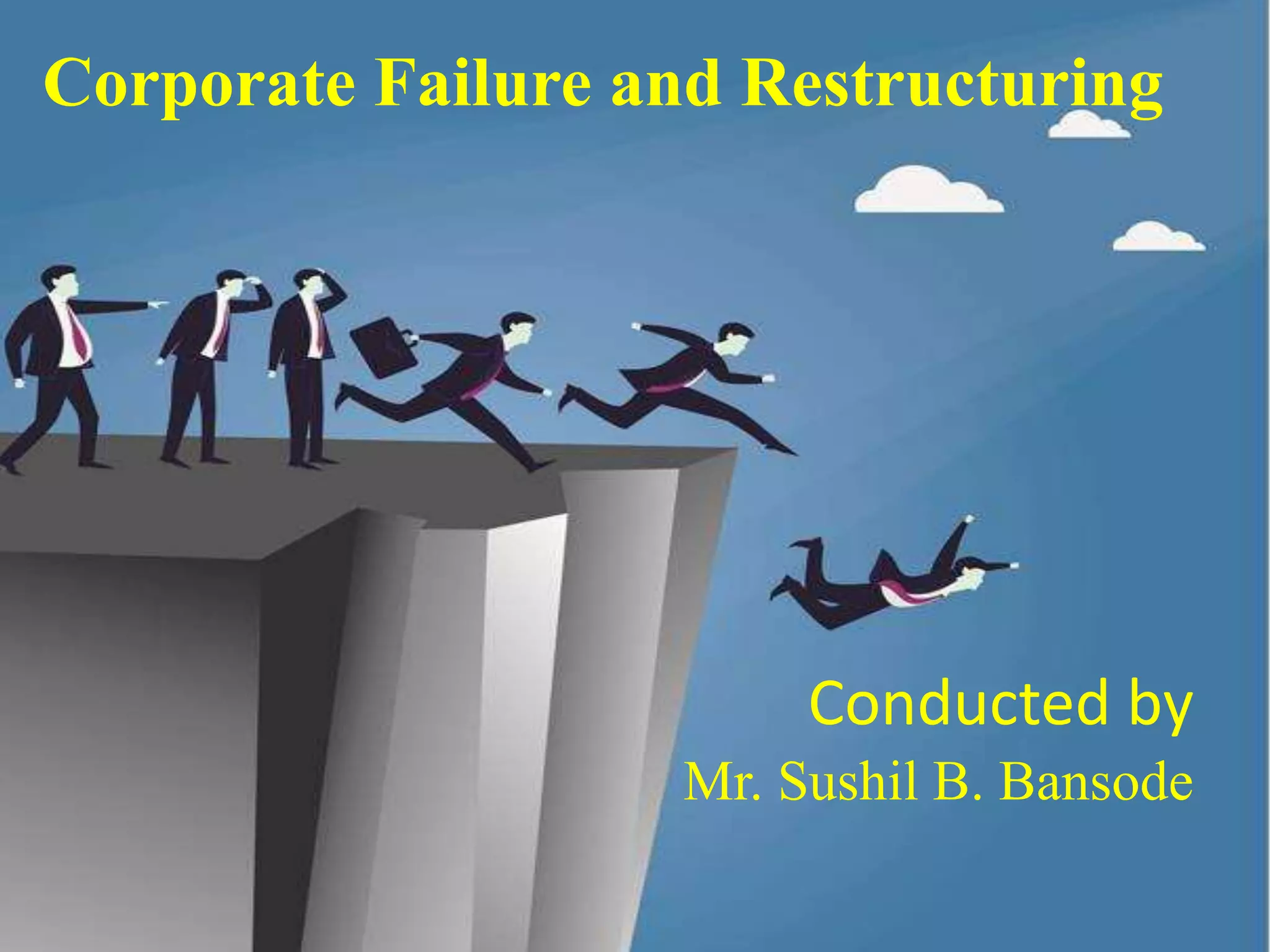

Corporate Failure and Restructuring
Conducted by
Mr. Sushil B. Bansode
Corporate Failure
• The term corporate failure entails discontinuation of
company’s operations leading to inability to reap sufficient
profit or revenue to pay the business expenses.
• It happens due to poor management, incompetence, and
bad marketing strategies.
Causes of Corporate Failure
• Economic Distress
• Mismanagement
• Technological Causes
• Working Capital Problems
• Fraudulent Management
Remedies of Corporate Failure
• Be prepared
• Find what can build your energy back up
• Do not make emotional decisions
• Have a strong support network
• Reevaluate your situation
• Learn from failures
Corporate Restructuring
Corporate restructuring is an action taken by
the corporate entity to modify its capital structure or its
operations significantly. Generally, corporate
restructuring happens when a corporate entity is
experiencing significant problems and is in financial
jeopardy.
Forms of Corporate Restructuring
• Mergers
• Amalgamation
• Acquisitions/ Take-over
• Demergers
• Divesture
• Buy outs
• Financial Restructuring
• Strategic alliances
Amalgamation
Merger or Amalgamation is an arrangement
whereby the assets of two or more companies become
vested in one company (which may or may not be one
of the original two companies). It is a legal process
by which two or more companies are joined together
to form a new entity or one or more companies are
absorbed by another company and as a consequence
the amalgamating company loses its existence and its
shareholders become the shareholders of the new or
amalgamated company.
Acquisitions
• An acquisition occurs when one company buys most or
all of another company's shares.
• If a firm buys more than 50% of a target company's
shares, it effectively gains control of that company.
• An acquisition is often friendly, while a takeover can be
hostile; a merger creates a brand new entity from two
separate companies.
Take-over
A takeover occurs when one company makes a bid
to assume control of or acquire another, often by
purchasing a majority stake in the target firm. In the
takeover process, the company making the bid is the
acquirer while the company it wishes to take control of
is called the target.
Demergers
• De-merger is an arrangement whereby some part
undertaking of one company is transferred to another
company which operates completely separate from the
original company. Shareholders of the original company
are usually given an equivalent stake of ownership in the
new company.
• De-merger is undertaken basically for two reasons. The
first as an exercise in corporate restructuring and the
second is to give effect to kind of family partitions in case
of family owned enterprises. A de-merger is also done to
help each of the segments operate more smoothly, as they
can now focus on a more specific task.
Divesture
The removal of assets from a person or firm's balance
sheet through sale, exchange, closure, bankruptcy, or
some other means. Divestiture may occur when a person or
company has acquired more than he/she/it can properly
administer. This sort of divestiture may occur slowly;
for example, a corporation may slowly sell subsidiaries
to concentrate exclusively on its core
competence. On the other hand, divestiture may occur beca
use a person or company has become cash poor and needs t
o build liquidity very quickly.
Buy outs
• A buyout is the acquisition of a controlling interest in a
company and is used synonymously with the term
acquisition.
• If the stake is bought by the firm’s management, it is
known as a management buyout, while if high levels of
debt are used to fund the buyout, it is called a leveraged
buyout.
• Buyouts often occur when a company is going private.
Financial Restructuring
Financial restructuring is a mode of restructuring a
firm that has gone into financial distress and which has
huge accumulated losses, overvalued or fictitious assets
and negligible or negative net worth. As a corrective
measure, such firms may sell major assets, merge with
other firms, negotiate with creditors, banks, debentures-
holders and shareholders to reduce their claims, swap
debt-equity, leverage buy-out, etc.
Strategic Alliances
A strategic alliance is an arrangement between two
companies to undertake a mutually beneficial project
while each retains its independence. The agreement is
less complex and less binding than a joint venture, in
which two businesses pool resources to create a
separate business entity.
Thank You…

Corporate failure and restructuring

  • 1.
    Corporate Failure andRestructuring Conducted by Mr. Sushil B. Bansode
  • 2.
    Corporate Failure • Theterm corporate failure entails discontinuation of company’s operations leading to inability to reap sufficient profit or revenue to pay the business expenses. • It happens due to poor management, incompetence, and bad marketing strategies.
  • 3.
    Causes of CorporateFailure • Economic Distress • Mismanagement • Technological Causes • Working Capital Problems • Fraudulent Management
  • 4.
    Remedies of CorporateFailure • Be prepared • Find what can build your energy back up • Do not make emotional decisions • Have a strong support network • Reevaluate your situation • Learn from failures
  • 5.
    Corporate Restructuring Corporate restructuringis an action taken by the corporate entity to modify its capital structure or its operations significantly. Generally, corporate restructuring happens when a corporate entity is experiencing significant problems and is in financial jeopardy.
  • 6.
    Forms of CorporateRestructuring • Mergers • Amalgamation • Acquisitions/ Take-over • Demergers • Divesture • Buy outs • Financial Restructuring • Strategic alliances
  • 7.
    Amalgamation Merger or Amalgamationis an arrangement whereby the assets of two or more companies become vested in one company (which may or may not be one of the original two companies). It is a legal process by which two or more companies are joined together to form a new entity or one or more companies are absorbed by another company and as a consequence the amalgamating company loses its existence and its shareholders become the shareholders of the new or amalgamated company.
  • 8.
    Acquisitions • An acquisitionoccurs when one company buys most or all of another company's shares. • If a firm buys more than 50% of a target company's shares, it effectively gains control of that company. • An acquisition is often friendly, while a takeover can be hostile; a merger creates a brand new entity from two separate companies.
  • 9.
    Take-over A takeover occurswhen one company makes a bid to assume control of or acquire another, often by purchasing a majority stake in the target firm. In the takeover process, the company making the bid is the acquirer while the company it wishes to take control of is called the target.
  • 10.
    Demergers • De-merger isan arrangement whereby some part undertaking of one company is transferred to another company which operates completely separate from the original company. Shareholders of the original company are usually given an equivalent stake of ownership in the new company. • De-merger is undertaken basically for two reasons. The first as an exercise in corporate restructuring and the second is to give effect to kind of family partitions in case of family owned enterprises. A de-merger is also done to help each of the segments operate more smoothly, as they can now focus on a more specific task.
  • 11.
    Divesture The removal ofassets from a person or firm's balance sheet through sale, exchange, closure, bankruptcy, or some other means. Divestiture may occur when a person or company has acquired more than he/she/it can properly administer. This sort of divestiture may occur slowly; for example, a corporation may slowly sell subsidiaries to concentrate exclusively on its core competence. On the other hand, divestiture may occur beca use a person or company has become cash poor and needs t o build liquidity very quickly.
  • 12.
    Buy outs • Abuyout is the acquisition of a controlling interest in a company and is used synonymously with the term acquisition. • If the stake is bought by the firm’s management, it is known as a management buyout, while if high levels of debt are used to fund the buyout, it is called a leveraged buyout. • Buyouts often occur when a company is going private.
  • 13.
    Financial Restructuring Financial restructuringis a mode of restructuring a firm that has gone into financial distress and which has huge accumulated losses, overvalued or fictitious assets and negligible or negative net worth. As a corrective measure, such firms may sell major assets, merge with other firms, negotiate with creditors, banks, debentures- holders and shareholders to reduce their claims, swap debt-equity, leverage buy-out, etc.
  • 14.
    Strategic Alliances A strategicalliance is an arrangement between two companies to undertake a mutually beneficial project while each retains its independence. The agreement is less complex and less binding than a joint venture, in which two businesses pool resources to create a separate business entity.
  • 15.