 Every organism whether plant or animal is unique in
itself. There is a wide diversity in the flora (plants)
and fauna (animals) in the world. The diversity we see
today is the result of 3.5 billion years of organic
evolution. During the course of this evolution several
species vanished from the surface of the Earth and
became extinct. It is estimated that more than fifty
times the existing species have become extinct. With
such a vast number of organisms - both living and
extinct, it becomes impossible to study every one of
them at individual level. This task of studying the
diversity of living organisms can be made easier and
more effective if the various organisms are arranged
in an orderly manner.
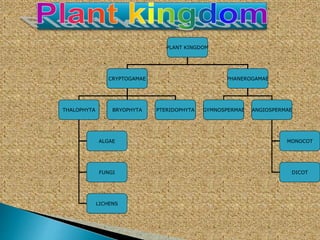
PLANT KINGDOM
CRYPTOGAMAE PHANEROGAMAE
THALOPHYTA BRYOPHYTA PTERIDOPHYTA
ALGAE
FUNGI
LICHENS
GYMNOSPERMAE ANGIOSPERMAE
MONOCOT
DICOT
Eichler in 1883 suggested a system to
classify the plant kingdom which is well
accepted. He said that the plant kingdom is
subdivided into two subkingdoms:
Cryptogamae and Phanerogamae. sub
kingdom cryptogamae are lower plants that
do not bear flowers or seeds. They form
three divisions.
 The plant body is not differentiated into stem, root and leaves but is in the
form of an undivided thallus.
 Vascular tissues are absent.
 The reproductive organs are single-celled and there is no embryo formation
after fertilization.
 This division includes three sub-divisions: algae, fungi and lichens.
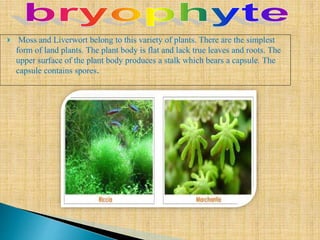
 Moss and Liverwort belong to this variety of plants. There are the simplest
form of land plants. The plant body is flat and lack true leaves and roots. The
upper surface of the plant body produces a stalk which bears a capsule. The
capsule contains spores.
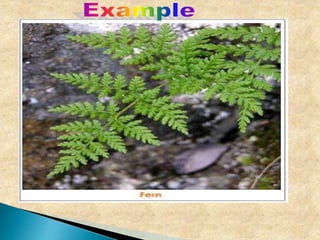
 The plant body is differentiated into stem, leaves and
roots.
 Vascular system is present.
 Leaves usually have leaflets. Spores are borne on the
undersurface of the leaf.
 They grow in damp cool shady places.
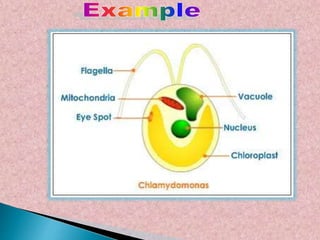
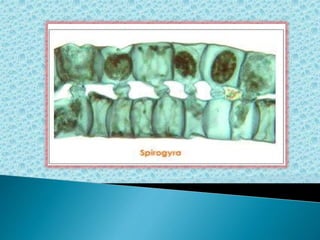
 Occur in ponds, lakes and fresh water bodies. Sea
weeds are found in marine waters.
 May be single celled, colonial or filamentous.
 Are autotropic i.e., they can prepare their own food
with the help of the green pigment i.e., chlorophyll
present in the plant. Sometimes red, blue, yellow and
brown pigments are found.
 Blue-green bacteria (cyanobacteria) are included in
this group of plants.
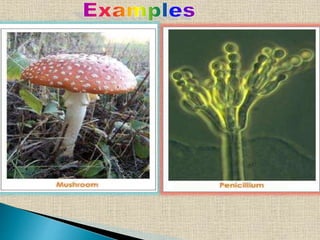
 These do not contain chlorophyll and hence are
heterotropic and have diverse modes of nutrition.
They may be saprophytic i.e., depending on dead
or decaying organic matter for their food, or may
be parasitic i.e., depending on living organisms for
their food
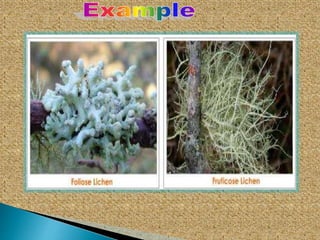
1. This is a group which has two varieties of plants, an
algae and a fungus living in perfect harmony. They
co-exist for mutual benefit. This relationship is
known as symbiosis. The fungus absorbs water and
mineral salts and supplies it to the alga. The alga
prepares food and supplies it to the fungus.
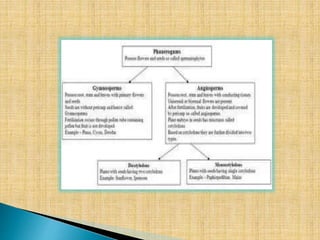
 This division is made up of plants that bear flowers and seeds and make up
the majority of the larger plants. The body is differentiated into true stem,
leaves and roots. Propagation of the plant takes place with the help of
seeds. Seeds are formed as a result of sexual reproduction. The male and
female gametes (sex cells) fuse together inside the ovary (female part of
the flower) and develop into the seed. In some plants seed is not produced
inside an ovary. Phanerogamae is made into two further divisions.
 Gymnosperms (naked seeded plants)
 Angiosperms (Seed borne within a fruit)
Kingdom phanerogamae
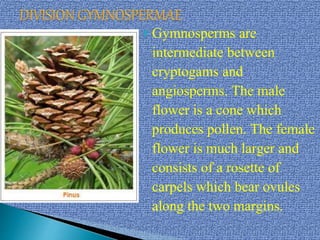
 Gymnosperms are
intermediate between
cryptogams and
angiosperms. The male
flower is a cone which
produces pollen. The female
flower is much larger and
consists of a rosette of
carpels which bear ovules
along the two margins.
 This group constitutes the largest group of plants. Seeds are
produced inside an ovary which later becomes the fruit. These
are highly evolved group of plants. The plant body is distinctly
differentiated into roots, stem and leaves.
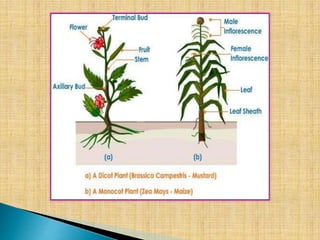
 Based on the number of cotyledons (seed-leaves) that form
the seed this group is divided into:
 Monocotyledons (One seed leaf)
Example: Rice, Wheat
Dicotyledons (two seed leaves)
Example: Beans, Mango
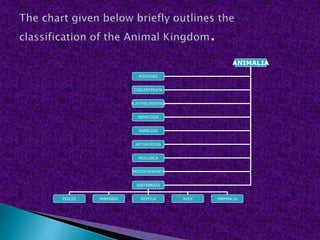
ANIMALIA
PORIFERA
COELENTERATA
PLATYHELMINTHES
NEMATODA
ANNELIDA
ARTHROPODA
MOLLUSCA
PROTOCHORDATA
VERTEBRATA
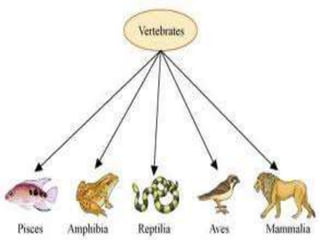
PISCES AMPHIBIA REPTILA AVES MAMMALIA
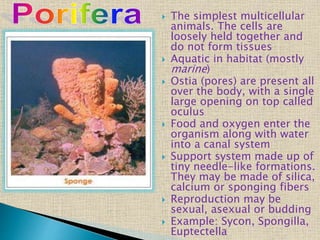
 The simplest multicellular
animals. The cells are
loosely held together and
do not form tissues
 Aquatic in habitat (mostly
marine)
 Ostia (pores) are present all
over the body, with a single
large opening on top called
oculus
 Food and oxygen enter the
organism along with water
into a canal system
 Support system made up of
tiny needle-like formations.
They may be made of silica,
calcium or sponging fibers
 Reproduction may be
sexual, asexual or budding
 Example: Sycon, Spongilla,
Euptectella
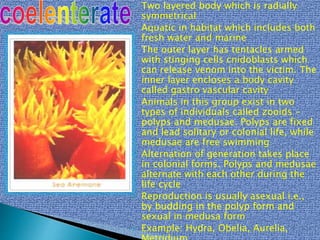
 Two layered body which is radially
symmetrical
 Aquatic in habitat which includes both
fresh water and marine
 The outer layer has tentacles armed
with stinging cells cnidoblasts which
can release venom into the victim. The
inner layer encloses a body cavity
called gastro vascular cavity
 Animals in this group exist in two
types of individuals called zooids -
polyps and medusae. Polyps are fixed
and lead solitary or colonial life, while
medusae are free swimming
 Alternation of generation takes place
in colonial forms. Polyps and medusae
alternate with each other during the
life cycle
 Reproduction is usually asexual i.e.,
by budding in the polyp form and
sexual in medusa form
 Example: Hydra, Obelia, Aurelia,
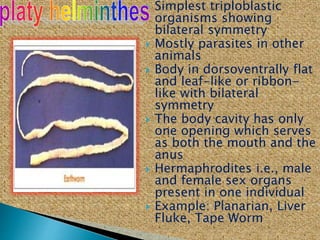
 Simplest triploblastic
organisms showing
bilateral symmetry
 Mostly parasites in other
animals
 Body in dorsoventrally flat
and leaf-like or ribbon-
like with bilateral
symmetry
 The body cavity has only
one opening which serves
as both the mouth and the
anus
 Hermaphrodites i.e., male
and female sex organs
present in one individual
 Example: Planarian, Liver
Fluke, Tape Worm
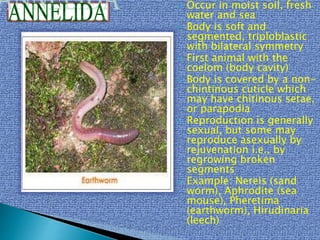
 Occur in moist soil, fresh
water and sea
 Body is soft and
segmented, triploblastic
with bilateral symmetry
 First animal with the
coelom (body cavity)
 Body is covered by a non-
chintinous cuticle which
may have chitinous setae,
or parapodia
 Reproduction is generally
sexual, but some may
reproduce asexually by
rejuvenation i.e., by
regrowing broken
segments
 Example: Nereis (sand
worm), Aphrodite (sea
mouse), Pheretima
(earthworm), Hirudinaria
(leech)
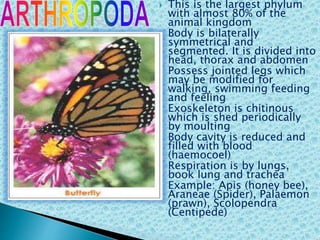
 This is the largest phylum
with almost 80% of the
animal kingdom
 Body is bilaterally
symmetrical and
segmented. It is divided into
head, thorax and abdomen
 Possess jointed legs which
may be modified for
walking, swimming feeding
and feeling
 Exoskeleton is chitinous
which is shed periodically
by moulting
 Body cavity is reduced and
filled with blood
(haemocoel)
 Respiration is by lungs,
book lung and trachea
 Example: Apis (honey bee),
Araneae (Spider), Palaemon
(prawn), Scolopendra
(Centipede)
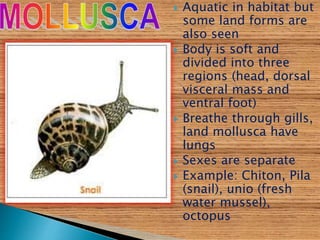
 Aquatic in habitat but
some land forms are
also seen
 Body is soft and
divided into three
regions (head, dorsal
visceral mass and
ventral foot)
 Breathe through gills,
land mollusca have
lungs
 Sexes are separate
 Example: Chiton, Pila
(snail), unio (fresh
water mussel),
octopus
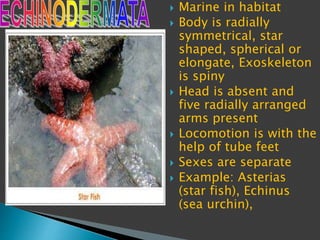
 Marine in habitat
 Body is radially
symmetrical, star
shaped, spherical or
elongate, Exoskeleton
is spiny
 Head is absent and
five radially arranged
arms present
 Locomotion is with the
help of tube feet
 Sexes are separate
 Example: Asterias
(star fish), Echinus
(sea urchin),
VERTEBRATA
These animals have a true vertebral column and internal
skeleton,allowing a completely different distribution of muscles
attachment points to be used for movement .
Vertebrates are bilaterally symmetrical,triploblastic
coelomic and segmented ,with complex differentiation of body
tissues and organs.All chordates posses the flollowing features:
(i) Have a notochord
(ii)Have a dorsal nerve chord
(iii)Are triploblastic
(iv)Have paired gill pouches
(v)Are ceolomate.
Vertebrates are grouped into five classes.
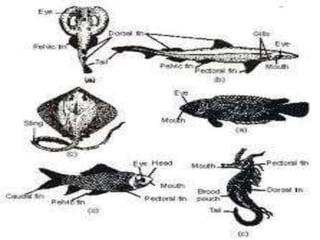
Pisces
They are commnly called as fish.
They exclusively aquatic.
Their skin is covered with
scales/plates.
They obtain oxygen dissolve in
water by using gills.
They lay legs.
They are cool blooded.
B
o
d
y
c
o
v
e
r
e
d
w
i
t
h
s
c
a
l
e
s
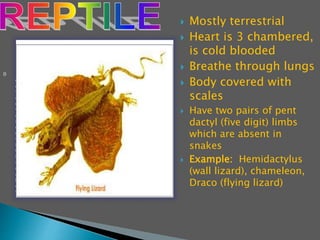
 Mostly terrestrial
 Heart is 3 chambered,
is cold blooded
 Breathe through lungs
 Body covered with
scales
 Have two pairs of pent
dactyl (five digit) limbs
which are absent in
snakes
 Example: Hemidactylus
(wall lizard), chameleon,
Draco (flying lizard)
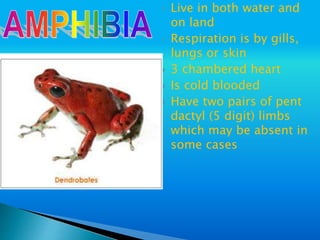
 Live in both water and
on land
 Respiration is by gills,
lungs or skin
 3 chambered heart
 Is cold blooded
 Have two pairs of pent
dactyl (5 digit) limbs
which may be absent in
some cases
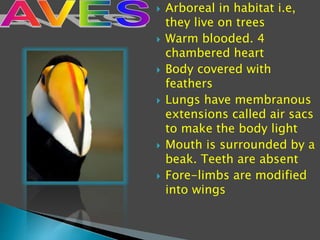
 Arboreal in habitat i.e,
they live on trees
 Warm blooded. 4
chambered heart
 Body covered with
feathers
 Lungs have membranous
extensions called air sacs
to make the body light
 Mouth is surrounded by a
beak. Teeth are absent
 Fore-limbs are modified
into wings
 Most intelligent of all
organisms
 Warm blooded with 4
chambered heart
 Give birth to young
ones
 The mother suckles her
young ones on milk
secreted by special
glands called
mammary glands
 Body covered with hair
 Have two pairs of pent
dactyl limbs
 Breathe through lungs
Diversityinlivingorganisms for class 9 by kr

Diversityinlivingorganisms for class 9 by kr

  • 2.
     Every organismwhether plant or animal is unique in itself. There is a wide diversity in the flora (plants) and fauna (animals) in the world. The diversity we see today is the result of 3.5 billion years of organic evolution. During the course of this evolution several species vanished from the surface of the Earth and became extinct. It is estimated that more than fifty times the existing species have become extinct. With such a vast number of organisms - both living and extinct, it becomes impossible to study every one of them at individual level. This task of studying the diversity of living organisms can be made easier and more effective if the various organisms are arranged in an orderly manner.
  • 4.
    PLANT KINGDOM CRYPTOGAMAE PHANEROGAMAE THALOPHYTABRYOPHYTA PTERIDOPHYTA ALGAE FUNGI LICHENS GYMNOSPERMAE ANGIOSPERMAE MONOCOT DICOT
  • 5.
    Eichler in 1883suggested a system to classify the plant kingdom which is well accepted. He said that the plant kingdom is subdivided into two subkingdoms: Cryptogamae and Phanerogamae. sub kingdom cryptogamae are lower plants that do not bear flowers or seeds. They form three divisions.
  • 6.
     The plantbody is not differentiated into stem, root and leaves but is in the form of an undivided thallus.  Vascular tissues are absent.  The reproductive organs are single-celled and there is no embryo formation after fertilization.  This division includes three sub-divisions: algae, fungi and lichens.
  • 7.
     Moss andLiverwort belong to this variety of plants. There are the simplest form of land plants. The plant body is flat and lack true leaves and roots. The upper surface of the plant body produces a stalk which bears a capsule. The capsule contains spores.
  • 8.
     The plantbody is differentiated into stem, leaves and roots.  Vascular system is present.  Leaves usually have leaflets. Spores are borne on the undersurface of the leaf.  They grow in damp cool shady places.
  • 10.
     Occur inponds, lakes and fresh water bodies. Sea weeds are found in marine waters.  May be single celled, colonial or filamentous.  Are autotropic i.e., they can prepare their own food with the help of the green pigment i.e., chlorophyll present in the plant. Sometimes red, blue, yellow and brown pigments are found.  Blue-green bacteria (cyanobacteria) are included in this group of plants.
  • 13.
     These donot contain chlorophyll and hence are heterotropic and have diverse modes of nutrition. They may be saprophytic i.e., depending on dead or decaying organic matter for their food, or may be parasitic i.e., depending on living organisms for their food
  • 15.
    1. This isa group which has two varieties of plants, an algae and a fungus living in perfect harmony. They co-exist for mutual benefit. This relationship is known as symbiosis. The fungus absorbs water and mineral salts and supplies it to the alga. The alga prepares food and supplies it to the fungus.
  • 17.
     This divisionis made up of plants that bear flowers and seeds and make up the majority of the larger plants. The body is differentiated into true stem, leaves and roots. Propagation of the plant takes place with the help of seeds. Seeds are formed as a result of sexual reproduction. The male and female gametes (sex cells) fuse together inside the ovary (female part of the flower) and develop into the seed. In some plants seed is not produced inside an ovary. Phanerogamae is made into two further divisions.  Gymnosperms (naked seeded plants)  Angiosperms (Seed borne within a fruit) Kingdom phanerogamae
  • 19.
     Gymnosperms are intermediatebetween cryptogams and angiosperms. The male flower is a cone which produces pollen. The female flower is much larger and consists of a rosette of carpels which bear ovules along the two margins.
  • 20.
     This groupconstitutes the largest group of plants. Seeds are produced inside an ovary which later becomes the fruit. These are highly evolved group of plants. The plant body is distinctly differentiated into roots, stem and leaves.  Based on the number of cotyledons (seed-leaves) that form the seed this group is divided into:  Monocotyledons (One seed leaf) Example: Rice, Wheat Dicotyledons (two seed leaves) Example: Beans, Mango
  • 24.
  • 25.
     The simplestmulticellular animals. The cells are loosely held together and do not form tissues  Aquatic in habitat (mostly marine)  Ostia (pores) are present all over the body, with a single large opening on top called oculus  Food and oxygen enter the organism along with water into a canal system  Support system made up of tiny needle-like formations. They may be made of silica, calcium or sponging fibers  Reproduction may be sexual, asexual or budding  Example: Sycon, Spongilla, Euptectella
  • 26.
     Two layeredbody which is radially symmetrical  Aquatic in habitat which includes both fresh water and marine  The outer layer has tentacles armed with stinging cells cnidoblasts which can release venom into the victim. The inner layer encloses a body cavity called gastro vascular cavity  Animals in this group exist in two types of individuals called zooids - polyps and medusae. Polyps are fixed and lead solitary or colonial life, while medusae are free swimming  Alternation of generation takes place in colonial forms. Polyps and medusae alternate with each other during the life cycle  Reproduction is usually asexual i.e., by budding in the polyp form and sexual in medusa form  Example: Hydra, Obelia, Aurelia,
  • 27.
     Simplest triploblastic organismsshowing bilateral symmetry  Mostly parasites in other animals  Body in dorsoventrally flat and leaf-like or ribbon- like with bilateral symmetry  The body cavity has only one opening which serves as both the mouth and the anus  Hermaphrodites i.e., male and female sex organs present in one individual  Example: Planarian, Liver Fluke, Tape Worm
  • 28.
     Occur inmoist soil, fresh water and sea  Body is soft and segmented, triploblastic with bilateral symmetry  First animal with the coelom (body cavity)  Body is covered by a non- chintinous cuticle which may have chitinous setae, or parapodia  Reproduction is generally sexual, but some may reproduce asexually by rejuvenation i.e., by regrowing broken segments  Example: Nereis (sand worm), Aphrodite (sea mouse), Pheretima (earthworm), Hirudinaria (leech)
  • 29.
     This isthe largest phylum with almost 80% of the animal kingdom  Body is bilaterally symmetrical and segmented. It is divided into head, thorax and abdomen  Possess jointed legs which may be modified for walking, swimming feeding and feeling  Exoskeleton is chitinous which is shed periodically by moulting  Body cavity is reduced and filled with blood (haemocoel)  Respiration is by lungs, book lung and trachea  Example: Apis (honey bee), Araneae (Spider), Palaemon (prawn), Scolopendra (Centipede)
  • 30.
     Aquatic inhabitat but some land forms are also seen  Body is soft and divided into three regions (head, dorsal visceral mass and ventral foot)  Breathe through gills, land mollusca have lungs  Sexes are separate  Example: Chiton, Pila (snail), unio (fresh water mussel), octopus
  • 31.
     Marine inhabitat  Body is radially symmetrical, star shaped, spherical or elongate, Exoskeleton is spiny  Head is absent and five radially arranged arms present  Locomotion is with the help of tube feet  Sexes are separate  Example: Asterias (star fish), Echinus (sea urchin),
  • 32.
    VERTEBRATA These animals havea true vertebral column and internal skeleton,allowing a completely different distribution of muscles attachment points to be used for movement . Vertebrates are bilaterally symmetrical,triploblastic coelomic and segmented ,with complex differentiation of body tissues and organs.All chordates posses the flollowing features: (i) Have a notochord (ii)Have a dorsal nerve chord (iii)Are triploblastic (iv)Have paired gill pouches (v)Are ceolomate. Vertebrates are grouped into five classes.
  • 34.
    Pisces They are commnlycalled as fish. They exclusively aquatic. Their skin is covered with scales/plates. They obtain oxygen dissolve in water by using gills. They lay legs. They are cool blooded.
  • 36.
    B o d y c o v e r e d w i t h s c a l e s  Mostly terrestrial Heart is 3 chambered, is cold blooded  Breathe through lungs  Body covered with scales  Have two pairs of pent dactyl (five digit) limbs which are absent in snakes  Example: Hemidactylus (wall lizard), chameleon, Draco (flying lizard)
  • 37.
     Live inboth water and on land  Respiration is by gills, lungs or skin  3 chambered heart  Is cold blooded  Have two pairs of pent dactyl (5 digit) limbs which may be absent in some cases
  • 38.
     Arboreal inhabitat i.e, they live on trees  Warm blooded. 4 chambered heart  Body covered with feathers  Lungs have membranous extensions called air sacs to make the body light  Mouth is surrounded by a beak. Teeth are absent  Fore-limbs are modified into wings
  • 39.
     Most intelligentof all organisms  Warm blooded with 4 chambered heart  Give birth to young ones  The mother suckles her young ones on milk secreted by special glands called mammary glands  Body covered with hair  Have two pairs of pent dactyl limbs  Breathe through lungs