"Diversity is not simply a matter of the changing
demographics in students or faculty. Attending to it
has also altered the very knowledge base upon
which the intellectual integrity of the academy
rests. Institutions across the country are taking
advantage of the explosion of new scholarship
about the diversity of cultural traditions and
histories in America and around the world. Diversity
has also provided additional interpretive lenses
through which to analyze ideas and society. . ." -
from Diversity Web (www.diversityweb.org)
 Poverty & Academic Needs of Students
 Factors of the Achievement Gap
 English Language Learners
 Gender Inequalities
 Inclusion
Poverty                   Academic Needs


   The extent to which an           School Attendance
    individual does without
    resources                        Social Support
     Financial
     Emotional                      Parental Involvement
     Mental
     Spiritual
                                     School Support
     Physical
                                       Relevant Curriculum
     Support Systems
      (Network of Relationships)
     Relationships/Role Models        Gifted Programs
     Knowledge of Hidden Rules
      Among Social Classes             Culturally Sensitive
                                        Teachers
                          (Payne)
Communication                            Discipline


                                             Poverty
   Child, Adult,
                                                 Forgiveness & Penance
    & Parent Voices
                                                 Not about Change
           Adult
             Usually absent in poverty
             Used for Negotiation           Effective Discipline
                                                 Structure
   When a Student is                            Choice
    Disciplined at School
           Child Voice                      Teach That There are
             Powerless
           Parent Voice                      Two Sets of Behaviors
             Disrespectful to Educator          School
                                                 Street
                                (Payne)
                                                                   (Payne)
Social Support                            Effects

   Acts as a Protector/                Students with Support
    Buffer to Help Stabilize             from
    Students                             Parents, Teachers, &
                                         Friends have:
   Sources                               Higher GPA
                                          Better Standardized Test
     Parents
                                           Scores
     Teachers
        Provide
         Emotional, Appraisal, Inf      Parental Involvement
         ormational, &                      Better School
         Instrumental Support
                                             Attendance
     Classmates
                                                More completed
     Close Friends                              assignments
     Schools
               (Malecki & Demaray)
Relevant Curriculum                     Culturally Sensitive Teachers


   Social Class & Culture                       Reflect On Their Own
                                                  Cultural Identity &
                                                  Classroom Practices
   Connects Schools to                                            (Mitchell, Boutte & Hill)
    their Communities
         Raises Academic
          Achievement                            Help Students Learn about
                                                  Multiple Worldviews
                                 (Williams)
                                                                            (Boutte & Hill)


   Gifted Programs                              Make Classroom
         Culturally Diverse                      Interactions & Discussions
            Curriculum                           Culturally Sensitive
            Groups of Students
                                                      Chinese: Do not make mistakes
         Access in Rural Schools                      in public
                                                        Give students time to prepare
                    (Ford , Cross & Burney)              for a class discussion
                                                                                       (Fu)
Factors of the Achievement Gap

  What Does the Future Hold?

            Matt Hoffman
The Achievement Gap
 Refers to the observed disparity between students
  academic performance, especially groups defined by
  gender, race and social class.
 Factors Concerning the Achievement Gap
     School Districts
       Large/Small Districts
           Lack of support
        Urban/Rural
        Funding
        Staff Accountability
     Student Population
        Support from home
        English Language Learners
        Learning Disabilities
     (NCTAF)
Who Is Accountable?
                           The Disparity Between Minority and Majority Students:
   The Educators               Race
                                    Do school systems “water down” their material
                                   for minority students?
   The School District             Are English Language Learners and English as a
                                   Second Language students adequately instructed?
   The State                      (Fu)
                                    Castaneda v. Pickard
                                           1. The program must be based on an
   The Student                          educational theory recognized as sound by
                                         experts in the field or that is considered by
   The Nation                           experts as a legitimate experimental strategy
                                           2. The program must be implemented with
                                         adequate resources and personnel.
                                           3. The district must evaluate the program to
                                         determine whether it is achieving results and
                                         make appropriate adjustments, where
                                         needed, to ensure that language barriers are
                                         actually being overcome. (McBride)
                                Gender
                                    Do educators differ in their instruction between
                                   Girls and boys?
                                          Boys are statistically called upon more
   Districts need to support their star teachers
     Union/District collaboration
       The Union and the school district cooperated with each other to
        create a new series of schools known as “Empowerment Schools”
     Clark County (Las Vegas) Empowerment Schools
       Bonuses for “Job Well Done”
             Based upon school performance
             Increase of schools meeting Adequate Yearly Progress
             Increase of 12th grade graduation rate
             Decrease in dropout rate 9th through 12th grade
             Higher proficiency scores (NCTAF)

   Teachers need to recognize past tendencies and be willing to
    adapt

   The importance of recognizing cultural differences and priorities

   All children can learn
Students whose first language is not English, and can
encompass both students who are just beginning to
learn English and those who have already developed
considerable proficiency.

The term is used to describe a student whose first
language is not English and has difficulties in
speaking, reading, writing, or understanding the
English language. These difficulties may be sufficient
to deny the student the ability to meet the State’s
proficient level of achievement on State
assessments, the ability to successfully achieve in
classrooms where the language of instruction is
English, or the opportunity to participate fully in
society.
   USA
      1980 – 4.7% of all students were ELL
      2000 – 7.4% of all students were ELL
      2030 – 40% of all school age children may be ELL.
      (Berliner and Biddle 1995)

   Concentration of ELLs in a handful of states
      Hispanic – largest group
      Asian – second largest group


   70% of ELLs are in only 10% of elementary
    schools and most are in urban areas
   English                        “Sink or Swim” approach –
                                    teach children in English
     (Sheltered English or         even as students learn the
       Immersion Education)         language – Some students
                                    have pull out ESL
   English and Native
    Language                       Use both languages and
                                    transition over time to
     (Transitional Bilingual
                                    English. Develops literacy in
       Education)                   primary language as
                                    foundation for English
                                    reading.
   English and Native
    Language                       Use both languages – all
     (Two-Way Bilingual            students are learning 2
       Education Immersion)         languages
   Dropout Rates

   School resources

   Social and academic language

   NCLB and Achievement Tests – ELLs score lower on standardized tests

   Low expectations of teachers. They may receive less access to standard
    grade-level curriculum

   Labeling of students – Language learning disability versus a child is
    manifesting the normal process of acquiring a second language.
        Interference/Codeswitching/Language
        Students put on an IEP because they do not understand the
        language.

   Lack of qualified bilingual education programs and teachers

   High percent of ELLs in urban schools that generally have more new teachers
    and also more teachers uncertified than those at other schools. (13)
   Get to know your Students
   Create a Community of Learners
   Make tasks relevant, meaningful and engaging.
   Weave students’ first language and culture into instructional
    conversations and curriculum.
   Believe that all students can learn and have a high expectations
   Create context for students with manipulatives, pictures and
    video.
   Teach academic strategies, socio-cultural expectations, and
    academic norms, as these are not readily acquired otherwise.
   Use parent volunteers, especially parents of English language
    learners.
   Enrich print environment of your classroom – books and
    magazines in student’s first language. In younger grades put
    color and number words in different languages.
   Writing, class instruction/tests, and reading
   Take professional development classes.
   Children notice differences between the sexes, races, and
    ethnicities by age 2 or 3
   Stereotypes are internalized and acted upon about age 4
   Gender differences are the most prevalent bias in children
   Societies rules, customs, and values have shaped the differences in
    male and female children
     › Each sex is taught to behave in different ways
     › Children learn their gender stereotypes based on the society
        they live in
     › Females are raised to be submissive and dependent
   Teachers may push their own beliefs about gender roles onto
    students
    ›   See boys as needing competition, discipline, structure and support
    ›   See girls as lacking confidence and losing out on teacher attention
   Different expectations and behavior standards exist for boys and
    girls
    ›   Girls are expected to do better at Language Arts
    ›   Boys are expected to be better at mathematics and sciences
 Teachers unknowingly restrict areas of study and goals of their
  students reducing their potential
 Parents reinforce gender biases by expecting boys to perform better
  in mathematics and sciences while discouraging girls from pursuing
  excellence in these subjects
 Teachers treat behavioral offenses by boys more strict than similar
  offenses by girls
Boys                                  Girls
   Stereotyped as lazy, badly          Stereotypes as talkative
    behaved and immature                Raise hands and wait on
   Shout out answers to questions       teacher to call on them to
    in classroom                         answer questions
   Are encouraged to pursue            Are discouraged from
    careers in areas requiring           pursuing careers in areas
    mathematics and science              requiring mathematics and
   Given leadership roles in            science
    mixed sex groups                    Receive less extensive
   More severely punished for           feedback on assignments
    misbehavior                         Relegated to submissive role in
   Prefer careers as doctors and        group projects
    scientists                          Career ambitions often
                                         include teaching
   Schools and school districts should increase the percentage of girls who
    take the trio of core science courses: physics, biology, and chemistry.
   Algebra I and geometry should be mandatory for all students.
   Teachers and counselors should encourage girls to take math and
    science classes at the challenging AP or honors level.
   Educators need to develop programs at the classroom, school district, or
    state level to increase girls' enrollment in computer science courses.
   Equity must be viewed as essential to teacher education and the
    achievement of academic excellence.
   Producers and purchasers of educational materials should establish
    processes and criteria by which to screen curricula and instructional
    materials for bias in images, text, or logic.
   Colleges and universities should continue to use a broad range of
    material to assess students.
   Testing organizations should consider adding a writing section to the SAT
    exam to more accurately reflect students' academic skills.
   The relationship between girls' and boys' test scores and grades should
    be further researched.
   Much more research is needed on gender equity and technology.
(Taylor, Smiley, & Richards)
   Diversity                                   Reflective Practice
    ›   placement regardless of                  ›   Educators reflect and modify
        learning ability, race, linguistic           their attitudes, teaching and
        ability, economic status, cultural           classroom management
        background, etc.                             practices and curricula to
    ›   acknowledge, affirm and                      accommodate individual needs.
        celebrate the value of all               ›   Educators are
        learners                                     flexible, responsive and aware
    ›   promote acceptance, equity                   of student’s needs
        and collaboration in response to         ›   Think critically and examine
        individual needs.                            their practices for self
                                                     improvement and to ensure that
                                                     all student’s needs are met


   Collaboration                               Individual Needs
    ›   It is a group effort between             ›   Sensitivity to and acceptance of
        educators, other                             individual needs and differences
        professionals, students, families
        and community agencies

                                                               (Salend)
   FOR CHILDREN WITH SPECIAL NEEDS
    › Provides a diverse stimulating environment with more
      engaged instructional time and a greater exposure
      to academic activities

    › Enables development of friendships with same age
      peers

    › Enhances self-respect & self-esteem by sharing same
      activities as non-disabled peers

    › Provides peer models who can facilitate
      communication, social and adaptive behaviors
                                                 (Berg)
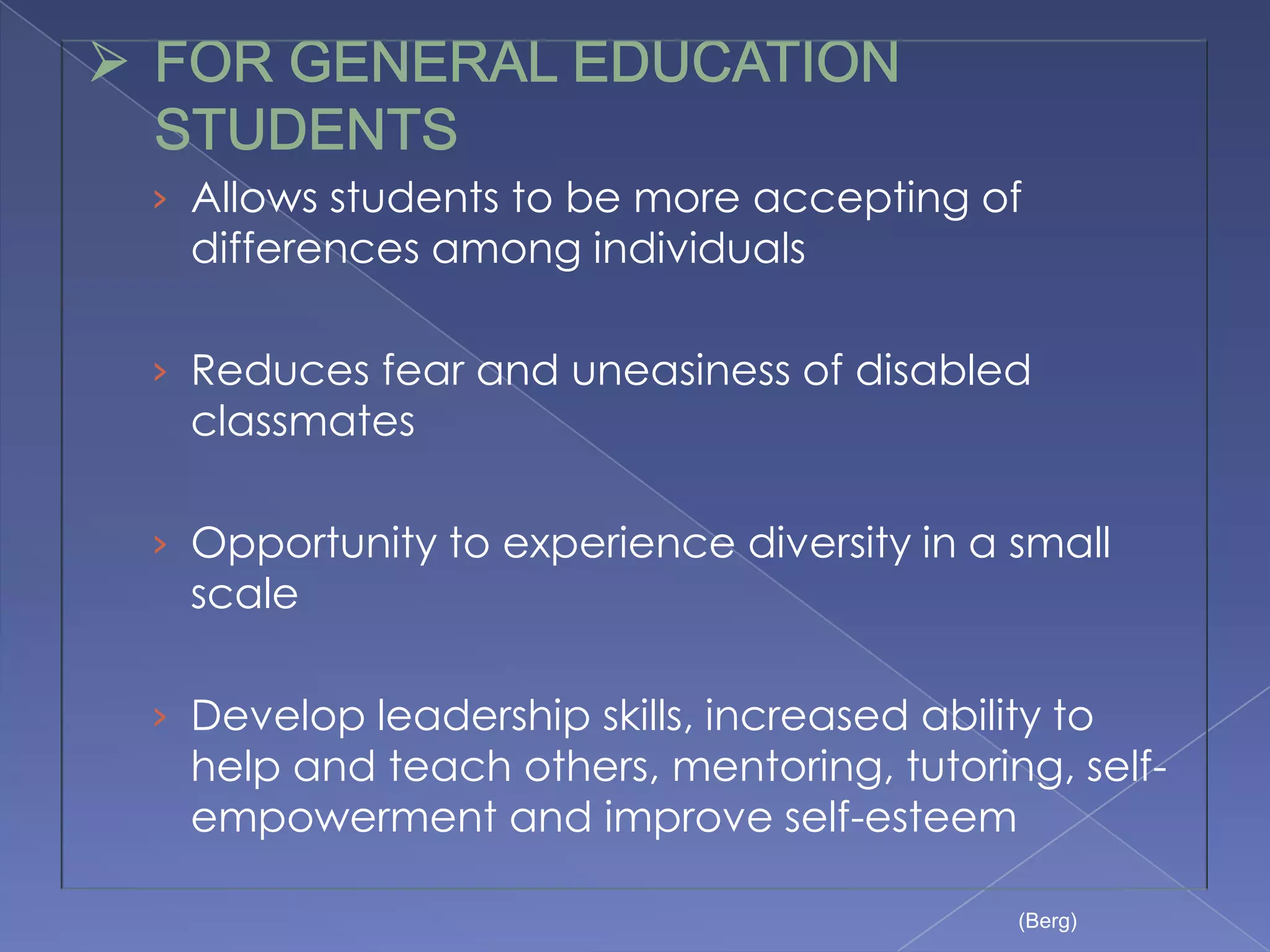
› Allows students to be more accepting of
  differences among individuals

› Reduces fear and uneasiness of disabled
  classmates

› Opportunity to experience diversity in a small
  scale

› Develop leadership skills, increased ability to
  help and teach others, mentoring, tutoring, self-
  empowerment and improve self-esteem

                                             (Berg)
› Creates an awareness and appreciation of individual
  differences in all students

› Allows teachers to learn new teaching techniques that
  can help all their students

› Allows greater creativity with teaching methods, avoids
  monotony

› Allows them to develop team work/ collaboration skills


› Increases awareness of the importance of direct
  individual instruction

                                                  (Berg)
› Focus on socialization part of their education may take
  precedence over the academic part

› Some students with disabilities may need the special
  education classroom to get the maximum it benefit of their
  education: smaller class size, less distractions, more one-on-
  one instruction

› May lower self-esteem and self-concept if they become
  frustrated and are ridiculed or isolated

› Many feel that students with disabilities will become
  depressed upon realizing what they cannot do compared
  with their peers
                                                       (Berg)
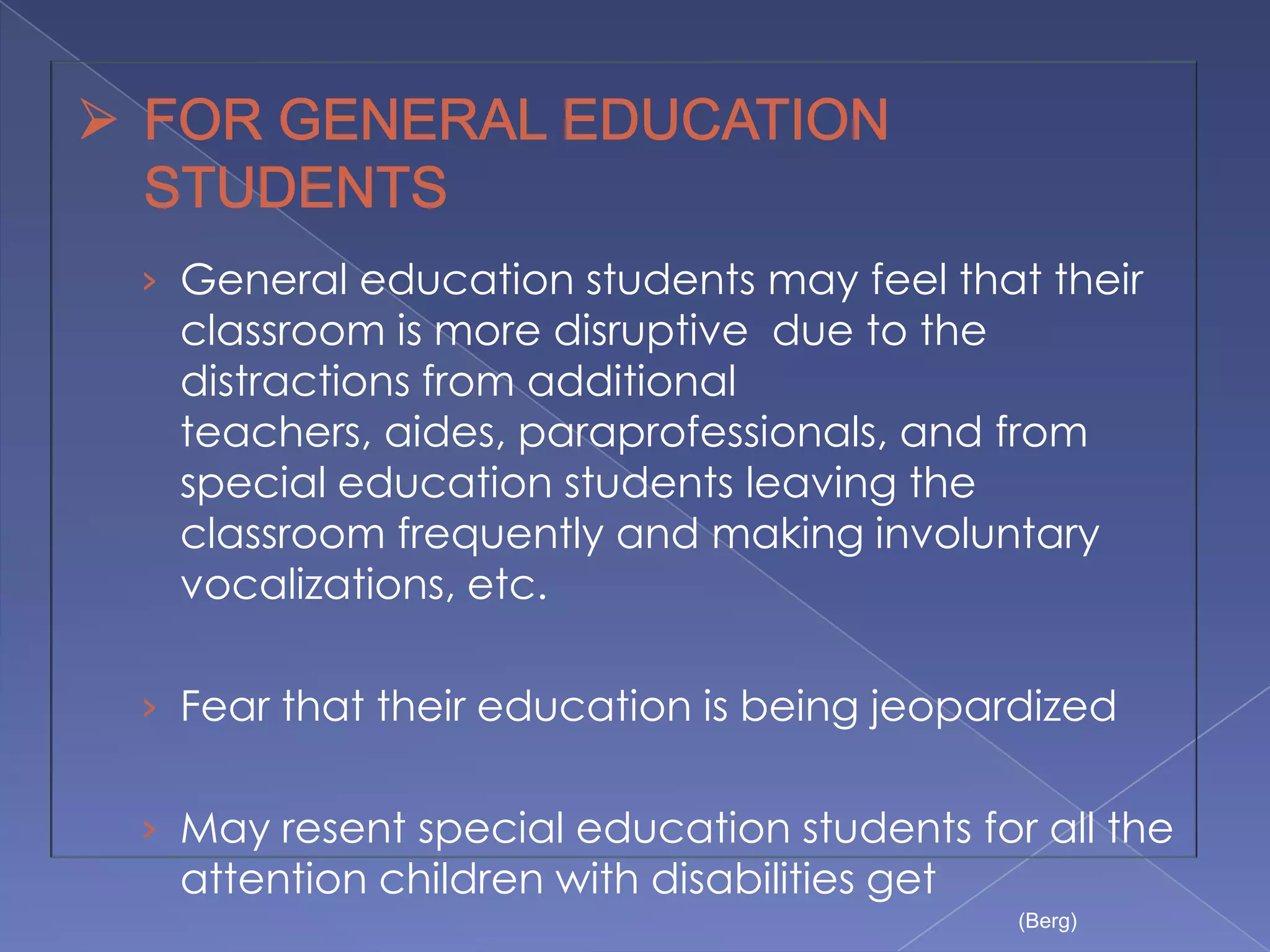
› General education students may feel that their
 classroom is more disruptive due to the
 distractions from additional
 teachers, aides, paraprofessionals, and from
 special education students leaving the
 classroom frequently and making involuntary
 vocalizations, etc.

› Fear that their education is being jeopardized


› May resent special education students for all the
 attention children with disabilities get
                                            (Berg)
› May have a constant thought of fear that they are going
  to fail at successfully and appropriately carrying out
  inclusion

› May not have the proper training to teach and deal with
  students with disabilities

› Discomfort with giving up control of their classroom when
  they will have to co-teach and collaborate

› May not have proper support, and an appropriate
  amount of planning and collaboration time


                                                     (Berg)
   http://www.youtube.com/watch?v=N105TGmMkLk&feature=related
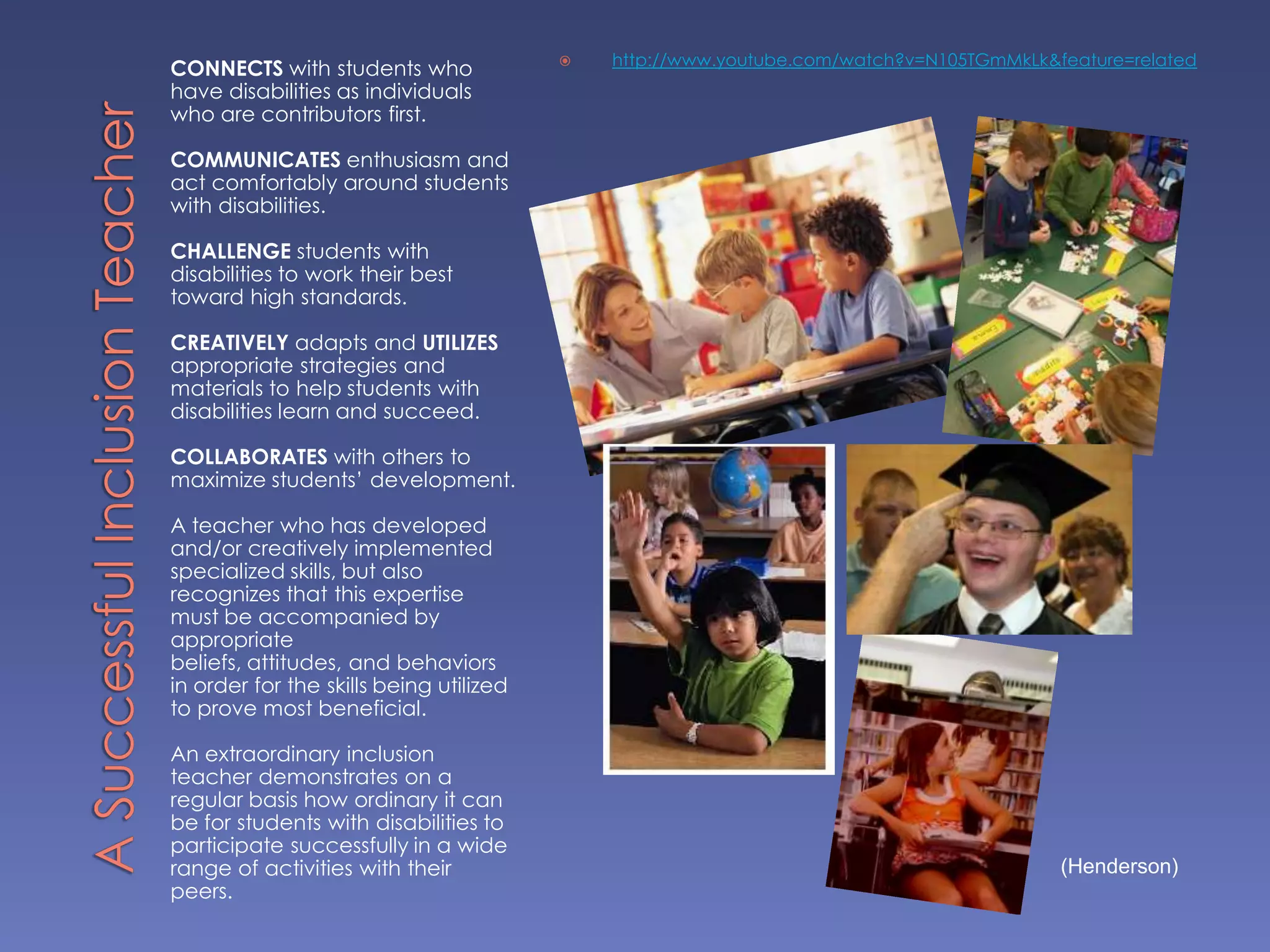
CONNECTS with students who
have disabilities as individuals
who are contributors first.

COMMUNICATES enthusiasm and
act comfortably around students
with disabilities.

CHALLENGE students with
disabilities to work their best
toward high standards.

CREATIVELY adapts and UTILIZES
appropriate strategies and
materials to help students with
disabilities learn and succeed.

COLLABORATES with others to
maximize students’ development.

A teacher who has developed
and/or creatively implemented
specialized skills, but also
recognizes that this expertise
must be accompanied by
appropriate
beliefs, attitudes, and behaviors
in order for the skills being utilized
to prove most beneficial.

An extraordinary inclusion
teacher demonstrates on a
regular basis how ordinary it can
be for students with disabilities to
participate successfully in a wide
range of activities with their                                                           (Henderson)
peers.
Questions??

Diverisity in Education

  • 2.
    "Diversity is notsimply a matter of the changing demographics in students or faculty. Attending to it has also altered the very knowledge base upon which the intellectual integrity of the academy rests. Institutions across the country are taking advantage of the explosion of new scholarship about the diversity of cultural traditions and histories in America and around the world. Diversity has also provided additional interpretive lenses through which to analyze ideas and society. . ." - from Diversity Web (www.diversityweb.org)
  • 3.
     Poverty &Academic Needs of Students  Factors of the Achievement Gap  English Language Learners  Gender Inequalities  Inclusion
  • 5.
    Poverty Academic Needs  The extent to which an  School Attendance individual does without resources  Social Support  Financial  Emotional  Parental Involvement  Mental  Spiritual  School Support  Physical  Relevant Curriculum  Support Systems (Network of Relationships)  Relationships/Role Models  Gifted Programs  Knowledge of Hidden Rules Among Social Classes  Culturally Sensitive Teachers (Payne)
  • 6.
    Communication Discipline  Poverty  Child, Adult,  Forgiveness & Penance & Parent Voices  Not about Change  Adult  Usually absent in poverty  Used for Negotiation  Effective Discipline  Structure  When a Student is  Choice Disciplined at School  Child Voice  Teach That There are  Powerless  Parent Voice Two Sets of Behaviors  Disrespectful to Educator  School  Street (Payne) (Payne)
  • 7.
    Social Support Effects  Acts as a Protector/  Students with Support Buffer to Help Stabilize from Students Parents, Teachers, & Friends have:  Sources  Higher GPA  Better Standardized Test  Parents Scores  Teachers  Provide Emotional, Appraisal, Inf  Parental Involvement ormational, &  Better School Instrumental Support Attendance  Classmates  More completed  Close Friends assignments  Schools (Malecki & Demaray)
  • 8.
    Relevant Curriculum Culturally Sensitive Teachers  Social Class & Culture  Reflect On Their Own Cultural Identity & Classroom Practices  Connects Schools to (Mitchell, Boutte & Hill) their Communities  Raises Academic Achievement  Help Students Learn about Multiple Worldviews (Williams) (Boutte & Hill)  Gifted Programs  Make Classroom  Culturally Diverse Interactions & Discussions  Curriculum Culturally Sensitive  Groups of Students  Chinese: Do not make mistakes  Access in Rural Schools in public  Give students time to prepare (Ford , Cross & Burney) for a class discussion (Fu)
  • 9.
    Factors of theAchievement Gap What Does the Future Hold? Matt Hoffman
  • 10.
    The Achievement Gap Refers to the observed disparity between students academic performance, especially groups defined by gender, race and social class.  Factors Concerning the Achievement Gap  School Districts  Large/Small Districts  Lack of support  Urban/Rural  Funding  Staff Accountability  Student Population  Support from home  English Language Learners  Learning Disabilities  (NCTAF)
  • 11.
    Who Is Accountable?  The Disparity Between Minority and Majority Students:  The Educators  Race  Do school systems “water down” their material for minority students?  The School District  Are English Language Learners and English as a Second Language students adequately instructed?  The State (Fu)  Castaneda v. Pickard 1. The program must be based on an  The Student educational theory recognized as sound by experts in the field or that is considered by  The Nation experts as a legitimate experimental strategy 2. The program must be implemented with adequate resources and personnel. 3. The district must evaluate the program to determine whether it is achieving results and make appropriate adjustments, where needed, to ensure that language barriers are actually being overcome. (McBride)  Gender  Do educators differ in their instruction between Girls and boys?  Boys are statistically called upon more
  • 12.
    Districts need to support their star teachers  Union/District collaboration  The Union and the school district cooperated with each other to create a new series of schools known as “Empowerment Schools”  Clark County (Las Vegas) Empowerment Schools  Bonuses for “Job Well Done”  Based upon school performance  Increase of schools meeting Adequate Yearly Progress  Increase of 12th grade graduation rate  Decrease in dropout rate 9th through 12th grade  Higher proficiency scores (NCTAF)  Teachers need to recognize past tendencies and be willing to adapt  The importance of recognizing cultural differences and priorities  All children can learn
  • 14.
    Students whose firstlanguage is not English, and can encompass both students who are just beginning to learn English and those who have already developed considerable proficiency. The term is used to describe a student whose first language is not English and has difficulties in speaking, reading, writing, or understanding the English language. These difficulties may be sufficient to deny the student the ability to meet the State’s proficient level of achievement on State assessments, the ability to successfully achieve in classrooms where the language of instruction is English, or the opportunity to participate fully in society.
  • 15.
    USA 1980 – 4.7% of all students were ELL 2000 – 7.4% of all students were ELL 2030 – 40% of all school age children may be ELL. (Berliner and Biddle 1995)  Concentration of ELLs in a handful of states Hispanic – largest group Asian – second largest group  70% of ELLs are in only 10% of elementary schools and most are in urban areas
  • 16.
    English  “Sink or Swim” approach – teach children in English  (Sheltered English or even as students learn the Immersion Education) language – Some students have pull out ESL  English and Native Language  Use both languages and transition over time to  (Transitional Bilingual English. Develops literacy in Education) primary language as foundation for English reading.  English and Native Language  Use both languages – all  (Two-Way Bilingual students are learning 2 Education Immersion) languages
  • 17.
    Dropout Rates  School resources  Social and academic language   NCLB and Achievement Tests – ELLs score lower on standardized tests  Low expectations of teachers. They may receive less access to standard grade-level curriculum  Labeling of students – Language learning disability versus a child is manifesting the normal process of acquiring a second language. Interference/Codeswitching/Language Students put on an IEP because they do not understand the language.  Lack of qualified bilingual education programs and teachers  High percent of ELLs in urban schools that generally have more new teachers and also more teachers uncertified than those at other schools. (13)
  • 18.
    Get to know your Students  Create a Community of Learners  Make tasks relevant, meaningful and engaging.  Weave students’ first language and culture into instructional conversations and curriculum.  Believe that all students can learn and have a high expectations  Create context for students with manipulatives, pictures and video.  Teach academic strategies, socio-cultural expectations, and academic norms, as these are not readily acquired otherwise.  Use parent volunteers, especially parents of English language learners.  Enrich print environment of your classroom – books and magazines in student’s first language. In younger grades put color and number words in different languages.  Writing, class instruction/tests, and reading  Take professional development classes.
  • 20.
    Children notice differences between the sexes, races, and ethnicities by age 2 or 3  Stereotypes are internalized and acted upon about age 4  Gender differences are the most prevalent bias in children  Societies rules, customs, and values have shaped the differences in male and female children › Each sex is taught to behave in different ways › Children learn their gender stereotypes based on the society they live in › Females are raised to be submissive and dependent
  • 21.
    Teachers may push their own beliefs about gender roles onto students › See boys as needing competition, discipline, structure and support › See girls as lacking confidence and losing out on teacher attention  Different expectations and behavior standards exist for boys and girls › Girls are expected to do better at Language Arts › Boys are expected to be better at mathematics and sciences  Teachers unknowingly restrict areas of study and goals of their students reducing their potential  Parents reinforce gender biases by expecting boys to perform better in mathematics and sciences while discouraging girls from pursuing excellence in these subjects  Teachers treat behavioral offenses by boys more strict than similar offenses by girls
  • 22.
    Boys Girls  Stereotyped as lazy, badly  Stereotypes as talkative behaved and immature  Raise hands and wait on  Shout out answers to questions teacher to call on them to in classroom answer questions  Are encouraged to pursue  Are discouraged from careers in areas requiring pursuing careers in areas mathematics and science requiring mathematics and  Given leadership roles in science mixed sex groups  Receive less extensive  More severely punished for feedback on assignments misbehavior  Relegated to submissive role in  Prefer careers as doctors and group projects scientists  Career ambitions often include teaching
  • 23.
    Schools and school districts should increase the percentage of girls who take the trio of core science courses: physics, biology, and chemistry.  Algebra I and geometry should be mandatory for all students.  Teachers and counselors should encourage girls to take math and science classes at the challenging AP or honors level.  Educators need to develop programs at the classroom, school district, or state level to increase girls' enrollment in computer science courses.  Equity must be viewed as essential to teacher education and the achievement of academic excellence.  Producers and purchasers of educational materials should establish processes and criteria by which to screen curricula and instructional materials for bias in images, text, or logic.  Colleges and universities should continue to use a broad range of material to assess students.  Testing organizations should consider adding a writing section to the SAT exam to more accurately reflect students' academic skills.  The relationship between girls' and boys' test scores and grades should be further researched.  Much more research is needed on gender equity and technology.
  • 25.
  • 26.
    Diversity  Reflective Practice › placement regardless of › Educators reflect and modify learning ability, race, linguistic their attitudes, teaching and ability, economic status, cultural classroom management background, etc. practices and curricula to › acknowledge, affirm and accommodate individual needs. celebrate the value of all › Educators are learners flexible, responsive and aware › promote acceptance, equity of student’s needs and collaboration in response to › Think critically and examine individual needs. their practices for self improvement and to ensure that all student’s needs are met  Collaboration  Individual Needs › It is a group effort between › Sensitivity to and acceptance of educators, other individual needs and differences professionals, students, families and community agencies (Salend)
  • 27.
    FOR CHILDREN WITH SPECIAL NEEDS › Provides a diverse stimulating environment with more engaged instructional time and a greater exposure to academic activities › Enables development of friendships with same age peers › Enhances self-respect & self-esteem by sharing same activities as non-disabled peers › Provides peer models who can facilitate communication, social and adaptive behaviors (Berg)
  • 28.
    › Allows studentsto be more accepting of differences among individuals › Reduces fear and uneasiness of disabled classmates › Opportunity to experience diversity in a small scale › Develop leadership skills, increased ability to help and teach others, mentoring, tutoring, self- empowerment and improve self-esteem (Berg)
  • 29.
    › Creates anawareness and appreciation of individual differences in all students › Allows teachers to learn new teaching techniques that can help all their students › Allows greater creativity with teaching methods, avoids monotony › Allows them to develop team work/ collaboration skills › Increases awareness of the importance of direct individual instruction (Berg)
  • 30.
    › Focus onsocialization part of their education may take precedence over the academic part › Some students with disabilities may need the special education classroom to get the maximum it benefit of their education: smaller class size, less distractions, more one-on- one instruction › May lower self-esteem and self-concept if they become frustrated and are ridiculed or isolated › Many feel that students with disabilities will become depressed upon realizing what they cannot do compared with their peers (Berg)
  • 31.
    › General educationstudents may feel that their classroom is more disruptive due to the distractions from additional teachers, aides, paraprofessionals, and from special education students leaving the classroom frequently and making involuntary vocalizations, etc. › Fear that their education is being jeopardized › May resent special education students for all the attention children with disabilities get (Berg)
  • 32.
    › May havea constant thought of fear that they are going to fail at successfully and appropriately carrying out inclusion › May not have the proper training to teach and deal with students with disabilities › Discomfort with giving up control of their classroom when they will have to co-teach and collaborate › May not have proper support, and an appropriate amount of planning and collaboration time (Berg)
  • 33.
    http://www.youtube.com/watch?v=N105TGmMkLk&feature=related CONNECTS with students who have disabilities as individuals who are contributors first. COMMUNICATES enthusiasm and act comfortably around students with disabilities. CHALLENGE students with disabilities to work their best toward high standards. CREATIVELY adapts and UTILIZES appropriate strategies and materials to help students with disabilities learn and succeed. COLLABORATES with others to maximize students’ development. A teacher who has developed and/or creatively implemented specialized skills, but also recognizes that this expertise must be accompanied by appropriate beliefs, attitudes, and behaviors in order for the skills being utilized to prove most beneficial. An extraordinary inclusion teacher demonstrates on a regular basis how ordinary it can be for students with disabilities to participate successfully in a wide range of activities with their (Henderson) peers.
  • 34.

Editor's Notes

  • #8 Emotional: CaringAppraisal: feedback & Evaluation InfoInformational: Needed Info and AdviceInstrumental: Examples= Time, $$Students with Low Socio-Economic Status who have Support from Parents, Teachers, & Friends have
  • #9 Example: Researching mathematicians from a wide range of countries and cultures.Has raised academic achievement by connecting schools to their Latino, Native, or African American Communities (Williams)Access in Rural Schools: Satellite Conferences, Online Gifted Program, Multiple Schools working together to provide a gifted programReflecting On Their Cultural Identity & Classroom PracticesEmpathy for those who are different from youRecognize the possibilities of what can be in others