CREATING AN INCLUSIVE SCHOOL
UNIT IV-Inclusive Education
Presentation by
CR.BanuPriya,
15-EDCS-12.
Promoting Inclusive Education.
Mixed-Ability Grouping and Teaching.
Differences between Inclusive, Integrated and Special Education.
Teacher Development Initiatives for Inclusive Schooling.
• Main reason for not succeeding in inclusive education is lack of awareness among
anyone.
• The parents should be well educated on this as well as children.
• Most parents don’t want their child to study with a disabled child or the
extremely gifted child.
• This inclusive education comes not only with the effort of schools or teacher. It is
a combined work to be implemented by schools, parents and the children.
• Steps should be taken to create more awareness to Promote Inclusive Education
Promoting Inclusive Education:-
• To promote inclusive education where pupils from different backgrounds
and beliefs are taught together so they can learn with one another and
about one another."
• Supports students in text based environments.
• Promotes independence and confidence.
• Enhances learning anywhere, anytime.
• Enhances learning and the expression of ideas
• Improves writing fluency.
• Promotes healthy lifestyles and life skills.
• Consolidate knowledge creatively.
• Opportunities to express knowledge in a 21st century medium..
Mixed – Ability Grouping and Teaching:-
Mixed Ability or Heterogeneous
Classes made up of students of different levels of proficiency.
They differ in many ways:-
• They may have different strength,
• They may have different weakness,
• They may have different approaches to learning,
• They may respond differently to various teaching methods and classroom situations
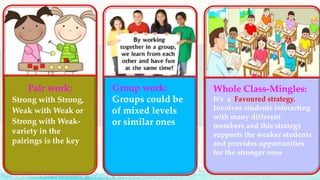
Pair work:
Strong with Strong,
Weak with Weak or
Strong with Weak-
variety in the
pairings is the key
Group work:
Groups could be
of mixed levels
or similar ones
Whole Class-Mingles:
It’s a Favoured strategy.
Involves students interacting
with many different
members and this strategy
supports the weaker students
and provides opportunities
for the stronger ones
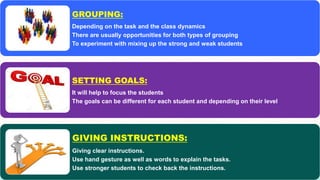
GROUPING:
Depending on the task and the class dynamics
There are usually opportunities for both types of grouping
To experiment with mixing up the strong and weak students
SETTING GOALS:
It will help to focus the students
The goals can be different for each student and depending on their level
GIVING INSTRUCTIONS:
Giving clear instructions.
Use hand gesture as well as words to explain the tasks.
Use stronger students to check back the instructions.
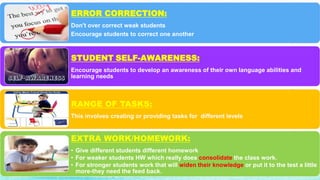
ERROR CORRECTION:
Don't over correct weak students
Encourage students to correct one another
STUDENT SELF-AWARENESS:
Encourage students to develop an awareness of their own language abilities and
learning needs
RANGE OF TASKS:
This involves creating or providing tasks for different levels
EXTRA WORK/HOMEWORK:
• Give different students different homework
• For weaker students HW which really does consolidate the class work.
• For stronger students work that will widen their knowledge or put it to the test a little
more-they need the feed back.
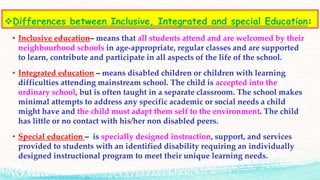
Differences between Inclusive, Integrated and special Education:
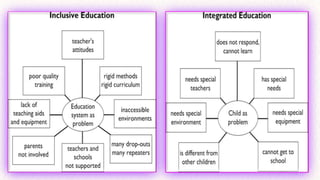
• Inclusive education– means that all students attend and are welcomed by their
neighbourhood schools in age-appropriate, regular classes and are supported
to learn, contribute and participate in all aspects of the life of the school.
• Integrated education – means disabled children or children with learning
difficulties attending mainstream school. The child is accepted into the
ordinary school, but is often taught in a separate classroom. The school makes
minimal attempts to address any specific academic or social needs a child
might have and the child must adapt them self to the environment. The child
has little or no contact with his/her non disabled peers.
• Special education – is specially designed instruction, support, and services
provided to students with an identified disability requiring an individually
designed instructional program to meet their unique learning needs.
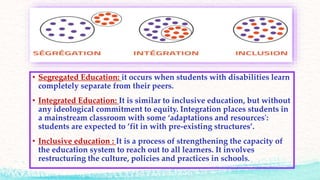
• Segregated Education: it occurs when students with disabilities learn
completely separate from their peers.
• Integrated Education: It is similar to inclusive education, but without
any ideological commitment to equity. Integration places students in
a mainstream classroom with some ‘adaptations and resources':
students are expected to ’fit in with pre-existing structures’.
• Inclusive education : It is a process of strengthening the capacity of
the education system to reach out to all learners. It involves
restructuring the culture, policies and practices in schools.
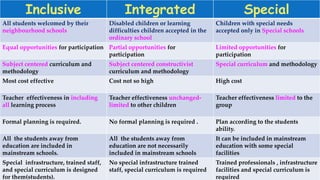
Inclusive Integrated Special
All students welcomed by their
neighbourhood schools
Disabled children or learning
difficulties children accepted in the
ordinary school
Children with special needs
accepted only in Special schools
Equal opportunities for participation Partial opportunities for
participation
Limited opportunities for
participation
Subject centered curriculum and
methodology
Subject centered constructivist
curriculum and methodology
Special curriculum and methodology
Most cost effective Cost not so high High cost
Teacher effectiveness in including
all learning process
Teacher effectiveness unchanged-
limited to other children
Teacher effectiveness limited to the
group
Formal planning is required. No formal planning is required . Plan according to the students
ability.
All the students away from
education are included in
mainstream schools.
All the students away from
education are not necessarily
included in mainstream schools
It can be included in mainstream
education with some special
facilities
Special infrastructure, trained staff,
and special curriculum is designed
for them(students).
No special infrastructure trained
staff, special curriculum is required
Trained professionals , infrastructure
facilities and special curriculum is
required
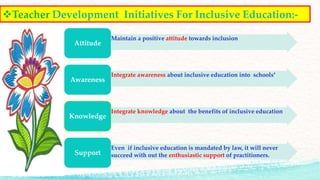
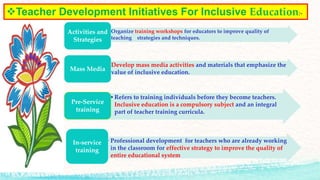
Teacher Development Initiatives For Inclusive Education:-
•Maintain a positive attitude towards inclusion
Attitude
•Integrate awareness about inclusive education into schools’
Awareness
•Integrate knowledge about the benefits of inclusive education
Knowledge
•Even if inclusive education is mandated by law, it will never
succeed with out the enthusiastic support of practitioners.Support
• Organize training workshops for educators to improve quality of
teaching strategies and techniques.
Activities and
Strategies
•Develop mass media activities and materials that emphasize the
value of inclusive education.
Mass Media
•Refers to training individuals before they become teachers.
Inclusive education is a compulsory subject and an integral
part of teacher training curricula.
Pre-Service
training
•Professional development for teachers who are already working
in the classroom for effective strategy to improve the quality of
entire educational system
In-service
training
Teacher Development Initiatives For Inclusive Education:-
Teacher development has to be the heart of initiatives for
developing inclusive practices in schools(Aniscow,2003).
The teacher should be a cultivator to cultivating growth by
sowing seeds of inclusive education.
Teachers are the key factor to successfully Implementing
Inclusive Education.
Proper knowledge and educational qualifications are
required from them as well as a high commitment to
students individual needs.
The teacher should help the students to learn with one
another and about one another.
The teacher should take a flexible approach towards the
students.
Just make it possible ensure Education for All!
•Conclusion:-
INCLUSION starts with I
As We are a group of B.Ed. students studying the
implementation of inclusive education in the classroom
setting. We are attempting to discover the “how” of this
process. Also, we would like to deduce which education
methods and strategies work best in an inclusive setting.
As future practitioners of education, we cannot avoid this
issue and will at some point in our careers find ourselves at
the helm of an inclusion class. As such, we believe that
research into this subject can improve our abilities as the
educators and guides of future generations.
"When everyone is included, everyone wins."
https://www.youtube.com/watch?v=8HPh4RoV63s

inclusive education

  • 1.
    CREATING AN INCLUSIVESCHOOL UNIT IV-Inclusive Education Presentation by CR.BanuPriya, 15-EDCS-12. Promoting Inclusive Education. Mixed-Ability Grouping and Teaching. Differences between Inclusive, Integrated and Special Education. Teacher Development Initiatives for Inclusive Schooling.
  • 2.
    • Main reasonfor not succeeding in inclusive education is lack of awareness among anyone. • The parents should be well educated on this as well as children. • Most parents don’t want their child to study with a disabled child or the extremely gifted child. • This inclusive education comes not only with the effort of schools or teacher. It is a combined work to be implemented by schools, parents and the children. • Steps should be taken to create more awareness to Promote Inclusive Education
  • 3.
    Promoting Inclusive Education:- •To promote inclusive education where pupils from different backgrounds and beliefs are taught together so they can learn with one another and about one another." • Supports students in text based environments. • Promotes independence and confidence. • Enhances learning anywhere, anytime. • Enhances learning and the expression of ideas • Improves writing fluency. • Promotes healthy lifestyles and life skills. • Consolidate knowledge creatively. • Opportunities to express knowledge in a 21st century medium..
  • 4.
    Mixed – AbilityGrouping and Teaching:- Mixed Ability or Heterogeneous Classes made up of students of different levels of proficiency. They differ in many ways:- • They may have different strength, • They may have different weakness, • They may have different approaches to learning, • They may respond differently to various teaching methods and classroom situations
  • 5.
    Pair work: Strong withStrong, Weak with Weak or Strong with Weak- variety in the pairings is the key Group work: Groups could be of mixed levels or similar ones Whole Class-Mingles: It’s a Favoured strategy. Involves students interacting with many different members and this strategy supports the weaker students and provides opportunities for the stronger ones
  • 6.
    GROUPING: Depending on thetask and the class dynamics There are usually opportunities for both types of grouping To experiment with mixing up the strong and weak students SETTING GOALS: It will help to focus the students The goals can be different for each student and depending on their level GIVING INSTRUCTIONS: Giving clear instructions. Use hand gesture as well as words to explain the tasks. Use stronger students to check back the instructions.
  • 7.
    ERROR CORRECTION: Don't overcorrect weak students Encourage students to correct one another STUDENT SELF-AWARENESS: Encourage students to develop an awareness of their own language abilities and learning needs RANGE OF TASKS: This involves creating or providing tasks for different levels EXTRA WORK/HOMEWORK: • Give different students different homework • For weaker students HW which really does consolidate the class work. • For stronger students work that will widen their knowledge or put it to the test a little more-they need the feed back.
  • 8.
    Differences between Inclusive,Integrated and special Education: • Inclusive education– means that all students attend and are welcomed by their neighbourhood schools in age-appropriate, regular classes and are supported to learn, contribute and participate in all aspects of the life of the school. • Integrated education – means disabled children or children with learning difficulties attending mainstream school. The child is accepted into the ordinary school, but is often taught in a separate classroom. The school makes minimal attempts to address any specific academic or social needs a child might have and the child must adapt them self to the environment. The child has little or no contact with his/her non disabled peers. • Special education – is specially designed instruction, support, and services provided to students with an identified disability requiring an individually designed instructional program to meet their unique learning needs.
  • 9.
    • Segregated Education:it occurs when students with disabilities learn completely separate from their peers. • Integrated Education: It is similar to inclusive education, but without any ideological commitment to equity. Integration places students in a mainstream classroom with some ‘adaptations and resources': students are expected to ’fit in with pre-existing structures’. • Inclusive education : It is a process of strengthening the capacity of the education system to reach out to all learners. It involves restructuring the culture, policies and practices in schools.
  • 10.
    Inclusive Integrated Special Allstudents welcomed by their neighbourhood schools Disabled children or learning difficulties children accepted in the ordinary school Children with special needs accepted only in Special schools Equal opportunities for participation Partial opportunities for participation Limited opportunities for participation Subject centered curriculum and methodology Subject centered constructivist curriculum and methodology Special curriculum and methodology Most cost effective Cost not so high High cost Teacher effectiveness in including all learning process Teacher effectiveness unchanged- limited to other children Teacher effectiveness limited to the group Formal planning is required. No formal planning is required . Plan according to the students ability. All the students away from education are included in mainstream schools. All the students away from education are not necessarily included in mainstream schools It can be included in mainstream education with some special facilities Special infrastructure, trained staff, and special curriculum is designed for them(students). No special infrastructure trained staff, special curriculum is required Trained professionals , infrastructure facilities and special curriculum is required
  • 12.
    Teacher Development InitiativesFor Inclusive Education:- •Maintain a positive attitude towards inclusion Attitude •Integrate awareness about inclusive education into schools’ Awareness •Integrate knowledge about the benefits of inclusive education Knowledge •Even if inclusive education is mandated by law, it will never succeed with out the enthusiastic support of practitioners.Support
  • 13.
    • Organize trainingworkshops for educators to improve quality of teaching strategies and techniques. Activities and Strategies •Develop mass media activities and materials that emphasize the value of inclusive education. Mass Media •Refers to training individuals before they become teachers. Inclusive education is a compulsory subject and an integral part of teacher training curricula. Pre-Service training •Professional development for teachers who are already working in the classroom for effective strategy to improve the quality of entire educational system In-service training Teacher Development Initiatives For Inclusive Education:-
  • 14.
    Teacher development hasto be the heart of initiatives for developing inclusive practices in schools(Aniscow,2003). The teacher should be a cultivator to cultivating growth by sowing seeds of inclusive education. Teachers are the key factor to successfully Implementing Inclusive Education. Proper knowledge and educational qualifications are required from them as well as a high commitment to students individual needs. The teacher should help the students to learn with one another and about one another. The teacher should take a flexible approach towards the students. Just make it possible ensure Education for All!
  • 15.
    •Conclusion:- INCLUSION starts withI As We are a group of B.Ed. students studying the implementation of inclusive education in the classroom setting. We are attempting to discover the “how” of this process. Also, we would like to deduce which education methods and strategies work best in an inclusive setting. As future practitioners of education, we cannot avoid this issue and will at some point in our careers find ourselves at the helm of an inclusion class. As such, we believe that research into this subject can improve our abilities as the educators and guides of future generations.
  • 16.
    "When everyone isincluded, everyone wins." https://www.youtube.com/watch?v=8HPh4RoV63s