
12 Keys to High-Quality
Early Childhood Inclusion
Wednesday, February 28, 2018
Presented by
Kathryn Wahl
Director II, Inclusion Collaborative
Santa Clara County Office of Education
Join the Teaching All Students: Practical Strategies for Inclusive Classrooms community:
www.edweb.net/inclusiveeducation
• Close any applications that use bandwidth or resources on your device
• To chat, click on “Chat” or “Attendee Chat” at the top left of your screen
• Please post your questions by clicking the question mark
at the top center of your screen
• For a larger view of the slides click the “Full Screen” image on the upper
right of your screen
• For audio issues, you can “Switch to Phone” by clicking the telephone
icon at the top center of your screen
• Tweet using #edWebinar
Here are some edWebinar tips …
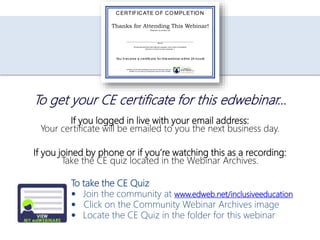
If you logged in live with your email address:
Your certificate will be emailed to you the next business day.
If you joined by phone or if you’re watching this as a recording:
Take the CE quiz located in the Webinar Archives.
To take the CE Quiz
 Join the community at www.edweb.net/inclusiveeducation
 Click on the Community Webinar Archives image
 Locate the CE Quiz in the folder for this webinar
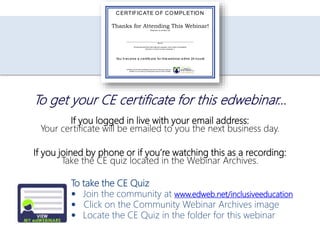
To get your CE certificate for this edwebinar…
Thanks for Attending This Webinar!
Presented by edWeb.net
___________________________________________________________________________
Name
All requirements for this in-service program have been completed.
Number of clock hours completed: 1
CERTIFICATE OF COMPLETION
You’ll receive a certificate for this webinar within 24 hours!
edWeb.net is a free professional social and learning network.
edWeb.TV is a premium subscription service from edWeb.
 Invitations to upcoming webinars
 Webinar recordings and resources
 CE quizzes
 Online discussions
www.edweb.net/inclusiveeducation
You’ll receive the following benefits:
Join our free community!
Teaching All Students
To join, go
to:
SPECIAL OFFER!
Save 20%* at brookespublishing.com with code EDWEB2018
*Expires 3/31/18. Not to be combined with any other discounts or offers. Consumer orders
only, please. Excludes BOL training, pre-discounted bundles, and online products such as
ASQ Online and AEPSinteractive™.
Kathryn Wahl
As Director of the Santa Clara County Office of Education’s (SCCOE) Inclusion
Collaborative Department, Kathryn Wahl is responsible for promoting,
supporting and advocating for all children to have full access to inclusive
environments, regardless of their abilities, both locally, regionally and
statewide. The Inclusion Collaborate of SCCOE strives to build a culture that
values all children by strengthening, sustaining, and ensuring inclusive
practices.
Join the Teaching All Students community: www.edweb.net/inclusiveeducation
EdWeb.net
12 Keys to High-Quality
Early Childhood Inclusion
February 28, 2018
12 Keys to High-Quality
Early Childhood Inclusion
Inclusion Collaborative 8
Presented By:
Kathy Wahl
Kathy_Wahl@SCCOE.org
Director II
Inclusion Collaborative,
Santa Clara County Office of Education
(408) 453-6554
Kathy_Wahl@sccoe.org
W e l c o m i n g A l l S t u d e n t s
Inclusion Collaborative 10
Greetings & Introductions
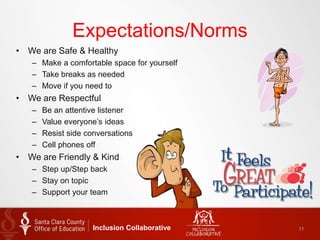
Expectations/Norms
Inclusion Collaborative 11
• We are Safe & Healthy
– Make a comfortable space for yourself
– Take breaks as needed
– Move if you need to
• We are Respectful
– Be an attentive listener
– Value everyone’s ideas
– Resist side conversations
– Cell phones off
• We are Friendly & Kind
– Step up/Step back
– Stay on topic
– Support your team
What do YOU bring
to this training?
Inclusion Collaborative 12
• What do you know about Early Childhood Inclusion?
• What are the benefits of inclusion in early education?
• What practices do you use to include all children?
• Discuss with your team
Outcomes for Today
• Understand services provided by the Inclusion
Collaborative
• Increased understanding of
– What is high quality early childhood inclusion
– 12 inclusive practices associated with high quality
– How to utilize the Inclusive Classroom Profile to support
improvement
– Next steps
Inclusion Collaborative 13
Inclusion Collaborative
Mission:
The Inclusion Collaborative of SCCOE builds a culture
that values all children by strengthening, sustaining, and
ensuring inclusive practices.
Vision:
Our community embraces diversity and supports lifelong
quality inclusion for everyone.
Inclusion Collaborative 14
Inclusion Collaborative Services
• Coaching
• Technical Assistance
– Site Meetings
– Resource Materials
• Professional Development
– Countywide (Make & Takes, Teaching Pyramid, etc.)
– Annual Inclusion Collaborative State Conference
– Available for districts & organizations for on-site training
Inclusion Collaborative 15
Inclusion Collaborative Services
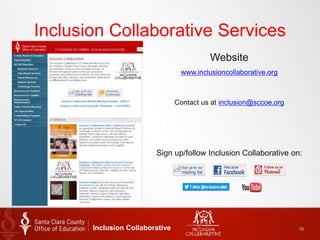
Website
www.inclusioncollaborative.org
Contact us at inclusion@sccoe.org
Sign up/follow Inclusion Collaborative on:
Inclusion Collaborative 16
17
Website
www.inclusioncollaborative.org
Contact us at inclusion@sccoe.org
Sign up/follow Inclusion Collaborative on:
Social Media
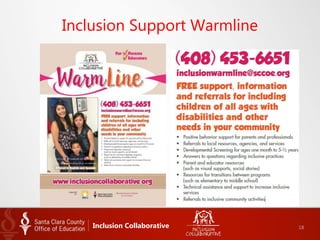
Inclusion Support Warmline
Inclusion Collaborative 18
19
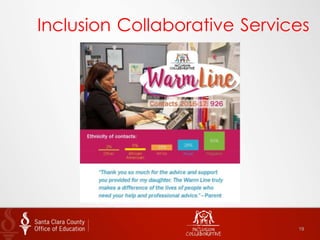
Inclusion Collaborative Services
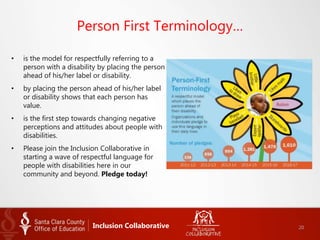
Person First Terminology…
• is the model for respectfully referring to a
person with a disability by placing the person
ahead of his/her label or disability.
• by placing the person ahead of his/her label
or disability shows that each person has
value.
• is the first step towards changing negative
perceptions and attitudes about people with
disabilities.
• Please join the Inclusion Collaborative in
starting a wave of respectful language for
people with disabilities here in our
community and beyond. Pledge today!
Inclusion Collaborative 20
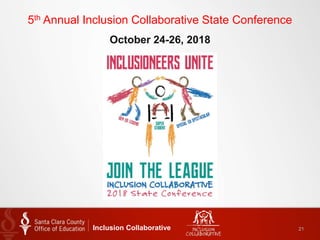
5th Annual Inclusion Collaborative State Conference
Inclusion Collaborative 21
October 24-26, 2018
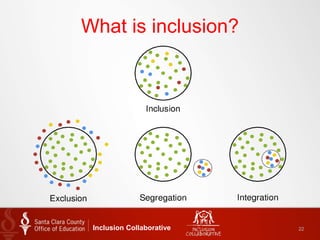
What is inclusion?
Inclusion Collaborative 22
Definition of Inclusion
• An Attitude
• A Philosophy
• Promotes a sense of belonging, community and
membership
• Values differences & diversity
• Builds positive social relationships & friendships
• Promotes reaching full developmental and
learning potential
Belonging & Membership
"When inclusive [practice] is fully embraced, we
abandon the idea that children have to become 'normal'
in order to contribute to the world. Instead, we search
for and nourish the gifts that are inherent in all people.
We begin to look beyond typical ways of becoming
valued members of the community, and in doing so,
begin to realize the achievable goal of providing all
children with an authentic sense of belonging." --
Norman Kunc (1992)
Inclusion Collaborative 24
Inclusive Programs
• Use Evidence-Based Practices
• Creatively adapt activities so that each child
can participate
• Make reasonable modifications to policies,
practices and procedures
• Embed children’s developmental goals into
daily routines
• Welcome all children!
Importance of Environment
A Universally Designed Environment works for ALL
 Inclusion is not based on a child’s ability in certain academic areas.
 Regardless of a child’s ability level, supports can be provided and
points of access created so ALL children can participate
 Multiple access points: different ways of accessing material…i.e.,
reading, feeling/touching
 “There has to be quality of learning in that classroom, not just
placing a child in that classroom for socialization”
Inclusion Collaborative 26
Who Benefits from Inclusion?
• All children (with & without disabilities)
• All parents (with & without a child with
a disability)
• Adults who work with children
• Communities
Benefits of Inclusion for
Children with Disabilities
• Seen as a child first, special needs second
• Observe and imitate other children
• Become more independent & self-reliant
• Learn to cope & problem solve
• Learn appropriate social skills
• Build a positive self-concept
• Make new friends
[Students with special needs]… “educated
in regular classes do better academically
and socially than comparable students in
non-inclusive settings” (Baker, Wang and
Wahlberg, 1994 p.34)
Blackorby and colleagues (2005) found
that students who spend more time in
general education than their peers
performed closer to grade level, had
higher test scores and were less
frequently absent.
Benefits of Inclusion for
Children without Disabilities
• Learn to accept & become comfortable with
individual differences
• Increase their self-esteem through helping
others
• Recognize strengths and abilities in children
who are “different”
• Explore new ways of being a friend
• Decrease fears & prejudices
• Gain new awareness of ability to express
caring, concern & compassion
Benefits of Inclusion
for the Adults in the classroom
• Broadens teaching & personal experiences
• Expands techniques for individualizing
activities
• Provides a service for children with special
needs & their families
• Helps prepare all children for future
experiences in their community
• Learn about available resources in the
community
• Increases opportunities to encourage
acceptance & individual differences
Benefits of Inclusion for
Communities
• Promotes acceptance of individual
differences throughout the community
• Provides more collaboration of resources
within the community
• Creates an environment of welcoming and
belonging.
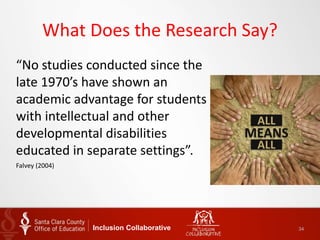
What Does the Research Say?
“No studies conducted since the
late 1970’s have shown an
academic advantage for students
with intellectual and other
developmental disabilities
educated in separate settings”.
Falvey (2004)
Inclusion Collaborative 34
ALL
ALL
MEANS
Evidence on Inclusion
No evidence has been found that children with
particular and/or severe disabilities are poor
candidates for inclusive programs.
Michigan University, 2006
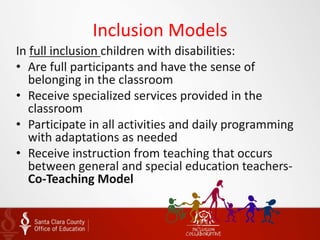
Inclusion Models
In full inclusion children with disabilities:
• Are full participants and have the sense of
belonging in the classroom
• Receive specialized services provided in the
classroom
• Participate in all activities and daily programming
with adaptations as needed
• Receive instruction from teaching that occurs
between general and special education teachers-
Co-Teaching Model
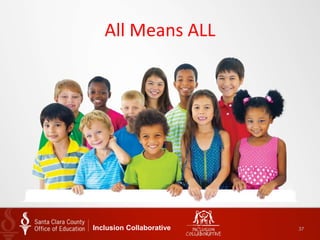
All Means ALL
Inclusion Collaborative 37
Inclusion Collaborative 38
EQUALITY vs EQUITY
In the first image, it is
assumed that everyone will
benefit from the same
supports. They are being
treated equally.
In the second image,
individuals are given different
supports to make it possible
for them to have equal access
to the game. They are being
treated equitably.
In the third image, all three can
see the game without any
supports or accommodations
because the cause of the
inequity was addressed. The
systemic barrier has been
removed.
A little
background…
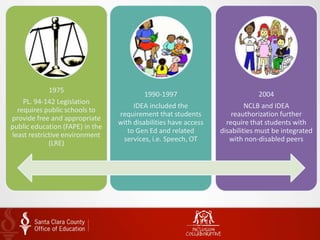
1975
PL. 94-142 Legislation
requires public schools to
provide free and appropriate
public education (FAPE) in the
least restrictive environment
(LRE)
1990-1997
IDEA included the
requirement that students
with disabilities have access
to Gen Ed and related
services, i.e. Speech, OT
2004
NCLB and IDEA
reauthorization further
require that students with
disabilities must be integrated
with non-disabled peers
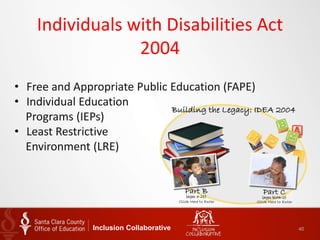
Individuals with Disabilities Act
2004
Inclusion Collaborative 40
• Free and Appropriate Public Education (FAPE)
• Individual Education
Programs (IEPs)
• Least Restrictive
Environment (LRE)
41
IT’S THE LAW!
Least Restrictive Environment
School districts must ensure to the
maximum extent appropriate that students
with disabilities ages 3-21 are educated
with children who are not disabled and
participate in nonacademic and
extracurricular activities with children who
are not disabled. CFR Sec. 300.116
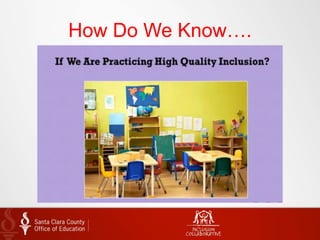
How Do We Know….
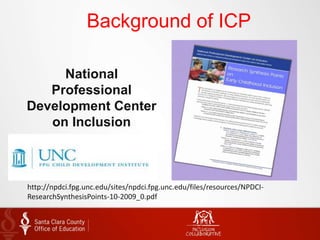
Background of ICP
National
Professional
Development Center
on Inclusion
http://npdci.fpg.unc.edu/sites/npdci.fpg.unc.edu/files/resources/NPDCI-
ResearchSynthesisPoints-10-2009_0.pdf
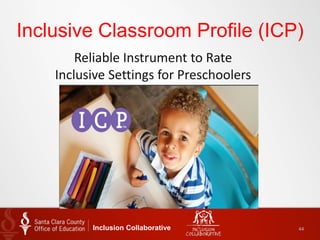
Inclusive Classroom Profile (ICP)
Inclusion Collaborative 44
Reliable Instrument to Rate
Inclusive Settings for Preschoolers
What is the ICP?
• Authored by Elena Soukakou (2012)
• Structured observation rating scale designed to
assess the quality of daily classroom practice that
support developmental needs of children with
disabilities in early childhood settings.
• Designed to be used in preschool classrooms that
have at least 1 child with a disability
Inclusive Classroom Profile
ICP Ratings
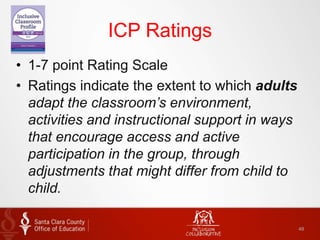
• 1-7 point Rating Scale
• Ratings indicate the extent to which adults
adapt the classroom’s environment,
activities and instructional support in ways
that encourage access and active
participation in the group, through
adjustments that might differ from child to
child.
49
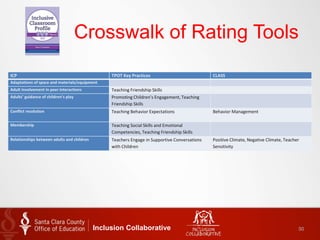
Crosswalk of Rating Tools
ICP TPOT Key Practices CLASS
Adaptations of space and materials/equipment
Adult involvement in peer interactions Teaching Friendship Skills
Adults’ guidance of children’s play Promoting Children’s Engagement, Teaching
Friendship Skills
Conflict resolution Teaching Behavior Expectations Behavior Management
Membership Teaching Social Skills and Emotional
Competencies, Teaching Friendship Skills
Relationships between adults and children Teachers Engage in Supportive Conversations
with Children
Positive Climate, Negative Climate, Teacher
Sensitivity
Inclusion Collaborative 50
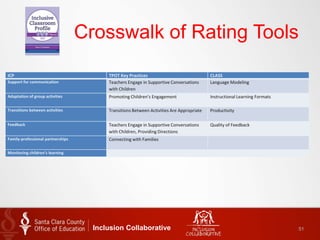
Crosswalk of Rating Tools
ICP TPOT Key Practices CLASS
Support for communication Teachers Engage in Supportive Conversations
with Children
Language Modeling
Adaptation of group activities Promoting Children’s Engagement Instructional Learning Formats
Transitions between activities Transitions Between Activities Are Appropriate Productivity
Feedback Teachers Engage in Supportive Conversations
with Children, Providing Directions
Quality of Feedback
Family-professional partnerships Connecting with Families
Monitoring children’s learning
Inclusion Collaborative 51
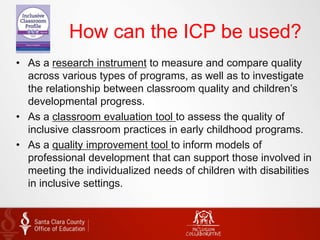
How can the ICP be used?
• As a research instrument to measure and compare quality
across various types of programs, as well as to investigate
the relationship between classroom quality and children’s
developmental progress.
• As a classroom evaluation tool to assess the quality of
inclusive classroom practices in early childhood programs.
• As a quality improvement tool to inform models of
professional development that can support those involved in
meeting the individualized needs of children with disabilities
in inclusive settings.
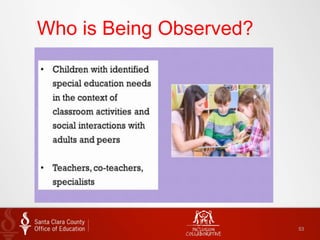
Who is Being Observed?
53
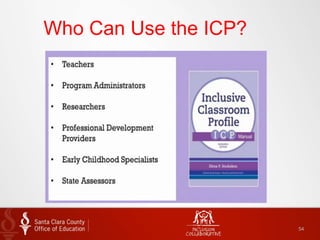
Who Can Use the ICP?
54
ICP Item Measures
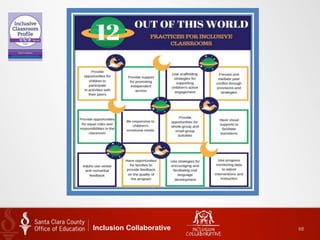
12 Areas of Inclusive Practice
1. Adaptations of space and materials/equipment
2. Adult involvement in peer interactions
3. Adults’ guidance of children’s activities and play
4. Conflict resolution
5. Membership
6. Relationships between adults and children
7. Support for communication
8. Adaptation of group activities
9. Transitions between activities
10. Feedback
11. Family-professional partnerships
12. Monitoring children’s learning
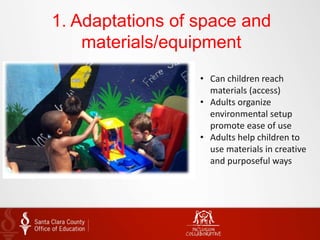
1. Adaptations of space and
materials/equipment
• Can children reach
materials (access)
• Adults organize
environmental setup
promote ease of use
• Adults help children to
use materials in creative
and purposeful ways
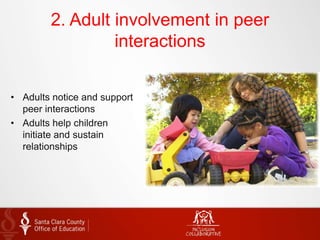
2. Adult involvement in peer
interactions
• Adults notice and support
peer interactions
• Adults help children
initiate and sustain
relationships
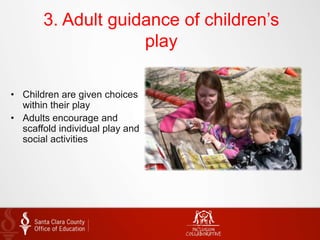
3. Adult guidance of children’s
play
• Children are given choices
within their play
• Adults encourage and
scaffold individual play and
social activities
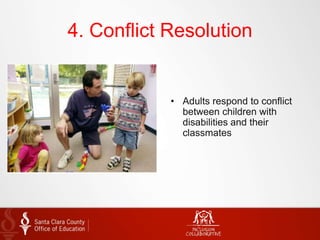
4. Conflict Resolution
• Adults respond to conflict
between children with
disabilities and their
classmates
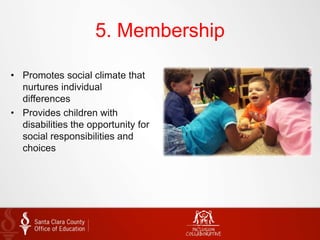
5. Membership
• Promotes social climate that
nurtures individual
differences
• Provides children with
disabilities the opportunity for
social responsibilities and
choices
6. Adult-child social interactions
• Focuses on nature and
frequency of
interactions between
adults and the children
with disabilities
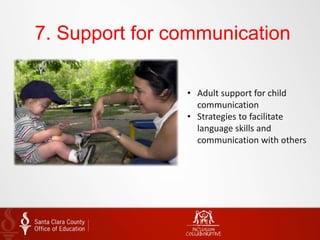
7. Support for communication
• Adult support for child
communication
• Strategies to facilitate
language skills and
communication with others
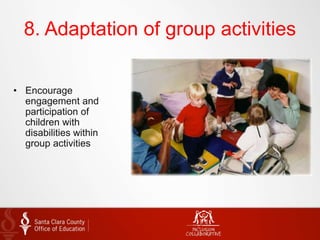
8. Adaptation of group activities
• Encourage
engagement and
participation of
children with
disabilities within
group activities
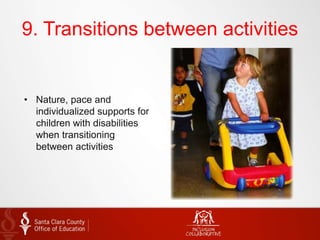
9. Transitions between activities
• Nature, pace and
individualized supports for
children with disabilities
when transitioning
between activities
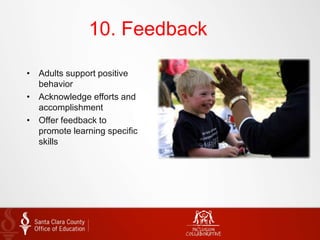
10. Feedback
• Adults support positive
behavior
• Acknowledge efforts and
accomplishment
• Offer feedback to
promote learning specific
skills
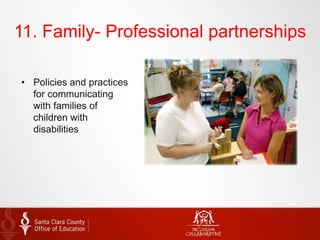
11. Family- Professional partnerships
• Policies and practices
for communicating
with families of
children with
disabilities
12. Monitoring children’s learning
• Procedures and tools
for monitoring
children’s progress
Inclusion Collaborative 68
What do Indicators Measure
• Was the practice implemented?
• How well was the practice being implemented?
• Frequency: How often is it implemented?
• Context: Where was the practice embedded?
• Intensity: What level of scaffolding?
• Individualization: Was each child supported as
needed?
• Consistency: Was the practice implemented
consistently throughout the day?
Criteria for Rating Indicators
• Define terms (e.g. several, group time)
• Present instructions for rating indicators
• List examples of practices that ‘count’
• Provide guidelines for special cases
Administration of ICP
Includes the following:
• Observation (O)
• Interview (I)
• Document Review (DR)
Plan for approximately 3 hours total time.
Teacher review is approximately 20 mins.
2018 Pilot Project
• 18 Quality Matters Rated Sites Selected (with a
current QRIS Score of 4 or 5)
• 6 Reliable Raters –assigned to 3 sites each
• Feb. 2018: Pre ICP Rating completed each site - with
ICP Action Plan
• March & April 2018 – Monthly ICP Trainings at F5
• May 2018: Post ICP Rating Completed
• Sites scoring 5 on ICP: receive “Inclusion
Endorsement” from Quality Matters
“Inclusion Endorsement”
by June 2018
• Recommendations for sites to receive
“Inclusion Endorsement” to First 5 Quality
Matters – post results on website
• Final recommendations for ICP use with the
Quality Matters in Santa Clara County by
June 30th 2018
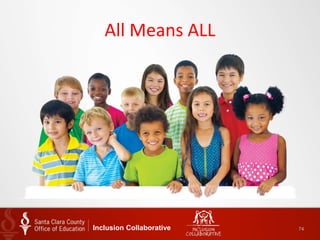
All Means ALL
Inclusion Collaborative 74
Reflections
How will you use
this information?
Inclusion Collaborative 75
Thank you!
We hope you to see you at another training!
Inclusion Collaborative 76
Q&A Session
*Not to be combined with any other discounts or offers. Consumer orders only,
please. Excludes BOL training, pre-discounted bundles, and online products such as
ASQ Online and AEPSinteractive™.
Questions?
brookeswebmeeting@brookespublishing.com
Save 20%
at brookespublishing.com*
Use code: EDWEB2018
Expires 3/31/18
Thank you to our presenter!
Learn more about Brookes Publishing at www.brookespublishing.com
Kathryn Wahl
Director II, Inclusion Collaborative
Santa Clara County Office of Education
Email: Kathryn_Wahl@sccoe.org
Website: www.inclusioncollaborative.org
Give us your feedback on this edWebinar! Click on this link in the Chat:
http://tinyurl.com/edWebinarEval
If you logged in live with your email address:
Your certificate will be emailed to you the next business day.
If you joined by phone or if you’re watching this as a recording:
Take the CE quiz located in the Webinar Archives.
To take the CE Quiz
 Join the community at www.edweb.net/inclusiveeducation
 Click on the Community Webinar Archives image
 Locate the CE Quiz in the folder for this webinar
To get your CE certificate for this edwebinar…
Thanks for Attending This Webinar!
Presented by edWeb.net
___________________________________________________________________________
Name
All requirements for this in-service program have been completed.
Number of clock hours completed: 1
CERTIFICATE OF COMPLETION
You’ll receive a certificate for this webinar within 24 hours!
edWeb.net is a free professional social and learning network.
edWeb.TV is a premium subscription service from edWeb.
For an invitation, join
Teaching All Students: Practical Strategies for Inclusive Classrooms
www.edweb.net/inclusiveeducation
Practical Strategies to Modify Your Curriculum for
Students Working Below Grade Level
Presented by Nicole Eredics
Author of Inclusion in Action: Practical Strategies to Modify Your Curriculum
Upcoming edWebinars are posted on Twitter @edwebnet
Join us for the next edWebinar!
Tuesday, March 27, 2018 @ 3:00 pm Eastern Time
 Invitations to upcoming webinars
 Webinar recordings and resources
 CE quizzes
 Online discussions
www.edweb.net/inclusiveeducation
You’ll receive the following benefits:
Join our free community!
Teaching All Students
To join, go
to:

12 Keys to High-Quality Early Childhood Inclusion

  • 1.
    12 Keys toHigh-Quality Early Childhood Inclusion Wednesday, February 28, 2018 Presented by Kathryn Wahl Director II, Inclusion Collaborative Santa Clara County Office of Education Join the Teaching All Students: Practical Strategies for Inclusive Classrooms community: www.edweb.net/inclusiveeducation
  • 2.
    • Close anyapplications that use bandwidth or resources on your device • To chat, click on “Chat” or “Attendee Chat” at the top left of your screen • Please post your questions by clicking the question mark at the top center of your screen • For a larger view of the slides click the “Full Screen” image on the upper right of your screen • For audio issues, you can “Switch to Phone” by clicking the telephone icon at the top center of your screen • Tweet using #edWebinar Here are some edWebinar tips …
  • 3.
    If you loggedin live with your email address: Your certificate will be emailed to you the next business day. If you joined by phone or if you’re watching this as a recording: Take the CE quiz located in the Webinar Archives. To take the CE Quiz  Join the community at www.edweb.net/inclusiveeducation  Click on the Community Webinar Archives image  Locate the CE Quiz in the folder for this webinar To get your CE certificate for this edwebinar… Thanks for Attending This Webinar! Presented by edWeb.net ___________________________________________________________________________ Name All requirements for this in-service program have been completed. Number of clock hours completed: 1 CERTIFICATE OF COMPLETION You’ll receive a certificate for this webinar within 24 hours! edWeb.net is a free professional social and learning network. edWeb.TV is a premium subscription service from edWeb.
  • 4.
     Invitations toupcoming webinars  Webinar recordings and resources  CE quizzes  Online discussions www.edweb.net/inclusiveeducation You’ll receive the following benefits: Join our free community! Teaching All Students To join, go to:
  • 5.
    SPECIAL OFFER! Save 20%*at brookespublishing.com with code EDWEB2018 *Expires 3/31/18. Not to be combined with any other discounts or offers. Consumer orders only, please. Excludes BOL training, pre-discounted bundles, and online products such as ASQ Online and AEPSinteractive™.
  • 6.
    Kathryn Wahl As Directorof the Santa Clara County Office of Education’s (SCCOE) Inclusion Collaborative Department, Kathryn Wahl is responsible for promoting, supporting and advocating for all children to have full access to inclusive environments, regardless of their abilities, both locally, regionally and statewide. The Inclusion Collaborate of SCCOE strives to build a culture that values all children by strengthening, sustaining, and ensuring inclusive practices. Join the Teaching All Students community: www.edweb.net/inclusiveeducation
  • 7.
    EdWeb.net 12 Keys toHigh-Quality Early Childhood Inclusion February 28, 2018
  • 8.
    12 Keys toHigh-Quality Early Childhood Inclusion Inclusion Collaborative 8 Presented By: Kathy Wahl Kathy_Wahl@SCCOE.org Director II Inclusion Collaborative, Santa Clara County Office of Education (408) 453-6554 Kathy_Wahl@sccoe.org
  • 9.
    W e lc o m i n g A l l S t u d e n t s
  • 10.
  • 11.
    Expectations/Norms Inclusion Collaborative 11 •We are Safe & Healthy – Make a comfortable space for yourself – Take breaks as needed – Move if you need to • We are Respectful – Be an attentive listener – Value everyone’s ideas – Resist side conversations – Cell phones off • We are Friendly & Kind – Step up/Step back – Stay on topic – Support your team
  • 12.
    What do YOUbring to this training? Inclusion Collaborative 12 • What do you know about Early Childhood Inclusion? • What are the benefits of inclusion in early education? • What practices do you use to include all children? • Discuss with your team
  • 13.
    Outcomes for Today •Understand services provided by the Inclusion Collaborative • Increased understanding of – What is high quality early childhood inclusion – 12 inclusive practices associated with high quality – How to utilize the Inclusive Classroom Profile to support improvement – Next steps Inclusion Collaborative 13
  • 14.
    Inclusion Collaborative Mission: The InclusionCollaborative of SCCOE builds a culture that values all children by strengthening, sustaining, and ensuring inclusive practices. Vision: Our community embraces diversity and supports lifelong quality inclusion for everyone. Inclusion Collaborative 14
  • 15.
    Inclusion Collaborative Services •Coaching • Technical Assistance – Site Meetings – Resource Materials • Professional Development – Countywide (Make & Takes, Teaching Pyramid, etc.) – Annual Inclusion Collaborative State Conference – Available for districts & organizations for on-site training Inclusion Collaborative 15
  • 16.
    Inclusion Collaborative Services Website www.inclusioncollaborative.org Contactus at inclusion@sccoe.org Sign up/follow Inclusion Collaborative on: Inclusion Collaborative 16
  • 17.
    17 Website www.inclusioncollaborative.org Contact us atinclusion@sccoe.org Sign up/follow Inclusion Collaborative on: Social Media
  • 18.
  • 19.
  • 20.
    Person First Terminology… •is the model for respectfully referring to a person with a disability by placing the person ahead of his/her label or disability. • by placing the person ahead of his/her label or disability shows that each person has value. • is the first step towards changing negative perceptions and attitudes about people with disabilities. • Please join the Inclusion Collaborative in starting a wave of respectful language for people with disabilities here in our community and beyond. Pledge today! Inclusion Collaborative 20
  • 21.
    5th Annual InclusionCollaborative State Conference Inclusion Collaborative 21 October 24-26, 2018
  • 22.
  • 23.
    Definition of Inclusion •An Attitude • A Philosophy • Promotes a sense of belonging, community and membership • Values differences & diversity • Builds positive social relationships & friendships • Promotes reaching full developmental and learning potential
  • 24.
    Belonging & Membership "Wheninclusive [practice] is fully embraced, we abandon the idea that children have to become 'normal' in order to contribute to the world. Instead, we search for and nourish the gifts that are inherent in all people. We begin to look beyond typical ways of becoming valued members of the community, and in doing so, begin to realize the achievable goal of providing all children with an authentic sense of belonging." -- Norman Kunc (1992) Inclusion Collaborative 24
  • 25.
    Inclusive Programs • UseEvidence-Based Practices • Creatively adapt activities so that each child can participate • Make reasonable modifications to policies, practices and procedures • Embed children’s developmental goals into daily routines • Welcome all children!
  • 26.
    Importance of Environment AUniversally Designed Environment works for ALL  Inclusion is not based on a child’s ability in certain academic areas.  Regardless of a child’s ability level, supports can be provided and points of access created so ALL children can participate  Multiple access points: different ways of accessing material…i.e., reading, feeling/touching  “There has to be quality of learning in that classroom, not just placing a child in that classroom for socialization” Inclusion Collaborative 26
  • 27.
    Who Benefits fromInclusion? • All children (with & without disabilities) • All parents (with & without a child with a disability) • Adults who work with children • Communities
  • 28.
    Benefits of Inclusionfor Children with Disabilities • Seen as a child first, special needs second • Observe and imitate other children • Become more independent & self-reliant • Learn to cope & problem solve • Learn appropriate social skills • Build a positive self-concept • Make new friends
  • 29.
    [Students with specialneeds]… “educated in regular classes do better academically and socially than comparable students in non-inclusive settings” (Baker, Wang and Wahlberg, 1994 p.34)
  • 30.
    Blackorby and colleagues(2005) found that students who spend more time in general education than their peers performed closer to grade level, had higher test scores and were less frequently absent.
  • 31.
    Benefits of Inclusionfor Children without Disabilities • Learn to accept & become comfortable with individual differences • Increase their self-esteem through helping others • Recognize strengths and abilities in children who are “different” • Explore new ways of being a friend • Decrease fears & prejudices • Gain new awareness of ability to express caring, concern & compassion
  • 32.
    Benefits of Inclusion forthe Adults in the classroom • Broadens teaching & personal experiences • Expands techniques for individualizing activities • Provides a service for children with special needs & their families • Helps prepare all children for future experiences in their community • Learn about available resources in the community • Increases opportunities to encourage acceptance & individual differences
  • 33.
    Benefits of Inclusionfor Communities • Promotes acceptance of individual differences throughout the community • Provides more collaboration of resources within the community • Creates an environment of welcoming and belonging.
  • 34.
    What Does theResearch Say? “No studies conducted since the late 1970’s have shown an academic advantage for students with intellectual and other developmental disabilities educated in separate settings”. Falvey (2004) Inclusion Collaborative 34 ALL ALL MEANS
  • 35.
    Evidence on Inclusion Noevidence has been found that children with particular and/or severe disabilities are poor candidates for inclusive programs. Michigan University, 2006
  • 36.
    Inclusion Models In fullinclusion children with disabilities: • Are full participants and have the sense of belonging in the classroom • Receive specialized services provided in the classroom • Participate in all activities and daily programming with adaptations as needed • Receive instruction from teaching that occurs between general and special education teachers- Co-Teaching Model
  • 37.
    All Means ALL InclusionCollaborative 37
  • 38.
    Inclusion Collaborative 38 EQUALITYvs EQUITY In the first image, it is assumed that everyone will benefit from the same supports. They are being treated equally. In the second image, individuals are given different supports to make it possible for them to have equal access to the game. They are being treated equitably. In the third image, all three can see the game without any supports or accommodations because the cause of the inequity was addressed. The systemic barrier has been removed. A little background…
  • 39.
    1975 PL. 94-142 Legislation requirespublic schools to provide free and appropriate public education (FAPE) in the least restrictive environment (LRE) 1990-1997 IDEA included the requirement that students with disabilities have access to Gen Ed and related services, i.e. Speech, OT 2004 NCLB and IDEA reauthorization further require that students with disabilities must be integrated with non-disabled peers
  • 40.
    Individuals with DisabilitiesAct 2004 Inclusion Collaborative 40 • Free and Appropriate Public Education (FAPE) • Individual Education Programs (IEPs) • Least Restrictive Environment (LRE)
  • 41.
    41 IT’S THE LAW! LeastRestrictive Environment School districts must ensure to the maximum extent appropriate that students with disabilities ages 3-21 are educated with children who are not disabled and participate in nonacademic and extracurricular activities with children who are not disabled. CFR Sec. 300.116
  • 42.
    How Do WeKnow….
  • 43.
    Background of ICP National Professional DevelopmentCenter on Inclusion http://npdci.fpg.unc.edu/sites/npdci.fpg.unc.edu/files/resources/NPDCI- ResearchSynthesisPoints-10-2009_0.pdf
  • 44.
    Inclusive Classroom Profile(ICP) Inclusion Collaborative 44 Reliable Instrument to Rate Inclusive Settings for Preschoolers
  • 45.
    What is theICP? • Authored by Elena Soukakou (2012) • Structured observation rating scale designed to assess the quality of daily classroom practice that support developmental needs of children with disabilities in early childhood settings. • Designed to be used in preschool classrooms that have at least 1 child with a disability
  • 47.
  • 48.
  • 49.
    ICP Ratings • 1-7point Rating Scale • Ratings indicate the extent to which adults adapt the classroom’s environment, activities and instructional support in ways that encourage access and active participation in the group, through adjustments that might differ from child to child. 49
  • 50.
    Crosswalk of RatingTools ICP TPOT Key Practices CLASS Adaptations of space and materials/equipment Adult involvement in peer interactions Teaching Friendship Skills Adults’ guidance of children’s play Promoting Children’s Engagement, Teaching Friendship Skills Conflict resolution Teaching Behavior Expectations Behavior Management Membership Teaching Social Skills and Emotional Competencies, Teaching Friendship Skills Relationships between adults and children Teachers Engage in Supportive Conversations with Children Positive Climate, Negative Climate, Teacher Sensitivity Inclusion Collaborative 50
  • 51.
    Crosswalk of RatingTools ICP TPOT Key Practices CLASS Support for communication Teachers Engage in Supportive Conversations with Children Language Modeling Adaptation of group activities Promoting Children’s Engagement Instructional Learning Formats Transitions between activities Transitions Between Activities Are Appropriate Productivity Feedback Teachers Engage in Supportive Conversations with Children, Providing Directions Quality of Feedback Family-professional partnerships Connecting with Families Monitoring children’s learning Inclusion Collaborative 51
  • 52.
    How can theICP be used? • As a research instrument to measure and compare quality across various types of programs, as well as to investigate the relationship between classroom quality and children’s developmental progress. • As a classroom evaluation tool to assess the quality of inclusive classroom practices in early childhood programs. • As a quality improvement tool to inform models of professional development that can support those involved in meeting the individualized needs of children with disabilities in inclusive settings.
  • 53.
    Who is BeingObserved? 53
  • 54.
    Who Can Usethe ICP? 54
  • 55.
    ICP Item Measures 12Areas of Inclusive Practice 1. Adaptations of space and materials/equipment 2. Adult involvement in peer interactions 3. Adults’ guidance of children’s activities and play 4. Conflict resolution 5. Membership 6. Relationships between adults and children 7. Support for communication 8. Adaptation of group activities 9. Transitions between activities 10. Feedback 11. Family-professional partnerships 12. Monitoring children’s learning
  • 56.
    1. Adaptations ofspace and materials/equipment • Can children reach materials (access) • Adults organize environmental setup promote ease of use • Adults help children to use materials in creative and purposeful ways
  • 57.
    2. Adult involvementin peer interactions • Adults notice and support peer interactions • Adults help children initiate and sustain relationships
  • 58.
    3. Adult guidanceof children’s play • Children are given choices within their play • Adults encourage and scaffold individual play and social activities
  • 59.
    4. Conflict Resolution •Adults respond to conflict between children with disabilities and their classmates
  • 60.
    5. Membership • Promotessocial climate that nurtures individual differences • Provides children with disabilities the opportunity for social responsibilities and choices
  • 61.
    6. Adult-child socialinteractions • Focuses on nature and frequency of interactions between adults and the children with disabilities
  • 62.
    7. Support forcommunication • Adult support for child communication • Strategies to facilitate language skills and communication with others
  • 63.
    8. Adaptation ofgroup activities • Encourage engagement and participation of children with disabilities within group activities
  • 64.
    9. Transitions betweenactivities • Nature, pace and individualized supports for children with disabilities when transitioning between activities
  • 65.
    10. Feedback • Adultssupport positive behavior • Acknowledge efforts and accomplishment • Offer feedback to promote learning specific skills
  • 66.
    11. Family- Professionalpartnerships • Policies and practices for communicating with families of children with disabilities
  • 67.
    12. Monitoring children’slearning • Procedures and tools for monitoring children’s progress
  • 68.
  • 69.
    What do IndicatorsMeasure • Was the practice implemented? • How well was the practice being implemented? • Frequency: How often is it implemented? • Context: Where was the practice embedded? • Intensity: What level of scaffolding? • Individualization: Was each child supported as needed? • Consistency: Was the practice implemented consistently throughout the day?
  • 70.
    Criteria for RatingIndicators • Define terms (e.g. several, group time) • Present instructions for rating indicators • List examples of practices that ‘count’ • Provide guidelines for special cases
  • 71.
    Administration of ICP Includesthe following: • Observation (O) • Interview (I) • Document Review (DR) Plan for approximately 3 hours total time. Teacher review is approximately 20 mins.
  • 72.
    2018 Pilot Project •18 Quality Matters Rated Sites Selected (with a current QRIS Score of 4 or 5) • 6 Reliable Raters –assigned to 3 sites each • Feb. 2018: Pre ICP Rating completed each site - with ICP Action Plan • March & April 2018 – Monthly ICP Trainings at F5 • May 2018: Post ICP Rating Completed • Sites scoring 5 on ICP: receive “Inclusion Endorsement” from Quality Matters
  • 73.
    “Inclusion Endorsement” by June2018 • Recommendations for sites to receive “Inclusion Endorsement” to First 5 Quality Matters – post results on website • Final recommendations for ICP use with the Quality Matters in Santa Clara County by June 30th 2018
  • 74.
    All Means ALL InclusionCollaborative 74
  • 75.
    Reflections How will youuse this information? Inclusion Collaborative 75
  • 76.
    Thank you! We hopeyou to see you at another training! Inclusion Collaborative 76
  • 77.
    Q&A Session *Not tobe combined with any other discounts or offers. Consumer orders only, please. Excludes BOL training, pre-discounted bundles, and online products such as ASQ Online and AEPSinteractive™. Questions? brookeswebmeeting@brookespublishing.com Save 20% at brookespublishing.com* Use code: EDWEB2018 Expires 3/31/18
  • 78.
    Thank you toour presenter! Learn more about Brookes Publishing at www.brookespublishing.com Kathryn Wahl Director II, Inclusion Collaborative Santa Clara County Office of Education Email: Kathryn_Wahl@sccoe.org Website: www.inclusioncollaborative.org Give us your feedback on this edWebinar! Click on this link in the Chat: http://tinyurl.com/edWebinarEval
  • 79.
    If you loggedin live with your email address: Your certificate will be emailed to you the next business day. If you joined by phone or if you’re watching this as a recording: Take the CE quiz located in the Webinar Archives. To take the CE Quiz  Join the community at www.edweb.net/inclusiveeducation  Click on the Community Webinar Archives image  Locate the CE Quiz in the folder for this webinar To get your CE certificate for this edwebinar… Thanks for Attending This Webinar! Presented by edWeb.net ___________________________________________________________________________ Name All requirements for this in-service program have been completed. Number of clock hours completed: 1 CERTIFICATE OF COMPLETION You’ll receive a certificate for this webinar within 24 hours! edWeb.net is a free professional social and learning network. edWeb.TV is a premium subscription service from edWeb.
  • 80.
    For an invitation,join Teaching All Students: Practical Strategies for Inclusive Classrooms www.edweb.net/inclusiveeducation Practical Strategies to Modify Your Curriculum for Students Working Below Grade Level Presented by Nicole Eredics Author of Inclusion in Action: Practical Strategies to Modify Your Curriculum Upcoming edWebinars are posted on Twitter @edwebnet Join us for the next edWebinar! Tuesday, March 27, 2018 @ 3:00 pm Eastern Time
  • 81.
     Invitations toupcoming webinars  Webinar recordings and resources  CE quizzes  Online discussions www.edweb.net/inclusiveeducation You’ll receive the following benefits: Join our free community! Teaching All Students To join, go to:

Editor's Notes

  • #2 Replace title, subtitle (if necessary), date, presenter name, presenter byline, community name, community URL, headshot, logo
  • #4 Replace certificate screenshot, community URL and logo
  • #5 Replace community screenshot, community name, community URL, logo
  • #40 Shama
  • #42 The placement of students with disabilities ages three through 21 in appropriate settings has been an integral to Part B of the IDEA since its enactment. Three basic principles are included in the federal mandate. These are: Placement is based on the student 's individualized education program; Placement is in the least restrictive environment; and A continuum of alternative placement options is available to all students with disabilities.
  • #79 Replace title, subtitle (if necessary), date, presenter name, presenter byline, community name, community URL, headshot, logo
  • #80 Replace certificate screenshot, community URL and logo
  • #81 Replace title, subtitle (if necessary), date, presenter name, presenter byline, community name, community URL, logo
  • #82 Replace community screenshot, community name, community URL, logo