Except where otherwise noted, content in this presentation is licensed by Michelle Pacansky-Brock under a Creative Commons-Attribution-Non Commercial 4.0 License.
Michelle Pacansky-Brock
brocansky@gmail.com
@brocansky
tiny.cc/human-lmu
Slides by Michelle Pacansky-Brock CC-BY-NC
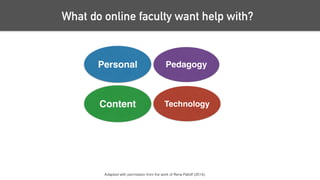
TechnologyContent
Personal Pedagogy
Adapted with permission from the work of Rena Palloff (2014).
What do online faculty want help with?
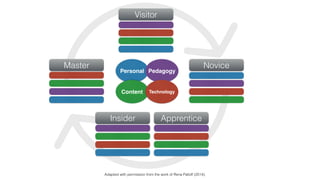
TechnologyContent
Personal Pedagogy
Visitor
Novice
ApprenticeInsider
Master
Adapted with permission from the work of Rena Palloff (2014).
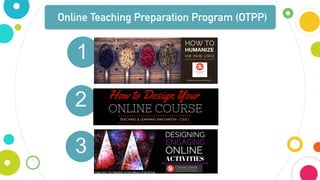
1
2
3
Online Teaching Preparation Program (OTPP)
““I am heartened by the approach of starting first
with humanizing the online experience. It helped
alleviate my major fears about teaching online …
[and] see that there are tools and strategies and
people who care about the topic. I see the
possibilities so much better now.”
- CI Faculty Member
““I have a much clearer idea of how to foster authentic
interactions in an online learning environment and why
humanizing online classes is so important. I am
enthusiastic about what can be achieved in online
teaching and also about how what I’ve learned shapes
my understanding of face-to-face teaching.”
- CI Faculty Member
““I think this is a must take course
for faculty who plan to teach online
OR who think online learning is
nothing more than a glorified
correspondence school.”
- CI Faculty Member
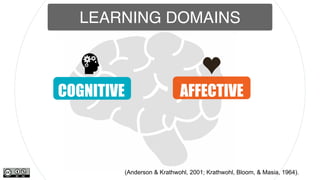
AFFECTIVECOGNITIVE
LEARNING DOMAINS
(Anderson & Krathwohl, 2001; Krathwohl, Bloom, & Masia, 1964).
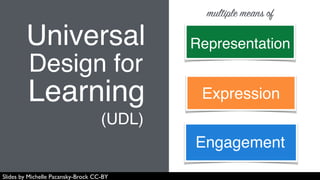
Universal
Learning
Design for
Representation
Expression
Engagement
(UDL)
multiple means of
Slides by Michelle Pacansky-Brock CC-BY
Slides by Michelle Pacansky-Brock CC-BY-NC
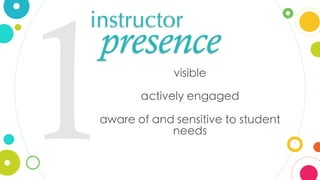
2ingredients' '
presence
instructor
1 "
Savery, (2005).
' '
#tilttip14
#tilttip14
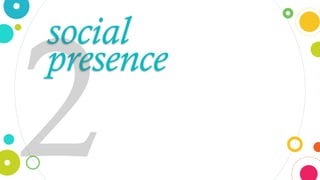
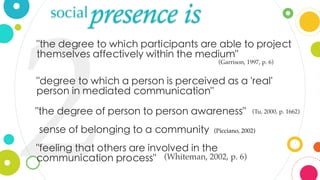
social
presence
2
2
' "
(Garrison, 1997, p. 6)
presence issocial
'
' (Tu, 2000, p. 1662)
" ' ' (Picciano, 2002)
'
(Whiteman, 2002, p. 6)
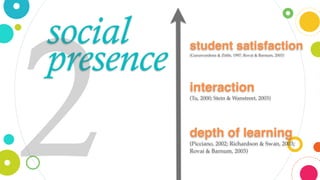
student satisfaction
(Gunawardena & Zittle, 1997; Rovai & Barnum, 2003)
interaction
(Tu, 2000; Stein & Wanstreet, 2003)
depth of learning
(Picciano, 2002; Richardson & Swan, 2003;
Rovai & Barnum, 2003)
social
presence
2
Slides by Michelle Pacansky-Brock CC-BY-NC
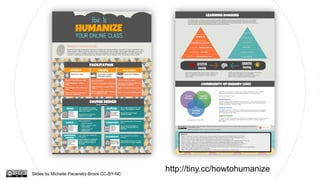
How do you humanize an
online class?
Slides by Michelle Pacansky-Brock CC-BY-NC
http://tiny.cc/howtohumanizeSlides by Michelle Pacansky-Brock CC-BY-NC
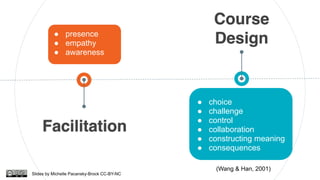
Course
Design
Facilitation
● presence
● empathy
● awareness
● choice
● challenge
● control
● collaboration
● constructing meaning
● consequences
(Wang & Han, 2001)
Slides by Michelle Pacansky-Brock CC-BY-NC
Don’t be a robot.
PRESENCE
Photo by Thomas Hawk CC-BY-NC Slides by Michelle Pacansky-Brock CC-BY-NC
Slides by Michelle Pacansky-Brock CC-BY-NC
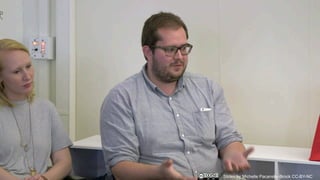
What is it that makes an online class
feel more human?
Slides by Michelle Pacansky-Brock CC-BY-NC
Take note of the themes as you listen.
Slides by Michelle Pacansky-Brock CC-BY-NC
EMPATHY
Photo by Christian Bernal CC-BY-NC-ND Slides by Michelle Pacansky-Brock CC-BY-NC
Don’t be a robot.
PRESENCE
Photo by Christian Bernal CC-BY-NC-ND Slides by Michelle Pacansky-Brock CC-BY-NC
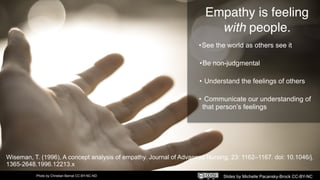
Empathy is feeling
with people.
•See the world as others see it
•Be non-judgmental
• Understand the feelings of others
• Communicate our understanding of
that person’s feelings
Wiseman, T. (1996), A concept analysis of empathy. Journal of Advanced Nursing, 23: 1162–1167. doi: 10.1046/j.
1365-2648.1996.12213.x
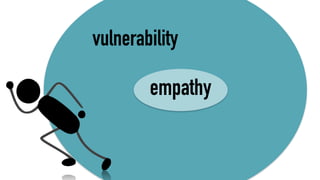
vulnerability
empathy
Photo by Sergiu Bocioiu CC-BY-NC Slides by Michelle Pacansky-Brock CC-BY-NC
When we start losing our tolerance for
vulnerability, uncertainty, for risk-taking —
we move away from the things we need
and crave the most like joy and love and
belonging, trust, empathy, creativity.”
-Brené Brown
Photo by Sergiu Bocioiu CC-BY-NC Slides by Michelle Pacansky-Brock CC-BY-NC
AWARENESS
Know your students’ needs.
Photo by Christian Bernal CC-BY-NC-ND
Photo by Sergiu Bocioiu CC-BY-NC Slides by Michelle Pacansky-Brock CC-BY-NC
Tell stories.
Photo by neliO. CC-BY-NC-ND Slides by Michelle Pacansky-Brock CC-BY-NC
Slides by Michelle Pacansky-Brock CC-BY-NC
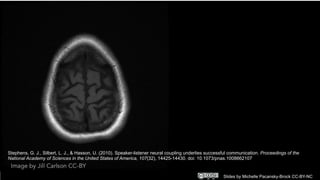
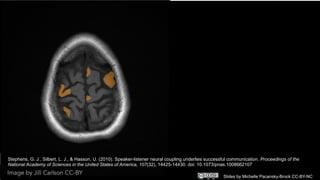
Stephens, G. J., Silbert, L. J., & Hasson, U. (2010). Speaker-listener neural coupling underlies successful communication. Proceedings of the
National Academy of Sciences in the United States of America, 107(32), 14425-14430. doi: 10.1073/pnas.1008662107
Slides by Michelle Pacansky-Brock CC-BY-NC
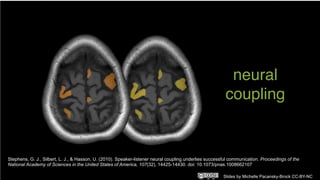
Stephens, G. J., Silbert, L. J., & Hasson, U. (2010). Speaker-listener neural coupling underlies successful communication. Proceedings of the
National Academy of Sciences in the United States of America, 107(32), 14425-14430. doi: 10.1073/pnas.1008662107
Stephens, G. J., Silbert, L. J., & Hasson, U. (2010). Speaker-listener neural coupling underlies successful communication. Proceedings of the
National Academy of Sciences in the United States of America, 107(32), 14425-14430. doi: 10.1073/pnas.1008662107
neural
coupling
Slides by Michelle Pacansky-Brock CC-BY-NC
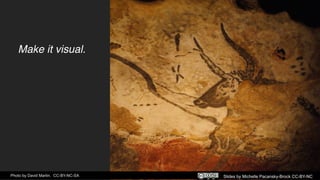
Make it visual.
Photo by David Martin. CC-BY-NC-SA Slides by Michelle Pacansky-Brock CC-BY-NC
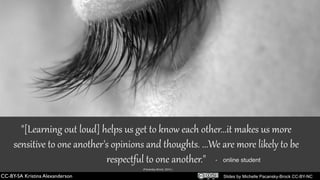
CC-BY Gustavo Devito
Embrace the
power of the
human voice.
- online student
(Pacansky-Brock, 2014.)
Slides by Michelle Pacansky-Brock CC-BY-NC
social-emotional speed bump
Based on anonymous student surveys conducted by Michelle Pacansky-Brock. All students were enrolled in a fully online History of Photography community college class.
Slides by Michelle Pacansky-Brock CC-BY
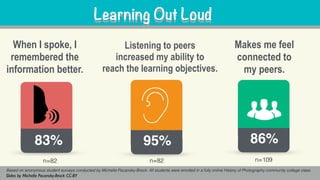
Learning Out LoudLearning Out Loud
Makes me feel
connected to
my peers.
n=109
86%
Listening to peers
increased my ability to
reach the learning objectives.
95%
n=82
When I spoke, I
remembered the
information better.
83%
n=82
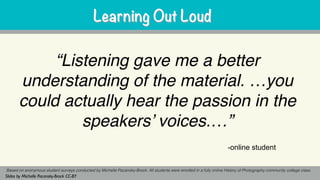
“Listening gave me a better
understanding of the material. …you
could actually hear the passion in the
speakers’ voices.…”
Based on anonymous student surveys conducted by Michelle Pacansky-Brock. All students were enrolled in a fully online History of Photography community college class.
Slides by Michelle Pacansky-Brock CC-BY
Learning Out LoudLearning Out Loud
-online student
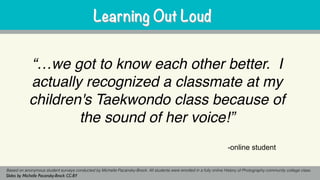
“…we got to know each other better. I
actually recognized a classmate at my
children's Taekwondo class because of
the sound of her voice!”
Based on anonymous student surveys conducted by Michelle Pacansky-Brock. All students were enrolled in a fully online History of Photography community college class.
Slides by Michelle Pacansky-Brock CC-BY
Learning Out LoudLearning Out Loud
-online student
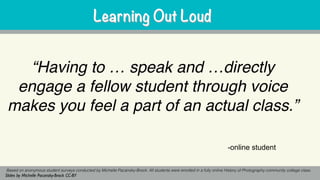
Learning Out Loud
“Having to … speak and …directly
engage a fellow student through voice
makes you feel a part of an actual class.”
Learning Out Loud
Based on anonymous student surveys conducted by Michelle Pacansky-Brock. All students were enrolled in a fully online History of Photography community college class.
Slides by Michelle Pacansky-Brock CC-BY
-online student
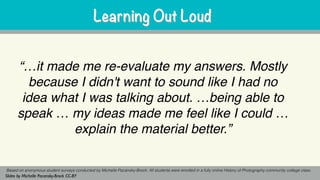
“…it made me re-evaluate my answers. Mostly
because I didn't want to sound like I had no
idea what I was talking about. …being able to
speak … my ideas made me feel like I could …
explain the material better.”
Based on anonymous student surveys conducted by Michelle Pacansky-Brock. All students were enrolled in a fully online History of Photography community college class.
Slides by Michelle Pacansky-Brock CC-BY
Learning Out LoudLearning Out Loud
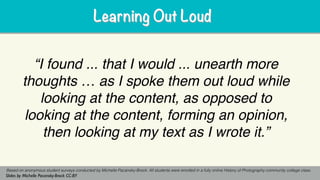
“I found ... that I would ... unearth more
thoughts … as I spoke them out loud while
looking at the content, as opposed to
looking at the content, forming an opinion,
then looking at my text as I wrote it.”
Based on anonymous student surveys conducted by Michelle Pacansky-Brock. All students were enrolled in a fully online History of Photography community college class.
Slides by Michelle Pacansky-Brock CC-BY
Learning Out LoudLearning Out Loud
Slides by Michelle Pacansky-Brock CC-BY-NC
Humanizing Practices
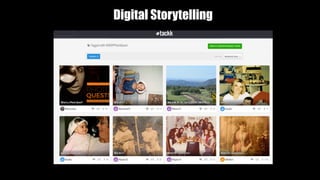
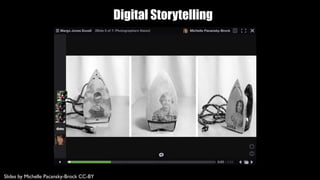
Digital Storytelling
Slides by Michelle Pacansky-Brock CC-BY
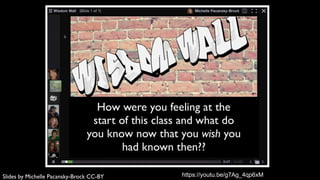
Digital Storytelling
Slides by Michelle Pacansky-Brock CC-BY https://youtu.be/g7Ag_4qp6xM
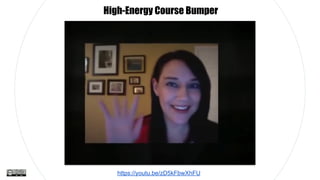
High-Energy Course Bumper
https://youtu.be/zD5kFbwXhFU
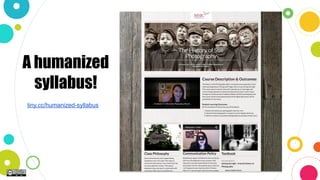
A humanized
syllabus!
tiny.cc/humanized-syllabus
Made on an iPad with Adobe Voice
https://voice.adobe.com/a/OVLp3
Photo%by%Giulio%Menna%0%Crea3ve%Commons%A8ribu3on0NonCommercial0ShareAlike%License%%h8p://www.flickr.com/photos/35694389@N02% Created%with%Haiku%Deck%
Photo%by%Design%By%Zouny%1%Crea5ve%Commons%A9ribu5on%License%%h9p://www.flickr.com/photos/47440581@N07% Created%with%Haiku%Deck%
Photo by Leo Reynolds. CC-BY-NC-SA
Credits
Special thanks to all the people who
made and released these awesome
resources for free:
Minicons by Webalys
Presentation template by
SlidesCarnival
Photographs by Unsplash
Presentation design
This presentation uses the following typographies and colors:
Titles: Nixie One
Body copy: Varela Round
You can download the fonts on this page:
http://www.google.com/fonts/#UsePlace:use/Collection:Nixie+One|Varela+Round
Click on the “arrow button” that appears on the top right
Yellow #f8bb00 Orange #ed4a00 Fucsia #e8004c
Blue #00acc3 Aqua #00d1c6 Lime #bbcd00
Green #65bb48 Gray #617a86 Light Gray #a1becc
You don’t need to keep this slide in your presentation. It’s only here to serve you as a design guide if
you need to create new slides or download the fonts to edit the presentation in PowerPoint®
Minicons Free Vector Icons Pack by Webalys is published under a Creative Commons Attribution license and Free for both personal and commercial use. You can
copy, adapt, remix, distribute or transmit it. If you use this set on your presentation remember to keep the “Credits” slide or provide a mention of this "Minicons
Free Vector Icons Pack" and a link back to this page: http://www.webalys.com/minicons

Humanizing Online Learning

  • 1.
    Except where otherwisenoted, content in this presentation is licensed by Michelle Pacansky-Brock under a Creative Commons-Attribution-Non Commercial 4.0 License. Michelle Pacansky-Brock brocansky@gmail.com @brocansky tiny.cc/human-lmu
  • 2.
    Slides by MichellePacansky-Brock CC-BY-NC
  • 3.
    TechnologyContent Personal Pedagogy Adapted withpermission from the work of Rena Palloff (2014). What do online faculty want help with?
  • 4.
  • 6.
  • 7.
    ““I am heartenedby the approach of starting first with humanizing the online experience. It helped alleviate my major fears about teaching online … [and] see that there are tools and strategies and people who care about the topic. I see the possibilities so much better now.” - CI Faculty Member
  • 8.
    ““I have amuch clearer idea of how to foster authentic interactions in an online learning environment and why humanizing online classes is so important. I am enthusiastic about what can be achieved in online teaching and also about how what I’ve learned shapes my understanding of face-to-face teaching.” - CI Faculty Member
  • 9.
    ““I think thisis a must take course for faculty who plan to teach online OR who think online learning is nothing more than a glorified correspondence school.” - CI Faculty Member
  • 10.
    AFFECTIVECOGNITIVE LEARNING DOMAINS (Anderson &Krathwohl, 2001; Krathwohl, Bloom, & Masia, 1964).
  • 11.
  • 12.
    Slides by MichellePacansky-Brock CC-BY-NC
  • 13.
    Slides by MichellePacansky-Brock CC-BY-NC
  • 14.
    Slides by MichellePacansky-Brock CC-BY-NC
  • 15.
  • 16.
  • 17.
  • 18.
    2 ' " (Garrison, 1997,p. 6) presence issocial ' ' (Tu, 2000, p. 1662) " ' ' (Picciano, 2002) ' (Whiteman, 2002, p. 6)
  • 19.
    student satisfaction (Gunawardena &Zittle, 1997; Rovai & Barnum, 2003) interaction (Tu, 2000; Stein & Wanstreet, 2003) depth of learning (Picciano, 2002; Richardson & Swan, 2003; Rovai & Barnum, 2003) social presence 2
  • 20.
    Slides by MichellePacansky-Brock CC-BY-NC
  • 21.
    How do youhumanize an online class? Slides by Michelle Pacansky-Brock CC-BY-NC
  • 22.
  • 23.
    Course Design Facilitation ● presence ● empathy ●awareness ● choice ● challenge ● control ● collaboration ● constructing meaning ● consequences (Wang & Han, 2001) Slides by Michelle Pacansky-Brock CC-BY-NC
  • 24.
    Don’t be arobot. PRESENCE Photo by Thomas Hawk CC-BY-NC Slides by Michelle Pacansky-Brock CC-BY-NC
  • 25.
    Slides by MichellePacansky-Brock CC-BY-NC
  • 26.
    What is itthat makes an online class feel more human? Slides by Michelle Pacansky-Brock CC-BY-NC Take note of the themes as you listen.
  • 27.
    Slides by MichellePacansky-Brock CC-BY-NC
  • 28.
    EMPATHY Photo by ChristianBernal CC-BY-NC-ND Slides by Michelle Pacansky-Brock CC-BY-NC
  • 29.
    Don’t be arobot. PRESENCE Photo by Christian Bernal CC-BY-NC-ND Slides by Michelle Pacansky-Brock CC-BY-NC Empathy is feeling with people. •See the world as others see it •Be non-judgmental • Understand the feelings of others • Communicate our understanding of that person’s feelings Wiseman, T. (1996), A concept analysis of empathy. Journal of Advanced Nursing, 23: 1162–1167. doi: 10.1046/j. 1365-2648.1996.12213.x
  • 30.
    vulnerability empathy Photo by SergiuBocioiu CC-BY-NC Slides by Michelle Pacansky-Brock CC-BY-NC
  • 31.
    When we startlosing our tolerance for vulnerability, uncertainty, for risk-taking — we move away from the things we need and crave the most like joy and love and belonging, trust, empathy, creativity.” -Brené Brown Photo by Sergiu Bocioiu CC-BY-NC Slides by Michelle Pacansky-Brock CC-BY-NC
  • 32.
    AWARENESS Know your students’needs. Photo by Christian Bernal CC-BY-NC-ND Photo by Sergiu Bocioiu CC-BY-NC Slides by Michelle Pacansky-Brock CC-BY-NC
  • 33.
    Tell stories. Photo byneliO. CC-BY-NC-ND Slides by Michelle Pacansky-Brock CC-BY-NC
  • 34.
    Slides by MichellePacansky-Brock CC-BY-NC Stephens, G. J., Silbert, L. J., & Hasson, U. (2010). Speaker-listener neural coupling underlies successful communication. Proceedings of the National Academy of Sciences in the United States of America, 107(32), 14425-14430. doi: 10.1073/pnas.1008662107
  • 35.
    Slides by MichellePacansky-Brock CC-BY-NC Stephens, G. J., Silbert, L. J., & Hasson, U. (2010). Speaker-listener neural coupling underlies successful communication. Proceedings of the National Academy of Sciences in the United States of America, 107(32), 14425-14430. doi: 10.1073/pnas.1008662107
  • 36.
    Stephens, G. J.,Silbert, L. J., & Hasson, U. (2010). Speaker-listener neural coupling underlies successful communication. Proceedings of the National Academy of Sciences in the United States of America, 107(32), 14425-14430. doi: 10.1073/pnas.1008662107 neural coupling Slides by Michelle Pacansky-Brock CC-BY-NC
  • 37.
    Make it visual. Photoby David Martin. CC-BY-NC-SA Slides by Michelle Pacansky-Brock CC-BY-NC
  • 38.
    CC-BY Gustavo Devito Embracethe power of the human voice.
  • 39.
    - online student (Pacansky-Brock,2014.) Slides by Michelle Pacansky-Brock CC-BY-NC
  • 44.
  • 45.
    Based on anonymousstudent surveys conducted by Michelle Pacansky-Brock. All students were enrolled in a fully online History of Photography community college class. Slides by Michelle Pacansky-Brock CC-BY Learning Out LoudLearning Out Loud Makes me feel connected to my peers. n=109 86% Listening to peers increased my ability to reach the learning objectives. 95% n=82 When I spoke, I remembered the information better. 83% n=82
  • 46.
    “Listening gave mea better understanding of the material. …you could actually hear the passion in the speakers’ voices.…” Based on anonymous student surveys conducted by Michelle Pacansky-Brock. All students were enrolled in a fully online History of Photography community college class. Slides by Michelle Pacansky-Brock CC-BY Learning Out LoudLearning Out Loud -online student
  • 47.
    “…we got toknow each other better. I actually recognized a classmate at my children's Taekwondo class because of the sound of her voice!” Based on anonymous student surveys conducted by Michelle Pacansky-Brock. All students were enrolled in a fully online History of Photography community college class. Slides by Michelle Pacansky-Brock CC-BY Learning Out LoudLearning Out Loud -online student
  • 48.
    Learning Out Loud “Havingto … speak and …directly engage a fellow student through voice makes you feel a part of an actual class.” Learning Out Loud Based on anonymous student surveys conducted by Michelle Pacansky-Brock. All students were enrolled in a fully online History of Photography community college class. Slides by Michelle Pacansky-Brock CC-BY -online student
  • 49.
    “…it made mere-evaluate my answers. Mostly because I didn't want to sound like I had no idea what I was talking about. …being able to speak … my ideas made me feel like I could … explain the material better.” Based on anonymous student surveys conducted by Michelle Pacansky-Brock. All students were enrolled in a fully online History of Photography community college class. Slides by Michelle Pacansky-Brock CC-BY Learning Out LoudLearning Out Loud
  • 50.
    “I found ...that I would ... unearth more thoughts … as I spoke them out loud while looking at the content, as opposed to looking at the content, forming an opinion, then looking at my text as I wrote it.” Based on anonymous student surveys conducted by Michelle Pacansky-Brock. All students were enrolled in a fully online History of Photography community college class. Slides by Michelle Pacansky-Brock CC-BY Learning Out LoudLearning Out Loud
  • 51.
    Slides by MichellePacansky-Brock CC-BY-NC
  • 52.
  • 54.
  • 55.
    Slides by MichellePacansky-Brock CC-BY Digital Storytelling
  • 56.
    Slides by MichellePacansky-Brock CC-BY https://youtu.be/g7Ag_4qp6xM
  • 57.
  • 58.
  • 59.
    Made on aniPad with Adobe Voice https://voice.adobe.com/a/OVLp3
  • 60.
  • 61.
  • 62.
    Photo by LeoReynolds. CC-BY-NC-SA
  • 65.
    Credits Special thanks toall the people who made and released these awesome resources for free: Minicons by Webalys Presentation template by SlidesCarnival Photographs by Unsplash
  • 66.
    Presentation design This presentationuses the following typographies and colors: Titles: Nixie One Body copy: Varela Round You can download the fonts on this page: http://www.google.com/fonts/#UsePlace:use/Collection:Nixie+One|Varela+Round Click on the “arrow button” that appears on the top right Yellow #f8bb00 Orange #ed4a00 Fucsia #e8004c Blue #00acc3 Aqua #00d1c6 Lime #bbcd00 Green #65bb48 Gray #617a86 Light Gray #a1becc You don’t need to keep this slide in your presentation. It’s only here to serve you as a design guide if you need to create new slides or download the fonts to edit the presentation in PowerPoint®
  • 67.
    Minicons Free VectorIcons Pack by Webalys is published under a Creative Commons Attribution license and Free for both personal and commercial use. You can copy, adapt, remix, distribute or transmit it. If you use this set on your presentation remember to keep the “Credits” slide or provide a mention of this "Minicons Free Vector Icons Pack" and a link back to this page: http://www.webalys.com/minicons