Developing Cognitive Strategies and Content
Knowledge to Improve Academic Achievement:

The Responsibility of Teachers and School Leaders


                   JUDITH TOURE, ED.D.
                   CARLOW UNIVERSITY
                     PITTSBURGH, PA
                     JTOURE@CARLOW.EDU


          FIRST ANNUAL HIGHER EDUCATION COMPACT
                 BEST PRACTICES SYMPOSIUM

                      CLEVELAND, OH
                       JUNE 11, 2012
Overview


Demographic imperative


Themes from the literature:
   Racialized ideologies in PK-12 contexts


     Culturally relevant leadership in PK-12

     Culturally relevant pedagogy in undergraduate education


Implications
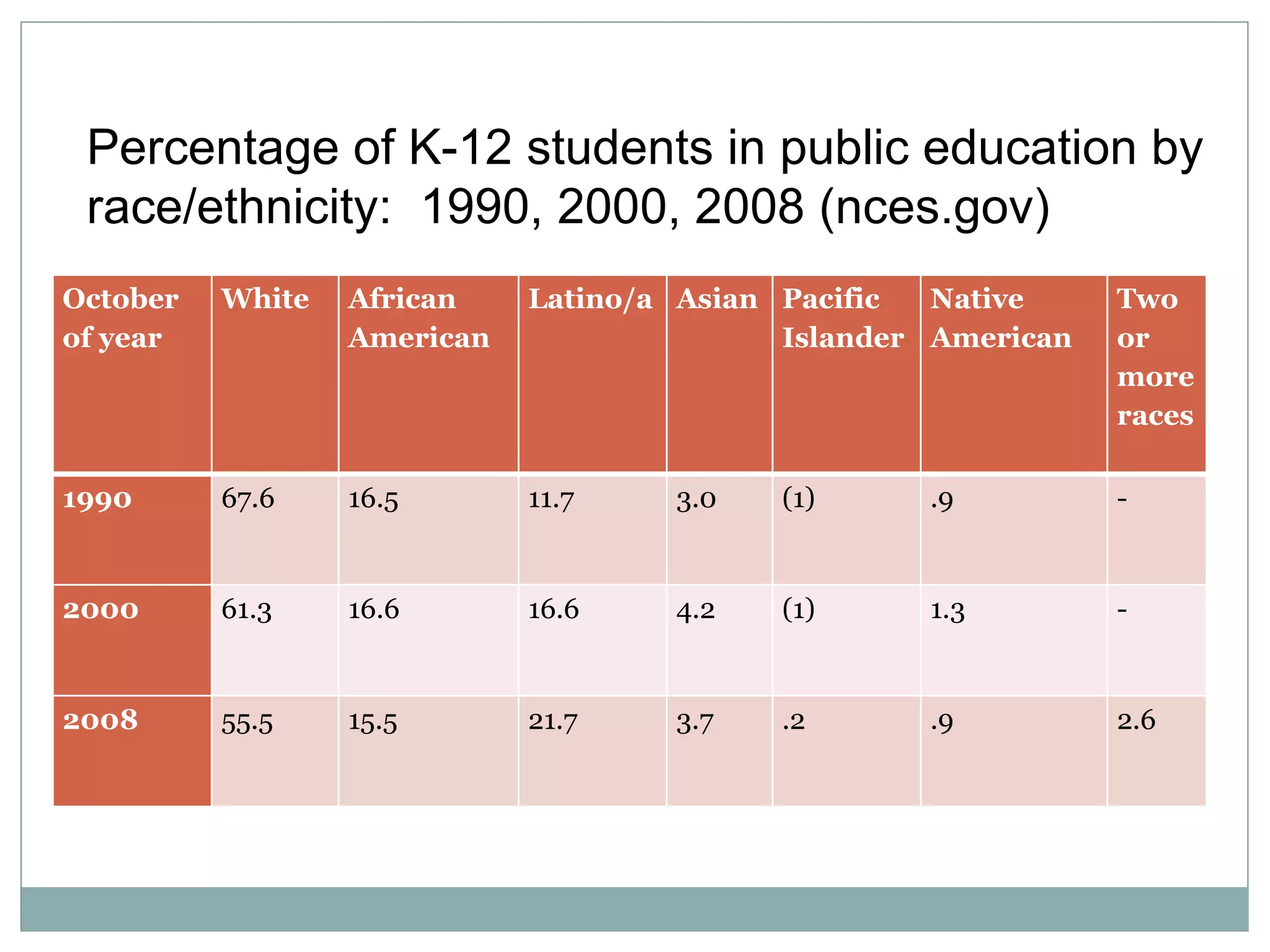
Percentage of K-12 students in public education by
 race/ethnicity: 1990, 2000, 2008 (nces.gov)
October   White            African                      Latino/a Asian Pacific  Native                                                 Two
of year                    American                                    Islander American                                               or
                                                                                                                                       more
                                                                                                                                       races

1990      67.6        16.5                11.7
            Racial/Ethnic Enrollment in Public Schools                         3.0              (1)                    .9              -

            Table A-4-1. Number and percentage distribution of the race/ethnicity of public school students enrolled in kindergarten
            through 12th grade:

2000      61.3             16.6                         16.6                   4.2              (1)                    1.3             -


2008      55.5             15.5                         21.7                   3.7              .2                     .9              2.6
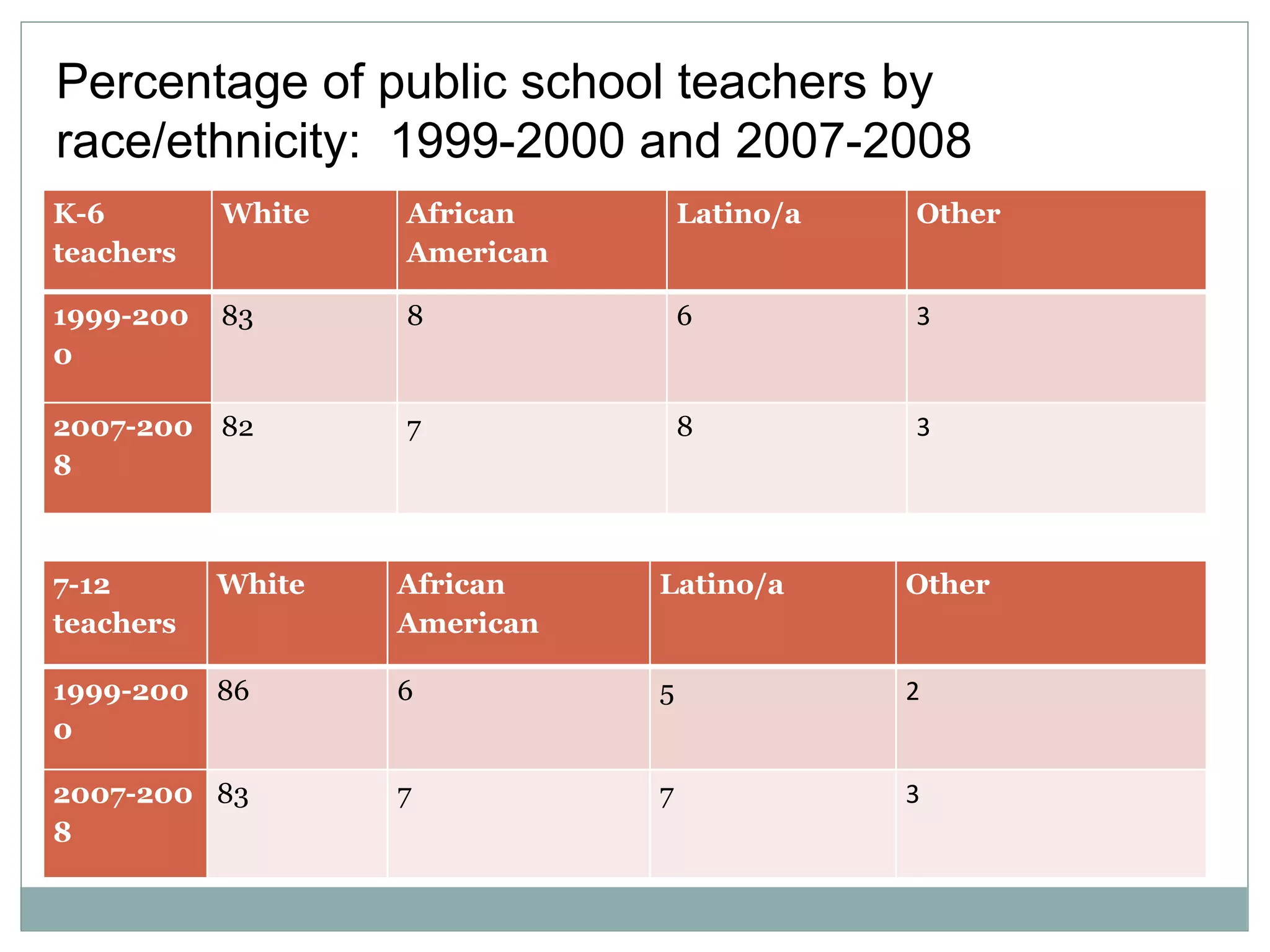
Percentage of public school teachers by
race/ethnicity: 1999-2000 and 2007-2008
K-6        White   African        Latino/a   Other
teachers           American

1999-200   83      8              6          3
0

2007-200 82        7              8          3
8


7-12       White   African    Latino/a       Other
teachers           American

1999-200 86        6          5              2
0

2007-200 83        7          7              3
8
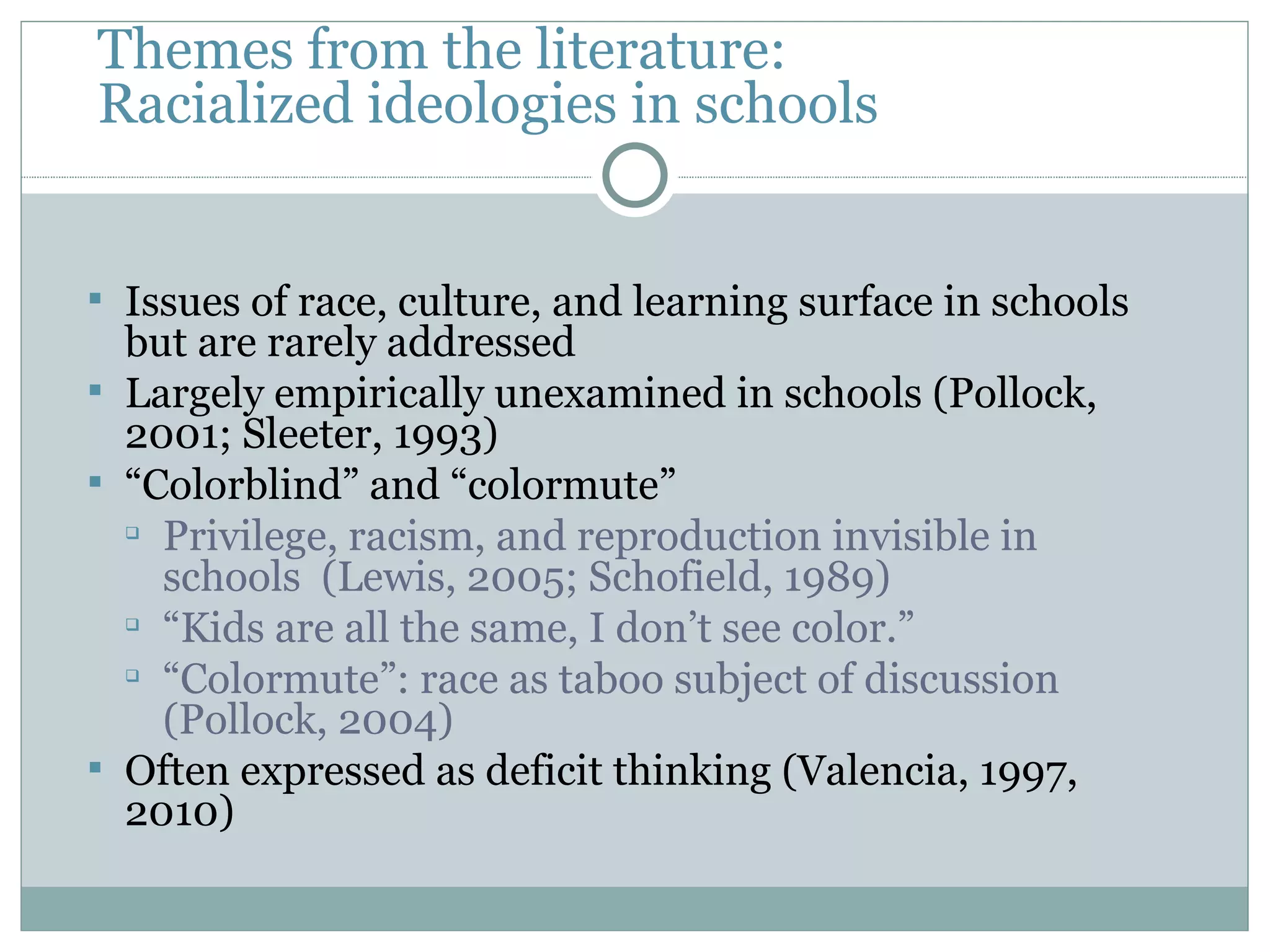
Themes from the literature:
Racialized ideologies in schools


 Issues of race, culture, and learning surface in schools
  but are rarely addressed
 Largely empirically unexamined in schools (Pollock,
  2001; Sleeter, 1993)
 “Colorblind” and “colormute”
  
    Privilege, racism, and reproduction invisible in
    schools (Lewis, 2005; Schofield, 1989)
  
    “Kids are all the same, I don’t see color.”
  
    “Colormute”: race as taboo subject of discussion
    (Pollock, 2004)
 Often expressed as deficit thinking (Valencia, 1997,
  2010)
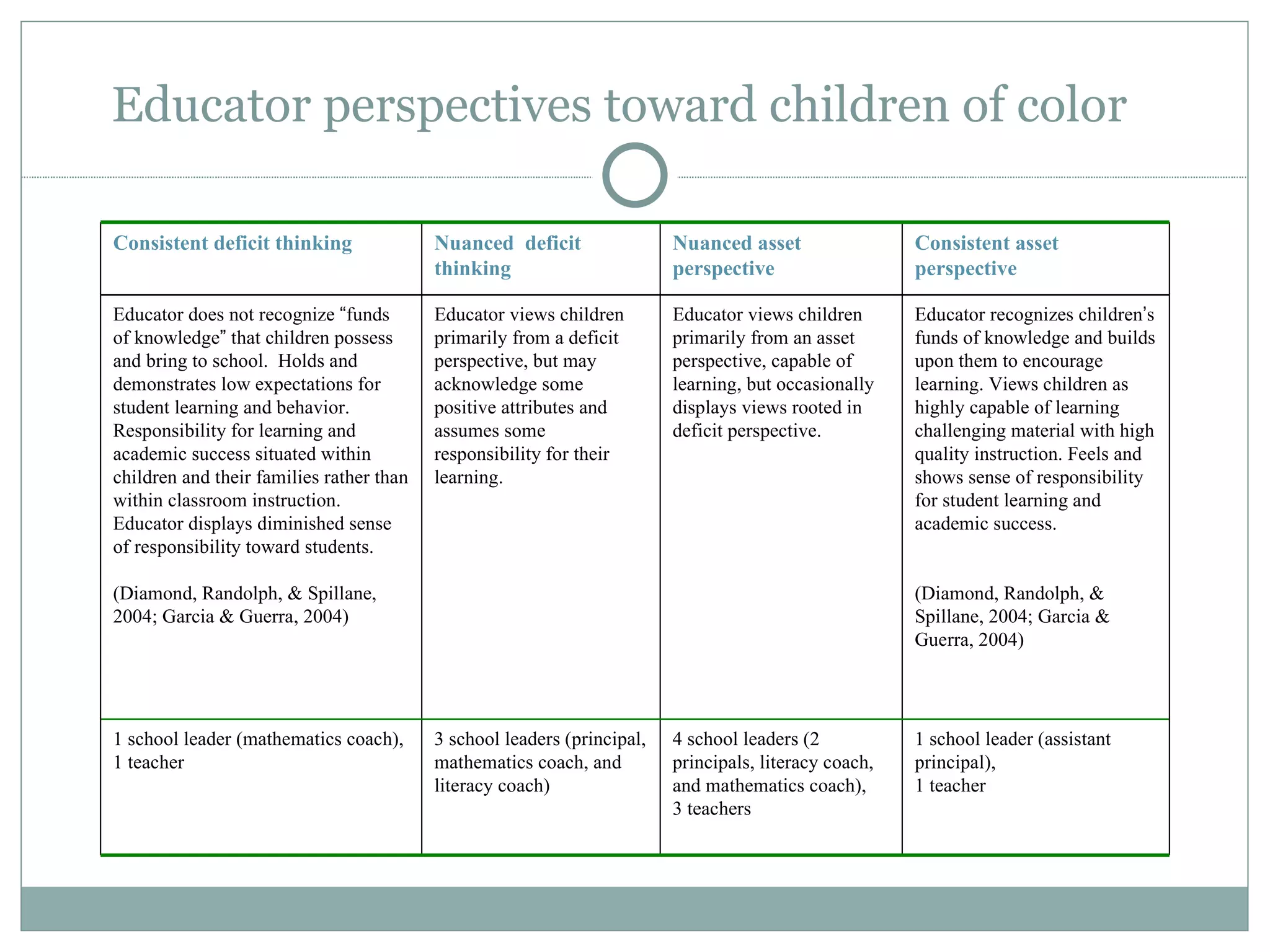
Educator perspectives toward children of color

Consistent deficit thinking               Nuanced deficit                Nuanced asset                 Consistent asset
                                          thinking                       perspective                   perspective

Educator does not recognize “funds        Educator views children        Educator views children       Educator recognizes children’s
of knowledge” that children possess       primarily from a deficit       primarily from an asset       funds of knowledge and builds
and bring to school. Holds and            perspective, but may           perspective, capable of       upon them to encourage
demonstrates low expectations for         acknowledge some               learning, but occasionally    learning. Views children as
student learning and behavior.            positive attributes and        displays views rooted in      highly capable of learning
Responsibility for learning and           assumes some                   deficit perspective.          challenging material with high
academic success situated within          responsibility for their                                     quality instruction. Feels and
children and their families rather than   learning.                                                    shows sense of responsibility
within classroom instruction.                                                                          for student learning and
Educator displays diminished sense                                                                     academic success.
of responsibility toward students.

(Diamond, Randolph, & Spillane,                                                                        (Diamond, Randolph, &
2004; Garcia & Guerra, 2004)                                                                           Spillane, 2004; Garcia &
                                                                                                       Guerra, 2004)


1 school leader (mathematics coach),      3 school leaders (principal,   4 school leaders (2           1 school leader (assistant
1 teacher                                 mathematics coach, and         principals, literacy coach,   principal),
                                          literacy coach)                and mathematics coach),       1 teacher
                                                                         3 teachers
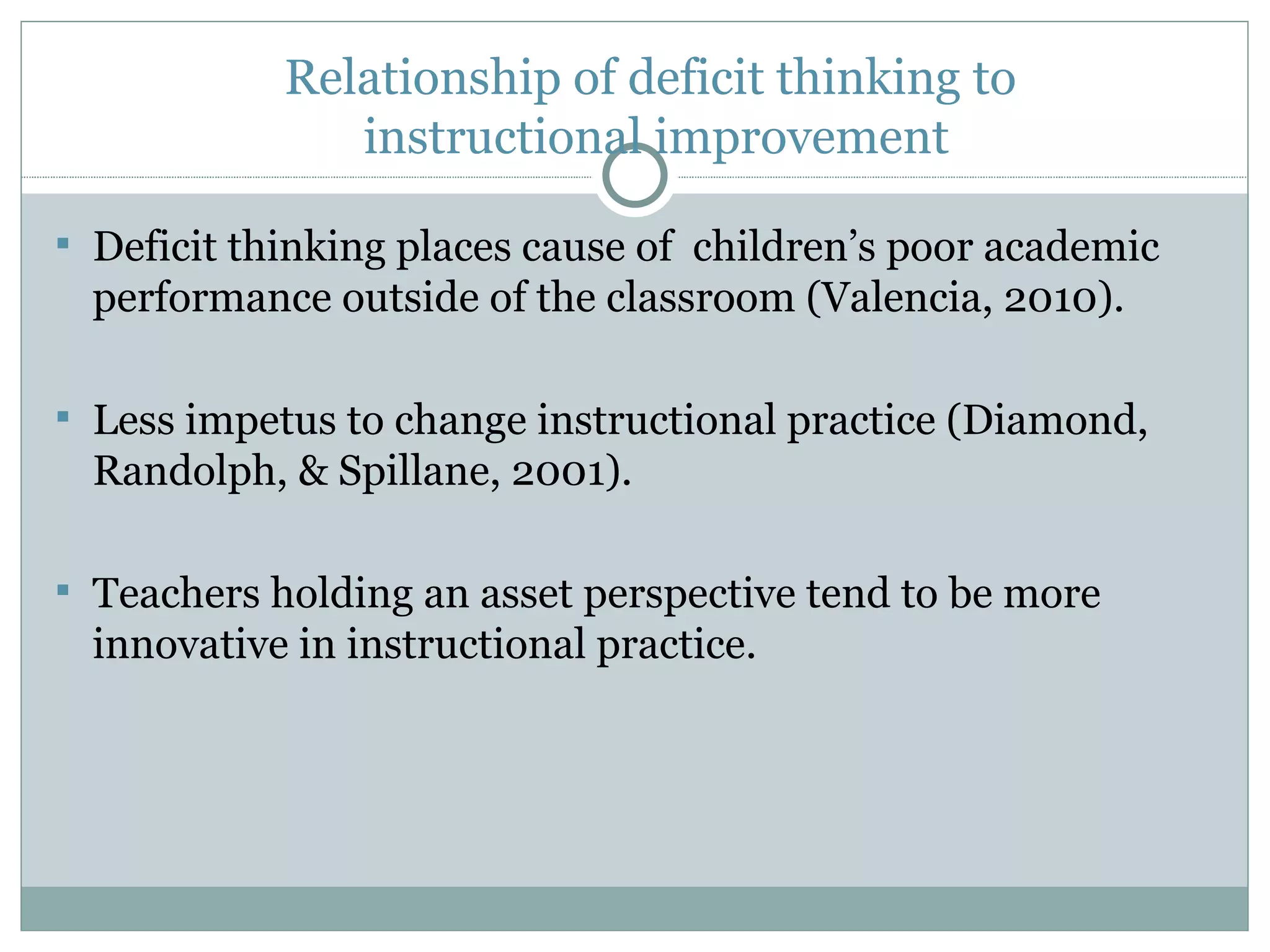
Relationship of deficit thinking to
               instructional improvement

 Deficit thinking places cause of children’s poor academic
  performance outside of the classroom (Valencia, 2010).

 Less impetus to change instructional practice (Diamond,
  Randolph, & Spillane, 2001).

 Teachers holding an asset perspective tend to be more
  innovative in instructional practice.
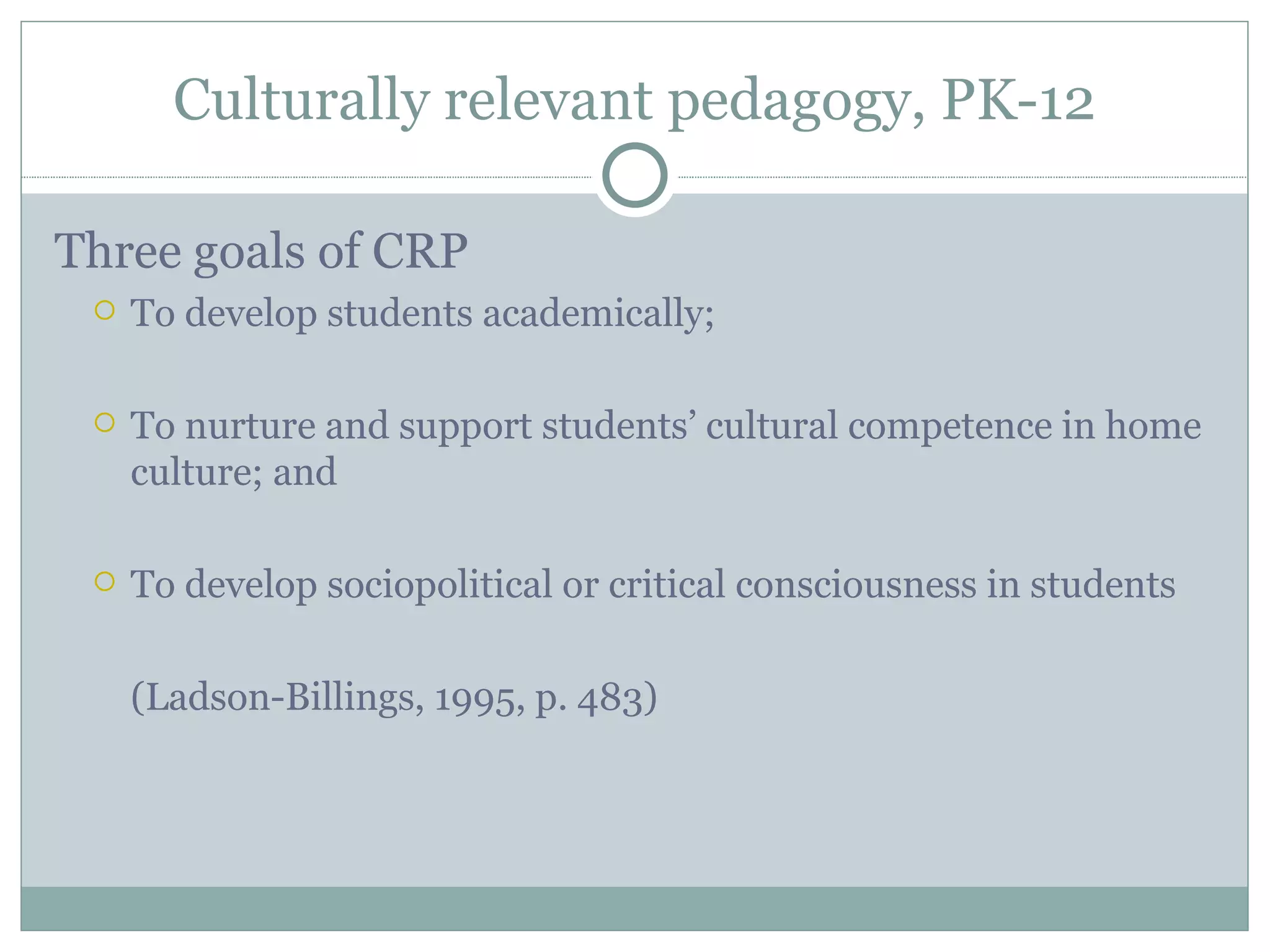
Culturally relevant pedagogy, PK-12

Three goals of CRP
    To develop students academically;

    To nurture and support students’ cultural competence in home
     culture; and

    To develop sociopolitical or critical consciousness in students

     (Ladson-Billings, 1995, p. 483)
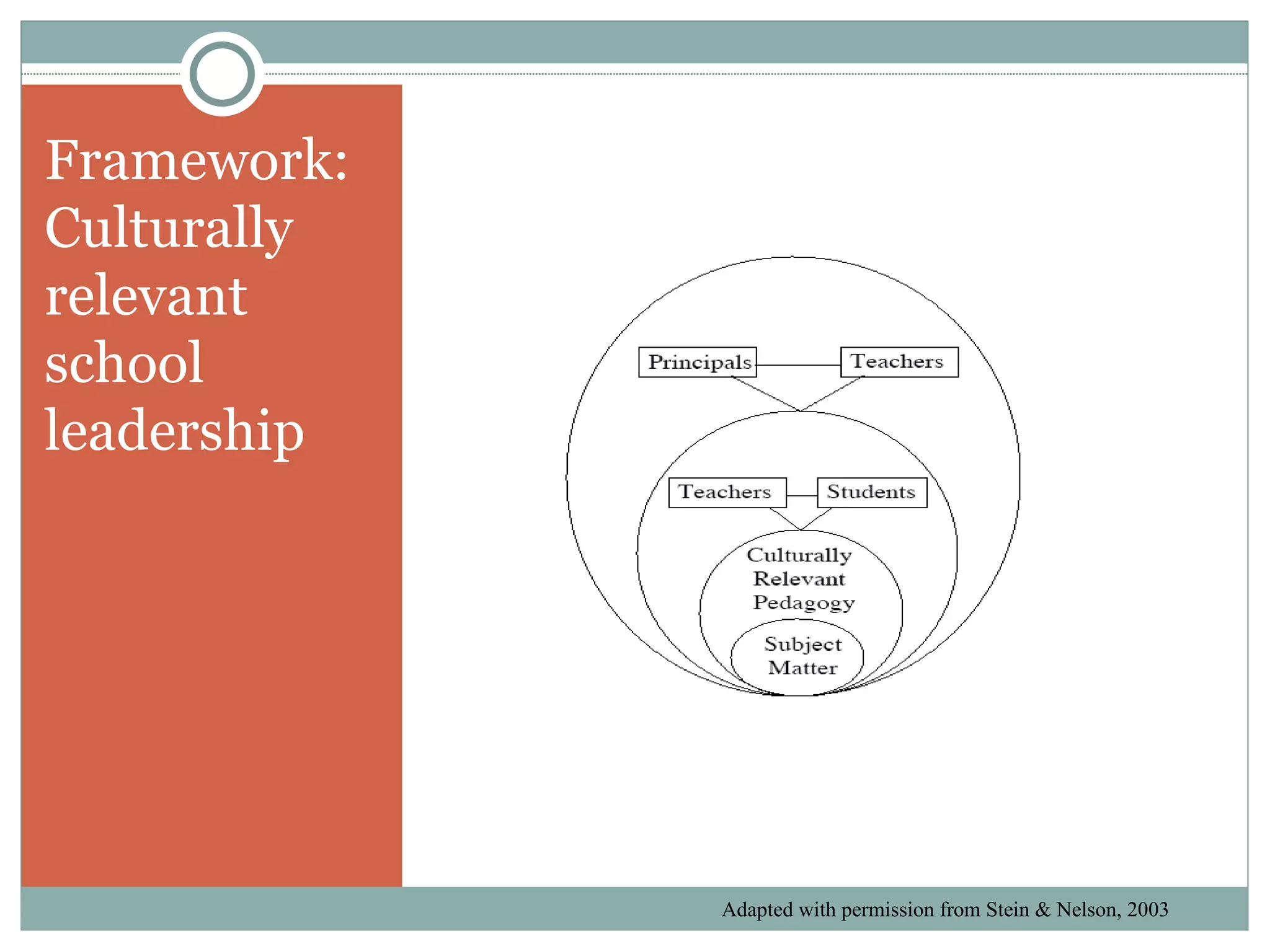
Framework:
Culturally
relevant
school
leadership


             Adapted with permission from Stein & Nelson, 2003
What about demographics and
culturally relevant pedagogy in the
     post-secondary context?
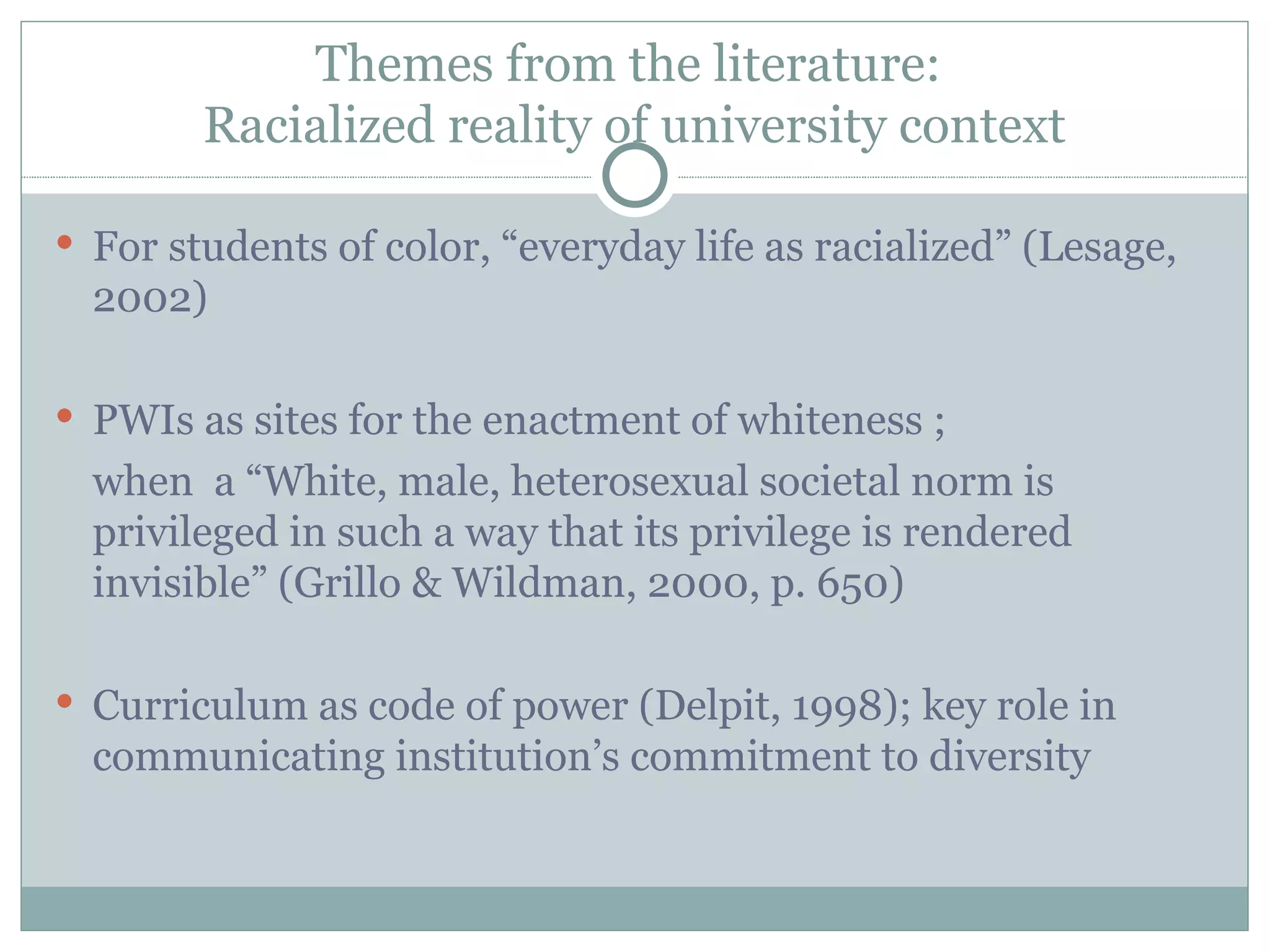
Who are our students?
Total % of undergraduate enrollment in degree-granting institutions
                         by race/ethnicity


     Percentage distribution
     (nces.gov)                  1980      1990      2000     2008


     White                         81      77.5      68.3      63.2

     African American             9.7       9.6       11.8     13.9

     Latina/o                     4.1       6.1       10.3     12.9

     Asian/Pacific Islander       2.4       4.2        6.4      6.8

     American Indian/ Alaska
     Native                       0.7       0.8        1.1      1.1
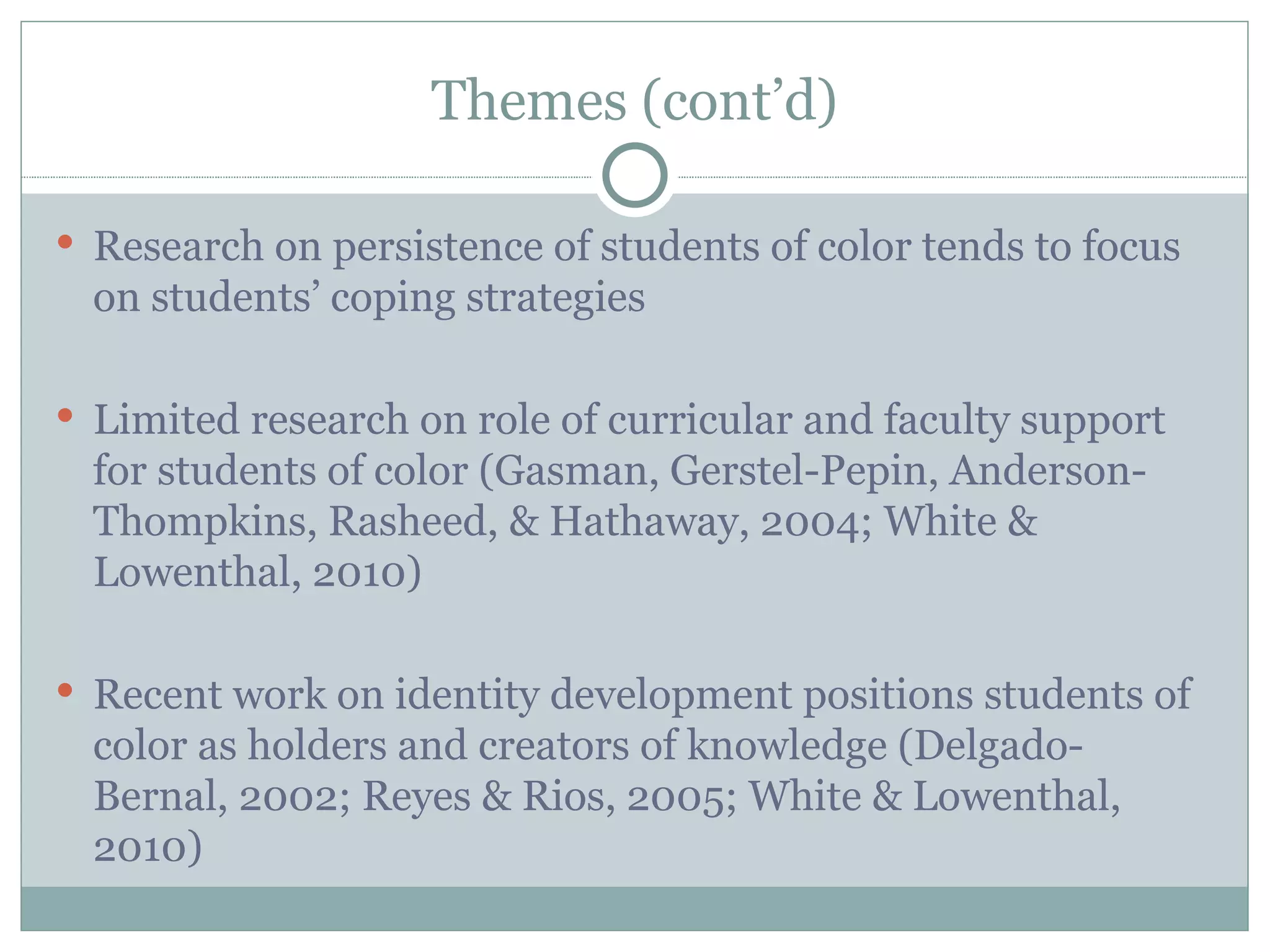
Themes from the literature:
        Racialized reality of university context

 For students of color, “everyday life as racialized” (Lesage,
  2002)

 PWIs as sites for the enactment of whiteness ;
  when a “White, male, heterosexual societal norm is
  privileged in such a way that its privilege is rendered
  invisible” (Grillo & Wildman, 2000, p. 650)

 Curriculum as code of power (Delpit, 1998); key role in
  communicating institution’s commitment to diversity
Themes (cont’d)

 Research on persistence of students of color tends to focus
  on students’ coping strategies

 Limited research on role of curricular and faculty support
  for students of color (Gasman, Gerstel-Pepin, Anderson-
  Thompkins, Rasheed, & Hathaway, 2004; White &
  Lowenthal, 2010)

 Recent work on identity development positions students of
  color as holders and creators of knowledge (Delgado-
  Bernal, 2002; Reyes & Rios, 2005; White & Lowenthal,
  2010)
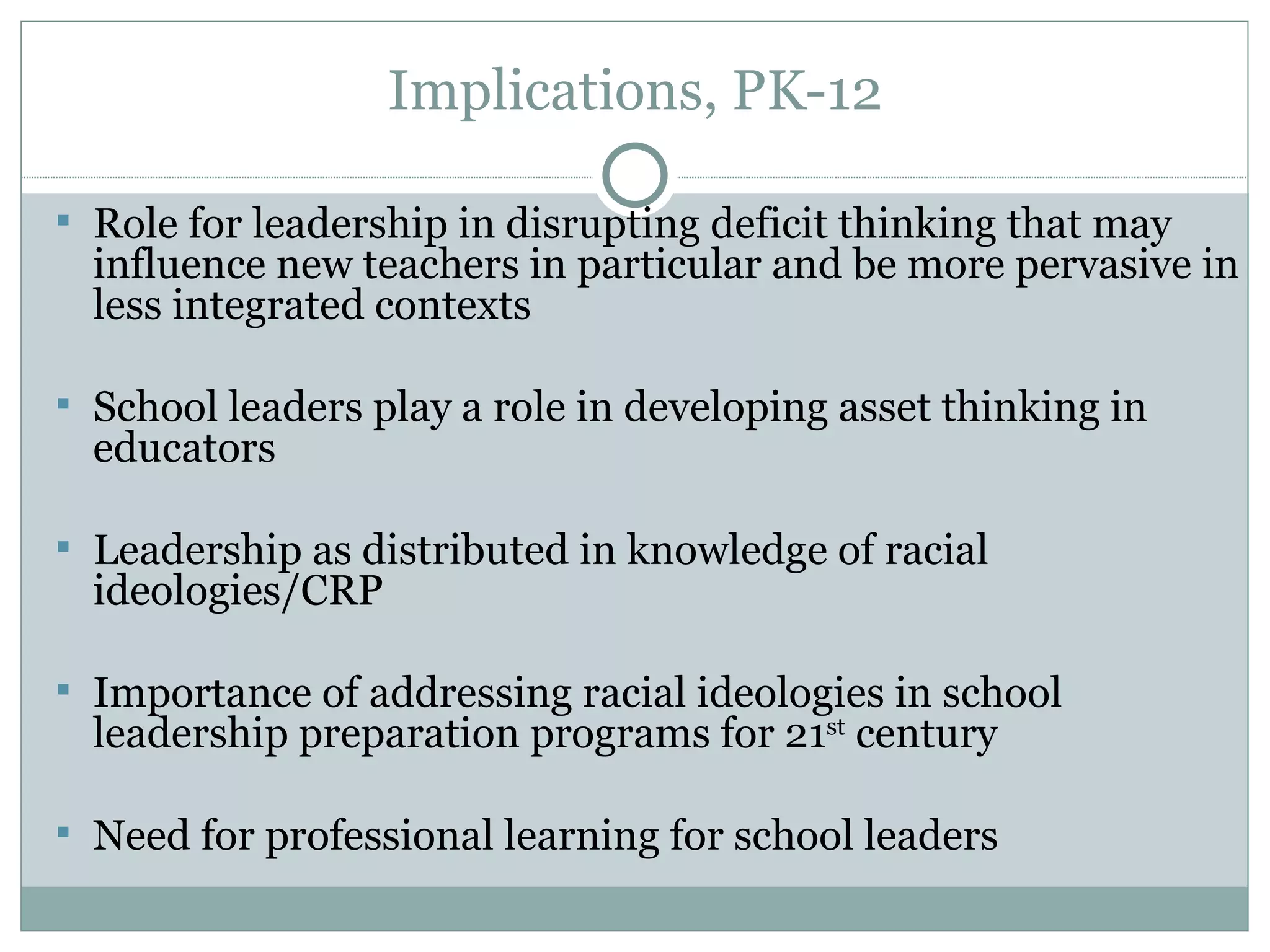
Implications, PK-12

 Role for leadership in disrupting deficit thinking that may
  influence new teachers in particular and be more pervasive in
  less integrated contexts

 School leaders play a role in developing asset thinking in
  educators

 Leadership as distributed in knowledge of racial
  ideologies/CRP

 Importance of addressing racial ideologies in school
  leadership preparation programs for 21st century

 Need for professional learning for school leaders
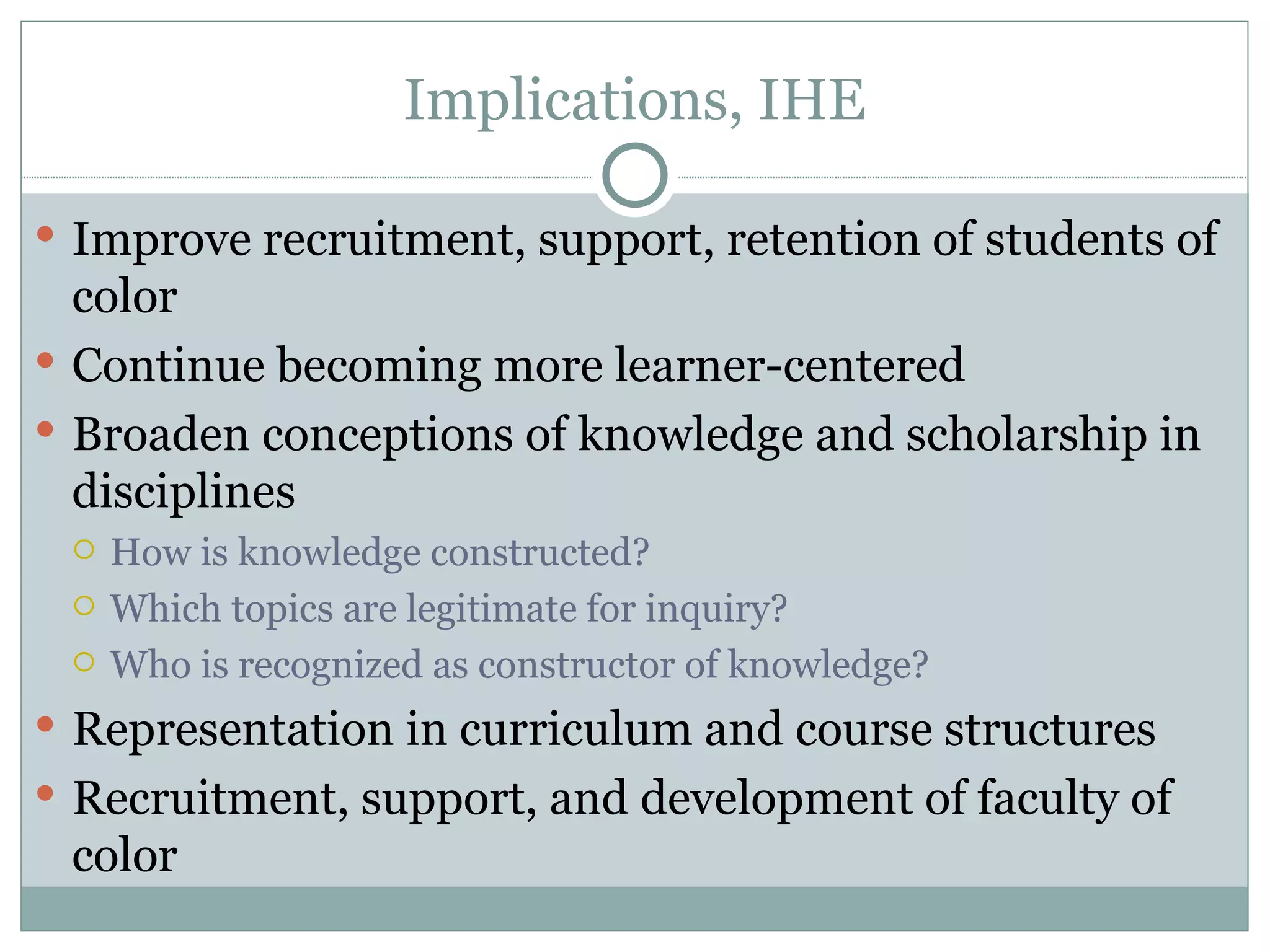
Implications, IHE

 Improve recruitment, support, retention of students of
  color
 Continue becoming more learner-centered
 Broaden conceptions of knowledge and scholarship in
  disciplines
    How is knowledge constructed?
    Which topics are legitimate for inquiry?
    Who is recognized as constructor of knowledge?
 Representation in curriculum and course structures
 Recruitment, support, and development of faculty of
 color

Toure degrees by design 6.11.12

  • 1.
    Developing Cognitive Strategiesand Content Knowledge to Improve Academic Achievement: The Responsibility of Teachers and School Leaders JUDITH TOURE, ED.D. CARLOW UNIVERSITY PITTSBURGH, PA JTOURE@CARLOW.EDU FIRST ANNUAL HIGHER EDUCATION COMPACT BEST PRACTICES SYMPOSIUM CLEVELAND, OH JUNE 11, 2012
  • 2.
    Overview Demographic imperative Themes fromthe literature:  Racialized ideologies in PK-12 contexts  Culturally relevant leadership in PK-12  Culturally relevant pedagogy in undergraduate education Implications
  • 3.
    Percentage of K-12students in public education by race/ethnicity: 1990, 2000, 2008 (nces.gov) October White African Latino/a Asian Pacific Native Two of year American Islander American or more races 1990 67.6 16.5 11.7 Racial/Ethnic Enrollment in Public Schools 3.0 (1) .9 - Table A-4-1. Number and percentage distribution of the race/ethnicity of public school students enrolled in kindergarten through 12th grade: 2000 61.3 16.6 16.6 4.2 (1) 1.3 - 2008 55.5 15.5 21.7 3.7 .2 .9 2.6
  • 4.
    Percentage of publicschool teachers by race/ethnicity: 1999-2000 and 2007-2008 K-6 White African Latino/a Other teachers American 1999-200 83 8 6 3 0 2007-200 82 7 8 3 8 7-12 White African Latino/a Other teachers American 1999-200 86 6 5 2 0 2007-200 83 7 7 3 8
  • 5.
    Themes from theliterature: Racialized ideologies in schools  Issues of race, culture, and learning surface in schools but are rarely addressed  Largely empirically unexamined in schools (Pollock, 2001; Sleeter, 1993)  “Colorblind” and “colormute”  Privilege, racism, and reproduction invisible in schools (Lewis, 2005; Schofield, 1989)  “Kids are all the same, I don’t see color.”  “Colormute”: race as taboo subject of discussion (Pollock, 2004)  Often expressed as deficit thinking (Valencia, 1997, 2010)
  • 6.
    Educator perspectives towardchildren of color Consistent deficit thinking Nuanced deficit Nuanced asset Consistent asset thinking perspective perspective Educator does not recognize “funds Educator views children Educator views children Educator recognizes children’s of knowledge” that children possess primarily from a deficit primarily from an asset funds of knowledge and builds and bring to school. Holds and perspective, but may perspective, capable of upon them to encourage demonstrates low expectations for acknowledge some learning, but occasionally learning. Views children as student learning and behavior. positive attributes and displays views rooted in highly capable of learning Responsibility for learning and assumes some deficit perspective. challenging material with high academic success situated within responsibility for their quality instruction. Feels and children and their families rather than learning. shows sense of responsibility within classroom instruction. for student learning and Educator displays diminished sense academic success. of responsibility toward students. (Diamond, Randolph, & Spillane, (Diamond, Randolph, & 2004; Garcia & Guerra, 2004) Spillane, 2004; Garcia & Guerra, 2004) 1 school leader (mathematics coach), 3 school leaders (principal, 4 school leaders (2 1 school leader (assistant 1 teacher mathematics coach, and principals, literacy coach, principal), literacy coach) and mathematics coach), 1 teacher 3 teachers
  • 7.
    Relationship of deficitthinking to instructional improvement  Deficit thinking places cause of children’s poor academic performance outside of the classroom (Valencia, 2010).  Less impetus to change instructional practice (Diamond, Randolph, & Spillane, 2001).  Teachers holding an asset perspective tend to be more innovative in instructional practice.
  • 8.
    Culturally relevant pedagogy,PK-12 Three goals of CRP  To develop students academically;  To nurture and support students’ cultural competence in home culture; and  To develop sociopolitical or critical consciousness in students (Ladson-Billings, 1995, p. 483)
  • 9.
    Framework: Culturally relevant school leadership Adapted with permission from Stein & Nelson, 2003
  • 10.
    What about demographicsand culturally relevant pedagogy in the post-secondary context?
  • 11.
    Who are ourstudents? Total % of undergraduate enrollment in degree-granting institutions by race/ethnicity Percentage distribution (nces.gov) 1980 1990 2000 2008 White 81 77.5 68.3 63.2 African American 9.7 9.6 11.8 13.9 Latina/o 4.1 6.1 10.3 12.9 Asian/Pacific Islander 2.4 4.2 6.4 6.8 American Indian/ Alaska Native 0.7 0.8 1.1 1.1
  • 12.
    Themes from theliterature: Racialized reality of university context  For students of color, “everyday life as racialized” (Lesage, 2002)  PWIs as sites for the enactment of whiteness ; when a “White, male, heterosexual societal norm is privileged in such a way that its privilege is rendered invisible” (Grillo & Wildman, 2000, p. 650)  Curriculum as code of power (Delpit, 1998); key role in communicating institution’s commitment to diversity
  • 13.
    Themes (cont’d)  Researchon persistence of students of color tends to focus on students’ coping strategies  Limited research on role of curricular and faculty support for students of color (Gasman, Gerstel-Pepin, Anderson- Thompkins, Rasheed, & Hathaway, 2004; White & Lowenthal, 2010)  Recent work on identity development positions students of color as holders and creators of knowledge (Delgado- Bernal, 2002; Reyes & Rios, 2005; White & Lowenthal, 2010)
  • 14.
    Implications, PK-12  Rolefor leadership in disrupting deficit thinking that may influence new teachers in particular and be more pervasive in less integrated contexts  School leaders play a role in developing asset thinking in educators  Leadership as distributed in knowledge of racial ideologies/CRP  Importance of addressing racial ideologies in school leadership preparation programs for 21st century  Need for professional learning for school leaders
  • 15.
    Implications, IHE  Improverecruitment, support, retention of students of color  Continue becoming more learner-centered  Broaden conceptions of knowledge and scholarship in disciplines  How is knowledge constructed?  Which topics are legitimate for inquiry?  Who is recognized as constructor of knowledge?  Representation in curriculum and course structures  Recruitment, support, and development of faculty of color

Editor's Notes

  • #6 Many White educators do not interrogate their own privilege, and lack an understanding of racism and its reproduction in schools (Pollock, 2001; Sleeter, 1993). Issues of race, culture, and learning are invisible to many educators. They refrain from public discussion of race although it is discussed in private, resulting in Pollock’s term: colormute. These ideologies are often expressed through a deficit perspective. When teachers and school leaders believe that students come to them with deficits rather than assets or “funds of knowledge” from their homes, there are implications for teaching and learning. A deficit perspective places the cause of children’s poor academic performance outside of the classroom. Teachers and school leaders who hold this perspective hold low expectations for children.
  • #7 Although one of the school leaders and one of the focal teachers in this study held “consistent” deficit perspectives toward children of color, and one of the school leaders and one of the focal teachers held “consistent” asset perspectives, most of the participants fell between these opposing perspectives. Five participants (a principal, two mathematics coaches, a literacy coach, and a 1st grade teacher) in the study showed evidence of a deficit perspective when discussing children of color, with three of them (the principal, one of the mathematics coaches, and the literacy coach) occasionally showing a perspective that fit more with an asset perspective. Accordingly, they were considered to hold an “inconsistent” deficit perspective. In contrast, there were nine participants who held an asset perspective toward children. Yet seven of them occasionally voiced deficit beliefs and are therefore described as “inconsistent” in terms of an asset perspective.
  • #8 Diamond, Randolph & Spillane found that in integrated contexts, teachers addressed perceived deficits directly, but in schools that were largely African American, with high rates of free and reduced lunch eligibility, teachers appeared to resist instructional innovations, articulating a belief that perceived student deficits served as a barrier to learning. Eurocentric cultural assumptions about teaching and learning continue to be dominant and most valued by majority white educators in urban schools (McDermott, 1997). In schools that serve African American children, teachers who hold a deficit perspective toward students have been found to resist efforts to improve instruction, whereas those who held an asset perspective were more innovative in both literacy and math instruction (p. 24-Diamond, Randolph, & Spillane, 2001; Gutstein). The connection between the deficit perspective among teachers and motivation to change one’s teaching practice is an important one to recognize for instructional leaders whose goal is school reform.
  • #10 This framework embeds the inner core of subject matter within a pedagogy that is culturally relevant. It emphasizes teaching children with an understanding of their assets or funds of knowledge. Within this framework, teachers and school leaders learn to draw from culturally relevant pedagogy in order to incorporate and scaffold from students’ funds of knowledge to teach subject matter and improve instruction. This framework represents culturally relevant leadership content knowledge, and is drawn from leadership content knowledge, expanding it to include knowledge of culturally relevant pedagogy. Within this framework, accomplished teachers know subject matter and how to assist student learning of subject matter concurrently with knowing how children of diverse racial and cultural backgrounds learn subject matter; i.e., culturally relevant pedagogy. School leaders share this knowledge and assists teachers in developing it. They assess what teachers know, and they know how teachers learn culturally relevant pedagogy, and how to assist teachers in learning culturally relevant ways of teaching subject matter. Centrality of subject matter knowledge to teaching, learning, and leadership Relationship of culture to teaching, learning, and leadership as integral to leadership content knowledge Impact of “colorblind” ideologies in schools
  • #14 Focus on Development of coping strategies that contribute to persistence Few studies examine persistence at the doctoral level. In 2000-01, 4.9% of doctorates were awarded to African American students, and 3.4% to Latino/a students. (NCES, 2002)
  • #15 1) There is a role for school leadership in disrupting racialized ideologies, including deficit perspectives held by many educators. 2) L-ship as distributed not only in terms of subject matter knowledge but it may be beneficial to start thinking of distributed leadership in terms of knowledge of CRP, including critical consciousness reexamination of requirements for leadership preparation which currently lack an emphasis on culturally relevant leadership content knowledge or issues of social justice (Dantley, 2002; Pena, 1997; Rusch, 2004; Theoharis, 2007). White principals who will lead in diverse settings within a context of increasing attention to teacher development would benefit from preparation that provides in depth knowledge of culturally relevant pedagogy. This knowledge would include a broader, more critical understanding of the history of race and racism in American education and how it intersects with education. Cross-cultural field experiences with opportunities to make sense of cultures other than one’s home culture would enrich leadership preparation. It would require knowledgeable principal educators with deep understanding of cross-cultural leadership. Future leaders who engage in sustained examination of their own racial and cultural heritage would better understand those of their students and teachers, and be better situated to develop teacher capacity (Pena, 1997). For White prospective principals, developing a critical understanding of whiteness and privilege could pave the way toward greater understanding of the legacy of race and racism in our educational system. These understandings could strengthen leaders’ critical consciousness which would allow them to facilitate teacher learning in this area as well.