Question Answer Relationship
Enhancing Comprehension
Module 5
Team A
ROSIE AMSTUTZ
JASON PRICE
MEG TROHA
GARY HANSEN
EMILY CAVENDISH
SALLY PATTON
JEN DODGE
ANDREW KRICKENBARGER
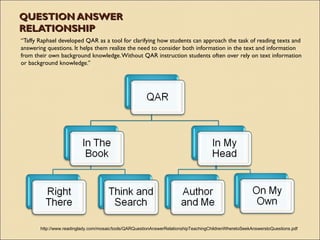
QUESTION ANSWER
RELATIONSHIP
“Taffy Raphael developed QAR as a tool for clarifying how students can approach the task of reading texts and
answering questions. It helps them realize the need to consider both information in the text and information
from their own background knowledge. Without QAR instruction students often over rely on text information
or background knowledge.”


       http://www.readinglady.com/mosaic/tools/QARQuestionAnswerRelationshipTeachingChildrenWheretoSeekAnswerstoQuestions.pdf
Why Use It?
                                  o      QAR

                                         EXPLICITLY SHOWS THE RELATIONSHIP BETWEEN
                                         QUESTION AND ANSWERS

                                         CATEGORIZES DIFFERENT TYPES AND LEVELS OF
                                         QUESTIONS

                                         HELPS STUDENT TO ANALYZE, COMPREHEND,
                                         AND RESPOND TO TEXT CONCEPTS

                                         HELPS REFUTE THE COMMON MISCONCEPTION
                                         HELD BY STUDENTS THAT THE TEXT HAS ALL THE
                                         ANSWERS


http://www.readinglady.com/mosaic/tools/QARQuestionAnswerRelationshipTeachingChildrenWheretoSeekAnswerstoQuestions.pdf
White Socks Only
by Evelyn Coleman
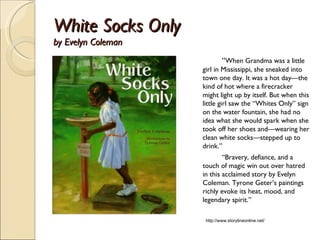
                             “When Grandma was a little
                    girl in Mississippi, she sneaked into
                    town one day. It was a hot day—the
                    kind of hot where a firecracker
                    might light up by itself. But when this
                    little girl saw the “Whites Only” sign
                    on the water fountain, she had no
                    idea what she would spark when she
                    took off her shoes and—wearing her
                    clean white socks—stepped up to
                    drink.”
                            “Bravery, defiance, and a
                    touch of magic win out over hatred
                    in this acclaimed story by Evelyn
                    Coleman. Tyrone Geter’s paintings
                    richly evoke its heat, mood, and
                    legendary spirit.”

                     http://www.storylineonline.net/
WHY THIS BOOK WAS
SELECTED


   This book was selected because it was readily available to all teammates via the world wide
    web. (Rosie)

   It has "big issues" that allow for questions that go beyond what's in the book. (Gary)


   It is a picture book suitable for middle school students and this affords us an opportunity to
    demonstrate how effectively picture books can be used in those grade levels. (Rosie)

   For me, as a middle/high school teacher, it's closer to my experience. (Gary)

   It is a picture book that can be used to develop the questions needed to fit all the
    categories needed. (Rosie)
QAR: White Socks Only

IN THE BOOK
QUESTIONS
RIGHT THERE QUESTIONS:  The answer is in one place in the text. 
Words from the question and words that answer the question are
often "right there" in the same sentence.
                                       What were three things the Chicken
                                        Man was known for in town?


                                       Why did the girl (grandmother) hold
                                        her arms out to her sides when she
                                        was walking in to town?

                                       Why did the girl (grandmother) walk
                                        faster when she passed the Chicken
                                        Man sitting on his front porch?

                                       What simile does the girl
                                        (grandmother) use to compare the
                                        egg cooking on the side walk?
RIGHT THERE
Continued…


   What did the Chicken Man give to the little girl?

   What does the girl (grandmother) think the sign “Whites Only” means?

   When the black people continued to drink from the fountain, what did the angry white man
    do?


   Why didn’t the Chicken Man have to bend over very far to drink from the fountain?

   What did the girl’s (grandmother) mom say when the black people told her what happened
    in town?
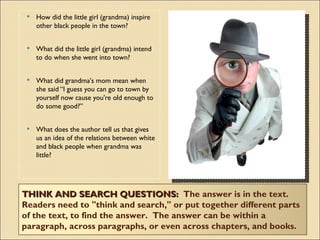
   How did the little girl (grandma) inspire
     other black people in the town?


    What did the little girl (grandma) intend
     to do when she went into town?


    What did grandma's mom mean when
     she said “I guess you can go to town by
     yourself now cause you're old enough to
     do some good?”


    What does the author tell us that gives
     us an idea of the relations between white
     and black people when grandma was
     little?


THINK AND SEARCH QUESTIONS:  The answer is in the text. 
Readers need to "think and search," or put together different parts
of the text, to find the answer.  The answer can be within a
paragraph, across paragraphs, or even across chapters, and books.
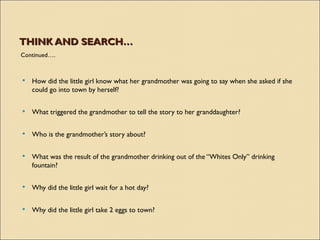
THINK AND SEARCH…
Continued….


   How did the little girl know what her grandmother was going to say when she asked if she
    could go into town by herself?

   What triggered the grandmother to tell the story to her granddaughter?


   Who is the grandmother’s story about?


   What was the result of the grandmother drinking out of the “Whites Only” drinking
    fountain?

   Why did the little girl wait for a hot day?

   Why did the little girl take 2 eggs to town?
QAR: White Socks Only

ON MY OWN
QUESTIONS
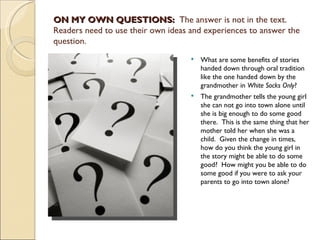
ON MY OWN QUESTIONS:  The answer is not in the text. 
Readers need to use their own ideas and experiences to answer the
question.
                                       What are some benefits of stories
                                        handed down through oral tradition
                                        like the one handed down by the
                                        grandmother in White Socks Only?
                                       The grandmother tells the young girl
                                        she can not go into town alone until
                                        she is big enough to do some good
                                        there.  This is the same thing that her
                                        mother told her when she was a
                                        child.  Given the change in times,
                                        how do you think the young girl in
                                        the story might be able to do some
                                        good?  How might you be able to do
                                        some good if you were to ask your
                                        parents to go into town alone?
ON MY OWN….
Continued


   In real life, do you really think it is possible for children to inspire change?  If so, what kinds
    of things have you seen children inspire adults to do?  Why do you think adults are not
    moved to make change themselves?  More specifically, why do you think the adults in the
    book, never went to take a drink from the drinking fountain?

   In what circumstances have you had to stand up for someone or something?  Did other
    people come to your support as happened in the book?  If not, how would that have
    changed your conviction in what you were standing up for?

   In the story, the girl does not understand what she did wrong to elicit the negative reaction
    from the angry white man; therefore, the realization that she is not welcome by him and the
    group of white people is even more hurtful and confusing. In our classroom, how can we
    promote an environment where all classmates are valued and included and avoid having any
    one of us feeling hurt and confused as the girl in the story did when she felt unwelcome and
    unwanted by the group?
   Looking at the picture on the cover, and
    reading the title, what do you think this
    book is about?


   What was the “Whites Only” sign all
    about?  Did these signs really exist? 
    When?  Why?


   How do you think it felt when the egg
    was slinking down [her] dress and
    legs?  (This could help put your students
    into the scene, and feel some of what the
    little girl is feeling.)


AUTHOR AND ME:  The answer is not in the text.  To answer the
question, readers need to think about how the text and what they
already know fit together.
AUTHOR AND ME
Continued…


   Why was the white man going to whip the little girl? (Depending upon the age of the kids
    and how you are using the book, the man can represent the whole segregationist white
    south while the girl can represent the whole black race being oppressed at the time, or the
    discussion can be more narrowly about this specific incident.)

   Why do you think the author wrote a book about this topic?
References
   http://www.readinglady.com/mosaic/tools/QARQuestionAnswerRelationshipTeachingChildrenWheretoSeekAnswerst


   http://www.storylineonline.net/


   Forum discussions

The Question Answer Relationship: How to Enhance Comprehension

  • 1.
  • 2.
    Team A ROSIE AMSTUTZ JASONPRICE MEG TROHA GARY HANSEN EMILY CAVENDISH SALLY PATTON JEN DODGE ANDREW KRICKENBARGER
  • 3.
    QUESTION ANSWER RELATIONSHIP “Taffy Raphaeldeveloped QAR as a tool for clarifying how students can approach the task of reading texts and answering questions. It helps them realize the need to consider both information in the text and information from their own background knowledge. Without QAR instruction students often over rely on text information or background knowledge.” http://www.readinglady.com/mosaic/tools/QARQuestionAnswerRelationshipTeachingChildrenWheretoSeekAnswerstoQuestions.pdf
  • 4.
    Why Use It? o QAR EXPLICITLY SHOWS THE RELATIONSHIP BETWEEN QUESTION AND ANSWERS CATEGORIZES DIFFERENT TYPES AND LEVELS OF QUESTIONS HELPS STUDENT TO ANALYZE, COMPREHEND, AND RESPOND TO TEXT CONCEPTS HELPS REFUTE THE COMMON MISCONCEPTION HELD BY STUDENTS THAT THE TEXT HAS ALL THE ANSWERS http://www.readinglady.com/mosaic/tools/QARQuestionAnswerRelationshipTeachingChildrenWheretoSeekAnswerstoQuestions.pdf
  • 5.
    White Socks Only byEvelyn Coleman “When Grandma was a little girl in Mississippi, she sneaked into town one day. It was a hot day—the kind of hot where a firecracker might light up by itself. But when this little girl saw the “Whites Only” sign on the water fountain, she had no idea what she would spark when she took off her shoes and—wearing her clean white socks—stepped up to drink.” “Bravery, defiance, and a touch of magic win out over hatred in this acclaimed story by Evelyn Coleman. Tyrone Geter’s paintings richly evoke its heat, mood, and legendary spirit.” http://www.storylineonline.net/
  • 6.
    WHY THIS BOOKWAS SELECTED  This book was selected because it was readily available to all teammates via the world wide web. (Rosie)  It has "big issues" that allow for questions that go beyond what's in the book. (Gary)  It is a picture book suitable for middle school students and this affords us an opportunity to demonstrate how effectively picture books can be used in those grade levels. (Rosie)  For me, as a middle/high school teacher, it's closer to my experience. (Gary)  It is a picture book that can be used to develop the questions needed to fit all the categories needed. (Rosie)
  • 7.
    QAR: White SocksOnly IN THE BOOK QUESTIONS
  • 8.
    RIGHT THERE QUESTIONS: The answer is in one place in the text.  Words from the question and words that answer the question are often "right there" in the same sentence.  What were three things the Chicken Man was known for in town?  Why did the girl (grandmother) hold her arms out to her sides when she was walking in to town?  Why did the girl (grandmother) walk faster when she passed the Chicken Man sitting on his front porch?  What simile does the girl (grandmother) use to compare the egg cooking on the side walk?
  • 9.
    RIGHT THERE Continued…  What did the Chicken Man give to the little girl?  What does the girl (grandmother) think the sign “Whites Only” means?  When the black people continued to drink from the fountain, what did the angry white man do?  Why didn’t the Chicken Man have to bend over very far to drink from the fountain?  What did the girl’s (grandmother) mom say when the black people told her what happened in town?
  • 10.
    How did the little girl (grandma) inspire other black people in the town?  What did the little girl (grandma) intend to do when she went into town?  What did grandma's mom mean when she said “I guess you can go to town by yourself now cause you're old enough to do some good?”  What does the author tell us that gives us an idea of the relations between white and black people when grandma was little? THINK AND SEARCH QUESTIONS:  The answer is in the text.  Readers need to "think and search," or put together different parts of the text, to find the answer.  The answer can be within a paragraph, across paragraphs, or even across chapters, and books.
  • 11.
    THINK AND SEARCH… Continued….  How did the little girl know what her grandmother was going to say when she asked if she could go into town by herself?  What triggered the grandmother to tell the story to her granddaughter?  Who is the grandmother’s story about?  What was the result of the grandmother drinking out of the “Whites Only” drinking fountain?  Why did the little girl wait for a hot day?  Why did the little girl take 2 eggs to town?
  • 12.
    QAR: White SocksOnly ON MY OWN QUESTIONS
  • 13.
    ON MY OWNQUESTIONS:  The answer is not in the text.  Readers need to use their own ideas and experiences to answer the question.  What are some benefits of stories handed down through oral tradition like the one handed down by the grandmother in White Socks Only?  The grandmother tells the young girl she can not go into town alone until she is big enough to do some good there.  This is the same thing that her mother told her when she was a child.  Given the change in times, how do you think the young girl in the story might be able to do some good?  How might you be able to do some good if you were to ask your parents to go into town alone?
  • 14.
    ON MY OWN…. Continued  In real life, do you really think it is possible for children to inspire change?  If so, what kinds of things have you seen children inspire adults to do?  Why do you think adults are not moved to make change themselves?  More specifically, why do you think the adults in the book, never went to take a drink from the drinking fountain?  In what circumstances have you had to stand up for someone or something?  Did other people come to your support as happened in the book?  If not, how would that have changed your conviction in what you were standing up for?  In the story, the girl does not understand what she did wrong to elicit the negative reaction from the angry white man; therefore, the realization that she is not welcome by him and the group of white people is even more hurtful and confusing. In our classroom, how can we promote an environment where all classmates are valued and included and avoid having any one of us feeling hurt and confused as the girl in the story did when she felt unwelcome and unwanted by the group?
  • 15.
    Looking at the picture on the cover, and reading the title, what do you think this book is about?  What was the “Whites Only” sign all about?  Did these signs really exist?  When?  Why?  How do you think it felt when the egg was slinking down [her] dress and legs?  (This could help put your students into the scene, and feel some of what the little girl is feeling.) AUTHOR AND ME:  The answer is not in the text.  To answer the question, readers need to think about how the text and what they already know fit together.
  • 16.
    AUTHOR AND ME Continued…  Why was the white man going to whip the little girl? (Depending upon the age of the kids and how you are using the book, the man can represent the whole segregationist white south while the girl can represent the whole black race being oppressed at the time, or the discussion can be more narrowly about this specific incident.)  Why do you think the author wrote a book about this topic?
  • 17.
    References  http://www.readinglady.com/mosaic/tools/QARQuestionAnswerRelationshipTeachingChildrenWheretoSeekAnswerst  http://www.storylineonline.net/  Forum discussions