By—
Er Rajinder Kumar
Govt polytechnic college
Amritsar
1
Hello viewers ,in this lecture we shall
learn about the distribution system. So
that dc as well as ac distribution system
also we shall discuss about The
components of a pole mounted
substation and components fitted on
lattice steel tower for transmission of a
HT line. some insulators will also be
discussed…..
2
The Transmission system can be
divided into two parts:----
Primary Transmission
Secondary Transmission
The Distribution system can be
divided into two parts:----
Primary Distribution
Secondary Distribution
3
A distributor is set to the legal
requirement that power must be
supplied at a voltage within ± 6% of the
declared voltage., whereas a
transmission system is not subject to any
such restriction . Its voltage can vary as
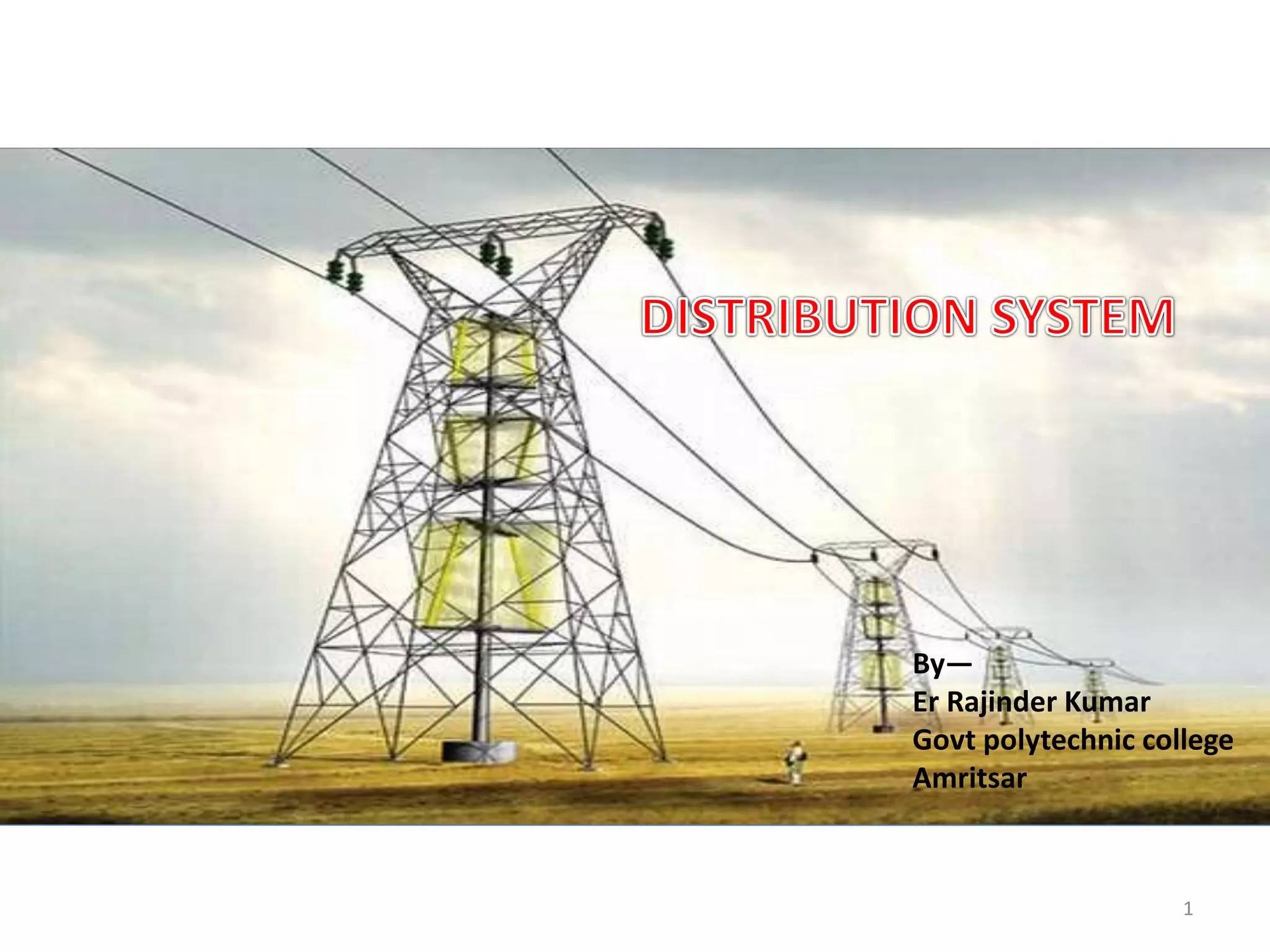
much as 10% to 15% due to variation in
loads. any restriction in transmission
system is technical and not legal. The
transmission system of an area is called
GRID.
4
The different grids are inter connected
through the lines to form a regional grid
and the different regional grids are further
interconnected to form a national grid.
Each grid operates independently.
However power can be transmitted from
one grid to another. The maximum
generation voltage in advanced countries is
33 kV while that in India is 11 kV. The
amount of power that has to be
transmitted through transmission lines is
5
The amount of power that has to be
transmitted through transmission lines is
very large and if this power is transmitted
at 11kV the line current and power loss
will be large. There fore the voltage is
stepped to a higher level by using step-up
transformers located in sub-stations.
Also volume of conductor
used in transmission lines depends upon
the voltage and current.
6
The three phase transmission and
distribution system may consist of
Overhead lines
Underground cables
The main advantage of
underground system are that it is less
prone to electric hazards like rain , wind
& lightning. and that it does not interfere
with other amenities.
7
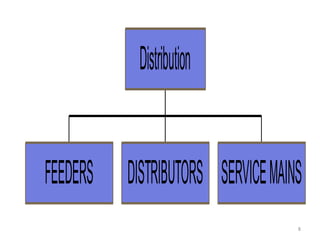
FEEDERS DISTRIBUTORS SERVICEMAINS
Distribution
8
FEEDERS
• These are the cables supplying power
in bulk to a selected number of points
called feeding points The feeders run
along streets overhead (or
underground, in some cases) and
power the distribution transformers
at or near the customer premises.
9
DISTRIBUTORS
• Distributors are used for
current Tapping for the various
consumers these cables are
generally having the main
street for there route .
10
SERVICE MAIN
• Service mains are the small
cables teed of off from the
distributors and taken into the
premises of the various
consumers these are low
tension cables.
11
EFFECT OF SUPPLY VOLTAGE ON THE SIZE OF
DISTRIBUTOR
The allowable current density for given
type of cable laid is not constant but
decreases somewhat as the cable size
increases. If voltage of the system is
increased N folds then for a given power
delivered The current is reduced to
1/Nth.
Size of cable is reduced to 1/Nth.
12
BALANCERS
The generators supplying a three-
wire feeder are all connected in
parallel across the outers, and it is
therefore necessary to fix the
potential of the middle wire midway
between that of the outers,
otherwise voltages will not be equal,
unless the currents taken from the
outers are equal.
13
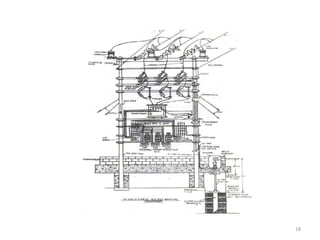
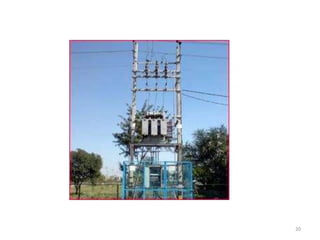
POLE-MOUNTED
SUBSTATION
The substation consisting of a transformer
and other apparatus installed on the pole
structure is known as
pole mounted substation
As the name implies such substation are
installed on H-pole structure many times
14
COMPONENTS OF
11kV/ 400V POLE MOUNTED SUB-
STATION
It is an out-door type substation
and is erected on a pole structure. this
erected pole is also called H-pole
structure
The various components of such
a sub-station numbered as under:-
15
1)---R.C.C. Pole Structure
2)--Platform for transformer
3)--Transformer
4)--Pin-Type insulator
5)-Jumpers
6)--Strain insulator
7)--Fuses
8)--Gang Operating switch
9)--P.G. Clamps
16
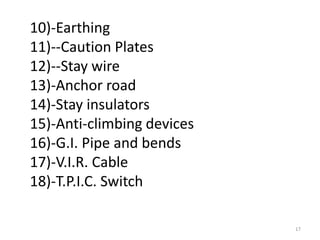
10)-Earthing
11)--Caution Plates
12)--Stay wire
13)-Anchor road
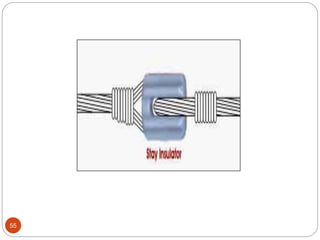
14)-Stay insulators
15)-Anti-climbing devices
16)-G.I. Pipe and bends
17)-V.I.R. Cable
18)-T.P.I.C. Switch
17
18
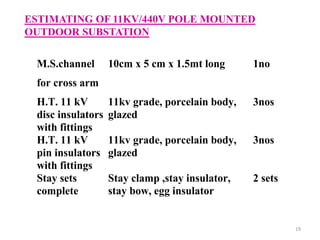
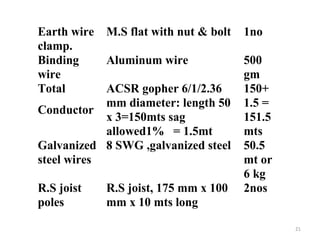
ESTIMATING OF 11KV/440V POLE MOUNTED
OUTDOOR SUBSTATION
M.S.channel
for cross arm
10cm x 5 cm x 1.5mt long 1no
H.T. 11 kV
disc insulators
with fittings
11kv grade, porcelain body,
glazed
3nos
H.T. 11 kV
pin insulators
with fittings
11kv grade, porcelain body,
glazed
3nos
Stay sets
complete
Stay clamp ,stay insulator,
stay bow, egg insulator
2 sets
19
20
Earth wire
clamp.
M.S flat with nut & bolt 1no
Binding
wire
Aluminum wire 500
gm
Total
Conductor
ACSR gopher 6/1/2.36
mm diameter: length 50
x 3=150mts sag
allowed1% = 1.5mt
150+
1.5 =
151.5
mts
Galvanized
steel wires
8 SWG ,galvanized steel 50.5
mt or
6 kg
R.S joist
poles
R.S joist, 175 mm x 100
mm x 10 mts long
2nos
21
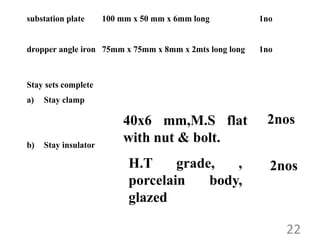
substation plate 100 mm x 50 mm x 6mm long 1no
dropper angle iron 75mm x 75mm x 8mm x 2mts long long 1no
Stay sets complete
a) Stay clamp
b) Stay insulator
40x6 mm,M.S flat
with nut & bolt.
2nos
2nosH.T grade, ,
porcelain body,
glazed
22
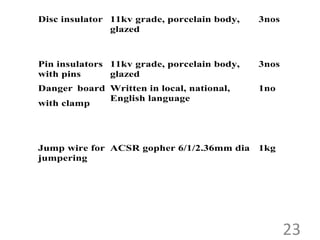
Disc insulator 11kv grade, porcelain body,
glazed
3nos
Pin insulators
with pins
11kv grade, porcelain body,
glazed
3nos
Danger board
with clamp
Written in local, national,
English language
1no
Jump wire for
jumpering
ACSR gopher 6/1/2.36mm dia 1kg
23
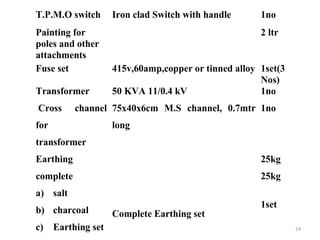
T.P.M.O switch Iron clad Switch with handle 1no
Painting for
poles and other
attachments
2 ltr
Fuse set 415v,60amp,copper or tinned alloy 1set(3
Nos)
Transformer
Cross channel
for
transformer
50 KVA 11/0.4 kV
75x40x6cm M.S channel, 0.7mtr
long
1no
1no
Earthing
complete
a) salt
b) charcoal
c) Earthing set
Complete Earthing set
25kg
25kg
1set
24
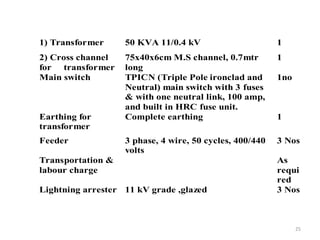
1) Transformer
2) Cross channel
for transformer
50 KVA 11/0.4 kV
75x40x6cm M.S channel, 0.7mtr
long
1
1
Main switch TPICN (Triple Pole ironclad and
Neutral) main switch with 3 fuses
& with one neutral link, 100 amp,
and built in HRC fuse unit.
1no
Earthing for
transformer
Complete earthing 1
Feeder 3 phase, 4 wire, 50 cycles, 400/440
volts
3 Nos
Transportation &
labour charge
As
requi
red
Lightning arrester 11 kV grade ,glazed 3 Nos
25
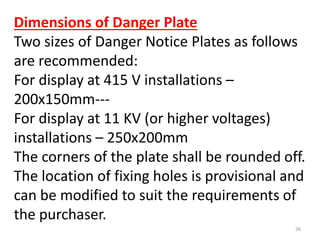
Dimensions of Danger Plate
Two sizes of Danger Notice Plates as follows
are recommended:
For display at 415 V installations –
200x150mm---
For display at 11 KV (or higher voltages)
installations – 250x200mm
The corners of the plate shall be rounded off.
The location of fixing holes is provisional and
can be modified to suit the requirements of
the purchaser.
26
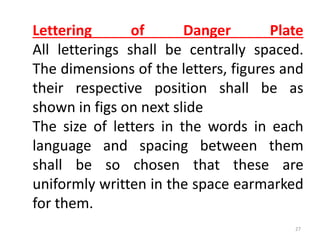
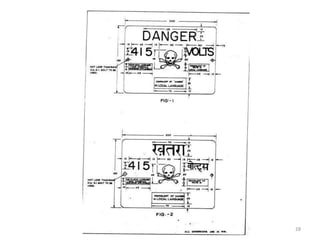
Lettering of Danger Plate
All letterings shall be centrally spaced.
The dimensions of the letters, figures and
their respective position shall be as
shown in figs on next slide
The size of letters in the words in each
language and spacing between them
shall be so chosen that these are
uniformly written in the space earmarked
for them.
27
28
Languages of Danger Plate
Under Rule No. 35 of Indian Electricity Rules,
1956, the owner of every medium, high and
extra high voltage installation is required to
affix permanently in a conspicuous position a
danger notice in Hindi or English and, in
addition, in the local language, with the sign of
skull and bones.
The type and size of lettering to be done in
Hindi is indicated in the specimen danger
notice plates shown in Fig. 2 and those in
English are shown in Figs.
29
Now let us discuss about the components
Regarding the lattice steel tower for
distribution the ac voltage. The main
supporting unit of overhead transmission line
is transmission tower. Transmission towers
have to carry the heavy transmission
conductor at a sufficient safe height from
ground. In addition to that all towers have to
sustain all kinds of natural calamities
30
•So transmission tower designing is
an important engineering job where
all three basic engineering
concepts, civil, mechanical and
electrical engineering concepts are
equally applicable.
• Main parts of a transmission
tower A power transmission tower
consists of the following parts,
31
•1) Peak of transmission tower
2) Cross Arm of transmission tower
3) Boom of transmission tower
4) Cage of transmission tower
5) Transmission Tower Body
6) Leg of transmission tower
7) Stub/Anchor Bolt and Base plate
assembly of transmission tower
32
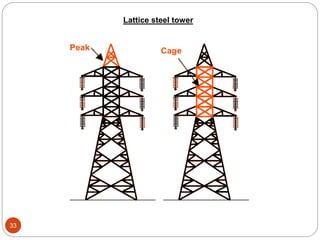
Lattice steel tower
33
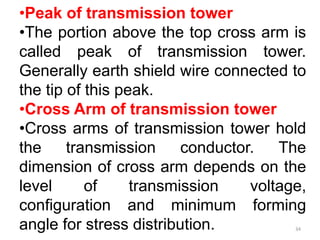
•Peak of transmission tower
•The portion above the top cross arm is
called peak of transmission tower.
Generally earth shield wire connected to
the tip of this peak.
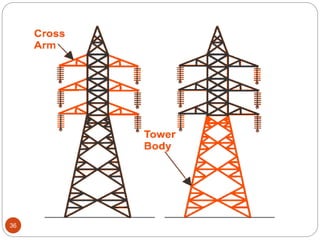
•Cross Arm of transmission tower
•Cross arms of transmission tower hold
the transmission conductor. The
dimension of cross arm depends on the
level of transmission voltage,
configuration and minimum forming
angle for stress distribution. 34
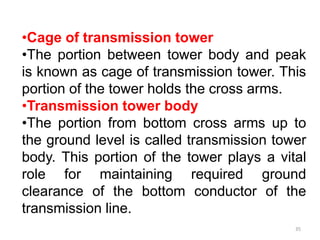
•Cage of transmission tower
•The portion between tower body and peak
is known as cage of transmission tower. This
portion of the tower holds the cross arms.
•Transmission tower body
•The portion from bottom cross arms up to
the ground level is called transmission tower
body. This portion of the tower plays a vital
role for maintaining required ground
clearance of the bottom conductor of the
transmission line.
35
36
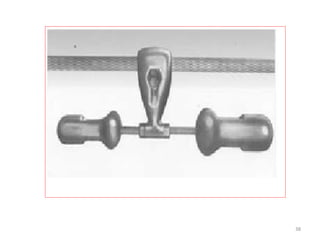
The “Stockbridge” type vibration damper
is commonly used to control vibration of
overhead conductors and OPGW. The
vibration damper has a length of steel
messenger cable. Two metallic weights
are attached to the ends of the
messenger cable. The centre clamp,
which is attached to the messenger
cable, is used to install the vibration
damper onto the overhead conductor.
37
38
Ring Distributor
A ring distributor is a distributor which is
arranged to form a closed circuit and which
is fed atone or more than one points. For
the purpose of calculating voltage
distribution, it can be looked uponas
consisting of a series of open distributors
fed at both ends. By using a ring distributor
fed properly, great economy in copper can
be
39
affected. If the ring distributor is fed at one
point then, for the purposes of calculation,
it is equivalent to a straight distributor fed
at both ends with equal voltages There are
3 type of power distribution namely
loop,network and radial.Radial distribution
is the type of power distribution where the
power is delivered from the main branch to
sub-branches then it split out from the
sub-branches again. it is the cheapest but
least reliable network configuration.
40
Ring main system –- In this system, various
power stations or sub-stations are
interconnected alternate routes, thus forming
a closed ring. In case of damage to any section
of the ring, that section may be disconnected
for repairs and power will be supplied from
both ends of the ring. A radial system has a
single simultaneous path of power .
The distribution systems are typically radial
because networked systems are more
expensive.
41
ADVANTAGES OF OUT-DOOR SUBSTATIONS
• Fault location is easier.
• Extension of the installation is easier.
• Less time is required foe their erection.
• The cost of civil engine4ering work is
less.
• Practically no danger of a fault which
appears at one point being carried over
to another point.
42
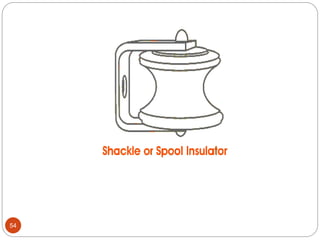
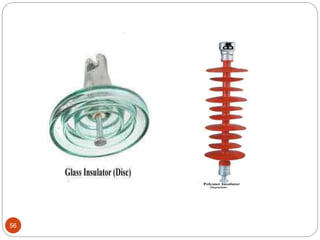
Now let us discuss some insulators used
In distribution systems
Pin type insulators
Post type insulators
Disc type insulators
D-Shakle type insulators
Egg type insulators
Reel insulators ………etc
43
44
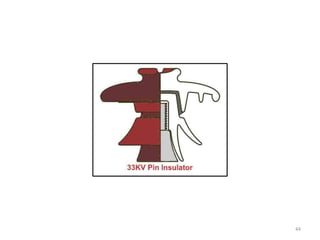
Pin Insulator is earliest developed
overhead insulator, but still popularly
used in power network up to 33KV
system. Pin type insulator can be one part,
two parts or three parts type, depending
upon application voltage. In 11KV system
we generally use one part type insulator
where whole pin insulator is one piece of
properly shaped porcelain or glass. As the
leakage path of insulator is through its
surface 45
In higher voltage like 33KV and 66KV
manufacturing of one part porcelain pin
insulator becomes difficult. Because in higher
voltage, the thickness of the insulator become
more and a quite thick single piece porcelain
insulator can not manufactured practically. In
this case we use multiple part pin insulator,
where a number of properly designed
porcelain shells are fixed together by Portland
cement to form one complete insulator unit.
For 33KV tow parts and for 66KV three parts
pin insulator are generally used.
46
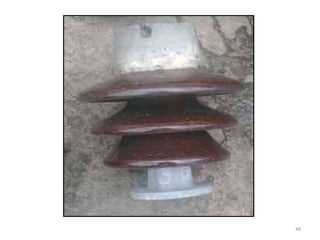
Post Insulator--
Post insulator is more or less similar to Pin
insulator but former is suitable for higher
voltage application. Post insulator has higher
numbers of petticoats and has greater height.
This type of insulator can be mounted on
supporting structure horizontally as well as
vertically. The insulator is made of one piece
of porcelain but has fixing clamp arrangement
are in both top and bottom end.
47
48
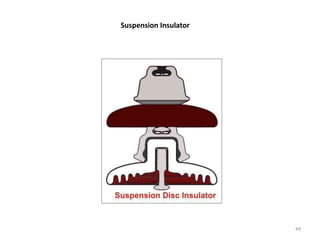
Suspension Insulator
49
In higher voltage, beyond 33KV, it
becomes uneconomical to use pin
insulator because size, weight of the
insulator become more. Handling and
replacing bigger size single unit insulator
are quite difficult task. For overcoming
these difficulties, suspension insulator
was developed.
50
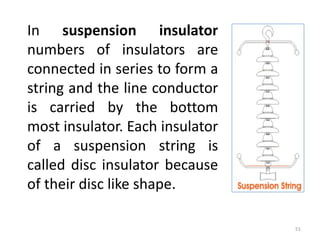
In suspension insulator
numbers of insulators are
connected in series to form a
string and the line conductor
is carried by the bottom
most insulator. Each insulator
of a suspension string is
called disc insulator because
of their disc like shape.
51
52
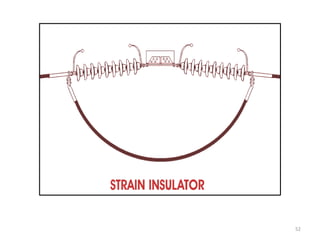
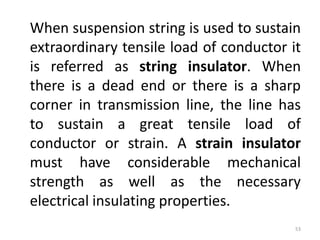
When suspension string is used to sustain
extraordinary tensile load of conductor it
is referred as string insulator. When
there is a dead end or there is a sharp
corner in transmission line, the line has
to sustain a great tensile load of
conductor or strain. A strain insulator
must have considerable mechanical
strength as well as the necessary
electrical insulating properties.
53
54
55
56
rk3353@yahoo.co.in
57

Distribution system 2

  • 1.
    By— Er Rajinder Kumar Govtpolytechnic college Amritsar 1
  • 2.
    Hello viewers ,inthis lecture we shall learn about the distribution system. So that dc as well as ac distribution system also we shall discuss about The components of a pole mounted substation and components fitted on lattice steel tower for transmission of a HT line. some insulators will also be discussed….. 2
  • 3.
    The Transmission systemcan be divided into two parts:---- Primary Transmission Secondary Transmission The Distribution system can be divided into two parts:---- Primary Distribution Secondary Distribution 3
  • 4.
    A distributor isset to the legal requirement that power must be supplied at a voltage within ± 6% of the declared voltage., whereas a transmission system is not subject to any such restriction . Its voltage can vary as much as 10% to 15% due to variation in loads. any restriction in transmission system is technical and not legal. The transmission system of an area is called GRID. 4
  • 5.
    The different gridsare inter connected through the lines to form a regional grid and the different regional grids are further interconnected to form a national grid. Each grid operates independently. However power can be transmitted from one grid to another. The maximum generation voltage in advanced countries is 33 kV while that in India is 11 kV. The amount of power that has to be transmitted through transmission lines is 5
  • 6.
    The amount ofpower that has to be transmitted through transmission lines is very large and if this power is transmitted at 11kV the line current and power loss will be large. There fore the voltage is stepped to a higher level by using step-up transformers located in sub-stations. Also volume of conductor used in transmission lines depends upon the voltage and current. 6
  • 7.
    The three phasetransmission and distribution system may consist of Overhead lines Underground cables The main advantage of underground system are that it is less prone to electric hazards like rain , wind & lightning. and that it does not interfere with other amenities. 7
  • 8.
  • 9.
    FEEDERS • These arethe cables supplying power in bulk to a selected number of points called feeding points The feeders run along streets overhead (or underground, in some cases) and power the distribution transformers at or near the customer premises. 9
  • 10.
    DISTRIBUTORS • Distributors areused for current Tapping for the various consumers these cables are generally having the main street for there route . 10
  • 11.
    SERVICE MAIN • Servicemains are the small cables teed of off from the distributors and taken into the premises of the various consumers these are low tension cables. 11
  • 12.
    EFFECT OF SUPPLYVOLTAGE ON THE SIZE OF DISTRIBUTOR The allowable current density for given type of cable laid is not constant but decreases somewhat as the cable size increases. If voltage of the system is increased N folds then for a given power delivered The current is reduced to 1/Nth. Size of cable is reduced to 1/Nth. 12
  • 13.
    BALANCERS The generators supplyinga three- wire feeder are all connected in parallel across the outers, and it is therefore necessary to fix the potential of the middle wire midway between that of the outers, otherwise voltages will not be equal, unless the currents taken from the outers are equal. 13
  • 14.
    POLE-MOUNTED SUBSTATION The substation consistingof a transformer and other apparatus installed on the pole structure is known as pole mounted substation As the name implies such substation are installed on H-pole structure many times 14
  • 15.
    COMPONENTS OF 11kV/ 400VPOLE MOUNTED SUB- STATION It is an out-door type substation and is erected on a pole structure. this erected pole is also called H-pole structure The various components of such a sub-station numbered as under:- 15
  • 16.
    1)---R.C.C. Pole Structure 2)--Platformfor transformer 3)--Transformer 4)--Pin-Type insulator 5)-Jumpers 6)--Strain insulator 7)--Fuses 8)--Gang Operating switch 9)--P.G. Clamps 16
  • 17.
    10)-Earthing 11)--Caution Plates 12)--Stay wire 13)-Anchorroad 14)-Stay insulators 15)-Anti-climbing devices 16)-G.I. Pipe and bends 17)-V.I.R. Cable 18)-T.P.I.C. Switch 17
  • 18.
  • 19.
    ESTIMATING OF 11KV/440VPOLE MOUNTED OUTDOOR SUBSTATION M.S.channel for cross arm 10cm x 5 cm x 1.5mt long 1no H.T. 11 kV disc insulators with fittings 11kv grade, porcelain body, glazed 3nos H.T. 11 kV pin insulators with fittings 11kv grade, porcelain body, glazed 3nos Stay sets complete Stay clamp ,stay insulator, stay bow, egg insulator 2 sets 19
  • 20.
  • 21.
    Earth wire clamp. M.S flatwith nut & bolt 1no Binding wire Aluminum wire 500 gm Total Conductor ACSR gopher 6/1/2.36 mm diameter: length 50 x 3=150mts sag allowed1% = 1.5mt 150+ 1.5 = 151.5 mts Galvanized steel wires 8 SWG ,galvanized steel 50.5 mt or 6 kg R.S joist poles R.S joist, 175 mm x 100 mm x 10 mts long 2nos 21
  • 22.
    substation plate 100mm x 50 mm x 6mm long 1no dropper angle iron 75mm x 75mm x 8mm x 2mts long long 1no Stay sets complete a) Stay clamp b) Stay insulator 40x6 mm,M.S flat with nut & bolt. 2nos 2nosH.T grade, , porcelain body, glazed 22
  • 23.
    Disc insulator 11kvgrade, porcelain body, glazed 3nos Pin insulators with pins 11kv grade, porcelain body, glazed 3nos Danger board with clamp Written in local, national, English language 1no Jump wire for jumpering ACSR gopher 6/1/2.36mm dia 1kg 23
  • 24.
    T.P.M.O switch Ironclad Switch with handle 1no Painting for poles and other attachments 2 ltr Fuse set 415v,60amp,copper or tinned alloy 1set(3 Nos) Transformer Cross channel for transformer 50 KVA 11/0.4 kV 75x40x6cm M.S channel, 0.7mtr long 1no 1no Earthing complete a) salt b) charcoal c) Earthing set Complete Earthing set 25kg 25kg 1set 24
  • 25.
    1) Transformer 2) Crosschannel for transformer 50 KVA 11/0.4 kV 75x40x6cm M.S channel, 0.7mtr long 1 1 Main switch TPICN (Triple Pole ironclad and Neutral) main switch with 3 fuses & with one neutral link, 100 amp, and built in HRC fuse unit. 1no Earthing for transformer Complete earthing 1 Feeder 3 phase, 4 wire, 50 cycles, 400/440 volts 3 Nos Transportation & labour charge As requi red Lightning arrester 11 kV grade ,glazed 3 Nos 25
  • 26.
    Dimensions of DangerPlate Two sizes of Danger Notice Plates as follows are recommended: For display at 415 V installations – 200x150mm--- For display at 11 KV (or higher voltages) installations – 250x200mm The corners of the plate shall be rounded off. The location of fixing holes is provisional and can be modified to suit the requirements of the purchaser. 26
  • 27.
    Lettering of DangerPlate All letterings shall be centrally spaced. The dimensions of the letters, figures and their respective position shall be as shown in figs on next slide The size of letters in the words in each language and spacing between them shall be so chosen that these are uniformly written in the space earmarked for them. 27
  • 28.
  • 29.
    Languages of DangerPlate Under Rule No. 35 of Indian Electricity Rules, 1956, the owner of every medium, high and extra high voltage installation is required to affix permanently in a conspicuous position a danger notice in Hindi or English and, in addition, in the local language, with the sign of skull and bones. The type and size of lettering to be done in Hindi is indicated in the specimen danger notice plates shown in Fig. 2 and those in English are shown in Figs. 29
  • 30.
    Now let usdiscuss about the components Regarding the lattice steel tower for distribution the ac voltage. The main supporting unit of overhead transmission line is transmission tower. Transmission towers have to carry the heavy transmission conductor at a sufficient safe height from ground. In addition to that all towers have to sustain all kinds of natural calamities 30
  • 31.
    •So transmission towerdesigning is an important engineering job where all three basic engineering concepts, civil, mechanical and electrical engineering concepts are equally applicable. • Main parts of a transmission tower A power transmission tower consists of the following parts, 31
  • 32.
    •1) Peak oftransmission tower 2) Cross Arm of transmission tower 3) Boom of transmission tower 4) Cage of transmission tower 5) Transmission Tower Body 6) Leg of transmission tower 7) Stub/Anchor Bolt and Base plate assembly of transmission tower 32
  • 33.
  • 34.
    •Peak of transmissiontower •The portion above the top cross arm is called peak of transmission tower. Generally earth shield wire connected to the tip of this peak. •Cross Arm of transmission tower •Cross arms of transmission tower hold the transmission conductor. The dimension of cross arm depends on the level of transmission voltage, configuration and minimum forming angle for stress distribution. 34
  • 35.
    •Cage of transmissiontower •The portion between tower body and peak is known as cage of transmission tower. This portion of the tower holds the cross arms. •Transmission tower body •The portion from bottom cross arms up to the ground level is called transmission tower body. This portion of the tower plays a vital role for maintaining required ground clearance of the bottom conductor of the transmission line. 35
  • 36.
  • 37.
    The “Stockbridge” typevibration damper is commonly used to control vibration of overhead conductors and OPGW. The vibration damper has a length of steel messenger cable. Two metallic weights are attached to the ends of the messenger cable. The centre clamp, which is attached to the messenger cable, is used to install the vibration damper onto the overhead conductor. 37
  • 38.
  • 39.
    Ring Distributor A ringdistributor is a distributor which is arranged to form a closed circuit and which is fed atone or more than one points. For the purpose of calculating voltage distribution, it can be looked uponas consisting of a series of open distributors fed at both ends. By using a ring distributor fed properly, great economy in copper can be 39
  • 40.
    affected. If thering distributor is fed at one point then, for the purposes of calculation, it is equivalent to a straight distributor fed at both ends with equal voltages There are 3 type of power distribution namely loop,network and radial.Radial distribution is the type of power distribution where the power is delivered from the main branch to sub-branches then it split out from the sub-branches again. it is the cheapest but least reliable network configuration. 40
  • 41.
    Ring main system–- In this system, various power stations or sub-stations are interconnected alternate routes, thus forming a closed ring. In case of damage to any section of the ring, that section may be disconnected for repairs and power will be supplied from both ends of the ring. A radial system has a single simultaneous path of power . The distribution systems are typically radial because networked systems are more expensive. 41
  • 42.
    ADVANTAGES OF OUT-DOORSUBSTATIONS • Fault location is easier. • Extension of the installation is easier. • Less time is required foe their erection. • The cost of civil engine4ering work is less. • Practically no danger of a fault which appears at one point being carried over to another point. 42
  • 43.
    Now let usdiscuss some insulators used In distribution systems Pin type insulators Post type insulators Disc type insulators D-Shakle type insulators Egg type insulators Reel insulators ………etc 43
  • 44.
  • 45.
    Pin Insulator isearliest developed overhead insulator, but still popularly used in power network up to 33KV system. Pin type insulator can be one part, two parts or three parts type, depending upon application voltage. In 11KV system we generally use one part type insulator where whole pin insulator is one piece of properly shaped porcelain or glass. As the leakage path of insulator is through its surface 45
  • 46.
    In higher voltagelike 33KV and 66KV manufacturing of one part porcelain pin insulator becomes difficult. Because in higher voltage, the thickness of the insulator become more and a quite thick single piece porcelain insulator can not manufactured practically. In this case we use multiple part pin insulator, where a number of properly designed porcelain shells are fixed together by Portland cement to form one complete insulator unit. For 33KV tow parts and for 66KV three parts pin insulator are generally used. 46
  • 47.
    Post Insulator-- Post insulatoris more or less similar to Pin insulator but former is suitable for higher voltage application. Post insulator has higher numbers of petticoats and has greater height. This type of insulator can be mounted on supporting structure horizontally as well as vertically. The insulator is made of one piece of porcelain but has fixing clamp arrangement are in both top and bottom end. 47
  • 48.
  • 49.
  • 50.
    In higher voltage,beyond 33KV, it becomes uneconomical to use pin insulator because size, weight of the insulator become more. Handling and replacing bigger size single unit insulator are quite difficult task. For overcoming these difficulties, suspension insulator was developed. 50
  • 51.
    In suspension insulator numbersof insulators are connected in series to form a string and the line conductor is carried by the bottom most insulator. Each insulator of a suspension string is called disc insulator because of their disc like shape. 51
  • 52.
  • 53.
    When suspension stringis used to sustain extraordinary tensile load of conductor it is referred as string insulator. When there is a dead end or there is a sharp corner in transmission line, the line has to sustain a great tensile load of conductor or strain. A strain insulator must have considerable mechanical strength as well as the necessary electrical insulating properties. 53
  • 54.
  • 55.
  • 56.
  • 57.