A.C.
TRANSMISSION
AND
DISTRIBUTION
"+ 0 ) 2 6 - 4
Learning Objectives
➣➣➣➣➣ General Layout of the
System
➣➣➣➣➣ Power System and System
Networks
➣➣➣➣➣ Systems of A.C. Distribution
➣➣➣➣➣ Effect of Voltage on Trans-
mission Efficiency
➣➣➣➣➣ Comparison of Conductor
Materials Required for
Various Overhead Systems
➣➣➣➣➣ Reactance of an Isolated
Single-Phase Transmission
Line
➣➣➣➣➣ A.C. Distribution
Calculations
➣➣➣➣➣ Load Division Between
Parallel Lines
➣➣➣➣➣ Suspension Insulators
➣➣➣➣➣ Calculation of Voltage
Distribution along Different
Units
➣➣➣➣➣ Interconnectors
➣➣➣➣➣ Voltage Drop Over the
Interconnectors
➣➣➣➣➣ Sag and Tension with
Support at Unequal Levels
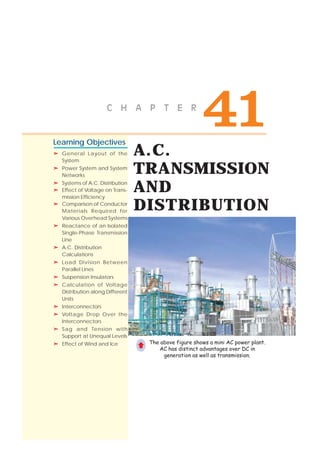
➣➣➣➣➣ Effect of Wind and Ice The above figure shows a mini AC power plant.
AC has distinct advantages over DC in
generation as well as transmission.
Ç
CONTENTSCONTENTS
CONTENTSCONTENTS
1604 ElectricalTechnology
41.1. General Layout of the System
The conductor system by means of which electric power is conveyed from a generating station to
the consumer’s premises may, in general, be divided into two distinct parts i.e. transmission system
and distribution system. Each part can again be sub-divided into two—primary transmission and
secondary transmission and similarly, primary distribution and secondary distribution and then
finally the system of supply to individual consumers. A typical layout of a generating, transmission
and distribution network of a large system would be made up of elements as shown by a single-line
diagram of Fig. 41.1 although it has to be realized that one or more of these elements may be missing
in any particular system. For example, in a certain system, there may be no secondary transmission
and in another case, when the generating station is nearby, there may be no transmission and the
distribution system proper may begin at the generator bus-bars.
Now-a-days, generation and transmission is almost exclusively three-phase. The secondary trans-
mission is also 3-phase whereas the distribution to the ultimate customer may be 3-phase or single-
phase depending upon the requirements of the customers.
In Fig. 41.1, C.S. represents the central station where power is generated by 3-phase alternators
at 6.6 or 11 or 13.2 or even 32 kV. The voltage is then stepped up by suitable 3-phase transformers for
transmission purposes. Taking the generated voltage as 11 kV, the 3-phase transformers step it up to
132 kV as shown. Primary or high-voltage transmission is carried out at 132 kV*. The transmission
voltage is, to a very large extent, determined by economic considerations. High voltage transmission
requires conductors of smaller cross-section which results in economy of copper or aluminium. But
at the same time cost of insulating the line and other expenses are increased. Hence, the economical
voltage of transmission is that for which the saving in copper or aluminium is not offset (i) by the
increased cost of insulating the line (ii) by the increased size of transmission-line structures and
(iii) by the increased size of generating stations and sub-stations. A rough basis of determining the
most economical transmission voltage is to use 650 volt per km of transmission line. For example, if
transmission line is 200 km, then the most economical transmission voltage will be 200 × 650
≅ 132,000 V or 132 kV.
The 3-phase, 3-wire overhead high-voltage transmission line next terminates in step-down trans-
formers in a sub-station known as Receiving Station (R.S.) which usually lies at the outskirts of a city
because it is not safe to bring high-voltage overhead transmission lines into thickly-populated areas.
Here, the voltage is stepped down to 33 kV. It may be noted here that for ensuring continuity of
service transmission is always by duplicate lines.
From the Receiving Station, power is next transmitted at 33 kV by underground cables (and
occasionally by overhead lines) to various sub-stations (SS) located at various strategic points in the
city. This is known as secondary or low-voltage transmission. From now onwards starts the primary
and secondary distribution.
At the sub-station (SS) voltage is reduced from 33kV to 3.3kV 3-wire for primary distribution.
Consumers whose demands exceeds 50 kVA are usually supplied from SS by special 3.3 kV feeders.
The secondary distribution is done at 400/230 V for which purpose voltage is reduced from
3.3 kV to 400 V at the distribution sub-stations. Feeders radiating from distribution sub-station
supply power to distribution networks in their respective areas. If the distribution network happens to
be at a great distance from sub-station, then they are supplied from the secondaries of distribution
transformers which are either pole-mounted or else housed in kiosks at suitable points of the distribu-
tion networks. The most common system for secondary distribution is 400/230-V, 3-phase 4-wire
system. The single-phase residential lighting load is connected between any one line and the neutral
* High voltages like 750 kV are in use in USSR (Konakovo-Moscow line) and 735 kV in Canada (Montreal-
Manicoagan Scheme).
A.C.Transmission and Distribution 1605
whereas 3-phase, 400-V motor load
is connected across 3-phase lines
directly.
It should be noted that low-voltage
distribution system is sub-divided
into feeders, distributors and service
mains. No consumer is given direct
connection from the feeders, instead
consumers are connected to
distribution network through their
service mains. The a.c. distributors
are, in many ways, similar to the d.c.
distributors as regards their
constructional details and restrictions
on drops in voltage.
Summarizing the above, we have
1. Generating voltage :
6.6, 11, 13.2 or 33 kV.
2. High voltage transmission :
220 kV, 132 kV, 66kV.
3. High voltage or primary
distribution : 3.3, 6.6 kV.
4. Low-voltage distribution :
A.C. 400/230, 3-phase, 4-wire
D.C. 400/230 ; 3-wire system
The standard frequency for a.c. work-
ing is 50 Hz or 60 Hz (as in U.S.A.).
For single-phase traction work,
frequencies as low as 25 or 16 2/3Hz
are also used.
41.2. Power Systems and
System Networks
It is a common practice now-a-days
to interconnect many types of gener-
ating stations (thermal and hydroelec-
tric etc.) by means of a common elec-
trical network and operate them all
in parallel.
This combination of generating stations forms what is known as power system. The various
elements of such a system like generating stations, transmission lines, the substations, feeders and
distributors etc. become tied into a whole by the integrated process of continuous generation and
consumption of electric energy.
A system network (or grid) is the name given to that part of power system which consists of the
sub-stations and transmission lines of various voltage rating.
Fig. 41.2 shows single-line diagram representing the main connections of a power system con-
sisting of a heating and power central station (HCS), a large-capacity hydro-electric station (HS) and
Fig. 41.1
1606 ElectricalTechnology
Fig. 41.2
two regional thermal power stations (RTS-1 and RTS-2). The stations HS, RTS-1 and RTS-2 are
situated at large distances from the consumers, hence voltage of the electric power generated by them
has to be stepped up by suitable transformers before it is fed into the system transmission network.
As shown in Fig. 41.2, HS is connected with the main 110-kV network of the system with the
help of (i) two-220 kV transmission lines L-1 and (ii) main (regional) sub-station A which houses two
220/110 kV, 2-winding transformers for interconnecting the two transmission lines.
Transmission lines L-2, L-3 and L-4 constitute a high-voltage loop or ring mains. As seen,
disconnnection of any one of the lines will not interrupt the connections between the elements of the
system. Station RTS-1 feeds directly into the 110-kV line loop whereas RTS-2 is connected to the
main network of the system by lines L-5 and L-6 through the buses of substations B and C. HCS is
interconnected with 110-kV system through the buses of substation A by means of 10/110-kV trans-
formers and line L-7.
It may be pointed out here that the main substations of the system are A and B. Substation B
houses 3-winding transformers. The 35-kV supply is provided over quite large areas whereas
6-10 kV supply is supplied to consumers situated with a limited radius from the substations. Substations
C and D are equipped with 2-winding transformers which operate at voltages indicated in the diagram.
Substation C is known as a through substation whereas D is known as a spur or terminal substation.
Obviously, Fig. 41.2 shows only part of 220-kV and 110-kV lines and leaves out the 35, 10 and
6-kV circuits originating from the buses of the substations. Also, left out are low-voltage circuits for
transmission and distribution (see Fig. 41.9).
A.C.Transmission and Distribution 1607
41.3. Systems of A.C. Distribution
As mentioned earlier, a.c. power
transmission is always at high voltage and mostly
by 3-phase system. The use of single-phase
system is limited to single-phase electric
railways. Single-phase power transmission is
used only for short distances and for relatively
low voltages. As will be shown later, 3-phase
power transmission requires less copper
than either single-phase or 2-phase power
transmission.
The distribution system begins either at the
sub-station where power is delivered by over-
head transmission lines and stepped down by
transformers or in some cases at the generating
station itself. Where a large area is involved,
primary and secondary distributions may be used.
With respect to phases, the following
systems are available for the distribution of
a.c. power.
1. Single-phase, 2-wire system.
2. Single-phase, 3-wire system.
3. Two-phase, 3-wire system.
4. Two-phase, 4-wire system.
5. Three-phase, 3-wire system.
6. Three-phase, 4-wire system.
41.4. Single-phase, 2-wire System
It is shown in Fig. 41.3 (a) and (b). In Fig. 41.3 (a), one of the two wires is earthed whereas in
Fig. 41.3 (b) mid-point of the phase winding is earthed.
41.5. Single-phase, 3-wire System
The 1-phase, 3-wire system is identical in principle with the 3-wire d.c. system. As shown in
Fig. 41.4, the third wire or neutral is connected to the centre of the transformer secondary and earthed
for protecting personnel from electric shock should the transformer insulation break down or the
secondary main contact high voltage wire.
Fig. 41.3 Fig. 41.4
The above figure shows an electrical substation.
A substation is a high-voltage electric system facility.
It is used to switch generators, equipment, and circuits
or lines in and out of a system. It is also used to
change AC voltages from one level to another, and/or
change alternating current to direct current or direct
current to alternating current. Some substations are
small with little more than a transformer and associated
switches.
1608 ElectricalTechnology
41.6. Two-phase, 3-wire System
This system is still used at some places. The third wire is taken from the junction of the
two-phase windings I and II, whose voltages are in quadrature with each other as shown in Fig. 41.5.
If the voltage between the third or neutral wire and either of the two wires is V, then the voltage
between the outer wires is V as shown. As compared to 2-phase, 4-wire system, the 3-wire system
suffers from the defect that it produces voltage unbalance because of the unsymmetrical voltage
drop in the neutral.
Fig. 41.5 Fig. 41.6
41.7. Two-phase, 4-wire System
As shown in Fig. 41.6, the four wires are taken from the ends of the two-phase windings and
the mid-points of the windings are connected together. As before, the voltage of the two windings are
in quadrature with each other and the junction point may or may not be earthed. If voltage between
the two wires of a phase winding be V, then the voltage between one wire of phase I and one wire of
phase II is 0.707 V.
41.8. Three-phase, 3-wire System
Three-phase systems are used extensively. The 3-wire system may be delta-connected or star-
connected whose star point is usually earthed. The voltage between lines is V in delta-connection and
3 V in case of star connection where V is the voltage of each phase as shown in Fig. 41.7 (a) and (b)
respectively.
Fig. 41.7 Fig. 41.8
41.9. Three-phase, 4-wire System
The 4th or neutral wire is taken from the star point of the star-connection as shown in Fig. 41.8
and is of half the cross-section of the outers or line conductors. If V is the voltage of each winding,
A.C.Transmission and Distribution 1609
then line voltage is 3 V. Usually, phase voltage i.e. voltage between any outer and the neutral for a
symmetrical system is 230 V so that the voltage between any two lines or outers is 3 × 230 = 400 V.
Single-phase residential lighting loads or single-phase motors which run on 230 V are connected
between the neutral and any one of the line wires. These loads are connected symmetrically so that
line wires are loaded equally. Hence, the resultant current in the neutral wire is zero or at least
minimum. The three phase induction motors requiring higher voltages of 400 V or so are put across
the lines directly.
41.10. Distribution
The distribution system may be divided into feeders, distributors, sub-distributors and service
mains. As already explained in Art. 41.1, feeders are the conductors which connect the sub-station (in
some cases the generating station) to the distributors serving a certain allotted area. From distributors
various tappings are taken. The connecting link between the distributors and the consumers' termi-
nals are the service mains. The essential difference between a feeder and a distributor is that whereas
the current loading of a feeder is the same throughout its length, the distributor has a distributed
loading which results in variations of current along its entire length. In other words, no direct tappings
are taken from a feeder to a consumer’s premises.
Fig. 41.9 Fig. 41.10
In early days, radial distribution of tree-system type, as shown in Fig. 41.9, was used. In this
system, a number of independent feeders branch out radially from a common source of supply i.e. a
sub-station or generating station. The distribution transformers were connected to the taps along the
length of the feeders. One of the main disadvantages of this system was that the consumer had to
depend on one feeder only so that if a fault or breakdown occurred in his feeder, his supply of power
was completely cut off till the fault was repaired. Hence, there was no absolute guarantee of continu-
ous power supply.
For maintaining continuity of service, ring-main distributor (R.M.D.) system as shown in
Fig. 41.10, is employed almost universally. SS represents the sub-station from which two feeders
supply power to the ring-main distributor at feeding points F1 and F2. The ring-main forms a com-
plete loop and has isolating switches provided at the poles at strategic points for isolating a particular
section in case of fault. In this way, continuity of service can be maintained to other consumers on
1610 ElectricalTechnology
healthy sections of the ring-main. The number of feeders of the ring-main depends on (i) the nature
of loading—heavy or light (ii) the total length of the R.M.D. and (iii) on the permissible/allowable
drop of voltage. Service mains (S) are taken off at various points of the R.M.D. Sometimes sub-
distributors are also used. Since a loop or closed ring-main can be assumed to be equivalent to a
number of straight distributors fed at both ends, the voltage drop is small which results in economy of
conductor material. The service mains are the connecting link between the consumer’s terminals and
the R.M.D. or sub-distributor.
41.11. Effect of Voltage on Transmission Efficiency
Let us suppose that a power of W watt is to be delivered by a 3-phase transmission line at a line
voltage of E and power factor cos φ.
The line current I =
3 cos
W
E φ
Let l = length of the line conductor ; σ = current density
ρ = specific resistance of conductor material, A = cross-section of conductor
then A =
3 . .cos
I W
E
=
σ σ φ
Now R =
3 cosl El
A W
σ ρ φρ
=
Line loss = 3 × loss per conductor = 3 I
2
R
=
2
2 2
3 cos 3
3
cos3 cos
l lWW
W EE
σ ρ φ σρ
× =
φφ
...(1)
Line intake or input = output + losses =
3 3
1
cos cos
lW l
W W
E E
 ρσ σρ
+ = + φ φ 
∴ efficiency of transmission
=
output 3
1 approx
input cos3
1
cos
lW
El
W
E
 σρ
= = − φ σρ  + φ 
...(2)
Voltage drop per line =
3 cos
3 cos
l E WIR l
W E
σρ φ
= × = σρ
φ
...(3)
Volume of copper =
3 3
3
cos3 cos
Wl Wl
lA
EE
= =
σ φσ φ
...(4)
For a given value of transmitted power W, line length l, current density σ and specific resistance
ρ of the given conductor material, the effect of supply voltage on transmission can be seen as
follows :
1. From equation (1), line loss is inversely proportional to E. It is also inversely proportional
to power factor, cos φ.
2. Transmission efficiency increases with voltage of transmission and power factor as seen
from equation (2).
3. As seen from equation (3) for a given current density, the resistance drop per line is constant
(since ρ and l have been assumed fixed in the present case). Hence, percentage drop is
decreased as E is increased.
4. The volume of copper required for a transmission line is inversely proportional to the volt-
age and the power factor as seen from equation (4).
A.C.Transmission and Distribution 1611
It is clear from the above that for long distance transmission of a.c. power, high voltage and high
power factors are essential. But as pointed out earlier in Art. 41.1, economical upper limit of voltage
is reached when the saving in cost of copper or aluminium is offset by the increased cost of insulation
and increased cost of transformers and high-voltage switches etc. Usually, 650 volt per route km is
taken as a rough guide.
41.12. Comparison of Conductor Materials Required for Various Overhead
Systems
We will now calculate the amounts of conductor material required for various systems of
a.c. power transmission. To do it without prejudice to any system, we will make the following
assumptions :
1. Amount of power transmitted by each system is the same.
2. Distance of transmission is the same in each case.
3. Transmission efficiency is the same i.e. the losses are the same in each case.
4. Loads are balanced in the case of 3-wire systems.
5. Cross-section of the neutral wire is half that of any outer.
6. Maximum voltage to earth is the same in all cases.
By way of illustration a few cases will be compared, although the reader is advised to attempt
others as well.
(i) Two-wire d.c. System and Three-phase, 3-wire System
Let in both cases, E be the maximum voltage between conductors and W the power transmitted.
In d.c. system, let R1 be the resistance of each conductor and I1 the current, then I1 = (W/E), hence
losses in the two conductors are = 2I1
2
R1 = 2 (W/E)
2
R1 ...(i)
For a.c. system, let resistance per conductor be R2 and power factor cos φ, then since E is the
maximum voltage, the R.M.S. voltage is / 2.E
Current in each line, I2 =
3 ( / 2) cos
W
E φ
Total losses in three conductors are,
3l2
2
R2
=
2
2
2 22 2
2 1
.
3 ( / 2) cos cos
W W
R R
E E
 
= × 
φ φ 
...(ii)
Since transmission efficiency and hence losses are the same, therefore equating (i)
and (ii), we get
2
1
2
2W R
E
=
2
1
22 2 2
2
2 1 1. or
cos cos
RW
R
RE
=
φ φ
Since area of cross-section is inversely proportional to the resistance.
∴
area of one a.c. conductor
area of one d.c. conductor
= 2
1
cos φ
Now, for a given length, volumes are directly proportional to the areas of cross-section.
∴
volume of one a.c. conductor
volume of one d.c. conductor
= 2
1
cos φ
Keeping in mind the fact, that there are two conductors in d.c. system and three in a.c. system
under consideration, we have
total volume in 3-wire a.c. system
total volume in 2-wire d.c. system
= 2 2
1 3 1.5.
2cos cos
=
φ φ
(ii) Three-phase, 4-wire and 3-wire d.c. Systems
The neutral conductor of each system is earthed. Let E be the maximum voltage to earth and W
the power to be transmitted in both cases.
1612 ElectricalTechnology
For d.c. 3-wire system, voltage between outers is 2E. If I1 and R1 are the current in and resistance
of each conductor, then I1 = W/2E. Assuming a balanced load (in which case there would be no
current flowing in the neutral conductor), the value of loss in two conductors is
2I1
2
R1 = 2(W/2E)
2
R1= W
2
R1/2E
2
In the case of a.c. system, if E is the maximum voltage between any wire and neutral, then its
R.M.S. value is E/ 2 . Hence, the line voltage = 3 . / 2.E The line current is
I2 =
3 ( 3 / 2) cos
W
E× φ
where cos φ is the power factor. If R2 is the resistance of each line, then total loss in 3 lines is
= 3I2
2
R2
=
2 2
2 2 2
2
3
3 ( 3 / 2) cos 3 cos
W RW R
E E
 
× × = 
φ φ 
For equal transmission efficiencies, the two losses should be the same.
∴
2
1
2
2
W R
E
=
2
1 1
2 2 2
2
2 4or
3 cos 3 cos
W R R
RE
=
φ φ
Since volume is directly proportional to the area of cross-section which is itself inversely propor-
tional to the resistance, hence
volume of one a.c. conductor
volume of one d.c. conductor
= 2
4
3 cos φ
Assuming the neutral wires of each system to have half the cross-section of the outers, there is
3.5 times the quantity of one conductor in a.c. and 2.5 times in the d.c. system. Hence
total volume in the a.c. system
total volume in the d.c. system
= 2 2
3.5 4 1.867
2.5 3cos cos
× =
φ φ
In Table 41.1 are given the ratios of copper in any system as compared with that in the
corresponding d.c. 2-wire system which has been alloted a basic number of 100.
Table No. 41.1
System With same maximum With same maximum voltage
voltage to earth between conductors
D.C. 2-wire 100 100
D.C. 2-wire
Mid-point earthed 25 100
D.C. 3-wire
Neutral = ½ outer 31.25 125
D.C. 3-wire
Neutral = ½ outer 37.5 150
Single-phase, 2-wire 200/cos
2
φ 200/cos
2
φ
Single-phase, 2-wire
Mid-point earthed 50/cos
2
φ 200/cos
2
φ
Single-phase, 3-wire
Neutral = ½ outer 62.5/cos
2
φ 250/cos
2
φ
Two-phase, 4-wire 50/cos2
φ 200/cos2
φ
A.C.Transmission and Distribution 1613
Two-phase, 3-wire 146/cos
2
φ 291/cos
2
φ
Three-phase, 3-wire 50/cos
2
φ 150/cos
2
φ
Three-phase, 4-wire
Neutral = outer 67/cos
2
φ 200/cos
2
φ
A comparison of costs for underground systems employing multicore cables can also be worked
out on similar lines. In these case, however, maximum voltage between the conductors is taken as the
criterion.
It would be clear from the above discussion, that for a.c. systems, the expression for volume
contains cos
2
φ in denominator. Obviously, reasonable economy in copper can be achieved only
when cos φ approaches unity as closely as possible. For equal line loss, the volume of copper
required for cos φ = 0.8 will be 1/0.8
2
= 1.6 times that required for cos φ = 1.
Since the cost of distribution system represents a large percentage of the total capital investment
of power supply companies, it is quite reasonable that a consumer should be penalized for low power
factor of his load. This point is fully dealt with in Chapt. 47.
Example 41.1. A 3-phase, 4-wire system is used for lighting. Compare the amount of copper
required with that needed for a 2-wire D.C. system with same line voltage. Assume the same losses
and balanced load. The neutral is one half the cross-section of one of the respective outers.
Solution. (a) Two-wire DC Let V = voltage between conductors
P = power delivered, R1= resistance/conductor
Current I1 = P/V
power loss = 2I1
2
R1 = 2 P
2
R1/V
2
(b) Three-phase, 4-wire
Let V be the line-to-neutral voltage and R2 resistance of each phase wire.
P = 3VI2 cos φ = 3VI2 —if cos φ = 1
Power loss = 3I2
2
R2 = 3(P/3V)2
R2 =P2
R2/3V2
Since power losses in both systems are equal
∴ 2P2
R1/V2
= P2
R2/3V2
or R1/R2 = 1/6
If A1 and A2 are the cross-sectional areas of conductors in the two systems, then A1/A2 = 6. Be-
cause R ∝ l/A
∴ Cu reqd. for 2-wire system = 2 A1l
Cu reqd. for 3-φ, 4-wire system = (3 A2l + A2l/2)
∴
Cu for 3 system
Cu for d.c. system
− φ
= 2
1
3.5 3.5 1 0.292
2 2 6
A l
Al
= × =
Cu for 3-φ system = 0.292 ××××× Cu for d.c. system.
Example 41.2. Estimate the weight of copper required to supply a load of 100 MW at upf by a
3-phase, 380-kV system over a distance of 100 km. The neutral point is earthed. The resistance of
the conductor is 0.045 ohm/cm
2
/km. The weight of copper is 0.01 kg/cm
3
. The efficiency of trans-
mission can be assumed to be 90 percent. (Power Systems, AMIE, Sec. B, 1994)
Solution. Power loss in the line = (1 − 0.9) × 100 = 10 MW
Line current = 100 × 106
/√3 × 380 × 103
× 1 = 152 A
Since I
2
R loss in 3-conductors is 10 × 106 W, loss per conductor is = 10 × 10
6
/3 = 3.333 × 10
6
W
1614 ElectricalTechnology
Resistance per conductor = 10 × 10
6
/3 × 152
2
= 144.3 Ω
Resistance per conductor per km = 144.3/100 = 1.443 Ω
∴ Conductor cross-section = 0.045/1.443 = 0.03 m
3
Volume of copper per meter run = 0.03 × 100 = 3 cm
3
Weight of copper for 3-conductor for 100 km length = 3 × (3 × 0.01) × 100 × 1000 = 9000 kg
Example41.3. A d.c. 2-wire distribution system is converted
into a.c. 3-phase, 3-wire system by adding a third conductor of
the same size as the two existing conductors. If voltage between
conductors and percentage power loss remain the same, calcu-
late the percentage additional balanced load which can now be
carried by the conductors at 0.95 p.f.
Solution. (a) DC 2-wire system [Fig. 40.11 (a)]
If R is the resistance per conductor, then power transmitted
is P = VI1 and power loss = 2I12R. Percentage power loss
= 2I1
2
R × 100/VI1
= 2I1R × 100/V
(b) as 3-phase, 3-wire system [Fig. 40.11 (b)]
P2 = √3 VI2 cos φ, power loss = 3I2
2
R
% power loss = 3I2
2
R/P2 = √3I2R × 100 V cos φ
Since losses in the two cases are the same
∴ 2I1R × 100/V = √3I2R × 100/V cos φ or I2 = 2 cos φ × I1/√3
∴ P2 = √3.V.2 cos
2
φ × I1/√3 = 2VI1 cos
2
φ = 2VI1 (0.95)
2
= 1.8 VI1
Percentage additional power transmitted in a 3-phase, 3-wire system
= 2 1 1 1
1 1
1.8
100 100
P P VI VI
P VI
− −
× = × = 80%
Example 41.4. A 2-phase, 3-wire a.c. system has a middle conductor of same cross-sectional
area as the outer and supplies a load of 20 MW. The system is converted into 3-phase, 4-wire system
by running a neutral wire. Calculate the new power which can be supplied if voltage across con-
sumer terminal and percentage line losses remain the same. Assume balanced load.
Solution. The two systems are shown
in Fig. 41.12. Let R be the resistance per
conductor.
P1 = 2V I1 cos φ; Cu loss,
W1 = 2I1
2
R
Percentage Cu loss
= (W1/P1) × 100
= (2I2
R/2VI1 cos φ) × 100
= I1R × 100/V cos φ
P2 = 3VI2 cos φ
W2 = 3I2
2
R
% line loss = (W2/P2) × 100
= (3I2
2
R/3VI2 cos φ) × 100
= I2R × 100/V cos φ
Fig. 41.11
Fig. 41.12
A.C.Transmission and Distribution 1615
Since percentage line losses are the same in both cases
∴ I1R × 100/V cos φ = I2R × 100/V cos φ ∴ I1 = I2
Now, P1 = 2VI1 cos φ = 20 MW ; ∴ VI1 cos φ = 10 MW
P2 = 3VI2 cos φ = 3VI1 cos φ = 3 × 10 = 30 MW
41.13. Constants of a Transmission Line
A transmission line not only has an ohmic resistance but also inductance and capacitance
between its conductors. These are known as the constants of a transmission line. While calculating
the drop in a.c. transmission and distribution circuits, we will have to consider (i) resistive or ohmic
drop—in phase with the current (ii) inductive drop—leading the current by 90° and (iii) the capaci-
tive drop and charging current taken by the capacitance of the line. The capacitance and hence the
charging current is usually negligible for short transmission lines.
41.14. Reactance of an Isolated Single-Phase Transmission Line
In Fig. 41.13 (a) are shown the cross-sections of two conductors of a single-phase line spaced D
from centre to centre.
Since currents through the two conductors will, at any time, always be flowing in opposite direc-
tions, the fields surrounding them always reinforce each other in the space between them as shown in
Fig. 41.13.
Fig. 41.13
The two parallel conductors form a rectangular loop of one turn through which flux is produced
by currents in the two conductors. Since this flux links the loop, the loop possesses inductance. It
might be thought that this inductance is negligible because the loop has only one turn and the entire
flux-path lies through air of high reluctance. But as the cross-sectional area of the loop is large, from
1 to 10 metre wide and several km long, even for a small flux density, the total flux linking the loop is
large and so inductance is appreciable.
It can be proved that inductance per loop metre (when r ≤ D) is ...(i)
L =
µ
π
loge D/r +
µ
4
i
π
henry/metre
where µ = absolute permeability of the surrounding medium
µi = absolute permeability of the conductor material
Now, µ = µ0 µr and µi = µ0 µr where µr and µr′ are the relative permeabilities of the surrounding
medium and the conductor material. If surrounding medium is air, then µr = 1. Also, if conductor is
made of copper, then µr′ = 1. Hence, the above expression becomes.
L = o oµ µ µ µ
log /
4
r r
h D r
′ 
+ π π 
H/m
1616 ElectricalTechnology
= oµ
4π
(log h D/r + 1) H/m = 10
–7
(1 + log h Dr) H/m
Loop reactance X = 2πfL ohm/metre
Obviously, the inductance of each single conductor is half the above value*.
inductance/conductor =
1
2
(1 + log h D/r) × 10
–7
H/m ...(ii)
reactance/conductor = 2 π f ×
1
2
(1 + log h D/r) × 10
–7
Ω/m
41.15. Reactance of 3-phase Transmission Line
In 3-phase transmission, it is more convenient to consider the reactance of each conductor
instead of the looped line or of the entire circuit. Two cases will be considered for 3-phase lines.
(i) Symmetrical Spacing
In Fig. 41.14 (a) are shown the three conductors spaced symmetrically i.e. each conductor is at
the apex of the same
equilateral triangle
ABC of side D. The
inductance per
conductor per metre is
found by using
equation (ii) in Art
41.14 because it can be
shown that inductance
per km of one
conductor of 3-phase
circuit is the same as
the inductance per
conductor per km of
single-phase circuit
with equivalent spacing.
(ii) Unsymmetrical Spacing
In Fig. 41.14 (b) is shown a 3-phase circuit with conductors placed unsymmetrically. In this case
also, the inductance is given by equation (ii) of Art. 41.14 with the only modification that D is put
equal to 3
1 2 3( )D D D .
41.16. Capacitance of a Single-phase Transmission Line
We know that any two conductors which are separated by an insulating medium constitute a
capacitor. When a potential difference is established across two such conductors, the current flows in
at one conductor and out at the other so long as that p.d. is maintained. The conductors of an over-
head transmission line fulfil these conditions, hence when an alternating potential difference is
applied across a transmission line, it draws a leading current even when it is unloaded. This leading
current is in quadrature with the applied voltage and is known as the charging current. Its value
depends upon voltage, the capacitance of the line and the frequency of alternating current.
As shown in Art 5.10, the capacitance between conductors of a single-phase line is approxi-
mately given by
Fig. 41.14
* It may be noted that standard conductors have a slightly higher inductance.
A.C.Transmission and Distribution 1617
C = 0
10 10
0.0121
/ /km
log / 2.3 log / log /
r r
F m F
h D r D r D r
π∈ ∈ ∈π∈ = = µ
Here, D is the distance between conductor centres and r the radius of each conductor, both
expressed in the same units (Fig. 41.15).
Fig. 41.15 Fig. 41.16
As shown in Fig. 41.16, the capacitance to neutral Cn = 2C where point O is the neutral of the
system. Obviously, the total capacitance between conductors A and B is given by finding the resultant
of two capacitances each of value Cn joined in series, the resultant, obviously, being equal to C.
It is important to remember that if capacitance to neutral is used for calculating the charging
current, then voltage to neutral must also be used.
∴ Cn =
2
2 F/m
log /e
C
D r
π∈
= ...(ii)
∴ line charging current = 2 A/m
1/(2 ) n
C n
V V
fC V
X fC
= = π
π
where V is the voltage to neutral.
However, it may be noted that ground effect has been neglected while deriving the above expres-
sion. This amounts to the tacit assumption that height h of the conductors is very large as compared
to their spacing ‘d’. In case ground effect is to be taken into account, the expression for capacitance
becomes.
Cn =
2 2
2
F/m
log
1 /4
dh
r d h
π∈
+
(Ex. 41.7)
Example 41.5. What is the inductance per loop metre of two parallel conductors of a single
phase system if each has a diameter of 1 cm and their axes are 5 cm apart when conductors have a
relative permeability of (a) unity and (b) 100. The relative permeability of the surrounding medium
is unity in both cases. End effects may be neglected and the current may be assumed uniformly
distributed over cross-section of the wires.
Solution. (a) Here, µ = µ0 = 4π × 10
–7
H/m ; µi = 1
∴ L = ( )
7
54 10 1log /0.5
4
h
−
π ×
+ =
π
1.02 µµµµµH/m
(b) Here, µ = µ0 = 4π × 10
–7
; µi = 100 µ0
L = ( )
7
54 10 100log /0.5
4
h
−
π ×
+ =
π
10.9 µµµµµH/m
Example 41.6. A 20-km single-phase transmission line having 0.823 cm diameter has two line
conductors separated by 1.5 metre. The conductor has a resistance of 0.311 ohm per kilometre.
Find the loop impedance of this line at 50 Hz. (Gen. Trans.  Dist. Bombay Univ. 1992)
Solution. Loop length = 20 km = 2 × 10
4
m
Total loop inductance is L =
4
2 10 log / henry
4
i
e D r
µ µ
× + π π 
Here, D = 1.5 m ; r = 0.823/2 = 0.412 cm = 4.12 × 10
–3
m
Assuming µr = 1 for copper conductors since they are non-magnetic and also taking µr = 1 for air,
we have
1618 ElectricalTechnology
L = ( )3
4 7
4 1.5/4.12 102 10 4 10 12 10 log / log H
4 4
i
e eD r
−−
×µ × × π × µ
× + = + π π π 
= 8 × 10
–3
(5.89 + 0.25) = 49.12 × 10
–3
H
Reactance X = 2π × 50 × 49.12 × 10
–3
= 15.44 Ω ; Loop resistance = 2 × 20 × 0.311 = 12.44 Ω
Loop impedance = 2 2
12.44 15.44+ = 19.86 ΩΩΩΩΩ
Example 41.7. The conductors in a single-phase transmission line are 6 m above ground. Each
conductor has a diameter of 1.5 cm and the two conductors are spaced 3 m apart. Calculate the
capacitance per km of the line (i) excluding ground effect and (ii) including the ground effect.
Solution. The line conductors are shown in Fig. 41.17.
(i) Cn =
12
0
2
2 2 8.854 10
F/m
log / log 3/0.75 10hd r h
−
−
π∈ π × ×
=
×
= 9.27 × 10
–12
F/m = 9.27 ××××× 10
–3
µF/km
(ii) In this case,
Cn = 0
2 2
2
F/m
log
1 /4
dh
r d h
π∈
+
=
12
12 2 2
2 8.854 10
3log
0.75 10 1 3 /4 6
h
−
−
π × ×
× + ×
= 9.33 × 10
–12
F/m = 9.33 ××××× 10
–3
mF/km
It is seen that line capacitance when considering ground
effect is more (by about 0.64% in the present case).
41.17. Capacitance of a Three-phase Transmission Line
In Fig. 41.18 (a) are shown three conductors spaced symmetrically and having a capacitance of
C between each pair. The value of C i.e. line-to-line capacitance is the same as given by equation
(i) in Art. 41.16.
Considering the two conductors A and B, their line capacitance C can be regarded as consisting
of two line-to-neutral capacitances connected in series, so that for the line-to-neutral capacitance of A
with respect to neutral plane 1, as in Art. 41.16, we have
Cn1 =
2 F/m
log /e D r
π∈
Fig. 41.18
Fig. 41.17
A.C.Transmission and Distribution 1619
Similarly, line-to-neutral capacitance of conductor A with respect to neutral plane 3 is
Cn3 =
2 F/m
log /e D r
π∈
The vector sum of these capacitances is equal to either because their phase angle is 120º i.e. the
phase angle of the voltages which cut across them.
Hence, the capacitance to neutral per metre of one conductor of a 3-phase transmission line is
Cn =
2 F/m
log /e D r
π∈
In case the conductors are placed
asymmetrically, the distance used is D = 3
1 2 3( ).D D D
41.18. Short Single-phase Line Calculations
Single-phase circuits are always short and work at relatively low voltages. In such cases, the line
constants can be regarded as ‘lumped’ instead of being distributed and capacitance can be neglected.
Let ES = voltage at sending end ; ER = voltage at receiving end
I = line current cos φR = power factor at receiving end
R = resistance of both conductors; X = reactance of both conductors = ωL
Then, the equivalent circuit of a short single-phase line is as shown in Fig. 41.19.
Resistive drop = IR —in phase with I
Reactive drop = IX —in quadrature with I
The vector diagram is shown in Fig. 41.20. From the right-angled triangle OMA, we get
OM
2
= OA
2
+ A M
2
= (OK + K A)
2
+ (AC + CM)
2
ES = 2 2
[( cos ) ( sin ) ]R R R RE IR E IXφ + + φ +
An approximate expression for the voltage drop is as follows :
Fig. 41.19 Fig. 41.20
Draw the various dotted lines as in Fig. 41.20. Here, ML is ⊥ OF, CL is || OF and CD is ⊥ OF. As
seen
OM = OF (approximately).
= OD + DF = OB + BD + DF
or ES = ER + BD + DF = ER + BD + CL = ER + IR cos φR + IX sin φR
or ES – ER = IR cos φR + IX sin φR ∴ drop = I(R cos φR + X sin φR) (approx.)
Voltage regn. of line = [(ES – ER)/ER] × 100
1620 ElectricalTechnology
Solution in Complex Notation
Let us take ER as reference vector as shown in Fig.
41.21 so that ER = (ER + j0)
As seen from ∆ OAB, ES is equal to the vector sum
of ER and IZ or ES = ER + IZ
Now, I = I ∠ − φR = I (cos φR – j sin φR)
Similarly, Z = Z ∠ θ = (R + jX)
∴ ES = ER + IZ ∠ θ − φR
or ES = ER + I (cos φR − j sin φR) (R + jX)
= ER + (IR cos φR + IX sin φR) + j (IX cos φR − IR sin φR)
2
∴ ES = 2 2
( cos sin ) ( sin sin )R R R R RE IR IX IX IR+ φ + φ + φ − φ
If the p.f. is leading, then
I = I ∠ φR = I (cos φR + j sin φR)
∴ ES = ER + IZ ∠θ + φR = ER + I (cos φR + j sin φR) (R + jX)
It may be noted that the sending end power factor angle is φs = (φR + α).
Example 41.8. A single-phase line has an impedance of 5∠ 60° and supplies a load of 120 A,
3,300 V at 0.8 p.f. lagging. Calculate the sending-end voltage and draw a vector diagram.
(City  Guides, London)
Solution. The vector diagram is similar to that shown in Fig. 41.21. Here
ER = 3,300 ∠ 0°, Z = 5 ∠ 60°
Since φR = cos
−1
(0.8) = 36°52′, ∴ I = 120 ∠ −36°52′
Voltage drop = IZ = 120 × 5 ∠ 60º − 36°52′
= 600 ∠ 23°8′ = 600 (0.9196 + j0.3928) = 551.8 + j 235.7
∴ ES = (3,300 + j0) + (551.8 + j235.7) = 3,851.8 + j235.7
ES = 2 2
3851.8 235.7+ =3,860 V
Example 40.9. An overhead, single-phase transmission line delivers 1100 kW at 33 kV at
0.8 p.f. lagging. The total resistance of the line is 10 Ω and total inductive reactance is 15 Ω. Deter-
mine (i) sending-end voltage (ii) sending-end p.f. and (iii) transmission efficiency.
(Electrical Technology-I, Bombay Univ.)
Solution. Full-load line current is I = 1100/33 × 0.8 = 41.7 A
Line loss = I
2
R = 41.7
2
× 10 = 17,390 W = 17.39 kW
(iii) Transmission efficiency =
1100 100output
output + losses 1100 17.39
×
= =
+
98.5%
(i) Line voltage drop = IZ = 41.7(0.8 − j 0.6) (10 + j15) = 709 + j250
Sending-end voltage is
ES = ER + IZ = (33,000 + j0) + (709 + j 250)
= 33,709 + j 250 = 33,710 ∠25°
Hence, sending-end voltage is 33.71 kV
(ii) As seen from Fig. 41.22, α= 0°25′
Sending-end p.f. angle is
θ + α = 36°52′ + 0°25′ = 37°17′
∴ p.f. = cos 37°17′ = 0.795 (lag). Fig. 41.22
Fig. 41.21
A.C.Transmission and Distribution 1621
Note. As seen from Fig. 41.22, approximate line drop is
= I(R cos φR + X sin φR) = 41.7 (10 × 0.8 + 15 × 0.6) = 709 V
∴ ES = 33,000 + 709 = 33,709 V —as above
Example 41.10. What is the maximum length in km for a 1-phase transmission line having
copper conductors of 0.775 cm2
cross-section over which 200 kW at unity power factor and at
3300 V can be delivered ? The efficiency of transmission is 90 per cent. Take specific resistance as
(1.725 × 10⁻⁸
) Ω-m. (Electrical Technology, Bombay Univ.)
Solution. Since transmission efficiency is 90 per cent, sending-end power is 200/0.9 kW.
Line loss = (200/0.9 – 200) = 22.22 kW = 22,220 W
Line current = 200,000/3300 × 1 = 60.6 A
If R is the resistance of one conductor, then
2I
2
R = line loss or 2 × 60.62 × R = 22,220 or R = 3.03 W
Now, R =
1
A
ρ ∴ 3.03 = 1.725 × 10⁻⁸
× l/0.775 × 10−4
∴ l = 13,600, m = 13.6 km
Example 41.11. An industrial load consisting of a group of induction motors which aggregate
500 kW at 0.6 power factor lagging is supplied by a distribution feeder having an equivalent imped-
ance of (0.15 + j0.6) ohm. The voltage at the load end of the feeder is 2300 volts.
(a) Determine the load current.
(b) Find the power, reactive power and voltampere supplied to the sending end of the feeder.
(c) Find the voltage at the sending end of the feeder.
(Electrical Technology, Vikram Univ., Ujjain)
Solution. (a) I = 500 × 103/√3 = 209 A
(c) Let VR = (2300 + j0); I = 209 (0.6 − j 0.8)
Voltage drop = IZ = 209 (0.6 – j 0.8) (0.15 + j 0.6) = 119 + j50
VS = VR + IZ = 2300 + 119 + j 50 = 2419 + j 50 = 2420 ∠ 1.2′
(b) Sending power = 3 2420 209 0.5835× × × = 511.17 kW
Sending-end reactive power = 3 2420 209 0.8121× × × = 711.42 kVAR
Sending-end volt amperekVA = 3 2420 209× × = 876 kVA
or kVA = 2 2 2 2
kW + kVAR 511.17 711.42= + = 876
41.19. Short Three-phase Transmission Line Constants
Three-phase calculations are made in the same way as single-phase calculations because a
3-phase unit can be regarded as consisting of 3 single-phase units each transmitting one-third of the
total power. In Fig. 41.23 is shown a 3-phase system in which each conductor has a resistance of RΩ
and inductance of XΩ. In the case of a 3-phase system, it is advantageous to work in phase instead of
in line-to-line values. In Fig. 41.24, one phase is shown separately. Since in a balanced load, there is
no current in the neutral wire hence no current flows through the ground.
The resistive and reactive drops are calculated as before. By adding these drops vectorially to
the receiving-end voltage, the sending-end voltage can be calculated. The line voltage at the sending-
end can be found by multiplying this value by 3 .
1622 ElectricalTechnology
Fig. 41.23 Fig. 41.24
In the figure, a star-connected load is assumed. But if it is a delta-connected load then it can be
replaced by an equivalent star-connected load.
Example 41.12. A 33-kV, 3-phase generating station is to supply 10 MW load at 31 kV and 0.9
power factor lagging over a 3-phase transmission line 3 km long. For the efficiency of the line to be
96% , what must be the resistance and reactance of the line?
(Electrical Power-III, Bangalore Univ.)
Solution. Power output = 10 MW ; η = 0.96 ; Power input = 10/0.96 = 10.417 MW
Total loss = 0.417 MW
Now, I = 10 × 106/√3 × 31 × 103 × 0.9 = 207 A
If R is the resistance per phase, then 3 × 2072 × R = 0.417 × 10⁶ ∴ R = 3.24 ΩΩΩΩΩ
Now, VS per phase = 33/√3 = 19.052 kV and VR per phase = 31/√3 = 17.898 kV
Using the approximate relation of Art. 36-18, we get
VS = VR + I (R cos φR + X sin φR)
19,052 = 17,898 + 207(3.24 × 0.9 + X × 0.4368) ∴ X = 6.1 ΩΩΩΩΩ/phase.
Example 41.13. A balanced Y-connected load of (300 + j100) Ω is supplied by a 3-phase line
40 km long with an impedance of (0.6 + j0.7) Ω per km (line-to-neutral). Find the voltage at the
receiving end when the voltage at the sending end is 66 kV. What is the phase angle between these
voltages? Also, find the transmission efficiency of the line.
(Elect. Power Systems, Gujarat Univ.)
Solution. The circuit connections are shown in Fig. 41.25.
Resistance for 40 km conductor length = 40 × 0.6 = 24 Ω
Reactance for 40 km conductor length = 40 × 0.7 = 28 Ω
Total resistance/phase = 300 + 24 = 324 Ω
Total reactance/phase = 100 + 28 = 128 Ω
Total impedance/phase = 2 2
324 128+ = 348 Ω
Line current = 66,000 / 3 38,100
110 A
348 348
√
= =
Now, tan φR = 00/300 ; φR = 18.4′ ; cos φR = 0.949, sin φR = 0.316
Voltage drop in conductor resistance = 110 × 24 = 2640 V
Voltage drop in conductor reactance = 110 × 28 = 3080 V
A.C.Transmission and Distribution 1623
Fig. 41.25
It is seen from Art. 41.18 that
VS = (VR + IR cos φR + IX sin φR) + j (IX cos φR – IR sin φR)
= (VR + 2640 × 0.949 + 3080 × 0.316) + j (3080 × 0.949 – 2640 × 0.316)
= (VR + 3475) + j 2075
Now, VS = 66000 / 3 = 38,100 V
∴ 38,1002
= (VR + 3475)2
+ 20752
, VR = 34,585 V
Line voltage across load = 34,585 × √3 = 59.88 kV
∴ VS = (34,585 + 3475) + j 2075 = 38,060 + j 2075 = 38,100 ∠ 3.1°
Obviously, VS leads VR by 3.1° as shown in Fig. 41.25 (b).
Power delivered to the load/phase = 110
2
× 300 W
Power transmitted/phase = 110
2
× 324 W
∴ transmission efficiency η = (300/324) × 100 = 92.6%
Example 41.14. Define ‘regulation’ and ‘efficiency’ of a short transmission line.
A 3-phase, 50-Hz, transmission line having resistance of 5Ω per phase and inductance of 30 mH
per phase supplies a load of 1000 kW at 0.8 lagging and 11 kV at the receiving end. Find.
(a) sending end voltage and power factor (b) transmission efficiency (c) regulation.
(Electrical Engineering-III. Poona Univ. 1990)
Solution. VR per phase = 11,000/√3 = 6,350 V
Line current, = 1000 × 10
3
/√3 × 11,000 × 0.8 = 65.6 A
XL = 2π × 50 × 30 × 10
−3
= 9.4 Ω, R = 5Ω ; Zph = (5 + j 9.4) Ω
∴ drop per conductor = 65.6 (0.8 − j 0.6) (5 + j 9.4) = 632 + j 296
(a) VS = 6350 + (632 + j 296) = 6,982 + j 296 = 6,988 ∠2.4°
Sending-end line voltage = 6,988 × √3 = 12,100 V = 12.1 kV
As seen from Fig. 41.25 (b), α = 2.4°, Now, cos φR = 0.8, φR = 36.9°
φS = 36.9° + 2.4° = 39.3°, cos φS = 0.774 (lag).
(b) Total power loss = 3 I
2
R = 3 × 65.62 × 5 = 64,550 W = 64.55 kW
Input power = 1000 + 64.55 = 1064.55 kW
1624 ElectricalTechnology
∴ power transmission η = 1000/1064.55 = 0.9394 or 93.94%
(c) Now, line regulation is defined as the rise in voltage when full-load is thrown off the line
divided by voltage at the load end.
∴ % regn. =
(12.1 - 11)
11
× 100 = 10%
Example 41.15. A short 3-φ line with an impedance of (6 + j8) Ω per line has sending and
receiving end line voltages of 120 and 110 kV respectively for some receiving-end load at a p.f. of
0.9. Find the active power and the reactive power at the receiving end.
(Transmission and Distribution, Madras Univ.)
Solution. As seen from Art. 41.18, considering phase values, we have
VS = VR + I (R cos φR + X sin φR)
Now, VS per phase = 120/√3 = 69,280 V
Similarly, VR per phase = 110/√3 = 63,507 V
∴ 69,280 = 63,507 + I (6 × 0.9 + 8 × 0.435)
∴ Line current I = 5,773/8.88 = 650 A
Active power at receiving end = √3VL IL cos φ = √3 × 110 × 650 × 0.9 = 111,400 kW
Reactive power at receiving end = √3 VL IL sin φ = √3 × 110 × 650 × 0.435 = 53,870 kVAR
Example 41.16. A 3-phase, 20 km line delivers a load of 10 MW at 11 kV having a lagging p.f.
of 0.707 at the receiving end. The line has a resistance of 0.02 Ω/km phase and an inductive reac-
tance of 0.07 Ω/km/phase. Calculate the regulation and efficiency of the line. If, now, the receiving-
end p.f. is raised to 0.9 by using static capacitors, calculate the new value of regulation and
efficiency. (Electrical Engg. ; Bombay Univ.)
Solution. (i) When p.f. = 0.707 (lag)
Line current = 10 × 106
/√3 × 11,000 × 0.707 = 743 A
VR per phase = 11,000/√3 = 6,352 V
Total resistance/phase for 20 km = 20 × 0.02 = 0.4 W
Total reactance/phase for 20 km = 20 × 0.07 = 1.4 W
∴ Total impedance/phase = (0.4 + j 1.4) Ω
If VR is taken as the reference vector, then drop per phase
= 743 (0.707 − j 0.707) (0.4 + j 1.4) = (945 + j 525)
∴ VS = 6,352 + 945 + j 525 = 7,297 + j 525
or VS = 2 2
7297 525 7,315 V+ =
∴ % regulation =
7,315 6,352
100
6,352
−
× = 15.1 %
Total line loss = 3I
2
R = 3 × 7432 × 0.4 = 662 kW
Total output = 10 + 0.662 = 10.662 MW ∴ η = 10 × 100/10.662 = 94%
(ii) When p.f. = 0.9 (lag)
Line current = 10
7
/√3 × 11,000 × 0.9 = 583 A
Drop/phase = 583 (0.9 − j 0.435) (0.4 + j 1.4) = 565 + j 633
VS = 6,352 + (565 + j 633) = 6,917 + j 633
∴ VS = 2 2
6,917 633+ = 6,947 V
A.C.Transmission and Distribution 1625
∴ % regulation =
6,947 6,352
100
6,352
−
× = 9.37%
Total line loss = 3 × 5832 × 0.4 = 408 kW ; Total output = 10.408 MW
∴ η = 10 × 100/10.408 = 96.1%
Example 41.17. A load of 1,000 kW at 0.8 p.f. lagging is received at the end of a 3-phase line
10 km long. The resistance and inductance of each conductor per km are 0.531 W and 1.76 mH
respectively. The voltage at the receiving end is 11 kV at 50 Hz. Find the sending-end voltage and
the power loss in the line. What would be the reduction in the line loss if the p.f. of the load were
improved to unity? (Elect. Power Systems, Gujarat Univ.)
Solution. Line current = 1,000 × 1,000/√3 × 11 × 1,000 × 0.8 = 65.6 A
Voltage/phase = 11,000/√3 = 6,352 V
X = 2π × 50 × 176 × 10√3 × 10 = 5.53 Ω ; R= 0.531 × 10 = 5.31 Ω ∴ Z= (5.31 + j 5.53)
Voltage drop/phase = 65.6 (0.8 − j 0.6) (5.31 + j 5.53) = 496.4 + j 81.2
∴ VS = 6,352 + 496.4 + j 81.2 = 6,848 + j 81 = 6,848 V numerically (approx.)
∴ line-to-line sending-end voltage = 6,848 × √3 = 11,860 V = 11.86 kV
Total loss = 3 × 5.31 × 65.62 = 68,550 W = 68.55 kW
Line current for unity p.f. = 1,000/11 × √3 = 52.49 A
∴ New losses = 3 × 5.31 × 52.492 = 43.89 kW
∴ reduction = 68.55 − 43.89 = 24.66 kW
Example 41.18. Estimate the distance over which a load of 15,000 kW at 0.85 p.f. can be
delivered by a 3-phase transmission line having conductors of steel-cored aluminium each of resis-
tance 0.905 W per kilometre. The voltage at the receiving end is to be 132 kV and the loss in
transmission is to be 7.5% of the load. (Transmission and Distribution, Madras Univ.)
Solution. Line current = 15,000/132 × √3 × 0.85 = 77.2 A
Total loss = 7.5% of 15,000 = 1,125 kW
If R is the resistance of one conductor, then
3 I2
R = 1,125,000 or 3 × (77.2)2
× R = 1,125,000 ; R = 62.94 Ω
Length of the line = 62.94/0.905 = 69.55 km.
Example 41.19. A 3-φ line has a resistance of 5.31Ω and inductance of 0.0176 H. Power is
transmitted at 33 kV, 50-Hz from one end and the load at the receiving end is 3,600 kW at 0.8 p.f.
lagging. Find the line current, receiving-end voltage, sending-end p.f. and efficiency of transmisson.
(Transmission and Distribution-I, Madras Univ.)
Solution. VS = VR +IR cos φR + IX sin φR approximately
Now, power delivered/phase = VR I cos φR
∴ 1,200 × 1,000 = VR . I. × 0.8 ∴ I = 15 × 105/VR
Also, VS per phase = 33,000/√3 = 19,050 V
R = 5.31 Ω ; X = 0.0176 × 314 = 5.54 Ω
∴ 19,050 = VR +
5 5
15 10 15 10
5.31 0.8 5.54 0.6
R RV V
× ×
× × + × ×
∴ VR
2
− 19,050 VR + 11,358,000 = 0 or VR =
19.050 17,810 36.860
2 2
±
= = 18,430 V
Line voltage at the receiving end = 18,430 × √3 = 32 kV
I = 15 × 105/18,430 = 81.5 A
1626 ElectricalTechnology
Now, VS = VR + I (cos φR − j sin φR) (R + jX)
= 18,430 + 81.5 (0.8 – j 0.6) (5.31 + j 5.54)
= 18,430 + 615 + j 100 = 19,050 ∠ 0.3°
φR = cos–1
(0.8) = 36°52′ ;
φS = 36°52′ + 18′ = 37°10′
∴ sending-end p.f. = cos φS = cos 37°10′ = 0.797 A
Power lost in line = 3 I2
R = 3 × 81.52 × 5.31 = 106 kW
Power at sending end = 3,600 + 106 = 3,706 kW
transmission η = 3,600 × 100/3,706 = 97.2%
Example 41.20. A 3-phase short transmission line has resistance and reactance per phase of
15Ω and 20 Ω respectively. If the sending-end voltage is 33 kV and the regulation of the line is not
to exceed 10%, find the maximum power in kW which can be transmitted over the line. Find also the
k VAR supplied by the line when delivering the maximum power.
Solution. As seen from Art. 41.18
VS
2
= (VR + IR cos φR + IX sin φR)
2
+ (IX cos φR − IR φR)
2
= VR
2
+ 2 IVR (R cos φR + X sin φR) + I2
(R2
+ X2
)
real power/phase, P = VR I cos φR ; reactive power/ phase, Q = VR I sin φR
∴ P2
+ Q2
= VR
2
I2
or I2
= (P2
+ Q2
) /VR
2
Substituting this value above, we get
VS
2
= VR
2
+ 2PR + 2QX +
2 2
2
R
P Q
V
+
(R
2
+ X
2
)
or VS
2
= VR
2
– 2PR – 2QX –
2 2
2
R
P Q
V
+ (R
2
+ X
2
) = 0 ...(i)
To find the maximum power transmitted by the line, differentiate the above equation w.r.t. Q and
put dP/dQ = 0 (treating VS and VR as constants).
∴
2 2 2 2
2
( ) ( )
2 2 2 . . 2
R R
R X R XdP dPR X P Q
dQ V dP V
+ +
− − − − = 0
Since dP/dQ =
2 22 2
2 2 2 2
( )
0 2 2 0 or R R
R
V X V XR X
X Q Q
V R X Z
− −+
∴ + = = =
+
Putting this value of Q in Eq. (i) above we have
2 22 2
2 2
2 2
2 R
S R
R
V XP Z PR V V
V Z
+ − + − = 0
or
2 2 2
2 2
2 2
2 1S R
R
P Z XPR V V
V Z
 
+ − + − 
 
= 0
or
2 22 2
2 2
2 S R
S
R
V VP Z PR V
V Z
+
+ + − = 0
Solving for P, we get Pmax =
2
2
. watts/phaseSR
R
VV
Z R
VZ
 
− 
 
In the present case, VS = 33,000/√3 = 19,050 V ; Since regulation is limited to 10%,
∴ VR + 10% VR= VS or 1.1 VR = 19,050 ; VR = 17,320 V ; Z = 2 2
15 20+ = 25 Ω
A.C.Transmission and Distribution 1627
Fig. 41.26
∴ Pmax per phase = ( )
2
69,05017.320 25 15 6 10 W = 6 MW
25 17,320
1 
× − = × 
 
Total maximum power = 3 × 6 = 18 MW
kVAR supplied/phase Q =
2 2
3
2 2
7,320 20
10 9,598
25
RV X
Z
−1 ×
= − × =
Total kVAR supplie = 3 × 9,598 = 28,794.
Example 41.21. A 3- φ, 50-Hz generating station supplies a load of 9,900 kW at 0.866 p.f. (lag)
through a short overhead transmission line. Determine the sending-end voltage if the receiving-end
voltage is 66 kV and also the efficiency of transmission. The resistance per km is 4Ω and inductance
40 mH. What is the maximum power in kVA that can be transmitted through the line if both the
sending and receiving-end voltages are kept at 66 kV and resistance of the line is negligible.
Solution. R = 4 Ω ; X = 40 × 10
–3
× 314 = 12.56 Ω
Line current I = 9,900/√3 × 66 × 0.866 = 100 A
VR = 66,000/√3 = 38,100 V ; cos φR = 0.866 ; sin φR = 0.5
VS = VR + I(R cos φR + X sin φR) = 38,100 + 100(4 × 0.866 + 12.56 × 0.5) = 39,075 V
Line value of sending-end voltage = 39,075 × √3 = 67.5 kV
Total line loss = 3I2
R = 3 × 1002
× 4 = 120 kW
∴ η = 9,900/(9,900 + 120) = 0.988 or 98.8%
Max, value of Q for 3-phases =
2
2
3.
.RV
X
Z
Now, VS = VR = 38,100 V and resistance is negligible.
∴ Max. value of Q =
2
2
3.
.RV
X
Z
10
–3
= 3 × 3,810 × 10
–3
/12.56 = 3,48,000 kVA
Example 41.22. A 3-phase load of 2,000 kVA,
0.8 p.f. is supplied at 6.6 kV, 50-Hz by means of a
33 kV transmission line 20 km long and a 5 : 1
transformer. The resistance per km of each conductor
is 0.4 Ω and reactance 0.5Ω. The resistance and
reactance of the transformer primary are 7.5 Ω and
13.2 Ω, whilst the resistanceof the secondary is
0.35 Ω and reactance 0.65 Ω. Find the voltage
necessary at the sending end of transformission line
when 6.6 kV is maintained at the load-end and find
the sending-end power factor. Determine also the
efficiency of transmission.
Solution. One phase of the system is shown in Fig. 41.26. Impedance per phase of high voltage
line = (8 + j 10)
Impedance of the transformer primary
= (7.5 + j 13.2) ohm
Total impedance on the high-tension side
= (8 + j 10) + (7.5 + j 13.2) = 15.5 + j 23.2
This impedance can be transferred to secondary side by using the relation given in Art. 30.12.
Hence, impedance as referred to secondary side is
= (15.5 + j 23.2)/52 = 0.62 + j 0.928
1628 ElectricalTechnology
Adding to them the impedance of the transformer secondary, we get the total impedance as
referred to low-voltage side
= (0.62 + j 0.928) + (0.35 + j 0.65) = 0.97 + j 1.578
Now, kVA load per phase = 2,000/3.0 = 667
Receiving-end voltage/phase = 6.6/ 3 = 3.81 kV
∴ current in the line = 667/3.81 = 175 A
Drop per conductor = I(R cos φ + X sin φ) = 175(0.97 × 0.8 + 1.578 × 0.6) = 302 V
Now, ES = ER + I(R cos φ + X sin φ)
Hence, sending-end voltage (phase to neutral as referred to the lower voltage side) is 3,810 +
302 = 4,112 V. As referred to high-voltage side, its value = 4,112 × 5 = 20,560 V
Line voltage = 20,560 × 3 /1000 = 35.6 kV
If φS is the power factor angle at the sending-end, then
tan φS =
sin ( / ) 0.6 (175 1.578/3810)
0.796
cos ( / ) 0.8 (175 0.97/3.10)
B
R
IX E
IR E
φ + + ×
= =
φ + + ×
∴ φS = tan
–1
(0.796) = 38°31′ ∴ cos φS = cos 38°31′ = 0.782
Power loss/phase = 1752 × 0.97/1000 = 29.7 kW
Power at the receiving end/phase = 2000 × 0.8/3 = 533.3 kW
∴ transmission efficiency =
533.3 100
533.3 29.7
×
+
= 94.7 %
Tutorial Problem No. 41.1
1. 500 kW at 11kV are received from 3-phase transmission line each wire of which has a resistance of
1.2 Ω and a reactance of 1 Ω. Calculate the supply pressure when the power factor of the load is
(i) unity and (ii) 0.5 leading. [(i) 11,055 V (ii) 10,988 V]
2. What load can be delivered by a 3-phase overhead line 5 km long with a pressure drop of 10%.
Given that the station voltage is 11 kV, resistance per km of each line 0.09 Ω, reactance per km 0.08
Ω and the power factor of the load 0.8 lagging. [14,520 kW]
3. Estimate the distance over which a load of 15,000 kW at 0.85 power factor can be delivered by a
3-phase transmission line having conductors of steel-cored aluminium each of resistance 0.56 Ω per
km. The p.d. at the receiving end is to be 132 kV and the loss in transmission is not to exceed 7.5%
[121.9 km] (I.E.E. London)
4. A d.c. 2-wire system is to be converted into 3-phase, 3-wire a.c. system by adding a third conductor
of the same size as the two existing conductors. Calculate the percentage additional balanced load
that can now be carried by the conductors at 0.96 p.f. lagging. Assume the same voltage between the
conductors and the same percentage power loss. [84%]
5. A 3-phase short transmission line of resistance 8 Ω and reactance 11 Ω per phase is supplied with a
voltage of 11 kV. At the end of the line is a balanced load of PkW per phase at a p.f. of 0.8 leading.
For what value of P is the voltage regulation of the line zero?
[210 kW] (Electrical Technology, M.S. Univ. Baroda)
6. A 3-ph, 50-Hz transmission line 10 km long delivers 2,500 kVA at 10 kV. The p.f. of the load is 0.8
(lag). The resistance of each conductor is 0.3 W/km and the inductance 1.82 mH/km. Find (a) the
voltage and p.f. at the sending end (b) the efficiency of transmission and (c) the percentage regulation
of the line. [(a) 11.48 kV ; 0.763 (b) 91.4% (c) 14.8%]
7. The conductors in a single-phase transmission line are 6 m above the ground. Each conductor has
1.5 cm diameter and the conductors are spaced 3 m apart. Starting from the fundamentals, determine
the capacitance per kilometre of the line first including and then excluding the effect of ground.
What do you conclude ? [4.60 ××××× 10
–3
µµµµµF/km ; 4.63 ××××× 10
–3
µµµµµF/km] (Ranchi Univ.)
A.C.Transmission and Distribution 1629
41.20. Effect of Capacitance
So far we have neglected the effect of capacitance on the line regulation because the capaci-
tances of short lines transmitting at relatively low voltages (up to 20 kV) are negligible. But as the
voltage and length of the transmission line increase, the capacitance gradually becomes of greater
importance. Similarly, the leakage across insulators also assumes greater importance. Hence, exact
calculations of regulation for long lines take into consideration the capacitance and leakage reactance
of the lines and are quite elaborate, the amount of elaboration depending on the transmitting voltage.
(i) In the case of short lines, ordinarily, the capacitance is negligible. But if in a problem, the
line capacitance is given and if the line is less than 80 km, then the line capacitance can be lumped at
the receiving or load end as shown in Fig. 41.27 (a) although this method of localizing the line
capacitance at the load end over-estimates the effect of capacitance. In that case, the line current IS is
the vector sum of the load current IR and the charging current IC of the capacitance. Hence, IS = IR + IC.
Fig. 41.27
Now, charging current IC = jωCER ∴ IR = IR (cos φR − j sin φR)
∴ IS = IR cos φR – jIR sin φR + j CER = IR cos φR + j(– IR sin φR + ωCER)
Line drop = IS(R + jX) ∴ ES = ER + IS (R + JX)
The vector diagram is shown in Fig. 41.27 (b).
(ii) In the case of lines with voltages up to 100 kV and 150 km in length,satisfactory solutions
can be obtained by the so-called T-method and π-or pi method as described below.
Example 41.23. A (medium) single-phase transmission line 50 km long has the following
constants :
resistance/km = 0.5 Ω; reactance/km = 1.6 Ω
susceptance/km = 28 × 10
−6
S; receiving-end line voltage = 66,000 V
Assuming that total capacitance of the line is located at receiving end alone, determine the
sending-end voltage, the sending-end current and regulation. The line is delivering 15,000 kW at
0.8 p.f. lagging. Draw a vector diagram to illustrate your answer.
Solution. Let ES and ER be sending-end and receiving-end voltages respectively as shown in
Fig. 41.28.
Load current at the receiving-end is IR = 15 × 10
4
/66 × 10
3
× 0.8 = 284 A
Total resistance = 0.5 × 50 = 25 Ω ; Total resistance = 1.6 × 50 = 80 Ω
Susceptance B = 28 × 10−6
× 50 = 14 × 10−4
Siemens
Capacitive admittance Y = B = 14 × 10
−4
Siemens
1630 ElectricalTechnology
As seen from vector diagram of Fig. 41.29, sending-end current IS is the vector sum of load
current IR and capacitive current IC.
Now, IC = ER Y = 66,000 × 14 × 10
−4
= 92 A
Let ER = (66,000 + j 0)
IR = 284 (0.8 − j 0.6) = 227 − j190; IC = j 92
IS = IR + IC = (227 − j 190 + j 92) = 240 ∠ − 18°57′ ; Z = 25 + j 80 = 84 ∠ 72°36′
Line drop = ISZ = 240 ∠−18°57′ × 84 ∠ 72°36′ = 20,160 ∠ 53°39′ = 11,950 + j 16,240
ES = ER + ISZ = 66,000 + (11,950 + j 16,240) = 79,500 ∠11°44′
Regulation =
79,500 66,000
100 100
66,000
S R
S
E E
E
− −
× = × = 20.5%
Fig. 41.28 Fig. 41.29
41.21. “Nominal” T-method
In this T-method, also known as mid-capacitor method, the whole of the line capacitance is
assumed to be concentrated at the middle point of the line and half the line resistance and reactance
are lumped on its either side as shown in Fig. 41.30.
It is seen that E1 = ER + IRZBC. Knowing E1, we can find IC as under.
IC = jωCE1 ∴ IS = IC + IR
Obviously, current through portion A B is IS ; hence voltage drop = IS ZAB
∴ ES = E1 + IS ZAB
Fig. 41.30
A.C.Transmission and Distribution 1631
Fig. 41.31
The vector diagram is shown in Fig. 41.31. Receiving-end voltage ER is taken as the reference
vector. It may be pointed out here that all values are phase values i.e. line to neutral values. IR is the
load current lagging ER by φR, CD = IR.R/2 and parallel to IR. BD = IR X/2 and perpendicular to IR. OB
represents E1 i.e. the voltage across the middle capacitor. BE represents IS.R/2 and is parallel to IS.
Similarly, EA = IS.X/2 and perpendicular to IS. OA represents the voltage at the sending end.
It may be noted that if leakage is appreciable, then leakage conductance G can be assumed to be
concentrated at the middle point of the line and can be represented by non-inductive conductance G
shunting the middle capacitor as shown in Fig. 41.32.
Fig. 41.32
Example 41.24. A 3-phase, 50-Hz overhead transmission line 100 km long with 132 kV
between lines at the receiving end has the following constants :
resistance/km/phase = 0.15 Ω ; inductance/km/phase = 1.20 mH
capacitance/km/phase = 0.01 mF
Determine, using an approximate method of allowing for capacitance, the voltage, current and
p.f. at the sending end when the load at the receiving end is 72 MW at 0.8 p.f. lagging. Draw vector
diagram for the circuit assumed. (Electrical Power System ; Gujarat Univ.)
Solution. For a 100-km length of the line,
R = 0.15 × 100 = 15 Ω ; XL = 314 × 1.2 × 10
−3
× 100 = 37.7 Ω
XC = 106/314 × 0.01 × 100 = 3187 Ω
1632 ElectricalTechnology
Using the nominal T-method, the equivalent circuit is shown in Fig. 41.33 (a)
VR = 132/√3 = 76.23 kV = 76,230 V. Hence, VR = 76,230 + j 0
Load current, IR = 72 × 102/√3 × 132 × 103 × 0.8 = 394 A
∴ IR = 394 (0.8 − j 0.6) = 315 − j 236 A ; ZBC = (7.5 + j 18.85) W
Drop/phase over BC = IRZBC = (315 − j 236) (7.5 + j 18.85) = 6802 + j 4180
V1 = VR + IRZBC = (76,230 + j0) + ( 6802 + j 4180) = 88,030 + j 4180
IC =
1
C
V
X
83,030 4180
1.31 26
3187
j
j
j
+
= = − +
−
IS = IC + IR = (−1.31 + j 26) + (315 − j 236) = (313.7 − j 210) = 377.3 ∠− 33.9°
Drop/phase over AB = ISZAB = (313.7 − j 210) (7.5 + j 18.85) = 6320 + j 4345
∴ VS = V1 + ISZAB = (83,030 + j 4180) + (6320 + j 4345) = 89,350 + j 8525 = 89,750 ∠ 5.4°
Line value of sending-end voltage = √3 × 89,750 × 10−3
= 155.7 kV
Fig. 41.33
Phase difference between VS and IS = 33.9° + 5.4° = 39.3° with current lagging as shown in
Fig. 41.33 (b) cos φS = cos 39.3° = 0.774 (lag)
Example 41.25. A 3-phase, 50-Hz transmission line, 100 km long delivers 20 MW at 0.9 p.f.
lagging and at 110 kV. The resistance and reactance of the line per phase per km are 0.2 Ω and
0.4 Ω respectively while the capacitive admittance is 2.5 × 10
−6
S per km. Calculate (a) the voltage
and current at the sending end and (b) the efficiency of transmission. Use the nominal T-method.
(Electrical Power-I, M.S. Univ. Baroda)
Solution. Resistance for 100 km = 0.2 × 100 = 20 Ω
Reactance for 100 km = 0.4 × 100 = 40 Ω
Capacitive admittance for 100 km = 2.5 × 10−6
× 100 = 2.5 × 10⁻⁴
S
Let us take the receiving-end voltage ER as reference vector.
ER = 110/√3 = 63.5 kV ; IR = 20 × 106/√3 × 110 × 103 × 0.9 = 116.6 A
cos φR = 0.9 ; sin φR = 0.435 (from tables)
With reference to Fig. 41.34, we have
ER = (63.5 + j 0) kV ; IR = 116.6(0.9 − j 0. 435) = 105 − j 50.7 ; ZBC = (10 + j 20)
A.C.Transmission and Distribution 1633
Fig. 41.34
Voltage drop between points B and C is
VBC = IRZBC = (105 − j 50.7) (10 + j 20) = (2,064 + j 1,593) V
E1 = ER + IRZBC = (63,500 + 2,064 + j 1,593) = 65,564 + j 1,593
IC = E1Y = (65,564 + j 1,593) × j 2.5 × 10−4
= (−0.4 + j 16.4) A
IS = IR + IC = (105 − j 50.7) + (−0.4 + j 16.4) = (104.6 − j 34.3) = 110.1 ∠18º 9
Drop between points A and B is
VAB = ISZAB = (104.6 − j 34.3) (10 + j 20) = 1,732 + j 1,749
ES = E1 + VAB = (65,564 + j 1,593) + (1,732 + j 1,749) = 67,296 + j 3,342 = 67,380 ∠2º 51
(a) Sending-end voltage (line value) is 67,380 × √3 = 116,700 V = 116.7 kV
Sending-end current = 110.1 A
Note. Phase difference between ES and IS is (−18º9 − 2º51) = − 21º with current lagging. Hence,
p.f. at sending-end is cos φ S = cos 21º = 0.934 (lag).
(b) Copper loss for three phases between points B and C (Fig. 41.32) is
= 3 × 116.6
2
× 10 = 0.408 MW
Copper loss for three phases between points A and B is = 3 × 110.1
2
× 10 = 0.363 MW
Total Cu loss for 100 km of line length = 0.408 + 0.363 = 0.771 MW
Transmission η = 20 × 100/20.771 = 96.27 %
Note. Line losses could also be computed by finding the line input which = √3 ES.IS cos φS.
41.22. “Nominal” πππππ-method
In this method, the line-to-neutral capacitance is divided into two halves ; one half being
concentrated or localized at the sending-end and the other half at the receiving-end as shown in
Fig. 41.35 (a). The capacitance at the sending or generating end has no effect on line drop or line
regulation but its charging current must be added to the line current in order to obtain the total
sending-end current IS.
It is obvious that IS is the vector sum of IC2 and IL where IL is the vector sum of IC1 and IR. The
vector diagram is shown in Fig. 41.35 (b). ER is taken as the reference vector. Current IL is vector
sum of IR and IC1 (which is ahead of ER by 90º). The drop A B = IL R is in phase with vector for IL and
reactive drop BC = IL X is in quadrature with IL. OC represents the sending-end voltage. The send-
ing-end current IS is the vector sum ofIL andIC2 (which itself is ahead ofES by 90º). It may be noted that
1634 ElectricalTechnology
Fig. 41.35
if leakage reactance is
not negligible, then leak-
age conductance G can
also be divided into two
equal halves and put at
both ends in parallel with
the capacitors as shown
in Fig. 41.36.
41.23. Ferranti
Effect
A long or medium
transmission line has con-
siderable capacitance and
so draws leading charg-
ing current from the generating-end even when unloaded. Moreover, receiving-end voltage VR under
no-load condition is found to be greater than sending-end voltage VS. This phenomenon is known as
Ferranti effect.
Fig. 41.37
Fig. 41.37 (a) shows the distributed parameters of such a line. It may be replaced by the circuit
of Fig, 41.37 (b) where these distributed parameters have been lumped. As shown in the phasor
Fig. 41.36
A.C.Transmission and Distribution 1635
diagram of Fig. 41.38, the charging current IC leads VR
by 90º and produces a phase voltage drop = IC Z = IC (R
+ j XL).
Obviously, VS  VR Now, IC = VRωC
As seen from Fig. 41.38
VS = 2 2
( ) ( )R C L CV I X I R− +
If R is negligible, then
VS = (VR − IC XL) or VR = VS + IC XL
41.24. Charging Current and Line Loss of an Unloaded Transmission Line
Fig. 41.39 shows the distribution of capacitance in a long transmission line of length l. Obvi-
ously, charging current IC has maximum value at the sending end and linearly falls to zero at the
receiving end. Accordingly, value of charging current at distance x from the sending end is propor-
tionally equal to IC (l − x)/l. The RMS value I of this current is given by
I2
=
2 2 2
2 2
2 30 0
( )1 . ( 2 )
l l
C CI l x I
dx l x lx dx
l l l
−
= + −∫ ∫
=
2 23
2 2
3
0
3 3
l
C CI Ixl x lx
l
 
+ − = 
 
∴ I = IC / 3
If R is the resistance of the line per phase, then total power loss in the line is
= 3 I2
R =
2
3
3
CI
R
 
  
= IC
2
R.
Example 41.26. A 3-phase transmission line,
100 km long has following constants: resistance per
km per phase = 0.28 Ω; inductive reactance per km
per phase = 0.63 Ω. Capacitive susceptance per
km per phase = 4 × 10
−6
siemens. If the load at the
receiving end is 75 MVA at 0.8 p.f. lagging with 132
kV between lines calculate sending-end voltage,
current and p.f. Use nominal-π-method.
(Power System-I, AMIE, Sec. B. 1994)
Solution. For a line of length 100 km,
resistance/phase = 0.28 × 100 = 28 Ω ;
inductive reactance/phase = 0.63 × 100 = 63 Ω
Capacitive susceptance/phase = 4 × 10−6
× 100
= 4 × 10⁻⁴
S
Capacitive susceptance at each end = 2 × 10
−4
S
VR = 132 × 10
3
/ 3 = 76,230 V ; VR = (76,230
+ j 0) ; IR = 75 × 10
6
/ 3 × 132 × 10
3
× 0.8 = 410
IR = 410 (0.8 − j 0.6) = 328 − j 246
YC1 = j 2 × 10⁻⁴
S ; IC1 = VR . YC1
= 76,230 × j 2 × 10
−4
= j 15.25 A
Fig. 41.39
Fig. 41.38
1636 ElectricalTechnology
IL = IR + IC1 = 328 − j 231 A
Drop per conductor = IL . ZL = (328 − j 231) (28 + j 63) = 23,737 + j 14,196
VS = VR + IL ZL = 76,230 + 23,737 + j 14,196 = 99,967 + j 14,196 = 100,970 ∠8.1º
Line value of sending-end voltage = 100,970 × 10
−3
× 3 = 174.9 kW
IC = YS YC2 = 100,970 ∠8.1º × 2 × 10
−4
∠90º = 20.19 ∠98.1º = −2.84 + j 20
IS = IC
2
+ IL = (−2.84 + j 20) + (328 − j 231) = 325.2 − j 211 = 388 ∠−33º
Angle between VS and IS = 8.1º + 33º = 41.4º ; cos φ = 0.877 (lag)
Fig. 41.40
Example 41.27. A 100-km long, three-phase, 50-Hz transmission line has resistance/phase/
km = 0.1 Ω ; reactance/phase/km = 0.5 Ω ; susceptance/phase/km = 10 × 10
−6
siemens.
If the line supplies a load of 20 MW at 0.9 p.f. lagging at 66 kV at the receiving end, calculate by
nominal ‘p’ method, the regulation and efficiency of the line. Neglect leakage.
(Electrical Power-I, Bombay Univ. 1991)
Solution. For a 100 km line
resistance/phase = 0.1 × 100 = 10 Ω ; inductive reactance/phase = 0.5 × 100 = 50 Ω
Capacitive susceptance/phase = 10 × 10
−4
× 100 = 10 × 10
−4
siemens
Susceptance at each end = 5 × 10
−4
siemens
VR = 66 × 10
3
/ 3 = 38,100 V ∴ VR = (38,100 + j 0)
IR = 20 × 10
6
/ 3 × 66 × 10
3
× 0.9 = 195 A ; IR = 195(0.9 − j 0.435) = 176 − j 85
IC1 = 38100 × j 5 × 10
−4
= j 19.1 A ; IL = IR + IC1 = 176 − j 66
drop/conductor = IL ZL = (176 − j 66) (10 + j 50) = 5060 + j 8140
VS = VR + IL ZL = 38,100 + 5060 + j 8140 = 43,160 + j 8140 = 43,920 ∠10.7º
Line value = 43,920 × 10
−3
× 3 = 76 kV
IC2 = VS.YC2 = 43,920 ∠10.7º × 5 × 10
−4
∠ 90º = 21.96 ∠ 100.7º = − 4.1 + j 21.6
IS = IC2 + IL = 172 − j 44.4 = 177.6 ∠−14.5º ; φS = 14.5º + 10.7º = 25.2º
cos φS = 0.905 (lag)
(i) % regulation =
76 66
100
66
−
× = 15.15%
A.C.Transmission and Distribution 1637
(ii) line input = 3 × 76 × 103 × 177.6 × 0.905 = 21.5 × 10
6
Ω = 21.15 MW
∴ transmission η = 20 × 100/21.15 = 94.56%
Example 41.28. (a) A 50-Hz, 3-phase, 100-km long line delivers a load of 40 MVA at 110 kV
and 0.7 p.f. lag. The line constants (line to neutral) are : resistance of 11 ohms, inductive reactance
of 38 ohms and capacitive susceptance of 3 × 10
−4
siemens. Find the sending-end voltage, current,
power factor and efficiency of power transmission.
(b) draw the vector diagram.
(c) If the sending-end voltage is held constant and load is removed, calculate the receiving-end
voltage and current. (Electrical Power-II, Bangalore Univ.)
Solution. (a) Nominal π-method will be used to solve this problem. Capacitive susceptance (or
admittance) at each end = Y /2 = 3 × 10
−4
/2 = 1.5 × 10
−4
siemens as shown in Fig. 41.41.
VR =110/ 3 = 63.5 kV/phase ; IR = 40 × 10
6
/√3 × 110 × 10
3
= 210 A
Let VR =(63,500 + j 0) ; IR = 210 (0.7 − j 0.714) = (147 − j 150)
YC1 =1.5 × 10
−4
siemens ; IC1 = VRYC1 = 63,500 × j1.5 × 10
−4
= j 9.5 A
As seen from Fig. 41.36
IL = IR + IC1 = (147 − j 140.5) A
Voltage drop/phase = IL ZL = (147 − j 140.5) (11 + j 38) = 6956 + j 4041
VS = VR + ILZL = 63,500 + 6,956 + j4041 = 70,456 + j4041 = 70,570 ∠3.2º
Line value of sending-end voltage
= √3 × 70,570 = 122.2 kV
IC1 = VS YC2
= (70,570 + j 4041) × j 1.5 × 10
−4
= −0.6 + j 10.6 = 10.6 ∠93.2º
IS = IC2
+ IL
= (−0.6 + j 10.6) + (147 − j 140.5)
= 146.4 − j 129.9 = 195.7 ∠−41.6º
Angle between VS and IS = 41.6º + 3.2º = 44.8º;
cos φS = cos 44.8º = 0.71 (lag)
Power input = √3 × 122.2 × 10
3
× 195.7 × 0.7 = 29.41 MW
Power output = 40 × 0.7 = 28 MW
∴ power transmission η = 28/29.41 = 0.952 or 95.2%
(b) vector diagram is similar to that shown in Fig. 41.35 (b).
(c) As seen from Fig. 41.41 under no-load condition, current in the conductor is
= IC1
= j 9.5 A
Drop/phase = IC1
ZL = j 9.5(11 + j 38) = −361 + j 105
VS = 63,500 + (−361 + j 105) = 63,140 + j 105 = 63,140 ∠0.1º
IC2 = (63,140 + j 105) × j 1.5 × 10−4
= (− 0.016 + j 9.47) A
IS = IC1
+ IC2
= j 9.5 − 0.016 + j 9.47 = (− 0.016 + j 18.97) A
Tutorial Problem No. 41.2
1. A 50-Hz, 3-phase line 100 km long delivers a load of 40,000 kVA at 110 kV and a lagging power
factor of 0.7. The line constants (line-to-neutral) are : resistance 11 Ω ; inductive reactance 38 Ω;
capacitive susceptance 3 × 10
−4
S (half at each end), leakage negligible. Find the sending-end volt-
age, current, power factor and power input. [122 kV ; 195.8 A ; 0.715 ; 29.675 kW]
Fig. 41.41
1638 ElectricalTechnology
2. A 50-Hz, 3-phase transmission line has the following constants (line-to-neutral). Resistance 11 Ω,
reactance 38 Ω; susceptance 3 × 10
−4
S, leakage negligible. The capacitance can be assumed located
half at each end of the line. Calculate the sending-end voltage, the line current and the efficiency of
transmission when the load at the end of the line is 40,000 kVA at 110 kV power factor 0.7 lagging.
[122 kV ; 203.35 A ; 95.5%]
3. A 3-phase transmission line has the following constants (line-to-neutral) ; R = 10 Ω ; inductive
reactance = 20 Ω, capacitive reactance = 2.5 k Ω. Using the nominal T-method, calculate the voltage,
line current and power factor at sending-end and the efficiency of transmission when the transmis-
sion line supplies a balanced load of 10 MW at 66 kV and power factor 0.8 lagging.
[69.5 kV ; 100 A ; 0.85 lag ; 96.8 %] (Electrical Technology ; M.S. Univ. Baroda)
4. A 3-phase line has a resistance of 5.31 ohms and inductance of 0.0176 henry. Power is transmitted at
33 kV, 50 Hz from one end and the load at the receiving end is 3600 kW at 80 per cent power factor.
Find the line current, receiving-end voltage, sending-end power factor and the efficiency of trans-
mission. [81.5 A, 31.9 kV, 0.796, 97.2%] (U.P.S.C.)
5. Calculate the % regulation of 6.6 kV single-phase A.C. transmission line delivering 40 amps current
at 0.8 lagging power factor. The total resistance and reactance of the line are 4.0 ohm and 5.0 ohm per
phase respectively. [3.76%]
6. A-3 phase load of 2,000 kVA at 0.8 power factor is supplied at 6.6 kV, 50 Hz by means of a 33 kV
transmission line, 32 km long in association with a 33/6.6 kV step-down transformer. The resistance
and reactance of each conductor per km are 0.4 ohm and 0.5 ohm respectively. The resistance and
reactance of the transformer primary are 7.5 ohm and 13.2 ohm while those of secondary are 0.35
ohm and 0.65 Ω respectively. Find the voltage necessary at the sending end of the transmission line
when the voltage is maintained at 6.6 kV at the receiving end. Determine also the sending-end power
and efficiency of transmission. [35.4 kV, 1,689.5 kW, 94.7%]
7. The generalised A and B constants of a transmission line are 0.96 ∠1º and 120 ∠80º respectively. If
the line to line voltages at the sending and receiving ends are both 110 kV and the phase angle
between them is 30º, find the receiving-end power factor and the current.
With the sending-end voltage maintained at 110 kV, if the load is suddenly thrown off, find the
corresponding receiving-end voltage. [0.868 (lead), 326 A,114.5 kV]
8. A 3-phase, 50-Hz, 150 km line has a resistance, inductive reactance and capacitive shunt admittance
of 0.1 Ω, 0.5 Ω and 3 × 10
−6
siemens/km/phase. If the line delivers 50 MW at 110 kV and 0.8 p.f. lag,
determine the sending-end voltage and current. Assume a nominal π-circuit for the line.
[143.7 kV, 306.3 A]
41.25. Generalised Circuit Constants of a Transmission Line
For any 4-terminal network i.e. one having two input and two output terminals (like a transmis-
sion line) the sending-end voltage per phase and the currents at the receiving and sending-end can be
expressed by the following two equations :
VS = AVR + BIR ...(i)
IS = CVR + DIR ...(ii)
where A, B, C and D are the constants known as ‘generalized circuit constants’ of the transmission
line. Their values depend on the particular method adopted for solving the transmission network. Let
us consider the following cases.
(i) Short Line. In the case of lines up to 50 km, the effect of capacitance on the line perfor-
mance is negligible. Hence, such a line can be represented as shown in Fig. 41.42 (a).
Here, IS = IR and VS = VR + IRZ
Comparing these with Eq. (i) and (ii) above, we get that
A = 1 ; B = Z, C = 0 and D = 1
A.C.Transmission and Distribution 1639
Incidentally, it may be noted that AD −−−−− BC = 1
(ii) Medium Line–Nominal-T Method
The circuit is shown in Fig. 41.42 (b).
It is seen that, VS = V1 + IS Z/2 ...(iii)
Also V1 = VR + IRZ/2 ...(iv)
Now, IC = IS − IR = V1Y = Y (VR + IRZ/2)
∴ IS = VRY + IR ( )1
2
+ YZ
...(v)
Fig. 41.42
Eliminating V1 from Eq. (iii) and (iv) we get
VS =
2 2
S R
R + +
I Z I Z
V ...(vi)
Substituting the value of IS, we get
VS = ( )
2
1
2 4R R
 
+ + +  
YZ YZ
V Z I ...(vii)
Comparing Eq. (vii) and (v) with Eq. (i) and (ii) respectively, it is found that
A = D = 1
2
+ YZ
; B = ( )1
4
+
YZ and C = Y
It can again be proved that AD −−−−− BC = 1.
(iii) Medium Line–Nominal- πππππ Method
The circuit is shown in Fig. 41.42 (c). Here, series impedance per phase = (R + j X) and admit-
tance is Y = jω C.
As seen, IS = I + IC2 = I + VS Y/2 ...(viii)
Also I = IC1 + IR = IR + VR Y/2 ...(ix)
Now, VS = VR + IZ = VR + Z
2
R
R
 
+  
V Y
I
= ( )1
2
+
YZ
VR + ZIR ...(x)
Eliminating I from Eq. (viii) and (ix), we get
IS = IR +
2 2
SR
+
V YV Y
Now, substituting the value of VS, we have
1640 ElectricalTechnology
IS = IR + ( )1
2 2 2
R
R R
 + + +  
V Y Y YZ V ZI
or IS = ( ) ( )1 1
4 2R R+ + +
YZ YZY V I ...(xi)
Comparing Eq. (x) and (ii) with Eq. (i) and (xi) above, we get,
A = D = ( )1
2
+
YZ
; B = Z, C = ( )1
4
+
YZY
Again, it can be shown that AD −−−−− BC = 1
Example 41.29. Find the following for a single-circuit transmission line delivering a load of
50 MVA at 110 kV and p.f. 0.8 lagging :
(i) sending-end voltage, (ii) sending-end current, (iii) sending-end power, (iv) efficiency of
transmission. (Given A = D = 0.98 ∠3º , B = 110 ∠75º ohm, C = 0.0005 ∠80º ohm)
(Power Systems, AMIE, Sec. B, 1993)
Solution. Receiving-end voltage, VR = 110/ 3 = 63.5 kV
Taking this voltage as reference voltage, we have
VR = (63,500 + j 0)
IR = 50 × 10
6
/ 3 × 110 × 10
3
= 262.4 A
IR = 262.4 ∠cos
−1
0.8 = 262.4 (0.8 − j 0.6) = (210 − j 157.5) A
AVR = 0.98 ∠3º × 63,500 ∠0º = 62,230 ∠3º = (62145 + j 3260) V
BIR = 110 ∠75º × 262.4 ∠36.86º = 28,865 ∠111.8º = (−10,720 + j 26,800) V
(i) VS = AVR + BIR = 51,425 + j 30,060 = 59,565, ∠30.3º V
CVR = 0.0005 ∠80º × 63,500 ∠0º = 31.75 ∠80º = (5.5 + j 31.3) A
Fig. 41.43
DIR = 0.98∠3º × 262.4 ∠36.86º = 257.75 ∠39.86º = 197.4 + j 164.8
(ii) IS = CVR + DIR = 203 + j 196 = 282 ∠∠∠∠∠44ºA
(iii) Sending-end power = 3VS IS cos φS = 3 × 59.565 × 282 × cos ∠44.30º − 30.3º = 48.96 MW
Receiving end power = 50 × 0.8 = 40 MW
(iv) Transmission η = 40 × 100/48.96 = 81.7%
Example 41.30. A 150 km, 3-φ, 110-V, 50-Hz transmission line transmits a load of 40,000 kW at
0.8 p.f. lag at receiving end.
resistance/km/phase = 0.15 Ω, reactance/km/phase = 0.6 Ω ; susceptance/km/phase = 10
−5
S
(a) determine the A, B, C and D constants of the line (b) find regulation of the line.
(Power System-I, AMIE, 1993)
Solution. We will use the nominal-π method to solve the problem. For a length of 150 km :
R = 0.15 × 150 = 22.5 Ω ; X = 0.6 × 150 = 90 Ω ; Y = 150 × 10
−5
S = 15 × 10
−4
S
Z = (R + j X) = (22.5 + j 90) = 92.8 ∠75º ohm ; Y = 15 × 10−4
∠90º S
A.C.Transmission and Distribution 1641
(a) A = D = ( )1
2
+
YZ = 1 +
4
15 10
2
j
−
×
(22.5 + j 90) = (0.9675 + j 0.01688)
= 0.968 ∠ 1.0º
B = Z = 92.8 ∠7.5º ; C = ( )1
4
+ YZY = j 15 × 10
−4 411 . 15 10 (22.5 90)
4
j j− + × +
  
= − 0.00001266 + j 0.00145 = 0.00145 ∠90.5º
(b) Now, the regulation at the receiving-end is defined as the change in voltage when full-load is
thrown off, the sending-end voltage being held constant.
Now, when load is thrown off, IR = 0. Hence, putting this value in VS = AVR + BIR, we get
VS = AVRO or VRO = SV
A
∴ % regn. =
( / )
100 100RO R S R
R R
V V V A V
V V
− −
× = ×
Now, VR = 100/ 3 kV = 63,520 V—at load
IR = 40 × 10
6
/ 3 × 110 × 10
3
× 0.8 = 263 A ; IR = 263 (0.8 − j 0.6) = (210 − j 158)
VS = AVR + BIR = 63,520 (0.9675 + j 0.01688) + (22.5 + j 90) (210 − j 158)
= 80,450 + j 16,410 = 82,110 ∠11.5º
VS /A = 82,110/0.968 = 84,800 ; regn. =
84,800 63,520
63,520
− × 100 = 33.5%
Example 41.31. A 132-kV, 50-Hz, 3-phase transmission line delivers a load of 50 MW at 0.8 p.f.
lagging at receiving-end.
The generalised constants of the transmission line are
A = D = 0.95 ∠1.4º ; B = 96 ∠ 7.8º ; C = 0.0015 ∠90º
Find the regulation of the line and the charging current. Use nominal T-method.
(Electrical Power-I, Bombay Univ.)
Solution. IR = 50 × 10
6
/ 3 × 132 × 10
3
× 0.8 = 273 A
IR = 273 (0.8 − j 0.6) = 218 − j 164 = 273 ∠−36.9º
VR = 132,000/ 3 = 76,230 ; VR = 76,230 + j 0
VS = AVR + BIR = 76,230 ∠0º × 0.95 ∠1.4º + 96 ∠78º. 273 ∠ −36.9º
= 72,418 ∠ 1.4 + 26,208 ∠41.1º = 89,000 + j 21,510 = 92,150 ∠13º
IS = CVR + DIR = 76,230 × 0.0015 ∠90º + 0.95 ∠ 1.4º. 273 ∠−36.9º
= j 114 + 259.3 ∠−35.5º = 211 − j 36
VRO =VS/A = 92,150/0.95 = 97,000 ; % regn =
97,000 76,230
76,230
−
= 27.1
IC = IS − IR = (211 − j 36) − (218 − j 164) = −7 + j 128 = 128.2 ∠ 93.1º
Example 41.32. A 3-phase transmission line consists of two lines 1 and 2 connected in series,
line 1 being at the sending end and 2 at the receiving end. The respective auxiliary constants of the
two lines are : A1, B1, C1, D1 and A2, B2, C2, D2. Find the A, B, C, D constants of the whole line which
is equivalent to two series-connected lines.
Solution. The two series-connected lines along with their constants as shown in Fig. 41.43.
For line No. 1
VS = A1V + B1I ; IS = C1V + D1I ...(i)
For line No. 2
V = A2VR + B2IR ; I = C2VR + D2I2 ...(ii)
Substituting the values of V and I from Eq. (ii) into Eq. (i), we get
1642 ElectricalTechnology
VS = A1 (A2VR + B2IR) + B1(C2VR + D2IR) = (A1A2 + B1C2 )VR + (A1B2 + B1D2 )IR
and IS = C1(A2VR + B2IR) + D1(C2VR + D2IR) = (C1A2 + D1C2 )VR + (C1B2 + D1D2 )IR
Hence, the two lines connected in series have equivalent auxiliary constants of
A = A1A2 + B1C2, B = A1B2 + B1D2
C = C1A2 + D1C2 and D = C1B2 + D1D2
41.26. Corona
When an alternating potential difference is applied across two conductors whose spacing is large
as compared to their diameter, there is no apparent change in the condition of the atmospheric air
surrounding the wires if voltage is low. However, when the p.d. is increased, then a point is reached
when a faint luminous glow of bluish colour appears along the lengths of conductors and at the same
time a hissing sound is heard. This bluish discharge is known as corona. Corona is always accompa-
nied by the production of ozone which is readily detected because of its characteristic odour. If the
p.d. is further increased, then the glow and hissing both increase in intensity till a spark-over between
the conductors takes place due to the break-down of air insulation. If the conductors are smooth and
polished, the corona glow is uniform along their length but if there is any roughness, they will be
picked up by relatively brighter illumination. In the case of conductors with a spacing shorter as
compared to their diameters, sparking may take place without any visible glow. If the p.d. between
wires is direct instead of alternating, there is a difference in the appearance of the two wires. The
positive wire has a smooth glow about it whereas the glow about the negative wire is spotty.
Corona occurs when the electrostatic stress in the air around the conductors exceeds 30 kVA
(maximum)/cm or 21.1 kV (r.m.s.)/cm. The effective disruptive critical voltage to neutral is given by
the relation.
VC = m0g0 δ r logh D/r kV/phase = 2.3 m0g0 δ r log10 D/r kV/phase
where m0 = irregularity factor which takes into account the surface conditions of the conductor.
D = distance between conductors in cm.
r = radius of the conductor in cm or the radius of the circumscribing circle in a stranded
cable.
g0 = breakdown strength or disruptive gradient of air at 76 cm of mercury and 25ºC
= 30 kV (max.)/cm = 21.1 kV (r.m.s.)/cm
δ = air density factor
Substituting the value of g0, we have
VC = 21.1 m0 δ r logh D/r kV/phase = 21.1 m0 δ r × 2.3 log10 D/r kV/phase
= 48.8 m0 δ r log10 D/r kV/phase
The value of δ is given by δ =
3.92
273
b
t+
where b = barometric pressure in cm of Hg and t = temp. in degrees centigrade.
when b = 76 cm and t = 25º, C δ = 1
The irregularity factor m0 depends on the shape of cross-section of the wire and the state of its
surface. Its value is unity for an absolutely smooth wire of one strand of circular section and less than
unity for wires roughened due to weathering as shown below :
Irregularity Factor
Polished wires ... 1.0
Weathered wires ... 0.93 to 0.98
7-strand cables, concentric lay ... 0.83 to 0.87
Cables with more than 7-strands ... 0.80 to 0.85
A.C.Transmission and Distribution 1643
41.27. Visual Critical Voltage
This voltage is higher than the disruptive critical voltage VC. It is the voltage at which corona
appears all along the line. The effective or r.m.s. value of visual critical voltage is given by the
following empirical relation.
Vv = mv g0 δ r 0.31
ä r
 
+  
 
logh D/r kV/phase
= 21.1 mv δ r
0.31
ä r
 
+  
 
× 2.3 log10 D/r kV/phase
= 48.8 mv δ r
0.31
ä r
 
+  
 
log10 D/r kV/phase
where mv is another irregularity factor having a value of 1.0 for smooth conductors and 0.72 to 0.82
for rough conductors.
41.28. Corona Power
Formation of corona is always accompanied by dissipation of energy. This loss will have some
effect on efficiency of the line but will not have any appreciable effect on the line regulation. This loss
is affected both by atmospheric and line conditions. Soon after the critical voltage is reached, the
corona loss increases as the square of the excess voltage. The loss for voltage of V kilovolt to neutral
is given by the following empirical relation.
P = ( ) 2 5( 25)
241 ( ) 10
ä c
f r
V V
D
−+
− × kW/km/phase
where f is the frequency of the a.c. in Hz.
Obviously, total loss equals 3 times the above.
41.29. Disadvantages of Corona
1. There is a definite dissipation of power although it is not so important except under abnor-
mal weather conditions like storms etc.
2. Corrosion due to ozone formation.
3. The current drawn by the line due to corona losses is non-sinusoidal in character, hence it
causes non-sinusoidal drop in the line which may cause some interference with neighbouring
communication circuits due to electromagnetic and electrostatic induction. Such a shape of
corona current tends to introduce a large third harmonic component.
However, it has been found that corona works as a safety valve for surges.
4. Particularly intense corona effects are observed at a working voltage of 35 kV or higher.
Hence, designs have to be made to avoid any corona on the bus-bars of substations rated for
35 kV and higher voltages during their normal operation. Corona discharge round bus-bars
is extremely undesirable because the intense ionization of the air reduces its dielectric strength,
makes it easier for the flashover to occur in the insulators and between phases particularly
when the surfaces concerned are dirty or soiled with other deposits. The ozone produced
due to corona discharge aggressively attacks the metallic components in the substations and
switchgear, covering them with oxides. Moreover, the crackling sound of the corona
discharge in a substation masks other sounds like light crackling noise due to arcing in a
loose contact, the sound of an impending breakdown or creepage discharge in the equip-
ment, the rattling noise due to the loosening of steel in a transformer core etc. The timely
detection of such sounds is very important if any serious breakdown is to be avoided.
1644 ElectricalTechnology
Example 41.33. Find the disruptive critical voltage for a transmission line having :
conductor spacing = 1 m ; conductor (stranded) radius = 1 cm
barometric pressure = 76 cm of Hg ; temperature = 40ºC
Air break-down potential gradient (at 76 cm of Hg and at 25ºC) = 21.1 kV (r.m.s.)/cm.
(Electric Power Systems-I, Gujarat Univ.)
Solution. VC = 2.3 m0 g0 r log10 D/r kV/phase
Here, g0 = 21.1 kV (r.m.s.)/cm ; m0 = 0.85 (assumed)
δ = 3.92 × 76/(273 + 40) = 0.952 ; log10 D/r = log10100/1 = 2
∴ Vc = 2.3 × 0.85 × 21.1 × 0.952 × 1 × 2 = 78.54 kV (r.m.s.)/phase
Line value = 78.54 × √3 = 136 kV (r.m.s.)/phase
Example 41.34. Find the disruptive critical and visual corona voltage of a grid-line operating
at 132 kV.
conductor dia = 1.9 cm ; conductor spacing = 3.81 m
temperature = 44ºC ; barometric pressure = 73.7 cm
conductor surface factor :
fine weather = 0.8 ; rough weather = 0.66.
(Electrical Power Systems-III, Gujarat Univ.)
Solution. Vc = 48.8 m0 δ r log10 D/r kV/phase
Here, m0 = 0.8 ; δ = 3.92 × 73.7/(273 + 44) = 0.91
log10 381/1.9 = log10 200.4 = 2.302
∴ Vc = 48.8 × 0.8 × 0.91 × 1.9 × 2.302 = 155.3 kV/phase
Vv = 48.8 mv δ r 0.31
är
 
+  
 
log10 D/r kV/phase
Here, mv = 0.66 ; δ = 0.91 ; ä 0.91 1.9r = × = 1.314
∴ Vv = 48.8 × 0.66 × 0.91 × 1.9 ( )0.31
1.314
+ 2.302 = 157.5 kV/phase
Example 41.35. A certain 3-phase equilateral transmission line has a total corona loss of
53 kW at 106 kV and a loss of 98 kW at 110.9 kV. What is the disruptive critical voltage between
lines? What is the corona loss at 113 kV? (Electrical Power Systems-II, Gujarat Univ.)
Solution. As seen from Art. 41.28, the total corona loss for three phases is given by
P =
2 5241( 25)
3 . ( ) 10
ä c
f r
V V
D
−+
× − × kW/km
Other things being equal, P ∝ (V − Vc)
2
∴ 53 ∝
2
106
3
cV
 
− 
 
∝ (61.2 − Vc)2
—1st case
98 ∝
2
110.9
3
cV
 
− 
 
∝ (64 − Vc)
2
— 2nd case
∴ 98
53
=
2
2
(64 )
(61.2 )
c
c
V
V
−
−
or Vc = 54.2 kV/km
Similarly, W ∝
2
113
3
cV
 
− 
 
∝ (65.2 − Vc)2
A.C.Transmission and Distribution 1645
98
W =
2 2
2 2
(65.2 ) (65.2 54.2)
(64 ) (64 54.2)
c
c
V
V
− −
=
− −
∴ W = 123.4 kW
Example 41.36. A 3-phase, 50-Hz, 220-kV transmission line consists of conductors of 1.2 cm
radius spaced 2 metres at the corners of an equilateral triangle. Calculate the corona power loss per
km of the line at a temperature of 20ºC and barometric pressure of 72.2 cm. Take the surface factors
of the conductor as 0.96. (Electrical Power-II, Bangalore Univ.)
Solution. As seen from Art. 41.28, corona loss per phase is
P =
( 25)
241 ( / )
ä
f
r D
+
. (V − Vc)
2
× 10
−5
kW/km/phase
Here, δ =
3.92 3.92 72.2
273 273 20
b
t
×
=
+ +
= 0.966
Vc = 48.8 m0 δ r log10 D/r = 48.8 × 0.96 × 0.966 × 1.2 × 10
200log
1.2
= 120.66 kV/phase
V = 220/ 3 = 127 kV/phase
∴ P = ( ) 2 575 1.2
241 (127 120.66) 10
0.966 200
−
× × × − × = 0.579 kW/km/phase
Total loss for 3 phase = 3 × 0.579 = 1.737 kW/km
41.30. Underground Cables
Underground cables
are used where overhead
lines are not possible as
in large cities despite the
fact that in their case,
cost per kW per km is
much more as compared
to overhead transmission
lines. Another advantage
of overhead system for
distributors is that tap-
ping can be made at any
time without any dis-
turbance, which is of
great importance in rap-
idly developing areas.
However, underground
cables are more advanta-
geous for feeders which are not likely to be disturbed for tapping purposes because, being less liable
to damage through storms or lighting or even wilful damage, they offer a safer guarantee of supply.
But this advantage may be offset by the cost of trenching and expensive jointing necessary in case of
repairs.
However, cables score over overhead lines in cases where voltage regulation is more important,
because, due to very small spacing of their conductors, they have a very low inductance and hence
low inductive drops.
Underground cables are used where overhead transmission is difficult
1646 ElectricalTechnology
Cables may be classified in two ways according to
(i) the type of insulating material used in their manu-
facture or (ii) the voltage at which they transmit power.
The latter method of classification is, however, more
generally used according to which cables are divided
into three groups :
1. Low-tension cables–up to 1000 V
2. High-tension cables–up to 23,000 V
3. Super-tension cables–from 66 kV to 132 kV
For all cables, the conductor is tinned stranded
copper of high conductivity. Stranding is done to secure
flexibility and the number of conductors in a core is
generally 3, 7, 19 and 37 etc. Except for 3-strand, all
numbers have a centrally-disposed conductor with all others surrounding it. A cable may have one or
more than one core depending on the type of service for which it is intended. It may be (i) single-core
(ii) two-core (iii) three-core and (iv) four-core etc.
In Fig. 41.44 is shown a section through a twin-cored, high-tension lead-covered underground
cable sheathed with a continuous tube of pure lead whereas Fig. 41.45 shows a section of a typical
concentric type 2-core cable used for single-phase distribution. The cores are arranged concentri-
cally. The outer core is arranged in the form of hollow tubing. Both cores are of stranded copper and
paper-insulated and are protected by a lead-sheath.
In Fig. 41.46 is shown a section through a 3-core extra-high-tension paper-insulated lead-
covered and steel-wire armoured cable.
The cores are surrounded by insulation or impregnated paper, varnished cambric or vulcanised
bitumen.
The insulation is, in turn, surrounded by a metal sheath made of lead or a lead alloy and prevents
the entry of moisture into the inner parts. On the sheath is applied the bedding which consists of two
compounded paper tapes along with suitable compounded fibrous materials.
Next comes ‘armouring’ which is placed over the bedding and consists of either galvanized steel
wires or two layers of steel tape. Armouring may not be done in the case of some cables.
Next comes ‘serving’ which consists of compounded fibrous material (jute etc.) placed over the
armouring in the case of armoured cables or over the metal sheath in the case of unarmoured cables-
in which case serving consists of two layers of compounded paper tapes and a final covering of
compounded fibrous material.
Fig. 41.45 Fig. 41.46
Fig. 41.44
A.C.Transmission and Distribution 1647
41.31. Insulation Resistance of a Single-core Cable
The expression for the insulation resistance of such a cable, as derived in Art. 5.14.
=
2
10
1
2.3
log
2
r
l r
ρ
π ohm
The value of specific resistance for paper is approximately 500 Ω-m.
41.32. Capacitance and Dielectric Stress
This has already been dealt with in Art. 5.9 and 5.13.
41.33. Capacitance of 3-core Belted Cables
The capacitance of a cable is much more important than of the overhead wires of the same length
because in cables (i) conductors are nearer to each other and the sheath and (ii) they are separated by
a dielectric medium of higher permittivity as compared to air. Fig. 41.47 shows a system of capacitances
Fig. 41.47
in a belted 3-core cable used for 3-phase system. It can be regarded as equivalent to three-phase
cables having a common sheath. Since there is a p.d. between pairs of conductors and between each
conductor and sheath, there exist electrostatic fields as shown in Fig. 41.47 (a) which shows average
distribution of electrostatic flux, though, actually, the distribution would be continually changing
because of changing potential difference
between conductors themselves and
between conductors and sheath. Because
of the existence of this electrostatic
coupling, there exist six capacitances as
shown in Fig. 41.47 (b). The three
capacitances between three cores are
delta-connected whereas the other three
between each core and the sheath are
star-connected, the sheath forming the
star-point [Fig. 41.47 (c)].
The three delta-connected capaci-
tances each of value C1 can be converted
into equivalent star-capacitance C2 which
will be three times the delta-capacitances C1 as shown in Fig. 41.48.
The two star capacitances can now be combined as shown in Fig. 41.49 (a). In this way, the
whole cable is equivalent to three star-connected capacitors each of capacitance Cn = 3C1 + CS as
shown in Fig. 41.49 (b).
Fig. 41.48
1648 ElectricalTechnology
Fig. 41.49
If Vp is the phase voltage, then the charging current is given by
IC = VP (CS + 3C1)ω = VP ωCn
41.34. Tests for Three-phase Cable Capacitance
The following three tests may be used for the measurement of C1 and CS :
(i) In the first test, all the three cores are bunched together and then capacitance is measured by
usual methods between these bunched cores and the earthed sheath. This gives 3 CS because the three
capacitances are in parallel.
(ii) In the second method, two cores are bunched with the sheath and capacitance is measured
between these and the third core. It gives 2C1 + CS. From this value, C1 and CS can be found.
(iii) In the third method, the capacitance CL between two cores or lines is measured with the third
core free or shorted to earth. This gives
1
2 2
SCC
C
 
+ + 
 
= 1
1 (3 )
2 2
n
S
C
C C+ =
Hence, Cn is twice the measured value i.e. Cn = 2CL
Therefore, charging current IC = ωVPCn =
2 .
3
L LV Cω
where VL is the line voltage (not phase voltage).
Example 41.37. A single-core lead-covered cable is to be designed for 66-kV to earth. Its
conductor radius is 1.0 cm and its three insulating materials A, B, C have permittivities of 5.4 and 3
respectively with corresponding maximum safe working stress of 38 kV per cm (r.m.s. value), 26-kV
per cm and 20-kV per cm respectively. Find the minimum diameter of the lead sheath.
Solution. g1max =
0 1 0
or 38
2 2 5 1r
Q Q
r
=
π∈ ∈ π∈ × ×
...(i)
g2max =
0 2 1 0 1
or 26
2 2 4r
Q Q
r r
=
π∈ ∈ π ∈ × ×
...(ii)
g3max =
0 3 2 0 2
or 20
2 2 3r
Q Q
r r
=
π∈ ∈ π∈ × ×
...(iii)
From (i) and (ii), we get, 38/26 = 4r1/5, r1 = 1.83 cm
Similarly, from (i) and (ii),
A.C.Transmission and Distribution 1649
38/20 = 3r2/5 ; r2 = 3.17 cm
V1 = g1max × r × 2.3 log10 r1/r
= 38 × 1 × 2.3 log10
1.83
1
= 22.9 kV
V2 = g2max × r1 × 2.3 log10
2
1
r
r
= 26 × 1.83 × 2.3 log10
3.17
1.83
= 26.1 kV
V3 = g3max × r2 × 2.3 log10
3
2
r
r
= 20 × 3.17 × 2.3 log10
3
3.17
r
= 145.82 log10
3
3.17
r
Now, V = V1 + V2 + V3
∴ 66 = 22.9 + 26.1 + 145.82 log10
3
3.17
r
∴ r3 = 4.15 cm
∴ diameter of the sheath = 2r3 = 2 × 4.15 = 8.3 cm
Example 41.38. The capacitances per kilometer of a 3-phase cable are 0.63 µF between the
three cores bunched and the sheath and 0.37 µF between one core and the other two connected to
sheath. Calculate the charging current taken by eight kilometres of this cable when connected to a
3-phase, 50-Hz, 6,600-V supply.
Solution. As shown in Art. 40.33, 0.63 = 3CS ∴ CS = 0.21 µ F/km
From the second test,
0.37 = 2C1 + C2 = 2C1 + 0.21 ∴ C1 = 0.08 µ F/km
∴ CS for 8 km = 0.21 × 8 = 1.68 µ F ; C1 for 8 km = 0.08 × 8 = 0.64 µ F
Cn = CS + 3C1 = 1.68 + (3 × 0.64) = 3.6 µ F
Now, Vp = (6,600/ 3 ); ω = 314 rad/s
IC = ωVpCn = (6,600/√3) × 3.6 × 10
–6
× 314 = 4.31 ampere
Example 41.39. A 3-core, 3-phase belted cable tested for capacitance between a pair of cores
on single phase with the third core earthed, gave a capacitance of 0.4 mF per km. Calculate the
charging current for 1.5 km length of this cable when connected to 22 kV, 3-phase, 50-Hz supply.
Solution. CL = 0.4 µF, VL = 22,000 V, ω = 314 rad/s
IC =
2
3
ωVLCL =
62 22,000 0.4 10 314 3.2
3
A
−
× × × × =
Charging current for 15 km = 3.2 × 15 = 48 A
Example 41.40. A 3-core, 3-phase metal-sheathed cable has (i) capacitance of 1 µF between
shorted conductors and sheath and (ii) capacitance between two conductors shorted with the sheath
and the third conductor 0.6 µF. Find the capacitance (a) between any two conductors (b) between
any two shorted conductors and the third conductor. (Power Systems-I, AMIE, Sec. B, 1993)
Solution. (a) The capacitance between two cores or lines when the third core is free or shorted
to earth is given by 1/2 (3C1 + CS)
Now, (i) we have 3CS = 1µ F or Cs = 1/3 µ F = 0.333 µ F
Fig. 41.50
1650 ElectricalTechnology
From (ii) we get, 2C1 + CS = 0.6 µ F, 2C1 = 0.6 − 0.333 = 0.267 µ F,
∴ C1 = 0.133 µ F
(b) The capacitance between two shorted conductors and the other is given by
1
2
2
3
S S
S
C C
C
C
×
+ = 2C1 +
2
3
CS = 2 × 0.133 +
2
3
× 0.333 = 0.488 mF
41.35. A.C. Distributor Calculations
These calculations are similar to those for d.c. distributor but with the following differences :
1. The loads tapped off will be at different power factors. Each power factor is taken with
respect to the voltage at the feeding point which is regarded as a reference vector.
2. The currents in the sections of the distributor will be given by the vector sum of load cur-
rents and not by their arithmetic sum as in a d.c. distributor. Currents can be added algebra-
ically only when they are expressed in the complex notation.
3. The voltage drop, in the case of a.c. circuits, is not only due to ohmic resistance but due to
inductive reactance as well (neglecting capacitive reactance if any).
It has already been shown that voltage drop in an inductive circuit is given by
I (R cos φ + X sin φ)
The total drop will be given by Σ I (R cos φ + X sin φ).
Questions on a.c. distributors may be solved in the following three ways :
1. Express voltages, currents and impedances in complex notation and then proceed exactly as
in d.c. distributors.
2. Split the various currents into their active and reactive components. Now, the drop in the
case of active components will be due to resistance only and in the case of reactive compo-
nents due to reactance only. Find out these two drops and then add the two to find the total
drop.
3. In cases where approximate solutions are sufficient, quick results can be obtained by finding
the “distribution centre” or centre of gravity of the load.
All these three methods are illustrated by Ex. 41.42 given on the next page :
Example 41.41. A 2-wire a.c. feeder 1 km long supplies a load of 100 A at 0.8 p.f. lag 200 volts
at its far end and a load of 60 A at 0.9 p.f. lag at its mid-point. The resistance and reactance per km
(lead and return) are 0.06 ohm and 0.08 ohm respectively. Calculate the voltage drop along the
distributor from sending end to mid-point and from mid-point to far end.
(Power Systems-I, AMIE, Sec. B, 1993)
Solution. Fig. 41.51 shows the feeder AC 1 km long having B as its mid-point and A as its
sending-end point.
Fig. 41.51
Let the voltage of point C be taken as reference voltage.
A.C.Transmission and Distribution 1651
VC = 200 + j0, IC = 100(0.8 – j 0.6) = (80 – j 60) A
Loop impedance of feeder BC (lead and return) = (0.06 + j 0.08)/2 = (0.03 + j 0.04) ohm
Voltage drop in BC = (80 − j 60) (0.03 + j 0.04) = (4.8 + j1.4) V
∴ VB = 200 + 4.8 + j 1.4 = (204.8 + j 1.4) V
Current IB = 60 (0.9 − j 0.4357) = (54 − j 26.14) A
Current in feeder AB i.e. IAB = IC + IB = (80 − j 60) + (54 − j 26.14) = (134 − j 86.14) A
Drop in section AB = (134 − j 86.14) (0.03 + j 0.04) = (7.46 + j 2.78) V
Voltage drop from point A to point B = (7.46 + j 2.78) V
Example 41.42. A single-phase a.c. distributor 500 m long has a total impedance of (0.02 +
j0.04) Ω and is fed from one end at 250V. It is loaded as under :
(i) 50 A at unity power factor 200 m from feeding point.
(ii) 100 A at 0.8 p.f. lagging 300 m from feeding point.
(iii) 50 A at 0.6 p.f. lagging at the far end.
Calculate the total voltage drop and voltage at the far end. (Power System-I, AMIE, 1994)
Solution. First Method
Current in sectionAD (Fig. 41.52) is the vec-
tor sum of the three load currents.
∴ current in AD
= 50 + 100 (0.8 − j 0.6) + 50 (0.6 −j 0.8)
= 160 − j100
Impedance of section AD
= (200/500) (0.02 + j 0.04)
= (0.008 + j 0.016) W
Voltage drop in section AD = (160 − j 100) × (0.008 + j 0.016) = (2.88 + j 1.76)V
Current in section DC = (160 − j100) − 50 = (110 − j100) A
Impedance of DC = (0.004 + j 0.008) Ω
Drop in CD = (100 − j100) (0.004 + j 0.008) = (1.24 + j 0.48) V
Current in CB = 50 (0.6 − j0.8) = (30 − j 40) A
Impedence of CB = (0.008 + j 0.016) Ω
∴ drop in CB = (30 − j40) (0.008 + j0.016) = (0.88 + j0.16) V
Total drop = (2.88 + j 1.76) + (1.24 + j 0.48) + (0.88 + j 0.16) = (5 + j 2.4) V
Voltage at far end = (250 + j0) − (5 + j2.4) = 245 − j 2.4 volt
Its magnitude is = 2 2
245 2.4+ = 245 V (approx)
Second Method
We will split the currents into their active and reactive components as under :
50 × 1 = 50 A ; 100 × 0.8 = 80 A; 50 × 0.6 = 30 A
These are shown in Fig. 41.51 (a). The reactive or wattless components are
50 × 0 = 0 ; 100 × 0.6 = 60 A ; 50 × 0.8 = 40 A
These are shown in Fig. 41.53 (b). The resistances and reactances are shown in their respective
figures.
Fig. 41.52
1652 ElectricalTechnology
Fig. 41.53
Drops due to active components of currents are given by taking moments
= 50 × 0.008 + 80 × 0.012 + 30 × 0.02 = 1.96 V
Drops due to reactive components = 60 × 0.024 + 40 × 0.04 = 3.04
Total drop = 1.96 + 3.04 = 5 V
This is approximately the same as before.
Third Method
The centre of gravity (C.G.) of the load is at the following distance from the feeding end
50 200 100 300 50 500
200
× + × + ×
= 325 m
Value of resistance upto C.G. = 325 × 0.02/500 = 0.013 Ω.
Value of reactance upto C.G. = 325 × 0.04/500 = 0.026 Ω.
Average p.f. =
50 1 100 0.8 50 0.6
0.8
200
× + × + ×
=
cos φav = 0.8 ; sin φav = 0.6
Drop = 200(0.013 × 0.8 + 0.026 × 0.6) = 5.2 V
This is approximately the same as before.
Example 41.43. A single-phase distributor, one km long has resistance and reactance per
conductor of 0.2 Ω and 0.3 Ω respectively. At the far end, the voltage VB = 240 V and the current is
100 A at a power factor of 0.8 lag. At the mid-point A of the distributor current of 100 A is tapped at
a power factor of 0.6 lag with reference to the voltage VA at the mid-point. Calculate the supply
voltage VS for the distributor and the phase angle between VS and VB.
Solution. As shown in Fig. 41.54 (a), let SB be the distributor with A as the mid point. Total
impedance of the distributor is = (0.4 + j0.6) Ω.
Let the voltage VB at point B be taken as the reference voltage.
∴ VB = (240 + j0)V ; IB = 100 (0.8 − j 0.6) = 80 − j 60 A
Drop in section AB = (80 − j60) (0.2 + j0.3) = (34 + j12) V
VA = VB + drop over AB = (240 + j 0) + (34 + j12) = (274 + j12) V
The phase difference between VA and VB is = tan
–1
(12/274) = 2°30′
The load current IA has lagging power factor of 0.6 with respect to VA. It lags VA by an angle
φ = cos–1
(0.6) = 53°8′.
Hence, it lags behind VB by an angle of (53°8′ − 2°30′) = 50°38′ as shown in the vector diagram
of Fig. 41.54 (b).
A.C.Transmission and Distribution 1653
Fig. 41.54
IA = 100 (cos 50°38′ − jsin 50°38′) = (63.4 − j77.3) A
I = IA + IB = (80 − j 60) + (63.4 − j77.3) = (143.4 − j137.3) A
Drop in section SA = (143.4 − j137.3) (0.2 + j 0.3) = (69.87 + j 15.56)
VS = VA + drop in section SA
= (274 + j12) + (69.87 + j15.56) = 343.9 + j 27.6 = 345 ∠5°28′ V
Hence, supply voltage is 345 V and lead VB by 5°28′
Example 41.44. A 1-phase ring distributor ABC is fed at A. The loads at B and C are 20 A at
0.8 p.f. lagging and 15 A at 0.6 p.f. lagging respectively, both expressed with reference to voltage
at A. The total impedances of the sections AB, BC and CA are (1 + j1), (1 + j2) and (1 + j3) ohm
respectively. Find the total current fed at A and the current in each section.
(Transmission and Distribution-II, Madras Univ.)
Solution. Thevenin’s theorem will be used to solve this problem. The ring distributor is shown
in Fig. 41.55 (a). Imagine feeder BC to be removed [Fig. 41.55 (b)].
Current in AB = 20(0.8 − j0.6) = (16 − j12) A Current in section AC = 15(0.6 − j0.8) = (9 − j12)A
Drop over AB = (16 − j12)(1 + j1) = (28 + j4) V Drop over AC = (9 − j12)(1 + j3) = (45 + j15)V
Obviously, point C is at a lower potential as compared to point B.
p.d. between B and C = (45 + j15) − (28 + j4) = (17 + j11) V
Impedance of the network as looked into from points B and C is = (1 + j1) + (1 + j3) = (2 + j4)Ω..
The equivalent Thevenin’s source is shown in Fig. 41.55 (c) with feeder BC connected across it.
Current in BC =
17 11
(2 4) (1 2)
j
j j
+
+ + +
= (2.6 − j1.53) A
Current in AB = (16 − j12) + (2.6 − j1.53) = 18.6 − j 13.53 = 23 ∠− 36° A
Current in BC = (9 − j12) − (2.6 − j1.53) = 6.4 − j11.5 = 13.2 ∠− 60.9° A
Total current fed at point A = (16 − j12) + (9 − j12) = 25 − j24 = 34.6 ∠− 43.8° A.
1654 ElectricalTechnology
Fig. 41.55
Example 41.45. A 2-wire ring distributor ABC is supplied at A at 400 V. Point loads of 20 A at
a p.f. of 0.8 lagging and 30 A at a p.f. 0.6 lagging are tapped off at B and C respectively. Both the
power factors refer to the voltage at A. The respective go-and-return impedances of sections AB,BC
and CA are (1 + j2) ohm, (2 + j3) ohm and (1 + j3) ohm. Calculate the current flowing through each
section and the potentials at B and C. Use Superposition theorem.
(Power Systems-I, M.S. Univ. Baroda 1992)
Solution. The distributor circuit is shown in Fig. 41.56 (a). Currents in various sections are as
shown. First, consider the load at point B acting alone as in Fig. 41.56 (b). The input current at point
A divides in the inverse ratio of the impedances of the two paths A B and ACB.
Let the currents be I1′ and I2′
I1′ =
(1 3) (2 3) (3 6)
(16 12) (16 12) (12 9)
(1 3) (2 3) (1 3) 4 8
j j j
j j j A
j j j j
+ + + +
− × = − × = −
+ + + + +
I2′ = (16 − j12) − (12 − j9) = (4 − j3) A
Now, consider the load at point C to act alone as shown in Fig. 40.56 (c). Let the currents now
be I1″ and I2″.
Fig. 41.56
I1″ =
1 3
(18 24)
4 8
j
j
j
+
− ×
+
= 7.5 − j7.5; I2″ = (18 − j24) − (7.5 − j7.5) = (10.5 − j16.5) A
A.C.Transmission and Distribution 1655
As per Superposition theorem, the current I1 in section A B is the vector sum of I1′ and I1″.
∴ I1 = I1′ + I1″ = (12 − j9) + (7.5 − j7.5) = (19.5 − j16.5) A
I2 = I2′ + I2″ = (4 − j3) + (10.5 − j16.5) = (14.5 − j19.5) A
I3 = I1″ − I2′ = (7.5 − j7.5) − (4 − j3) = (3.5 − j4.5) A
Potential of B = 400 – drop over A B
= 400 − (19.5 − j16.5)(1 + j2) = 347.5 − j22.5 = 348 ∠ −3.7°V
Potential of C = 400 − (14.5 − j19.5)(1 + j3) = 327 − j24 = 328 ∠−4.2°V
Example 41.46. A 3-phase ring main ABCD, fed from end A, supplies balanced loads of 50 A at
0.8 p.f. lagging at B, 120 A at u.p.f. at C and 70 A at 0.866 p.f. lagging at D, the load currents being
referred to the voltage at point A.
The impedance per phase of the various line sections are :
section AB = (1 + j0.6) Ω ; section BC = (1.2 + j0.9) Ω
section CD = (0.8 + j0.5) Ω ; section DA = (3 + j2) Ω
Determine the currents in the various sections. (Electrical Power-I, Bombay Univ.)
Solution. One phase of the ring main is shown in Fig. 41.57. Let the current in section
AB = (x + jy) A.
Fig. 41.57
Current in BC = (x + jy) − 50(0.8 − j0.6) = (x − 40) + j(y + 30)
Current in CD = (x − 40) + j(y + 30) − (120 + j0) = (x − 160) + j(y + 30)
Current in DA = (x − 160) + j(y + 30) − 70(0.866 − j0.5) = (x − 220.6) + j(y + 65)
Applying Kirchhoff’s voltage law to the closed loop ABCDA, we have
(1 + j0.6)(x + jy) + (1.2 + j0.9)
[(x − 40) + j(y + 30)] + (0.8 + j0.5)
[(x − 160) + j(y + 30)] + (3 + j2)
[(x − 220.6) + j(y + 65)] = 0
or (6x − 4y + 1009.8) + j(4x + 6y − 302.2) = 0
Since the real (or active) and imaginary (or reactive) parts have to be separately zero.
∴ 6x − 4y + 1009.8 = 0 and 4x + 6y − 302.2 = 0
Solving for x and y, we get
x = 139.7 and y = − 42.8
∴ Current in section AB = (139.7 − j42.8) A
Current in section BC = (139.7 − 40) + j(− 42.8 + 30) = (99.7 − j12.8) A
1656 ElectricalTechnology
Current in section CD = (139.7 − 160) + j(− 42.8 + 30) = (− 20.3 − j12.8) A
Current in section DA = (139.7 − 220.6) + j(− 42.8 + 65) = (− 80.9 + j22.2) A
41.36. Load Division Between Parallel Lines
It is common practice to work two or more cables or overhead lines in parallel when continuity
of supply is essential. In the case of a fault developing in one line of cable, the other lines or cables
carry the total load till the fault is rectified.”
Let us take the case of two lines in parallel and having impedances of Z1 and Z2. Their combined
impedance is
Z =
1 2
1 2
Z × Z
Z + Z
If I is the current delivered to both lines, then total drop = IZ = 1 2
1 2
Z Z
I ×
Z + Z
If I1 and I2 are the respective currents flowing in the two lines, then
I1 =
voltage drop
= 2
1 1 2
IZ
Z Z + Z
; Similarly, I2 = 2
1 2
IZ
Z + Z
It may be noted that in the case of two impedances in parallel, it is convenient to take voltage
vector as the reference vector.
Example 41.47. A total load of 12,000 kW at a power factor of 0.8 lagging is transmitted to a
substation by two overhead three-phase lines connected in parallel. One line has a conductor resis-
tance of 2 Ω per conductor and reactance (line to neutral) of 1.5 Ω, the corresponding values for the
other line being 1.5 and 1.2 Ω respectively. Calculate the power transmitted by each overhead line.
(London Univ.)
Solution. Let us assume a line voltage of 1000 kV for convenience.
Z1 = (2 + j1.5); Z2 = (1.5 + j1.2) Ω
Total load current I = 12,000/√3 × 1000 × 0.8 = 8.66 A
Taking voltage along reference vector, we have I = 8.66 (0.8 − j0.6)
I1 =
8.66 (0.8 0.6) (1.5 1.2)
(2 1.5) (1.5 1.2)
j j
j j
− +
+ +
= 4.437(6.882 − j5.39) A
∴ power transmitted by 1st line is
W1 = 6 3
10 4.437 6.882
1000
√
× × × = 5,280 kW
Similarly I2 =
8.66 (0.8 0.6) (2 1.5)
(2 1.5) (1.5 1.2)
j j
j j
− +
+ +
= 4.437(8.75 − j6.75) A
W2 =
6 310 4.437 8.75
1000
× × × = 6,720 kW
As a check, total power = 5,280 + 6,720 = 12,000 kW
41.37. Suspension Insulators
Suspension insulators are used when transmission voltage is high. A number of them are con-
nected in series to form a chain and the line conductor is carried by the bottom most insulator.
As shown in Fig. 41.58 a ‘cap’ type suspension insulator consists of a single disc-shaped piece
of porcelain grooved on the under surface to increase the surface leakage path. A galvanized cast
iron cap is cemented at the top of the insulator. In the hollow cavity of the insulator is cemented a
galvanized forged steel pin, the lower enlarged end of which fits into the cavity of the steel cap of the
lower suspension insulator and forms a ball and socket connection.
A.C.Transmission and Distribution 1657
A string of suspension insulators con-
sists of many units, the number of units de-
pending on the value of the transmission
voltage. There exists mutual capacitance
between different units and, in addition,
there is capacitance to ground of each unit
because of the nearness of the tower, the
cross-arm and the line. Due to this capaci-
tance to ground, the total system voltage is
not equally distributed over the different
units of the string. The unit nearest to the
line conductor carries the maximum per-
centage of voltage, the figure progressively
decreasing as the unit nearest to the tower
is approached. The inequality of voltage
distribution between individual units be-
comes more pronounced as the number of
insulators increases and it also depends on
the ratio (capacitance of insulator/capaci-
tance of earth).
String Efficiency
If there are n units in the string, then its efficiency is given by
% string η =
total voltage across the string
100
voltage across unit adjacent the linen
×
×
41.38. Calculation of Voltage Distribution along Different Units
Let, C = capacitance to ground
kC = mutual capacitance between units
The current and voltage distribution is as shown in Fig. 41.59. It is seen that
I1 = 1
1/
V
kCω
= ωkCV1 ; Similarly i1 = 1
1/
V
Cω
= ωCV1
Now, I2 = I1 + i1 = ωCV1 (1 + k) and V2 = 2 1 (1 )I V k
kC k
+
=
ω
The current i2 is produced by the voltage combination of (V1 + V2)
Now, V1 +V2 = 1 1
1 1 2
1 1 ;
k k
V V
k k
+ +   
+ = +       2 1
1 2
1
k
i CV
k
+ 
∴ = ω +  
At junction B, we have
I3 = I2 + i2 = { }1
(1 2 )
1
k
CV k
k
+
ω +
=
2
1
(1 3 )k k
CV
k
+ +
ω
However, I3 = ωkCV3 ; ∴ V3 =
2
1
12 2
(1 3 ) 3 11
V k k
V
kk k
+ +  
= + + 
 
The current i3 is produced by the voltage combination of (V1 + V2 + V3)
Fig. 41.58
1658 ElectricalTechnology
Now, V1 + V2 + V3
=
2
1 2
(1 ) (1 3 )
1
k k k
V
k k
 + + +
+ + 
  
∴ i3 =
2
1 2
1 4 3k k
CV
k
 + +
ω   
 
At junction C, we have
I4 = I3 + i3 = ωCV1
2 2
2 2
(1 3 ) (1 4 3 )k k k k
k k
 + + + +
+ 
  
Now, I4 = ωkCV4,
∴ V4 = V1
2 2
2 2
(1 3 ) (1 4 3 )k k k k
k k
 + + + +
+ 
  
= 1 2 2
6 5 1
1V
k k k
 
+ + + 
 
For the fifth insulator from the top, we have
V5 = 2 3 4
10 15 7 1
1
k k k k
 
+ + + + 
 
and so on.
If the string has n units, the total voltage is
given by
V = (V1 + V2 + V3 + V4 + ................. + Vn)
Example 41.48. For a string insulator with four discs, the capacitance of the disc is ten times
the capacitance between the pin and earth. Calculate the voltage across each disc when used on a
66-kV line. Also, calculate the string efficiency. (Power Systems-I, AMIE Sec. B, 1994)
Solution. Let C be the self-capacitance of each disc and kC the capacitance between each link
pin and earth. We are given that k = 10
As seen from Art. 41.38,
V2 = 1 1
(1 ) 11
10
k
V V
k
+
=
V3 = 1 12
3 1 131
1
100
V V
k k
 
+ + = 
 
V4 = 1 12 3
6 5 1 1561
1
100
V V
k k k
 
+ + + = 
 
V = V1 + V2 + V3 + V4 = V1 + 1 1 1 1
11 131 1561 4971
10 100 1000 1000
V V V V+ + =
∴ V1 =
1000 66 1000
4971 49713
V = × = 7.66 kV
V2 = 1
11 11 7.66
10 10
V = × = 8.426 kV
V3 = 1
131 131 7.66
100 100
V = × = 10.03 kV
Fig. 41.59
A.C.Transmission and Distribution 1659
V4 = 1
1561 1561 7.66
1000 1000
V = × = 11.96 kV
String η =
4
66 100
100
4 3 4 11.96
V
V
×
× =
× × ×
= 79.65 %
Example 41.49. Explain what is meant by string efficiency and how it can be improved. Each
line of a 3-phase, 33-kV system is suspended by a string of 3 identical insulator discs. The capaci-
tance of each disc is 9 times the capacitance to ground. Find voltage distribution across each
insulator and the string efficiency. Suggest a method for improving the string efficiency.
(Power Systems-I, AMIE, Sec. B, 1993)
Solution. Let C be the self-capacitance of each disc and kC the mutual capacitance between the
units. We are given that k = 9.
V2 = 1 1
(1 ) 10 ;
9
k
V V
k
+
=
V3 =
2
1 12
(1 3 ) 109
81
k k
V V
k
+ +
=
Total voltage, V = V1 + V2 + V3 = 1 1 1 1
10 109 280
9 81 81
V V V V+ + =
∴
33
3
= 1 1
33 81280 ;
81 3 280
V V
×
∴ =
×
= 5.51 kV
V2 = (10/9) V1 = 6.12 kV ; V3 = (109/81)V1 = 7.41 kV
String efficiency =
3
33/ 3
100 100
3 3 7.41
V
V
× = ×
× ×
= 85%
The string efficiency can be improved by providing a guard ring surrounding the lower-most unit
which is connected to the metal work at the bottom. This ring increases the capacitance between the
metal work and the line and helps in equalising the voltage distribution along the different units. The
efficiency can also be improved by grading the insulators and by making the ratio (capacitance to
earth/capacitance per insulator) as small as possible.
41.39. Interconnectors
An interconnector is a tieline which enables two generating stations to operate in parallel. It
facilitates the flow of electric power in either direction between the two stations.
41.40. Voltage Drop Over the Interconnector
Let station 1 supply a current of 1 to station 2 along an interconnector having a resistance of RW
and reactance of XTW per phase as shown in Fig. 41.60 (a). If the receiving end p.f. is cos φ lagging,
then the vector diagram will be as shown in Fig. 41.60 (b).
Voltage drop over the interconnector
= I (cos φ − jsin φ) (R + jX)
= I (Rcos φ + X sin φ) + jI (Xcos φ − R sin φ)
% voltage drop =
2
( cos sin ) ( cos sin )
100
I R X jI X R
E
 φ + φ + φ − φ
× 
 
Let I cos φ = Id and I sin φ = Iq, where Id and Iq are the in-phase and quadrature components.
∴ voltage drop =
2
( ) ( )
100d q d qI R I X j I X I R
E
+ + −  
× 
  
1660 ElectricalTechnology
∴ in-phase voltage drop =
2
( )
100
d qI R I X
E
+
×
and quadrature voltage drop =
2
2
( )
100
d qI X I R
E
−
×
(a) (b)
Fig. 41.60
Example 41.50. The bus-bar voltages of two stations A and B are 33 kV and are in phase. If
station A sends 8.5 MW power at u.p.f. to station B through an interconnector having an impedance
of (3 + j4)Ω, determine the bus-bar voltage of station A and the phase angle shift between the bus-
bar voltages.
Solution. With reference to Fig. 41.61,
Voltage of station B, VB = 33,000/√3 = 19,050 V/phase
Since power transferred to station B is 8.5 M W, current in the interconnector is
I = 8.5 × 10
3
/√3=148.7 A
Taking VB as the reference vector,
VA = VB + I(cos φ − j sin φ) (R + jX)
= 19,050 + 148.7 (1 − j0) (3 + j4)
= 19,496 + j595 = 19,502 ∠1.75°
The line-to-line bus-bar voltage of station
A is
= 19,502 × 3 = 33.78 kV
The phase-shift angle between bus-bar voltages is 1.75°
41.41. Sag and Stress Analysis
The conductors of a transmission line are attached to suitable insulators carried on supports of
wood, iron, steel or reinforced concrete. Obviously, the supports must be strong enough to withstand
not only the dead weight of the conductors themselves but also the loads due to ice and sleet that may
adhere to them and to wind pressure. Moreover, the minimum factor of safety for the conductors
should be 2.0 based on ultimate strength.
Sag and stresses vary with temperature on account of thermal expansion and contraction of the
line conductors. The value of sag as well as tension of a conductor would now be calculated when
(i) supports are at equal levels and (ii) supports are at unequal levels.
41.42. Sag and Tension with Supports at Equal Levels
Fig. 41.62 shows a span of a wire with the two supports at the same elevation and separated by a
horizontal distance 2l. It can be proved that the conductor AB forms a catenary with the lowest point
O forming the mid-point (where the curve is straight).
Fig. 41.61
A.C.Transmission and Distribution 1661
Let W be the weight of the
wire per unit length and let
point O be chosen as the
reference point for measuring
the co-ordinates of different
points on the wire. Consider a
point P having co-ordinates of
x and y. The tension T at point
P can be resolved into two
rectangular components. Tx
and Ty so that T =
2 2
.x yT T+
If S is the length of the arc OP,
then its weight isWS which acts
vertically downward through
the centre of gravity of OP.
There are four forces acting on
OP—two vertical and two
horizontal. Since OP is in
equilibrium, the net force is zero. Equating the horizontal and vertical components, we have,
T0 = Tx and Ty = WS.
It may be noted that the horizontal component of tension is constant throughout the length of the
wire :
Since line PT is tangential to the curve OB at point P, tan θ =
y
x
T
T
It is also seen from the elementary piece PP′ of the line that tan θ = dy/dx
∴ dy/dx = tan θ =
y
x
T
T or dy/dx = WS/T0 ...(i)
If PP′ = dS, then dS = 2 2 2
( ) ( ) 1 ( / )dx dy dx dy dx+ = +
or
dS
dx
=
22
2 20
2
0
1 1 or
1
dy WS dSdx
dx T
W S
T
  + = + =   
     
+   
 
Integrating both sides, we have x =
10
0
sinh
T WS C
W T
−   
+  
   
where C is the constant of integration.
Now, when x = 0, S = 0. Putting these values above, we find that C = 0.
∴ x =
10 0
0 0
sinh or sinh
T TWS WxS
W T W T
−     
=    
     
...(ii)
Substituting this value of S in Eq. (i),we get
dy
dx
=
0 0
sinh or sinhWx Wxdy dx
T T
   
=   
   
Fig. 41.62
1662 ElectricalTechnology
∴ y = 0
0 0
sinh cosh
TEx Wxdx D
T W T
    
= +    
    
∫
where D is also the constant of integration. At the origin point O, x = 0 and y = 0. Hence, the above
equation becomes
0 = 0 0 0
cosh 0
T T T
D D D
W W W
   
+ + + ∴ = −      
Substituting this value of D in the above equation, we get
y = 0 0 0
0 0
cosh cosh 1
T T TWx Wx
W T W W T
     
− = −     
      
...(iii)
This is the equation of the curve known as catenary. Hence, when a wire is hung between two
supports, it forms a catenary
(a) The tension at point P (x, y) is given by
T
2
= Tx2 + Ty2 = T02 + W
2
S
2
=
2
02 02
0
sinh WxT T
T
 
+   
—from Eq. (iii)
=
2 2
02 0
0 0 0
1 sinh 2 cosh coshWx Wx WxT T T T
T T T
      
+ = − ∴ =            
...(iv)
(b) Tension at points A and B where x = ± l is given by T = T0 cosh (Wl /T0) ...(v)
(c) The maximum sag is represented by the value of y at either of the two points A and B for
which x = + l and x = − l respectively. Writing y = dmax and putting x = ± l in Eq. (iii), we get,
dmax = 0
0
cosh 1
T Wl
W T
  
−  
  
...(vi)
(d) The length of the wire or conductor in a half span is as seen from Eq. (ii) above,
S = 0
0
sinh
T Wl
W T
 
 
 
Approximate Formulae
The hyperbolic sine and cosine functions can be expanded into the following series
sinh z =
3 5 7 2 4 6
... and cosh 1 ...
3! 5! 7 ! 2! 4! 6!
z z z z z zz z+ + + + = + + + +
Using the above, the approximate values of T d and S points at A and B may be found as follows :
(i) T = T0 cosh
2 2
0 2
0 0
1 ...
2
Wl W lT
T T
  
= + +       
—neglecting higher powers
=
2 2
0 0
02
W lT T
T
+ ≅ —if
2 2
02
W l
T
is negligible
∴ T = T0 — i.e. tension at the supports is very approximately equal to the horizontal tension
acting at any point on the wire.
(ii) d =
2 2
0 0
2
0 0
cosh 1 1 ... 1
2
T TWl W l
W T W T
    
− = + + −            
=
2 2 2
0
(approx)
2 2 2
Wl Wl Wld
T T T
= ∴ =
It should be noted that W and T should be in the same units i.e. kg-wt or newton.
A.C.Transmission and Distribution 1663
(iii) S = 0T
W
sinh +
3 3 2 3
0
3 2
0 0 0 0
...
6 6
TWl Wl W l W ll
T W T T T
  
= + + = +       
—neglecting higher terms.
The total length of the wire along the curve is L = 2S =
2 2
2
2
3
W ll
T
+
This length consists of the unstertched length Lu and the stretch or extension.
∴ unstretched length Lu = L —extension ∆ L
Now, E = / 2 .or
/2
T A lTl
l l EA
∆ =
∆
Substituting the value of T from the relation d = Wl
2
/2T, we have
∆l =
2 3 3
2
.
2 u
l Wl Wl Wl
L L
EA d EAd EAd
= ∴ = −
(iv) y =
2 2
0 0
2
0 0
cosh 1 1 ... 1
2
T TWx W x
W T W T
    
− = + + −            
or y =
2
2
Wx
T
—the equation of a parabola
It shows that the catenary curve formed by the sagging is very approximately like a parabola in
shape.
The above formulae are sufficiently accurate for all practical purposes provided sag is less than
10% of the span.
41.43. Sag and Tension with Supports at Unequal Levels
Fig. 41.63 shows a span between two supports A and B whose elevations differ by η, their
horizontal spacing being 2l as before. Such spans are generally met with in a hilly country. Let O
be the lowest point of the catenary AOB. Obviously, OA is a catenary of half-span x1 and OB of
half-span x2.
Overhead cables are economical and easy to maintain, which are usually made of bare copper or aluminum
wires
1664 ElectricalTechnology
Fig. 41.63
The equations derived in Art. 41.42 also apply to this case.
(i) As seen from Eq. (vi) of Art. 41.42.
d1 = 0 1
0
cosh 1
T Wx
W T
  
−  
  
—putting l = x1
d2 = 0 2
0
cosh 1
T Wx
W T
  
−  
  
—putting l = x2
(ii) T1 = T0 cosh 1
0
Wx
T
 
 
 
and T2 = T0 cosh 2
0
Wx
T
 
 
 
It is obvious that maximum tension occurs at the higher support B.
∴ max. permissible tension = T0 cosh 2
0
Wx
T
 
 
 
Approximate Formulae
Is is obvious that
d2 − d1 = 0 2 2
1 2
0 0
cosh cosh and 2
T Wx Wx
h x x l
W T T
    
− = + =    
    
Using approximations similar to those in Art. 41.42, we get
d1 =
2 2 2 2
1 1 2 2
2
0 0
and
2 2 2 2
Wx Wx Wx Wx
d
T T T T
= = =
(it has been assumed, as before, that T = T0)
∴ d2 − d1 = h =
2
W
T
(x2
2
− x1
2
) =
2
W
T
(x2 + x1) (x2 − x1) =
Wl
T
(x2 − x1)
A.C.Transmission and Distribution 1665
∴ x2 − x1 =
hT
Wl
; Now, x2 − x1 = hT/Wl and x2 + x1 = 2l
∴ x1 = 21 and 1
2 2
− = +hT hTx
Wl Wl
*
Having found x1 and x2, values of d1 and d2 can be easily calculated. It is worth noting that in
some cases, x1 may be negative which means that there may be no horizontal point (like point O) in
the span. Such a thing is very likely to happen when the line runs up a steep mountain side.
41.44. Effect of Wind and Ice
In the formulae derived
so far, effect of ice and wind
loading has not been taken
into account. It is found that
under favourable atmo-
spheric conditions, quite an
appreciable thickness of ice
is formed on transmission
lines. The weight of ice acts
vertically downwards i.e. in
the same direction as the
weight of the conductor it-
self as shown in Fig. 41.64.
In addition, there may be
high wind which exerts con-
siderable force on the con-
ductor. This force is sup-
posed to act in a horizontal
direction. If Wi is the weight
of ice per unit length of the
conductor and Wu the force per unit length exerted by the wind, then total weight of the conductor per
unit length is
Wt = 2 2
( )i wW W W+ +
It is obvious that in all equa-
tions derived in Art. 41.42 and
41.43, W should be replaced by
Wt. As seen from Fig. 41.64 (b),
the conductor sets itself in a
plane at an angle of θ = tan
−1
[Wω/(W + Wi)] to the vertical
but keeps the shape of a cat-
enary (or a parabola approxi-
mately).
Note. (i) If P is the wind pressure per unit projected area of the conductor, then wind load or
force per unit length of the ice-covered conductor is
Wω = P × (D + 2R) × l = P × D —if conductor is without ice
* If we put h = 0 i.e. assume supports at the same level, then as expected x1
= x2
= l
Effects of wind, ice and snow are important considerations while
designing electric cables
Fig. 41.64
1666 ElectricalTechnology
(ii) Ice is in the form of a hollow cylinder of inner diameter = D and outer diameter = (D + 2R).
Hence, volume per unit length of such a cylinder is
= ð
4
[(D + 2R)
2
− D
2
] × 1 =
4
π
(4DR + 4R
2
) = πR(D + R)
If ρ is the ice density, then weight of ice per unit length of the conductor is
Wi = ρ × volume = πρ R(D + R)
When ice and wind loads are taken into account, then the approximate formulae derived in Art.
41.42 become
d =
2 2 3 2
2
; 1 and
2 26
t t tW l W l W x
S y
T TT
= + =
Here ‘d’ represents the slant sag in a direction making an angle of θ with the vertical. The
vertical sag would be = d cos θ.
Similarly, formulae given in Art. 41.43 become
d1 =
2 2
1 2
2 1 2
. .
; ; 1 and 1
2 2 2 . 2 .
t t
t t
W x W x hT hTd x x
T T W l W l
= = − = +
Example 41.51. A transmission line conductor at a river crossing is supported from two towers
at heights of 70 m above water level. The horizontal distance between towers is 300 m. If the tension
in conductor is 1,500 kg, find the clearance at a point midway between the towers. The size of
conductor is 0.9 cm
2
. Density of conductor material is 8.9 g/cm
3
and suspension length of the string
is 2 metres.
Solution. Sag, d = Wl
2
/2T
l = 150 m, W = lAρ = 2 × (0.9 × 10
−4
) × (8.9 × 10
3
) = 0.8 kg wt; T = 1500 kg wt
d = Wl
2
/2T = 0.8 × 150
2
/2 × 1500 = 6 m
Clearance between conductor and water at mid-way between the towers
= 70 − 6 − 2 = 62 m
Example 41.52. The effective diameter of a line is 1.96 cm and it weighs 90 kg per 100 metre
length. What would be the additional loading due to ice of radial thickness 1.25 cm and a horizontal
wind pressure of 30 kg/m
2
of projected area? Also, find the total weight per metre run of the line.
Density of ice is 920 kg/m
3
.
Solution. It should be noted that weights of the conductor and ice act vertically downwards
whereas wind pressure is supposed to act horizontally. Hence, the total force on one metre length of
the conductor is found by adding the horizontal and vertical forces vectorially.
∴ total weight Wt = 2 2
( ) ,i wW W W+ + Wi = πρR (D + R)
Here ρ = 920 kg/m
3
, R = 0.0125 m; D = 0.0196 m
Ww = P(D + 2R) = 30(0.0196 + 2 × 0.0125) = 1.34 kg wt/m; W = 90/100 = 0.9 kg wt/m
∴ Wi = π × 920 × 0.0125(0.0196 + 0.0125) = 1.16 kg wt/m
∴ Wt = 2 2 2 2
( ) (0.9 1.16) 1.34i wW W W+ + = + + = 2.46 kg wt/m
Example 41.53. A transmission line has a span of 150 metres between supports, the supports
being at the same level. The conductor has a cross-sectional area of 2 cm
2
. The ultimate strength is
5,000 kg/cm
2
. The specific gravity of the material is 8.9. If the wind pressure is 1.5 kg/m length of
the conductor, calculate the sag at the centre of the conductor if factor of safety is 5.
(Electrical Technology-I, Bombay Univ.)
A.C.Transmission and Distribution 1667
Solution. Safety factor =
breaking or ultimate stress
working stress
∴ working stress = 5,000/5 = 10
3
kg/cm
2
; Working tension, T = 10
2
× 2 = 2,000 kg wt.
Vol. of one metre length of conductor = 2 × 100 = 200 cm
3
Wt. of 1 m of material = 8.9 × 200 g or W = 8.9 × 200/1,000 = 1.98 kg-wt.
Total Wt. per metre = 2 2 2 2
1.98 1.5wW W+ = + = 2.48 kg-wt
Now d = Wl
2
/2T = 2.48 × (150/2)
2
/2 × 2,000 = 3.5 metre
Example 41.54. A transmission line has a span of 200 metres between level supports. The
conductor has a cross-sectional area of 1.29 cm
2
, weighs 1,170 kg/km and has a breaking stress of
4,218 kg/cm
2
. Calculate the sag for a factor of safety of 5 allowing a wind pressure of 122 kg per m
2
of projected area. What is the vertical sag?
(Transmission and Distribution-II, Kerala Univ.)
Solution. Safety factor =
breaking or ultimate stress
working stress
working stress = 4,218/5 = 843.6 kg/cm
2
Working tension T = 843.6 × 1.29 = 1,088 kg.wt
∴ W = 1,170 kg/km = 1.17 kg.wt/metre
Let us now find diameter of the conductor from the equation
πd
2
/4 = 1.29 or d = 1.28 cm
∴ Projected area of the conductor per metre length is = 1.28 × 10
−2
× 1 = 1.28 × 10
−2
m
2
Ww = 122 × 1.28 × 10
−2
= 1.56 kg-wt/m
∴ Wt = 2 2 2 2
1.17 1.56wW W+ = + = 1.95 kg-wt/m
Slant sag d = Wtl
2
/2T = 1.95 × 100
2
/2 × 1088 = 8.96 m
Now, tan θ = Ww/W = 1.56/1.17 = 1.333; θ = 53.2°
∴ vertical sag = d cos 53.2° = 8.96 × 0.599 = 5.3 m
Example 41.55. A transmission line has a span of 214 metres. The line conductor has a cross-
section of 3.225 cm2
and has an ultimate breaking strengh of 2,540 kg/cm2
. Assuming that the line
is covered with ice and provides a combined copper and ice load of 1.125 kg/m while the wind
pressure is 1.5 kg/m run (i) calculate the maximum sag produced. Take a factor of safety of 3
(ii) also determine the vertical sag. (Electrical Power Systems, Gujarat Univ.)
Solution. (i) Maximum sag in a direction making an angle of θ (Fig. 41.64) is d = Wtl
2
/2T
Here, W +Wi = 1.125 kg-wt/m ; Ww = 1.5 kg-wt/m
Wt = 2 2
1.125 1.5+ = 1.874 kg-wt/m; l = 214/2 = 107 m
Safety factor =
ultimate breaking stress
working stress
∴ working stress = 2,540/3 = 847 kg-wt/cm
2
Permissible tension T = 847 × 3.225 = 2,720 kg-wt
∴ d = 1.874 × 10⁷
2
/2 × 2,720 = 3.95 m
(ii) Now tan θ = Ww/(Wi + W) = 1.5/1.125 = 0.126 ; θ = 53.2° ; cos θ = 0.599
∴ vertical sag = d cos θ = 3.95 × 0.599 = 2.35 m
1668 ElectricalTechnology
Example 41.56. Two towers of height 30 and 90 m respectively support a transmission line
conductor at water crossing. The horizontal distance between the towers is 500 m. If the tension in
the conductor is 1,600 kg, find the minimum clearance of the conductor and the clearance of the
conductor mid-way between the supports. Weight of the conductor is 1.5 kg/m. Bases of the towers
can be considered to be at the water level. (Electrical Power-I, Bombay Univ.)
Solution. x1 =
2
hTl
Wl
−
Here, l = 500/2 = 250 m
h = 90 − 30 = 60 m
T = 1,600 kg-wt ;
W = 1.5 kg-wt/m
∴ x =
60 1,600
250
2 1.5 250
×
−
× ×
= 250 − 128 = 122 m
x1 = 250 + 128 = 378 m
d1 =
2 2
1 1.5 122
2 2 1600
xW
T
×
=
×
= 7 m
As seen from Fig. 41.65, clearance of the
lowest point O from the water level
= 30 − 7 = 23 m
The horizontal distance of mid-point P from the reference point O is x = (250 − 122) = 128m*.
The height of the point P above O is
dmid =
2 2
1 1.5 128
2 2 1,600
Wx
T
×
=
×
= 7.68 m
Hence, clearance of mid-point above water level is 23 + 7.68 = 30.68 m
Example 41.57. An overhead transmission line at a river crossing is supported from two towers
at heights of 50 m and 100 m above the water level, the horizontal distance between the towers being
400 m. If the maximum allowable tension is 1,800 kg and the conductor weighs 1 kg/m, find the
clearance between the conductor and water at a point mid-way between the towers.
(Power System-I, AMIE, Sec. B, 1994)
Solution. Here, h = 100 − 50 = 50 m ;
l = 400/2 = 200 m
T = 1800 kg-wt
W = 1 kg-wt/m
x1 =
2
hTl
Wl
−
=
50 1800
200
2 1 200
×
−
× ×
= − 25 m
x2 = l +
2
hT
Wl
200 + 225
= 425 m
Fig. 41.65
Fig. 41.66
* Or x =
1
2
(x2
−x1
). In this case, x =
1
2
(378 − 122) = 128 m
A.C.Transmission and Distribution 1669
Since x1 turns out to be negative, point A lies on the same side of O as B (Fig. 41.66). Distance
of mid-point P from O is x = (425 + 25) = 225 m. Hence, height of P above O is
dmid =
22
1 225
14 m
2 1,800
Wx
T
×
= =
×
Now, d2 =
2 2
2 1 425
50.2 m
2 2 1,800
Wx
T
×
= =
×
Hence, P is (50.2−14) = 36.2 m below point B. It means that mid-point P is (100 − 36.2)
= 63.8 m above water level.
Example 41.58. A conductor is strung across a river, being supported at the two ends at heights
of 20 m and 16 m respectively, from the bed of the river. The distance between the supports is 375 m
and the weight of the conductor = 1.2 kg/m.
If the clearance of the conductor from the river bed be 9 m, find the horizontal tension in the
conductor. Assume a parabolic configuration and that there is no wind or ice loading.
(Electrical Power-I, Bombay Univ.)
Solution. Here, l = 375/2 = 187.5 m; h = 20 − 16 = 4 m; W = 1.2 kg-wt/m; T = ?
x1 =
4
187.5 187.5
2 2 1.2 187.5 112.5
ThT T
l
Wl
×
− = − = −
× ×
or x1 = (187.5 − m) where m = T/112.5
Also, d1 + 9 = 16 or d1 = 7 =
2
1
2
Wx
T
∴ 7 =
2
1.2 (187.5 )
225
m
m
−
(Œ 2T = 2m × 112.5 = 225 m)
or 1.2 m
2
− 2,025 m + 42,180 = 0 or m = 1,677 or 10.83
Rejecting the bigger value which is absurd, we have
m = 10.83 or T/112.5 = 10.83 or T = 1,215 kg-wt/m
Tutorial Problem No. 41.3
1. Show diagrammatically the distribution of electrostatic capacitance in a 3-core, 3-phase lead-sheathed
cable.
The capacitance of such a cable measured between any two of the conductors, the sheathing being
earthed, is 0.3 µF per km. Find the equivalent star-connected capacitance and the kVA required to
keep 10 km of the cable charged when connected to 20,000-V, 50 Hz bus-bars. [0-6 µµµµµ F ; 754 kVA]
2. The 3-phase output from a hydro-electric station is transmitted to a distributing centre by two over-
head lines connected in parallel but following different routes. Find how a total load of 5,000 kW at
a p.f. of 0.8 lagging would divide between the two routes if the respective line resistances are 1.5 and
1.0 Ω and their reactances at 25 Hz are 1.25 and 1.2 Ω.
[2,612 kW ; 2,388 kW](City  Guilds, London)
3. Two 3-phase cables connected in parallel supply a 6,600-V, 1,000-kW load at a lagging power factor
of 0.8. The current in one of the cables is 70 A and it delivers 600 kW. Calculate its reactance and
resistance, given that the other cable has reactance of 2.6 Ω and a resistance of 2 Ω.
[R = .795 ΩΩΩΩΩ ; X = 1.7 ΩΩΩΩΩ] (London Univ.)
4. A concentric cable has a conductor diameter of 1 cm and an insulation thickness of 1.5 cm. Find the
maximum field strength when the cable is subjected to a test pressure of 33 kV.
[47.6 kV/cm (r.m.s.) or 67.2 kV/cm (peak)] (London Univ.)
1670 ElectricalTechnology
5. A single-phase ring distributor XYZ is fed at X. The loads at Y and Z are 20 A at 0.8 p.f. lagging and
15 A at 0.6 p.f. lagging respectively, both expressed with reference to voltage at X. The total
impedances of the three sections X Y, YZ and ZX are (1 + j1), (1 + j2) and (1 + j3) ohms respectively.
Find the total current fed at X and the current in each section with respect to suply voltage at X.
(Allahabad Univ.)
[34.6 ∠ −∠ −∠ −∠ −∠ − 43.8° A ; AXY = 23.1 ∠−∠−∠−∠−∠− 32° A, AXZ = 13.1 ∠−∠−∠−∠−∠− 60.8°. YZ = 3.01 ∠−∠−∠−∠−∠− 30.5°A]
6. A single-phase distributor has a resistance of 0.2 ohm and reactance 0.3 ohm. At the far end, the
voltage VB = 240 volts, the current is 100 A and the power factor is 0.8. At the mid point A, current
of 100 A is supplied at a power factor 0.6 with reference to voltage VA at point A. Find supply
voltage VS and the phase angle between VS and VB. [292 V, 2.6º]
7. Estimate the corona loss for a 3-phase 110-kV, 50-Hz, 150-km long transmission line consisting of
three conductors, each of 10 mm diameter and spaced 2.5 metre apart in an equilateral triangle
formation. The temperature of air is 30ºC and the atmospheric pressure is 750 mm of mercury. Take
the irregularity factor as 0.85. [385 kW](AMIE)
8. A transmission line conductor at a river crossing is supported from two towers at heights of 20 m and
60 m above water level. The horizontal distance between the towers is 300 m. If the tension in the
conductor is 1800 kg and the conductor weighs 1.0 kg per metre, find the clearance between the
conductor and the water level at a point mid-way between the towers. Use approximate method.
(18.75 m) (AMIE)
9. Show that the positive and negative sequence impedances of transmission lines are same where
as its zero sequence impedance is higher than positive sequence impedance.
(Nagpur University, Summer 2004)
10. A 132 kV, 3 phase, 50 Hz overhead line of 100 km length has a capacitance to earth of each line
of 0.01 µF/km. Determine inductance and kVA rating of the arc suppression coil suitable for this
system. (Nagpur University, Summer 2004)
1. With same maximum voltage between conduc-
tors, the ratio of copper volumes in 3-phase, 3-
wire system and 1-phase, 2-wire system is
(a) 4/3 (b) 3/4
(c) 5/3 (d) 3/5
2. The volume of copper required for an a.c. trans-
mission line is inversely proportional to
(a) current (b) voltage
(c) power factor (d) both (b) and (c)
(e) both (a) and (c).
3. For a.c. transmission lines less than 80 km in
length, it is usual to lump the line capacitance
at
(a) the receiving end
(b) the sending end
(c) the mid-point
(d) any convenient point.
4. Corona occurs between two transmission wires
when they
(a) are closely-spaced
(b) are widely-spaced
(c) have high potential difference
(d) carry d.c. power.
5. The only advantage of corona is that it
(a) makes line current non-sinusoidal
(b) works as a safety-valve for surges
(c) betrays its presence by hissing sound
(d) produces a pleasing luminous glow.
6. The sag produced in the conductor of a trans-
mission wire depends on
(a) weight of the conductor per unit length
(b) tension in the conductor
(c) length of the conductor
(d) all of the above
(e) none of the above.
7. Suspension insulators are used when transmis-
sion voltage is
(a) high (b) low
(c) fluctuating (d) steady
8. The string efficiency of suspension insulators
can be increased by
(a) providing a guard ring
(b) grading the insulators
OBJECTIVE TESTS – 41
A.C.Transmission and Distribution 1671
(c) using identical insulator disc
(d) both (a)  (b).
9. An interconnector between two generating sta-
tions facilitates to
(a) keep their voltage constant
(b) run them in parallel
(c) transfer power in either direction
(d) both (b)  (c)
10. The effective disruptive critical voltage of a
transmission line does NOT depend on
(a) irregularity factor
(b) conductor radius
(c) distance between conductors
(d) material of the conductors.
11. By which of the following systems electric
power may be transmitted?
(a) Overhead system
(b) Underground system
(c) Both (a) and (b)
(d) None of the above
12. ....... are the conductors, which cannect the
consumer's terminals to the distribution
(a) Distributors
(b) Service mains
(c) Feeders
(d) None of the above
13. The underground system cannot be operated
above
(a) 440 V (b) 11 kV
(c) 33 kV (d) 66 kV
14. Overhead system can be designed for
operation upto
(a) 11 kV (b) 33 kV
(c) 66 kV (d) 400 kV
15. If variable part of annual cost on account of
interest and depreciation on the capital outlay
is equal to the annual cost of electrical energy
wasted in the conductors, the total annual cost
will be minimum and the corresponding size
of conductor will be most economical. This
statement is known as
(a) Kelvin's law (b) Ohm's law
(c) Kirchhoff's law (d) Faraday's law
(e) none of the above
16. The wooden poles well impregnated with
creosite oil or any preservative compound have
life
(a) from 2 to 5 years
(b) 10 to 15 years
(c) 25 to 30 years
(d) 60 to 70 years
17. Which of the following materials is not used
for transmission and distribution of electrical
power?
(a) Copper
(b) Aluminium
(c) Steel
(d) Tungsten
18. Galvanised steel wire is generally used as
(a) stay wire
(b) earth wire
(c) structural components
(d) all of the above
19. The usual spans with R.C.C. poles are
(a) 40–50 metres
(b) 60–100 metres
(c) 80–100 metres
(d) 300–500 metres
20. The corona is considerably affected by which
of the following?
(a) Size of the conductor
(b) Shape of the conductor
(c) Surface condition of the conductor
(d) All of the above
21. Which of the following are the constants of the
transmission lines?
(a) Resistance
(b) Inductance
(c) Capacitance
(d) All of the above
22. %age regulation of a transmission line is given
by
(a)
V V
V
R S
R
2
−
× 100
(b)
V V
V
S R
R
−
× 100
(c)
V V
V
S R
S
−
× 100
(d)
V V
V
S R
R
2
−
× 100
where VS and VR are the voltages at the
sending end and receiving and respectively.
23. The phenomenon of rise in voltage at the
receiving end of the open-circuited or lightly
loaded line is called the
(a) Seeback effect
(b) Ferranti effect
(c) Raman effect
(d) none of the above
1672 ElectricalTechnology
24. The square root of the ratio of line impedance
and shunt admittance is called the
(a) surge impedance of the line
(b) conductance of the line
(c) regulation of the line
(d) none of the above
25. Which of the following is the demerit of a
‘constant voltage transmission system’?
(a) Increase of short-circuit current of the
system
(b) Availability of steady voltage at all loads
at the line terminals
(c) Possibility of better protection for the line
due to possible use of higher terminal
reactances
(d) Improvement of power factor at times of
moderate and heavy loads
(e) Possibility of carrying increased power
for a given conductor size in case of long-
distance heavy power transmission
26. Low voltage cables are meant for use up to
(a) 1.1 kV
(b) 3.3 kV
(c) 6.6 kV
(d) 11 kV
27. The operating voltage of high voltage cables
is upto
(a) 1.1 kV
(b) 3.3 kV
(c) 6.6 kV
(d) 11 kV
28. The operating voltage of supertension cables
is upto
(a) 3.3 kV
(b) 6.6 kV
(c) 11 kV
(d) 33 kV
29. The operating voltage of extra high tension
cables is upto
(a) 6.6 kV
(b) 11 kV
(c) 33 kV
(d) 66 kV
(e) 132 kV
30. Which of the following methods is used for
laying of underground cables?
(a) Direct laying
(b) Draw-in-system
(c) Solid system
(d) All of the above
31. Which of the following is the source of heat
generation in the cables?
(a) Dielectric losses in cable insulation
(b) I2R losses in the conductor
(c) Losses in the metallic sheathings and
armourings
(d) All of the above
32. Due to which of the following reasons the
cables should not be operated too hot?
(a) The oil may loose its viscosity and it may
start drawing off from higher levels
(b) Expansion of the oil may cause the sheath
to burst
(c) Unequal expansion may create voids in
the insulation which will lead to ionization
(d) The thermal instability may rise due to
the rapid increase of dielectric losses with
temperature
33. Which of the following D.C. distribution
system is the simplest and lowest in first cost?
(a) Radial system
(b) Ring system
(c) Inter-connected system
(d) Non of the above
34. A booster is a
(a) series wound generator
(b) shunt wound generator
(c) synchronous generator
(d) none of the above
35. Besides a method of trial and error, which of
the following methods is employed for
solution of network problems in interconnected
system?
(a) Circulating current method
(b) Thevenin's theorem
(c) Superposition of currents
(d) direct application of Kirchhoff's laws
(e) All of the above
36. Which of the following faults is most likely to
occur in cables?
(a) Cross or short-circuit fault
(b) Open circuit fault
(c) Breakdown of cable insulation
(d) all of the above
37. The cause of damage to the lead sheath of a
cable is
(a) crystallisation of the lead through
vibration
(b) chemical action on the lead when
(c) mechanical damage
(d) all of the above
38. The voltage of the single phase supply to
residential consumers is
(a) 110 V
(b) 210 V
(c) 230 V
(d) 400 V
39. Most of the high voltage transmission lines in
India are
(a) underground
(b) overhead
A.C.Transmission and Distribution 1673
(c) either of the above
(d) none of the above
40. The distributors for residential areas are
(a) single phase
(b) three-phase three wire
(c) three-phase four wire
(d) non of the above
41. The conductors of the overhead lines are
(a) solid
(b) stranded
(c) both solid and stranded
(d) none of the above
42. High voltage transmission lines use
(a) suspension insulators
(b) pin insulators
(c) both (a) and (b)
(d) none of the above
43. Multicore cables generally use
(a) square conductors
(b) circular conductors
(c) rectangular conductors
(d) sector-shaped conductors
(e) none of the above
44. Distributio lines in India generally use
(a) wooden poles
(b) R.C.C. poles
(c) steel towers
(d) none of the above
45. The material commonly used for insulation in
high voltage cables is
(a) lead
(b) paper
(c) rubber
(d) none of the above
46. The loads on distributors systems are generally
(a) balanced
(b) unbalanced
(c) either of the above
(d) none of the above
47. The power factor of industrial loads is
generally
(a) unity
(b) lagging
(c) leading
(d) zero
48. Overhead lines generally use
(a) copper conductors
(b) all aluminium conductors
(c) A.C.S.R. conductors
(d) none of these
49. In transmission lines the cross-arms are made
of
(a) copper
(b) wood
(c) R.C.C.
(d) steel
50. The material generally used for armour of high
voltage cables is
(a) aluminium
(b) steel
(c) brass
(d) copper
51. Transmission line insulators are made of
(a) glass
(b) porcelain
(c) iron
(d) P.V.C.
52. The material commonly used for sheaths of
underground cables is
(a) lead
(b) rubber
(c) copper
(d) iron
53. The minimum clearance between the ground
and a 220 kV line is about
(a) 4.3 m
(b) 5.5 m
(c) 7.0 m
(d) 10.5 m
54. The spacing between phase conductors of a
220 kV line is approximately equal to
(a) 2 m
(b) 3.5 m
(c) 6 m
(d) 8.5 m
55. Large industrial consumers are supplied
electrical energy at
(a) 400 V
(b) 11 kV
(c) 66 kV
(d) 400 kV
56. In a D.C. 3-wire distribution system, balancer
fields are cross-connected in order to
(a) boost the generated voltage
(b) balance loads on both sides of the neutral
(c) make both machines run as unloaded
motors
(d) equalize voltages on the positive and
negative outers
57. In a D.C. 3-wire distributor using balancers
and having unequal loads on the two sides
(a) both balancers run as generators
(b) both balancers run as motors
(c) balancer connected to lightly-loaded side
runs as a motor
(d) balancer connected to heavily-loaded side
runs as a motor
58. Transmitted power remaining the same, if
supply voltae of a D.C. 2-wire feeder is
increased 100 percent, saving in copper is
1674 ElectricalTechnology
(a) 25 percent
(b) 50 percent
(c) 75 percent
(d) 100 percent
59. A uniformly-loaded D.C. distributor is fed at
both ends with equal voltages. As compared
to a similar distributor fed at one end only, the
drop at a middle point is
(a) one-fourth
(b) one-third
(c) one-half
(d) twice
(e) none of the above
60. As compared to a 2-wire D.C. distributor, a
3-wire distributor with same maximum
voltage to earth uses only
(a) 31.25 percent of copper
(b) 33.3 percent of copper
(c) 66.7 percent of copper
(d) 125 percent of copper
61. Which of the following is usually not the
generating voltage?
(a) 6.6 kV
(b) 8.8 kV
(c) 11 kV
(d) 13.2 kV
62. For an overhead line, the surge impedance is
taken as
(a) 20–40 ohms
(b) 70–80 ohms
(c) 100–200 ohms
(d) 500–1000 ohms
(e) none of the above
63. The presence of ozone due to corona is
harmful because it
(a) reduces power factor
(b) corrodes the material
(c) gives odour
(d) transfer energy to the ground
(e) none of the above
64. A feeder, in a transmission system, feeds power
to
(a) distributors
(b) generating stations
(c) service mains
(d) all of the above
65. The power transmitted will be maximum when
(a) corona losses are minimum
(b) reactance is high
(c) sending end voltage is more
(d) receiving end voltage is more
66. A 3-phase 4 wire system is commonly used on
(a) primary transmission
(b) secondary transmission
(c) primary distribution
(d) secondary distribution
67. Which of the following materials is used for
overhead transmission lines?
(a) Steel cored aluminium
(b) Galvanised steel
(c) Cadmium copper
(d) Any of the above
68. Which of the following is not a constituent for
making porcelain insulators?
(a) Quartz
(b) Kaolin
(c) Felspar
(d) Silica
69. There is a greater possibility of occurence of
corona during
(a) dry weather
(b) winter
(c) summer heat
(d) humid weather
(e) none of the above
70. Which of the following relays is used on long
transmission lines?
(a) Impedance realy
(b) Mho's relay
(c) Reactance relay
(d) None of the above
71. The steel used in steel cored conductors is
usually
(a) alloy steel
(b) stainless steel
(c) mild steel
(d) high speed steel
(e) all of the above
72. Which of the following distribution system is
more reliable?
(a) Radial system
(b) Tree system
(c) Ring main system
(d) All are equally reliable
73. Which of the followin characteristics should
the line supports for transmission lines possess?
(a) Low cost
(b) High mechanical strength
(c) Longer life
(d) All of the above
74. Transmission voltage of 11 kV is normally
used for distance upto
(a) 20–25 km
(b) 40–50 km
(c) 60–70 km
(d) 80–100 km
75. which of the following regulations is
considered best?
(a) 50%
(b) 20%
A.C.Transmission and Distribution 1675
(c) 10%
(d) 2%
76. Skin effect is proportional to
(a) (conductor diameter)4
(b) (conductor diameter)3
(c) (conductor diameter)2
(d) (conductor diameter)1/2
(e) none of the above
77. A conductor, due to sag between two supports,
takes the form of
(a) semi-circle
(b) triangle
(c) ellipse
(d) catenary
78. In A.C.S.R. conductors, the insulation between
aluminium and steel conductors is
(a) insulin
(b) bitumen
(c) varnish
(d) no insulation is required
79. Which of the following bus-bar schemes has
the lowest cost?
(a) Ring bus-bar scheme
(b) Single bus-bar scheme
(c) Breaker and a hlaf scheme
(d) Main and transfer scheme
80. Owing to skin effect
(a) current flows through the half cross-
section of the conductor
(b) portion of the conductor near the surface
carries more current and core of the
conductor carries less current
(c) portion of the conductor near the surface
carries less current and core of the
conductor carries more current
(d) none of the above
81. By which of the following methods string
efficiency can be improved?
(a) Using a guard ring
(b) Grading the insulator
(c) Using long cross arm
(d) Any of the above
(e) None of the above
82. In aluminium conductors, steel core is
provided to
(a) compensate for skin effect
(b) neutralise proximity effect
(c) reduce line inductance
(d) increase the tensile strength
83. By which of the following a bus-bar is rated?
(a) Current only
(b) Current and voltage
(c) Current, voltage and frequency
(d) Current, voltage, frequency and short time
current
84. A circuit is disconnected by isolators when
(a) line is energize
(b) there is no current in the line
(c) line is on full load
(d) circuit breaker is not open
85. For which of the following equipment current
rating is not necessary?
(a) Circuit breakers
(b) Isolators
(c) Load break switch
(d) Circuit breakers and load break switches
86. In a substation the following equipment is not
installed
(a) exciters
(b) series capacitors
(c) shunt reactors
(d) voltage transformers
87. Corona usuall occurs when the electrostatic
stress in air around the conductor exceeds
(a) 6.6 kV (r.m.s. value)/cm
(b) 11 kV (r.m.s. value)/cm
(c) 22 kV (maximum value)/cm
(d) 30 kV (maximum value)/cm
88. The voltage drop, for constant voltage
transmission is compensated by installing
(a) inductors
(b) capacitors
(c) synchronous motors
(d) all of above
(e) none of the above
89. The use of strain type insulators is made where
the conductors are
(a) dead ended
(b) at intermediate anchor towers
(c) any of the above
(d) none of the above
90. The current drawn by the line due to corona
losses is
(a) non-sinusoidal
(b) sinusoidal
(c) triangular
(d) square
91. Pin type insulators are generally not used for
voltages beyond
(a) 1 kV
(b) 11 kV
(c) 22 kV
(d) 33 kV
92. Aluminium has a specific gravity of
(a) 1.5
(b) 2.7
(c) 4.2
(d) 7.8
93. For transmission of power over a distance of
200 km, the transmission voltage should be
1676 ElectricalTechnology
(a) 132 kV
(b) 66 kV
(c) 33 kV
(d) 11 kV
94. For aluminium, as compared to copper, all the
following factors have higher values except
(a) specific volume
(b) electrical conductivity
(c) co-efficient of linear expansion
(d) resistance per unit length for same cross-
section
95. Which of the following equipment, for
regulating the voltage in distribution feeder,
will be most economical?
(a) Static condenser
(b) Synchronous condenser
(c) The changing transformer
(d) Booster transformer
96. In a tap changing transformer, the tappings are
provided on
(a) primary winding
(b) secondary winding
(c) high voltage winding
(d) any of the above
97. Constant voltage transmission entails the
following disadvantage
(a) large conductor area is required for same
power transmission
(b) short-circuit current of the system is
increased
(c) either of the above
(d) none of the above
98. On which of the following factors skin effect
depends?
(a) Frequency of the current
(b) Size of the conductor
(c) Resistivity of the conductor material
(d) All of the above
99. The effect of corona can be detected by
(a) presence of zone detected by odour
(b) hissing sound
(c) faint luminous glow of bluish colour
(d) all of the above
100. for transmission of power over a distance of
500 km, the transmission voltage should be in
the range
(a) 150 to 220 kV
(b) 100 to 120 kV
(c) 60 to 100 kV
(d) 20 to 50 kV
101. In the analysis of which of the following lines
shunt capacitance is neglected?
(a) Short transmission lines
(b) Medium transmission lines
(c) Long transmission lines
(d) Modium as well as long transmission lines
102. When the interconnector between two stations
has large reactance
(a) the transfer of power will take place with
voltage fluctuation and noise
(b) the transfer of power will take place with
least loss
(c) the stations will fall out of step because
of large angular displacement between the
stations
(d) none of the above
103. The frequency of voltage generated, in case of
generators, can be increased by
(a) using reactors
(b) increasing the load
(c) adjusting the governor
(d) reducing the terminal voltage
(e) none of the above
104. When an alternator connected to the bus-bar
is shut down the bus-bar voltage will
(a) fall
(b) rise
(c) remain uncharged
(d) none of the above
105. The angular displacement between two
interconnected stations is mainly due to
(a) armature reactance of both alternators
(b) reactance of the interconnector
(c) synchronous reactance of both the
alternators
(d) all of the above
106. Electro-mechanical voltage regulators are
generally used in
(a) reactors
(b) generators
(c) transformers
(d) all of the above
107. Series capacitors on transmission lines are of
little use when the load VAR requirement is
(a) large
(b) small
(c) fluctuating
(d) any of the above
108. The voltage regulation in magnetic amplifier
type voltage regulator is effected by
(a) electromagnetic induction
(b) varying the resistance
(c) varying the reactance
(d) variable transformer
109. when a conductor carries more current on the
surface as compared to core, it is due to
(a) permeability variation
(b) corona
(c) skin effect
(d) unsymmetrical fault
A.C.Transmission and Distribution 1677
(e) none of the above
110. The following system is not generally used
(a) 1-phase 3 wire
(b) 1-phase 4 wire
(c) 3-phase 3 wire
(d) 3-phase 4 wire
111. The skin effect of a conductor will reduce as
the
(a) resistivity of conductor material increases
(b) permeability of conductor material
increases
(c) diameter increases
(d) frequency increases
112. When a live conductor of public electric wupply
breaks down and touches the earth which of
the following will happen?
(a) Current will flow to earth
(b) Supply voltage will drop
(c) Supply voltage will increase
(d) No current will flow in the conductor
113. 310 km line is considered as
(a) a long line
(b) a medium line
(c) a short line
(d) any of the above
114. The conductors are bundled primarily to
(a) increase reactance
(b) reduce reactance
(c) reduce ratio interference
(d) none of the above
115. The surge impedance in a transmission line
having negligible resistance is given as
(a) LC
(b) L C/
(c) 1/LC
(d) L + C
(e) none of the above
116. The top most conductor in a high transmission
line is
(a) earth conductor
(b) R-phase conductor
(c) Y-phase conductor
(d) B-phase conductor
117. In A.C.S.R. conductor the function of steel is
to
(a) provide additional mechanical strength
(b) prevent corona
(c) take care of surges
(d) reduce inductance and subsequently
improve power factor
118. In transmission and distribution system the
permissible voltage variation is
(a) ±1 percent
(b) ± 10 percent
(c) ± 20 percent
(d) ± 30 percent
(e) none of the above
119. By which of the following methods voltage of
transmission can be regulated?
(a) use of series capacitors to neutralies
the effect of series reactance
(b) Switching in shunt capacitors at the
receiving end during have loads
(c) Use of tap changing transformers
(d) Any of the above methods
120. Which of the following distribution systems is
the most economical?
(a) A.C. 1-phase system
(b) A.C. 3-phase 3 wire system
(c) A.C. 3-phase 4 wire system
(d) Direct current system
121. Which of the following is the main advantage
of A.C. transmission system over D.C.
transmission system?
(a) Less instability problem
(b) Less insulation problems
(c) Easy transformation
(d) Less losses in transmission over long
distances
122. A tap changing transformer is used to
(a) supply low voltage current for instruments
(b) step up the voltage
(c) step down the voltage
(d) step up as well as step down the voltage
123. Which of the following bar schemes is the
most expensive?
(a) Double bus-bar double breaker
(b) Ringbus-bar scheme
(c) Single bus-bar scheme
(d) Main and transfer scheme
124. By which of the following methods the
protection agains direct lightning strokes and
high voltage sweep waves is provided?
(a) Lightening arresters
(b) Ground wire
(c) Lightening arresters and ground wires
(d) Earthing of neutral
(d) None of the above
125. In which of the following voltage regulators
the effect of dead zero is found?
(a) Electromagnetic type
(b) Magnetic amplifier
(c) Electronic type using integrated circuits
(e) all of the above
126. Corona results in
1678 ElectricalTechnology
(a) radio interference
(b) power factor improvement
(c) better regulation
(d) none of the above
127. Which of the following has least effect on
corona?
(a) Atmospheric temperature
(b) Number of ions
(c) Size and charge per ion
(d) Mean free path
128. In context of corona, if the conductors are
polished and smooth, which of the following
statements is correct?
(a) Hissing sound will be more intense
(b) Power loss will be least
(c) Corona glow will be uniform along the
length of the conductor
(d) Corona glow will not occur
129. Power loss due to corona is not directly
proportional to
(a) spacing between conductors
(b) supply voltage frequency
(c) phase-neutral voltage
(d) all of the above
130. Poles which carry transformers are usually
(a) circular
(b) I-type
(c) A-type
(d) H-type
(e) none of the above
131. Out of the following which type of poles are
bulky?
(a) Transmission towers
(b) Concrete poles
(c) Tubular steel poles
(d) Wooden poles
132. The effect of ice on transmission line
conductors is to increase the
(a) transmission losses
(b) weight of the conductor
(c) tendency for corona
(d) resistance to flow of current
133. If the height of transmission tower is increased
(a) the line capacitance will decrease but line
inductance will remain uncharged
(b) the line capacitance and inductance will
not change
(c) the line capacitance will increase but line
inductance will decrease
(d) the line capacitance will decrease and line
inductance will increase
134. If staring efficiency is 100 percent it means
that
(a) potential across each disc is zero
(b) potential across each disc is same
(c) one of the insulator discs is shorted
(d) none of the above
135. In a 70/6 A.C.S.R. conductor there are
(a) 35 aluminium conductors and 3 steel
conductors
(b) 70 aluminium conductors and 6 steel
conductors
(c) 70 steel conductors and 6 aluminium
conductors
(d) none of the above
136. On which of the following does the size of a
feeder depend?
(a) Voltage drop
(b) Voltage
(c) Frequency
(d) Current carrying capacity
137. Which of the following are connected by the
service mains?
(a) Transformer and earth
(b) Distributor and relay system
(c) Distributor and consumer terminals
(d) Distributor and transformer
138. In the design of a distributor which of the
following is the major consideration?
(a) Voltage drop
(b) Current carrying capacity
(c) Frequency
(d) kVA of system
(e) None of the above
139. In a distribution system major cost is that of
(a) earthing system
(b) distribution transformer
(c) conductors
(d) meters
140. A booster is connected in
(a) parallel with earth connection
(b) parallel with the feeder
(c) series with the feeder
(d) series with earth connection
141. With which of the following are step-up
substations associated?
(a) Concentrated load
(b) Consumer location
(c) Distributors
(d) Generating stations
(e) None of the above
142. Which of the following equipment should be
installed by the consumers having low power
factor?
(a) Synchronous condensers
(b) Capacitor bank
(c) Tap changing transformer
(d) Any of the above
(e) None of the above
143. Which of the following equipment is used to
A.C.Transmission and Distribution 1679
limit short-circuit current level in a substation?
(a) Isolator
(b) Lightning switch
(c) Coupling capacitor
(d) Series reactor
144. Steepness of the travelling waves is alternated
by .......... of the line
(a) capacitance
(b) inductance
(c) resistance
(d) all of the above
145. The limit of distance of transmission line may
be increased by the use of
(a) series resistances
(b) shunt capacitors and series reactors
(c) series capacitors and shunt reactors
(d) synchronous condensers
(e) none of the above
146. By which of the following feactors is the sag
of a transmission line least affected?
(a) Current through the conductor
(b) Ice deposited on the conductor
(c) Self weight of conductor
(d) Temperature of surrounding air
(e) None of the above
147. Which of the following cause transient
disturbances?
(a) Faults
(b) Load variations
(c) Switching operations
(d) Any of the above
148. A gay wire
(a) protects conductors against shortcircuiting
(b) provides emergency earth route
(c) provides protection against surges
(d) supports the pole
149. Which of the following is neglected in the
analysis of short transmission lines?
(a) Series impedance
(b) Shunt admittance
(c) I2
R loss
(d) None of the above
(e) All of the above
150. Basically the boosters are
(a) synchronous motors
(b) capacitors
(c) inductors
(d) transformers
151. Which of the following is a static exciter?
(a) Rectifier
(b) Rotorol
(c) Amplidyne
(d) D.C. separately excited generator
152. For exact compensation of voltage drop in the
feeder the booster
(a) must be earthed
(b) must work on line voltage
(c) must work on linear portion of its
V-I characteristics
(d) must work on non-linear portion of its
V-I characteristics
153. The purpose of using a booster is to
(a) increase current
(b) reduce current
(c) reduce voltage drop
(d) compensate for voltage drop
(e) none of the above
154. Induction regulators are used for voltage
control in
(a) alternators
(b) primary distribution
(c) secondary distribution
(d) none of the above
155. A synchronous condenser is generally installed
at the ........ of the transmission line
(a) receiving end
(b) sending end
(c) middle
(d) none of the above
156. The area of cross-section of the neutral in a
3-wire D.C. system is generally ........ the area
of cross-section of main conductor
(a) same as
(b) one-fourth
(c) one half
(d) double
157. For which of the following, the excitation
control method is satisfactory?
(a) Low voltage lines
(b) High voltage lines
(c) Short lines
(d) Long lines
158. In which of the following cases shunt
capacitance is negligible?
(a) Short transmission lines
(b) Medium transmission lines
(c) Long transmission lines
(d) All transmission lines
159. A lightning arrester is usually located nearer
to
(a) transformer
(b) isolator
(c) busbar
(d) circuit breaker
(e) none of the above
160. The material used for the manufacture of
grounding wires is
(a) cast iron
(b) aluminium
1680 ElectricalTechnology
(c) stainlesssteel
(d) galvanised steel
161. Surge absorbers protect against ..........
oscillations
(a) high voltage high frequency
(b) high voltage low frequency
(c) low voltage high frequency
(d) low voltage low frequency
162. Skin effect is noticeable only at .........
frequencies
(a) audio
(b) low
(c) high
(d) all
163. Per system stability is least affected by
(a) reactance of generator
(b) input torque
(c) losses
(d) reactance of transmission line
164. When the load at the receiving end of a long
transmission line is removed, the sending end
voltage is less than the receiving end voltage.
This effect is known as
(a) Ferranti effect
(b) Proximity effect
(c) Kelvin effect
(d) Faraday effect
(e) Skin effect
165. In medium transmission lines the shunt
capacitance is taken into account in
(a) T-method
(b) π-method
(c) steinmetz method
(d) all of the above
166. System grounding is done so that
(a) inductive interference between power and
communication circuits can be controlled
(b) the floating potential on the lower voltage
winding for a transformer is brought down
to an insignificant value
(c) the arcing faults to earth would not set up
dangerously high voltage on healthy phases
(d) for all above reasons
167. Which of the following can be used for
bus-bars?
(a) Tubes
(b) Rods
(c) Bars
(d) Any of the above
168. If the height of transmission tower is increased,
which of the following parameters is likely to
change?
(a) Capacitance
(b) Inductance
(c) Resistance
(d) All of the above
(e) None of the above
169. A.C.S.R. conductor having 7 steel stands
surrounded by 25 aluminium conductors will
be specified as
(a) 25/7
(b) 50/15
(c) 7/25
(d) 15/50
170. Impedance relay is used on ....... transmission
lines
(a) short
(b) medium
(c) long
(d) all
171. Corona is likely to occur maximum in
(a) transmission lines
(b) distribution lines
(c) domestic wiring
(d) all of the above
172. The effect of wind pressure is more
predominant on
(a) supporting towers
(b) neutral wires
(c) transmission lines
(d) insulators
173. As compared to cables, the disadvantages of
transmission lines is
(a) inductive interference between power and
communication circuits
(b) exposure to lightning
(c) exposure to atmospheric hazards like
smoke, ice, etc.
(d) all of the above
174. In overhead transmission lines the effect of
capacitance cand be neglected when the length
of line is less than
(a) 80 km
(b) 110km
(c) 150 km
(d) 210 km
175. The effective resistance of a conductor will be
the same as ‘ohmic resistance’ when
(a) power factor is unity
(b) current is uniformly distributed in the
conductor cross-section
(c) voltage is low
(d) current is in true sine wave from
176. Conductors for high voltage transmission lines
are suspended from towers to
(a) increase clearance from ground
(b) reduce clearance from ground
(c) take care of extension in length during
summer
(d) reduce wind and snow loads
A.C.Transmission and Distribution 1681
(e) none of the above
177. To increase the capacity of a transmission line
for transmitting power which of the following
must be decreased?
(a) Capacitance
(b) Line inductance
(c) Voltage
(d) All of the above
178. By using bundled conductors which of the
following is reduced?
(a) Power loss due to corona
(b) Capacitance of the circuit
(c) Inductance of the circuit
(d) None of the above
(e) All of the above
179. Which of the following short-circuits is most
dangerous?
(a) Dead short-circuit
(b) Line to ground short-circuit
(c) Line to line short-circuit
(d) Line to line and ground short-circuit
(e) all of the above
180. Due to which of the following reasons
aluminium is being favoured as busbar
material?
(a) Low density
(b) Low cost
(c) Ease of fabrication
(d) None of the above
181. In case of transmission line conductors with
the increase in atmospheric temperature
(a) length decreases but stress increases
(b) length increases but stress decreases
(c) both the length and stress increases
(d) both the length and stress decrease
182. Skin effect exists only in
(a) a.c. transmission
(b) high voltage d.c. overhead transmission
(c) low voltage d.c. overhead transmission
(d) cables carrying d.c. current
183. Floating neutral, in 3-phase supply, is
undesirable because it causes
(a) low voltage across the load
(b) high voltage across the load
(c) unequal line voltages across the load
(d) none of the above
184. The surge resistance of cables is
(a) 20 ohms
(b) 50 ohms
(c) 200 ohms
(d) 300 ohms
185. The electrostatic stress in underground cables
is
(a) zero at the conductor as well as on the
sheath
(b) same at the conductor and sheath
(c) minimum at the conductor and minimum
at the sheath
(d) maximum at the conductor and minimum
at the sheath
186. The ground ring transmission lines are used to
(a) reduce the transmission losses
(b) reduce the earth capacitance of the lowest
unit
(c) increase the earth capacitance of the lowest
unit
(d) none of the above
187. The string efficiency of an insulator can be
increased by
(a) correct grading of insulators of various
capacitances
(b) reducing the number of strings
(c) increasing the number of strings in the
insulator
(d) none of the above
188. High voltages for transmitting power is
economically available from
(a) d.c. currents
(b) a.c. currents
(c) carrier currents
(d) none of the above
189. High voltage is primarily used, for long
distance power transmission, to
(a) reduce the time of transmission
(b) reduce the transmission losses
(c) make the system reliable
(d) none of the above
190. By using bundle conductors, the critical
voltage for the formation of corona will
(a) remain same
(b) decrease
(c) increase
(d) not occur
191. If the voltage is increased x times, the size of
the conductor would be
(a) reduced to 1/x2
times
(b) reduced to 1/x times
(c) increased x times
(d) increased to x2
times
(e) none of the above
192. The colour of the neutral of three-core flexible
cable is
(a) blue
(b) brown
(c) red
(d) black
193. In the cablessheaths are used to
(a) prevent the moisture from entering the
cable
1682 ElectricalTechnology
(b) provide strength to the cable
(c) provide proper insulation
(d) none of the above
194. The charging current in the cables
(a) leads the voltage by 180o
(b) leads the voltageby 90o
(c) lags the voltage by 90o
(d) lags the voltage by 180o
195. Ground wire is used to
(a) avoid overloading
(b) give the support to the tower
(c) give good regulation
(d) connect a circuit conductor or other
device to an earth-plate
196. Earthing is necessary to give protection against
(a) danger of electric shock
(b) voltage fluctuation
(c) overloading
(d) high temperature of the conductors
197. Resistance grounding isused for voltage
between
(a) 3.3kV to 11 kV
(b) 11 kV to 33 kV
(c) 33 kV to 66 kV
(d) none of the above
198. Solid grounding is adopted for voltages below
(a) 100 V
(b) 200 V
(c) 400 V
(d) 660 V
199. The size of the earth wire is determined by
(a) the atmospheric conditions
(b) the voltage of the service wires
(c) the ampere capacity of the service wires
(d) none of the above
200. Transmission lines link
(a) generating station to receiving and
station
(b) receiving and station to distribution
transformer
(c) distribution transformer to consumer
premises
(d) service points to consumer premises
(e) none of the above
ANSWERS
1. (b) 2. (d) 3. (a) 4. (c) 5. (b) 6. (d) 7. (a) 8. (d) 9. (d) 10. (d)
11. (c) 12. (b) 13. (d) 14. (d) 15. (a) 16. (c) 17. (d) 18. (d) 19. (c) 20. (d)
21. (d) 22. (b) 23. (b) 24. (a) 25. (a) 26. (c) 27. (d) 28. (d) 29. (d) 30. (d)
31. (d) 32. (e) 33. (a) 34. (a) 35. (e) 36. (d) 37. (d) 38. (c) 39. (b) 40. (c)
41. (b) 42. (a) 43. (d) 44. (b) 45. (b) 46. (b) 47. (b) 48. (c) 49. (d) 50. (b)
51. (b) 52. (a) 53. (c) 54. (c) 55. (c) 56. (d) 57. (c) 58. (b) 59. (a) 60. (a)
61. (b) 62. (c) 63. (b) 64. (a) 65. (c) 66. (d) 67. (d) 68. (d) 69. (d) 70. (b)
71. (c) 72. (c) 73. (d) 74. (a) 75. (b) 76. (c) 77. (d) 78. (d) 79. (b) 80. (b)
81. (d) 82. (d) 83. (d) 84. (b) 85. (b) 86. (a) 87. (d) 88. (c) 89. (c) 90. (a)
91. (d) 92. (b) 93. (a) 94. (b) 95. (d) 96. (b) 97. (b) 98. (d) 99. (d) 100. (a)
101. (a) 102. (c) 103. (c) 104. (c) 105. (b) 106. (b) 107. (b) 108. (c) 109. (c) 110. (b)
111. (a) 112. (a) 113. (a) 114. (b) 115. (b) 116. (a) 117. (a) 118. (b) 119. (d) 120. (d)
121. (d) 122. (d) 123. (a) 124. (c) 125. (a) 126. (a) 127. (a) 128. (c) 129. (a) 130. (d)
131. (b) 132. (b) 133. (a) 134. (b) 135. (b) 136. (d) 137. (c) 138. (a) 139. (b) 140. (c)
141. (d) 142. (b) 143. (d) 144. (c) 145. (c) 146. (a) 147. (d) 148. (d) 149. (b) 150. (d)
151. (a) 152. (c) 153. (d) 154. (b) 155. (a) 156. (c) 157. (c) 158. (a) 159. (a) 160. (d)
161. (c) 162. (c) 163. (c) 164. (a) 165. (d) 166. (d) 167. (d) 168. (a) 169. (a) 170. (b)
171. (a) 172. (a) 173. (d) 174. (a) 175. (b) 176. (a) 177. (b) 178. (a) 179. (a) 180. (b)
181. (b) 182. (a) 183. (c) 184. (b) 185. (d) 186. (b) 187. (a) 188. (b) 189. (b) 190. (c)
191. (a) 192. (a) 193. (a) 194. (b) 195. (d) 196. (a) 197. (a) 198. (d) 199. (c) 200. (a)
GO To FIRST

Lmaac transmissionand distribution

  • 1.
    A.C. TRANSMISSION AND DISTRIBUTION "+ 0 )2 6 - 4 Learning Objectives ➣➣➣➣➣ General Layout of the System ➣➣➣➣➣ Power System and System Networks ➣➣➣➣➣ Systems of A.C. Distribution ➣➣➣➣➣ Effect of Voltage on Trans- mission Efficiency ➣➣➣➣➣ Comparison of Conductor Materials Required for Various Overhead Systems ➣➣➣➣➣ Reactance of an Isolated Single-Phase Transmission Line ➣➣➣➣➣ A.C. Distribution Calculations ➣➣➣➣➣ Load Division Between Parallel Lines ➣➣➣➣➣ Suspension Insulators ➣➣➣➣➣ Calculation of Voltage Distribution along Different Units ➣➣➣➣➣ Interconnectors ➣➣➣➣➣ Voltage Drop Over the Interconnectors ➣➣➣➣➣ Sag and Tension with Support at Unequal Levels ➣➣➣➣➣ Effect of Wind and Ice The above figure shows a mini AC power plant. AC has distinct advantages over DC in generation as well as transmission. Ç CONTENTSCONTENTS CONTENTSCONTENTS
  • 2.
    1604 ElectricalTechnology 41.1. GeneralLayout of the System The conductor system by means of which electric power is conveyed from a generating station to the consumer’s premises may, in general, be divided into two distinct parts i.e. transmission system and distribution system. Each part can again be sub-divided into two—primary transmission and secondary transmission and similarly, primary distribution and secondary distribution and then finally the system of supply to individual consumers. A typical layout of a generating, transmission and distribution network of a large system would be made up of elements as shown by a single-line diagram of Fig. 41.1 although it has to be realized that one or more of these elements may be missing in any particular system. For example, in a certain system, there may be no secondary transmission and in another case, when the generating station is nearby, there may be no transmission and the distribution system proper may begin at the generator bus-bars. Now-a-days, generation and transmission is almost exclusively three-phase. The secondary trans- mission is also 3-phase whereas the distribution to the ultimate customer may be 3-phase or single- phase depending upon the requirements of the customers. In Fig. 41.1, C.S. represents the central station where power is generated by 3-phase alternators at 6.6 or 11 or 13.2 or even 32 kV. The voltage is then stepped up by suitable 3-phase transformers for transmission purposes. Taking the generated voltage as 11 kV, the 3-phase transformers step it up to 132 kV as shown. Primary or high-voltage transmission is carried out at 132 kV*. The transmission voltage is, to a very large extent, determined by economic considerations. High voltage transmission requires conductors of smaller cross-section which results in economy of copper or aluminium. But at the same time cost of insulating the line and other expenses are increased. Hence, the economical voltage of transmission is that for which the saving in copper or aluminium is not offset (i) by the increased cost of insulating the line (ii) by the increased size of transmission-line structures and (iii) by the increased size of generating stations and sub-stations. A rough basis of determining the most economical transmission voltage is to use 650 volt per km of transmission line. For example, if transmission line is 200 km, then the most economical transmission voltage will be 200 × 650 ≅ 132,000 V or 132 kV. The 3-phase, 3-wire overhead high-voltage transmission line next terminates in step-down trans- formers in a sub-station known as Receiving Station (R.S.) which usually lies at the outskirts of a city because it is not safe to bring high-voltage overhead transmission lines into thickly-populated areas. Here, the voltage is stepped down to 33 kV. It may be noted here that for ensuring continuity of service transmission is always by duplicate lines. From the Receiving Station, power is next transmitted at 33 kV by underground cables (and occasionally by overhead lines) to various sub-stations (SS) located at various strategic points in the city. This is known as secondary or low-voltage transmission. From now onwards starts the primary and secondary distribution. At the sub-station (SS) voltage is reduced from 33kV to 3.3kV 3-wire for primary distribution. Consumers whose demands exceeds 50 kVA are usually supplied from SS by special 3.3 kV feeders. The secondary distribution is done at 400/230 V for which purpose voltage is reduced from 3.3 kV to 400 V at the distribution sub-stations. Feeders radiating from distribution sub-station supply power to distribution networks in their respective areas. If the distribution network happens to be at a great distance from sub-station, then they are supplied from the secondaries of distribution transformers which are either pole-mounted or else housed in kiosks at suitable points of the distribu- tion networks. The most common system for secondary distribution is 400/230-V, 3-phase 4-wire system. The single-phase residential lighting load is connected between any one line and the neutral * High voltages like 750 kV are in use in USSR (Konakovo-Moscow line) and 735 kV in Canada (Montreal- Manicoagan Scheme).
  • 3.
    A.C.Transmission and Distribution1605 whereas 3-phase, 400-V motor load is connected across 3-phase lines directly. It should be noted that low-voltage distribution system is sub-divided into feeders, distributors and service mains. No consumer is given direct connection from the feeders, instead consumers are connected to distribution network through their service mains. The a.c. distributors are, in many ways, similar to the d.c. distributors as regards their constructional details and restrictions on drops in voltage. Summarizing the above, we have 1. Generating voltage : 6.6, 11, 13.2 or 33 kV. 2. High voltage transmission : 220 kV, 132 kV, 66kV. 3. High voltage or primary distribution : 3.3, 6.6 kV. 4. Low-voltage distribution : A.C. 400/230, 3-phase, 4-wire D.C. 400/230 ; 3-wire system The standard frequency for a.c. work- ing is 50 Hz or 60 Hz (as in U.S.A.). For single-phase traction work, frequencies as low as 25 or 16 2/3Hz are also used. 41.2. Power Systems and System Networks It is a common practice now-a-days to interconnect many types of gener- ating stations (thermal and hydroelec- tric etc.) by means of a common elec- trical network and operate them all in parallel. This combination of generating stations forms what is known as power system. The various elements of such a system like generating stations, transmission lines, the substations, feeders and distributors etc. become tied into a whole by the integrated process of continuous generation and consumption of electric energy. A system network (or grid) is the name given to that part of power system which consists of the sub-stations and transmission lines of various voltage rating. Fig. 41.2 shows single-line diagram representing the main connections of a power system con- sisting of a heating and power central station (HCS), a large-capacity hydro-electric station (HS) and Fig. 41.1
  • 4.
    1606 ElectricalTechnology Fig. 41.2 tworegional thermal power stations (RTS-1 and RTS-2). The stations HS, RTS-1 and RTS-2 are situated at large distances from the consumers, hence voltage of the electric power generated by them has to be stepped up by suitable transformers before it is fed into the system transmission network. As shown in Fig. 41.2, HS is connected with the main 110-kV network of the system with the help of (i) two-220 kV transmission lines L-1 and (ii) main (regional) sub-station A which houses two 220/110 kV, 2-winding transformers for interconnecting the two transmission lines. Transmission lines L-2, L-3 and L-4 constitute a high-voltage loop or ring mains. As seen, disconnnection of any one of the lines will not interrupt the connections between the elements of the system. Station RTS-1 feeds directly into the 110-kV line loop whereas RTS-2 is connected to the main network of the system by lines L-5 and L-6 through the buses of substations B and C. HCS is interconnected with 110-kV system through the buses of substation A by means of 10/110-kV trans- formers and line L-7. It may be pointed out here that the main substations of the system are A and B. Substation B houses 3-winding transformers. The 35-kV supply is provided over quite large areas whereas 6-10 kV supply is supplied to consumers situated with a limited radius from the substations. Substations C and D are equipped with 2-winding transformers which operate at voltages indicated in the diagram. Substation C is known as a through substation whereas D is known as a spur or terminal substation. Obviously, Fig. 41.2 shows only part of 220-kV and 110-kV lines and leaves out the 35, 10 and 6-kV circuits originating from the buses of the substations. Also, left out are low-voltage circuits for transmission and distribution (see Fig. 41.9).
  • 5.
    A.C.Transmission and Distribution1607 41.3. Systems of A.C. Distribution As mentioned earlier, a.c. power transmission is always at high voltage and mostly by 3-phase system. The use of single-phase system is limited to single-phase electric railways. Single-phase power transmission is used only for short distances and for relatively low voltages. As will be shown later, 3-phase power transmission requires less copper than either single-phase or 2-phase power transmission. The distribution system begins either at the sub-station where power is delivered by over- head transmission lines and stepped down by transformers or in some cases at the generating station itself. Where a large area is involved, primary and secondary distributions may be used. With respect to phases, the following systems are available for the distribution of a.c. power. 1. Single-phase, 2-wire system. 2. Single-phase, 3-wire system. 3. Two-phase, 3-wire system. 4. Two-phase, 4-wire system. 5. Three-phase, 3-wire system. 6. Three-phase, 4-wire system. 41.4. Single-phase, 2-wire System It is shown in Fig. 41.3 (a) and (b). In Fig. 41.3 (a), one of the two wires is earthed whereas in Fig. 41.3 (b) mid-point of the phase winding is earthed. 41.5. Single-phase, 3-wire System The 1-phase, 3-wire system is identical in principle with the 3-wire d.c. system. As shown in Fig. 41.4, the third wire or neutral is connected to the centre of the transformer secondary and earthed for protecting personnel from electric shock should the transformer insulation break down or the secondary main contact high voltage wire. Fig. 41.3 Fig. 41.4 The above figure shows an electrical substation. A substation is a high-voltage electric system facility. It is used to switch generators, equipment, and circuits or lines in and out of a system. It is also used to change AC voltages from one level to another, and/or change alternating current to direct current or direct current to alternating current. Some substations are small with little more than a transformer and associated switches.
  • 6.
    1608 ElectricalTechnology 41.6. Two-phase,3-wire System This system is still used at some places. The third wire is taken from the junction of the two-phase windings I and II, whose voltages are in quadrature with each other as shown in Fig. 41.5. If the voltage between the third or neutral wire and either of the two wires is V, then the voltage between the outer wires is V as shown. As compared to 2-phase, 4-wire system, the 3-wire system suffers from the defect that it produces voltage unbalance because of the unsymmetrical voltage drop in the neutral. Fig. 41.5 Fig. 41.6 41.7. Two-phase, 4-wire System As shown in Fig. 41.6, the four wires are taken from the ends of the two-phase windings and the mid-points of the windings are connected together. As before, the voltage of the two windings are in quadrature with each other and the junction point may or may not be earthed. If voltage between the two wires of a phase winding be V, then the voltage between one wire of phase I and one wire of phase II is 0.707 V. 41.8. Three-phase, 3-wire System Three-phase systems are used extensively. The 3-wire system may be delta-connected or star- connected whose star point is usually earthed. The voltage between lines is V in delta-connection and 3 V in case of star connection where V is the voltage of each phase as shown in Fig. 41.7 (a) and (b) respectively. Fig. 41.7 Fig. 41.8 41.9. Three-phase, 4-wire System The 4th or neutral wire is taken from the star point of the star-connection as shown in Fig. 41.8 and is of half the cross-section of the outers or line conductors. If V is the voltage of each winding,
  • 7.
    A.C.Transmission and Distribution1609 then line voltage is 3 V. Usually, phase voltage i.e. voltage between any outer and the neutral for a symmetrical system is 230 V so that the voltage between any two lines or outers is 3 × 230 = 400 V. Single-phase residential lighting loads or single-phase motors which run on 230 V are connected between the neutral and any one of the line wires. These loads are connected symmetrically so that line wires are loaded equally. Hence, the resultant current in the neutral wire is zero or at least minimum. The three phase induction motors requiring higher voltages of 400 V or so are put across the lines directly. 41.10. Distribution The distribution system may be divided into feeders, distributors, sub-distributors and service mains. As already explained in Art. 41.1, feeders are the conductors which connect the sub-station (in some cases the generating station) to the distributors serving a certain allotted area. From distributors various tappings are taken. The connecting link between the distributors and the consumers' termi- nals are the service mains. The essential difference between a feeder and a distributor is that whereas the current loading of a feeder is the same throughout its length, the distributor has a distributed loading which results in variations of current along its entire length. In other words, no direct tappings are taken from a feeder to a consumer’s premises. Fig. 41.9 Fig. 41.10 In early days, radial distribution of tree-system type, as shown in Fig. 41.9, was used. In this system, a number of independent feeders branch out radially from a common source of supply i.e. a sub-station or generating station. The distribution transformers were connected to the taps along the length of the feeders. One of the main disadvantages of this system was that the consumer had to depend on one feeder only so that if a fault or breakdown occurred in his feeder, his supply of power was completely cut off till the fault was repaired. Hence, there was no absolute guarantee of continu- ous power supply. For maintaining continuity of service, ring-main distributor (R.M.D.) system as shown in Fig. 41.10, is employed almost universally. SS represents the sub-station from which two feeders supply power to the ring-main distributor at feeding points F1 and F2. The ring-main forms a com- plete loop and has isolating switches provided at the poles at strategic points for isolating a particular section in case of fault. In this way, continuity of service can be maintained to other consumers on
  • 8.
    1610 ElectricalTechnology healthy sectionsof the ring-main. The number of feeders of the ring-main depends on (i) the nature of loading—heavy or light (ii) the total length of the R.M.D. and (iii) on the permissible/allowable drop of voltage. Service mains (S) are taken off at various points of the R.M.D. Sometimes sub- distributors are also used. Since a loop or closed ring-main can be assumed to be equivalent to a number of straight distributors fed at both ends, the voltage drop is small which results in economy of conductor material. The service mains are the connecting link between the consumer’s terminals and the R.M.D. or sub-distributor. 41.11. Effect of Voltage on Transmission Efficiency Let us suppose that a power of W watt is to be delivered by a 3-phase transmission line at a line voltage of E and power factor cos φ. The line current I = 3 cos W E φ Let l = length of the line conductor ; σ = current density ρ = specific resistance of conductor material, A = cross-section of conductor then A = 3 . .cos I W E = σ σ φ Now R = 3 cosl El A W σ ρ φρ = Line loss = 3 × loss per conductor = 3 I 2 R = 2 2 2 3 cos 3 3 cos3 cos l lWW W EE σ ρ φ σρ × = φφ ...(1) Line intake or input = output + losses = 3 3 1 cos cos lW l W W E E  ρσ σρ + = + φ φ  ∴ efficiency of transmission = output 3 1 approx input cos3 1 cos lW El W E  σρ = = − φ σρ  + φ  ...(2) Voltage drop per line = 3 cos 3 cos l E WIR l W E σρ φ = × = σρ φ ...(3) Volume of copper = 3 3 3 cos3 cos Wl Wl lA EE = = σ φσ φ ...(4) For a given value of transmitted power W, line length l, current density σ and specific resistance ρ of the given conductor material, the effect of supply voltage on transmission can be seen as follows : 1. From equation (1), line loss is inversely proportional to E. It is also inversely proportional to power factor, cos φ. 2. Transmission efficiency increases with voltage of transmission and power factor as seen from equation (2). 3. As seen from equation (3) for a given current density, the resistance drop per line is constant (since ρ and l have been assumed fixed in the present case). Hence, percentage drop is decreased as E is increased. 4. The volume of copper required for a transmission line is inversely proportional to the volt- age and the power factor as seen from equation (4).
  • 9.
    A.C.Transmission and Distribution1611 It is clear from the above that for long distance transmission of a.c. power, high voltage and high power factors are essential. But as pointed out earlier in Art. 41.1, economical upper limit of voltage is reached when the saving in cost of copper or aluminium is offset by the increased cost of insulation and increased cost of transformers and high-voltage switches etc. Usually, 650 volt per route km is taken as a rough guide. 41.12. Comparison of Conductor Materials Required for Various Overhead Systems We will now calculate the amounts of conductor material required for various systems of a.c. power transmission. To do it without prejudice to any system, we will make the following assumptions : 1. Amount of power transmitted by each system is the same. 2. Distance of transmission is the same in each case. 3. Transmission efficiency is the same i.e. the losses are the same in each case. 4. Loads are balanced in the case of 3-wire systems. 5. Cross-section of the neutral wire is half that of any outer. 6. Maximum voltage to earth is the same in all cases. By way of illustration a few cases will be compared, although the reader is advised to attempt others as well. (i) Two-wire d.c. System and Three-phase, 3-wire System Let in both cases, E be the maximum voltage between conductors and W the power transmitted. In d.c. system, let R1 be the resistance of each conductor and I1 the current, then I1 = (W/E), hence losses in the two conductors are = 2I1 2 R1 = 2 (W/E) 2 R1 ...(i) For a.c. system, let resistance per conductor be R2 and power factor cos φ, then since E is the maximum voltage, the R.M.S. voltage is / 2.E Current in each line, I2 = 3 ( / 2) cos W E φ Total losses in three conductors are, 3l2 2 R2 = 2 2 2 22 2 2 1 . 3 ( / 2) cos cos W W R R E E   = ×  φ φ  ...(ii) Since transmission efficiency and hence losses are the same, therefore equating (i) and (ii), we get 2 1 2 2W R E = 2 1 22 2 2 2 2 1 1. or cos cos RW R RE = φ φ Since area of cross-section is inversely proportional to the resistance. ∴ area of one a.c. conductor area of one d.c. conductor = 2 1 cos φ Now, for a given length, volumes are directly proportional to the areas of cross-section. ∴ volume of one a.c. conductor volume of one d.c. conductor = 2 1 cos φ Keeping in mind the fact, that there are two conductors in d.c. system and three in a.c. system under consideration, we have total volume in 3-wire a.c. system total volume in 2-wire d.c. system = 2 2 1 3 1.5. 2cos cos = φ φ (ii) Three-phase, 4-wire and 3-wire d.c. Systems The neutral conductor of each system is earthed. Let E be the maximum voltage to earth and W the power to be transmitted in both cases.
  • 10.
    1612 ElectricalTechnology For d.c.3-wire system, voltage between outers is 2E. If I1 and R1 are the current in and resistance of each conductor, then I1 = W/2E. Assuming a balanced load (in which case there would be no current flowing in the neutral conductor), the value of loss in two conductors is 2I1 2 R1 = 2(W/2E) 2 R1= W 2 R1/2E 2 In the case of a.c. system, if E is the maximum voltage between any wire and neutral, then its R.M.S. value is E/ 2 . Hence, the line voltage = 3 . / 2.E The line current is I2 = 3 ( 3 / 2) cos W E× φ where cos φ is the power factor. If R2 is the resistance of each line, then total loss in 3 lines is = 3I2 2 R2 = 2 2 2 2 2 2 3 3 ( 3 / 2) cos 3 cos W RW R E E   × × =  φ φ  For equal transmission efficiencies, the two losses should be the same. ∴ 2 1 2 2 W R E = 2 1 1 2 2 2 2 2 4or 3 cos 3 cos W R R RE = φ φ Since volume is directly proportional to the area of cross-section which is itself inversely propor- tional to the resistance, hence volume of one a.c. conductor volume of one d.c. conductor = 2 4 3 cos φ Assuming the neutral wires of each system to have half the cross-section of the outers, there is 3.5 times the quantity of one conductor in a.c. and 2.5 times in the d.c. system. Hence total volume in the a.c. system total volume in the d.c. system = 2 2 3.5 4 1.867 2.5 3cos cos × = φ φ In Table 41.1 are given the ratios of copper in any system as compared with that in the corresponding d.c. 2-wire system which has been alloted a basic number of 100. Table No. 41.1 System With same maximum With same maximum voltage voltage to earth between conductors D.C. 2-wire 100 100 D.C. 2-wire Mid-point earthed 25 100 D.C. 3-wire Neutral = ½ outer 31.25 125 D.C. 3-wire Neutral = ½ outer 37.5 150 Single-phase, 2-wire 200/cos 2 φ 200/cos 2 φ Single-phase, 2-wire Mid-point earthed 50/cos 2 φ 200/cos 2 φ Single-phase, 3-wire Neutral = ½ outer 62.5/cos 2 φ 250/cos 2 φ Two-phase, 4-wire 50/cos2 φ 200/cos2 φ
  • 11.
    A.C.Transmission and Distribution1613 Two-phase, 3-wire 146/cos 2 φ 291/cos 2 φ Three-phase, 3-wire 50/cos 2 φ 150/cos 2 φ Three-phase, 4-wire Neutral = outer 67/cos 2 φ 200/cos 2 φ A comparison of costs for underground systems employing multicore cables can also be worked out on similar lines. In these case, however, maximum voltage between the conductors is taken as the criterion. It would be clear from the above discussion, that for a.c. systems, the expression for volume contains cos 2 φ in denominator. Obviously, reasonable economy in copper can be achieved only when cos φ approaches unity as closely as possible. For equal line loss, the volume of copper required for cos φ = 0.8 will be 1/0.8 2 = 1.6 times that required for cos φ = 1. Since the cost of distribution system represents a large percentage of the total capital investment of power supply companies, it is quite reasonable that a consumer should be penalized for low power factor of his load. This point is fully dealt with in Chapt. 47. Example 41.1. A 3-phase, 4-wire system is used for lighting. Compare the amount of copper required with that needed for a 2-wire D.C. system with same line voltage. Assume the same losses and balanced load. The neutral is one half the cross-section of one of the respective outers. Solution. (a) Two-wire DC Let V = voltage between conductors P = power delivered, R1= resistance/conductor Current I1 = P/V power loss = 2I1 2 R1 = 2 P 2 R1/V 2 (b) Three-phase, 4-wire Let V be the line-to-neutral voltage and R2 resistance of each phase wire. P = 3VI2 cos φ = 3VI2 —if cos φ = 1 Power loss = 3I2 2 R2 = 3(P/3V)2 R2 =P2 R2/3V2 Since power losses in both systems are equal ∴ 2P2 R1/V2 = P2 R2/3V2 or R1/R2 = 1/6 If A1 and A2 are the cross-sectional areas of conductors in the two systems, then A1/A2 = 6. Be- cause R ∝ l/A ∴ Cu reqd. for 2-wire system = 2 A1l Cu reqd. for 3-φ, 4-wire system = (3 A2l + A2l/2) ∴ Cu for 3 system Cu for d.c. system − φ = 2 1 3.5 3.5 1 0.292 2 2 6 A l Al = × = Cu for 3-φ system = 0.292 ××××× Cu for d.c. system. Example 41.2. Estimate the weight of copper required to supply a load of 100 MW at upf by a 3-phase, 380-kV system over a distance of 100 km. The neutral point is earthed. The resistance of the conductor is 0.045 ohm/cm 2 /km. The weight of copper is 0.01 kg/cm 3 . The efficiency of trans- mission can be assumed to be 90 percent. (Power Systems, AMIE, Sec. B, 1994) Solution. Power loss in the line = (1 − 0.9) × 100 = 10 MW Line current = 100 × 106 /√3 × 380 × 103 × 1 = 152 A Since I 2 R loss in 3-conductors is 10 × 106 W, loss per conductor is = 10 × 10 6 /3 = 3.333 × 10 6 W
  • 12.
    1614 ElectricalTechnology Resistance perconductor = 10 × 10 6 /3 × 152 2 = 144.3 Ω Resistance per conductor per km = 144.3/100 = 1.443 Ω ∴ Conductor cross-section = 0.045/1.443 = 0.03 m 3 Volume of copper per meter run = 0.03 × 100 = 3 cm 3 Weight of copper for 3-conductor for 100 km length = 3 × (3 × 0.01) × 100 × 1000 = 9000 kg Example41.3. A d.c. 2-wire distribution system is converted into a.c. 3-phase, 3-wire system by adding a third conductor of the same size as the two existing conductors. If voltage between conductors and percentage power loss remain the same, calcu- late the percentage additional balanced load which can now be carried by the conductors at 0.95 p.f. Solution. (a) DC 2-wire system [Fig. 40.11 (a)] If R is the resistance per conductor, then power transmitted is P = VI1 and power loss = 2I12R. Percentage power loss = 2I1 2 R × 100/VI1 = 2I1R × 100/V (b) as 3-phase, 3-wire system [Fig. 40.11 (b)] P2 = √3 VI2 cos φ, power loss = 3I2 2 R % power loss = 3I2 2 R/P2 = √3I2R × 100 V cos φ Since losses in the two cases are the same ∴ 2I1R × 100/V = √3I2R × 100/V cos φ or I2 = 2 cos φ × I1/√3 ∴ P2 = √3.V.2 cos 2 φ × I1/√3 = 2VI1 cos 2 φ = 2VI1 (0.95) 2 = 1.8 VI1 Percentage additional power transmitted in a 3-phase, 3-wire system = 2 1 1 1 1 1 1.8 100 100 P P VI VI P VI − − × = × = 80% Example 41.4. A 2-phase, 3-wire a.c. system has a middle conductor of same cross-sectional area as the outer and supplies a load of 20 MW. The system is converted into 3-phase, 4-wire system by running a neutral wire. Calculate the new power which can be supplied if voltage across con- sumer terminal and percentage line losses remain the same. Assume balanced load. Solution. The two systems are shown in Fig. 41.12. Let R be the resistance per conductor. P1 = 2V I1 cos φ; Cu loss, W1 = 2I1 2 R Percentage Cu loss = (W1/P1) × 100 = (2I2 R/2VI1 cos φ) × 100 = I1R × 100/V cos φ P2 = 3VI2 cos φ W2 = 3I2 2 R % line loss = (W2/P2) × 100 = (3I2 2 R/3VI2 cos φ) × 100 = I2R × 100/V cos φ Fig. 41.11 Fig. 41.12
  • 13.
    A.C.Transmission and Distribution1615 Since percentage line losses are the same in both cases ∴ I1R × 100/V cos φ = I2R × 100/V cos φ ∴ I1 = I2 Now, P1 = 2VI1 cos φ = 20 MW ; ∴ VI1 cos φ = 10 MW P2 = 3VI2 cos φ = 3VI1 cos φ = 3 × 10 = 30 MW 41.13. Constants of a Transmission Line A transmission line not only has an ohmic resistance but also inductance and capacitance between its conductors. These are known as the constants of a transmission line. While calculating the drop in a.c. transmission and distribution circuits, we will have to consider (i) resistive or ohmic drop—in phase with the current (ii) inductive drop—leading the current by 90° and (iii) the capaci- tive drop and charging current taken by the capacitance of the line. The capacitance and hence the charging current is usually negligible for short transmission lines. 41.14. Reactance of an Isolated Single-Phase Transmission Line In Fig. 41.13 (a) are shown the cross-sections of two conductors of a single-phase line spaced D from centre to centre. Since currents through the two conductors will, at any time, always be flowing in opposite direc- tions, the fields surrounding them always reinforce each other in the space between them as shown in Fig. 41.13. Fig. 41.13 The two parallel conductors form a rectangular loop of one turn through which flux is produced by currents in the two conductors. Since this flux links the loop, the loop possesses inductance. It might be thought that this inductance is negligible because the loop has only one turn and the entire flux-path lies through air of high reluctance. But as the cross-sectional area of the loop is large, from 1 to 10 metre wide and several km long, even for a small flux density, the total flux linking the loop is large and so inductance is appreciable. It can be proved that inductance per loop metre (when r ≤ D) is ...(i) L = µ π loge D/r + µ 4 i π henry/metre where µ = absolute permeability of the surrounding medium µi = absolute permeability of the conductor material Now, µ = µ0 µr and µi = µ0 µr where µr and µr′ are the relative permeabilities of the surrounding medium and the conductor material. If surrounding medium is air, then µr = 1. Also, if conductor is made of copper, then µr′ = 1. Hence, the above expression becomes. L = o oµ µ µ µ log / 4 r r h D r ′  + π π  H/m
  • 14.
    1616 ElectricalTechnology = oµ 4π (logh D/r + 1) H/m = 10 –7 (1 + log h Dr) H/m Loop reactance X = 2πfL ohm/metre Obviously, the inductance of each single conductor is half the above value*. inductance/conductor = 1 2 (1 + log h D/r) × 10 –7 H/m ...(ii) reactance/conductor = 2 π f × 1 2 (1 + log h D/r) × 10 –7 Ω/m 41.15. Reactance of 3-phase Transmission Line In 3-phase transmission, it is more convenient to consider the reactance of each conductor instead of the looped line or of the entire circuit. Two cases will be considered for 3-phase lines. (i) Symmetrical Spacing In Fig. 41.14 (a) are shown the three conductors spaced symmetrically i.e. each conductor is at the apex of the same equilateral triangle ABC of side D. The inductance per conductor per metre is found by using equation (ii) in Art 41.14 because it can be shown that inductance per km of one conductor of 3-phase circuit is the same as the inductance per conductor per km of single-phase circuit with equivalent spacing. (ii) Unsymmetrical Spacing In Fig. 41.14 (b) is shown a 3-phase circuit with conductors placed unsymmetrically. In this case also, the inductance is given by equation (ii) of Art. 41.14 with the only modification that D is put equal to 3 1 2 3( )D D D . 41.16. Capacitance of a Single-phase Transmission Line We know that any two conductors which are separated by an insulating medium constitute a capacitor. When a potential difference is established across two such conductors, the current flows in at one conductor and out at the other so long as that p.d. is maintained. The conductors of an over- head transmission line fulfil these conditions, hence when an alternating potential difference is applied across a transmission line, it draws a leading current even when it is unloaded. This leading current is in quadrature with the applied voltage and is known as the charging current. Its value depends upon voltage, the capacitance of the line and the frequency of alternating current. As shown in Art 5.10, the capacitance between conductors of a single-phase line is approxi- mately given by Fig. 41.14 * It may be noted that standard conductors have a slightly higher inductance.
  • 15.
    A.C.Transmission and Distribution1617 C = 0 10 10 0.0121 / /km log / 2.3 log / log / r r F m F h D r D r D r π∈ ∈ ∈π∈ = = µ Here, D is the distance between conductor centres and r the radius of each conductor, both expressed in the same units (Fig. 41.15). Fig. 41.15 Fig. 41.16 As shown in Fig. 41.16, the capacitance to neutral Cn = 2C where point O is the neutral of the system. Obviously, the total capacitance between conductors A and B is given by finding the resultant of two capacitances each of value Cn joined in series, the resultant, obviously, being equal to C. It is important to remember that if capacitance to neutral is used for calculating the charging current, then voltage to neutral must also be used. ∴ Cn = 2 2 F/m log /e C D r π∈ = ...(ii) ∴ line charging current = 2 A/m 1/(2 ) n C n V V fC V X fC = = π π where V is the voltage to neutral. However, it may be noted that ground effect has been neglected while deriving the above expres- sion. This amounts to the tacit assumption that height h of the conductors is very large as compared to their spacing ‘d’. In case ground effect is to be taken into account, the expression for capacitance becomes. Cn = 2 2 2 F/m log 1 /4 dh r d h π∈ + (Ex. 41.7) Example 41.5. What is the inductance per loop metre of two parallel conductors of a single phase system if each has a diameter of 1 cm and their axes are 5 cm apart when conductors have a relative permeability of (a) unity and (b) 100. The relative permeability of the surrounding medium is unity in both cases. End effects may be neglected and the current may be assumed uniformly distributed over cross-section of the wires. Solution. (a) Here, µ = µ0 = 4π × 10 –7 H/m ; µi = 1 ∴ L = ( ) 7 54 10 1log /0.5 4 h − π × + = π 1.02 µµµµµH/m (b) Here, µ = µ0 = 4π × 10 –7 ; µi = 100 µ0 L = ( ) 7 54 10 100log /0.5 4 h − π × + = π 10.9 µµµµµH/m Example 41.6. A 20-km single-phase transmission line having 0.823 cm diameter has two line conductors separated by 1.5 metre. The conductor has a resistance of 0.311 ohm per kilometre. Find the loop impedance of this line at 50 Hz. (Gen. Trans. Dist. Bombay Univ. 1992) Solution. Loop length = 20 km = 2 × 10 4 m Total loop inductance is L = 4 2 10 log / henry 4 i e D r µ µ × + π π  Here, D = 1.5 m ; r = 0.823/2 = 0.412 cm = 4.12 × 10 –3 m Assuming µr = 1 for copper conductors since they are non-magnetic and also taking µr = 1 for air, we have
  • 16.
    1618 ElectricalTechnology L =( )3 4 7 4 1.5/4.12 102 10 4 10 12 10 log / log H 4 4 i e eD r −− ×µ × × π × µ × + = + π π π  = 8 × 10 –3 (5.89 + 0.25) = 49.12 × 10 –3 H Reactance X = 2π × 50 × 49.12 × 10 –3 = 15.44 Ω ; Loop resistance = 2 × 20 × 0.311 = 12.44 Ω Loop impedance = 2 2 12.44 15.44+ = 19.86 ΩΩΩΩΩ Example 41.7. The conductors in a single-phase transmission line are 6 m above ground. Each conductor has a diameter of 1.5 cm and the two conductors are spaced 3 m apart. Calculate the capacitance per km of the line (i) excluding ground effect and (ii) including the ground effect. Solution. The line conductors are shown in Fig. 41.17. (i) Cn = 12 0 2 2 2 8.854 10 F/m log / log 3/0.75 10hd r h − − π∈ π × × = × = 9.27 × 10 –12 F/m = 9.27 ××××× 10 –3 µF/km (ii) In this case, Cn = 0 2 2 2 F/m log 1 /4 dh r d h π∈ + = 12 12 2 2 2 8.854 10 3log 0.75 10 1 3 /4 6 h − − π × × × + × = 9.33 × 10 –12 F/m = 9.33 ××××× 10 –3 mF/km It is seen that line capacitance when considering ground effect is more (by about 0.64% in the present case). 41.17. Capacitance of a Three-phase Transmission Line In Fig. 41.18 (a) are shown three conductors spaced symmetrically and having a capacitance of C between each pair. The value of C i.e. line-to-line capacitance is the same as given by equation (i) in Art. 41.16. Considering the two conductors A and B, their line capacitance C can be regarded as consisting of two line-to-neutral capacitances connected in series, so that for the line-to-neutral capacitance of A with respect to neutral plane 1, as in Art. 41.16, we have Cn1 = 2 F/m log /e D r π∈ Fig. 41.18 Fig. 41.17
  • 17.
    A.C.Transmission and Distribution1619 Similarly, line-to-neutral capacitance of conductor A with respect to neutral plane 3 is Cn3 = 2 F/m log /e D r π∈ The vector sum of these capacitances is equal to either because their phase angle is 120º i.e. the phase angle of the voltages which cut across them. Hence, the capacitance to neutral per metre of one conductor of a 3-phase transmission line is Cn = 2 F/m log /e D r π∈ In case the conductors are placed asymmetrically, the distance used is D = 3 1 2 3( ).D D D 41.18. Short Single-phase Line Calculations Single-phase circuits are always short and work at relatively low voltages. In such cases, the line constants can be regarded as ‘lumped’ instead of being distributed and capacitance can be neglected. Let ES = voltage at sending end ; ER = voltage at receiving end I = line current cos φR = power factor at receiving end R = resistance of both conductors; X = reactance of both conductors = ωL Then, the equivalent circuit of a short single-phase line is as shown in Fig. 41.19. Resistive drop = IR —in phase with I Reactive drop = IX —in quadrature with I The vector diagram is shown in Fig. 41.20. From the right-angled triangle OMA, we get OM 2 = OA 2 + A M 2 = (OK + K A) 2 + (AC + CM) 2 ES = 2 2 [( cos ) ( sin ) ]R R R RE IR E IXφ + + φ + An approximate expression for the voltage drop is as follows : Fig. 41.19 Fig. 41.20 Draw the various dotted lines as in Fig. 41.20. Here, ML is ⊥ OF, CL is || OF and CD is ⊥ OF. As seen OM = OF (approximately). = OD + DF = OB + BD + DF or ES = ER + BD + DF = ER + BD + CL = ER + IR cos φR + IX sin φR or ES – ER = IR cos φR + IX sin φR ∴ drop = I(R cos φR + X sin φR) (approx.) Voltage regn. of line = [(ES – ER)/ER] × 100
  • 18.
    1620 ElectricalTechnology Solution inComplex Notation Let us take ER as reference vector as shown in Fig. 41.21 so that ER = (ER + j0) As seen from ∆ OAB, ES is equal to the vector sum of ER and IZ or ES = ER + IZ Now, I = I ∠ − φR = I (cos φR – j sin φR) Similarly, Z = Z ∠ θ = (R + jX) ∴ ES = ER + IZ ∠ θ − φR or ES = ER + I (cos φR − j sin φR) (R + jX) = ER + (IR cos φR + IX sin φR) + j (IX cos φR − IR sin φR) 2 ∴ ES = 2 2 ( cos sin ) ( sin sin )R R R R RE IR IX IX IR+ φ + φ + φ − φ If the p.f. is leading, then I = I ∠ φR = I (cos φR + j sin φR) ∴ ES = ER + IZ ∠θ + φR = ER + I (cos φR + j sin φR) (R + jX) It may be noted that the sending end power factor angle is φs = (φR + α). Example 41.8. A single-phase line has an impedance of 5∠ 60° and supplies a load of 120 A, 3,300 V at 0.8 p.f. lagging. Calculate the sending-end voltage and draw a vector diagram. (City Guides, London) Solution. The vector diagram is similar to that shown in Fig. 41.21. Here ER = 3,300 ∠ 0°, Z = 5 ∠ 60° Since φR = cos −1 (0.8) = 36°52′, ∴ I = 120 ∠ −36°52′ Voltage drop = IZ = 120 × 5 ∠ 60º − 36°52′ = 600 ∠ 23°8′ = 600 (0.9196 + j0.3928) = 551.8 + j 235.7 ∴ ES = (3,300 + j0) + (551.8 + j235.7) = 3,851.8 + j235.7 ES = 2 2 3851.8 235.7+ =3,860 V Example 40.9. An overhead, single-phase transmission line delivers 1100 kW at 33 kV at 0.8 p.f. lagging. The total resistance of the line is 10 Ω and total inductive reactance is 15 Ω. Deter- mine (i) sending-end voltage (ii) sending-end p.f. and (iii) transmission efficiency. (Electrical Technology-I, Bombay Univ.) Solution. Full-load line current is I = 1100/33 × 0.8 = 41.7 A Line loss = I 2 R = 41.7 2 × 10 = 17,390 W = 17.39 kW (iii) Transmission efficiency = 1100 100output output + losses 1100 17.39 × = = + 98.5% (i) Line voltage drop = IZ = 41.7(0.8 − j 0.6) (10 + j15) = 709 + j250 Sending-end voltage is ES = ER + IZ = (33,000 + j0) + (709 + j 250) = 33,709 + j 250 = 33,710 ∠25° Hence, sending-end voltage is 33.71 kV (ii) As seen from Fig. 41.22, α= 0°25′ Sending-end p.f. angle is θ + α = 36°52′ + 0°25′ = 37°17′ ∴ p.f. = cos 37°17′ = 0.795 (lag). Fig. 41.22 Fig. 41.21
  • 19.
    A.C.Transmission and Distribution1621 Note. As seen from Fig. 41.22, approximate line drop is = I(R cos φR + X sin φR) = 41.7 (10 × 0.8 + 15 × 0.6) = 709 V ∴ ES = 33,000 + 709 = 33,709 V —as above Example 41.10. What is the maximum length in km for a 1-phase transmission line having copper conductors of 0.775 cm2 cross-section over which 200 kW at unity power factor and at 3300 V can be delivered ? The efficiency of transmission is 90 per cent. Take specific resistance as (1.725 × 10⁻⁸ ) Ω-m. (Electrical Technology, Bombay Univ.) Solution. Since transmission efficiency is 90 per cent, sending-end power is 200/0.9 kW. Line loss = (200/0.9 – 200) = 22.22 kW = 22,220 W Line current = 200,000/3300 × 1 = 60.6 A If R is the resistance of one conductor, then 2I 2 R = line loss or 2 × 60.62 × R = 22,220 or R = 3.03 W Now, R = 1 A ρ ∴ 3.03 = 1.725 × 10⁻⁸ × l/0.775 × 10−4 ∴ l = 13,600, m = 13.6 km Example 41.11. An industrial load consisting of a group of induction motors which aggregate 500 kW at 0.6 power factor lagging is supplied by a distribution feeder having an equivalent imped- ance of (0.15 + j0.6) ohm. The voltage at the load end of the feeder is 2300 volts. (a) Determine the load current. (b) Find the power, reactive power and voltampere supplied to the sending end of the feeder. (c) Find the voltage at the sending end of the feeder. (Electrical Technology, Vikram Univ., Ujjain) Solution. (a) I = 500 × 103/√3 = 209 A (c) Let VR = (2300 + j0); I = 209 (0.6 − j 0.8) Voltage drop = IZ = 209 (0.6 – j 0.8) (0.15 + j 0.6) = 119 + j50 VS = VR + IZ = 2300 + 119 + j 50 = 2419 + j 50 = 2420 ∠ 1.2′ (b) Sending power = 3 2420 209 0.5835× × × = 511.17 kW Sending-end reactive power = 3 2420 209 0.8121× × × = 711.42 kVAR Sending-end volt amperekVA = 3 2420 209× × = 876 kVA or kVA = 2 2 2 2 kW + kVAR 511.17 711.42= + = 876 41.19. Short Three-phase Transmission Line Constants Three-phase calculations are made in the same way as single-phase calculations because a 3-phase unit can be regarded as consisting of 3 single-phase units each transmitting one-third of the total power. In Fig. 41.23 is shown a 3-phase system in which each conductor has a resistance of RΩ and inductance of XΩ. In the case of a 3-phase system, it is advantageous to work in phase instead of in line-to-line values. In Fig. 41.24, one phase is shown separately. Since in a balanced load, there is no current in the neutral wire hence no current flows through the ground. The resistive and reactive drops are calculated as before. By adding these drops vectorially to the receiving-end voltage, the sending-end voltage can be calculated. The line voltage at the sending- end can be found by multiplying this value by 3 .
  • 20.
    1622 ElectricalTechnology Fig. 41.23Fig. 41.24 In the figure, a star-connected load is assumed. But if it is a delta-connected load then it can be replaced by an equivalent star-connected load. Example 41.12. A 33-kV, 3-phase generating station is to supply 10 MW load at 31 kV and 0.9 power factor lagging over a 3-phase transmission line 3 km long. For the efficiency of the line to be 96% , what must be the resistance and reactance of the line? (Electrical Power-III, Bangalore Univ.) Solution. Power output = 10 MW ; η = 0.96 ; Power input = 10/0.96 = 10.417 MW Total loss = 0.417 MW Now, I = 10 × 106/√3 × 31 × 103 × 0.9 = 207 A If R is the resistance per phase, then 3 × 2072 × R = 0.417 × 10⁶ ∴ R = 3.24 ΩΩΩΩΩ Now, VS per phase = 33/√3 = 19.052 kV and VR per phase = 31/√3 = 17.898 kV Using the approximate relation of Art. 36-18, we get VS = VR + I (R cos φR + X sin φR) 19,052 = 17,898 + 207(3.24 × 0.9 + X × 0.4368) ∴ X = 6.1 ΩΩΩΩΩ/phase. Example 41.13. A balanced Y-connected load of (300 + j100) Ω is supplied by a 3-phase line 40 km long with an impedance of (0.6 + j0.7) Ω per km (line-to-neutral). Find the voltage at the receiving end when the voltage at the sending end is 66 kV. What is the phase angle between these voltages? Also, find the transmission efficiency of the line. (Elect. Power Systems, Gujarat Univ.) Solution. The circuit connections are shown in Fig. 41.25. Resistance for 40 km conductor length = 40 × 0.6 = 24 Ω Reactance for 40 km conductor length = 40 × 0.7 = 28 Ω Total resistance/phase = 300 + 24 = 324 Ω Total reactance/phase = 100 + 28 = 128 Ω Total impedance/phase = 2 2 324 128+ = 348 Ω Line current = 66,000 / 3 38,100 110 A 348 348 √ = = Now, tan φR = 00/300 ; φR = 18.4′ ; cos φR = 0.949, sin φR = 0.316 Voltage drop in conductor resistance = 110 × 24 = 2640 V Voltage drop in conductor reactance = 110 × 28 = 3080 V
  • 21.
    A.C.Transmission and Distribution1623 Fig. 41.25 It is seen from Art. 41.18 that VS = (VR + IR cos φR + IX sin φR) + j (IX cos φR – IR sin φR) = (VR + 2640 × 0.949 + 3080 × 0.316) + j (3080 × 0.949 – 2640 × 0.316) = (VR + 3475) + j 2075 Now, VS = 66000 / 3 = 38,100 V ∴ 38,1002 = (VR + 3475)2 + 20752 , VR = 34,585 V Line voltage across load = 34,585 × √3 = 59.88 kV ∴ VS = (34,585 + 3475) + j 2075 = 38,060 + j 2075 = 38,100 ∠ 3.1° Obviously, VS leads VR by 3.1° as shown in Fig. 41.25 (b). Power delivered to the load/phase = 110 2 × 300 W Power transmitted/phase = 110 2 × 324 W ∴ transmission efficiency η = (300/324) × 100 = 92.6% Example 41.14. Define ‘regulation’ and ‘efficiency’ of a short transmission line. A 3-phase, 50-Hz, transmission line having resistance of 5Ω per phase and inductance of 30 mH per phase supplies a load of 1000 kW at 0.8 lagging and 11 kV at the receiving end. Find. (a) sending end voltage and power factor (b) transmission efficiency (c) regulation. (Electrical Engineering-III. Poona Univ. 1990) Solution. VR per phase = 11,000/√3 = 6,350 V Line current, = 1000 × 10 3 /√3 × 11,000 × 0.8 = 65.6 A XL = 2π × 50 × 30 × 10 −3 = 9.4 Ω, R = 5Ω ; Zph = (5 + j 9.4) Ω ∴ drop per conductor = 65.6 (0.8 − j 0.6) (5 + j 9.4) = 632 + j 296 (a) VS = 6350 + (632 + j 296) = 6,982 + j 296 = 6,988 ∠2.4° Sending-end line voltage = 6,988 × √3 = 12,100 V = 12.1 kV As seen from Fig. 41.25 (b), α = 2.4°, Now, cos φR = 0.8, φR = 36.9° φS = 36.9° + 2.4° = 39.3°, cos φS = 0.774 (lag). (b) Total power loss = 3 I 2 R = 3 × 65.62 × 5 = 64,550 W = 64.55 kW Input power = 1000 + 64.55 = 1064.55 kW
  • 22.
    1624 ElectricalTechnology ∴ powertransmission η = 1000/1064.55 = 0.9394 or 93.94% (c) Now, line regulation is defined as the rise in voltage when full-load is thrown off the line divided by voltage at the load end. ∴ % regn. = (12.1 - 11) 11 × 100 = 10% Example 41.15. A short 3-φ line with an impedance of (6 + j8) Ω per line has sending and receiving end line voltages of 120 and 110 kV respectively for some receiving-end load at a p.f. of 0.9. Find the active power and the reactive power at the receiving end. (Transmission and Distribution, Madras Univ.) Solution. As seen from Art. 41.18, considering phase values, we have VS = VR + I (R cos φR + X sin φR) Now, VS per phase = 120/√3 = 69,280 V Similarly, VR per phase = 110/√3 = 63,507 V ∴ 69,280 = 63,507 + I (6 × 0.9 + 8 × 0.435) ∴ Line current I = 5,773/8.88 = 650 A Active power at receiving end = √3VL IL cos φ = √3 × 110 × 650 × 0.9 = 111,400 kW Reactive power at receiving end = √3 VL IL sin φ = √3 × 110 × 650 × 0.435 = 53,870 kVAR Example 41.16. A 3-phase, 20 km line delivers a load of 10 MW at 11 kV having a lagging p.f. of 0.707 at the receiving end. The line has a resistance of 0.02 Ω/km phase and an inductive reac- tance of 0.07 Ω/km/phase. Calculate the regulation and efficiency of the line. If, now, the receiving- end p.f. is raised to 0.9 by using static capacitors, calculate the new value of regulation and efficiency. (Electrical Engg. ; Bombay Univ.) Solution. (i) When p.f. = 0.707 (lag) Line current = 10 × 106 /√3 × 11,000 × 0.707 = 743 A VR per phase = 11,000/√3 = 6,352 V Total resistance/phase for 20 km = 20 × 0.02 = 0.4 W Total reactance/phase for 20 km = 20 × 0.07 = 1.4 W ∴ Total impedance/phase = (0.4 + j 1.4) Ω If VR is taken as the reference vector, then drop per phase = 743 (0.707 − j 0.707) (0.4 + j 1.4) = (945 + j 525) ∴ VS = 6,352 + 945 + j 525 = 7,297 + j 525 or VS = 2 2 7297 525 7,315 V+ = ∴ % regulation = 7,315 6,352 100 6,352 − × = 15.1 % Total line loss = 3I 2 R = 3 × 7432 × 0.4 = 662 kW Total output = 10 + 0.662 = 10.662 MW ∴ η = 10 × 100/10.662 = 94% (ii) When p.f. = 0.9 (lag) Line current = 10 7 /√3 × 11,000 × 0.9 = 583 A Drop/phase = 583 (0.9 − j 0.435) (0.4 + j 1.4) = 565 + j 633 VS = 6,352 + (565 + j 633) = 6,917 + j 633 ∴ VS = 2 2 6,917 633+ = 6,947 V
  • 23.
    A.C.Transmission and Distribution1625 ∴ % regulation = 6,947 6,352 100 6,352 − × = 9.37% Total line loss = 3 × 5832 × 0.4 = 408 kW ; Total output = 10.408 MW ∴ η = 10 × 100/10.408 = 96.1% Example 41.17. A load of 1,000 kW at 0.8 p.f. lagging is received at the end of a 3-phase line 10 km long. The resistance and inductance of each conductor per km are 0.531 W and 1.76 mH respectively. The voltage at the receiving end is 11 kV at 50 Hz. Find the sending-end voltage and the power loss in the line. What would be the reduction in the line loss if the p.f. of the load were improved to unity? (Elect. Power Systems, Gujarat Univ.) Solution. Line current = 1,000 × 1,000/√3 × 11 × 1,000 × 0.8 = 65.6 A Voltage/phase = 11,000/√3 = 6,352 V X = 2π × 50 × 176 × 10√3 × 10 = 5.53 Ω ; R= 0.531 × 10 = 5.31 Ω ∴ Z= (5.31 + j 5.53) Voltage drop/phase = 65.6 (0.8 − j 0.6) (5.31 + j 5.53) = 496.4 + j 81.2 ∴ VS = 6,352 + 496.4 + j 81.2 = 6,848 + j 81 = 6,848 V numerically (approx.) ∴ line-to-line sending-end voltage = 6,848 × √3 = 11,860 V = 11.86 kV Total loss = 3 × 5.31 × 65.62 = 68,550 W = 68.55 kW Line current for unity p.f. = 1,000/11 × √3 = 52.49 A ∴ New losses = 3 × 5.31 × 52.492 = 43.89 kW ∴ reduction = 68.55 − 43.89 = 24.66 kW Example 41.18. Estimate the distance over which a load of 15,000 kW at 0.85 p.f. can be delivered by a 3-phase transmission line having conductors of steel-cored aluminium each of resis- tance 0.905 W per kilometre. The voltage at the receiving end is to be 132 kV and the loss in transmission is to be 7.5% of the load. (Transmission and Distribution, Madras Univ.) Solution. Line current = 15,000/132 × √3 × 0.85 = 77.2 A Total loss = 7.5% of 15,000 = 1,125 kW If R is the resistance of one conductor, then 3 I2 R = 1,125,000 or 3 × (77.2)2 × R = 1,125,000 ; R = 62.94 Ω Length of the line = 62.94/0.905 = 69.55 km. Example 41.19. A 3-φ line has a resistance of 5.31Ω and inductance of 0.0176 H. Power is transmitted at 33 kV, 50-Hz from one end and the load at the receiving end is 3,600 kW at 0.8 p.f. lagging. Find the line current, receiving-end voltage, sending-end p.f. and efficiency of transmisson. (Transmission and Distribution-I, Madras Univ.) Solution. VS = VR +IR cos φR + IX sin φR approximately Now, power delivered/phase = VR I cos φR ∴ 1,200 × 1,000 = VR . I. × 0.8 ∴ I = 15 × 105/VR Also, VS per phase = 33,000/√3 = 19,050 V R = 5.31 Ω ; X = 0.0176 × 314 = 5.54 Ω ∴ 19,050 = VR + 5 5 15 10 15 10 5.31 0.8 5.54 0.6 R RV V × × × × + × × ∴ VR 2 − 19,050 VR + 11,358,000 = 0 or VR = 19.050 17,810 36.860 2 2 ± = = 18,430 V Line voltage at the receiving end = 18,430 × √3 = 32 kV I = 15 × 105/18,430 = 81.5 A
  • 24.
    1626 ElectricalTechnology Now, VS= VR + I (cos φR − j sin φR) (R + jX) = 18,430 + 81.5 (0.8 – j 0.6) (5.31 + j 5.54) = 18,430 + 615 + j 100 = 19,050 ∠ 0.3° φR = cos–1 (0.8) = 36°52′ ; φS = 36°52′ + 18′ = 37°10′ ∴ sending-end p.f. = cos φS = cos 37°10′ = 0.797 A Power lost in line = 3 I2 R = 3 × 81.52 × 5.31 = 106 kW Power at sending end = 3,600 + 106 = 3,706 kW transmission η = 3,600 × 100/3,706 = 97.2% Example 41.20. A 3-phase short transmission line has resistance and reactance per phase of 15Ω and 20 Ω respectively. If the sending-end voltage is 33 kV and the regulation of the line is not to exceed 10%, find the maximum power in kW which can be transmitted over the line. Find also the k VAR supplied by the line when delivering the maximum power. Solution. As seen from Art. 41.18 VS 2 = (VR + IR cos φR + IX sin φR) 2 + (IX cos φR − IR φR) 2 = VR 2 + 2 IVR (R cos φR + X sin φR) + I2 (R2 + X2 ) real power/phase, P = VR I cos φR ; reactive power/ phase, Q = VR I sin φR ∴ P2 + Q2 = VR 2 I2 or I2 = (P2 + Q2 ) /VR 2 Substituting this value above, we get VS 2 = VR 2 + 2PR + 2QX + 2 2 2 R P Q V + (R 2 + X 2 ) or VS 2 = VR 2 – 2PR – 2QX – 2 2 2 R P Q V + (R 2 + X 2 ) = 0 ...(i) To find the maximum power transmitted by the line, differentiate the above equation w.r.t. Q and put dP/dQ = 0 (treating VS and VR as constants). ∴ 2 2 2 2 2 ( ) ( ) 2 2 2 . . 2 R R R X R XdP dPR X P Q dQ V dP V + + − − − − = 0 Since dP/dQ = 2 22 2 2 2 2 2 ( ) 0 2 2 0 or R R R V X V XR X X Q Q V R X Z − −+ ∴ + = = = + Putting this value of Q in Eq. (i) above we have 2 22 2 2 2 2 2 2 R S R R V XP Z PR V V V Z + − + − = 0 or 2 2 2 2 2 2 2 2 1S R R P Z XPR V V V Z   + − + −    = 0 or 2 22 2 2 2 2 S R S R V VP Z PR V V Z + + + − = 0 Solving for P, we get Pmax = 2 2 . watts/phaseSR R VV Z R VZ   −    In the present case, VS = 33,000/√3 = 19,050 V ; Since regulation is limited to 10%, ∴ VR + 10% VR= VS or 1.1 VR = 19,050 ; VR = 17,320 V ; Z = 2 2 15 20+ = 25 Ω
  • 25.
    A.C.Transmission and Distribution1627 Fig. 41.26 ∴ Pmax per phase = ( ) 2 69,05017.320 25 15 6 10 W = 6 MW 25 17,320 1  × − = ×    Total maximum power = 3 × 6 = 18 MW kVAR supplied/phase Q = 2 2 3 2 2 7,320 20 10 9,598 25 RV X Z −1 × = − × = Total kVAR supplie = 3 × 9,598 = 28,794. Example 41.21. A 3- φ, 50-Hz generating station supplies a load of 9,900 kW at 0.866 p.f. (lag) through a short overhead transmission line. Determine the sending-end voltage if the receiving-end voltage is 66 kV and also the efficiency of transmission. The resistance per km is 4Ω and inductance 40 mH. What is the maximum power in kVA that can be transmitted through the line if both the sending and receiving-end voltages are kept at 66 kV and resistance of the line is negligible. Solution. R = 4 Ω ; X = 40 × 10 –3 × 314 = 12.56 Ω Line current I = 9,900/√3 × 66 × 0.866 = 100 A VR = 66,000/√3 = 38,100 V ; cos φR = 0.866 ; sin φR = 0.5 VS = VR + I(R cos φR + X sin φR) = 38,100 + 100(4 × 0.866 + 12.56 × 0.5) = 39,075 V Line value of sending-end voltage = 39,075 × √3 = 67.5 kV Total line loss = 3I2 R = 3 × 1002 × 4 = 120 kW ∴ η = 9,900/(9,900 + 120) = 0.988 or 98.8% Max, value of Q for 3-phases = 2 2 3. .RV X Z Now, VS = VR = 38,100 V and resistance is negligible. ∴ Max. value of Q = 2 2 3. .RV X Z 10 –3 = 3 × 3,810 × 10 –3 /12.56 = 3,48,000 kVA Example 41.22. A 3-phase load of 2,000 kVA, 0.8 p.f. is supplied at 6.6 kV, 50-Hz by means of a 33 kV transmission line 20 km long and a 5 : 1 transformer. The resistance per km of each conductor is 0.4 Ω and reactance 0.5Ω. The resistance and reactance of the transformer primary are 7.5 Ω and 13.2 Ω, whilst the resistanceof the secondary is 0.35 Ω and reactance 0.65 Ω. Find the voltage necessary at the sending end of transformission line when 6.6 kV is maintained at the load-end and find the sending-end power factor. Determine also the efficiency of transmission. Solution. One phase of the system is shown in Fig. 41.26. Impedance per phase of high voltage line = (8 + j 10) Impedance of the transformer primary = (7.5 + j 13.2) ohm Total impedance on the high-tension side = (8 + j 10) + (7.5 + j 13.2) = 15.5 + j 23.2 This impedance can be transferred to secondary side by using the relation given in Art. 30.12. Hence, impedance as referred to secondary side is = (15.5 + j 23.2)/52 = 0.62 + j 0.928
  • 26.
    1628 ElectricalTechnology Adding tothem the impedance of the transformer secondary, we get the total impedance as referred to low-voltage side = (0.62 + j 0.928) + (0.35 + j 0.65) = 0.97 + j 1.578 Now, kVA load per phase = 2,000/3.0 = 667 Receiving-end voltage/phase = 6.6/ 3 = 3.81 kV ∴ current in the line = 667/3.81 = 175 A Drop per conductor = I(R cos φ + X sin φ) = 175(0.97 × 0.8 + 1.578 × 0.6) = 302 V Now, ES = ER + I(R cos φ + X sin φ) Hence, sending-end voltage (phase to neutral as referred to the lower voltage side) is 3,810 + 302 = 4,112 V. As referred to high-voltage side, its value = 4,112 × 5 = 20,560 V Line voltage = 20,560 × 3 /1000 = 35.6 kV If φS is the power factor angle at the sending-end, then tan φS = sin ( / ) 0.6 (175 1.578/3810) 0.796 cos ( / ) 0.8 (175 0.97/3.10) B R IX E IR E φ + + × = = φ + + × ∴ φS = tan –1 (0.796) = 38°31′ ∴ cos φS = cos 38°31′ = 0.782 Power loss/phase = 1752 × 0.97/1000 = 29.7 kW Power at the receiving end/phase = 2000 × 0.8/3 = 533.3 kW ∴ transmission efficiency = 533.3 100 533.3 29.7 × + = 94.7 % Tutorial Problem No. 41.1 1. 500 kW at 11kV are received from 3-phase transmission line each wire of which has a resistance of 1.2 Ω and a reactance of 1 Ω. Calculate the supply pressure when the power factor of the load is (i) unity and (ii) 0.5 leading. [(i) 11,055 V (ii) 10,988 V] 2. What load can be delivered by a 3-phase overhead line 5 km long with a pressure drop of 10%. Given that the station voltage is 11 kV, resistance per km of each line 0.09 Ω, reactance per km 0.08 Ω and the power factor of the load 0.8 lagging. [14,520 kW] 3. Estimate the distance over which a load of 15,000 kW at 0.85 power factor can be delivered by a 3-phase transmission line having conductors of steel-cored aluminium each of resistance 0.56 Ω per km. The p.d. at the receiving end is to be 132 kV and the loss in transmission is not to exceed 7.5% [121.9 km] (I.E.E. London) 4. A d.c. 2-wire system is to be converted into 3-phase, 3-wire a.c. system by adding a third conductor of the same size as the two existing conductors. Calculate the percentage additional balanced load that can now be carried by the conductors at 0.96 p.f. lagging. Assume the same voltage between the conductors and the same percentage power loss. [84%] 5. A 3-phase short transmission line of resistance 8 Ω and reactance 11 Ω per phase is supplied with a voltage of 11 kV. At the end of the line is a balanced load of PkW per phase at a p.f. of 0.8 leading. For what value of P is the voltage regulation of the line zero? [210 kW] (Electrical Technology, M.S. Univ. Baroda) 6. A 3-ph, 50-Hz transmission line 10 km long delivers 2,500 kVA at 10 kV. The p.f. of the load is 0.8 (lag). The resistance of each conductor is 0.3 W/km and the inductance 1.82 mH/km. Find (a) the voltage and p.f. at the sending end (b) the efficiency of transmission and (c) the percentage regulation of the line. [(a) 11.48 kV ; 0.763 (b) 91.4% (c) 14.8%] 7. The conductors in a single-phase transmission line are 6 m above the ground. Each conductor has 1.5 cm diameter and the conductors are spaced 3 m apart. Starting from the fundamentals, determine the capacitance per kilometre of the line first including and then excluding the effect of ground. What do you conclude ? [4.60 ××××× 10 –3 µµµµµF/km ; 4.63 ××××× 10 –3 µµµµµF/km] (Ranchi Univ.)
  • 27.
    A.C.Transmission and Distribution1629 41.20. Effect of Capacitance So far we have neglected the effect of capacitance on the line regulation because the capaci- tances of short lines transmitting at relatively low voltages (up to 20 kV) are negligible. But as the voltage and length of the transmission line increase, the capacitance gradually becomes of greater importance. Similarly, the leakage across insulators also assumes greater importance. Hence, exact calculations of regulation for long lines take into consideration the capacitance and leakage reactance of the lines and are quite elaborate, the amount of elaboration depending on the transmitting voltage. (i) In the case of short lines, ordinarily, the capacitance is negligible. But if in a problem, the line capacitance is given and if the line is less than 80 km, then the line capacitance can be lumped at the receiving or load end as shown in Fig. 41.27 (a) although this method of localizing the line capacitance at the load end over-estimates the effect of capacitance. In that case, the line current IS is the vector sum of the load current IR and the charging current IC of the capacitance. Hence, IS = IR + IC. Fig. 41.27 Now, charging current IC = jωCER ∴ IR = IR (cos φR − j sin φR) ∴ IS = IR cos φR – jIR sin φR + j CER = IR cos φR + j(– IR sin φR + ωCER) Line drop = IS(R + jX) ∴ ES = ER + IS (R + JX) The vector diagram is shown in Fig. 41.27 (b). (ii) In the case of lines with voltages up to 100 kV and 150 km in length,satisfactory solutions can be obtained by the so-called T-method and π-or pi method as described below. Example 41.23. A (medium) single-phase transmission line 50 km long has the following constants : resistance/km = 0.5 Ω; reactance/km = 1.6 Ω susceptance/km = 28 × 10 −6 S; receiving-end line voltage = 66,000 V Assuming that total capacitance of the line is located at receiving end alone, determine the sending-end voltage, the sending-end current and regulation. The line is delivering 15,000 kW at 0.8 p.f. lagging. Draw a vector diagram to illustrate your answer. Solution. Let ES and ER be sending-end and receiving-end voltages respectively as shown in Fig. 41.28. Load current at the receiving-end is IR = 15 × 10 4 /66 × 10 3 × 0.8 = 284 A Total resistance = 0.5 × 50 = 25 Ω ; Total resistance = 1.6 × 50 = 80 Ω Susceptance B = 28 × 10−6 × 50 = 14 × 10−4 Siemens Capacitive admittance Y = B = 14 × 10 −4 Siemens
  • 28.
    1630 ElectricalTechnology As seenfrom vector diagram of Fig. 41.29, sending-end current IS is the vector sum of load current IR and capacitive current IC. Now, IC = ER Y = 66,000 × 14 × 10 −4 = 92 A Let ER = (66,000 + j 0) IR = 284 (0.8 − j 0.6) = 227 − j190; IC = j 92 IS = IR + IC = (227 − j 190 + j 92) = 240 ∠ − 18°57′ ; Z = 25 + j 80 = 84 ∠ 72°36′ Line drop = ISZ = 240 ∠−18°57′ × 84 ∠ 72°36′ = 20,160 ∠ 53°39′ = 11,950 + j 16,240 ES = ER + ISZ = 66,000 + (11,950 + j 16,240) = 79,500 ∠11°44′ Regulation = 79,500 66,000 100 100 66,000 S R S E E E − − × = × = 20.5% Fig. 41.28 Fig. 41.29 41.21. “Nominal” T-method In this T-method, also known as mid-capacitor method, the whole of the line capacitance is assumed to be concentrated at the middle point of the line and half the line resistance and reactance are lumped on its either side as shown in Fig. 41.30. It is seen that E1 = ER + IRZBC. Knowing E1, we can find IC as under. IC = jωCE1 ∴ IS = IC + IR Obviously, current through portion A B is IS ; hence voltage drop = IS ZAB ∴ ES = E1 + IS ZAB Fig. 41.30
  • 29.
    A.C.Transmission and Distribution1631 Fig. 41.31 The vector diagram is shown in Fig. 41.31. Receiving-end voltage ER is taken as the reference vector. It may be pointed out here that all values are phase values i.e. line to neutral values. IR is the load current lagging ER by φR, CD = IR.R/2 and parallel to IR. BD = IR X/2 and perpendicular to IR. OB represents E1 i.e. the voltage across the middle capacitor. BE represents IS.R/2 and is parallel to IS. Similarly, EA = IS.X/2 and perpendicular to IS. OA represents the voltage at the sending end. It may be noted that if leakage is appreciable, then leakage conductance G can be assumed to be concentrated at the middle point of the line and can be represented by non-inductive conductance G shunting the middle capacitor as shown in Fig. 41.32. Fig. 41.32 Example 41.24. A 3-phase, 50-Hz overhead transmission line 100 km long with 132 kV between lines at the receiving end has the following constants : resistance/km/phase = 0.15 Ω ; inductance/km/phase = 1.20 mH capacitance/km/phase = 0.01 mF Determine, using an approximate method of allowing for capacitance, the voltage, current and p.f. at the sending end when the load at the receiving end is 72 MW at 0.8 p.f. lagging. Draw vector diagram for the circuit assumed. (Electrical Power System ; Gujarat Univ.) Solution. For a 100-km length of the line, R = 0.15 × 100 = 15 Ω ; XL = 314 × 1.2 × 10 −3 × 100 = 37.7 Ω XC = 106/314 × 0.01 × 100 = 3187 Ω
  • 30.
    1632 ElectricalTechnology Using thenominal T-method, the equivalent circuit is shown in Fig. 41.33 (a) VR = 132/√3 = 76.23 kV = 76,230 V. Hence, VR = 76,230 + j 0 Load current, IR = 72 × 102/√3 × 132 × 103 × 0.8 = 394 A ∴ IR = 394 (0.8 − j 0.6) = 315 − j 236 A ; ZBC = (7.5 + j 18.85) W Drop/phase over BC = IRZBC = (315 − j 236) (7.5 + j 18.85) = 6802 + j 4180 V1 = VR + IRZBC = (76,230 + j0) + ( 6802 + j 4180) = 88,030 + j 4180 IC = 1 C V X 83,030 4180 1.31 26 3187 j j j + = = − + − IS = IC + IR = (−1.31 + j 26) + (315 − j 236) = (313.7 − j 210) = 377.3 ∠− 33.9° Drop/phase over AB = ISZAB = (313.7 − j 210) (7.5 + j 18.85) = 6320 + j 4345 ∴ VS = V1 + ISZAB = (83,030 + j 4180) + (6320 + j 4345) = 89,350 + j 8525 = 89,750 ∠ 5.4° Line value of sending-end voltage = √3 × 89,750 × 10−3 = 155.7 kV Fig. 41.33 Phase difference between VS and IS = 33.9° + 5.4° = 39.3° with current lagging as shown in Fig. 41.33 (b) cos φS = cos 39.3° = 0.774 (lag) Example 41.25. A 3-phase, 50-Hz transmission line, 100 km long delivers 20 MW at 0.9 p.f. lagging and at 110 kV. The resistance and reactance of the line per phase per km are 0.2 Ω and 0.4 Ω respectively while the capacitive admittance is 2.5 × 10 −6 S per km. Calculate (a) the voltage and current at the sending end and (b) the efficiency of transmission. Use the nominal T-method. (Electrical Power-I, M.S. Univ. Baroda) Solution. Resistance for 100 km = 0.2 × 100 = 20 Ω Reactance for 100 km = 0.4 × 100 = 40 Ω Capacitive admittance for 100 km = 2.5 × 10−6 × 100 = 2.5 × 10⁻⁴ S Let us take the receiving-end voltage ER as reference vector. ER = 110/√3 = 63.5 kV ; IR = 20 × 106/√3 × 110 × 103 × 0.9 = 116.6 A cos φR = 0.9 ; sin φR = 0.435 (from tables) With reference to Fig. 41.34, we have ER = (63.5 + j 0) kV ; IR = 116.6(0.9 − j 0. 435) = 105 − j 50.7 ; ZBC = (10 + j 20)
  • 31.
    A.C.Transmission and Distribution1633 Fig. 41.34 Voltage drop between points B and C is VBC = IRZBC = (105 − j 50.7) (10 + j 20) = (2,064 + j 1,593) V E1 = ER + IRZBC = (63,500 + 2,064 + j 1,593) = 65,564 + j 1,593 IC = E1Y = (65,564 + j 1,593) × j 2.5 × 10−4 = (−0.4 + j 16.4) A IS = IR + IC = (105 − j 50.7) + (−0.4 + j 16.4) = (104.6 − j 34.3) = 110.1 ∠18º 9 Drop between points A and B is VAB = ISZAB = (104.6 − j 34.3) (10 + j 20) = 1,732 + j 1,749 ES = E1 + VAB = (65,564 + j 1,593) + (1,732 + j 1,749) = 67,296 + j 3,342 = 67,380 ∠2º 51 (a) Sending-end voltage (line value) is 67,380 × √3 = 116,700 V = 116.7 kV Sending-end current = 110.1 A Note. Phase difference between ES and IS is (−18º9 − 2º51) = − 21º with current lagging. Hence, p.f. at sending-end is cos φ S = cos 21º = 0.934 (lag). (b) Copper loss for three phases between points B and C (Fig. 41.32) is = 3 × 116.6 2 × 10 = 0.408 MW Copper loss for three phases between points A and B is = 3 × 110.1 2 × 10 = 0.363 MW Total Cu loss for 100 km of line length = 0.408 + 0.363 = 0.771 MW Transmission η = 20 × 100/20.771 = 96.27 % Note. Line losses could also be computed by finding the line input which = √3 ES.IS cos φS. 41.22. “Nominal” πππππ-method In this method, the line-to-neutral capacitance is divided into two halves ; one half being concentrated or localized at the sending-end and the other half at the receiving-end as shown in Fig. 41.35 (a). The capacitance at the sending or generating end has no effect on line drop or line regulation but its charging current must be added to the line current in order to obtain the total sending-end current IS. It is obvious that IS is the vector sum of IC2 and IL where IL is the vector sum of IC1 and IR. The vector diagram is shown in Fig. 41.35 (b). ER is taken as the reference vector. Current IL is vector sum of IR and IC1 (which is ahead of ER by 90º). The drop A B = IL R is in phase with vector for IL and reactive drop BC = IL X is in quadrature with IL. OC represents the sending-end voltage. The send- ing-end current IS is the vector sum ofIL andIC2 (which itself is ahead ofES by 90º). It may be noted that
  • 32.
    1634 ElectricalTechnology Fig. 41.35 ifleakage reactance is not negligible, then leak- age conductance G can also be divided into two equal halves and put at both ends in parallel with the capacitors as shown in Fig. 41.36. 41.23. Ferranti Effect A long or medium transmission line has con- siderable capacitance and so draws leading charg- ing current from the generating-end even when unloaded. Moreover, receiving-end voltage VR under no-load condition is found to be greater than sending-end voltage VS. This phenomenon is known as Ferranti effect. Fig. 41.37 Fig. 41.37 (a) shows the distributed parameters of such a line. It may be replaced by the circuit of Fig, 41.37 (b) where these distributed parameters have been lumped. As shown in the phasor Fig. 41.36
  • 33.
    A.C.Transmission and Distribution1635 diagram of Fig. 41.38, the charging current IC leads VR by 90º and produces a phase voltage drop = IC Z = IC (R + j XL). Obviously, VS VR Now, IC = VRωC As seen from Fig. 41.38 VS = 2 2 ( ) ( )R C L CV I X I R− + If R is negligible, then VS = (VR − IC XL) or VR = VS + IC XL 41.24. Charging Current and Line Loss of an Unloaded Transmission Line Fig. 41.39 shows the distribution of capacitance in a long transmission line of length l. Obvi- ously, charging current IC has maximum value at the sending end and linearly falls to zero at the receiving end. Accordingly, value of charging current at distance x from the sending end is propor- tionally equal to IC (l − x)/l. The RMS value I of this current is given by I2 = 2 2 2 2 2 2 30 0 ( )1 . ( 2 ) l l C CI l x I dx l x lx dx l l l − = + −∫ ∫ = 2 23 2 2 3 0 3 3 l C CI Ixl x lx l   + − =    ∴ I = IC / 3 If R is the resistance of the line per phase, then total power loss in the line is = 3 I2 R = 2 3 3 CI R      = IC 2 R. Example 41.26. A 3-phase transmission line, 100 km long has following constants: resistance per km per phase = 0.28 Ω; inductive reactance per km per phase = 0.63 Ω. Capacitive susceptance per km per phase = 4 × 10 −6 siemens. If the load at the receiving end is 75 MVA at 0.8 p.f. lagging with 132 kV between lines calculate sending-end voltage, current and p.f. Use nominal-π-method. (Power System-I, AMIE, Sec. B. 1994) Solution. For a line of length 100 km, resistance/phase = 0.28 × 100 = 28 Ω ; inductive reactance/phase = 0.63 × 100 = 63 Ω Capacitive susceptance/phase = 4 × 10−6 × 100 = 4 × 10⁻⁴ S Capacitive susceptance at each end = 2 × 10 −4 S VR = 132 × 10 3 / 3 = 76,230 V ; VR = (76,230 + j 0) ; IR = 75 × 10 6 / 3 × 132 × 10 3 × 0.8 = 410 IR = 410 (0.8 − j 0.6) = 328 − j 246 YC1 = j 2 × 10⁻⁴ S ; IC1 = VR . YC1 = 76,230 × j 2 × 10 −4 = j 15.25 A Fig. 41.39 Fig. 41.38
  • 34.
    1636 ElectricalTechnology IL =IR + IC1 = 328 − j 231 A Drop per conductor = IL . ZL = (328 − j 231) (28 + j 63) = 23,737 + j 14,196 VS = VR + IL ZL = 76,230 + 23,737 + j 14,196 = 99,967 + j 14,196 = 100,970 ∠8.1º Line value of sending-end voltage = 100,970 × 10 −3 × 3 = 174.9 kW IC = YS YC2 = 100,970 ∠8.1º × 2 × 10 −4 ∠90º = 20.19 ∠98.1º = −2.84 + j 20 IS = IC 2 + IL = (−2.84 + j 20) + (328 − j 231) = 325.2 − j 211 = 388 ∠−33º Angle between VS and IS = 8.1º + 33º = 41.4º ; cos φ = 0.877 (lag) Fig. 41.40 Example 41.27. A 100-km long, three-phase, 50-Hz transmission line has resistance/phase/ km = 0.1 Ω ; reactance/phase/km = 0.5 Ω ; susceptance/phase/km = 10 × 10 −6 siemens. If the line supplies a load of 20 MW at 0.9 p.f. lagging at 66 kV at the receiving end, calculate by nominal ‘p’ method, the regulation and efficiency of the line. Neglect leakage. (Electrical Power-I, Bombay Univ. 1991) Solution. For a 100 km line resistance/phase = 0.1 × 100 = 10 Ω ; inductive reactance/phase = 0.5 × 100 = 50 Ω Capacitive susceptance/phase = 10 × 10 −4 × 100 = 10 × 10 −4 siemens Susceptance at each end = 5 × 10 −4 siemens VR = 66 × 10 3 / 3 = 38,100 V ∴ VR = (38,100 + j 0) IR = 20 × 10 6 / 3 × 66 × 10 3 × 0.9 = 195 A ; IR = 195(0.9 − j 0.435) = 176 − j 85 IC1 = 38100 × j 5 × 10 −4 = j 19.1 A ; IL = IR + IC1 = 176 − j 66 drop/conductor = IL ZL = (176 − j 66) (10 + j 50) = 5060 + j 8140 VS = VR + IL ZL = 38,100 + 5060 + j 8140 = 43,160 + j 8140 = 43,920 ∠10.7º Line value = 43,920 × 10 −3 × 3 = 76 kV IC2 = VS.YC2 = 43,920 ∠10.7º × 5 × 10 −4 ∠ 90º = 21.96 ∠ 100.7º = − 4.1 + j 21.6 IS = IC2 + IL = 172 − j 44.4 = 177.6 ∠−14.5º ; φS = 14.5º + 10.7º = 25.2º cos φS = 0.905 (lag) (i) % regulation = 76 66 100 66 − × = 15.15%
  • 35.
    A.C.Transmission and Distribution1637 (ii) line input = 3 × 76 × 103 × 177.6 × 0.905 = 21.5 × 10 6 Ω = 21.15 MW ∴ transmission η = 20 × 100/21.15 = 94.56% Example 41.28. (a) A 50-Hz, 3-phase, 100-km long line delivers a load of 40 MVA at 110 kV and 0.7 p.f. lag. The line constants (line to neutral) are : resistance of 11 ohms, inductive reactance of 38 ohms and capacitive susceptance of 3 × 10 −4 siemens. Find the sending-end voltage, current, power factor and efficiency of power transmission. (b) draw the vector diagram. (c) If the sending-end voltage is held constant and load is removed, calculate the receiving-end voltage and current. (Electrical Power-II, Bangalore Univ.) Solution. (a) Nominal π-method will be used to solve this problem. Capacitive susceptance (or admittance) at each end = Y /2 = 3 × 10 −4 /2 = 1.5 × 10 −4 siemens as shown in Fig. 41.41. VR =110/ 3 = 63.5 kV/phase ; IR = 40 × 10 6 /√3 × 110 × 10 3 = 210 A Let VR =(63,500 + j 0) ; IR = 210 (0.7 − j 0.714) = (147 − j 150) YC1 =1.5 × 10 −4 siemens ; IC1 = VRYC1 = 63,500 × j1.5 × 10 −4 = j 9.5 A As seen from Fig. 41.36 IL = IR + IC1 = (147 − j 140.5) A Voltage drop/phase = IL ZL = (147 − j 140.5) (11 + j 38) = 6956 + j 4041 VS = VR + ILZL = 63,500 + 6,956 + j4041 = 70,456 + j4041 = 70,570 ∠3.2º Line value of sending-end voltage = √3 × 70,570 = 122.2 kV IC1 = VS YC2 = (70,570 + j 4041) × j 1.5 × 10 −4 = −0.6 + j 10.6 = 10.6 ∠93.2º IS = IC2 + IL = (−0.6 + j 10.6) + (147 − j 140.5) = 146.4 − j 129.9 = 195.7 ∠−41.6º Angle between VS and IS = 41.6º + 3.2º = 44.8º; cos φS = cos 44.8º = 0.71 (lag) Power input = √3 × 122.2 × 10 3 × 195.7 × 0.7 = 29.41 MW Power output = 40 × 0.7 = 28 MW ∴ power transmission η = 28/29.41 = 0.952 or 95.2% (b) vector diagram is similar to that shown in Fig. 41.35 (b). (c) As seen from Fig. 41.41 under no-load condition, current in the conductor is = IC1 = j 9.5 A Drop/phase = IC1 ZL = j 9.5(11 + j 38) = −361 + j 105 VS = 63,500 + (−361 + j 105) = 63,140 + j 105 = 63,140 ∠0.1º IC2 = (63,140 + j 105) × j 1.5 × 10−4 = (− 0.016 + j 9.47) A IS = IC1 + IC2 = j 9.5 − 0.016 + j 9.47 = (− 0.016 + j 18.97) A Tutorial Problem No. 41.2 1. A 50-Hz, 3-phase line 100 km long delivers a load of 40,000 kVA at 110 kV and a lagging power factor of 0.7. The line constants (line-to-neutral) are : resistance 11 Ω ; inductive reactance 38 Ω; capacitive susceptance 3 × 10 −4 S (half at each end), leakage negligible. Find the sending-end volt- age, current, power factor and power input. [122 kV ; 195.8 A ; 0.715 ; 29.675 kW] Fig. 41.41
  • 36.
    1638 ElectricalTechnology 2. A50-Hz, 3-phase transmission line has the following constants (line-to-neutral). Resistance 11 Ω, reactance 38 Ω; susceptance 3 × 10 −4 S, leakage negligible. The capacitance can be assumed located half at each end of the line. Calculate the sending-end voltage, the line current and the efficiency of transmission when the load at the end of the line is 40,000 kVA at 110 kV power factor 0.7 lagging. [122 kV ; 203.35 A ; 95.5%] 3. A 3-phase transmission line has the following constants (line-to-neutral) ; R = 10 Ω ; inductive reactance = 20 Ω, capacitive reactance = 2.5 k Ω. Using the nominal T-method, calculate the voltage, line current and power factor at sending-end and the efficiency of transmission when the transmis- sion line supplies a balanced load of 10 MW at 66 kV and power factor 0.8 lagging. [69.5 kV ; 100 A ; 0.85 lag ; 96.8 %] (Electrical Technology ; M.S. Univ. Baroda) 4. A 3-phase line has a resistance of 5.31 ohms and inductance of 0.0176 henry. Power is transmitted at 33 kV, 50 Hz from one end and the load at the receiving end is 3600 kW at 80 per cent power factor. Find the line current, receiving-end voltage, sending-end power factor and the efficiency of trans- mission. [81.5 A, 31.9 kV, 0.796, 97.2%] (U.P.S.C.) 5. Calculate the % regulation of 6.6 kV single-phase A.C. transmission line delivering 40 amps current at 0.8 lagging power factor. The total resistance and reactance of the line are 4.0 ohm and 5.0 ohm per phase respectively. [3.76%] 6. A-3 phase load of 2,000 kVA at 0.8 power factor is supplied at 6.6 kV, 50 Hz by means of a 33 kV transmission line, 32 km long in association with a 33/6.6 kV step-down transformer. The resistance and reactance of each conductor per km are 0.4 ohm and 0.5 ohm respectively. The resistance and reactance of the transformer primary are 7.5 ohm and 13.2 ohm while those of secondary are 0.35 ohm and 0.65 Ω respectively. Find the voltage necessary at the sending end of the transmission line when the voltage is maintained at 6.6 kV at the receiving end. Determine also the sending-end power and efficiency of transmission. [35.4 kV, 1,689.5 kW, 94.7%] 7. The generalised A and B constants of a transmission line are 0.96 ∠1º and 120 ∠80º respectively. If the line to line voltages at the sending and receiving ends are both 110 kV and the phase angle between them is 30º, find the receiving-end power factor and the current. With the sending-end voltage maintained at 110 kV, if the load is suddenly thrown off, find the corresponding receiving-end voltage. [0.868 (lead), 326 A,114.5 kV] 8. A 3-phase, 50-Hz, 150 km line has a resistance, inductive reactance and capacitive shunt admittance of 0.1 Ω, 0.5 Ω and 3 × 10 −6 siemens/km/phase. If the line delivers 50 MW at 110 kV and 0.8 p.f. lag, determine the sending-end voltage and current. Assume a nominal π-circuit for the line. [143.7 kV, 306.3 A] 41.25. Generalised Circuit Constants of a Transmission Line For any 4-terminal network i.e. one having two input and two output terminals (like a transmis- sion line) the sending-end voltage per phase and the currents at the receiving and sending-end can be expressed by the following two equations : VS = AVR + BIR ...(i) IS = CVR + DIR ...(ii) where A, B, C and D are the constants known as ‘generalized circuit constants’ of the transmission line. Their values depend on the particular method adopted for solving the transmission network. Let us consider the following cases. (i) Short Line. In the case of lines up to 50 km, the effect of capacitance on the line perfor- mance is negligible. Hence, such a line can be represented as shown in Fig. 41.42 (a). Here, IS = IR and VS = VR + IRZ Comparing these with Eq. (i) and (ii) above, we get that A = 1 ; B = Z, C = 0 and D = 1
  • 37.
    A.C.Transmission and Distribution1639 Incidentally, it may be noted that AD −−−−− BC = 1 (ii) Medium Line–Nominal-T Method The circuit is shown in Fig. 41.42 (b). It is seen that, VS = V1 + IS Z/2 ...(iii) Also V1 = VR + IRZ/2 ...(iv) Now, IC = IS − IR = V1Y = Y (VR + IRZ/2) ∴ IS = VRY + IR ( )1 2 + YZ ...(v) Fig. 41.42 Eliminating V1 from Eq. (iii) and (iv) we get VS = 2 2 S R R + + I Z I Z V ...(vi) Substituting the value of IS, we get VS = ( ) 2 1 2 4R R   + + +   YZ YZ V Z I ...(vii) Comparing Eq. (vii) and (v) with Eq. (i) and (ii) respectively, it is found that A = D = 1 2 + YZ ; B = ( )1 4 + YZ and C = Y It can again be proved that AD −−−−− BC = 1. (iii) Medium Line–Nominal- πππππ Method The circuit is shown in Fig. 41.42 (c). Here, series impedance per phase = (R + j X) and admit- tance is Y = jω C. As seen, IS = I + IC2 = I + VS Y/2 ...(viii) Also I = IC1 + IR = IR + VR Y/2 ...(ix) Now, VS = VR + IZ = VR + Z 2 R R   +   V Y I = ( )1 2 + YZ VR + ZIR ...(x) Eliminating I from Eq. (viii) and (ix), we get IS = IR + 2 2 SR + V YV Y Now, substituting the value of VS, we have
  • 38.
    1640 ElectricalTechnology IS =IR + ( )1 2 2 2 R R R  + + +   V Y Y YZ V ZI or IS = ( ) ( )1 1 4 2R R+ + + YZ YZY V I ...(xi) Comparing Eq. (x) and (ii) with Eq. (i) and (xi) above, we get, A = D = ( )1 2 + YZ ; B = Z, C = ( )1 4 + YZY Again, it can be shown that AD −−−−− BC = 1 Example 41.29. Find the following for a single-circuit transmission line delivering a load of 50 MVA at 110 kV and p.f. 0.8 lagging : (i) sending-end voltage, (ii) sending-end current, (iii) sending-end power, (iv) efficiency of transmission. (Given A = D = 0.98 ∠3º , B = 110 ∠75º ohm, C = 0.0005 ∠80º ohm) (Power Systems, AMIE, Sec. B, 1993) Solution. Receiving-end voltage, VR = 110/ 3 = 63.5 kV Taking this voltage as reference voltage, we have VR = (63,500 + j 0) IR = 50 × 10 6 / 3 × 110 × 10 3 = 262.4 A IR = 262.4 ∠cos −1 0.8 = 262.4 (0.8 − j 0.6) = (210 − j 157.5) A AVR = 0.98 ∠3º × 63,500 ∠0º = 62,230 ∠3º = (62145 + j 3260) V BIR = 110 ∠75º × 262.4 ∠36.86º = 28,865 ∠111.8º = (−10,720 + j 26,800) V (i) VS = AVR + BIR = 51,425 + j 30,060 = 59,565, ∠30.3º V CVR = 0.0005 ∠80º × 63,500 ∠0º = 31.75 ∠80º = (5.5 + j 31.3) A Fig. 41.43 DIR = 0.98∠3º × 262.4 ∠36.86º = 257.75 ∠39.86º = 197.4 + j 164.8 (ii) IS = CVR + DIR = 203 + j 196 = 282 ∠∠∠∠∠44ºA (iii) Sending-end power = 3VS IS cos φS = 3 × 59.565 × 282 × cos ∠44.30º − 30.3º = 48.96 MW Receiving end power = 50 × 0.8 = 40 MW (iv) Transmission η = 40 × 100/48.96 = 81.7% Example 41.30. A 150 km, 3-φ, 110-V, 50-Hz transmission line transmits a load of 40,000 kW at 0.8 p.f. lag at receiving end. resistance/km/phase = 0.15 Ω, reactance/km/phase = 0.6 Ω ; susceptance/km/phase = 10 −5 S (a) determine the A, B, C and D constants of the line (b) find regulation of the line. (Power System-I, AMIE, 1993) Solution. We will use the nominal-π method to solve the problem. For a length of 150 km : R = 0.15 × 150 = 22.5 Ω ; X = 0.6 × 150 = 90 Ω ; Y = 150 × 10 −5 S = 15 × 10 −4 S Z = (R + j X) = (22.5 + j 90) = 92.8 ∠75º ohm ; Y = 15 × 10−4 ∠90º S
  • 39.
    A.C.Transmission and Distribution1641 (a) A = D = ( )1 2 + YZ = 1 + 4 15 10 2 j − × (22.5 + j 90) = (0.9675 + j 0.01688) = 0.968 ∠ 1.0º B = Z = 92.8 ∠7.5º ; C = ( )1 4 + YZY = j 15 × 10 −4 411 . 15 10 (22.5 90) 4 j j− + × +    = − 0.00001266 + j 0.00145 = 0.00145 ∠90.5º (b) Now, the regulation at the receiving-end is defined as the change in voltage when full-load is thrown off, the sending-end voltage being held constant. Now, when load is thrown off, IR = 0. Hence, putting this value in VS = AVR + BIR, we get VS = AVRO or VRO = SV A ∴ % regn. = ( / ) 100 100RO R S R R R V V V A V V V − − × = × Now, VR = 100/ 3 kV = 63,520 V—at load IR = 40 × 10 6 / 3 × 110 × 10 3 × 0.8 = 263 A ; IR = 263 (0.8 − j 0.6) = (210 − j 158) VS = AVR + BIR = 63,520 (0.9675 + j 0.01688) + (22.5 + j 90) (210 − j 158) = 80,450 + j 16,410 = 82,110 ∠11.5º VS /A = 82,110/0.968 = 84,800 ; regn. = 84,800 63,520 63,520 − × 100 = 33.5% Example 41.31. A 132-kV, 50-Hz, 3-phase transmission line delivers a load of 50 MW at 0.8 p.f. lagging at receiving-end. The generalised constants of the transmission line are A = D = 0.95 ∠1.4º ; B = 96 ∠ 7.8º ; C = 0.0015 ∠90º Find the regulation of the line and the charging current. Use nominal T-method. (Electrical Power-I, Bombay Univ.) Solution. IR = 50 × 10 6 / 3 × 132 × 10 3 × 0.8 = 273 A IR = 273 (0.8 − j 0.6) = 218 − j 164 = 273 ∠−36.9º VR = 132,000/ 3 = 76,230 ; VR = 76,230 + j 0 VS = AVR + BIR = 76,230 ∠0º × 0.95 ∠1.4º + 96 ∠78º. 273 ∠ −36.9º = 72,418 ∠ 1.4 + 26,208 ∠41.1º = 89,000 + j 21,510 = 92,150 ∠13º IS = CVR + DIR = 76,230 × 0.0015 ∠90º + 0.95 ∠ 1.4º. 273 ∠−36.9º = j 114 + 259.3 ∠−35.5º = 211 − j 36 VRO =VS/A = 92,150/0.95 = 97,000 ; % regn = 97,000 76,230 76,230 − = 27.1 IC = IS − IR = (211 − j 36) − (218 − j 164) = −7 + j 128 = 128.2 ∠ 93.1º Example 41.32. A 3-phase transmission line consists of two lines 1 and 2 connected in series, line 1 being at the sending end and 2 at the receiving end. The respective auxiliary constants of the two lines are : A1, B1, C1, D1 and A2, B2, C2, D2. Find the A, B, C, D constants of the whole line which is equivalent to two series-connected lines. Solution. The two series-connected lines along with their constants as shown in Fig. 41.43. For line No. 1 VS = A1V + B1I ; IS = C1V + D1I ...(i) For line No. 2 V = A2VR + B2IR ; I = C2VR + D2I2 ...(ii) Substituting the values of V and I from Eq. (ii) into Eq. (i), we get
  • 40.
    1642 ElectricalTechnology VS =A1 (A2VR + B2IR) + B1(C2VR + D2IR) = (A1A2 + B1C2 )VR + (A1B2 + B1D2 )IR and IS = C1(A2VR + B2IR) + D1(C2VR + D2IR) = (C1A2 + D1C2 )VR + (C1B2 + D1D2 )IR Hence, the two lines connected in series have equivalent auxiliary constants of A = A1A2 + B1C2, B = A1B2 + B1D2 C = C1A2 + D1C2 and D = C1B2 + D1D2 41.26. Corona When an alternating potential difference is applied across two conductors whose spacing is large as compared to their diameter, there is no apparent change in the condition of the atmospheric air surrounding the wires if voltage is low. However, when the p.d. is increased, then a point is reached when a faint luminous glow of bluish colour appears along the lengths of conductors and at the same time a hissing sound is heard. This bluish discharge is known as corona. Corona is always accompa- nied by the production of ozone which is readily detected because of its characteristic odour. If the p.d. is further increased, then the glow and hissing both increase in intensity till a spark-over between the conductors takes place due to the break-down of air insulation. If the conductors are smooth and polished, the corona glow is uniform along their length but if there is any roughness, they will be picked up by relatively brighter illumination. In the case of conductors with a spacing shorter as compared to their diameters, sparking may take place without any visible glow. If the p.d. between wires is direct instead of alternating, there is a difference in the appearance of the two wires. The positive wire has a smooth glow about it whereas the glow about the negative wire is spotty. Corona occurs when the electrostatic stress in the air around the conductors exceeds 30 kVA (maximum)/cm or 21.1 kV (r.m.s.)/cm. The effective disruptive critical voltage to neutral is given by the relation. VC = m0g0 δ r logh D/r kV/phase = 2.3 m0g0 δ r log10 D/r kV/phase where m0 = irregularity factor which takes into account the surface conditions of the conductor. D = distance between conductors in cm. r = radius of the conductor in cm or the radius of the circumscribing circle in a stranded cable. g0 = breakdown strength or disruptive gradient of air at 76 cm of mercury and 25ºC = 30 kV (max.)/cm = 21.1 kV (r.m.s.)/cm δ = air density factor Substituting the value of g0, we have VC = 21.1 m0 δ r logh D/r kV/phase = 21.1 m0 δ r × 2.3 log10 D/r kV/phase = 48.8 m0 δ r log10 D/r kV/phase The value of δ is given by δ = 3.92 273 b t+ where b = barometric pressure in cm of Hg and t = temp. in degrees centigrade. when b = 76 cm and t = 25º, C δ = 1 The irregularity factor m0 depends on the shape of cross-section of the wire and the state of its surface. Its value is unity for an absolutely smooth wire of one strand of circular section and less than unity for wires roughened due to weathering as shown below : Irregularity Factor Polished wires ... 1.0 Weathered wires ... 0.93 to 0.98 7-strand cables, concentric lay ... 0.83 to 0.87 Cables with more than 7-strands ... 0.80 to 0.85
  • 41.
    A.C.Transmission and Distribution1643 41.27. Visual Critical Voltage This voltage is higher than the disruptive critical voltage VC. It is the voltage at which corona appears all along the line. The effective or r.m.s. value of visual critical voltage is given by the following empirical relation. Vv = mv g0 δ r 0.31 ä r   +     logh D/r kV/phase = 21.1 mv δ r 0.31 ä r   +     × 2.3 log10 D/r kV/phase = 48.8 mv δ r 0.31 ä r   +     log10 D/r kV/phase where mv is another irregularity factor having a value of 1.0 for smooth conductors and 0.72 to 0.82 for rough conductors. 41.28. Corona Power Formation of corona is always accompanied by dissipation of energy. This loss will have some effect on efficiency of the line but will not have any appreciable effect on the line regulation. This loss is affected both by atmospheric and line conditions. Soon after the critical voltage is reached, the corona loss increases as the square of the excess voltage. The loss for voltage of V kilovolt to neutral is given by the following empirical relation. P = ( ) 2 5( 25) 241 ( ) 10 ä c f r V V D −+ − × kW/km/phase where f is the frequency of the a.c. in Hz. Obviously, total loss equals 3 times the above. 41.29. Disadvantages of Corona 1. There is a definite dissipation of power although it is not so important except under abnor- mal weather conditions like storms etc. 2. Corrosion due to ozone formation. 3. The current drawn by the line due to corona losses is non-sinusoidal in character, hence it causes non-sinusoidal drop in the line which may cause some interference with neighbouring communication circuits due to electromagnetic and electrostatic induction. Such a shape of corona current tends to introduce a large third harmonic component. However, it has been found that corona works as a safety valve for surges. 4. Particularly intense corona effects are observed at a working voltage of 35 kV or higher. Hence, designs have to be made to avoid any corona on the bus-bars of substations rated for 35 kV and higher voltages during their normal operation. Corona discharge round bus-bars is extremely undesirable because the intense ionization of the air reduces its dielectric strength, makes it easier for the flashover to occur in the insulators and between phases particularly when the surfaces concerned are dirty or soiled with other deposits. The ozone produced due to corona discharge aggressively attacks the metallic components in the substations and switchgear, covering them with oxides. Moreover, the crackling sound of the corona discharge in a substation masks other sounds like light crackling noise due to arcing in a loose contact, the sound of an impending breakdown or creepage discharge in the equip- ment, the rattling noise due to the loosening of steel in a transformer core etc. The timely detection of such sounds is very important if any serious breakdown is to be avoided.
  • 42.
    1644 ElectricalTechnology Example 41.33.Find the disruptive critical voltage for a transmission line having : conductor spacing = 1 m ; conductor (stranded) radius = 1 cm barometric pressure = 76 cm of Hg ; temperature = 40ºC Air break-down potential gradient (at 76 cm of Hg and at 25ºC) = 21.1 kV (r.m.s.)/cm. (Electric Power Systems-I, Gujarat Univ.) Solution. VC = 2.3 m0 g0 r log10 D/r kV/phase Here, g0 = 21.1 kV (r.m.s.)/cm ; m0 = 0.85 (assumed) δ = 3.92 × 76/(273 + 40) = 0.952 ; log10 D/r = log10100/1 = 2 ∴ Vc = 2.3 × 0.85 × 21.1 × 0.952 × 1 × 2 = 78.54 kV (r.m.s.)/phase Line value = 78.54 × √3 = 136 kV (r.m.s.)/phase Example 41.34. Find the disruptive critical and visual corona voltage of a grid-line operating at 132 kV. conductor dia = 1.9 cm ; conductor spacing = 3.81 m temperature = 44ºC ; barometric pressure = 73.7 cm conductor surface factor : fine weather = 0.8 ; rough weather = 0.66. (Electrical Power Systems-III, Gujarat Univ.) Solution. Vc = 48.8 m0 δ r log10 D/r kV/phase Here, m0 = 0.8 ; δ = 3.92 × 73.7/(273 + 44) = 0.91 log10 381/1.9 = log10 200.4 = 2.302 ∴ Vc = 48.8 × 0.8 × 0.91 × 1.9 × 2.302 = 155.3 kV/phase Vv = 48.8 mv δ r 0.31 är   +     log10 D/r kV/phase Here, mv = 0.66 ; δ = 0.91 ; ä 0.91 1.9r = × = 1.314 ∴ Vv = 48.8 × 0.66 × 0.91 × 1.9 ( )0.31 1.314 + 2.302 = 157.5 kV/phase Example 41.35. A certain 3-phase equilateral transmission line has a total corona loss of 53 kW at 106 kV and a loss of 98 kW at 110.9 kV. What is the disruptive critical voltage between lines? What is the corona loss at 113 kV? (Electrical Power Systems-II, Gujarat Univ.) Solution. As seen from Art. 41.28, the total corona loss for three phases is given by P = 2 5241( 25) 3 . ( ) 10 ä c f r V V D −+ × − × kW/km Other things being equal, P ∝ (V − Vc) 2 ∴ 53 ∝ 2 106 3 cV   −    ∝ (61.2 − Vc)2 —1st case 98 ∝ 2 110.9 3 cV   −    ∝ (64 − Vc) 2 — 2nd case ∴ 98 53 = 2 2 (64 ) (61.2 ) c c V V − − or Vc = 54.2 kV/km Similarly, W ∝ 2 113 3 cV   −    ∝ (65.2 − Vc)2
  • 43.
    A.C.Transmission and Distribution1645 98 W = 2 2 2 2 (65.2 ) (65.2 54.2) (64 ) (64 54.2) c c V V − − = − − ∴ W = 123.4 kW Example 41.36. A 3-phase, 50-Hz, 220-kV transmission line consists of conductors of 1.2 cm radius spaced 2 metres at the corners of an equilateral triangle. Calculate the corona power loss per km of the line at a temperature of 20ºC and barometric pressure of 72.2 cm. Take the surface factors of the conductor as 0.96. (Electrical Power-II, Bangalore Univ.) Solution. As seen from Art. 41.28, corona loss per phase is P = ( 25) 241 ( / ) ä f r D + . (V − Vc) 2 × 10 −5 kW/km/phase Here, δ = 3.92 3.92 72.2 273 273 20 b t × = + + = 0.966 Vc = 48.8 m0 δ r log10 D/r = 48.8 × 0.96 × 0.966 × 1.2 × 10 200log 1.2 = 120.66 kV/phase V = 220/ 3 = 127 kV/phase ∴ P = ( ) 2 575 1.2 241 (127 120.66) 10 0.966 200 − × × × − × = 0.579 kW/km/phase Total loss for 3 phase = 3 × 0.579 = 1.737 kW/km 41.30. Underground Cables Underground cables are used where overhead lines are not possible as in large cities despite the fact that in their case, cost per kW per km is much more as compared to overhead transmission lines. Another advantage of overhead system for distributors is that tap- ping can be made at any time without any dis- turbance, which is of great importance in rap- idly developing areas. However, underground cables are more advanta- geous for feeders which are not likely to be disturbed for tapping purposes because, being less liable to damage through storms or lighting or even wilful damage, they offer a safer guarantee of supply. But this advantage may be offset by the cost of trenching and expensive jointing necessary in case of repairs. However, cables score over overhead lines in cases where voltage regulation is more important, because, due to very small spacing of their conductors, they have a very low inductance and hence low inductive drops. Underground cables are used where overhead transmission is difficult
  • 44.
    1646 ElectricalTechnology Cables maybe classified in two ways according to (i) the type of insulating material used in their manu- facture or (ii) the voltage at which they transmit power. The latter method of classification is, however, more generally used according to which cables are divided into three groups : 1. Low-tension cables–up to 1000 V 2. High-tension cables–up to 23,000 V 3. Super-tension cables–from 66 kV to 132 kV For all cables, the conductor is tinned stranded copper of high conductivity. Stranding is done to secure flexibility and the number of conductors in a core is generally 3, 7, 19 and 37 etc. Except for 3-strand, all numbers have a centrally-disposed conductor with all others surrounding it. A cable may have one or more than one core depending on the type of service for which it is intended. It may be (i) single-core (ii) two-core (iii) three-core and (iv) four-core etc. In Fig. 41.44 is shown a section through a twin-cored, high-tension lead-covered underground cable sheathed with a continuous tube of pure lead whereas Fig. 41.45 shows a section of a typical concentric type 2-core cable used for single-phase distribution. The cores are arranged concentri- cally. The outer core is arranged in the form of hollow tubing. Both cores are of stranded copper and paper-insulated and are protected by a lead-sheath. In Fig. 41.46 is shown a section through a 3-core extra-high-tension paper-insulated lead- covered and steel-wire armoured cable. The cores are surrounded by insulation or impregnated paper, varnished cambric or vulcanised bitumen. The insulation is, in turn, surrounded by a metal sheath made of lead or a lead alloy and prevents the entry of moisture into the inner parts. On the sheath is applied the bedding which consists of two compounded paper tapes along with suitable compounded fibrous materials. Next comes ‘armouring’ which is placed over the bedding and consists of either galvanized steel wires or two layers of steel tape. Armouring may not be done in the case of some cables. Next comes ‘serving’ which consists of compounded fibrous material (jute etc.) placed over the armouring in the case of armoured cables or over the metal sheath in the case of unarmoured cables- in which case serving consists of two layers of compounded paper tapes and a final covering of compounded fibrous material. Fig. 41.45 Fig. 41.46 Fig. 41.44
  • 45.
    A.C.Transmission and Distribution1647 41.31. Insulation Resistance of a Single-core Cable The expression for the insulation resistance of such a cable, as derived in Art. 5.14. = 2 10 1 2.3 log 2 r l r ρ π ohm The value of specific resistance for paper is approximately 500 Ω-m. 41.32. Capacitance and Dielectric Stress This has already been dealt with in Art. 5.9 and 5.13. 41.33. Capacitance of 3-core Belted Cables The capacitance of a cable is much more important than of the overhead wires of the same length because in cables (i) conductors are nearer to each other and the sheath and (ii) they are separated by a dielectric medium of higher permittivity as compared to air. Fig. 41.47 shows a system of capacitances Fig. 41.47 in a belted 3-core cable used for 3-phase system. It can be regarded as equivalent to three-phase cables having a common sheath. Since there is a p.d. between pairs of conductors and between each conductor and sheath, there exist electrostatic fields as shown in Fig. 41.47 (a) which shows average distribution of electrostatic flux, though, actually, the distribution would be continually changing because of changing potential difference between conductors themselves and between conductors and sheath. Because of the existence of this electrostatic coupling, there exist six capacitances as shown in Fig. 41.47 (b). The three capacitances between three cores are delta-connected whereas the other three between each core and the sheath are star-connected, the sheath forming the star-point [Fig. 41.47 (c)]. The three delta-connected capaci- tances each of value C1 can be converted into equivalent star-capacitance C2 which will be three times the delta-capacitances C1 as shown in Fig. 41.48. The two star capacitances can now be combined as shown in Fig. 41.49 (a). In this way, the whole cable is equivalent to three star-connected capacitors each of capacitance Cn = 3C1 + CS as shown in Fig. 41.49 (b). Fig. 41.48
  • 46.
    1648 ElectricalTechnology Fig. 41.49 IfVp is the phase voltage, then the charging current is given by IC = VP (CS + 3C1)ω = VP ωCn 41.34. Tests for Three-phase Cable Capacitance The following three tests may be used for the measurement of C1 and CS : (i) In the first test, all the three cores are bunched together and then capacitance is measured by usual methods between these bunched cores and the earthed sheath. This gives 3 CS because the three capacitances are in parallel. (ii) In the second method, two cores are bunched with the sheath and capacitance is measured between these and the third core. It gives 2C1 + CS. From this value, C1 and CS can be found. (iii) In the third method, the capacitance CL between two cores or lines is measured with the third core free or shorted to earth. This gives 1 2 2 SCC C   + +    = 1 1 (3 ) 2 2 n S C C C+ = Hence, Cn is twice the measured value i.e. Cn = 2CL Therefore, charging current IC = ωVPCn = 2 . 3 L LV Cω where VL is the line voltage (not phase voltage). Example 41.37. A single-core lead-covered cable is to be designed for 66-kV to earth. Its conductor radius is 1.0 cm and its three insulating materials A, B, C have permittivities of 5.4 and 3 respectively with corresponding maximum safe working stress of 38 kV per cm (r.m.s. value), 26-kV per cm and 20-kV per cm respectively. Find the minimum diameter of the lead sheath. Solution. g1max = 0 1 0 or 38 2 2 5 1r Q Q r = π∈ ∈ π∈ × × ...(i) g2max = 0 2 1 0 1 or 26 2 2 4r Q Q r r = π∈ ∈ π ∈ × × ...(ii) g3max = 0 3 2 0 2 or 20 2 2 3r Q Q r r = π∈ ∈ π∈ × × ...(iii) From (i) and (ii), we get, 38/26 = 4r1/5, r1 = 1.83 cm Similarly, from (i) and (ii),
  • 47.
    A.C.Transmission and Distribution1649 38/20 = 3r2/5 ; r2 = 3.17 cm V1 = g1max × r × 2.3 log10 r1/r = 38 × 1 × 2.3 log10 1.83 1 = 22.9 kV V2 = g2max × r1 × 2.3 log10 2 1 r r = 26 × 1.83 × 2.3 log10 3.17 1.83 = 26.1 kV V3 = g3max × r2 × 2.3 log10 3 2 r r = 20 × 3.17 × 2.3 log10 3 3.17 r = 145.82 log10 3 3.17 r Now, V = V1 + V2 + V3 ∴ 66 = 22.9 + 26.1 + 145.82 log10 3 3.17 r ∴ r3 = 4.15 cm ∴ diameter of the sheath = 2r3 = 2 × 4.15 = 8.3 cm Example 41.38. The capacitances per kilometer of a 3-phase cable are 0.63 µF between the three cores bunched and the sheath and 0.37 µF between one core and the other two connected to sheath. Calculate the charging current taken by eight kilometres of this cable when connected to a 3-phase, 50-Hz, 6,600-V supply. Solution. As shown in Art. 40.33, 0.63 = 3CS ∴ CS = 0.21 µ F/km From the second test, 0.37 = 2C1 + C2 = 2C1 + 0.21 ∴ C1 = 0.08 µ F/km ∴ CS for 8 km = 0.21 × 8 = 1.68 µ F ; C1 for 8 km = 0.08 × 8 = 0.64 µ F Cn = CS + 3C1 = 1.68 + (3 × 0.64) = 3.6 µ F Now, Vp = (6,600/ 3 ); ω = 314 rad/s IC = ωVpCn = (6,600/√3) × 3.6 × 10 –6 × 314 = 4.31 ampere Example 41.39. A 3-core, 3-phase belted cable tested for capacitance between a pair of cores on single phase with the third core earthed, gave a capacitance of 0.4 mF per km. Calculate the charging current for 1.5 km length of this cable when connected to 22 kV, 3-phase, 50-Hz supply. Solution. CL = 0.4 µF, VL = 22,000 V, ω = 314 rad/s IC = 2 3 ωVLCL = 62 22,000 0.4 10 314 3.2 3 A − × × × × = Charging current for 15 km = 3.2 × 15 = 48 A Example 41.40. A 3-core, 3-phase metal-sheathed cable has (i) capacitance of 1 µF between shorted conductors and sheath and (ii) capacitance between two conductors shorted with the sheath and the third conductor 0.6 µF. Find the capacitance (a) between any two conductors (b) between any two shorted conductors and the third conductor. (Power Systems-I, AMIE, Sec. B, 1993) Solution. (a) The capacitance between two cores or lines when the third core is free or shorted to earth is given by 1/2 (3C1 + CS) Now, (i) we have 3CS = 1µ F or Cs = 1/3 µ F = 0.333 µ F Fig. 41.50
  • 48.
    1650 ElectricalTechnology From (ii)we get, 2C1 + CS = 0.6 µ F, 2C1 = 0.6 − 0.333 = 0.267 µ F, ∴ C1 = 0.133 µ F (b) The capacitance between two shorted conductors and the other is given by 1 2 2 3 S S S C C C C × + = 2C1 + 2 3 CS = 2 × 0.133 + 2 3 × 0.333 = 0.488 mF 41.35. A.C. Distributor Calculations These calculations are similar to those for d.c. distributor but with the following differences : 1. The loads tapped off will be at different power factors. Each power factor is taken with respect to the voltage at the feeding point which is regarded as a reference vector. 2. The currents in the sections of the distributor will be given by the vector sum of load cur- rents and not by their arithmetic sum as in a d.c. distributor. Currents can be added algebra- ically only when they are expressed in the complex notation. 3. The voltage drop, in the case of a.c. circuits, is not only due to ohmic resistance but due to inductive reactance as well (neglecting capacitive reactance if any). It has already been shown that voltage drop in an inductive circuit is given by I (R cos φ + X sin φ) The total drop will be given by Σ I (R cos φ + X sin φ). Questions on a.c. distributors may be solved in the following three ways : 1. Express voltages, currents and impedances in complex notation and then proceed exactly as in d.c. distributors. 2. Split the various currents into their active and reactive components. Now, the drop in the case of active components will be due to resistance only and in the case of reactive compo- nents due to reactance only. Find out these two drops and then add the two to find the total drop. 3. In cases where approximate solutions are sufficient, quick results can be obtained by finding the “distribution centre” or centre of gravity of the load. All these three methods are illustrated by Ex. 41.42 given on the next page : Example 41.41. A 2-wire a.c. feeder 1 km long supplies a load of 100 A at 0.8 p.f. lag 200 volts at its far end and a load of 60 A at 0.9 p.f. lag at its mid-point. The resistance and reactance per km (lead and return) are 0.06 ohm and 0.08 ohm respectively. Calculate the voltage drop along the distributor from sending end to mid-point and from mid-point to far end. (Power Systems-I, AMIE, Sec. B, 1993) Solution. Fig. 41.51 shows the feeder AC 1 km long having B as its mid-point and A as its sending-end point. Fig. 41.51 Let the voltage of point C be taken as reference voltage.
  • 49.
    A.C.Transmission and Distribution1651 VC = 200 + j0, IC = 100(0.8 – j 0.6) = (80 – j 60) A Loop impedance of feeder BC (lead and return) = (0.06 + j 0.08)/2 = (0.03 + j 0.04) ohm Voltage drop in BC = (80 − j 60) (0.03 + j 0.04) = (4.8 + j1.4) V ∴ VB = 200 + 4.8 + j 1.4 = (204.8 + j 1.4) V Current IB = 60 (0.9 − j 0.4357) = (54 − j 26.14) A Current in feeder AB i.e. IAB = IC + IB = (80 − j 60) + (54 − j 26.14) = (134 − j 86.14) A Drop in section AB = (134 − j 86.14) (0.03 + j 0.04) = (7.46 + j 2.78) V Voltage drop from point A to point B = (7.46 + j 2.78) V Example 41.42. A single-phase a.c. distributor 500 m long has a total impedance of (0.02 + j0.04) Ω and is fed from one end at 250V. It is loaded as under : (i) 50 A at unity power factor 200 m from feeding point. (ii) 100 A at 0.8 p.f. lagging 300 m from feeding point. (iii) 50 A at 0.6 p.f. lagging at the far end. Calculate the total voltage drop and voltage at the far end. (Power System-I, AMIE, 1994) Solution. First Method Current in sectionAD (Fig. 41.52) is the vec- tor sum of the three load currents. ∴ current in AD = 50 + 100 (0.8 − j 0.6) + 50 (0.6 −j 0.8) = 160 − j100 Impedance of section AD = (200/500) (0.02 + j 0.04) = (0.008 + j 0.016) W Voltage drop in section AD = (160 − j 100) × (0.008 + j 0.016) = (2.88 + j 1.76)V Current in section DC = (160 − j100) − 50 = (110 − j100) A Impedance of DC = (0.004 + j 0.008) Ω Drop in CD = (100 − j100) (0.004 + j 0.008) = (1.24 + j 0.48) V Current in CB = 50 (0.6 − j0.8) = (30 − j 40) A Impedence of CB = (0.008 + j 0.016) Ω ∴ drop in CB = (30 − j40) (0.008 + j0.016) = (0.88 + j0.16) V Total drop = (2.88 + j 1.76) + (1.24 + j 0.48) + (0.88 + j 0.16) = (5 + j 2.4) V Voltage at far end = (250 + j0) − (5 + j2.4) = 245 − j 2.4 volt Its magnitude is = 2 2 245 2.4+ = 245 V (approx) Second Method We will split the currents into their active and reactive components as under : 50 × 1 = 50 A ; 100 × 0.8 = 80 A; 50 × 0.6 = 30 A These are shown in Fig. 41.51 (a). The reactive or wattless components are 50 × 0 = 0 ; 100 × 0.6 = 60 A ; 50 × 0.8 = 40 A These are shown in Fig. 41.53 (b). The resistances and reactances are shown in their respective figures. Fig. 41.52
  • 50.
    1652 ElectricalTechnology Fig. 41.53 Dropsdue to active components of currents are given by taking moments = 50 × 0.008 + 80 × 0.012 + 30 × 0.02 = 1.96 V Drops due to reactive components = 60 × 0.024 + 40 × 0.04 = 3.04 Total drop = 1.96 + 3.04 = 5 V This is approximately the same as before. Third Method The centre of gravity (C.G.) of the load is at the following distance from the feeding end 50 200 100 300 50 500 200 × + × + × = 325 m Value of resistance upto C.G. = 325 × 0.02/500 = 0.013 Ω. Value of reactance upto C.G. = 325 × 0.04/500 = 0.026 Ω. Average p.f. = 50 1 100 0.8 50 0.6 0.8 200 × + × + × = cos φav = 0.8 ; sin φav = 0.6 Drop = 200(0.013 × 0.8 + 0.026 × 0.6) = 5.2 V This is approximately the same as before. Example 41.43. A single-phase distributor, one km long has resistance and reactance per conductor of 0.2 Ω and 0.3 Ω respectively. At the far end, the voltage VB = 240 V and the current is 100 A at a power factor of 0.8 lag. At the mid-point A of the distributor current of 100 A is tapped at a power factor of 0.6 lag with reference to the voltage VA at the mid-point. Calculate the supply voltage VS for the distributor and the phase angle between VS and VB. Solution. As shown in Fig. 41.54 (a), let SB be the distributor with A as the mid point. Total impedance of the distributor is = (0.4 + j0.6) Ω. Let the voltage VB at point B be taken as the reference voltage. ∴ VB = (240 + j0)V ; IB = 100 (0.8 − j 0.6) = 80 − j 60 A Drop in section AB = (80 − j60) (0.2 + j0.3) = (34 + j12) V VA = VB + drop over AB = (240 + j 0) + (34 + j12) = (274 + j12) V The phase difference between VA and VB is = tan –1 (12/274) = 2°30′ The load current IA has lagging power factor of 0.6 with respect to VA. It lags VA by an angle φ = cos–1 (0.6) = 53°8′. Hence, it lags behind VB by an angle of (53°8′ − 2°30′) = 50°38′ as shown in the vector diagram of Fig. 41.54 (b).
  • 51.
    A.C.Transmission and Distribution1653 Fig. 41.54 IA = 100 (cos 50°38′ − jsin 50°38′) = (63.4 − j77.3) A I = IA + IB = (80 − j 60) + (63.4 − j77.3) = (143.4 − j137.3) A Drop in section SA = (143.4 − j137.3) (0.2 + j 0.3) = (69.87 + j 15.56) VS = VA + drop in section SA = (274 + j12) + (69.87 + j15.56) = 343.9 + j 27.6 = 345 ∠5°28′ V Hence, supply voltage is 345 V and lead VB by 5°28′ Example 41.44. A 1-phase ring distributor ABC is fed at A. The loads at B and C are 20 A at 0.8 p.f. lagging and 15 A at 0.6 p.f. lagging respectively, both expressed with reference to voltage at A. The total impedances of the sections AB, BC and CA are (1 + j1), (1 + j2) and (1 + j3) ohm respectively. Find the total current fed at A and the current in each section. (Transmission and Distribution-II, Madras Univ.) Solution. Thevenin’s theorem will be used to solve this problem. The ring distributor is shown in Fig. 41.55 (a). Imagine feeder BC to be removed [Fig. 41.55 (b)]. Current in AB = 20(0.8 − j0.6) = (16 − j12) A Current in section AC = 15(0.6 − j0.8) = (9 − j12)A Drop over AB = (16 − j12)(1 + j1) = (28 + j4) V Drop over AC = (9 − j12)(1 + j3) = (45 + j15)V Obviously, point C is at a lower potential as compared to point B. p.d. between B and C = (45 + j15) − (28 + j4) = (17 + j11) V Impedance of the network as looked into from points B and C is = (1 + j1) + (1 + j3) = (2 + j4)Ω.. The equivalent Thevenin’s source is shown in Fig. 41.55 (c) with feeder BC connected across it. Current in BC = 17 11 (2 4) (1 2) j j j + + + + = (2.6 − j1.53) A Current in AB = (16 − j12) + (2.6 − j1.53) = 18.6 − j 13.53 = 23 ∠− 36° A Current in BC = (9 − j12) − (2.6 − j1.53) = 6.4 − j11.5 = 13.2 ∠− 60.9° A Total current fed at point A = (16 − j12) + (9 − j12) = 25 − j24 = 34.6 ∠− 43.8° A.
  • 52.
    1654 ElectricalTechnology Fig. 41.55 Example41.45. A 2-wire ring distributor ABC is supplied at A at 400 V. Point loads of 20 A at a p.f. of 0.8 lagging and 30 A at a p.f. 0.6 lagging are tapped off at B and C respectively. Both the power factors refer to the voltage at A. The respective go-and-return impedances of sections AB,BC and CA are (1 + j2) ohm, (2 + j3) ohm and (1 + j3) ohm. Calculate the current flowing through each section and the potentials at B and C. Use Superposition theorem. (Power Systems-I, M.S. Univ. Baroda 1992) Solution. The distributor circuit is shown in Fig. 41.56 (a). Currents in various sections are as shown. First, consider the load at point B acting alone as in Fig. 41.56 (b). The input current at point A divides in the inverse ratio of the impedances of the two paths A B and ACB. Let the currents be I1′ and I2′ I1′ = (1 3) (2 3) (3 6) (16 12) (16 12) (12 9) (1 3) (2 3) (1 3) 4 8 j j j j j j A j j j j + + + + − × = − × = − + + + + + I2′ = (16 − j12) − (12 − j9) = (4 − j3) A Now, consider the load at point C to act alone as shown in Fig. 40.56 (c). Let the currents now be I1″ and I2″. Fig. 41.56 I1″ = 1 3 (18 24) 4 8 j j j + − × + = 7.5 − j7.5; I2″ = (18 − j24) − (7.5 − j7.5) = (10.5 − j16.5) A
  • 53.
    A.C.Transmission and Distribution1655 As per Superposition theorem, the current I1 in section A B is the vector sum of I1′ and I1″. ∴ I1 = I1′ + I1″ = (12 − j9) + (7.5 − j7.5) = (19.5 − j16.5) A I2 = I2′ + I2″ = (4 − j3) + (10.5 − j16.5) = (14.5 − j19.5) A I3 = I1″ − I2′ = (7.5 − j7.5) − (4 − j3) = (3.5 − j4.5) A Potential of B = 400 – drop over A B = 400 − (19.5 − j16.5)(1 + j2) = 347.5 − j22.5 = 348 ∠ −3.7°V Potential of C = 400 − (14.5 − j19.5)(1 + j3) = 327 − j24 = 328 ∠−4.2°V Example 41.46. A 3-phase ring main ABCD, fed from end A, supplies balanced loads of 50 A at 0.8 p.f. lagging at B, 120 A at u.p.f. at C and 70 A at 0.866 p.f. lagging at D, the load currents being referred to the voltage at point A. The impedance per phase of the various line sections are : section AB = (1 + j0.6) Ω ; section BC = (1.2 + j0.9) Ω section CD = (0.8 + j0.5) Ω ; section DA = (3 + j2) Ω Determine the currents in the various sections. (Electrical Power-I, Bombay Univ.) Solution. One phase of the ring main is shown in Fig. 41.57. Let the current in section AB = (x + jy) A. Fig. 41.57 Current in BC = (x + jy) − 50(0.8 − j0.6) = (x − 40) + j(y + 30) Current in CD = (x − 40) + j(y + 30) − (120 + j0) = (x − 160) + j(y + 30) Current in DA = (x − 160) + j(y + 30) − 70(0.866 − j0.5) = (x − 220.6) + j(y + 65) Applying Kirchhoff’s voltage law to the closed loop ABCDA, we have (1 + j0.6)(x + jy) + (1.2 + j0.9) [(x − 40) + j(y + 30)] + (0.8 + j0.5) [(x − 160) + j(y + 30)] + (3 + j2) [(x − 220.6) + j(y + 65)] = 0 or (6x − 4y + 1009.8) + j(4x + 6y − 302.2) = 0 Since the real (or active) and imaginary (or reactive) parts have to be separately zero. ∴ 6x − 4y + 1009.8 = 0 and 4x + 6y − 302.2 = 0 Solving for x and y, we get x = 139.7 and y = − 42.8 ∴ Current in section AB = (139.7 − j42.8) A Current in section BC = (139.7 − 40) + j(− 42.8 + 30) = (99.7 − j12.8) A
  • 54.
    1656 ElectricalTechnology Current insection CD = (139.7 − 160) + j(− 42.8 + 30) = (− 20.3 − j12.8) A Current in section DA = (139.7 − 220.6) + j(− 42.8 + 65) = (− 80.9 + j22.2) A 41.36. Load Division Between Parallel Lines It is common practice to work two or more cables or overhead lines in parallel when continuity of supply is essential. In the case of a fault developing in one line of cable, the other lines or cables carry the total load till the fault is rectified.” Let us take the case of two lines in parallel and having impedances of Z1 and Z2. Their combined impedance is Z = 1 2 1 2 Z × Z Z + Z If I is the current delivered to both lines, then total drop = IZ = 1 2 1 2 Z Z I × Z + Z If I1 and I2 are the respective currents flowing in the two lines, then I1 = voltage drop = 2 1 1 2 IZ Z Z + Z ; Similarly, I2 = 2 1 2 IZ Z + Z It may be noted that in the case of two impedances in parallel, it is convenient to take voltage vector as the reference vector. Example 41.47. A total load of 12,000 kW at a power factor of 0.8 lagging is transmitted to a substation by two overhead three-phase lines connected in parallel. One line has a conductor resis- tance of 2 Ω per conductor and reactance (line to neutral) of 1.5 Ω, the corresponding values for the other line being 1.5 and 1.2 Ω respectively. Calculate the power transmitted by each overhead line. (London Univ.) Solution. Let us assume a line voltage of 1000 kV for convenience. Z1 = (2 + j1.5); Z2 = (1.5 + j1.2) Ω Total load current I = 12,000/√3 × 1000 × 0.8 = 8.66 A Taking voltage along reference vector, we have I = 8.66 (0.8 − j0.6) I1 = 8.66 (0.8 0.6) (1.5 1.2) (2 1.5) (1.5 1.2) j j j j − + + + = 4.437(6.882 − j5.39) A ∴ power transmitted by 1st line is W1 = 6 3 10 4.437 6.882 1000 √ × × × = 5,280 kW Similarly I2 = 8.66 (0.8 0.6) (2 1.5) (2 1.5) (1.5 1.2) j j j j − + + + = 4.437(8.75 − j6.75) A W2 = 6 310 4.437 8.75 1000 × × × = 6,720 kW As a check, total power = 5,280 + 6,720 = 12,000 kW 41.37. Suspension Insulators Suspension insulators are used when transmission voltage is high. A number of them are con- nected in series to form a chain and the line conductor is carried by the bottom most insulator. As shown in Fig. 41.58 a ‘cap’ type suspension insulator consists of a single disc-shaped piece of porcelain grooved on the under surface to increase the surface leakage path. A galvanized cast iron cap is cemented at the top of the insulator. In the hollow cavity of the insulator is cemented a galvanized forged steel pin, the lower enlarged end of which fits into the cavity of the steel cap of the lower suspension insulator and forms a ball and socket connection.
  • 55.
    A.C.Transmission and Distribution1657 A string of suspension insulators con- sists of many units, the number of units de- pending on the value of the transmission voltage. There exists mutual capacitance between different units and, in addition, there is capacitance to ground of each unit because of the nearness of the tower, the cross-arm and the line. Due to this capaci- tance to ground, the total system voltage is not equally distributed over the different units of the string. The unit nearest to the line conductor carries the maximum per- centage of voltage, the figure progressively decreasing as the unit nearest to the tower is approached. The inequality of voltage distribution between individual units be- comes more pronounced as the number of insulators increases and it also depends on the ratio (capacitance of insulator/capaci- tance of earth). String Efficiency If there are n units in the string, then its efficiency is given by % string η = total voltage across the string 100 voltage across unit adjacent the linen × × 41.38. Calculation of Voltage Distribution along Different Units Let, C = capacitance to ground kC = mutual capacitance between units The current and voltage distribution is as shown in Fig. 41.59. It is seen that I1 = 1 1/ V kCω = ωkCV1 ; Similarly i1 = 1 1/ V Cω = ωCV1 Now, I2 = I1 + i1 = ωCV1 (1 + k) and V2 = 2 1 (1 )I V k kC k + = ω The current i2 is produced by the voltage combination of (V1 + V2) Now, V1 +V2 = 1 1 1 1 2 1 1 ; k k V V k k + +    + = +       2 1 1 2 1 k i CV k +  ∴ = ω +   At junction B, we have I3 = I2 + i2 = { }1 (1 2 ) 1 k CV k k + ω + = 2 1 (1 3 )k k CV k + + ω However, I3 = ωkCV3 ; ∴ V3 = 2 1 12 2 (1 3 ) 3 11 V k k V kk k + +   = + +    The current i3 is produced by the voltage combination of (V1 + V2 + V3) Fig. 41.58
  • 56.
    1658 ElectricalTechnology Now, V1+ V2 + V3 = 2 1 2 (1 ) (1 3 ) 1 k k k V k k  + + + + +     ∴ i3 = 2 1 2 1 4 3k k CV k  + + ω      At junction C, we have I4 = I3 + i3 = ωCV1 2 2 2 2 (1 3 ) (1 4 3 )k k k k k k  + + + + +     Now, I4 = ωkCV4, ∴ V4 = V1 2 2 2 2 (1 3 ) (1 4 3 )k k k k k k  + + + + +     = 1 2 2 6 5 1 1V k k k   + + +    For the fifth insulator from the top, we have V5 = 2 3 4 10 15 7 1 1 k k k k   + + + +    and so on. If the string has n units, the total voltage is given by V = (V1 + V2 + V3 + V4 + ................. + Vn) Example 41.48. For a string insulator with four discs, the capacitance of the disc is ten times the capacitance between the pin and earth. Calculate the voltage across each disc when used on a 66-kV line. Also, calculate the string efficiency. (Power Systems-I, AMIE Sec. B, 1994) Solution. Let C be the self-capacitance of each disc and kC the capacitance between each link pin and earth. We are given that k = 10 As seen from Art. 41.38, V2 = 1 1 (1 ) 11 10 k V V k + = V3 = 1 12 3 1 131 1 100 V V k k   + + =    V4 = 1 12 3 6 5 1 1561 1 100 V V k k k   + + + =    V = V1 + V2 + V3 + V4 = V1 + 1 1 1 1 11 131 1561 4971 10 100 1000 1000 V V V V+ + = ∴ V1 = 1000 66 1000 4971 49713 V = × = 7.66 kV V2 = 1 11 11 7.66 10 10 V = × = 8.426 kV V3 = 1 131 131 7.66 100 100 V = × = 10.03 kV Fig. 41.59
  • 57.
    A.C.Transmission and Distribution1659 V4 = 1 1561 1561 7.66 1000 1000 V = × = 11.96 kV String η = 4 66 100 100 4 3 4 11.96 V V × × = × × × = 79.65 % Example 41.49. Explain what is meant by string efficiency and how it can be improved. Each line of a 3-phase, 33-kV system is suspended by a string of 3 identical insulator discs. The capaci- tance of each disc is 9 times the capacitance to ground. Find voltage distribution across each insulator and the string efficiency. Suggest a method for improving the string efficiency. (Power Systems-I, AMIE, Sec. B, 1993) Solution. Let C be the self-capacitance of each disc and kC the mutual capacitance between the units. We are given that k = 9. V2 = 1 1 (1 ) 10 ; 9 k V V k + = V3 = 2 1 12 (1 3 ) 109 81 k k V V k + + = Total voltage, V = V1 + V2 + V3 = 1 1 1 1 10 109 280 9 81 81 V V V V+ + = ∴ 33 3 = 1 1 33 81280 ; 81 3 280 V V × ∴ = × = 5.51 kV V2 = (10/9) V1 = 6.12 kV ; V3 = (109/81)V1 = 7.41 kV String efficiency = 3 33/ 3 100 100 3 3 7.41 V V × = × × × = 85% The string efficiency can be improved by providing a guard ring surrounding the lower-most unit which is connected to the metal work at the bottom. This ring increases the capacitance between the metal work and the line and helps in equalising the voltage distribution along the different units. The efficiency can also be improved by grading the insulators and by making the ratio (capacitance to earth/capacitance per insulator) as small as possible. 41.39. Interconnectors An interconnector is a tieline which enables two generating stations to operate in parallel. It facilitates the flow of electric power in either direction between the two stations. 41.40. Voltage Drop Over the Interconnector Let station 1 supply a current of 1 to station 2 along an interconnector having a resistance of RW and reactance of XTW per phase as shown in Fig. 41.60 (a). If the receiving end p.f. is cos φ lagging, then the vector diagram will be as shown in Fig. 41.60 (b). Voltage drop over the interconnector = I (cos φ − jsin φ) (R + jX) = I (Rcos φ + X sin φ) + jI (Xcos φ − R sin φ) % voltage drop = 2 ( cos sin ) ( cos sin ) 100 I R X jI X R E  φ + φ + φ − φ ×    Let I cos φ = Id and I sin φ = Iq, where Id and Iq are the in-phase and quadrature components. ∴ voltage drop = 2 ( ) ( ) 100d q d qI R I X j I X I R E + + −   ×    
  • 58.
    1660 ElectricalTechnology ∴ in-phasevoltage drop = 2 ( ) 100 d qI R I X E + × and quadrature voltage drop = 2 2 ( ) 100 d qI X I R E − × (a) (b) Fig. 41.60 Example 41.50. The bus-bar voltages of two stations A and B are 33 kV and are in phase. If station A sends 8.5 MW power at u.p.f. to station B through an interconnector having an impedance of (3 + j4)Ω, determine the bus-bar voltage of station A and the phase angle shift between the bus- bar voltages. Solution. With reference to Fig. 41.61, Voltage of station B, VB = 33,000/√3 = 19,050 V/phase Since power transferred to station B is 8.5 M W, current in the interconnector is I = 8.5 × 10 3 /√3=148.7 A Taking VB as the reference vector, VA = VB + I(cos φ − j sin φ) (R + jX) = 19,050 + 148.7 (1 − j0) (3 + j4) = 19,496 + j595 = 19,502 ∠1.75° The line-to-line bus-bar voltage of station A is = 19,502 × 3 = 33.78 kV The phase-shift angle between bus-bar voltages is 1.75° 41.41. Sag and Stress Analysis The conductors of a transmission line are attached to suitable insulators carried on supports of wood, iron, steel or reinforced concrete. Obviously, the supports must be strong enough to withstand not only the dead weight of the conductors themselves but also the loads due to ice and sleet that may adhere to them and to wind pressure. Moreover, the minimum factor of safety for the conductors should be 2.0 based on ultimate strength. Sag and stresses vary with temperature on account of thermal expansion and contraction of the line conductors. The value of sag as well as tension of a conductor would now be calculated when (i) supports are at equal levels and (ii) supports are at unequal levels. 41.42. Sag and Tension with Supports at Equal Levels Fig. 41.62 shows a span of a wire with the two supports at the same elevation and separated by a horizontal distance 2l. It can be proved that the conductor AB forms a catenary with the lowest point O forming the mid-point (where the curve is straight). Fig. 41.61
  • 59.
    A.C.Transmission and Distribution1661 Let W be the weight of the wire per unit length and let point O be chosen as the reference point for measuring the co-ordinates of different points on the wire. Consider a point P having co-ordinates of x and y. The tension T at point P can be resolved into two rectangular components. Tx and Ty so that T = 2 2 .x yT T+ If S is the length of the arc OP, then its weight isWS which acts vertically downward through the centre of gravity of OP. There are four forces acting on OP—two vertical and two horizontal. Since OP is in equilibrium, the net force is zero. Equating the horizontal and vertical components, we have, T0 = Tx and Ty = WS. It may be noted that the horizontal component of tension is constant throughout the length of the wire : Since line PT is tangential to the curve OB at point P, tan θ = y x T T It is also seen from the elementary piece PP′ of the line that tan θ = dy/dx ∴ dy/dx = tan θ = y x T T or dy/dx = WS/T0 ...(i) If PP′ = dS, then dS = 2 2 2 ( ) ( ) 1 ( / )dx dy dx dy dx+ = + or dS dx = 22 2 20 2 0 1 1 or 1 dy WS dSdx dx T W S T   + = + =          +      Integrating both sides, we have x = 10 0 sinh T WS C W T −    +       where C is the constant of integration. Now, when x = 0, S = 0. Putting these values above, we find that C = 0. ∴ x = 10 0 0 0 sinh or sinh T TWS WxS W T W T −      =           ...(ii) Substituting this value of S in Eq. (i),we get dy dx = 0 0 sinh or sinhWx Wxdy dx T T     =        Fig. 41.62
  • 60.
    1662 ElectricalTechnology ∴ y= 0 0 0 sinh cosh TEx Wxdx D T W T      = +          ∫ where D is also the constant of integration. At the origin point O, x = 0 and y = 0. Hence, the above equation becomes 0 = 0 0 0 cosh 0 T T T D D D W W W     + + + ∴ = −       Substituting this value of D in the above equation, we get y = 0 0 0 0 0 cosh cosh 1 T T TWx Wx W T W W T       − = −             ...(iii) This is the equation of the curve known as catenary. Hence, when a wire is hung between two supports, it forms a catenary (a) The tension at point P (x, y) is given by T 2 = Tx2 + Ty2 = T02 + W 2 S 2 = 2 02 02 0 sinh WxT T T   +    —from Eq. (iii) = 2 2 02 0 0 0 0 1 sinh 2 cosh coshWx Wx WxT T T T T T T        + = − ∴ =             ...(iv) (b) Tension at points A and B where x = ± l is given by T = T0 cosh (Wl /T0) ...(v) (c) The maximum sag is represented by the value of y at either of the two points A and B for which x = + l and x = − l respectively. Writing y = dmax and putting x = ± l in Eq. (iii), we get, dmax = 0 0 cosh 1 T Wl W T    −      ...(vi) (d) The length of the wire or conductor in a half span is as seen from Eq. (ii) above, S = 0 0 sinh T Wl W T       Approximate Formulae The hyperbolic sine and cosine functions can be expanded into the following series sinh z = 3 5 7 2 4 6 ... and cosh 1 ... 3! 5! 7 ! 2! 4! 6! z z z z z zz z+ + + + = + + + + Using the above, the approximate values of T d and S points at A and B may be found as follows : (i) T = T0 cosh 2 2 0 2 0 0 1 ... 2 Wl W lT T T    = + +        —neglecting higher powers = 2 2 0 0 02 W lT T T + ≅ —if 2 2 02 W l T is negligible ∴ T = T0 — i.e. tension at the supports is very approximately equal to the horizontal tension acting at any point on the wire. (ii) d = 2 2 0 0 2 0 0 cosh 1 1 ... 1 2 T TWl W l W T W T      − = + + −             = 2 2 2 0 (approx) 2 2 2 Wl Wl Wld T T T = ∴ = It should be noted that W and T should be in the same units i.e. kg-wt or newton.
  • 61.
    A.C.Transmission and Distribution1663 (iii) S = 0T W sinh + 3 3 2 3 0 3 2 0 0 0 0 ... 6 6 TWl Wl W l W ll T W T T T    = + + = +        —neglecting higher terms. The total length of the wire along the curve is L = 2S = 2 2 2 2 3 W ll T + This length consists of the unstertched length Lu and the stretch or extension. ∴ unstretched length Lu = L —extension ∆ L Now, E = / 2 .or /2 T A lTl l l EA ∆ = ∆ Substituting the value of T from the relation d = Wl 2 /2T, we have ∆l = 2 3 3 2 . 2 u l Wl Wl Wl L L EA d EAd EAd = ∴ = − (iv) y = 2 2 0 0 2 0 0 cosh 1 1 ... 1 2 T TWx W x W T W T      − = + + −             or y = 2 2 Wx T —the equation of a parabola It shows that the catenary curve formed by the sagging is very approximately like a parabola in shape. The above formulae are sufficiently accurate for all practical purposes provided sag is less than 10% of the span. 41.43. Sag and Tension with Supports at Unequal Levels Fig. 41.63 shows a span between two supports A and B whose elevations differ by η, their horizontal spacing being 2l as before. Such spans are generally met with in a hilly country. Let O be the lowest point of the catenary AOB. Obviously, OA is a catenary of half-span x1 and OB of half-span x2. Overhead cables are economical and easy to maintain, which are usually made of bare copper or aluminum wires
  • 62.
    1664 ElectricalTechnology Fig. 41.63 Theequations derived in Art. 41.42 also apply to this case. (i) As seen from Eq. (vi) of Art. 41.42. d1 = 0 1 0 cosh 1 T Wx W T    −      —putting l = x1 d2 = 0 2 0 cosh 1 T Wx W T    −      —putting l = x2 (ii) T1 = T0 cosh 1 0 Wx T       and T2 = T0 cosh 2 0 Wx T       It is obvious that maximum tension occurs at the higher support B. ∴ max. permissible tension = T0 cosh 2 0 Wx T       Approximate Formulae Is is obvious that d2 − d1 = 0 2 2 1 2 0 0 cosh cosh and 2 T Wx Wx h x x l W T T      − = + =          Using approximations similar to those in Art. 41.42, we get d1 = 2 2 2 2 1 1 2 2 2 0 0 and 2 2 2 2 Wx Wx Wx Wx d T T T T = = = (it has been assumed, as before, that T = T0) ∴ d2 − d1 = h = 2 W T (x2 2 − x1 2 ) = 2 W T (x2 + x1) (x2 − x1) = Wl T (x2 − x1)
  • 63.
    A.C.Transmission and Distribution1665 ∴ x2 − x1 = hT Wl ; Now, x2 − x1 = hT/Wl and x2 + x1 = 2l ∴ x1 = 21 and 1 2 2 − = +hT hTx Wl Wl * Having found x1 and x2, values of d1 and d2 can be easily calculated. It is worth noting that in some cases, x1 may be negative which means that there may be no horizontal point (like point O) in the span. Such a thing is very likely to happen when the line runs up a steep mountain side. 41.44. Effect of Wind and Ice In the formulae derived so far, effect of ice and wind loading has not been taken into account. It is found that under favourable atmo- spheric conditions, quite an appreciable thickness of ice is formed on transmission lines. The weight of ice acts vertically downwards i.e. in the same direction as the weight of the conductor it- self as shown in Fig. 41.64. In addition, there may be high wind which exerts con- siderable force on the con- ductor. This force is sup- posed to act in a horizontal direction. If Wi is the weight of ice per unit length of the conductor and Wu the force per unit length exerted by the wind, then total weight of the conductor per unit length is Wt = 2 2 ( )i wW W W+ + It is obvious that in all equa- tions derived in Art. 41.42 and 41.43, W should be replaced by Wt. As seen from Fig. 41.64 (b), the conductor sets itself in a plane at an angle of θ = tan −1 [Wω/(W + Wi)] to the vertical but keeps the shape of a cat- enary (or a parabola approxi- mately). Note. (i) If P is the wind pressure per unit projected area of the conductor, then wind load or force per unit length of the ice-covered conductor is Wω = P × (D + 2R) × l = P × D —if conductor is without ice * If we put h = 0 i.e. assume supports at the same level, then as expected x1 = x2 = l Effects of wind, ice and snow are important considerations while designing electric cables Fig. 41.64
  • 64.
    1666 ElectricalTechnology (ii) Iceis in the form of a hollow cylinder of inner diameter = D and outer diameter = (D + 2R). Hence, volume per unit length of such a cylinder is = ð 4 [(D + 2R) 2 − D 2 ] × 1 = 4 π (4DR + 4R 2 ) = πR(D + R) If ρ is the ice density, then weight of ice per unit length of the conductor is Wi = ρ × volume = πρ R(D + R) When ice and wind loads are taken into account, then the approximate formulae derived in Art. 41.42 become d = 2 2 3 2 2 ; 1 and 2 26 t t tW l W l W x S y T TT = + = Here ‘d’ represents the slant sag in a direction making an angle of θ with the vertical. The vertical sag would be = d cos θ. Similarly, formulae given in Art. 41.43 become d1 = 2 2 1 2 2 1 2 . . ; ; 1 and 1 2 2 2 . 2 . t t t t W x W x hT hTd x x T T W l W l = = − = + Example 41.51. A transmission line conductor at a river crossing is supported from two towers at heights of 70 m above water level. The horizontal distance between towers is 300 m. If the tension in conductor is 1,500 kg, find the clearance at a point midway between the towers. The size of conductor is 0.9 cm 2 . Density of conductor material is 8.9 g/cm 3 and suspension length of the string is 2 metres. Solution. Sag, d = Wl 2 /2T l = 150 m, W = lAρ = 2 × (0.9 × 10 −4 ) × (8.9 × 10 3 ) = 0.8 kg wt; T = 1500 kg wt d = Wl 2 /2T = 0.8 × 150 2 /2 × 1500 = 6 m Clearance between conductor and water at mid-way between the towers = 70 − 6 − 2 = 62 m Example 41.52. The effective diameter of a line is 1.96 cm and it weighs 90 kg per 100 metre length. What would be the additional loading due to ice of radial thickness 1.25 cm and a horizontal wind pressure of 30 kg/m 2 of projected area? Also, find the total weight per metre run of the line. Density of ice is 920 kg/m 3 . Solution. It should be noted that weights of the conductor and ice act vertically downwards whereas wind pressure is supposed to act horizontally. Hence, the total force on one metre length of the conductor is found by adding the horizontal and vertical forces vectorially. ∴ total weight Wt = 2 2 ( ) ,i wW W W+ + Wi = πρR (D + R) Here ρ = 920 kg/m 3 , R = 0.0125 m; D = 0.0196 m Ww = P(D + 2R) = 30(0.0196 + 2 × 0.0125) = 1.34 kg wt/m; W = 90/100 = 0.9 kg wt/m ∴ Wi = π × 920 × 0.0125(0.0196 + 0.0125) = 1.16 kg wt/m ∴ Wt = 2 2 2 2 ( ) (0.9 1.16) 1.34i wW W W+ + = + + = 2.46 kg wt/m Example 41.53. A transmission line has a span of 150 metres between supports, the supports being at the same level. The conductor has a cross-sectional area of 2 cm 2 . The ultimate strength is 5,000 kg/cm 2 . The specific gravity of the material is 8.9. If the wind pressure is 1.5 kg/m length of the conductor, calculate the sag at the centre of the conductor if factor of safety is 5. (Electrical Technology-I, Bombay Univ.)
  • 65.
    A.C.Transmission and Distribution1667 Solution. Safety factor = breaking or ultimate stress working stress ∴ working stress = 5,000/5 = 10 3 kg/cm 2 ; Working tension, T = 10 2 × 2 = 2,000 kg wt. Vol. of one metre length of conductor = 2 × 100 = 200 cm 3 Wt. of 1 m of material = 8.9 × 200 g or W = 8.9 × 200/1,000 = 1.98 kg-wt. Total Wt. per metre = 2 2 2 2 1.98 1.5wW W+ = + = 2.48 kg-wt Now d = Wl 2 /2T = 2.48 × (150/2) 2 /2 × 2,000 = 3.5 metre Example 41.54. A transmission line has a span of 200 metres between level supports. The conductor has a cross-sectional area of 1.29 cm 2 , weighs 1,170 kg/km and has a breaking stress of 4,218 kg/cm 2 . Calculate the sag for a factor of safety of 5 allowing a wind pressure of 122 kg per m 2 of projected area. What is the vertical sag? (Transmission and Distribution-II, Kerala Univ.) Solution. Safety factor = breaking or ultimate stress working stress working stress = 4,218/5 = 843.6 kg/cm 2 Working tension T = 843.6 × 1.29 = 1,088 kg.wt ∴ W = 1,170 kg/km = 1.17 kg.wt/metre Let us now find diameter of the conductor from the equation πd 2 /4 = 1.29 or d = 1.28 cm ∴ Projected area of the conductor per metre length is = 1.28 × 10 −2 × 1 = 1.28 × 10 −2 m 2 Ww = 122 × 1.28 × 10 −2 = 1.56 kg-wt/m ∴ Wt = 2 2 2 2 1.17 1.56wW W+ = + = 1.95 kg-wt/m Slant sag d = Wtl 2 /2T = 1.95 × 100 2 /2 × 1088 = 8.96 m Now, tan θ = Ww/W = 1.56/1.17 = 1.333; θ = 53.2° ∴ vertical sag = d cos 53.2° = 8.96 × 0.599 = 5.3 m Example 41.55. A transmission line has a span of 214 metres. The line conductor has a cross- section of 3.225 cm2 and has an ultimate breaking strengh of 2,540 kg/cm2 . Assuming that the line is covered with ice and provides a combined copper and ice load of 1.125 kg/m while the wind pressure is 1.5 kg/m run (i) calculate the maximum sag produced. Take a factor of safety of 3 (ii) also determine the vertical sag. (Electrical Power Systems, Gujarat Univ.) Solution. (i) Maximum sag in a direction making an angle of θ (Fig. 41.64) is d = Wtl 2 /2T Here, W +Wi = 1.125 kg-wt/m ; Ww = 1.5 kg-wt/m Wt = 2 2 1.125 1.5+ = 1.874 kg-wt/m; l = 214/2 = 107 m Safety factor = ultimate breaking stress working stress ∴ working stress = 2,540/3 = 847 kg-wt/cm 2 Permissible tension T = 847 × 3.225 = 2,720 kg-wt ∴ d = 1.874 × 10⁷ 2 /2 × 2,720 = 3.95 m (ii) Now tan θ = Ww/(Wi + W) = 1.5/1.125 = 0.126 ; θ = 53.2° ; cos θ = 0.599 ∴ vertical sag = d cos θ = 3.95 × 0.599 = 2.35 m
  • 66.
    1668 ElectricalTechnology Example 41.56.Two towers of height 30 and 90 m respectively support a transmission line conductor at water crossing. The horizontal distance between the towers is 500 m. If the tension in the conductor is 1,600 kg, find the minimum clearance of the conductor and the clearance of the conductor mid-way between the supports. Weight of the conductor is 1.5 kg/m. Bases of the towers can be considered to be at the water level. (Electrical Power-I, Bombay Univ.) Solution. x1 = 2 hTl Wl − Here, l = 500/2 = 250 m h = 90 − 30 = 60 m T = 1,600 kg-wt ; W = 1.5 kg-wt/m ∴ x = 60 1,600 250 2 1.5 250 × − × × = 250 − 128 = 122 m x1 = 250 + 128 = 378 m d1 = 2 2 1 1.5 122 2 2 1600 xW T × = × = 7 m As seen from Fig. 41.65, clearance of the lowest point O from the water level = 30 − 7 = 23 m The horizontal distance of mid-point P from the reference point O is x = (250 − 122) = 128m*. The height of the point P above O is dmid = 2 2 1 1.5 128 2 2 1,600 Wx T × = × = 7.68 m Hence, clearance of mid-point above water level is 23 + 7.68 = 30.68 m Example 41.57. An overhead transmission line at a river crossing is supported from two towers at heights of 50 m and 100 m above the water level, the horizontal distance between the towers being 400 m. If the maximum allowable tension is 1,800 kg and the conductor weighs 1 kg/m, find the clearance between the conductor and water at a point mid-way between the towers. (Power System-I, AMIE, Sec. B, 1994) Solution. Here, h = 100 − 50 = 50 m ; l = 400/2 = 200 m T = 1800 kg-wt W = 1 kg-wt/m x1 = 2 hTl Wl − = 50 1800 200 2 1 200 × − × × = − 25 m x2 = l + 2 hT Wl 200 + 225 = 425 m Fig. 41.65 Fig. 41.66 * Or x = 1 2 (x2 −x1 ). In this case, x = 1 2 (378 − 122) = 128 m
  • 67.
    A.C.Transmission and Distribution1669 Since x1 turns out to be negative, point A lies on the same side of O as B (Fig. 41.66). Distance of mid-point P from O is x = (425 + 25) = 225 m. Hence, height of P above O is dmid = 22 1 225 14 m 2 1,800 Wx T × = = × Now, d2 = 2 2 2 1 425 50.2 m 2 2 1,800 Wx T × = = × Hence, P is (50.2−14) = 36.2 m below point B. It means that mid-point P is (100 − 36.2) = 63.8 m above water level. Example 41.58. A conductor is strung across a river, being supported at the two ends at heights of 20 m and 16 m respectively, from the bed of the river. The distance between the supports is 375 m and the weight of the conductor = 1.2 kg/m. If the clearance of the conductor from the river bed be 9 m, find the horizontal tension in the conductor. Assume a parabolic configuration and that there is no wind or ice loading. (Electrical Power-I, Bombay Univ.) Solution. Here, l = 375/2 = 187.5 m; h = 20 − 16 = 4 m; W = 1.2 kg-wt/m; T = ? x1 = 4 187.5 187.5 2 2 1.2 187.5 112.5 ThT T l Wl × − = − = − × × or x1 = (187.5 − m) where m = T/112.5 Also, d1 + 9 = 16 or d1 = 7 = 2 1 2 Wx T ∴ 7 = 2 1.2 (187.5 ) 225 m m − (Œ 2T = 2m × 112.5 = 225 m) or 1.2 m 2 − 2,025 m + 42,180 = 0 or m = 1,677 or 10.83 Rejecting the bigger value which is absurd, we have m = 10.83 or T/112.5 = 10.83 or T = 1,215 kg-wt/m Tutorial Problem No. 41.3 1. Show diagrammatically the distribution of electrostatic capacitance in a 3-core, 3-phase lead-sheathed cable. The capacitance of such a cable measured between any two of the conductors, the sheathing being earthed, is 0.3 µF per km. Find the equivalent star-connected capacitance and the kVA required to keep 10 km of the cable charged when connected to 20,000-V, 50 Hz bus-bars. [0-6 µµµµµ F ; 754 kVA] 2. The 3-phase output from a hydro-electric station is transmitted to a distributing centre by two over- head lines connected in parallel but following different routes. Find how a total load of 5,000 kW at a p.f. of 0.8 lagging would divide between the two routes if the respective line resistances are 1.5 and 1.0 Ω and their reactances at 25 Hz are 1.25 and 1.2 Ω. [2,612 kW ; 2,388 kW](City Guilds, London) 3. Two 3-phase cables connected in parallel supply a 6,600-V, 1,000-kW load at a lagging power factor of 0.8. The current in one of the cables is 70 A and it delivers 600 kW. Calculate its reactance and resistance, given that the other cable has reactance of 2.6 Ω and a resistance of 2 Ω. [R = .795 ΩΩΩΩΩ ; X = 1.7 ΩΩΩΩΩ] (London Univ.) 4. A concentric cable has a conductor diameter of 1 cm and an insulation thickness of 1.5 cm. Find the maximum field strength when the cable is subjected to a test pressure of 33 kV. [47.6 kV/cm (r.m.s.) or 67.2 kV/cm (peak)] (London Univ.)
  • 68.
    1670 ElectricalTechnology 5. Asingle-phase ring distributor XYZ is fed at X. The loads at Y and Z are 20 A at 0.8 p.f. lagging and 15 A at 0.6 p.f. lagging respectively, both expressed with reference to voltage at X. The total impedances of the three sections X Y, YZ and ZX are (1 + j1), (1 + j2) and (1 + j3) ohms respectively. Find the total current fed at X and the current in each section with respect to suply voltage at X. (Allahabad Univ.) [34.6 ∠ −∠ −∠ −∠ −∠ − 43.8° A ; AXY = 23.1 ∠−∠−∠−∠−∠− 32° A, AXZ = 13.1 ∠−∠−∠−∠−∠− 60.8°. YZ = 3.01 ∠−∠−∠−∠−∠− 30.5°A] 6. A single-phase distributor has a resistance of 0.2 ohm and reactance 0.3 ohm. At the far end, the voltage VB = 240 volts, the current is 100 A and the power factor is 0.8. At the mid point A, current of 100 A is supplied at a power factor 0.6 with reference to voltage VA at point A. Find supply voltage VS and the phase angle between VS and VB. [292 V, 2.6º] 7. Estimate the corona loss for a 3-phase 110-kV, 50-Hz, 150-km long transmission line consisting of three conductors, each of 10 mm diameter and spaced 2.5 metre apart in an equilateral triangle formation. The temperature of air is 30ºC and the atmospheric pressure is 750 mm of mercury. Take the irregularity factor as 0.85. [385 kW](AMIE) 8. A transmission line conductor at a river crossing is supported from two towers at heights of 20 m and 60 m above water level. The horizontal distance between the towers is 300 m. If the tension in the conductor is 1800 kg and the conductor weighs 1.0 kg per metre, find the clearance between the conductor and the water level at a point mid-way between the towers. Use approximate method. (18.75 m) (AMIE) 9. Show that the positive and negative sequence impedances of transmission lines are same where as its zero sequence impedance is higher than positive sequence impedance. (Nagpur University, Summer 2004) 10. A 132 kV, 3 phase, 50 Hz overhead line of 100 km length has a capacitance to earth of each line of 0.01 µF/km. Determine inductance and kVA rating of the arc suppression coil suitable for this system. (Nagpur University, Summer 2004) 1. With same maximum voltage between conduc- tors, the ratio of copper volumes in 3-phase, 3- wire system and 1-phase, 2-wire system is (a) 4/3 (b) 3/4 (c) 5/3 (d) 3/5 2. The volume of copper required for an a.c. trans- mission line is inversely proportional to (a) current (b) voltage (c) power factor (d) both (b) and (c) (e) both (a) and (c). 3. For a.c. transmission lines less than 80 km in length, it is usual to lump the line capacitance at (a) the receiving end (b) the sending end (c) the mid-point (d) any convenient point. 4. Corona occurs between two transmission wires when they (a) are closely-spaced (b) are widely-spaced (c) have high potential difference (d) carry d.c. power. 5. The only advantage of corona is that it (a) makes line current non-sinusoidal (b) works as a safety-valve for surges (c) betrays its presence by hissing sound (d) produces a pleasing luminous glow. 6. The sag produced in the conductor of a trans- mission wire depends on (a) weight of the conductor per unit length (b) tension in the conductor (c) length of the conductor (d) all of the above (e) none of the above. 7. Suspension insulators are used when transmis- sion voltage is (a) high (b) low (c) fluctuating (d) steady 8. The string efficiency of suspension insulators can be increased by (a) providing a guard ring (b) grading the insulators OBJECTIVE TESTS – 41
  • 69.
    A.C.Transmission and Distribution1671 (c) using identical insulator disc (d) both (a) (b). 9. An interconnector between two generating sta- tions facilitates to (a) keep their voltage constant (b) run them in parallel (c) transfer power in either direction (d) both (b) (c) 10. The effective disruptive critical voltage of a transmission line does NOT depend on (a) irregularity factor (b) conductor radius (c) distance between conductors (d) material of the conductors. 11. By which of the following systems electric power may be transmitted? (a) Overhead system (b) Underground system (c) Both (a) and (b) (d) None of the above 12. ....... are the conductors, which cannect the consumer's terminals to the distribution (a) Distributors (b) Service mains (c) Feeders (d) None of the above 13. The underground system cannot be operated above (a) 440 V (b) 11 kV (c) 33 kV (d) 66 kV 14. Overhead system can be designed for operation upto (a) 11 kV (b) 33 kV (c) 66 kV (d) 400 kV 15. If variable part of annual cost on account of interest and depreciation on the capital outlay is equal to the annual cost of electrical energy wasted in the conductors, the total annual cost will be minimum and the corresponding size of conductor will be most economical. This statement is known as (a) Kelvin's law (b) Ohm's law (c) Kirchhoff's law (d) Faraday's law (e) none of the above 16. The wooden poles well impregnated with creosite oil or any preservative compound have life (a) from 2 to 5 years (b) 10 to 15 years (c) 25 to 30 years (d) 60 to 70 years 17. Which of the following materials is not used for transmission and distribution of electrical power? (a) Copper (b) Aluminium (c) Steel (d) Tungsten 18. Galvanised steel wire is generally used as (a) stay wire (b) earth wire (c) structural components (d) all of the above 19. The usual spans with R.C.C. poles are (a) 40–50 metres (b) 60–100 metres (c) 80–100 metres (d) 300–500 metres 20. The corona is considerably affected by which of the following? (a) Size of the conductor (b) Shape of the conductor (c) Surface condition of the conductor (d) All of the above 21. Which of the following are the constants of the transmission lines? (a) Resistance (b) Inductance (c) Capacitance (d) All of the above 22. %age regulation of a transmission line is given by (a) V V V R S R 2 − × 100 (b) V V V S R R − × 100 (c) V V V S R S − × 100 (d) V V V S R R 2 − × 100 where VS and VR are the voltages at the sending end and receiving and respectively. 23. The phenomenon of rise in voltage at the receiving end of the open-circuited or lightly loaded line is called the (a) Seeback effect (b) Ferranti effect (c) Raman effect (d) none of the above
  • 70.
    1672 ElectricalTechnology 24. Thesquare root of the ratio of line impedance and shunt admittance is called the (a) surge impedance of the line (b) conductance of the line (c) regulation of the line (d) none of the above 25. Which of the following is the demerit of a ‘constant voltage transmission system’? (a) Increase of short-circuit current of the system (b) Availability of steady voltage at all loads at the line terminals (c) Possibility of better protection for the line due to possible use of higher terminal reactances (d) Improvement of power factor at times of moderate and heavy loads (e) Possibility of carrying increased power for a given conductor size in case of long- distance heavy power transmission 26. Low voltage cables are meant for use up to (a) 1.1 kV (b) 3.3 kV (c) 6.6 kV (d) 11 kV 27. The operating voltage of high voltage cables is upto (a) 1.1 kV (b) 3.3 kV (c) 6.6 kV (d) 11 kV 28. The operating voltage of supertension cables is upto (a) 3.3 kV (b) 6.6 kV (c) 11 kV (d) 33 kV 29. The operating voltage of extra high tension cables is upto (a) 6.6 kV (b) 11 kV (c) 33 kV (d) 66 kV (e) 132 kV 30. Which of the following methods is used for laying of underground cables? (a) Direct laying (b) Draw-in-system (c) Solid system (d) All of the above 31. Which of the following is the source of heat generation in the cables? (a) Dielectric losses in cable insulation (b) I2R losses in the conductor (c) Losses in the metallic sheathings and armourings (d) All of the above 32. Due to which of the following reasons the cables should not be operated too hot? (a) The oil may loose its viscosity and it may start drawing off from higher levels (b) Expansion of the oil may cause the sheath to burst (c) Unequal expansion may create voids in the insulation which will lead to ionization (d) The thermal instability may rise due to the rapid increase of dielectric losses with temperature 33. Which of the following D.C. distribution system is the simplest and lowest in first cost? (a) Radial system (b) Ring system (c) Inter-connected system (d) Non of the above 34. A booster is a (a) series wound generator (b) shunt wound generator (c) synchronous generator (d) none of the above 35. Besides a method of trial and error, which of the following methods is employed for solution of network problems in interconnected system? (a) Circulating current method (b) Thevenin's theorem (c) Superposition of currents (d) direct application of Kirchhoff's laws (e) All of the above 36. Which of the following faults is most likely to occur in cables? (a) Cross or short-circuit fault (b) Open circuit fault (c) Breakdown of cable insulation (d) all of the above 37. The cause of damage to the lead sheath of a cable is (a) crystallisation of the lead through vibration (b) chemical action on the lead when (c) mechanical damage (d) all of the above 38. The voltage of the single phase supply to residential consumers is (a) 110 V (b) 210 V (c) 230 V (d) 400 V 39. Most of the high voltage transmission lines in India are (a) underground (b) overhead
  • 71.
    A.C.Transmission and Distribution1673 (c) either of the above (d) none of the above 40. The distributors for residential areas are (a) single phase (b) three-phase three wire (c) three-phase four wire (d) non of the above 41. The conductors of the overhead lines are (a) solid (b) stranded (c) both solid and stranded (d) none of the above 42. High voltage transmission lines use (a) suspension insulators (b) pin insulators (c) both (a) and (b) (d) none of the above 43. Multicore cables generally use (a) square conductors (b) circular conductors (c) rectangular conductors (d) sector-shaped conductors (e) none of the above 44. Distributio lines in India generally use (a) wooden poles (b) R.C.C. poles (c) steel towers (d) none of the above 45. The material commonly used for insulation in high voltage cables is (a) lead (b) paper (c) rubber (d) none of the above 46. The loads on distributors systems are generally (a) balanced (b) unbalanced (c) either of the above (d) none of the above 47. The power factor of industrial loads is generally (a) unity (b) lagging (c) leading (d) zero 48. Overhead lines generally use (a) copper conductors (b) all aluminium conductors (c) A.C.S.R. conductors (d) none of these 49. In transmission lines the cross-arms are made of (a) copper (b) wood (c) R.C.C. (d) steel 50. The material generally used for armour of high voltage cables is (a) aluminium (b) steel (c) brass (d) copper 51. Transmission line insulators are made of (a) glass (b) porcelain (c) iron (d) P.V.C. 52. The material commonly used for sheaths of underground cables is (a) lead (b) rubber (c) copper (d) iron 53. The minimum clearance between the ground and a 220 kV line is about (a) 4.3 m (b) 5.5 m (c) 7.0 m (d) 10.5 m 54. The spacing between phase conductors of a 220 kV line is approximately equal to (a) 2 m (b) 3.5 m (c) 6 m (d) 8.5 m 55. Large industrial consumers are supplied electrical energy at (a) 400 V (b) 11 kV (c) 66 kV (d) 400 kV 56. In a D.C. 3-wire distribution system, balancer fields are cross-connected in order to (a) boost the generated voltage (b) balance loads on both sides of the neutral (c) make both machines run as unloaded motors (d) equalize voltages on the positive and negative outers 57. In a D.C. 3-wire distributor using balancers and having unequal loads on the two sides (a) both balancers run as generators (b) both balancers run as motors (c) balancer connected to lightly-loaded side runs as a motor (d) balancer connected to heavily-loaded side runs as a motor 58. Transmitted power remaining the same, if supply voltae of a D.C. 2-wire feeder is increased 100 percent, saving in copper is
  • 72.
    1674 ElectricalTechnology (a) 25percent (b) 50 percent (c) 75 percent (d) 100 percent 59. A uniformly-loaded D.C. distributor is fed at both ends with equal voltages. As compared to a similar distributor fed at one end only, the drop at a middle point is (a) one-fourth (b) one-third (c) one-half (d) twice (e) none of the above 60. As compared to a 2-wire D.C. distributor, a 3-wire distributor with same maximum voltage to earth uses only (a) 31.25 percent of copper (b) 33.3 percent of copper (c) 66.7 percent of copper (d) 125 percent of copper 61. Which of the following is usually not the generating voltage? (a) 6.6 kV (b) 8.8 kV (c) 11 kV (d) 13.2 kV 62. For an overhead line, the surge impedance is taken as (a) 20–40 ohms (b) 70–80 ohms (c) 100–200 ohms (d) 500–1000 ohms (e) none of the above 63. The presence of ozone due to corona is harmful because it (a) reduces power factor (b) corrodes the material (c) gives odour (d) transfer energy to the ground (e) none of the above 64. A feeder, in a transmission system, feeds power to (a) distributors (b) generating stations (c) service mains (d) all of the above 65. The power transmitted will be maximum when (a) corona losses are minimum (b) reactance is high (c) sending end voltage is more (d) receiving end voltage is more 66. A 3-phase 4 wire system is commonly used on (a) primary transmission (b) secondary transmission (c) primary distribution (d) secondary distribution 67. Which of the following materials is used for overhead transmission lines? (a) Steel cored aluminium (b) Galvanised steel (c) Cadmium copper (d) Any of the above 68. Which of the following is not a constituent for making porcelain insulators? (a) Quartz (b) Kaolin (c) Felspar (d) Silica 69. There is a greater possibility of occurence of corona during (a) dry weather (b) winter (c) summer heat (d) humid weather (e) none of the above 70. Which of the following relays is used on long transmission lines? (a) Impedance realy (b) Mho's relay (c) Reactance relay (d) None of the above 71. The steel used in steel cored conductors is usually (a) alloy steel (b) stainless steel (c) mild steel (d) high speed steel (e) all of the above 72. Which of the following distribution system is more reliable? (a) Radial system (b) Tree system (c) Ring main system (d) All are equally reliable 73. Which of the followin characteristics should the line supports for transmission lines possess? (a) Low cost (b) High mechanical strength (c) Longer life (d) All of the above 74. Transmission voltage of 11 kV is normally used for distance upto (a) 20–25 km (b) 40–50 km (c) 60–70 km (d) 80–100 km 75. which of the following regulations is considered best? (a) 50% (b) 20%
  • 73.
    A.C.Transmission and Distribution1675 (c) 10% (d) 2% 76. Skin effect is proportional to (a) (conductor diameter)4 (b) (conductor diameter)3 (c) (conductor diameter)2 (d) (conductor diameter)1/2 (e) none of the above 77. A conductor, due to sag between two supports, takes the form of (a) semi-circle (b) triangle (c) ellipse (d) catenary 78. In A.C.S.R. conductors, the insulation between aluminium and steel conductors is (a) insulin (b) bitumen (c) varnish (d) no insulation is required 79. Which of the following bus-bar schemes has the lowest cost? (a) Ring bus-bar scheme (b) Single bus-bar scheme (c) Breaker and a hlaf scheme (d) Main and transfer scheme 80. Owing to skin effect (a) current flows through the half cross- section of the conductor (b) portion of the conductor near the surface carries more current and core of the conductor carries less current (c) portion of the conductor near the surface carries less current and core of the conductor carries more current (d) none of the above 81. By which of the following methods string efficiency can be improved? (a) Using a guard ring (b) Grading the insulator (c) Using long cross arm (d) Any of the above (e) None of the above 82. In aluminium conductors, steel core is provided to (a) compensate for skin effect (b) neutralise proximity effect (c) reduce line inductance (d) increase the tensile strength 83. By which of the following a bus-bar is rated? (a) Current only (b) Current and voltage (c) Current, voltage and frequency (d) Current, voltage, frequency and short time current 84. A circuit is disconnected by isolators when (a) line is energize (b) there is no current in the line (c) line is on full load (d) circuit breaker is not open 85. For which of the following equipment current rating is not necessary? (a) Circuit breakers (b) Isolators (c) Load break switch (d) Circuit breakers and load break switches 86. In a substation the following equipment is not installed (a) exciters (b) series capacitors (c) shunt reactors (d) voltage transformers 87. Corona usuall occurs when the electrostatic stress in air around the conductor exceeds (a) 6.6 kV (r.m.s. value)/cm (b) 11 kV (r.m.s. value)/cm (c) 22 kV (maximum value)/cm (d) 30 kV (maximum value)/cm 88. The voltage drop, for constant voltage transmission is compensated by installing (a) inductors (b) capacitors (c) synchronous motors (d) all of above (e) none of the above 89. The use of strain type insulators is made where the conductors are (a) dead ended (b) at intermediate anchor towers (c) any of the above (d) none of the above 90. The current drawn by the line due to corona losses is (a) non-sinusoidal (b) sinusoidal (c) triangular (d) square 91. Pin type insulators are generally not used for voltages beyond (a) 1 kV (b) 11 kV (c) 22 kV (d) 33 kV 92. Aluminium has a specific gravity of (a) 1.5 (b) 2.7 (c) 4.2 (d) 7.8 93. For transmission of power over a distance of 200 km, the transmission voltage should be
  • 74.
    1676 ElectricalTechnology (a) 132kV (b) 66 kV (c) 33 kV (d) 11 kV 94. For aluminium, as compared to copper, all the following factors have higher values except (a) specific volume (b) electrical conductivity (c) co-efficient of linear expansion (d) resistance per unit length for same cross- section 95. Which of the following equipment, for regulating the voltage in distribution feeder, will be most economical? (a) Static condenser (b) Synchronous condenser (c) The changing transformer (d) Booster transformer 96. In a tap changing transformer, the tappings are provided on (a) primary winding (b) secondary winding (c) high voltage winding (d) any of the above 97. Constant voltage transmission entails the following disadvantage (a) large conductor area is required for same power transmission (b) short-circuit current of the system is increased (c) either of the above (d) none of the above 98. On which of the following factors skin effect depends? (a) Frequency of the current (b) Size of the conductor (c) Resistivity of the conductor material (d) All of the above 99. The effect of corona can be detected by (a) presence of zone detected by odour (b) hissing sound (c) faint luminous glow of bluish colour (d) all of the above 100. for transmission of power over a distance of 500 km, the transmission voltage should be in the range (a) 150 to 220 kV (b) 100 to 120 kV (c) 60 to 100 kV (d) 20 to 50 kV 101. In the analysis of which of the following lines shunt capacitance is neglected? (a) Short transmission lines (b) Medium transmission lines (c) Long transmission lines (d) Modium as well as long transmission lines 102. When the interconnector between two stations has large reactance (a) the transfer of power will take place with voltage fluctuation and noise (b) the transfer of power will take place with least loss (c) the stations will fall out of step because of large angular displacement between the stations (d) none of the above 103. The frequency of voltage generated, in case of generators, can be increased by (a) using reactors (b) increasing the load (c) adjusting the governor (d) reducing the terminal voltage (e) none of the above 104. When an alternator connected to the bus-bar is shut down the bus-bar voltage will (a) fall (b) rise (c) remain uncharged (d) none of the above 105. The angular displacement between two interconnected stations is mainly due to (a) armature reactance of both alternators (b) reactance of the interconnector (c) synchronous reactance of both the alternators (d) all of the above 106. Electro-mechanical voltage regulators are generally used in (a) reactors (b) generators (c) transformers (d) all of the above 107. Series capacitors on transmission lines are of little use when the load VAR requirement is (a) large (b) small (c) fluctuating (d) any of the above 108. The voltage regulation in magnetic amplifier type voltage regulator is effected by (a) electromagnetic induction (b) varying the resistance (c) varying the reactance (d) variable transformer 109. when a conductor carries more current on the surface as compared to core, it is due to (a) permeability variation (b) corona (c) skin effect (d) unsymmetrical fault
  • 75.
    A.C.Transmission and Distribution1677 (e) none of the above 110. The following system is not generally used (a) 1-phase 3 wire (b) 1-phase 4 wire (c) 3-phase 3 wire (d) 3-phase 4 wire 111. The skin effect of a conductor will reduce as the (a) resistivity of conductor material increases (b) permeability of conductor material increases (c) diameter increases (d) frequency increases 112. When a live conductor of public electric wupply breaks down and touches the earth which of the following will happen? (a) Current will flow to earth (b) Supply voltage will drop (c) Supply voltage will increase (d) No current will flow in the conductor 113. 310 km line is considered as (a) a long line (b) a medium line (c) a short line (d) any of the above 114. The conductors are bundled primarily to (a) increase reactance (b) reduce reactance (c) reduce ratio interference (d) none of the above 115. The surge impedance in a transmission line having negligible resistance is given as (a) LC (b) L C/ (c) 1/LC (d) L + C (e) none of the above 116. The top most conductor in a high transmission line is (a) earth conductor (b) R-phase conductor (c) Y-phase conductor (d) B-phase conductor 117. In A.C.S.R. conductor the function of steel is to (a) provide additional mechanical strength (b) prevent corona (c) take care of surges (d) reduce inductance and subsequently improve power factor 118. In transmission and distribution system the permissible voltage variation is (a) ±1 percent (b) ± 10 percent (c) ± 20 percent (d) ± 30 percent (e) none of the above 119. By which of the following methods voltage of transmission can be regulated? (a) use of series capacitors to neutralies the effect of series reactance (b) Switching in shunt capacitors at the receiving end during have loads (c) Use of tap changing transformers (d) Any of the above methods 120. Which of the following distribution systems is the most economical? (a) A.C. 1-phase system (b) A.C. 3-phase 3 wire system (c) A.C. 3-phase 4 wire system (d) Direct current system 121. Which of the following is the main advantage of A.C. transmission system over D.C. transmission system? (a) Less instability problem (b) Less insulation problems (c) Easy transformation (d) Less losses in transmission over long distances 122. A tap changing transformer is used to (a) supply low voltage current for instruments (b) step up the voltage (c) step down the voltage (d) step up as well as step down the voltage 123. Which of the following bar schemes is the most expensive? (a) Double bus-bar double breaker (b) Ringbus-bar scheme (c) Single bus-bar scheme (d) Main and transfer scheme 124. By which of the following methods the protection agains direct lightning strokes and high voltage sweep waves is provided? (a) Lightening arresters (b) Ground wire (c) Lightening arresters and ground wires (d) Earthing of neutral (d) None of the above 125. In which of the following voltage regulators the effect of dead zero is found? (a) Electromagnetic type (b) Magnetic amplifier (c) Electronic type using integrated circuits (e) all of the above 126. Corona results in
  • 76.
    1678 ElectricalTechnology (a) radiointerference (b) power factor improvement (c) better regulation (d) none of the above 127. Which of the following has least effect on corona? (a) Atmospheric temperature (b) Number of ions (c) Size and charge per ion (d) Mean free path 128. In context of corona, if the conductors are polished and smooth, which of the following statements is correct? (a) Hissing sound will be more intense (b) Power loss will be least (c) Corona glow will be uniform along the length of the conductor (d) Corona glow will not occur 129. Power loss due to corona is not directly proportional to (a) spacing between conductors (b) supply voltage frequency (c) phase-neutral voltage (d) all of the above 130. Poles which carry transformers are usually (a) circular (b) I-type (c) A-type (d) H-type (e) none of the above 131. Out of the following which type of poles are bulky? (a) Transmission towers (b) Concrete poles (c) Tubular steel poles (d) Wooden poles 132. The effect of ice on transmission line conductors is to increase the (a) transmission losses (b) weight of the conductor (c) tendency for corona (d) resistance to flow of current 133. If the height of transmission tower is increased (a) the line capacitance will decrease but line inductance will remain uncharged (b) the line capacitance and inductance will not change (c) the line capacitance will increase but line inductance will decrease (d) the line capacitance will decrease and line inductance will increase 134. If staring efficiency is 100 percent it means that (a) potential across each disc is zero (b) potential across each disc is same (c) one of the insulator discs is shorted (d) none of the above 135. In a 70/6 A.C.S.R. conductor there are (a) 35 aluminium conductors and 3 steel conductors (b) 70 aluminium conductors and 6 steel conductors (c) 70 steel conductors and 6 aluminium conductors (d) none of the above 136. On which of the following does the size of a feeder depend? (a) Voltage drop (b) Voltage (c) Frequency (d) Current carrying capacity 137. Which of the following are connected by the service mains? (a) Transformer and earth (b) Distributor and relay system (c) Distributor and consumer terminals (d) Distributor and transformer 138. In the design of a distributor which of the following is the major consideration? (a) Voltage drop (b) Current carrying capacity (c) Frequency (d) kVA of system (e) None of the above 139. In a distribution system major cost is that of (a) earthing system (b) distribution transformer (c) conductors (d) meters 140. A booster is connected in (a) parallel with earth connection (b) parallel with the feeder (c) series with the feeder (d) series with earth connection 141. With which of the following are step-up substations associated? (a) Concentrated load (b) Consumer location (c) Distributors (d) Generating stations (e) None of the above 142. Which of the following equipment should be installed by the consumers having low power factor? (a) Synchronous condensers (b) Capacitor bank (c) Tap changing transformer (d) Any of the above (e) None of the above 143. Which of the following equipment is used to
  • 77.
    A.C.Transmission and Distribution1679 limit short-circuit current level in a substation? (a) Isolator (b) Lightning switch (c) Coupling capacitor (d) Series reactor 144. Steepness of the travelling waves is alternated by .......... of the line (a) capacitance (b) inductance (c) resistance (d) all of the above 145. The limit of distance of transmission line may be increased by the use of (a) series resistances (b) shunt capacitors and series reactors (c) series capacitors and shunt reactors (d) synchronous condensers (e) none of the above 146. By which of the following feactors is the sag of a transmission line least affected? (a) Current through the conductor (b) Ice deposited on the conductor (c) Self weight of conductor (d) Temperature of surrounding air (e) None of the above 147. Which of the following cause transient disturbances? (a) Faults (b) Load variations (c) Switching operations (d) Any of the above 148. A gay wire (a) protects conductors against shortcircuiting (b) provides emergency earth route (c) provides protection against surges (d) supports the pole 149. Which of the following is neglected in the analysis of short transmission lines? (a) Series impedance (b) Shunt admittance (c) I2 R loss (d) None of the above (e) All of the above 150. Basically the boosters are (a) synchronous motors (b) capacitors (c) inductors (d) transformers 151. Which of the following is a static exciter? (a) Rectifier (b) Rotorol (c) Amplidyne (d) D.C. separately excited generator 152. For exact compensation of voltage drop in the feeder the booster (a) must be earthed (b) must work on line voltage (c) must work on linear portion of its V-I characteristics (d) must work on non-linear portion of its V-I characteristics 153. The purpose of using a booster is to (a) increase current (b) reduce current (c) reduce voltage drop (d) compensate for voltage drop (e) none of the above 154. Induction regulators are used for voltage control in (a) alternators (b) primary distribution (c) secondary distribution (d) none of the above 155. A synchronous condenser is generally installed at the ........ of the transmission line (a) receiving end (b) sending end (c) middle (d) none of the above 156. The area of cross-section of the neutral in a 3-wire D.C. system is generally ........ the area of cross-section of main conductor (a) same as (b) one-fourth (c) one half (d) double 157. For which of the following, the excitation control method is satisfactory? (a) Low voltage lines (b) High voltage lines (c) Short lines (d) Long lines 158. In which of the following cases shunt capacitance is negligible? (a) Short transmission lines (b) Medium transmission lines (c) Long transmission lines (d) All transmission lines 159. A lightning arrester is usually located nearer to (a) transformer (b) isolator (c) busbar (d) circuit breaker (e) none of the above 160. The material used for the manufacture of grounding wires is (a) cast iron (b) aluminium
  • 78.
    1680 ElectricalTechnology (c) stainlesssteel (d)galvanised steel 161. Surge absorbers protect against .......... oscillations (a) high voltage high frequency (b) high voltage low frequency (c) low voltage high frequency (d) low voltage low frequency 162. Skin effect is noticeable only at ......... frequencies (a) audio (b) low (c) high (d) all 163. Per system stability is least affected by (a) reactance of generator (b) input torque (c) losses (d) reactance of transmission line 164. When the load at the receiving end of a long transmission line is removed, the sending end voltage is less than the receiving end voltage. This effect is known as (a) Ferranti effect (b) Proximity effect (c) Kelvin effect (d) Faraday effect (e) Skin effect 165. In medium transmission lines the shunt capacitance is taken into account in (a) T-method (b) π-method (c) steinmetz method (d) all of the above 166. System grounding is done so that (a) inductive interference between power and communication circuits can be controlled (b) the floating potential on the lower voltage winding for a transformer is brought down to an insignificant value (c) the arcing faults to earth would not set up dangerously high voltage on healthy phases (d) for all above reasons 167. Which of the following can be used for bus-bars? (a) Tubes (b) Rods (c) Bars (d) Any of the above 168. If the height of transmission tower is increased, which of the following parameters is likely to change? (a) Capacitance (b) Inductance (c) Resistance (d) All of the above (e) None of the above 169. A.C.S.R. conductor having 7 steel stands surrounded by 25 aluminium conductors will be specified as (a) 25/7 (b) 50/15 (c) 7/25 (d) 15/50 170. Impedance relay is used on ....... transmission lines (a) short (b) medium (c) long (d) all 171. Corona is likely to occur maximum in (a) transmission lines (b) distribution lines (c) domestic wiring (d) all of the above 172. The effect of wind pressure is more predominant on (a) supporting towers (b) neutral wires (c) transmission lines (d) insulators 173. As compared to cables, the disadvantages of transmission lines is (a) inductive interference between power and communication circuits (b) exposure to lightning (c) exposure to atmospheric hazards like smoke, ice, etc. (d) all of the above 174. In overhead transmission lines the effect of capacitance cand be neglected when the length of line is less than (a) 80 km (b) 110km (c) 150 km (d) 210 km 175. The effective resistance of a conductor will be the same as ‘ohmic resistance’ when (a) power factor is unity (b) current is uniformly distributed in the conductor cross-section (c) voltage is low (d) current is in true sine wave from 176. Conductors for high voltage transmission lines are suspended from towers to (a) increase clearance from ground (b) reduce clearance from ground (c) take care of extension in length during summer (d) reduce wind and snow loads
  • 79.
    A.C.Transmission and Distribution1681 (e) none of the above 177. To increase the capacity of a transmission line for transmitting power which of the following must be decreased? (a) Capacitance (b) Line inductance (c) Voltage (d) All of the above 178. By using bundled conductors which of the following is reduced? (a) Power loss due to corona (b) Capacitance of the circuit (c) Inductance of the circuit (d) None of the above (e) All of the above 179. Which of the following short-circuits is most dangerous? (a) Dead short-circuit (b) Line to ground short-circuit (c) Line to line short-circuit (d) Line to line and ground short-circuit (e) all of the above 180. Due to which of the following reasons aluminium is being favoured as busbar material? (a) Low density (b) Low cost (c) Ease of fabrication (d) None of the above 181. In case of transmission line conductors with the increase in atmospheric temperature (a) length decreases but stress increases (b) length increases but stress decreases (c) both the length and stress increases (d) both the length and stress decrease 182. Skin effect exists only in (a) a.c. transmission (b) high voltage d.c. overhead transmission (c) low voltage d.c. overhead transmission (d) cables carrying d.c. current 183. Floating neutral, in 3-phase supply, is undesirable because it causes (a) low voltage across the load (b) high voltage across the load (c) unequal line voltages across the load (d) none of the above 184. The surge resistance of cables is (a) 20 ohms (b) 50 ohms (c) 200 ohms (d) 300 ohms 185. The electrostatic stress in underground cables is (a) zero at the conductor as well as on the sheath (b) same at the conductor and sheath (c) minimum at the conductor and minimum at the sheath (d) maximum at the conductor and minimum at the sheath 186. The ground ring transmission lines are used to (a) reduce the transmission losses (b) reduce the earth capacitance of the lowest unit (c) increase the earth capacitance of the lowest unit (d) none of the above 187. The string efficiency of an insulator can be increased by (a) correct grading of insulators of various capacitances (b) reducing the number of strings (c) increasing the number of strings in the insulator (d) none of the above 188. High voltages for transmitting power is economically available from (a) d.c. currents (b) a.c. currents (c) carrier currents (d) none of the above 189. High voltage is primarily used, for long distance power transmission, to (a) reduce the time of transmission (b) reduce the transmission losses (c) make the system reliable (d) none of the above 190. By using bundle conductors, the critical voltage for the formation of corona will (a) remain same (b) decrease (c) increase (d) not occur 191. If the voltage is increased x times, the size of the conductor would be (a) reduced to 1/x2 times (b) reduced to 1/x times (c) increased x times (d) increased to x2 times (e) none of the above 192. The colour of the neutral of three-core flexible cable is (a) blue (b) brown (c) red (d) black 193. In the cablessheaths are used to (a) prevent the moisture from entering the cable
  • 80.
    1682 ElectricalTechnology (b) providestrength to the cable (c) provide proper insulation (d) none of the above 194. The charging current in the cables (a) leads the voltage by 180o (b) leads the voltageby 90o (c) lags the voltage by 90o (d) lags the voltage by 180o 195. Ground wire is used to (a) avoid overloading (b) give the support to the tower (c) give good regulation (d) connect a circuit conductor or other device to an earth-plate 196. Earthing is necessary to give protection against (a) danger of electric shock (b) voltage fluctuation (c) overloading (d) high temperature of the conductors 197. Resistance grounding isused for voltage between (a) 3.3kV to 11 kV (b) 11 kV to 33 kV (c) 33 kV to 66 kV (d) none of the above 198. Solid grounding is adopted for voltages below (a) 100 V (b) 200 V (c) 400 V (d) 660 V 199. The size of the earth wire is determined by (a) the atmospheric conditions (b) the voltage of the service wires (c) the ampere capacity of the service wires (d) none of the above 200. Transmission lines link (a) generating station to receiving and station (b) receiving and station to distribution transformer (c) distribution transformer to consumer premises (d) service points to consumer premises (e) none of the above ANSWERS 1. (b) 2. (d) 3. (a) 4. (c) 5. (b) 6. (d) 7. (a) 8. (d) 9. (d) 10. (d) 11. (c) 12. (b) 13. (d) 14. (d) 15. (a) 16. (c) 17. (d) 18. (d) 19. (c) 20. (d) 21. (d) 22. (b) 23. (b) 24. (a) 25. (a) 26. (c) 27. (d) 28. (d) 29. (d) 30. (d) 31. (d) 32. (e) 33. (a) 34. (a) 35. (e) 36. (d) 37. (d) 38. (c) 39. (b) 40. (c) 41. (b) 42. (a) 43. (d) 44. (b) 45. (b) 46. (b) 47. (b) 48. (c) 49. (d) 50. (b) 51. (b) 52. (a) 53. (c) 54. (c) 55. (c) 56. (d) 57. (c) 58. (b) 59. (a) 60. (a) 61. (b) 62. (c) 63. (b) 64. (a) 65. (c) 66. (d) 67. (d) 68. (d) 69. (d) 70. (b) 71. (c) 72. (c) 73. (d) 74. (a) 75. (b) 76. (c) 77. (d) 78. (d) 79. (b) 80. (b) 81. (d) 82. (d) 83. (d) 84. (b) 85. (b) 86. (a) 87. (d) 88. (c) 89. (c) 90. (a) 91. (d) 92. (b) 93. (a) 94. (b) 95. (d) 96. (b) 97. (b) 98. (d) 99. (d) 100. (a) 101. (a) 102. (c) 103. (c) 104. (c) 105. (b) 106. (b) 107. (b) 108. (c) 109. (c) 110. (b) 111. (a) 112. (a) 113. (a) 114. (b) 115. (b) 116. (a) 117. (a) 118. (b) 119. (d) 120. (d) 121. (d) 122. (d) 123. (a) 124. (c) 125. (a) 126. (a) 127. (a) 128. (c) 129. (a) 130. (d) 131. (b) 132. (b) 133. (a) 134. (b) 135. (b) 136. (d) 137. (c) 138. (a) 139. (b) 140. (c) 141. (d) 142. (b) 143. (d) 144. (c) 145. (c) 146. (a) 147. (d) 148. (d) 149. (b) 150. (d) 151. (a) 152. (c) 153. (d) 154. (b) 155. (a) 156. (c) 157. (c) 158. (a) 159. (a) 160. (d) 161. (c) 162. (c) 163. (c) 164. (a) 165. (d) 166. (d) 167. (d) 168. (a) 169. (a) 170. (b) 171. (a) 172. (a) 173. (d) 174. (a) 175. (b) 176. (a) 177. (b) 178. (a) 179. (a) 180. (b) 181. (b) 182. (a) 183. (c) 184. (b) 185. (d) 186. (b) 187. (a) 188. (b) 189. (b) 190. (c) 191. (a) 192. (a) 193. (a) 194. (b) 195. (d) 196. (a) 197. (a) 198. (d) 199. (c) 200. (a) GO To FIRST