Air Circuit Breaker
BY:
Prof. Prasant Kumar
DePt. of electrical
engineering
Presentation on “Air Circuit Breaker”:
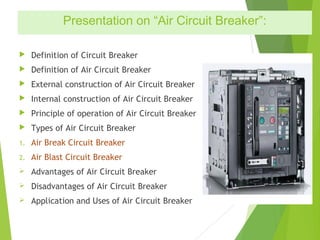
 Definition of Circuit Breaker
 Definition of Air Circuit Breaker
 External construction of Air Circuit Breaker
 Internal construction of Air Circuit Breaker
 Principle of operation of Air Circuit Breaker
 Types of Air Circuit Breaker
1. Air Break Circuit Breaker
2. Air Blast Circuit Breaker
 Advantages of Air Circuit Breaker
 Disadvantages of Air Circuit Breaker
 Application and Uses of Air Circuit Breaker
Definition of CIRCUIT BREAKER:
A circuit breaker is a device, which can-
 Make or Break a circuit manually or by remote
control under normal conditions
 Break a circuit automatically under fault conditions
(like over current, Short circuit, etc.)
A circuit breaker is used for switching mechanism
and protection of the system.
Other associated devices and components are also
used which associated with circuit breakers
like fuses, relays, switches etc.
Circuit breakers are widely used for protection of
different parts of the circuit like switchgears,
Transformers, Motors, Generators /Alternator etc.,
which leads the system stable and reliable.
Definition of Air Circuit Breaker:
 The type of circuit breaker, which operates in air at
atmospheric pressure, is known to be an Air Circuit
Breaker.
 Air circuit breaker has completely replaced by oil circuit
breaker.
 In different countries, still it is a preferable choice to
use an Air circuit breaker up to 15KV because, there is
no chance of oil fire like in oil circuit breaker.
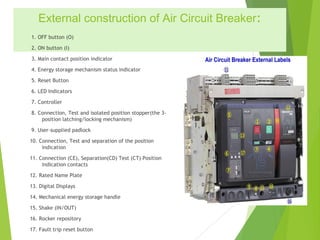
External construction of Air Circuit Breaker:
1. OFF button (O)
2. ON button (I)
3. Main contact position indicator
4. Energy storage mechanism status indicator
5. Reset Button
6. LED Indicators
7. Controller
8. Connection, Test and isolated position stopper(the 3-
position latching/locking mechanism)
9. User-supplied padlock
10. Connection, Test and separation of the position
indication
11. Connection (CE), Separation(CD) Test (CT) Position
indication contacts
12. Rated Name Plate
13. Digital Displays
14. Mechanical energy storage handle
15. Shake (IN/OUT)
16. Rocker repository
17. Fault trip reset button
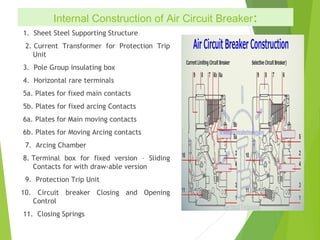
Internal Construction of Air Circuit Breaker:
1.  Sheet Steel Supporting Structure
2. Current Transformer for Protection Trip
Unit 
 3.  Pole Group insulating box
4.  Horizontal rare terminals
5a. Plates for fixed main contacts
5b. Plates for fixed arcing Contacts
6a. Plates for Main moving contacts
6b. Plates for Moving Arcing contacts
7.  Arcing Chamber
 8. Terminal box for fixed version – Sliding
Contacts for with draw-able version
9.  Protection Trip Unit
10. Circuit breaker Closing and Opening
Control
 11.  Closing Springs
Principle of Operation of Air Circuit Breaker:
 The working principle of Air Circuit breaker is rather different from
other types of circuit breaker.
 The main aim of circuit breaker is to prevent re-establishment of
arcing after current zero.
  During interruption of arc, it creates an arc voltage instead of supply
voltage.
 Arc voltage is defined as the minimum voltage required for
maintaining arc.
 The circuit breaker increases the voltage in three different ways:
1. The degree of ionization is decreases.
2. The length of the arc increases.
3. The area of contact of circuit breaker decreases.
Types of Air Circuit Breaker:
The Air Circuit Breaker are of Two types:
 1. Air break Circuit Breaker
 
 2. Air blast circuit breaker 
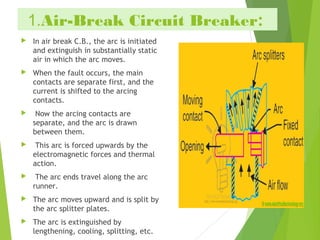
1.Air-Break Circuit Breaker: 
 In air break C.B., the arc is initiated
and extinguish in substantially static
air in which the arc moves.
 When the fault occurs, the main
contacts are separate first, and the
current is shifted to the arcing
contacts.
 Now the arcing contacts are
separate, and the arc is drawn
between them.
 This arc is forced upwards by the
electromagnetic forces and thermal
action.
 The arc ends travel along the arc
runner.
 The arc moves upward and is split by
the arc splitter plates.
 The arc is extinguished by
lengthening, cooling, splitting, etc.
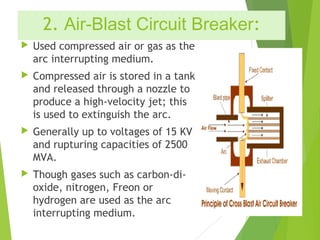
2. Air-Blast Circuit Breaker:
 Used compressed air or gas as the
arc interrupting medium.
 Compressed air is stored in a tank
and released through a nozzle to
produce a high-velocity jet; this
is used to extinguish the arc.
 Generally up to voltages of 15 KV
and rupturing capacities of 2500
MVA.
 Though gases such as carbon-di-
oxide, nitrogen, Freon or
hydrogen are used as the arc
interrupting medium.
Advantages of Air Circuit Breaker:
 Lesser arc energy requirement.
 The risk of fire is eliminated in
the operation.
 Speed of circuit breaker is much
higher during operation.
 Arc quenching is much faster.
 The duration of the arc is same
for all values of current.
 Stability of operation can be
maintained.
 Requires less maintenance.
Disadvantages of Air-Blast Circuit Breaker:
 The air supplier plant requires
additional maintenance.
 It contains high capacity air
compressor.
 There is a chance of air pressure
leakage from the air pipes junction.
 There is chance of a high rate rise of
re-striking voltage and current
chopping.
 The air has relatively lower arc
extinguishing properties
Application  and Uses of Air Circuit Breaker:
 It is used for protection of plants
 It is used for common protection of
electrical machines
 It used for protection of
transformers, capacitors and
generators.
 Air circuit breaker is also used in
Electricity sharing system and NGD
about 15kV
 Also used in Low as well as High
voltage and Currents applications  13Circuit Breaker
Air circuit breakers

Air circuit breakers

  • 1.
    Air Circuit Breaker BY: Prof.Prasant Kumar DePt. of electrical engineering
  • 2.
    Presentation on “AirCircuit Breaker”:  Definition of Circuit Breaker  Definition of Air Circuit Breaker  External construction of Air Circuit Breaker  Internal construction of Air Circuit Breaker  Principle of operation of Air Circuit Breaker  Types of Air Circuit Breaker 1. Air Break Circuit Breaker 2. Air Blast Circuit Breaker  Advantages of Air Circuit Breaker  Disadvantages of Air Circuit Breaker  Application and Uses of Air Circuit Breaker
  • 3.
    Definition of CIRCUITBREAKER: A circuit breaker is a device, which can-  Make or Break a circuit manually or by remote control under normal conditions  Break a circuit automatically under fault conditions (like over current, Short circuit, etc.) A circuit breaker is used for switching mechanism and protection of the system. Other associated devices and components are also used which associated with circuit breakers like fuses, relays, switches etc. Circuit breakers are widely used for protection of different parts of the circuit like switchgears, Transformers, Motors, Generators /Alternator etc., which leads the system stable and reliable.
  • 4.
    Definition of AirCircuit Breaker:  The type of circuit breaker, which operates in air at atmospheric pressure, is known to be an Air Circuit Breaker.  Air circuit breaker has completely replaced by oil circuit breaker.  In different countries, still it is a preferable choice to use an Air circuit breaker up to 15KV because, there is no chance of oil fire like in oil circuit breaker.
  • 5.
    External construction ofAir Circuit Breaker: 1. OFF button (O) 2. ON button (I) 3. Main contact position indicator 4. Energy storage mechanism status indicator 5. Reset Button 6. LED Indicators 7. Controller 8. Connection, Test and isolated position stopper(the 3- position latching/locking mechanism) 9. User-supplied padlock 10. Connection, Test and separation of the position indication 11. Connection (CE), Separation(CD) Test (CT) Position indication contacts 12. Rated Name Plate 13. Digital Displays 14. Mechanical energy storage handle 15. Shake (IN/OUT) 16. Rocker repository 17. Fault trip reset button
  • 6.
    Internal Construction ofAir Circuit Breaker: 1.  Sheet Steel Supporting Structure 2. Current Transformer for Protection Trip Unit   3.  Pole Group insulating box 4.  Horizontal rare terminals 5a. Plates for fixed main contacts 5b. Plates for fixed arcing Contacts 6a. Plates for Main moving contacts 6b. Plates for Moving Arcing contacts 7.  Arcing Chamber  8. Terminal box for fixed version – Sliding Contacts for with draw-able version 9.  Protection Trip Unit 10. Circuit breaker Closing and Opening Control  11.  Closing Springs
  • 7.
    Principle of Operationof Air Circuit Breaker:  The working principle of Air Circuit breaker is rather different from other types of circuit breaker.  The main aim of circuit breaker is to prevent re-establishment of arcing after current zero.   During interruption of arc, it creates an arc voltage instead of supply voltage.  Arc voltage is defined as the minimum voltage required for maintaining arc.  The circuit breaker increases the voltage in three different ways: 1. The degree of ionization is decreases. 2. The length of the arc increases. 3. The area of contact of circuit breaker decreases.
  • 8.
    Types of AirCircuit Breaker: The Air Circuit Breaker are of Two types:  1. Air break Circuit Breaker    2. Air blast circuit breaker 
  • 9.
    1.Air-Break Circuit Breaker:  In air break C.B., the arc is initiated and extinguish in substantially static air in which the arc moves.  When the fault occurs, the main contacts are separate first, and the current is shifted to the arcing contacts.  Now the arcing contacts are separate, and the arc is drawn between them.  This arc is forced upwards by the electromagnetic forces and thermal action.  The arc ends travel along the arc runner.  The arc moves upward and is split by the arc splitter plates.  The arc is extinguished by lengthening, cooling, splitting, etc.
  • 10.
    2. Air-Blast CircuitBreaker:  Used compressed air or gas as the arc interrupting medium.  Compressed air is stored in a tank and released through a nozzle to produce a high-velocity jet; this is used to extinguish the arc.  Generally up to voltages of 15 KV and rupturing capacities of 2500 MVA.  Though gases such as carbon-di- oxide, nitrogen, Freon or hydrogen are used as the arc interrupting medium.
  • 11.
    Advantages of AirCircuit Breaker:  Lesser arc energy requirement.  The risk of fire is eliminated in the operation.  Speed of circuit breaker is much higher during operation.  Arc quenching is much faster.  The duration of the arc is same for all values of current.  Stability of operation can be maintained.  Requires less maintenance.
  • 12.
    Disadvantages of Air-BlastCircuit Breaker:  The air supplier plant requires additional maintenance.  It contains high capacity air compressor.  There is a chance of air pressure leakage from the air pipes junction.  There is chance of a high rate rise of re-striking voltage and current chopping.  The air has relatively lower arc extinguishing properties
  • 13.
    Application  and Usesof Air Circuit Breaker:  It is used for protection of plants  It is used for common protection of electrical machines  It used for protection of transformers, capacitors and generators.  Air circuit breaker is also used in Electricity sharing system and NGD about 15kV  Also used in Low as well as High voltage and Currents applications  13Circuit Breaker