1
Distributed Data Management
Distributed Systems
Department of Computer Science
UC Irvine
2
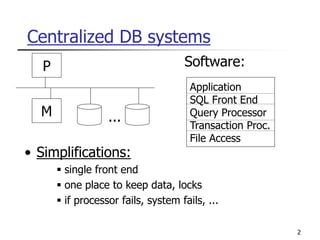
Centralized DB systems
Software:
Application
SQL Front End
Query Processor
Transaction Proc.
File Access
P
M ...
• Simplifications:
 single front end
 one place to keep data, locks
 if processor fails, system fails, ...
3
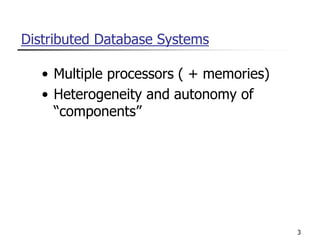
Distributed Database Systems
• Multiple processors ( + memories)
• Heterogeneity and autonomy of
“components”
4
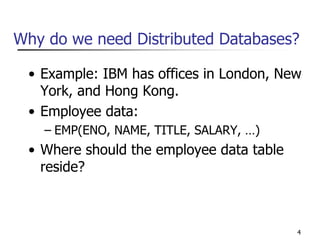
Why do we need Distributed Databases?
• Example: IBM has offices in London, New
York, and Hong Kong.
• Employee data:
– EMP(ENO, NAME, TITLE, SALARY, …)
• Where should the employee data table
reside?
5
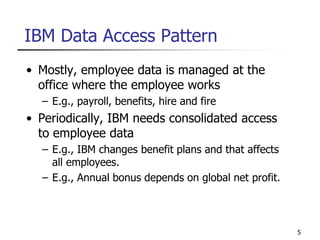
IBM Data Access Pattern
• Mostly, employee data is managed at the
office where the employee works
– E.g., payroll, benefits, hire and fire
• Periodically, IBM needs consolidated access
to employee data
– E.g., IBM changes benefit plans and that affects
all employees.
– E.g., Annual bonus depends on global net profit.
6
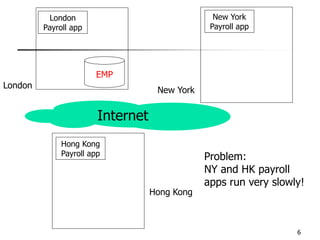
EMP
Internet
London
Payroll app
London
New York
Payroll app
New York
Hong Kong
Payroll app
Hong Kong
Problem:
NY and HK payroll
apps run very slowly!
7
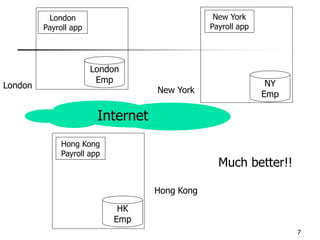
London
Emp
Internet
London
Payroll app
London
New York
Payroll app
New York
Hong Kong
Payroll app
Hong Kong
HK
Emp
NY
Emp
Much better!!
8
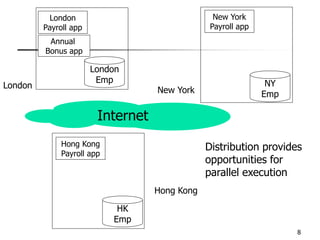
Internet
London
Payroll app
Annual
Bonus app
London
New York
Payroll app
New York
Hong Kong
Payroll app
Hong Kong
London
Emp NY
Emp
HK
Emp
Distribution provides
opportunities for
parallel execution
9
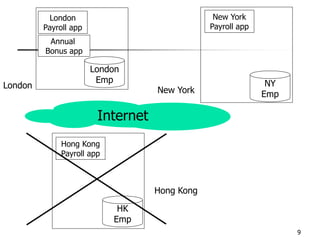
Internet
London
Payroll app
Annual
Bonus app
London
New York
Payroll app
New York
Hong Kong
Payroll app
Hong Kong
London
Emp NY
Emp
HK
Emp
10
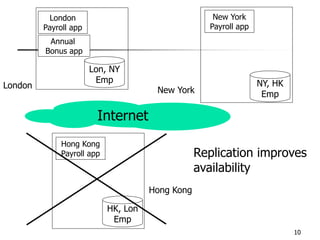
Internet
London
Payroll app
Annual
Bonus app
London
New York
Payroll app
New York
Hong Kong
Payroll app
Hong Kong
Lon, NY
Emp NY, HK
Emp
HK, Lon
Emp
Replication improves
availability
Homogeneous Distributed Databases
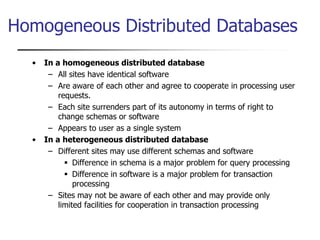
• In a homogeneous distributed database
– All sites have identical software
– Are aware of each other and agree to cooperate in processing user
requests.
– Each site surrenders part of its autonomy in terms of right to
change schemas or software
– Appears to user as a single system
• In a heterogeneous distributed database
– Different sites may use different schemas and software
 Difference in schema is a major problem for query processing
 Difference in software is a major problem for transaction
processing
– Sites may not be aware of each other and may provide only
limited facilities for cooperation in transaction processing
12
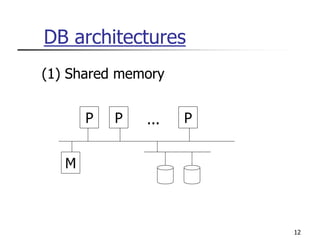
DB architectures
(1) Shared memory
P P P
...
M
13
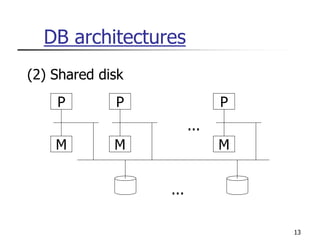
DB architectures
(2) Shared disk
...
...
P
M
P P
M M
14
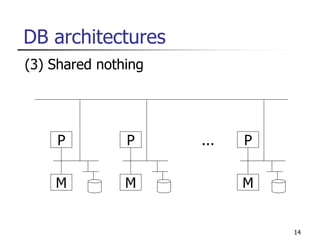
DB architectures
(3) Shared nothing
P
M
P
M
P
M
...
15
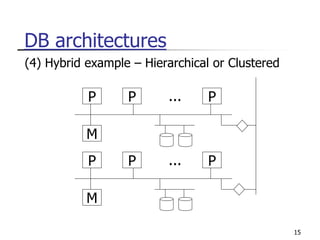
DB architectures
(4) Hybrid example – Hierarchical or Clustered
M
P P P
...
M
P P P
...
16
Issues for selecting architecture
• Reliability
• Scalability
• Geographic distribution of data
• Performance
• Cost
17
Parallel or distributed DB system?
• More similarities than differences!
18
• Typically, parallel DBs:
– Fast interconnect
– Homogeneous software
– High performance is goal
– Transparency is goal
19
• Typically, distributed DBs:
– Geographically distributed
– Data sharing is goal (may run into
heterogeneity, autonomy)
– Disconnected operation possible
20
Distributed Database Challenges
• Distributed Database Design
– Deciding what data goes where
– Depends on data access patterns of major
applications
– Two subproblems:
 Fragmentation: partition tables into fragments
 Allocation: allocate fragments to nodes
Distributed Data Storage
• Assume relational data model
• Replication
– System maintains multiple copies of data, stored in
different sites, for faster retrieval and fault tolerance.
• Fragmentation
– Relation is partitioned into several fragments stored in
distinct sites
• Replication and fragmentation can be combined
– Relation is partitioned into several fragments: system
maintains several identical replicas of each such
fragment.
Data Replication
• A relation or fragment of a relation is replicated
if it is stored redundantly in two or more sites.
• Full replication of a relation is the case where the
relation is stored at all sites.
• Fully redundant databases are those in which
every site contains a copy of the entire database.
Data Replication (Cont.)
• Advantages of Replication
– Availability: failure of site containing relation r does not result
in unavailability of r is replicas exist.
– Parallelism: queries on r may be processed by several nodes in
parallel.
– Reduced data transfer: relation r is available locally at each
site containing a replica of r.
• Disadvantages of Replication
– Increased cost of updates: each replica of relation r must be
updated.
– Increased complexity of concurrency control: concurrent updates
to distinct replicas may lead to inconsistent data unless special
concurrency control mechanisms are implemented.
 One solution: choose one copy as primary copy and apply
concurrency control operations on primary copy
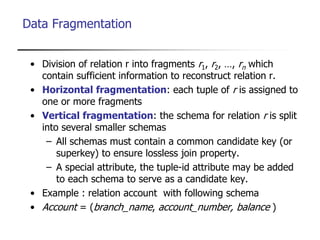
Data Fragmentation
• Division of relation r into fragments r1, r2, …, rn which
contain sufficient information to reconstruct relation r.
• Horizontal fragmentation: each tuple of r is assigned to
one or more fragments
• Vertical fragmentation: the schema for relation r is split
into several smaller schemas
– All schemas must contain a common candidate key (or
superkey) to ensure lossless join property.
– A special attribute, the tuple-id attribute may be added
to each schema to serve as a candidate key.
• Example : relation account with following schema
• Account = (branch_name, account_number, balance )
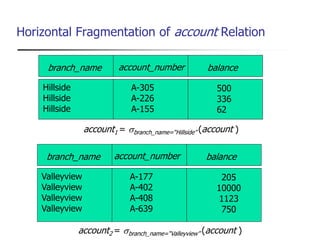
Horizontal Fragmentation of account Relation
branch_name account_number balance
Hillside
Hillside
Hillside
A-305
A-226
A-155
500
336
62
account1 = branch_name=“Hillside” (account )
branch_name account_number balance
Valleyview
Valleyview
Valleyview
Valleyview
A-177
A-402
A-408
A-639
205
10000
1123
750
account2 = branch_name=“Valleyview” (account )
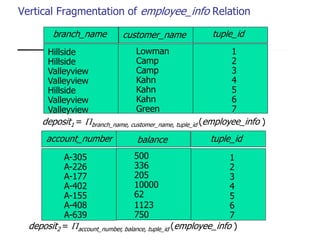
Vertical Fragmentation of employee_info Relation
branch_name customer_name tuple_id
Hillside
Hillside
Valleyview
Valleyview
Hillside
Valleyview
Valleyview
Lowman
Camp
Camp
Kahn
Kahn
Kahn
Green
deposit1 = branch_name, customer_name, tuple_id (employee_info )
1
2
3
4
5
6
7
account_number balance tuple_id
500
336
205
10000
62
1123
750
1
2
3
4
5
6
7
A-305
A-226
A-177
A-402
A-155
A-408
A-639
deposit2 = account_number, balance, tuple_id (employee_info )
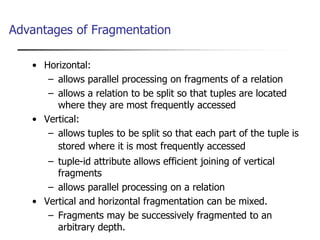
Advantages of Fragmentation
• Horizontal:
– allows parallel processing on fragments of a relation
– allows a relation to be split so that tuples are located
where they are most frequently accessed
• Vertical:
– allows tuples to be split so that each part of the tuple is
stored where it is most frequently accessed
– tuple-id attribute allows efficient joining of vertical
fragments
– allows parallel processing on a relation
• Vertical and horizontal fragmentation can be mixed.
– Fragments may be successively fragmented to an
arbitrary depth.
Data Transparency
• Data transparency: Degree to which system
user may remain unaware of the details of how
and where the data items are stored in a
distributed system
• Consider transparency issues in relation to:
– Fragmentation transparency
– Replication transparency
– Location transparency
Naming of Data Items - Criteria
1. Every data item must have a system-wide
unique name.
2. It should be possible to find the location of data
items efficiently.
3. It should be possible to change the location of
data items transparently.
4. Each site should be able to create new data
items autonomously.
Centralized Scheme - Name Server
• Structure:
– name server assigns all names
– each site maintains a record of local data items
– sites ask name server to locate non-local data items
• Advantages:
– satisfies naming criteria 1-3
• Disadvantages:
– does not satisfy naming criterion 4
– name server is a potential performance bottleneck
– name server is a single point of failure
Use of Aliases
• Alternative to centralized scheme: each site prefixes
its own site identifier to any name that it generates
i.e., site 17.account.
– Fulfills having a unique identifier, and avoids
problems associated with central control.
– However, fails to achieve network transparency.
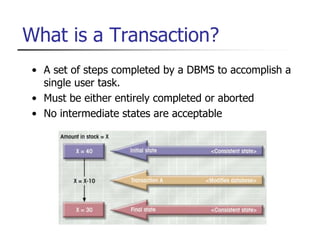
• A set of steps completed by a DBMS to accomplish a
single user task.
• Must be either entirely completed or aborted
• No intermediate states are acceptable
What is a Transaction?
Distributed Transactions
• Transaction may access data at several sites.
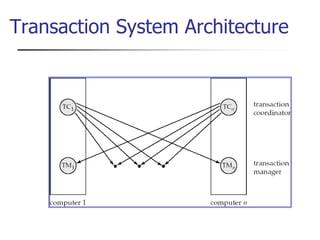
• Each site has a local transaction manager responsible for:
– Maintaining a log for recovery purposes
– Participating in coordinating the concurrent execution
of the transactions executing at that site.
• Each site has a transaction coordinator, which is
responsible for:
– Starting the execution of transactions that originate at the
site.
– Distributing subtransactions at appropriate sites for
execution.
– Coordinating the termination of each transaction that
originates at the site, which may result in the transaction
being committed at all sites or aborted at all sites.
Transaction System Architecture
System Failure Modes
• Failures unique to distributed systems:
– Failure of a site.
– Loss of massages
 Handled by network transmission control protocols such
as TCP-IP
– Failure of a communication link
 Handled by network protocols, by routing messages via
alternative links
– Network partition
 A network is said to be partitioned when it has
been split into two or more subsystems that lack
any connection between them
 Note: a subsystem may consist of a single node
• Network partitioning and site failures are generally
indistinguishable.
.
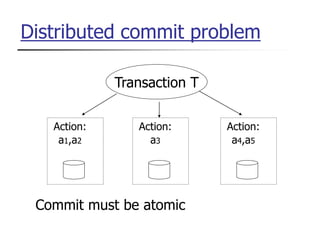
Distributed commit problem
Action:
a1,a2
Action:
a3
Action:
a4,a5
Transaction T
Commit must be atomic
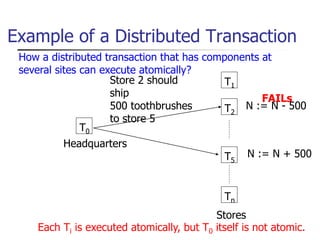
Example of a Distributed Transaction
Headquarters
T0
T1
Tn
T2
Stores
T5
Store 2 should
ship
500 toothbrushes
to store 5
N := N - 500
N := N + 500
Each Ti is executed atomically, but T0 itself is not atomic.
How a distributed transaction that has components at
several sites can execute atomically?
FAILs
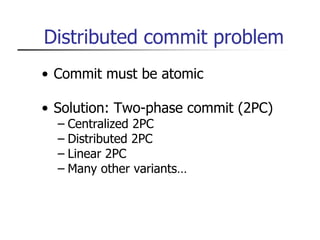
Distributed commit problem
• Commit must be atomic
• Solution: Two-phase commit (2PC)
– Centralized 2PC
– Distributed 2PC
– Linear 2PC
– Many other variants…
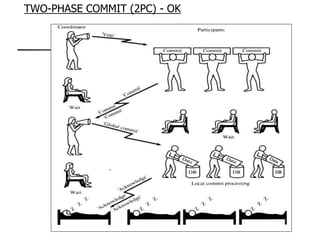
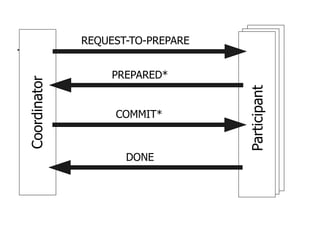
TWO-PHASE COMMIT (2PC) - OK
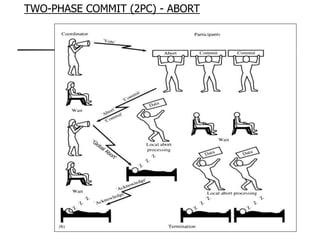
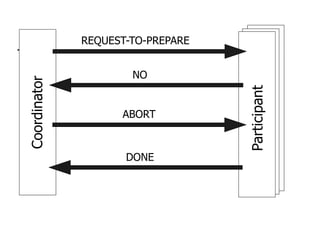
TWO-PHASE COMMIT (2PC) - ABORT
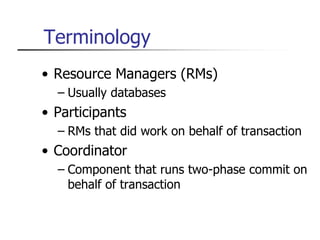
Terminology
• Resource Managers (RMs)
– Usually databases
• Participants
– RMs that did work on behalf of transaction
• Coordinator
– Component that runs two-phase commit on
behalf of transaction
Coordinator
Participant
REQUEST-TO-PREPARE
PREPARED*
COMMIT*
DONE
Coordinator
Participant
REQUEST-TO-PREPARE
NO
ABORT
DONE
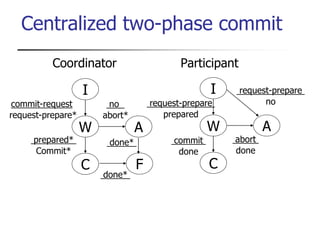
Centralized two-phase commit
Coordinator Participant
I
W
C
A
I
W
C
A
commit-request
request-prepare*
no
abort*
prepared*
Commit*
commit
done
request-prepare
prepared
request-prepare
no
abort
done
F
done*
done*
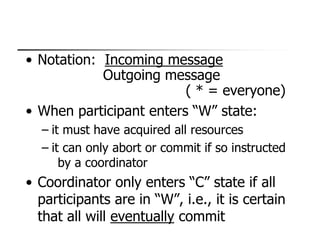
• Notation: Incoming message
Outgoing message
( * = everyone)
• When participant enters “W” state:
– it must have acquired all resources
– it can only abort or commit if so instructed
by a coordinator
• Coordinator only enters “C” state if all
participants are in “W”, i.e., it is certain
that all will eventually commit
• After coordinator receives DONE
message, it can forget about the
transaction
– E.g., cleanup control structures
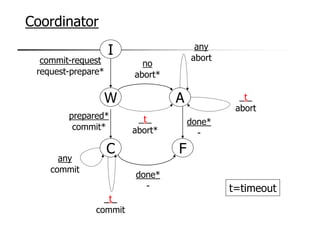
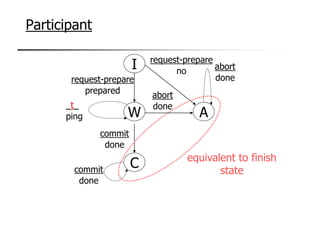
• Add timeouts to cope with messages
lost during crashes
Next
Coordinator
I
W
C
A
F
commit-request
request-prepare*
done*
-
done*
-
_t_
abort
any
abort
any
commit
_t_
commit
_t_
abort*
no
abort*
prepared*
commit*
t=timeout
Participant
I
W
C
A
request-prepare
prepared
equivalent to finish
state
_t_
ping
abort
done
commit
done
request-prepare
no
commit
done
abort
done
Distributed Query Processing
• For centralized systems, the primary criterion for
measuring the cost of a particular strategy is the
number of disk accesses.
• In a distributed system, other issues must be taken
into account:
– The cost of a data transmission over the network.
– The potential gain in performance from having
several sites process parts of the query in parallel.
Problem Statement
• Input: Query
How many times has the moon circled around
the earth in the last twenty years?
• Output: Answer
240!
• Objectives:
– response time, throughput, first answers, little
IO, ...
• Centralized vs. Distributed Query Processing
– same problem
– but, different parameters and objectives
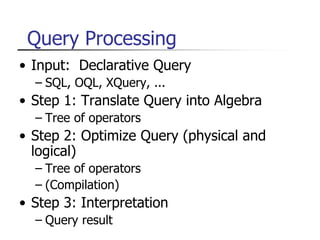
Query Processing
• Input: Declarative Query
– SQL, OQL, XQuery, ...
• Step 1: Translate Query into Algebra
– Tree of operators
• Step 2: Optimize Query (physical and
logical)
– Tree of operators
– (Compilation)
• Step 3: Interpretation
– Query result
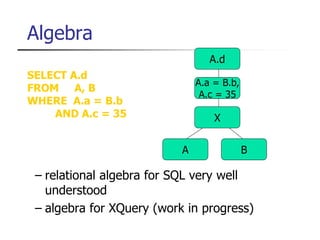
Algebra
– relational algebra for SQL very well
understood
– algebra for XQuery (work in progress)
SELECT A.d
FROM A, B
WHERE A.a = B.b
AND A.c = 35
A.d
A.a = B.b,
A.c = 35
X
A B
Query Optimization
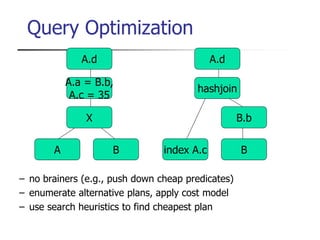
– no brainers (e.g., push down cheap predicates)
– enumerate alternative plans, apply cost model
– use search heuristics to find cheapest plan
A.d
A.a = B.b,
A.c = 35
X
A B
A.d
hashjoin
B.b
index A.c B
Query Execution
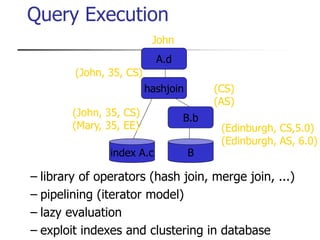
– library of operators (hash join, merge join, ...)
– pipelining (iterator model)
– lazy evaluation
– exploit indexes and clustering in database
A.d
hashjoin
B.b
index A.c B
(John, 35, CS)
(Mary, 35, EE) (Edinburgh, CS,5.0)
(Edinburgh, AS, 6.0)
(CS)
(AS)
(John, 35, CS)
John
Distributed Query Processing
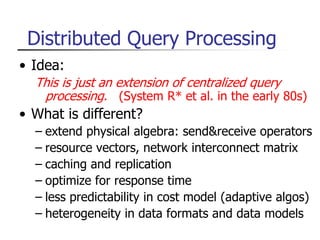
• Idea:
This is just an extension of centralized query
processing. (System R* et al. in the early 80s)
• What is different?
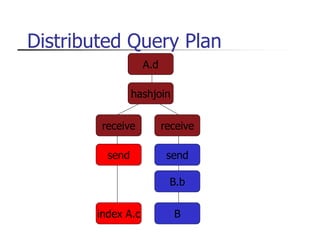
– extend physical algebra: send&receive operators
– resource vectors, network interconnect matrix
– caching and replication
– optimize for response time
– less predictability in cost model (adaptive algos)
– heterogeneity in data formats and data models
Distributed Query Plan
A.d
hashjoin
B.b
index A.c B
receive receive
send send
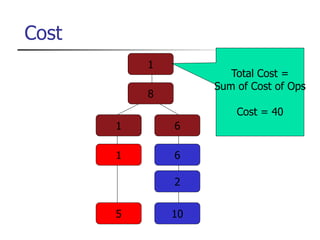
Cost
1
8
2
5 10
1 6
1 6
Total Cost =
Sum of Cost of Ops
Cost = 40
Query Transformation
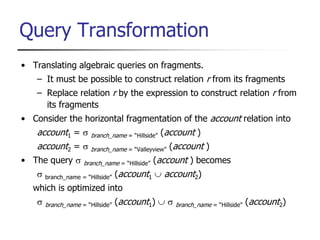
• Translating algebraic queries on fragments.
– It must be possible to construct relation r from its fragments
– Replace relation r by the expression to construct relation r from
its fragments
• Consider the horizontal fragmentation of the account relation into
account1 =  branch_name = “Hillside” (account )
account2 =  branch_name = “Valleyview” (account )
• The query  branch_name = “Hillside” (account ) becomes
 branch_name = “Hillside” (account1  account2)
which is optimized into
 branch_name = “Hillside” (account1)   branch_name = “Hillside” (account2)
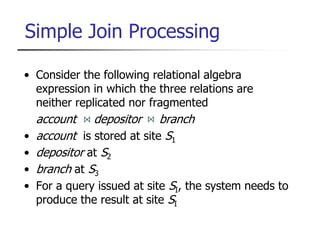
Simple Join Processing
• Consider the following relational algebra
expression in which the three relations are
neither replicated nor fragmented
account depositor branch
• account is stored at site S1
• depositor at S2
• branch at S3
• For a query issued at site SI, the system needs to
produce the result at site SI
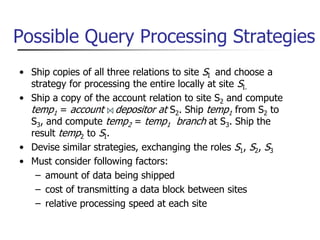
Possible Query Processing Strategies
• Ship copies of all three relations to site SI and choose a
strategy for processing the entire locally at site SI.
• Ship a copy of the account relation to site S2 and compute
temp1 = account depositor at S2. Ship temp1 from S2 to
S3, and compute temp2 = temp1 branch at S3. Ship the
result temp2 to SI.
• Devise similar strategies, exchanging the roles S1, S2, S3
• Must consider following factors:
– amount of data being shipped
– cost of transmitting a data block between sites
– relative processing speed at each site
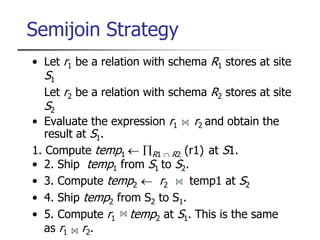
Semijoin Strategy
• Let r1 be a relation with schema R1 stores at site
S1
Let r2 be a relation with schema R2 stores at site
S2
• Evaluate the expression r1 r2 and obtain the
result at S1.
1. Compute temp1  R1  R2 (r1) at S1.
• 2. Ship temp1 from S1 to S2.
• 3. Compute temp2  r2 temp1 at S2
• 4. Ship temp2 from S2 to S1.
• 5. Compute r1 temp2 at S1. This is the same
as r1 r2.
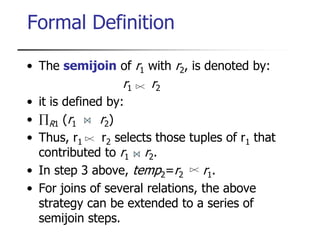
Formal Definition
• The semijoin of r1 with r2, is denoted by:
r1 r2
• it is defined by:
• R1 (r1 r2)
• Thus, r1 r2 selects those tuples of r1 that
contributed to r1 r2.
• In step 3 above, temp2=r2 r1.
• For joins of several relations, the above
strategy can be extended to a series of
semijoin steps.
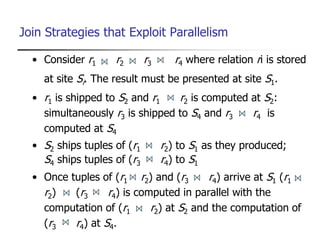
Join Strategies that Exploit Parallelism
• Consider r1 r2 r3 r4 where relation ri is stored
at site Si. The result must be presented at site S1.
• r1 is shipped to S2 and r1 r2 is computed at S2:
simultaneously r3 is shipped to S4 and r3 r4 is
computed at S4
• S2 ships tuples of (r1 r2) to S1 as they produced;
S4 ships tuples of (r3 r4) to S1
• Once tuples of (r1 r2) and (r3 r4) arrive at S1 (r1
r2) (r3 r4) is computed in parallel with the
computation of (r1 r2) at S2 and the computation of
(r3 r4) at S4.
Conclusion- Advantages of DDBMSs
• Reflects organizational structure
• Improved shareability and local autonomy
• Improved availability
• Improved reliability
• Improved performance
• Economics
• Modular growth
 Architectural complexity
 Cost
 Security
 Integrity control more difficult
 Lack of standards
 Lack of experience
 Database design more complex
Conclusion- Disadvantages of DDBMSs
References
• Chapter 22 of database systems concepts
(Silberschatz book)
• ICS courses on DBMS: CS222, CS223

Distributed Database Management System - Introduction

  • 1.
    1 Distributed Data Management DistributedSystems Department of Computer Science UC Irvine
  • 2.
    2 Centralized DB systems Software: Application SQLFront End Query Processor Transaction Proc. File Access P M ... • Simplifications:  single front end  one place to keep data, locks  if processor fails, system fails, ...
  • 3.
    3 Distributed Database Systems •Multiple processors ( + memories) • Heterogeneity and autonomy of “components”
  • 4.
    4 Why do weneed Distributed Databases? • Example: IBM has offices in London, New York, and Hong Kong. • Employee data: – EMP(ENO, NAME, TITLE, SALARY, …) • Where should the employee data table reside?
  • 5.
    5 IBM Data AccessPattern • Mostly, employee data is managed at the office where the employee works – E.g., payroll, benefits, hire and fire • Periodically, IBM needs consolidated access to employee data – E.g., IBM changes benefit plans and that affects all employees. – E.g., Annual bonus depends on global net profit.
  • 6.
    6 EMP Internet London Payroll app London New York Payrollapp New York Hong Kong Payroll app Hong Kong Problem: NY and HK payroll apps run very slowly!
  • 7.
    7 London Emp Internet London Payroll app London New York Payrollapp New York Hong Kong Payroll app Hong Kong HK Emp NY Emp Much better!!
  • 8.
    8 Internet London Payroll app Annual Bonus app London NewYork Payroll app New York Hong Kong Payroll app Hong Kong London Emp NY Emp HK Emp Distribution provides opportunities for parallel execution
  • 9.
    9 Internet London Payroll app Annual Bonus app London NewYork Payroll app New York Hong Kong Payroll app Hong Kong London Emp NY Emp HK Emp
  • 10.
    10 Internet London Payroll app Annual Bonus app London NewYork Payroll app New York Hong Kong Payroll app Hong Kong Lon, NY Emp NY, HK Emp HK, Lon Emp Replication improves availability
  • 11.
    Homogeneous Distributed Databases •In a homogeneous distributed database – All sites have identical software – Are aware of each other and agree to cooperate in processing user requests. – Each site surrenders part of its autonomy in terms of right to change schemas or software – Appears to user as a single system • In a heterogeneous distributed database – Different sites may use different schemas and software  Difference in schema is a major problem for query processing  Difference in software is a major problem for transaction processing – Sites may not be aware of each other and may provide only limited facilities for cooperation in transaction processing
  • 12.
  • 13.
    13 DB architectures (2) Shareddisk ... ... P M P P M M
  • 14.
    14 DB architectures (3) Sharednothing P M P M P M ...
  • 15.
    15 DB architectures (4) Hybridexample – Hierarchical or Clustered M P P P ... M P P P ...
  • 16.
    16 Issues for selectingarchitecture • Reliability • Scalability • Geographic distribution of data • Performance • Cost
  • 17.
    17 Parallel or distributedDB system? • More similarities than differences!
  • 18.
    18 • Typically, parallelDBs: – Fast interconnect – Homogeneous software – High performance is goal – Transparency is goal
  • 19.
    19 • Typically, distributedDBs: – Geographically distributed – Data sharing is goal (may run into heterogeneity, autonomy) – Disconnected operation possible
  • 20.
    20 Distributed Database Challenges •Distributed Database Design – Deciding what data goes where – Depends on data access patterns of major applications – Two subproblems:  Fragmentation: partition tables into fragments  Allocation: allocate fragments to nodes
  • 21.
    Distributed Data Storage •Assume relational data model • Replication – System maintains multiple copies of data, stored in different sites, for faster retrieval and fault tolerance. • Fragmentation – Relation is partitioned into several fragments stored in distinct sites • Replication and fragmentation can be combined – Relation is partitioned into several fragments: system maintains several identical replicas of each such fragment.
  • 22.
    Data Replication • Arelation or fragment of a relation is replicated if it is stored redundantly in two or more sites. • Full replication of a relation is the case where the relation is stored at all sites. • Fully redundant databases are those in which every site contains a copy of the entire database.
  • 23.
    Data Replication (Cont.) •Advantages of Replication – Availability: failure of site containing relation r does not result in unavailability of r is replicas exist. – Parallelism: queries on r may be processed by several nodes in parallel. – Reduced data transfer: relation r is available locally at each site containing a replica of r. • Disadvantages of Replication – Increased cost of updates: each replica of relation r must be updated. – Increased complexity of concurrency control: concurrent updates to distinct replicas may lead to inconsistent data unless special concurrency control mechanisms are implemented.  One solution: choose one copy as primary copy and apply concurrency control operations on primary copy
  • 24.
    Data Fragmentation • Divisionof relation r into fragments r1, r2, …, rn which contain sufficient information to reconstruct relation r. • Horizontal fragmentation: each tuple of r is assigned to one or more fragments • Vertical fragmentation: the schema for relation r is split into several smaller schemas – All schemas must contain a common candidate key (or superkey) to ensure lossless join property. – A special attribute, the tuple-id attribute may be added to each schema to serve as a candidate key. • Example : relation account with following schema • Account = (branch_name, account_number, balance )
  • 25.
    Horizontal Fragmentation ofaccount Relation branch_name account_number balance Hillside Hillside Hillside A-305 A-226 A-155 500 336 62 account1 = branch_name=“Hillside” (account ) branch_name account_number balance Valleyview Valleyview Valleyview Valleyview A-177 A-402 A-408 A-639 205 10000 1123 750 account2 = branch_name=“Valleyview” (account )
  • 26.
    Vertical Fragmentation ofemployee_info Relation branch_name customer_name tuple_id Hillside Hillside Valleyview Valleyview Hillside Valleyview Valleyview Lowman Camp Camp Kahn Kahn Kahn Green deposit1 = branch_name, customer_name, tuple_id (employee_info ) 1 2 3 4 5 6 7 account_number balance tuple_id 500 336 205 10000 62 1123 750 1 2 3 4 5 6 7 A-305 A-226 A-177 A-402 A-155 A-408 A-639 deposit2 = account_number, balance, tuple_id (employee_info )
  • 27.
    Advantages of Fragmentation •Horizontal: – allows parallel processing on fragments of a relation – allows a relation to be split so that tuples are located where they are most frequently accessed • Vertical: – allows tuples to be split so that each part of the tuple is stored where it is most frequently accessed – tuple-id attribute allows efficient joining of vertical fragments – allows parallel processing on a relation • Vertical and horizontal fragmentation can be mixed. – Fragments may be successively fragmented to an arbitrary depth.
  • 28.
    Data Transparency • Datatransparency: Degree to which system user may remain unaware of the details of how and where the data items are stored in a distributed system • Consider transparency issues in relation to: – Fragmentation transparency – Replication transparency – Location transparency
  • 29.
    Naming of DataItems - Criteria 1. Every data item must have a system-wide unique name. 2. It should be possible to find the location of data items efficiently. 3. It should be possible to change the location of data items transparently. 4. Each site should be able to create new data items autonomously.
  • 30.
    Centralized Scheme -Name Server • Structure: – name server assigns all names – each site maintains a record of local data items – sites ask name server to locate non-local data items • Advantages: – satisfies naming criteria 1-3 • Disadvantages: – does not satisfy naming criterion 4 – name server is a potential performance bottleneck – name server is a single point of failure
  • 31.
    Use of Aliases •Alternative to centralized scheme: each site prefixes its own site identifier to any name that it generates i.e., site 17.account. – Fulfills having a unique identifier, and avoids problems associated with central control. – However, fails to achieve network transparency.
  • 32.
    • A setof steps completed by a DBMS to accomplish a single user task. • Must be either entirely completed or aborted • No intermediate states are acceptable What is a Transaction?
  • 33.
    Distributed Transactions • Transactionmay access data at several sites. • Each site has a local transaction manager responsible for: – Maintaining a log for recovery purposes – Participating in coordinating the concurrent execution of the transactions executing at that site. • Each site has a transaction coordinator, which is responsible for: – Starting the execution of transactions that originate at the site. – Distributing subtransactions at appropriate sites for execution. – Coordinating the termination of each transaction that originates at the site, which may result in the transaction being committed at all sites or aborted at all sites.
  • 34.
  • 35.
    System Failure Modes •Failures unique to distributed systems: – Failure of a site. – Loss of massages  Handled by network transmission control protocols such as TCP-IP – Failure of a communication link  Handled by network protocols, by routing messages via alternative links – Network partition  A network is said to be partitioned when it has been split into two or more subsystems that lack any connection between them  Note: a subsystem may consist of a single node • Network partitioning and site failures are generally indistinguishable.
  • 36.
  • 37.
    Example of aDistributed Transaction Headquarters T0 T1 Tn T2 Stores T5 Store 2 should ship 500 toothbrushes to store 5 N := N - 500 N := N + 500 Each Ti is executed atomically, but T0 itself is not atomic. How a distributed transaction that has components at several sites can execute atomically? FAILs
  • 38.
    Distributed commit problem •Commit must be atomic • Solution: Two-phase commit (2PC) – Centralized 2PC – Distributed 2PC – Linear 2PC – Many other variants…
  • 39.
  • 40.
  • 41.
    Terminology • Resource Managers(RMs) – Usually databases • Participants – RMs that did work on behalf of transaction • Coordinator – Component that runs two-phase commit on behalf of transaction
  • 42.
  • 43.
  • 44.
    Centralized two-phase commit CoordinatorParticipant I W C A I W C A commit-request request-prepare* no abort* prepared* Commit* commit done request-prepare prepared request-prepare no abort done F done* done*
  • 45.
    • Notation: Incomingmessage Outgoing message ( * = everyone) • When participant enters “W” state: – it must have acquired all resources – it can only abort or commit if so instructed by a coordinator • Coordinator only enters “C” state if all participants are in “W”, i.e., it is certain that all will eventually commit
  • 46.
    • After coordinatorreceives DONE message, it can forget about the transaction – E.g., cleanup control structures
  • 47.
    • Add timeoutsto cope with messages lost during crashes Next
  • 48.
  • 49.
  • 50.
    Distributed Query Processing •For centralized systems, the primary criterion for measuring the cost of a particular strategy is the number of disk accesses. • In a distributed system, other issues must be taken into account: – The cost of a data transmission over the network. – The potential gain in performance from having several sites process parts of the query in parallel.
  • 51.
    Problem Statement • Input:Query How many times has the moon circled around the earth in the last twenty years? • Output: Answer 240! • Objectives: – response time, throughput, first answers, little IO, ... • Centralized vs. Distributed Query Processing – same problem – but, different parameters and objectives
  • 52.
    Query Processing • Input:Declarative Query – SQL, OQL, XQuery, ... • Step 1: Translate Query into Algebra – Tree of operators • Step 2: Optimize Query (physical and logical) – Tree of operators – (Compilation) • Step 3: Interpretation – Query result
  • 53.
    Algebra – relational algebrafor SQL very well understood – algebra for XQuery (work in progress) SELECT A.d FROM A, B WHERE A.a = B.b AND A.c = 35 A.d A.a = B.b, A.c = 35 X A B
  • 54.
    Query Optimization – nobrainers (e.g., push down cheap predicates) – enumerate alternative plans, apply cost model – use search heuristics to find cheapest plan A.d A.a = B.b, A.c = 35 X A B A.d hashjoin B.b index A.c B
  • 55.
    Query Execution – libraryof operators (hash join, merge join, ...) – pipelining (iterator model) – lazy evaluation – exploit indexes and clustering in database A.d hashjoin B.b index A.c B (John, 35, CS) (Mary, 35, EE) (Edinburgh, CS,5.0) (Edinburgh, AS, 6.0) (CS) (AS) (John, 35, CS) John
  • 56.
    Distributed Query Processing •Idea: This is just an extension of centralized query processing. (System R* et al. in the early 80s) • What is different? – extend physical algebra: send&receive operators – resource vectors, network interconnect matrix – caching and replication – optimize for response time – less predictability in cost model (adaptive algos) – heterogeneity in data formats and data models
  • 57.
    Distributed Query Plan A.d hashjoin B.b indexA.c B receive receive send send
  • 58.
    Cost 1 8 2 5 10 1 6 16 Total Cost = Sum of Cost of Ops Cost = 40
  • 59.
    Query Transformation • Translatingalgebraic queries on fragments. – It must be possible to construct relation r from its fragments – Replace relation r by the expression to construct relation r from its fragments • Consider the horizontal fragmentation of the account relation into account1 =  branch_name = “Hillside” (account ) account2 =  branch_name = “Valleyview” (account ) • The query  branch_name = “Hillside” (account ) becomes  branch_name = “Hillside” (account1  account2) which is optimized into  branch_name = “Hillside” (account1)   branch_name = “Hillside” (account2)
  • 60.
    Simple Join Processing •Consider the following relational algebra expression in which the three relations are neither replicated nor fragmented account depositor branch • account is stored at site S1 • depositor at S2 • branch at S3 • For a query issued at site SI, the system needs to produce the result at site SI
  • 61.
    Possible Query ProcessingStrategies • Ship copies of all three relations to site SI and choose a strategy for processing the entire locally at site SI. • Ship a copy of the account relation to site S2 and compute temp1 = account depositor at S2. Ship temp1 from S2 to S3, and compute temp2 = temp1 branch at S3. Ship the result temp2 to SI. • Devise similar strategies, exchanging the roles S1, S2, S3 • Must consider following factors: – amount of data being shipped – cost of transmitting a data block between sites – relative processing speed at each site
  • 62.
    Semijoin Strategy • Letr1 be a relation with schema R1 stores at site S1 Let r2 be a relation with schema R2 stores at site S2 • Evaluate the expression r1 r2 and obtain the result at S1. 1. Compute temp1  R1  R2 (r1) at S1. • 2. Ship temp1 from S1 to S2. • 3. Compute temp2  r2 temp1 at S2 • 4. Ship temp2 from S2 to S1. • 5. Compute r1 temp2 at S1. This is the same as r1 r2.
  • 63.
    Formal Definition • Thesemijoin of r1 with r2, is denoted by: r1 r2 • it is defined by: • R1 (r1 r2) • Thus, r1 r2 selects those tuples of r1 that contributed to r1 r2. • In step 3 above, temp2=r2 r1. • For joins of several relations, the above strategy can be extended to a series of semijoin steps.
  • 64.
    Join Strategies thatExploit Parallelism • Consider r1 r2 r3 r4 where relation ri is stored at site Si. The result must be presented at site S1. • r1 is shipped to S2 and r1 r2 is computed at S2: simultaneously r3 is shipped to S4 and r3 r4 is computed at S4 • S2 ships tuples of (r1 r2) to S1 as they produced; S4 ships tuples of (r3 r4) to S1 • Once tuples of (r1 r2) and (r3 r4) arrive at S1 (r1 r2) (r3 r4) is computed in parallel with the computation of (r1 r2) at S2 and the computation of (r3 r4) at S4.
  • 65.
    Conclusion- Advantages ofDDBMSs • Reflects organizational structure • Improved shareability and local autonomy • Improved availability • Improved reliability • Improved performance • Economics • Modular growth
  • 66.
     Architectural complexity Cost  Security  Integrity control more difficult  Lack of standards  Lack of experience  Database design more complex Conclusion- Disadvantages of DDBMSs
  • 67.
    References • Chapter 22of database systems concepts (Silberschatz book) • ICS courses on DBMS: CS222, CS223