(Fergusson College, Pune)
Distributed Databases
Presented By:
Group DS5
Diksha Butlekar 226507
Harshad Kalsait 226510
Harshit Singh 226511
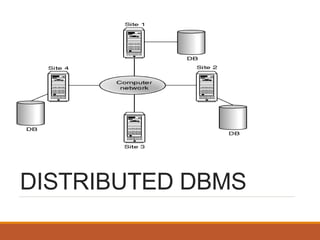
DISTRIBUTED
DATABASES
OUTLINE
 Concept Of D-DBMS
 Distributed Database Types
 Homogeneous
 Heterogeneous
 Distributed Database Design
 Data Fragmentation
 Data Allocation
 Data Replication
CONCEPT
A distributed database (DDB) is a collection of multiple,
logically interrelated databases distributed over a computer
network.
A distributed database management system (D–DBMS) is the
software that manages the DDB and provides an access
mechanism that makes this distribution transparent to the
users.
Distributed database system (DDBS) = DDB + D–DBMS
CONCEPT
 Collection of logically-related shared data.
 Data split into fragments.
 Fragments may be replicated.
 Fragments/replicas allocated to sites.
 Sites linked by a communications network.
 Data at each site is under control of a DBMS.
 DBMSs handle local applications autonomously.
 Each DBMS participates in at least one global application.
Functionality
 Security
 Keeping track of data
 Replicated data management
 System catalog management
 Distributed transaction management
 Distributed database recovery
DISTRIBUTED DBMS
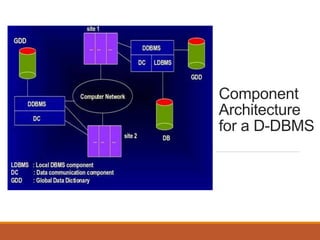
Component
Architecture
for a D-DBMS
Advantages Of
D-DBMS
 Organizational Structure
 Share-ability and Local Autonomy
 Improved Availability
 Improved Reliability
 Improved Performance
 Economics
 Modular Growth
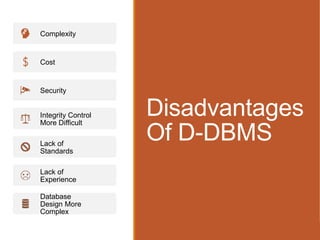
Disadvantages
Of D-DBMS
Complexity
Cost
Security
Integrity Control
More Difficult
Lack of
Standards
Lack of
Experience
Database
Design More
Complex
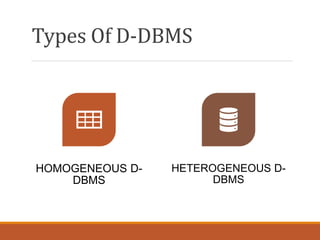
Types Of D-DBMS
HOMOGENEOUS D-
DBMS
HETEROGENEOUS D-
DBMS
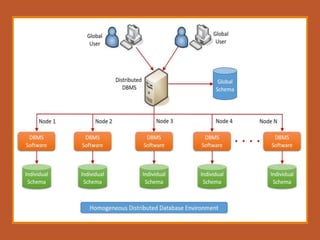
Homogeneous D-DBMS
All sites have identical software and are aware of each other
and agree to cooperate in processing user requests.
Much easier to design and manage
The operating system used, at each location must be
same or compatible.
The database application (or DBMS) used at each location
must be same or compatible.
It appears to user as a single system
All access is through one, global schema
The global schema is the union of all the local schema
Homogeneous
Distributed
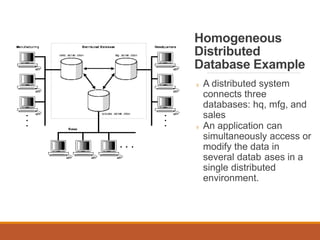
Database Example
A distributed system
connects three
databases: hq, mfg, and
sales
An application can
simultaneously access or
modify the data in
several datab ases in a
single distributed
environment.
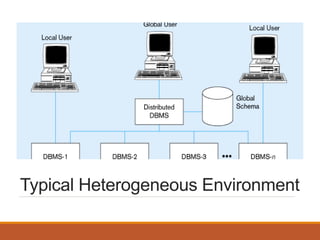
Heterogeneous
D-DBMS
 Different sites may use different schema
and software.
 Different nodes may have different
hardware and software and data structures
at various nodes or locations are also
incompatible.
 Different computers and operating
systems, data base applications or data
models may be used at each of the
locations.
 Difficult to manage and design.
Typical Heterogeneous Environment
Distributed
Database Design
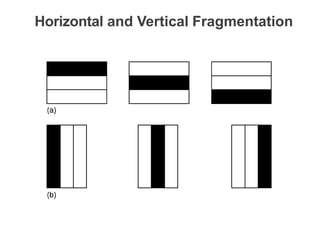
 Data Fragmentation
 Data can be distributed
by storing individual
tables at different sites
 Data can also be distributed
by decomposing a table
and storing portions at
different sites – called
Fragmentation
 Fragmentation can be
horizontal or vertical
Horizontal and Vertical Fragmentation
Why use Fragmentation?
 Usage - in general applications use views so it’s
appropriate to work with subsets
 Efficiency - data stored close to where it is most frequently
used
 Parallelism - a transaction can divided into several sub-
queries to increase degree of concurrency
 Security - data more secure - only stored where it is
needed
 Disadvantages: Performance - may be slower Integrity
- more difficult
Distributed Database Design
HorizontalFragmentation
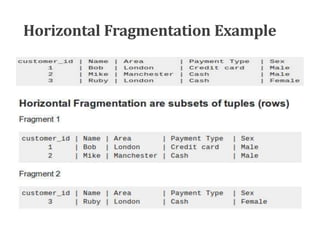
 Each fragment, Ti , of table T contains a subset of the
rows.
 Each tuple of T is assigned to one or more fragments.
 Horizontal fragmentation is lossless.
 A selection condition may be composed of several
conditions connected by AND or OR.
 Derived horizontal fragmentation: It is the partitioning
of a primary relation to other secondary relations which
are related with Foreign keys.
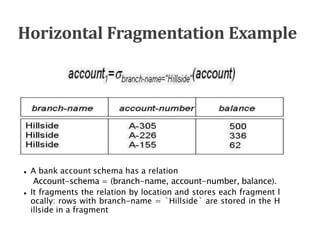
Horizontal Fragmentation Example
 A bank account schema has a relation
Account-schema = (branch-name, account-number, balance).
 It fragments the relation by location and stores each fragment l
ocally: rows with branch-name = `Hillside` are stored in the H
illside in a fragment
Horizontal Fragmentation Example
Distributed
Database
Design
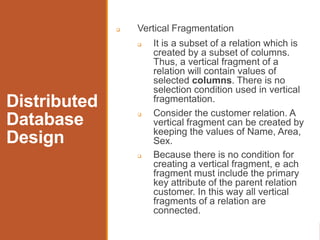
 Vertical Fragmentation
 It is a subset of a relation which is
created by a subset of columns.
Thus, a vertical fragment of a
relation will contain values of
selected columns. There is no
selection condition used in vertical
fragmentation.
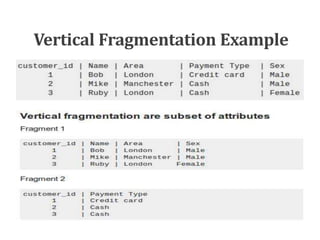
 Consider the customer relation. A
vertical fragment can be created by
keeping the values of Name, Area,
Sex.
 Because there is no condition for
creating a vertical fragment, e ach
fragment must include the primary
key attribute of the parent relation
customer. In this way all vertical
fragments of a relation are
connected.
Vertical Fragmentation Example
Distributed
Database
Design
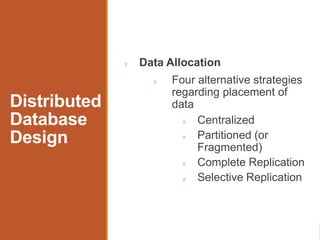
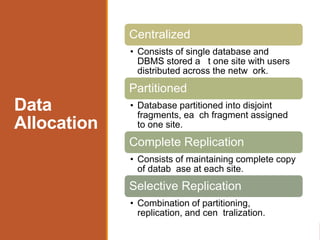
Data Allocation
Four alternative strategies
regarding placement of
data
Centralized
Partitioned (or
Fragmented)
Complete Replication
Selective Replication
Data
Allocation
Centralized
• Consists of single database and
DBMS stored a t one site with users
distributed across the netw ork.
Partitioned
• Database partitioned into disjoint
fragments, ea ch fragment assigned
to one site.
Complete Replication
• Consists of maintaining complete copy
of datab ase at each site.
Selective Replication
• Combination of partitioning,
replication, and cen tralization.
Distributed
Database
Design
Data Replication
System maintains
multiple copies of data,
stored in different sites,
for faster retrieval and
fault tolerance.
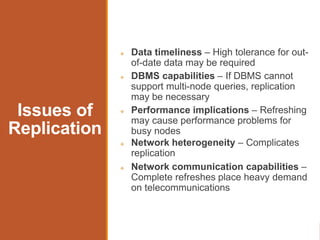
Issues of
Replication
 Data timeliness – High tolerance for out-
of-date data may be required
 DBMS capabilities – If DBMS cannot
support multi-node queries, replication
may be necessary
 Performance implications – Refreshing
may cause performance problems for
busy nodes
 Network heterogeneity – Complicates
replication
 Network communication capabilities –
Complete refreshes place heavy demand
on telecommunications
Advantages Of
Replication
 Availability: Failure of site containing
relation r does not result in
unavailability of r is replicas exist.
 Parallelism: Queries on r may be
processed by several nodes in
parallel.
 Reduced data transfer: relation r is
available locally at each site
containing a replica of r.
Disadvantages Of Replication
Increased cost of updates: each replica of relation r must be
updated.
Increased complexity of concurrency control: concurrent
updates t o distinct replicas may lead to inconsistent data
unless special c oncurrency control mechanisms are
implemented.
One solution: choose one copy as primary copy and apply
concurrency c ontrol operations on primary copy.
Distributed
Database
Design
• Data Fragmentation Relation
may be divided into several sub
relations, which are then
distributed.
• Breaking up the database into
logical units called fragments
and assigned for storage at
various sites.
• Data Allocation: The process of
assigning a particular fragment
to a particular site in a
distributed system.
• Data Replication: Copy of
fragment may be maintained at
several sites.
Key Issues:
Distributed
Databases Example
Apache Ignite
 Apache Cassandra
 AWS Simple DB
Apache HBase
REFERENCES
• https://en.wikipedia.org/wiki/Distributed_database
• https://www.geeksforgeeks.org/distributed-database-system/
• https://www.slideshare.net/VinayDPatel/distributed-database-management-
system-75423430
• https://www.tutorialspoint.com/distributed_dbms/index.htm
• Images: shorturl.at/fntxM
DDBS PPT (1).pptx

DDBS PPT (1).pptx

  • 1.
    (Fergusson College, Pune) DistributedDatabases Presented By: Group DS5 Diksha Butlekar 226507 Harshad Kalsait 226510 Harshit Singh 226511
  • 2.
  • 3.
    OUTLINE  Concept OfD-DBMS  Distributed Database Types  Homogeneous  Heterogeneous  Distributed Database Design  Data Fragmentation  Data Allocation  Data Replication
  • 4.
    CONCEPT A distributed database(DDB) is a collection of multiple, logically interrelated databases distributed over a computer network. A distributed database management system (D–DBMS) is the software that manages the DDB and provides an access mechanism that makes this distribution transparent to the users. Distributed database system (DDBS) = DDB + D–DBMS
  • 5.
    CONCEPT  Collection oflogically-related shared data.  Data split into fragments.  Fragments may be replicated.  Fragments/replicas allocated to sites.  Sites linked by a communications network.  Data at each site is under control of a DBMS.  DBMSs handle local applications autonomously.  Each DBMS participates in at least one global application.
  • 6.
    Functionality  Security  Keepingtrack of data  Replicated data management  System catalog management  Distributed transaction management  Distributed database recovery
  • 7.
  • 8.
  • 9.
    Advantages Of D-DBMS  OrganizationalStructure  Share-ability and Local Autonomy  Improved Availability  Improved Reliability  Improved Performance  Economics  Modular Growth
  • 10.
    Disadvantages Of D-DBMS Complexity Cost Security Integrity Control MoreDifficult Lack of Standards Lack of Experience Database Design More Complex
  • 11.
    Types Of D-DBMS HOMOGENEOUSD- DBMS HETEROGENEOUS D- DBMS
  • 12.
    Homogeneous D-DBMS All siteshave identical software and are aware of each other and agree to cooperate in processing user requests. Much easier to design and manage The operating system used, at each location must be same or compatible. The database application (or DBMS) used at each location must be same or compatible. It appears to user as a single system All access is through one, global schema The global schema is the union of all the local schema
  • 14.
    Homogeneous Distributed Database Example A distributedsystem connects three databases: hq, mfg, and sales An application can simultaneously access or modify the data in several datab ases in a single distributed environment.
  • 15.
    Heterogeneous D-DBMS  Different sitesmay use different schema and software.  Different nodes may have different hardware and software and data structures at various nodes or locations are also incompatible.  Different computers and operating systems, data base applications or data models may be used at each of the locations.  Difficult to manage and design.
  • 16.
  • 17.
    Distributed Database Design  DataFragmentation  Data can be distributed by storing individual tables at different sites  Data can also be distributed by decomposing a table and storing portions at different sites – called Fragmentation  Fragmentation can be horizontal or vertical
  • 18.
  • 19.
    Why use Fragmentation? Usage - in general applications use views so it’s appropriate to work with subsets  Efficiency - data stored close to where it is most frequently used  Parallelism - a transaction can divided into several sub- queries to increase degree of concurrency  Security - data more secure - only stored where it is needed  Disadvantages: Performance - may be slower Integrity - more difficult
  • 20.
    Distributed Database Design HorizontalFragmentation Each fragment, Ti , of table T contains a subset of the rows.  Each tuple of T is assigned to one or more fragments.  Horizontal fragmentation is lossless.  A selection condition may be composed of several conditions connected by AND or OR.  Derived horizontal fragmentation: It is the partitioning of a primary relation to other secondary relations which are related with Foreign keys.
  • 21.
    Horizontal Fragmentation Example A bank account schema has a relation Account-schema = (branch-name, account-number, balance).  It fragments the relation by location and stores each fragment l ocally: rows with branch-name = `Hillside` are stored in the H illside in a fragment
  • 22.
  • 23.
    Distributed Database Design  Vertical Fragmentation It is a subset of a relation which is created by a subset of columns. Thus, a vertical fragment of a relation will contain values of selected columns. There is no selection condition used in vertical fragmentation.  Consider the customer relation. A vertical fragment can be created by keeping the values of Name, Area, Sex.  Because there is no condition for creating a vertical fragment, e ach fragment must include the primary key attribute of the parent relation customer. In this way all vertical fragments of a relation are connected.
  • 24.
  • 25.
    Distributed Database Design Data Allocation Four alternativestrategies regarding placement of data Centralized Partitioned (or Fragmented) Complete Replication Selective Replication
  • 26.
    Data Allocation Centralized • Consists ofsingle database and DBMS stored a t one site with users distributed across the netw ork. Partitioned • Database partitioned into disjoint fragments, ea ch fragment assigned to one site. Complete Replication • Consists of maintaining complete copy of datab ase at each site. Selective Replication • Combination of partitioning, replication, and cen tralization.
  • 27.
    Distributed Database Design Data Replication System maintains multiplecopies of data, stored in different sites, for faster retrieval and fault tolerance.
  • 28.
    Issues of Replication  Datatimeliness – High tolerance for out- of-date data may be required  DBMS capabilities – If DBMS cannot support multi-node queries, replication may be necessary  Performance implications – Refreshing may cause performance problems for busy nodes  Network heterogeneity – Complicates replication  Network communication capabilities – Complete refreshes place heavy demand on telecommunications
  • 29.
    Advantages Of Replication  Availability:Failure of site containing relation r does not result in unavailability of r is replicas exist.  Parallelism: Queries on r may be processed by several nodes in parallel.  Reduced data transfer: relation r is available locally at each site containing a replica of r.
  • 30.
    Disadvantages Of Replication Increasedcost of updates: each replica of relation r must be updated. Increased complexity of concurrency control: concurrent updates t o distinct replicas may lead to inconsistent data unless special c oncurrency control mechanisms are implemented. One solution: choose one copy as primary copy and apply concurrency c ontrol operations on primary copy.
  • 31.
    Distributed Database Design • Data FragmentationRelation may be divided into several sub relations, which are then distributed. • Breaking up the database into logical units called fragments and assigned for storage at various sites. • Data Allocation: The process of assigning a particular fragment to a particular site in a distributed system. • Data Replication: Copy of fragment may be maintained at several sites. Key Issues:
  • 32.
    Distributed Databases Example Apache Ignite Apache Cassandra  AWS Simple DB Apache HBase
  • 33.
    REFERENCES • https://en.wikipedia.org/wiki/Distributed_database • https://www.geeksforgeeks.org/distributed-database-system/ •https://www.slideshare.net/VinayDPatel/distributed-database-management- system-75423430 • https://www.tutorialspoint.com/distributed_dbms/index.htm • Images: shorturl.at/fntxM