By Kuber Chandra
email: kuberchandra@yahoo.com
Outline
What is RAID?
RAID configurations used.
Performance of each configuration.
Implementations.
Way forward with RAID.
What is RAID?
Stands for Redundant Array of Independent Disks.
It’s a technology that enables greater levels of
performance, reliability and/or large volumes when
dealing with data.
How?? By concurrent use of two or more ‘hard disk
drives’.
How Exactly?? Mirroring, Stripping (of data) and Error
correction techniques combined with multiple disk arrays
give you the reliability and performance.
RAID flavors
Commonly used ones:
1.RAID 0
2.RAID 1
3.RAID 5
4.RAID 10
Other types used…but rarely: RAID 2,3,4,6,50……
RAID 0
a. It splits data among two or more disks.
b. Provides good performance.
c. Lack of data redundancy means there is
no fail over support with this
configuration.
d. In the diagram to the right, the odd blocks
are written to disk 0 and the even blocks
to disk 1 such that A1, A2, A3, A4, …
would be the order of blocks read if read
sequentially from the beginning.
e. Used in read only NFS systems and
gaming systems.
RAID 1
•RAID1 is ‘data mirroring’.
•Two copies of the data are held on
two physical disks, and the data is
always identical.
• Twice as many disks are required to
store the same data when compared to
RAID 0.
•Array continues to operate so long as
at least one drive is functioning.
RAID 5
• RAID 5 is an ideal combination of
good performance, good fault
tolerance and high capacity and
storage efficiency.
• An arrangement of parity and
CRC to help rebuilding drive data in
case of disk failures.
• “Distributed Parity” is the key
word here.
RAID 10
a. Combines RAID 1 and RAID
0.
b. Which means having the
pleasure of both - good
performance and good failover
handling.
c. Also called ‘Nested RAID’.
Implementations
Software based RAID:
Software implementations are provided by many
Operating Systems.
A software layer sits above the disk device drivers and
provides an abstraction layer between the logical
drives(RAIDs) and physical drives.
Server's processor is used to run the RAID software.
Used for simpler configurations like RAID0 and RAID1.
Implementations (contd…)
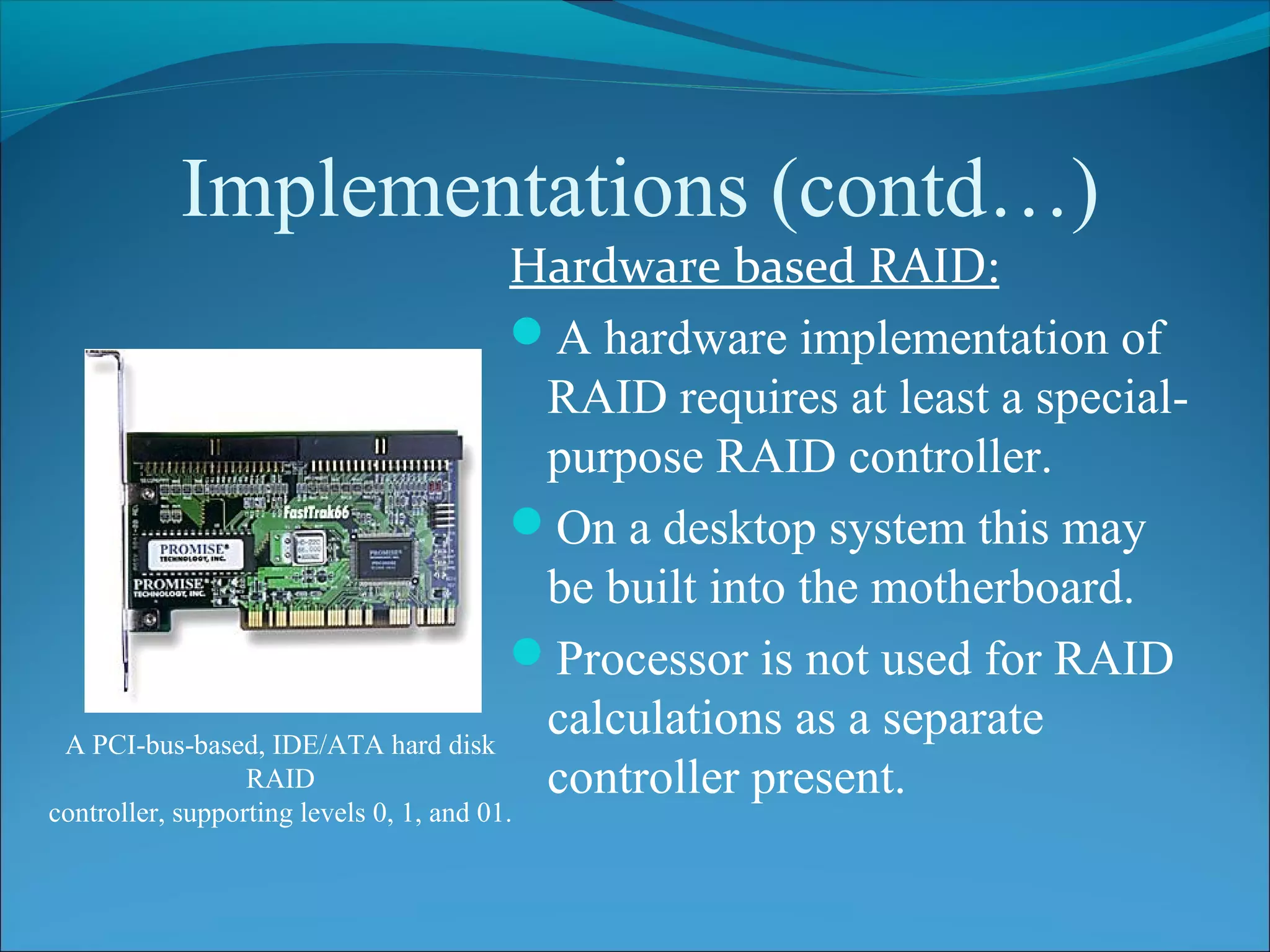
Hardware based RAID:
A hardware implementation of
RAID requires at least a special-
purpose RAID controller.
On a desktop system this may
be built into the motherboard.
Processor is not used for RAID
calculations as a separate
controller present.
A PCI-bus-based, IDE/ATA hard disk
RAID
controller, supporting levels 0, 1, and 01.
What’s happening present day?
RAID 6:
a.It is seen as the best way to
guarantee data integrity as it uses
double parity.
b.Lesser MTBF compared to
RAID5.
c.It has a drawback though of longer
write time.
Road ahead…
The expanded use of RAID-6 and other dual-parity
schemes is a virtual certainty.
RAID vendors to support "fast rebuild" features that can
restore hundreds of gigabytes in just an hour or so!!
Striping(of data) would extend across RAID groups -- not
just across drives within a group.
Improved disk diagnostic features should offer more
reliable predictions of impending drive failures, allowing
the rebuild process to begin before an actual fault occurs.
Hot Spares!!
References
http://searchstorage.techtarget.com/generic/0,29558
2,sid5_gci1196310,00.html
http://www.lascon.co.uk/d008005.htm
http://en.wikipedia.org/wiki/RAID_0#RAID_0
http://en.wikipedia.org/wiki/RAID
Presentation On RAID(Redundant Array Of Independent Disks) Basics

Presentation On RAID(Redundant Array Of Independent Disks) Basics

  • 1.
    By Kuber Chandra email:kuberchandra@yahoo.com
  • 2.
    Outline What is RAID? RAIDconfigurations used. Performance of each configuration. Implementations. Way forward with RAID.
  • 3.
    What is RAID? Standsfor Redundant Array of Independent Disks. It’s a technology that enables greater levels of performance, reliability and/or large volumes when dealing with data. How?? By concurrent use of two or more ‘hard disk drives’. How Exactly?? Mirroring, Stripping (of data) and Error correction techniques combined with multiple disk arrays give you the reliability and performance.
  • 4.
    RAID flavors Commonly usedones: 1.RAID 0 2.RAID 1 3.RAID 5 4.RAID 10 Other types used…but rarely: RAID 2,3,4,6,50……
  • 5.
    RAID 0 a. Itsplits data among two or more disks. b. Provides good performance. c. Lack of data redundancy means there is no fail over support with this configuration. d. In the diagram to the right, the odd blocks are written to disk 0 and the even blocks to disk 1 such that A1, A2, A3, A4, … would be the order of blocks read if read sequentially from the beginning. e. Used in read only NFS systems and gaming systems.
  • 6.
    RAID 1 •RAID1 is‘data mirroring’. •Two copies of the data are held on two physical disks, and the data is always identical. • Twice as many disks are required to store the same data when compared to RAID 0. •Array continues to operate so long as at least one drive is functioning.
  • 7.
    RAID 5 • RAID5 is an ideal combination of good performance, good fault tolerance and high capacity and storage efficiency. • An arrangement of parity and CRC to help rebuilding drive data in case of disk failures. • “Distributed Parity” is the key word here.
  • 8.
    RAID 10 a. CombinesRAID 1 and RAID 0. b. Which means having the pleasure of both - good performance and good failover handling. c. Also called ‘Nested RAID’.
  • 9.
    Implementations Software based RAID: Softwareimplementations are provided by many Operating Systems. A software layer sits above the disk device drivers and provides an abstraction layer between the logical drives(RAIDs) and physical drives. Server's processor is used to run the RAID software. Used for simpler configurations like RAID0 and RAID1.
  • 10.
    Implementations (contd…) Hardware basedRAID: A hardware implementation of RAID requires at least a special- purpose RAID controller. On a desktop system this may be built into the motherboard. Processor is not used for RAID calculations as a separate controller present. A PCI-bus-based, IDE/ATA hard disk RAID controller, supporting levels 0, 1, and 01.
  • 11.
    What’s happening presentday? RAID 6: a.It is seen as the best way to guarantee data integrity as it uses double parity. b.Lesser MTBF compared to RAID5. c.It has a drawback though of longer write time.
  • 12.
    Road ahead… The expandeduse of RAID-6 and other dual-parity schemes is a virtual certainty. RAID vendors to support "fast rebuild" features that can restore hundreds of gigabytes in just an hour or so!! Striping(of data) would extend across RAID groups -- not just across drives within a group. Improved disk diagnostic features should offer more reliable predictions of impending drive failures, allowing the rebuild process to begin before an actual fault occurs. Hot Spares!!
  • 13.