



PRESENTED BY: LEANDRO MICHAEL C. DE LOS SANTOS, JR.
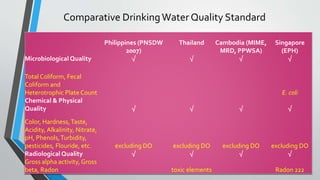
Philippines (PNSDW
2007)
Thailand Cambodia (MIME,
MRD, PPWSA)
Singapore
(EPH)
Microbiological Quality √ √ √ √
Total Coliform, Fecal
Coliform and
Heterotrophic Plate Count E. coli
Chemical & Physical
Quality √ √ √ √
Color, Hardness,Taste,
Acidity, Alkalinity, Nitrate,
pH, Phenols,Turbidity,
pesticides, Flouride, etc. excluding DO excluding DO excluding DO excluding DO
Radiological Quality √ √ √ √
Gross alpha activity, Gross
beta, Radon toxic elements Radon 222
Comparative DrinkingWater Quality Standard
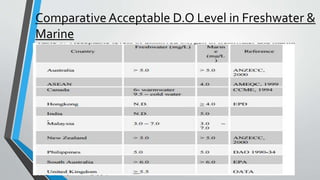
Comparative Acceptable D.O Level in Freshwater &
Marine
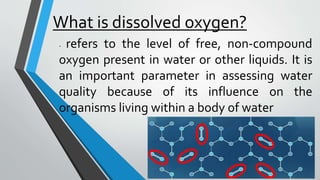
What is dissolved oxygen?
- refers to the level of free, non-compound
oxygen present in water or other liquids. It is
an important parameter in assessing water
quality because of its influence on the
organisms living within a body of water
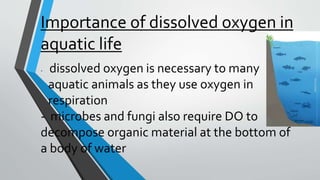
Importance of dissolved oxygen in
aquatic life
- dissolved oxygen is necessary to many
aquatic animals as they use oxygen in
respiration
- microbes and fungi also require DO to
decompose organic material at the bottom of
a body of water
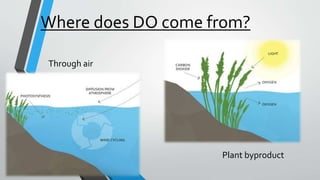
Where does DO come from?
Through air
Plant byproduct
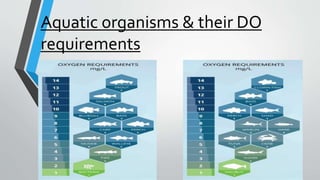
Aquatic organisms & their DO
requirements
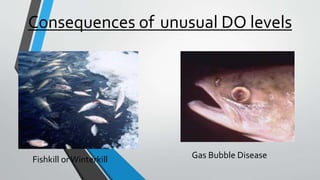
Consequences of unusual DO levels
Fishkill orWinterkill Gas Bubble Disease
Uses of dissolved oxygen analysis:
• Determine the health or cleanliness of a lake or
stream
• Determine the amount and type of biomass a
freshwater system can support
• Determine the amount of decomposition occurring in
the lake or stream
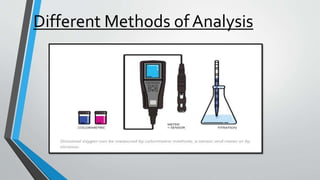
Different Methods ofAnalysis
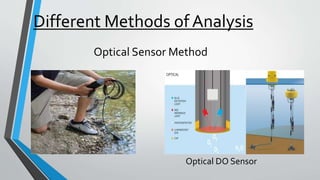
Optical Sensor Method
Optical DO Sensor
Different Methods ofAnalysis
Electrochemical DO Sensor or Amperometric or Clark-type Sensors
Different Methods ofAnalysis
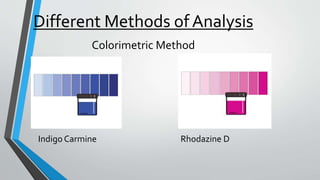
Colorimetric Method
Indigo Carmine Rhodazine D
Different Methods ofAnalysis
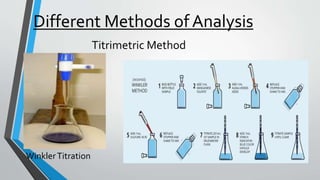
Titrimetric Method
WinklerTitration
Works Cited
Dissolved oxygen

Dissolved oxygen

Editor's Notes

  • #5 In limnology (the study of lakes), dissolved oxygen is an essential factor second only to water itself .  A dissolved oxygen level that is too high or too low can harm aquatic life and affect water quality.
  • #8 Comparative description of aquatic organisms and their DO requirements In summary, colder, deeper fresh waters have the capability to hold higher concentrations of dissolved oxygen, but due to microbial decomposition, lack of atmospheric contact for diffusion and the absence of photosynthesis, actual DO levels are often far below 100% saturation ¹⁰. Warm, shallow saltwater reaches 100% air saturation at a lower concentration, but can often achieve levels over 100% due to photosynthesis and aeration. Shallow waters also remain closer to 100% saturation due to atmospheric contact and constant diffusion ¹⁰.
  • #9 Furthermore, low concentrations of DO, when combined with the presence of toxic substances may lead to stress responses in aquatic ecosystems because the toxicity of certain elements, such as zinc, lead and copper, is increased by low concentrations of dissolved oxygen (Enderlein et al., 1996).
  • #13 In order to consistently polarize and de-polarize the electrodes for these short time periods, a pulsing polarographic DO sensor includes a third, silver reference electrode, separate from the silver anode 7. The electrochemical reaction (silver oxidation and oxygen reduction) remains the same. As rapid-pulse polarographic sensors reduce flow dependence when taking DO measurements, the water sample does not need to be stirred when using this sensor 7.