Practical (4.2)
• Date: 7TH May 2022
• 1. Estimation of (DO), BOD and COD
• 2. Estimation of PO4, SO4 and NO3
• 3. Estimation of major cations – Na, K, Ca, Mg and Salinity (hardness)
• 4. Field excursion to an industrial area to asses environmental impact
Dissolved oxygen
• Dissolved oxygen (DO): The amount of oxygen dissolved in a unit
volume of water
• when excess organic materials, such as large algal blooms, are
decomposed by microorganisms
– Low levels of oxygen (hypoxia)
– no oxygen levels (anoxia)
• During this decomposition process, DO in the water is consumed
• Fluctuation in DO levels depends upon various conditions
• DO is considered an important measure to determine
– water quality
– the amount and type of biomass a freshwater system can support
– the amount of decomposition occurring in the lake or stream.
– DO levels below 1 mg/L are considered hypoxic and usually devoid of
life.
• Aim: To estimate the Dissolved Oxygen (DO) in a given water sample
• Introduction: The term ‘Dissolved Oxygen’ is used to describe the amount
of oxygen dissolved in a unit volume of water. It is essential for the
maintenance of healthy lakes, rives etc. The presence of dissolved oxygen
in water is good sign. The minimum DO level of 4 to 5 mg/L or ppm is
desirble for survival of aquatic life.
• The D.O. is mainly influenced by addition of polluted water/waste to the
water body. The waste acts as food for certain bacteria and thus the
concentration of bacteria increases. This increased population cause
decline in the amount of D.O. The D.O. analysis play a key role in water
pollution control activities.
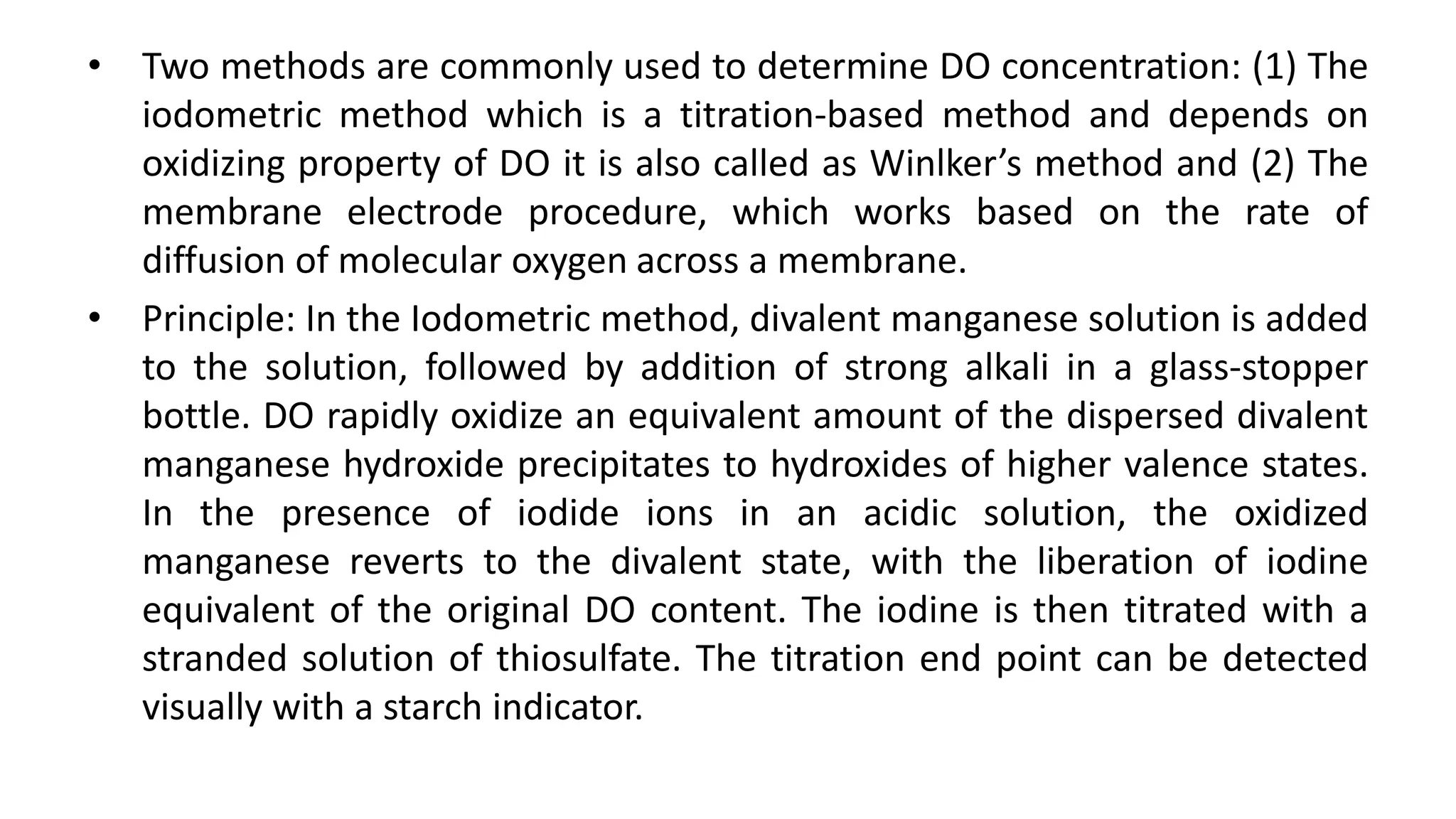
• Two methods are commonly used to determine DO concentration: (1) The
iodometric method which is a titration-based method and depends on
oxidizing property of DO it is also called as Winlker’s method and (2) The
membrane electrode procedure, which works based on the rate of
diffusion of molecular oxygen across a membrane.
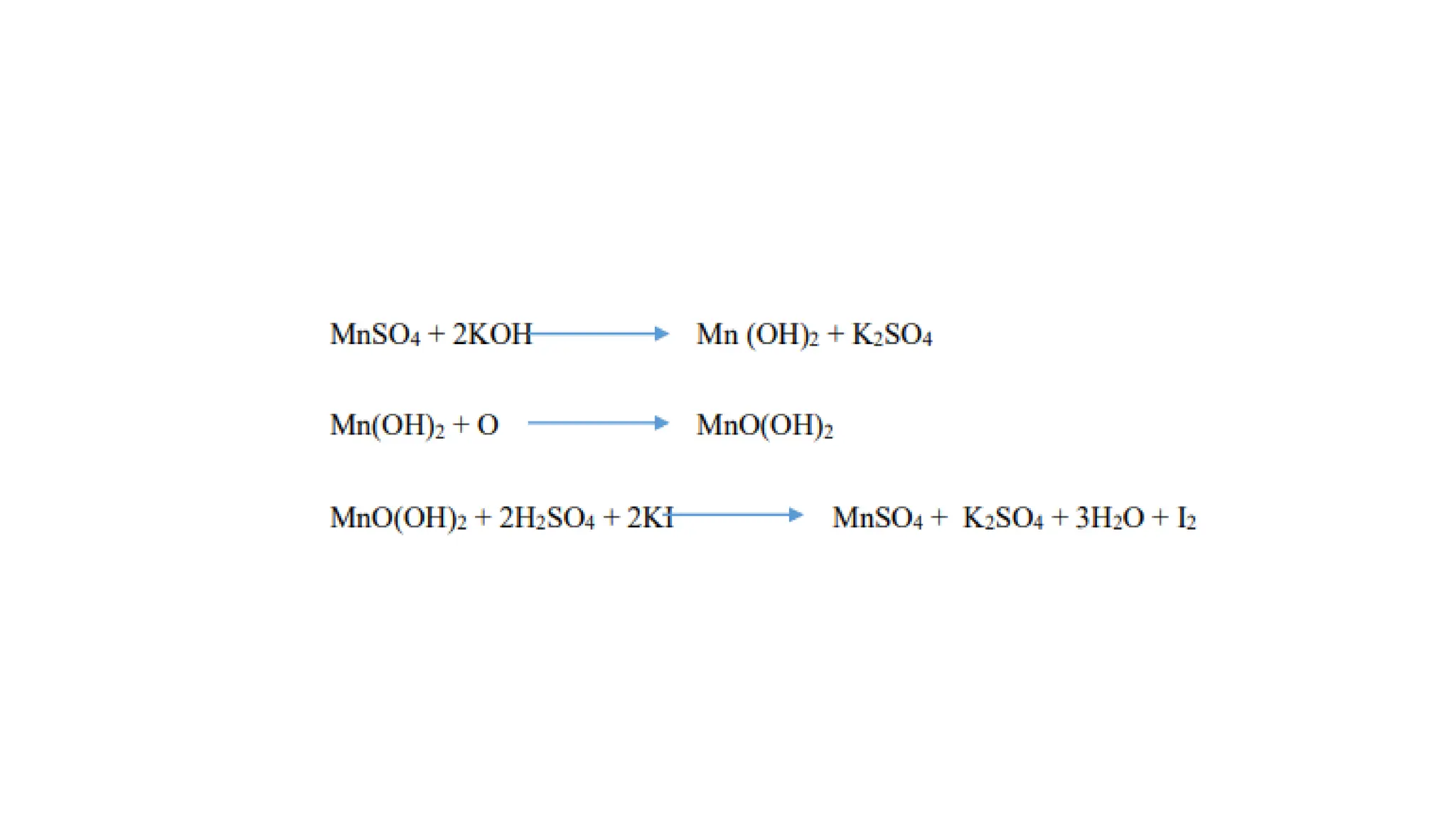
• Principle: In the Iodometric method, divalent manganese solution is added
to the solution, followed by addition of strong alkali in a glass-stopper
bottle. DO rapidly oxidize an equivalent amount of the dispersed divalent
manganese hydroxide precipitates to hydroxides of higher valence states.
In the presence of iodide ions in an acidic solution, the oxidized
manganese reverts to the divalent state, with the liberation of iodine
equivalent of the original DO content. The iodine is then titrated with a
stranded solution of thiosulfate. The titration end point can be detected
visually with a starch indicator.
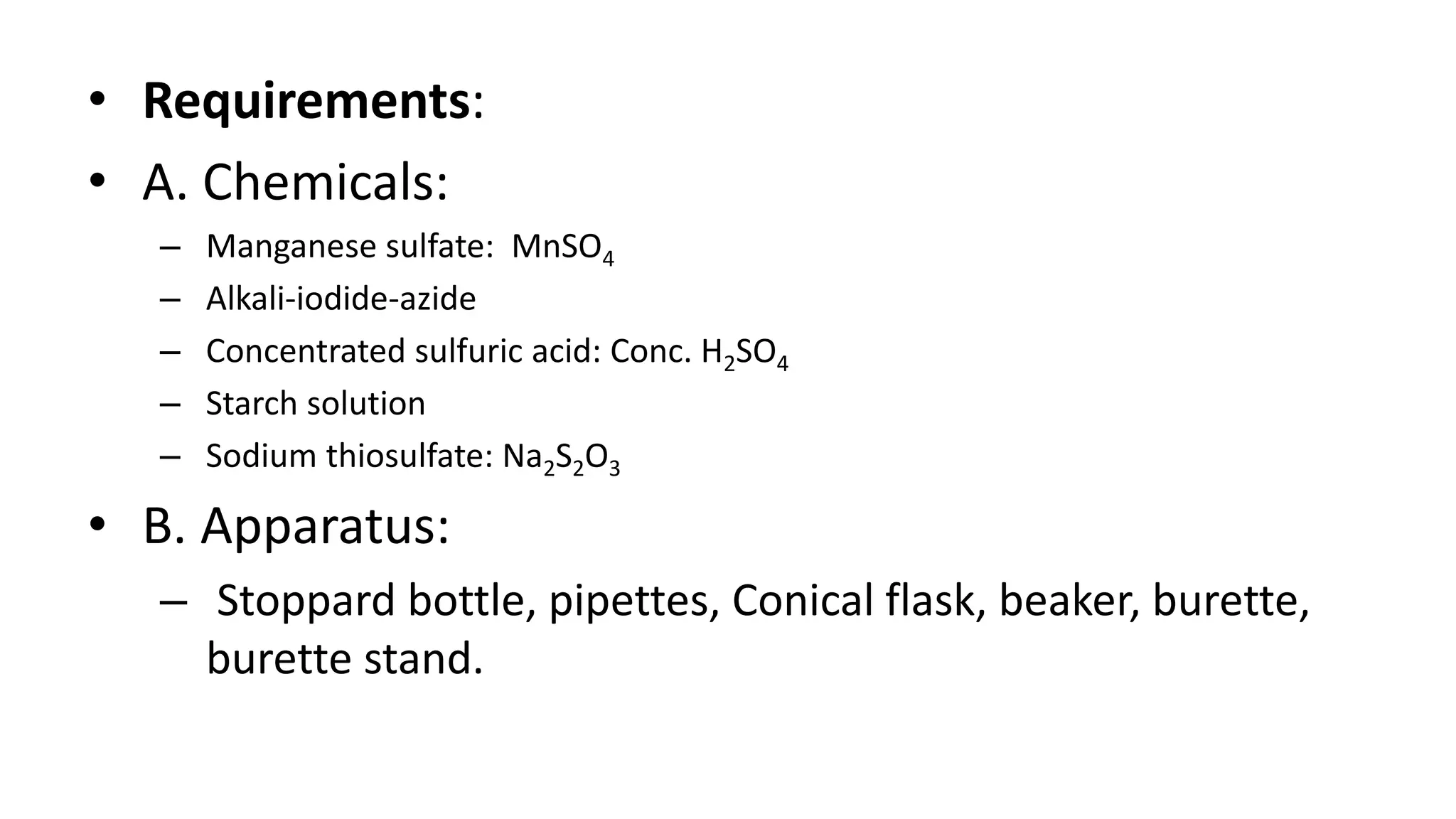
• Requirements:
• A. Chemicals:
– Manganese sulfate: MnSO4
– Alkali-iodide-azide
– Concentrated sulfuric acid: Conc. H2SO4
– Starch solution
– Sodium thiosulfate: Na2S2O3
• B. Apparatus:
– Stoppard bottle, pipettes, Conical flask, beaker, burette,
burette stand.
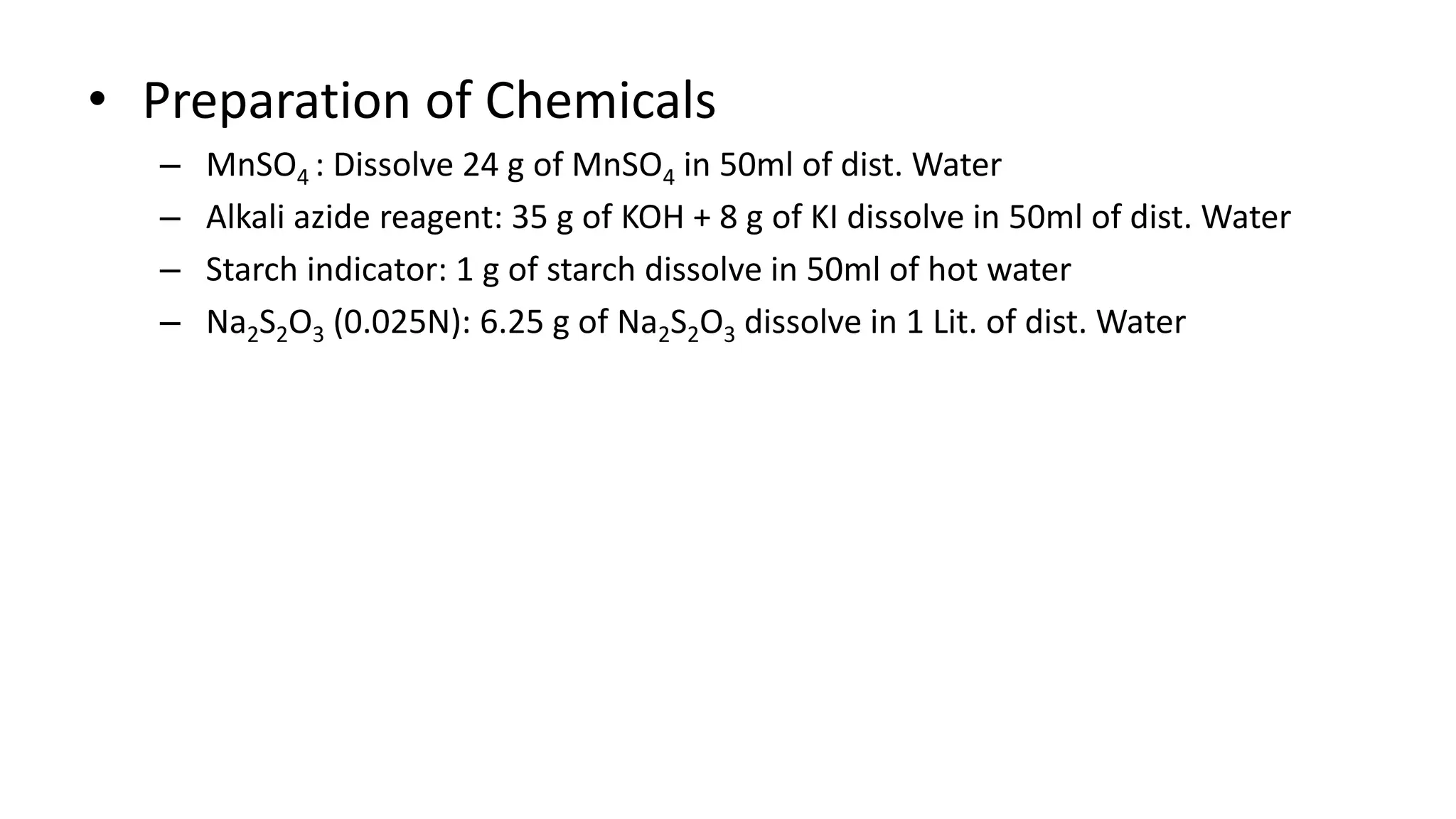
• Preparation of Chemicals
– MnSO4 : Dissolve 24 g of MnSO4 in 50ml of dist. Water
– Alkali azide reagent: 35 g of KOH + 8 g of KI dissolve in 50ml of dist. Water
– Starch indicator: 1 g of starch dissolve in 50ml of hot water
– Na2S2O3 (0.025N): 6.25 g of Na2S2O3 dissolve in 1 Lit. of dist. Water
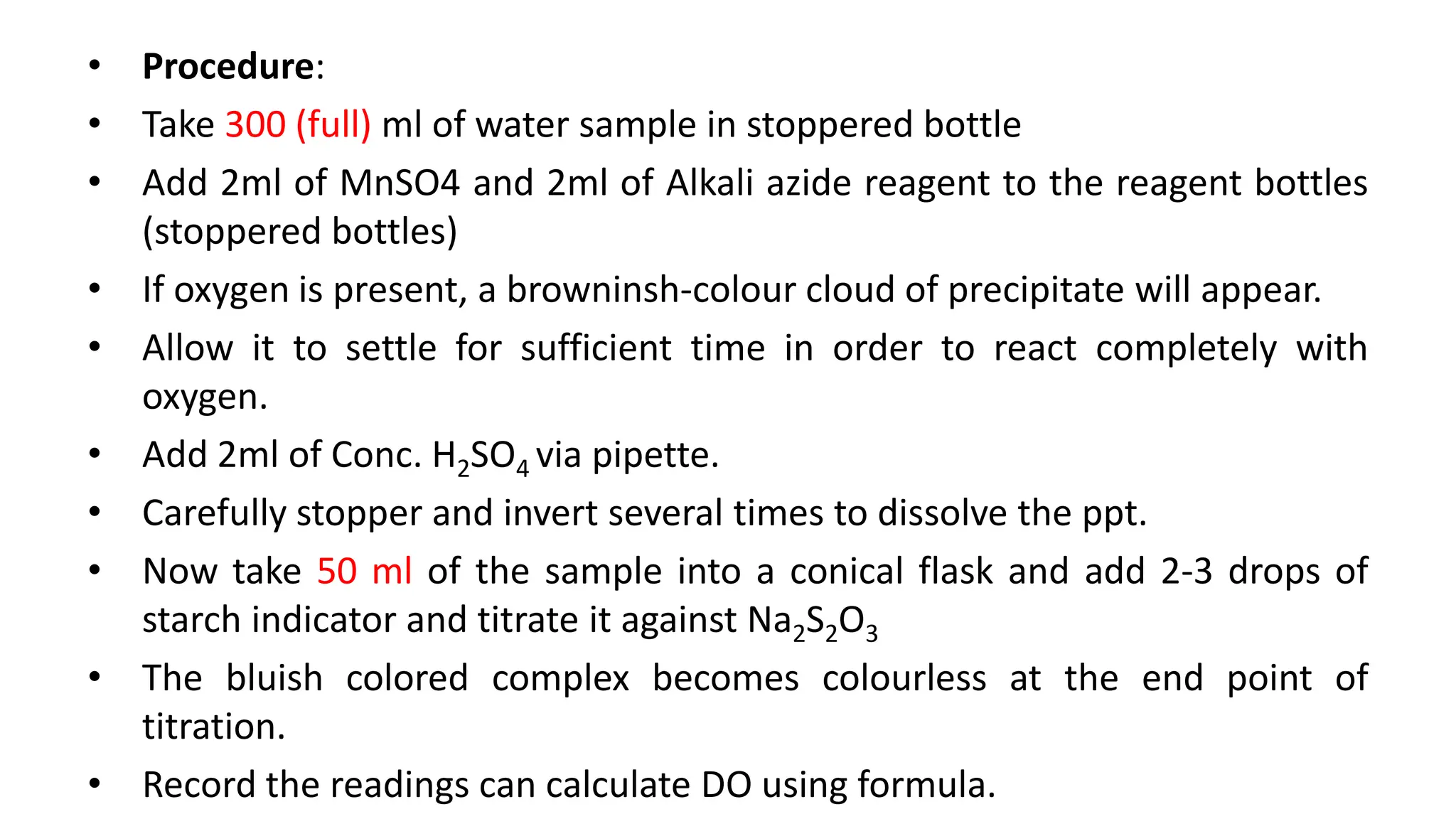
• Procedure:
• Take 300 (full) ml of water sample in stoppered bottle
• Add 2ml of MnSO4 and 2ml of Alkali azide reagent to the reagent bottles
(stoppered bottles)
• If oxygen is present, a browninsh-colour cloud of precipitate will appear.
• Allow it to settle for sufficient time in order to react completely with
oxygen.
• Add 2ml of Conc. H2SO4 via pipette.
• Carefully stopper and invert several times to dissolve the ppt.
• Now take 50 ml of the sample into a conical flask and add 2-3 drops of
starch indicator and titrate it against Na2S2O3
• The bluish colored complex becomes colourless at the end point of
titration.
• Record the readings can calculate DO using formula.
• https://www.youtube.com/watch?v=m9XGsEs
55Qo
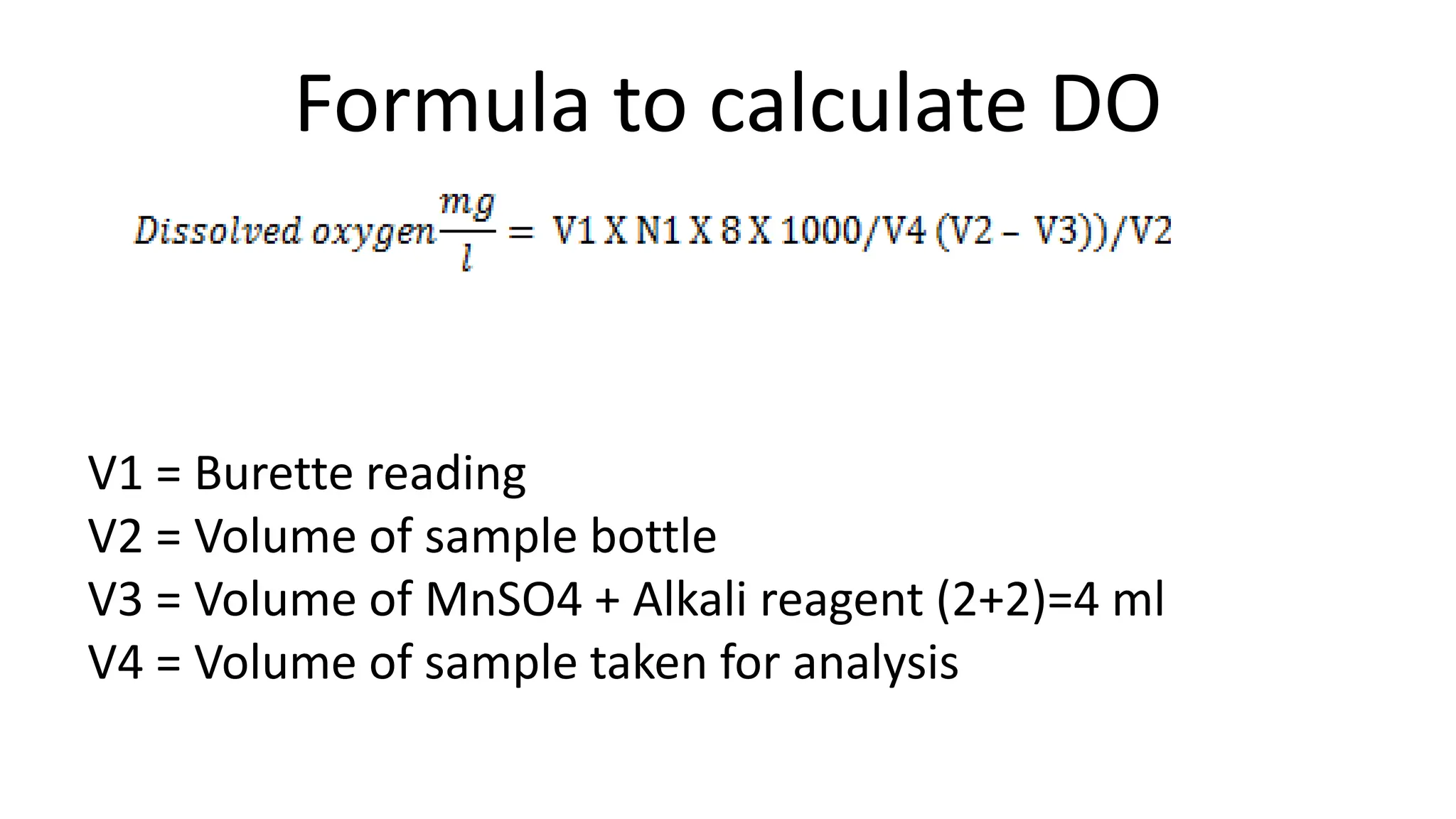
Formula to calculate DO
V1 = Burette reading
V2 = Volume of sample bottle
V3 = Volume of MnSO4 + Alkali reagent (2+2)=4 ml
V4 = Volume of sample taken for analysis

1. Estimation of DO.pdf practical which is helpful for botany and zoology students

  • 1.
  • 2.
    • Date: 7THMay 2022
  • 3.
    • 1. Estimationof (DO), BOD and COD • 2. Estimation of PO4, SO4 and NO3 • 3. Estimation of major cations – Na, K, Ca, Mg and Salinity (hardness) • 4. Field excursion to an industrial area to asses environmental impact
  • 4.
    Dissolved oxygen • Dissolvedoxygen (DO): The amount of oxygen dissolved in a unit volume of water • when excess organic materials, such as large algal blooms, are decomposed by microorganisms – Low levels of oxygen (hypoxia) – no oxygen levels (anoxia) • During this decomposition process, DO in the water is consumed
  • 5.
    • Fluctuation inDO levels depends upon various conditions • DO is considered an important measure to determine – water quality – the amount and type of biomass a freshwater system can support – the amount of decomposition occurring in the lake or stream. – DO levels below 1 mg/L are considered hypoxic and usually devoid of life.
  • 6.
    • Aim: Toestimate the Dissolved Oxygen (DO) in a given water sample • Introduction: The term ‘Dissolved Oxygen’ is used to describe the amount of oxygen dissolved in a unit volume of water. It is essential for the maintenance of healthy lakes, rives etc. The presence of dissolved oxygen in water is good sign. The minimum DO level of 4 to 5 mg/L or ppm is desirble for survival of aquatic life. • The D.O. is mainly influenced by addition of polluted water/waste to the water body. The waste acts as food for certain bacteria and thus the concentration of bacteria increases. This increased population cause decline in the amount of D.O. The D.O. analysis play a key role in water pollution control activities.
  • 7.
    • Two methodsare commonly used to determine DO concentration: (1) The iodometric method which is a titration-based method and depends on oxidizing property of DO it is also called as Winlker’s method and (2) The membrane electrode procedure, which works based on the rate of diffusion of molecular oxygen across a membrane. • Principle: In the Iodometric method, divalent manganese solution is added to the solution, followed by addition of strong alkali in a glass-stopper bottle. DO rapidly oxidize an equivalent amount of the dispersed divalent manganese hydroxide precipitates to hydroxides of higher valence states. In the presence of iodide ions in an acidic solution, the oxidized manganese reverts to the divalent state, with the liberation of iodine equivalent of the original DO content. The iodine is then titrated with a stranded solution of thiosulfate. The titration end point can be detected visually with a starch indicator.
  • 9.
    • Requirements: • A.Chemicals: – Manganese sulfate: MnSO4 – Alkali-iodide-azide – Concentrated sulfuric acid: Conc. H2SO4 – Starch solution – Sodium thiosulfate: Na2S2O3 • B. Apparatus: – Stoppard bottle, pipettes, Conical flask, beaker, burette, burette stand.
  • 10.
    • Preparation ofChemicals – MnSO4 : Dissolve 24 g of MnSO4 in 50ml of dist. Water – Alkali azide reagent: 35 g of KOH + 8 g of KI dissolve in 50ml of dist. Water – Starch indicator: 1 g of starch dissolve in 50ml of hot water – Na2S2O3 (0.025N): 6.25 g of Na2S2O3 dissolve in 1 Lit. of dist. Water
  • 11.
    • Procedure: • Take300 (full) ml of water sample in stoppered bottle • Add 2ml of MnSO4 and 2ml of Alkali azide reagent to the reagent bottles (stoppered bottles) • If oxygen is present, a browninsh-colour cloud of precipitate will appear. • Allow it to settle for sufficient time in order to react completely with oxygen. • Add 2ml of Conc. H2SO4 via pipette. • Carefully stopper and invert several times to dissolve the ppt. • Now take 50 ml of the sample into a conical flask and add 2-3 drops of starch indicator and titrate it against Na2S2O3 • The bluish colored complex becomes colourless at the end point of titration. • Record the readings can calculate DO using formula.
  • 12.
  • 13.
    Formula to calculateDO V1 = Burette reading V2 = Volume of sample bottle V3 = Volume of MnSO4 + Alkali reagent (2+2)=4 ml V4 = Volume of sample taken for analysis