E 5. Dissolved oxygen 
 Outline biochemical oxygen demand (BOD) as a 
measure of oxygen- demanding wastes in water. 
 Distinguish between aerobic and anaerobic 
decomposition of organic material in water. 
 Describe the process of eutrophication and its 
effects. 
 Describe the source and effects of thermal 
pollution in water.
DDiissssoollvveedd ooxxyyggeenn iinn wwaatteerr 
 solubility of oxygen at 1 atm and 293K is 
9 ppm 
 solubility of gases decreases as temperature 
rises 
 needed for aerobic respiration of aquatic 
plants and animals, e.g. 
 fish need 3 ppm or 3 mg dm-3 (kg of water) 
 large biodiversity needs 6 ppm
Dissolved oxygen 
 Aerobic respiration lowers the amount of 
dissolved oxygen in water. 
 The more aerobic respiration, the lower the 
amount of dissolved oxygen. 
 At times organic waste and other nutrients 
end up in the water of a river or lake.
DDiissssoollvveedd ooxxyyggeenn iinn wwaatteerr 
 Organic waste = faeces, dead organisms, urea, 
untreated sewage, waste from food production. 
 Organic waste in water is first broken down by 
aerobic respiration by bacteria (for energy). 
 Dissolved oxygen in the water is lowered. 
 Products of aerobic respiration: water, carbon 
dioxide, inorganic ions like nitrates, nitrites, 
phosphates.
DDiissssoollvveedd ooxxyyggeenn iinn wwaatteerr 
 BOD or Biochemical Oxygen Demand. 
 BOD can be used as an indicator of the amount of 
organic waste (=oxygen-demanding waste) and other 
nutrients in a sample of water. 
 BOD = measured by determining the amount of 
oxygen in a sample of water (in ppm) at the start and 
determining it again after 5 days. The difference is the 
BOD or amount of oxygen used up by aerobic 
bacteria to decompose the organic matter in the water 
sample a fixed over 5 days at 293K and in the dark.
DDiissssoollvveedd ooxxyyggeenn iinn wwaatteerr 
 The greater the BOD, the less dissolved 
oxygen there is. 
 The greater the BOD, the more organic 
waste there was in the water sample.
DDiissssoollvveedd ooxxyyggeenn:: mmeeaassuurreemmeenntt 
 Water sample is collected and added to 
oxygen saturated water ([O2 (aq)] is known). 
 Water is left for 5 days at 293K and in the 
dark. 
 New [O2 (aq)] is measured using an oxygen 
electrode or titration. 
 BOD = [O2 (aq)] - [O2 (aq)] 
 Pure water has BOD of less than 1 ppm.
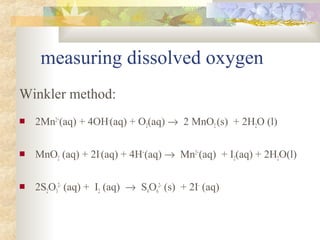
measuring dissolved oxygen 
Winkler method: 
 2Mn2+(aq) + 4OH-(aq) + O2(aq) ® 2 MnO2 (s) + 2H2O (l) 
 MnO2 (aq) + 2I-(aq) + 4H+(aq) ® Mn2+(aq) + I2(aq) + 2H2O(l) 
2- (aq) + I2 (aq) ® S4O6 
 2S2O3 
2- (s) + 2I- (aq)
EEuuttrroopphhiiccaattiioonn 
 Aerobic respiration of large amounts of organic matter produce 
large amounts of inorganic ions such as nitrates (fertilizers) 
and phosphates (detergents) in water. 
 These ions are nutrients to algae. 
 An algal bloom (or ‘red tide’) occurs. 
 This bloom removes a lot of dissolved oxygen from the water 
to below a level many aerobic organisms cannot survive 
including aerobic bacteria – they die. 
 More organic waste is added reducing oxygen further. 
 Anaerobic bacteria take over decomposition of organic waste. 
 Products of anaerobic respiration: methane, ammonia, amines, 
hydrogen sulphide – foul-smelling gases.
Eutrophication: causes 
 Untreated sewage (has a lot 
of organic waste). 
 Run-off animal waste from 
farms. 
 Nitrates from fertilizers. 
 Phosphates from detergents. 
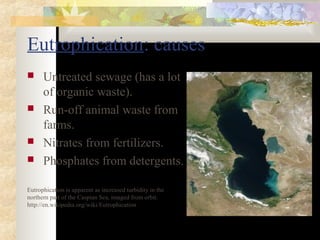
Eutrophication is apparent as increased turbidity in the 
northern part of the Caspian Sea, imaged from orbit. 
http://en.wikipedia.org/wiki/Eutrophication
EEuuttrroopphhiiccaattiioonn 
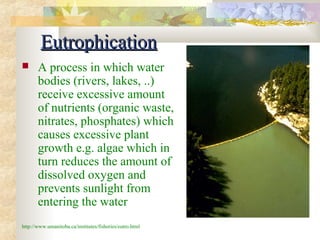
 A process in which water 
bodies (rivers, lakes, ..) 
receive excessive amount 
of nutrients (organic waste, 
nitrates, phosphates) which 
causes excessive plant 
growth e.g. algae which in 
turn reduces the amount of 
dissolved oxygen and 
prevents sunlight from 
entering the water 
http://www.umanitoba.ca/institutes/fisheries/eutro.html
EEuuttrroopphhiiccaattiioonn 
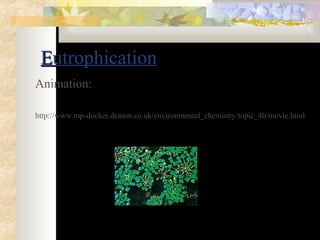
Animation: 
http://www.mp-docker.demon.co.uk/environmental_chemistry/topic_4b/movie.html
DDiissssoollvveedd ooxxyyggeenn:: temperature 
Higher water temperatures: 
 decrease amount of dissolved oxygen in 
water 
 increase rate of metabolism of aquatic life 
requiring them to need more oxygen

E5 environmental chemistry dissolved oxygen

  • 1.
    E 5. Dissolvedoxygen  Outline biochemical oxygen demand (BOD) as a measure of oxygen- demanding wastes in water.  Distinguish between aerobic and anaerobic decomposition of organic material in water.  Describe the process of eutrophication and its effects.  Describe the source and effects of thermal pollution in water.
  • 2.
    DDiissssoollvveedd ooxxyyggeenn iinnwwaatteerr  solubility of oxygen at 1 atm and 293K is 9 ppm  solubility of gases decreases as temperature rises  needed for aerobic respiration of aquatic plants and animals, e.g.  fish need 3 ppm or 3 mg dm-3 (kg of water)  large biodiversity needs 6 ppm
  • 3.
    Dissolved oxygen Aerobic respiration lowers the amount of dissolved oxygen in water.  The more aerobic respiration, the lower the amount of dissolved oxygen.  At times organic waste and other nutrients end up in the water of a river or lake.
  • 4.
    DDiissssoollvveedd ooxxyyggeenn iinnwwaatteerr  Organic waste = faeces, dead organisms, urea, untreated sewage, waste from food production.  Organic waste in water is first broken down by aerobic respiration by bacteria (for energy).  Dissolved oxygen in the water is lowered.  Products of aerobic respiration: water, carbon dioxide, inorganic ions like nitrates, nitrites, phosphates.
  • 5.
    DDiissssoollvveedd ooxxyyggeenn iinnwwaatteerr  BOD or Biochemical Oxygen Demand.  BOD can be used as an indicator of the amount of organic waste (=oxygen-demanding waste) and other nutrients in a sample of water.  BOD = measured by determining the amount of oxygen in a sample of water (in ppm) at the start and determining it again after 5 days. The difference is the BOD or amount of oxygen used up by aerobic bacteria to decompose the organic matter in the water sample a fixed over 5 days at 293K and in the dark.
  • 6.
    DDiissssoollvveedd ooxxyyggeenn iinnwwaatteerr  The greater the BOD, the less dissolved oxygen there is.  The greater the BOD, the more organic waste there was in the water sample.
  • 7.
    DDiissssoollvveedd ooxxyyggeenn:: mmeeaassuurreemmeenntt  Water sample is collected and added to oxygen saturated water ([O2 (aq)] is known).  Water is left for 5 days at 293K and in the dark.  New [O2 (aq)] is measured using an oxygen electrode or titration.  BOD = [O2 (aq)] - [O2 (aq)]  Pure water has BOD of less than 1 ppm.
  • 8.
    measuring dissolved oxygen Winkler method:  2Mn2+(aq) + 4OH-(aq) + O2(aq) ® 2 MnO2 (s) + 2H2O (l)  MnO2 (aq) + 2I-(aq) + 4H+(aq) ® Mn2+(aq) + I2(aq) + 2H2O(l) 2- (aq) + I2 (aq) ® S4O6  2S2O3 2- (s) + 2I- (aq)
  • 9.
    EEuuttrroopphhiiccaattiioonn  Aerobicrespiration of large amounts of organic matter produce large amounts of inorganic ions such as nitrates (fertilizers) and phosphates (detergents) in water.  These ions are nutrients to algae.  An algal bloom (or ‘red tide’) occurs.  This bloom removes a lot of dissolved oxygen from the water to below a level many aerobic organisms cannot survive including aerobic bacteria – they die.  More organic waste is added reducing oxygen further.  Anaerobic bacteria take over decomposition of organic waste.  Products of anaerobic respiration: methane, ammonia, amines, hydrogen sulphide – foul-smelling gases.
  • 10.
    Eutrophication: causes Untreated sewage (has a lot of organic waste).  Run-off animal waste from farms.  Nitrates from fertilizers.  Phosphates from detergents. Eutrophication is apparent as increased turbidity in the northern part of the Caspian Sea, imaged from orbit. http://en.wikipedia.org/wiki/Eutrophication
  • 11.
    EEuuttrroopphhiiccaattiioonn  Aprocess in which water bodies (rivers, lakes, ..) receive excessive amount of nutrients (organic waste, nitrates, phosphates) which causes excessive plant growth e.g. algae which in turn reduces the amount of dissolved oxygen and prevents sunlight from entering the water http://www.umanitoba.ca/institutes/fisheries/eutro.html
  • 12.
  • 13.
    DDiissssoollvveedd ooxxyyggeenn:: temperature Higher water temperatures:  decrease amount of dissolved oxygen in water  increase rate of metabolism of aquatic life requiring them to need more oxygen