




Dominant Approaches in Social Sciences
Structural Functionalism
Marxism
Institutionalism
Rational Choice Theory
Symbolic Interactionism
The Human – Environment System
Psychoanalysis
The Hermeneutical Phenomenology
The Feminist Theory
Institutionalism
Institutionalism
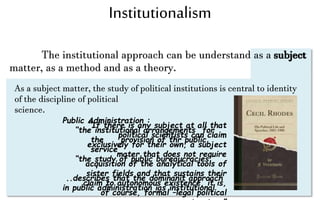
The institutional approach can be understand as a subject
matter, as a method and as a theory.
subject
As a subject matter, the study of political institutions is central to identity
of the discipline of political
science.
“If there is any subject at all that
political scientists can claim
exclusively for their own, a subject
mater that does not require
acquisition of the analytical tools of
sister fields and that sustains their
claim to autonomous existence, it is,
of course, formal –legal political
Public Administration :
“the institutional arrangements for
the provision of thr public
service”
“the study of public bureaucracies”
..describes that the dominanit approach
in public administration ias institutional
As a method, the traditional or classic institutional approach is
“descriptive-inductive, formal-legal, and historical comparative”
Institutionalism
The institutional approach can be understand as a subject
matter, as a method and as a theory.method
As such, the classical institutional approach systematically
describes and analyses phenomena that have occurred in the past
and explain contemporary political phenomena with reference to
past events. The goal is to explain and understand but not to
formulate laws. (Kavanagh 1991, 482, in Rhodes 1995, 42)
As a method, the traditional or classic institutional approach is
“descriptive-inductive, formal-legal, and historical comparative”
Institutionalism
The institutional approach can be understand as a subject
matter, as a method and as a theory.method
The institutional approach also applies formal-legal
inquiry. It involves the study of formal government
organizations and includes the study of public law.
As a method, the traditional or classic institutional approach is
“descriptive-inductive, formal-legal, and historical comparative”
As a method, the traditional or classic institutional approach is
“descriptive-inductive, formal-legal, and historical comparative”
Institutionalism
The institutional approach can be understand as a subject
matter, as a method and as a theory.method
“institutions can be understood and appreciated only by
those who know other systems of government… by the use
of a thorough comparative and historical.. A general
clarification of views may be obtained.”
As a method, the traditional or classic institutional approach is
“descriptive-inductive, formal-legal, and historical comparative”
Institutionalism
The institutional approach can be understand as a subject
matter, as a method and as a theory.theory.
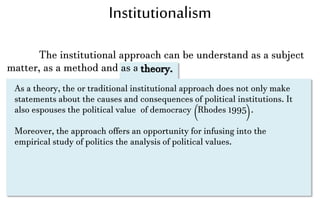
As a theory, the or traditional institutional approach does not only make
statements about the causes and consequences of political institutions. It
also espouses the political value of democracy (Rhodes 1995).
Moreover, the approach offers an opportunity for infusing into the
empirical study of politics the analysis of political values.
DISS - Approaches - Institutionalism

DISS - Approaches - Institutionalism

  • 1.
    Dominant Approaches inSocial Sciences Structural Functionalism Marxism Institutionalism Rational Choice Theory Symbolic Interactionism The Human – Environment System Psychoanalysis The Hermeneutical Phenomenology The Feminist Theory
  • 2.
  • 3.
    Institutionalism The institutional approachcan be understand as a subject matter, as a method and as a theory. subject As a subject matter, the study of political institutions is central to identity of the discipline of political science. “If there is any subject at all that political scientists can claim exclusively for their own, a subject mater that does not require acquisition of the analytical tools of sister fields and that sustains their claim to autonomous existence, it is, of course, formal –legal political Public Administration : “the institutional arrangements for the provision of thr public service” “the study of public bureaucracies” ..describes that the dominanit approach in public administration ias institutional
  • 4.
    As a method,the traditional or classic institutional approach is “descriptive-inductive, formal-legal, and historical comparative” Institutionalism The institutional approach can be understand as a subject matter, as a method and as a theory.method As such, the classical institutional approach systematically describes and analyses phenomena that have occurred in the past and explain contemporary political phenomena with reference to past events. The goal is to explain and understand but not to formulate laws. (Kavanagh 1991, 482, in Rhodes 1995, 42)
  • 5.
    As a method,the traditional or classic institutional approach is “descriptive-inductive, formal-legal, and historical comparative” Institutionalism The institutional approach can be understand as a subject matter, as a method and as a theory.method The institutional approach also applies formal-legal inquiry. It involves the study of formal government organizations and includes the study of public law. As a method, the traditional or classic institutional approach is “descriptive-inductive, formal-legal, and historical comparative”
  • 6.
    As a method,the traditional or classic institutional approach is “descriptive-inductive, formal-legal, and historical comparative” Institutionalism The institutional approach can be understand as a subject matter, as a method and as a theory.method “institutions can be understood and appreciated only by those who know other systems of government… by the use of a thorough comparative and historical.. A general clarification of views may be obtained.” As a method, the traditional or classic institutional approach is “descriptive-inductive, formal-legal, and historical comparative”
  • 8.
    Institutionalism The institutional approachcan be understand as a subject matter, as a method and as a theory.theory. As a theory, the or traditional institutional approach does not only make statements about the causes and consequences of political institutions. It also espouses the political value of democracy (Rhodes 1995). Moreover, the approach offers an opportunity for infusing into the empirical study of politics the analysis of political values.