
Presented by
Dr Ajith Y. MVSc
Division of Medicine
IVRI, Izatnagar, UP, India
Presence of Hemorrhage of unusual
duration or severity; Either external or
Internal or petechiae or echymosis on
mucosa/serosa/skin.
Occurs due to increased capillary fragility,
disorders in platelet function or defects in
coagulation mechanisms.
• Vasculitis
- Septicemic and viremic diseases:
Direct damage to endothelium due to infection.
African Horse Sickness, Equine herpes virus I
Anaplasma phagocytophila, Salmonella, Pasteurella
Evident by petechial and echymotic mucosa clinically
Throughout the body in PM examination
- Purpura hemorrhagica
Immune complex (IgA) mediated endothelial damage
Leukocytoclastic vasculitis
Sequelae of strangles (Streptococcus equi)
- Inflammation can be treated with corticosteroids
• Coagulation defects (Acquired)
Intoxications, impair production or function of clotting factors
Depletion of clotting factors: DIC
Protein losing nephropathy- antithrombin-Thrombosis (cattle)
Protein losing enteropathy- antithrombin-Thrombosis (horse)
Vit. K depend. factor deficiency- coumarol/ warfarin poisoning
Vit. K responsive hemorrhagic syndrome in post weaned pigs
Snake venom: Both procoagulants and anticoagulants-Epistaxis
Carcass hemorrhage or blood splash-lambs-Coumarin plant
Electrical stunning also produce carcass hemorrhage
Fungal toxins: Aflatoxins, Trichotecenes, Rubratoxin
HydroxyEthyl Starch: Prolongs cutaneous bleeding
Umbilical bleeding -newborn piglet: Prevented by Vit C to sows
Fasciola hepatica infestation-sheep: clotting factor deficiency
• Coagulation defects (Congenital)
- Hemophilia A (Factor VIII:C deficiency)
Foals and sheeps
Sex linked recessive trait (defective gene in ‘X’)
After first few weeks: Hematomas, epistaxis, anemia etc.
- Von Willebrand disease (Factor VIII:vWF deficiency)
vW Factor is a carrier protein for factor VIII
Mediates platelet adhesion to exposed subendothelium
Type I, II & III: Reported in horse, pig, sheep & calves
Autosomal recessive trait linked to ‘X’ chromosome
Desmopressin increase release of vWF from endothelium
- Factor XI deficiency: HF cattle
- Prekallikrein deficiency: Horses-Failure to clot
- Fibrinogen deficiency: Lamb
• Platelet disorders
- Thrombocytopenia- Decreases number
Decreased production: Neutropenia followed by anemia
Bracken fern, Trichothecene, Furazolidone poisonings
Radiation injuries and drug side effects
Myeloid dysplasia and bone marrow hypoplasia
Increased destruction: Immune mediated
Inflammation and infection: EIA, Anaplasma, swine fever, BVD
Isoimmune thrombocytopenia: Neonates-colostral antibodies-IgG
Autoimmune thrombocytopenia: Adults-Penicillin
Dexamethasone- 0.040mg/kg IM/IV/PO OD
Prednisolone- 1mg/kg PO
Azathioprine- 0.5-1.5mg/kg PO
Spleenectomy
Increased consumption: Trauma and DIC
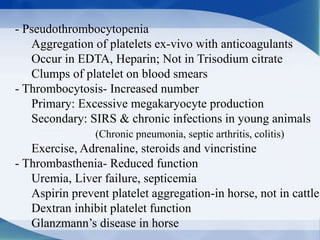
- Pseudothrombocytopenia
Aggregation of platelets ex-vivo with anticoagulants
Occur in EDTA, Heparin; Not in Trisodium citrate
Clumps of platelet on blood smears
- Thrombocytosis- Increased number
Primary: Excessive megakaryocyte production
Secondary: SIRS & chronic infections in young animals
(Chronic pneumonia, septic arthritis, colitis)
Exercise, Adrenaline, steroids and vincristine
- Thrombasthenia- Reduced function
Uremia, Liver failure, septicemia
Aspirin prevent platelet aggregation-in horse, not in cattle
Dextran inhibit platelet function
Glanzmann’s disease in horse
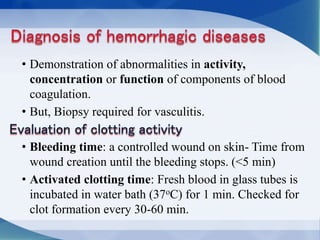
• Demonstration of abnormalities in activity,
concentration or function of components of blood
coagulation.
• But, Biopsy required for vasculitis.
• Bleeding time: a controlled wound on skin- Time from
wound creation until the bleeding stops. (<5 min)
• Activated clotting time: Fresh blood in glass tubes is
incubated in water bath (37oC) for 1 min. Checked for
clot formation every 30-60 min.
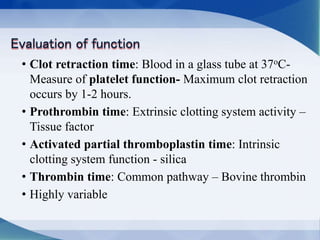
• Clot retraction time: Blood in a glass tube at 37oC-
Measure of platelet function- Maximum clot retraction
occurs by 1-2 hours.
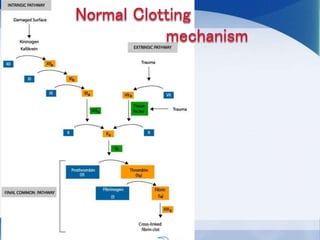
• Prothrombin time: Extrinsic clotting system activity –
Tissue factor
• Activated partial thromboplastin time: Intrinsic
clotting system function - silica
• Thrombin time: Common pathway – Bovine thrombin
• Highly variable
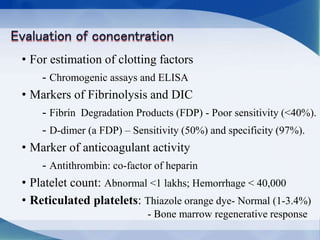
• For estimation of clotting factors
- Chromogenic assays and ELISA
• Markers of Fibrinolysis and DIC
- Fibrin Degradation Products (FDP) - Poor sensitivity (<40%).
- D-dimer (a FDP) – Sensitivity (50%) and specificity (97%).
• Marker of anticoagulant activity
- Antithrombin: co-factor of heparin
• Platelet count: Abnormal <1 lakhs; Hemorrhage < 40,000
• Reticulated platelets: Thiazole orange dye- Normal (1-3.4%)
- Bone marrow regenerative response
• Serum sample is minimally useful in tests for clotting
factors.
• Ideal anticoagulant: Trisodium citrate (1 part 3.8%
trisodium citrate in 9 parts of blood) – Ca chelation
• Not suitable anticoagulants
- Heparin: Inhibit thrombin activity, activate platelets
- EDTA: Interferes with platelet function
• Pseudothrombocytopenia: due to anticoagulant induced
ex-vivo aggregation of platelets.
• Plasma (2-10ml/kg) can be used to replace clotting
factor deficiency either due to failure in production or
increased consumption or dilution.
• Fresh frozen kept at -80oC retain much of clotting factors
• Platelet rich plasma can be prepared by centrifugation of
blood at 150xg (1000-1200 rpm) for 20-30 min.
• Aminocaproic acid: 30-100mg/kg IV, Inhibits
fibrinolysis, inhibit bleeding by persisting clot
• Tranexamic acid: Inhibits fibrin degradation
• Carbazochrome: Stabilizes capillary membrane
• Formalin: Horse (1L of 0.37-0.74% formalin in RL)
Goats (5.5% formalin in RL)
• Aspirin: In horses (12mg/kg), inhibit platelet aggregation;
whereas, not in cattle at 100mg/kg.
• Warfarin: Reduces concentration of Vit. K dependent
clotting factors by inhibiting hepatic production.
• Heparin and dalteparin/enoxaparin: 40IU/kg IV every
12-24 hrs
• Sodium pentosan polysulfate: Treatment of arthritis
• Hirudin: Anticoagulant from leaches. Thrombin inhibitor
• Tissue plasminogen activator: Dissolution of clots
• Streptokinase or Urokinase: Dissolution of fibrin clots
Diseases with hemorrhagic tendencies coagulation defects

Diseases with hemorrhagic tendencies coagulation defects

  • 1.
    Presented by Dr AjithY. MVSc Division of Medicine IVRI, Izatnagar, UP, India
  • 2.
    Presence of Hemorrhageof unusual duration or severity; Either external or Internal or petechiae or echymosis on mucosa/serosa/skin. Occurs due to increased capillary fragility, disorders in platelet function or defects in coagulation mechanisms.
  • 4.
    • Vasculitis - Septicemicand viremic diseases: Direct damage to endothelium due to infection. African Horse Sickness, Equine herpes virus I Anaplasma phagocytophila, Salmonella, Pasteurella Evident by petechial and echymotic mucosa clinically Throughout the body in PM examination - Purpura hemorrhagica Immune complex (IgA) mediated endothelial damage Leukocytoclastic vasculitis Sequelae of strangles (Streptococcus equi) - Inflammation can be treated with corticosteroids
  • 5.
    • Coagulation defects(Acquired) Intoxications, impair production or function of clotting factors Depletion of clotting factors: DIC Protein losing nephropathy- antithrombin-Thrombosis (cattle) Protein losing enteropathy- antithrombin-Thrombosis (horse) Vit. K depend. factor deficiency- coumarol/ warfarin poisoning Vit. K responsive hemorrhagic syndrome in post weaned pigs Snake venom: Both procoagulants and anticoagulants-Epistaxis Carcass hemorrhage or blood splash-lambs-Coumarin plant Electrical stunning also produce carcass hemorrhage Fungal toxins: Aflatoxins, Trichotecenes, Rubratoxin HydroxyEthyl Starch: Prolongs cutaneous bleeding Umbilical bleeding -newborn piglet: Prevented by Vit C to sows Fasciola hepatica infestation-sheep: clotting factor deficiency
  • 6.
    • Coagulation defects(Congenital) - Hemophilia A (Factor VIII:C deficiency) Foals and sheeps Sex linked recessive trait (defective gene in ‘X’) After first few weeks: Hematomas, epistaxis, anemia etc. - Von Willebrand disease (Factor VIII:vWF deficiency) vW Factor is a carrier protein for factor VIII Mediates platelet adhesion to exposed subendothelium Type I, II & III: Reported in horse, pig, sheep & calves Autosomal recessive trait linked to ‘X’ chromosome Desmopressin increase release of vWF from endothelium - Factor XI deficiency: HF cattle - Prekallikrein deficiency: Horses-Failure to clot - Fibrinogen deficiency: Lamb
  • 7.
    • Platelet disorders -Thrombocytopenia- Decreases number Decreased production: Neutropenia followed by anemia Bracken fern, Trichothecene, Furazolidone poisonings Radiation injuries and drug side effects Myeloid dysplasia and bone marrow hypoplasia Increased destruction: Immune mediated Inflammation and infection: EIA, Anaplasma, swine fever, BVD Isoimmune thrombocytopenia: Neonates-colostral antibodies-IgG Autoimmune thrombocytopenia: Adults-Penicillin Dexamethasone- 0.040mg/kg IM/IV/PO OD Prednisolone- 1mg/kg PO Azathioprine- 0.5-1.5mg/kg PO Spleenectomy Increased consumption: Trauma and DIC
  • 8.
    - Pseudothrombocytopenia Aggregation ofplatelets ex-vivo with anticoagulants Occur in EDTA, Heparin; Not in Trisodium citrate Clumps of platelet on blood smears - Thrombocytosis- Increased number Primary: Excessive megakaryocyte production Secondary: SIRS & chronic infections in young animals (Chronic pneumonia, septic arthritis, colitis) Exercise, Adrenaline, steroids and vincristine - Thrombasthenia- Reduced function Uremia, Liver failure, septicemia Aspirin prevent platelet aggregation-in horse, not in cattle Dextran inhibit platelet function Glanzmann’s disease in horse
  • 9.
    • Demonstration ofabnormalities in activity, concentration or function of components of blood coagulation. • But, Biopsy required for vasculitis. • Bleeding time: a controlled wound on skin- Time from wound creation until the bleeding stops. (<5 min) • Activated clotting time: Fresh blood in glass tubes is incubated in water bath (37oC) for 1 min. Checked for clot formation every 30-60 min.
  • 10.
    • Clot retractiontime: Blood in a glass tube at 37oC- Measure of platelet function- Maximum clot retraction occurs by 1-2 hours. • Prothrombin time: Extrinsic clotting system activity – Tissue factor • Activated partial thromboplastin time: Intrinsic clotting system function - silica • Thrombin time: Common pathway – Bovine thrombin • Highly variable
  • 11.
    • For estimationof clotting factors - Chromogenic assays and ELISA • Markers of Fibrinolysis and DIC - Fibrin Degradation Products (FDP) - Poor sensitivity (<40%). - D-dimer (a FDP) – Sensitivity (50%) and specificity (97%). • Marker of anticoagulant activity - Antithrombin: co-factor of heparin • Platelet count: Abnormal <1 lakhs; Hemorrhage < 40,000 • Reticulated platelets: Thiazole orange dye- Normal (1-3.4%) - Bone marrow regenerative response
  • 12.
    • Serum sampleis minimally useful in tests for clotting factors. • Ideal anticoagulant: Trisodium citrate (1 part 3.8% trisodium citrate in 9 parts of blood) – Ca chelation • Not suitable anticoagulants - Heparin: Inhibit thrombin activity, activate platelets - EDTA: Interferes with platelet function • Pseudothrombocytopenia: due to anticoagulant induced ex-vivo aggregation of platelets.
  • 13.
    • Plasma (2-10ml/kg)can be used to replace clotting factor deficiency either due to failure in production or increased consumption or dilution. • Fresh frozen kept at -80oC retain much of clotting factors • Platelet rich plasma can be prepared by centrifugation of blood at 150xg (1000-1200 rpm) for 20-30 min. • Aminocaproic acid: 30-100mg/kg IV, Inhibits fibrinolysis, inhibit bleeding by persisting clot • Tranexamic acid: Inhibits fibrin degradation • Carbazochrome: Stabilizes capillary membrane • Formalin: Horse (1L of 0.37-0.74% formalin in RL) Goats (5.5% formalin in RL)
  • 14.
    • Aspirin: Inhorses (12mg/kg), inhibit platelet aggregation; whereas, not in cattle at 100mg/kg. • Warfarin: Reduces concentration of Vit. K dependent clotting factors by inhibiting hepatic production. • Heparin and dalteparin/enoxaparin: 40IU/kg IV every 12-24 hrs • Sodium pentosan polysulfate: Treatment of arthritis • Hirudin: Anticoagulant from leaches. Thrombin inhibitor • Tissue plasminogen activator: Dissolution of clots • Streptokinase or Urokinase: Dissolution of fibrin clots