Autoimmune hemolytic
anemia
Kaipol Takpradit
Topic
Pathophysiology
Presentation
Treatment
AIHA pathophysiology
● Caused by autoantibody to self RBC
● Divided into
○ Primary AIHA: without obvious cause
○ Secondary AIHA: precipitated by some
condition
■ mainstay of treatment is removal of etiology
IgG autoantibody
● Bind to RBC and cause hemophagocytosis
in spleen
● Partial phagocytosis render RBC loss its
membrane and produce microspherocyte
IgM autoantibody
● Fix complement on RBC cause
intravascular hemolysis
● After fixation and lysis, C3b also cause
destruction of RBC in liver (Kupffer cells)
Cause of secondary AIHA
● Drug: penicillin, fludarabine, methyldopa
● Infection: mycoplasma
● Tumor: lymphoma, ovarian dermal cyst,
renal CA
● Other autoimmune disease: SLE
Antibody in AIHA
● Warm type
○ increase activity when near 37 c
○ usually IgG
● Cold type
○ increase activity when near 4c
○ usually IgM
○ cause auto-agglutination
○ fixed complement
● Mixed type
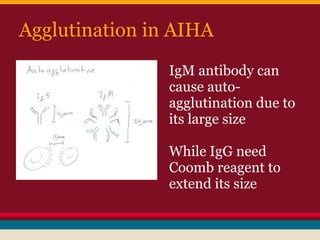
Agglutination in AIHA
IgM antibody can
cause auto-
agglutination due to
its large size
While IgG need
Coomb reagent to
extend its size
Coomb test
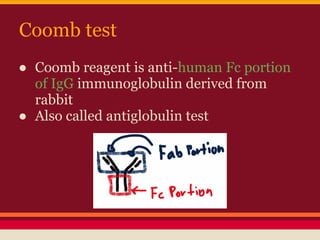
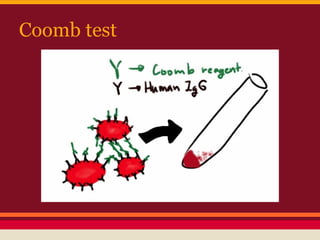
● Coomb reagent is anti-human Fc portion
of IgG immunoglobulin derived from
rabbit
● Also called antiglobulin test
Coomb test
● Most commercial Coomb reagent is
comprised of polyspecific antiglobulin
antibody
● Monospecific antibody for IgG, C3d, etc.
are available to identify type of AIHA
Coomb test
Coomb test
● Direct antiglobulin test (DAT)
○ detect IgG attached on patient's RBC
○ use in AIHA
● Indirect antiglobulin test (IAT)
○ detect IgG in patient's serum
○ the IgG must be lured to attach to control
RBC before perform DAT on the control RBC
○ use in cross-matching
Coomb test false positivity
● Poor technique (over centrifuged, dirty
test tube)
● Septicemia
● Drug induced non specific protein
adsorption (cephalosporin, clavulanic
acid)
● Wharton's jelly (non-specific adsorption)
● High paraproteinemia
● Alloantibody from transfused plasma
Coomb test false negativity
● Poor technique (incubation, cell washing,
centrifusion)
● IgA, IgM autoantibody
● Low-affinity antibody
● Too few antibody presence
● Prozone reaction from unlicensed product
(too many target antigen)
● Forget to apply antiglobulin reagent
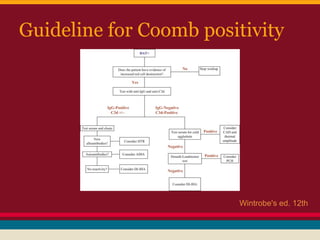
Guideline for Coomb positivity
Wintrobe's ed. 12th
Presentation of AIHA
● Acute anemia
● Increased reticulocyte count
● May have jaundice (indirect
hyperbilirubinemia; rarely > 5 mg/dL)
● Hepatosplenomegaly and
lymphadenopathy may present
● Other symptoms include edema, dark
urine, dizziness, confusion,
Other associated disease
Should aware of..
● Thrombocytopenia -> Evans syndrome
● Other autoimmune feature -> SLE
● Markedly large splenomegaly or
lymphadenopathy may indicate NHL
● Recently used drugs
● Patient may have increased risk of VTE
especially in association with lupus
anticoagulant or S/P splenectomy
Treatment of AIHA
● There is conflicting goal of treatment of
AIHA
● Generally accepted aim of treatment is Hb
10/dL
● Treatment goal must be weighted with
their side effect and cost
Treatment of warm/mixed type
AIHA
First line therapy is steroid
● Prednisolone 1 mkd (Pred)
● CR is achieved if Hb > 10 g/dL
● After CR reduce Pred by 50% (to 20-30
mg/day)
● Then reduce by 2.5-5 mg/day every
month
● Continue Pred 5 mg/day for 3-4 month
then stop if can remain in CR
Treatment of warm/mixed type
AIHA
Supportive treatment
● Folate supplement
● Antacid
● Calcium supplement
● Vitamin D supplement
● Bisphosphonate
● Monitor blood sugar (2-3 wk after Pred)
● Aware of VTE especially in association with
lupus anticoagulant or S/P splenectomy
Second line treatment
Indicate if
● Can not maintain acceptable Hb level
● Required Pred more than 15 mg/d
● Required Pred between 5-15 mg /d may
indicate second line treatment
Second line treatment
● Splenectomy
○ Response 38-82% (around 2/3)
○ Long term response vary around 50%
○ Pneumococcal vaccine is required 2 wk
before procedure and every 5 years
● Rituximab
○ Off label use
○ Dose 375 mg/m2 weekly x 4 doses
○ Response about 82%
○ But seem to relapse in 1 -3 years
Other second line therapy
● Azathioprine
● Cyclophosphamide
● Cyclosporine
● Mycophenolate mofetil
● Danazol
All treatment may be combined with low
dose steroid (Pred < 15 mg/day)
Treatment of cold type AIHA
● In most case associated with
lymphoproliferative disease
● Less common ass. with autoimmune,
infection, drugs (rarely)
Primary chronic cold agglutinin
disease (PAD)
● Have IgM monoclonal gammopathy or
lymphoma in marrow without overt
clinical sign
● Anemia is mild
● Treatment is usually not required
● Usually steroid and splenectomy resistant
● Most evidence of response are from
rituximab, though only in PR
Treatment of secondary AIHA
● SLE
○ Treatment is the same as primary AIHA
● CLL
○ Pred is the first-line (also in fludarabine asso.)
○ In active CLL case add chemo (chlorambucil,
R-CVP, etc.)
○ In refractory case rituximab and splenectomy
are indicated
● NHL
○ Treatment of NHL give a sustained response
FIN

AIHA for resident med.

  • 1.
  • 2.
  • 3.
    AIHA pathophysiology ● Causedby autoantibody to self RBC ● Divided into ○ Primary AIHA: without obvious cause ○ Secondary AIHA: precipitated by some condition ■ mainstay of treatment is removal of etiology
  • 4.
    IgG autoantibody ● Bindto RBC and cause hemophagocytosis in spleen ● Partial phagocytosis render RBC loss its membrane and produce microspherocyte
  • 5.
    IgM autoantibody ● Fixcomplement on RBC cause intravascular hemolysis ● After fixation and lysis, C3b also cause destruction of RBC in liver (Kupffer cells)
  • 6.
    Cause of secondaryAIHA ● Drug: penicillin, fludarabine, methyldopa ● Infection: mycoplasma ● Tumor: lymphoma, ovarian dermal cyst, renal CA ● Other autoimmune disease: SLE
  • 7.
    Antibody in AIHA ●Warm type ○ increase activity when near 37 c ○ usually IgG ● Cold type ○ increase activity when near 4c ○ usually IgM ○ cause auto-agglutination ○ fixed complement ● Mixed type
  • 8.
    Agglutination in AIHA IgMantibody can cause auto- agglutination due to its large size While IgG need Coomb reagent to extend its size
  • 9.
    Coomb test ● Coombreagent is anti-human Fc portion of IgG immunoglobulin derived from rabbit ● Also called antiglobulin test
  • 10.
    Coomb test ● Mostcommercial Coomb reagent is comprised of polyspecific antiglobulin antibody ● Monospecific antibody for IgG, C3d, etc. are available to identify type of AIHA
  • 11.
  • 12.
    Coomb test ● Directantiglobulin test (DAT) ○ detect IgG attached on patient's RBC ○ use in AIHA ● Indirect antiglobulin test (IAT) ○ detect IgG in patient's serum ○ the IgG must be lured to attach to control RBC before perform DAT on the control RBC ○ use in cross-matching
  • 13.
    Coomb test falsepositivity ● Poor technique (over centrifuged, dirty test tube) ● Septicemia ● Drug induced non specific protein adsorption (cephalosporin, clavulanic acid) ● Wharton's jelly (non-specific adsorption) ● High paraproteinemia ● Alloantibody from transfused plasma
  • 14.
    Coomb test falsenegativity ● Poor technique (incubation, cell washing, centrifusion) ● IgA, IgM autoantibody ● Low-affinity antibody ● Too few antibody presence ● Prozone reaction from unlicensed product (too many target antigen) ● Forget to apply antiglobulin reagent
  • 15.
    Guideline for Coombpositivity Wintrobe's ed. 12th
  • 16.
    Presentation of AIHA ●Acute anemia ● Increased reticulocyte count ● May have jaundice (indirect hyperbilirubinemia; rarely > 5 mg/dL) ● Hepatosplenomegaly and lymphadenopathy may present ● Other symptoms include edema, dark urine, dizziness, confusion,
  • 17.
    Other associated disease Shouldaware of.. ● Thrombocytopenia -> Evans syndrome ● Other autoimmune feature -> SLE ● Markedly large splenomegaly or lymphadenopathy may indicate NHL ● Recently used drugs ● Patient may have increased risk of VTE especially in association with lupus anticoagulant or S/P splenectomy
  • 18.
    Treatment of AIHA ●There is conflicting goal of treatment of AIHA ● Generally accepted aim of treatment is Hb 10/dL ● Treatment goal must be weighted with their side effect and cost
  • 19.
    Treatment of warm/mixedtype AIHA First line therapy is steroid ● Prednisolone 1 mkd (Pred) ● CR is achieved if Hb > 10 g/dL ● After CR reduce Pred by 50% (to 20-30 mg/day) ● Then reduce by 2.5-5 mg/day every month ● Continue Pred 5 mg/day for 3-4 month then stop if can remain in CR
  • 20.
    Treatment of warm/mixedtype AIHA Supportive treatment ● Folate supplement ● Antacid ● Calcium supplement ● Vitamin D supplement ● Bisphosphonate ● Monitor blood sugar (2-3 wk after Pred) ● Aware of VTE especially in association with lupus anticoagulant or S/P splenectomy
  • 21.
    Second line treatment Indicateif ● Can not maintain acceptable Hb level ● Required Pred more than 15 mg/d ● Required Pred between 5-15 mg /d may indicate second line treatment
  • 22.
    Second line treatment ●Splenectomy ○ Response 38-82% (around 2/3) ○ Long term response vary around 50% ○ Pneumococcal vaccine is required 2 wk before procedure and every 5 years ● Rituximab ○ Off label use ○ Dose 375 mg/m2 weekly x 4 doses ○ Response about 82% ○ But seem to relapse in 1 -3 years
  • 23.
    Other second linetherapy ● Azathioprine ● Cyclophosphamide ● Cyclosporine ● Mycophenolate mofetil ● Danazol All treatment may be combined with low dose steroid (Pred < 15 mg/day)
  • 24.
    Treatment of coldtype AIHA ● In most case associated with lymphoproliferative disease ● Less common ass. with autoimmune, infection, drugs (rarely)
  • 25.
    Primary chronic coldagglutinin disease (PAD) ● Have IgM monoclonal gammopathy or lymphoma in marrow without overt clinical sign ● Anemia is mild ● Treatment is usually not required ● Usually steroid and splenectomy resistant ● Most evidence of response are from rituximab, though only in PR
  • 26.
    Treatment of secondaryAIHA ● SLE ○ Treatment is the same as primary AIHA ● CLL ○ Pred is the first-line (also in fludarabine asso.) ○ In active CLL case add chemo (chlorambucil, R-CVP, etc.) ○ In refractory case rituximab and splenectomy are indicated ● NHL ○ Treatment of NHL give a sustained response
  • 27.