Chapter 4
WELCOME
Lecture 9
Data Analysis, Discussion
and Conclusion
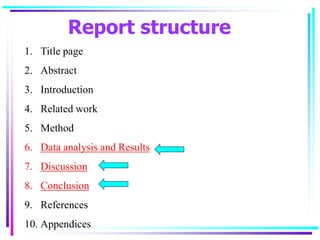
Report structure
1. Title page
2. Abstract
3. Introduction
4. Related work
5. Method
6. Data analysis and Results
7. Discussion
8. Conclusion
9. References
10. Appendices
Data Analysis
• Technological advances have made it possible for data
to be collected and directly fed into computers, removing
the possibility of human error.
•Questionnaire results must be reported using tables and
graphs
• Avoid first-person pronoun
• Use passive voice (It is shown / suggested that…)
• Questionnaire results must be reported using tables
and graphs
• Avoid first-person pronoun
• Use passive voice (It is shown / suggested that…)
Data Analysis
Data analysis techniques were used in your
study and why were they chosen. Such as in
our study, we utilized a combination of
descriptive statistics, inferential statistics, and
regression analysis to thoroughly examine the
factors affecting production and trading.
Data Analysis
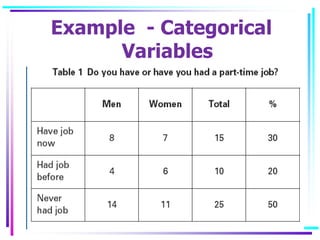
Example - Categorical
Variables
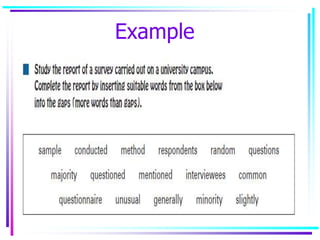
Example
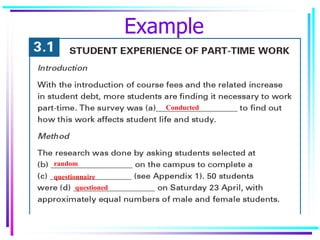
Example
Conducted
questionnaire
questioned
random
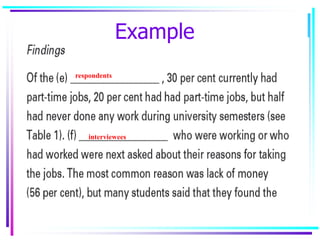
Example
respondents
interviewees
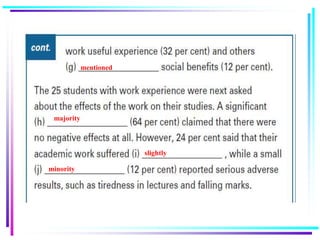
mentioned
majority
slightly
minority
questions
common
generally
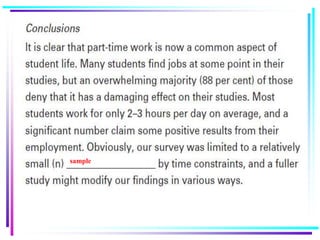
sample
 Interpret the main findings of your study and discuss any
patterns or trends observed .
 To interpret and discuss the findings of a study on factors
affecting the project, one would typically outline the key results
from the data analysis, explain observed patterns or trends, and
relate these findings to the broader context of development in the
region.
Highlighting your findings
•Begin a new paragraph
•Use different language
•If possible, use we and active form
•Use shorter than normal sentences
•Keep the paragraph short
Discussion and Conclusion
 In Discussion / Conclusions it is essential to:Be clear
what you did and what other authors have done
 2) Highlight your unique contribution & discuss
limitations of your findings
 4) State what the applications and implications of your
research are. Tie discussions to the literature and
recommendations for practice.
Discussion and Conclusion
 Compare your results with your initial hypotheses.
Were there any surprising findings. In comparing the
results of a study with initial hypotheses, it is crucial
to reflect on whether the findings support, refute, or
suggest modifications to the initial assumptions.
Discussion and Conclusion
Discuss the statistical significance of your results. What
tests did you use to determine this significance.
 When discussing the statistical significance of
research results, it's important to consider the types
of tests used and how they relate to the data and
research questions
Discussion and Conclusion
Describe how you presented your results and
explain why you chose these methods and
Presenting research results effectively is crucial
for communicating the significance and
implications of your study. The methods chosen
for presenting results depend on the nature of
the data, the audience, and the research
objectives
Discussion and Conclusion
What practical implications do your findings have, and
how do they contribute to the existing body of
knowledge To effectively discuss the practical
implications and contributions to the existing body of
knowledge of a study's findings, it's important to clearly
articulate how these results can be applied in real-world
contexts and how they extend, challenge, or refine
existing theories or practices.
Discussion and Conclusion
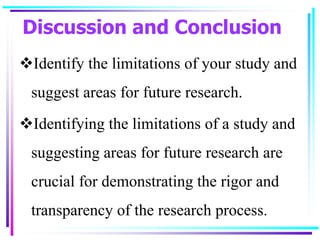
Identify the limitations of your study and
suggest areas for future research.
Identifying the limitations of a study and
suggesting areas for future research are
crucial for demonstrating the rigor and
transparency of the research process.
Discussion and Conclusion
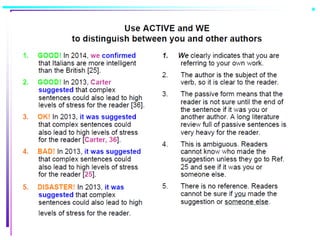
Not making the distinction clear between what YOU
did and what OTHERS have done causes more
confusion for the reader than any grammatical or
vocabulary mistake
Discussion and Conclusion
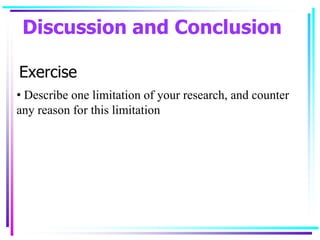
Exercise
• Describe one limitation of your research, and counter
any reason for this limitation
Discussion and Conclusion
• Don’t end your Discussion or project proposal by
talking about your limitations.
• End with something very positive – this will be the
reader’s final impression
Discussion and Conclusion
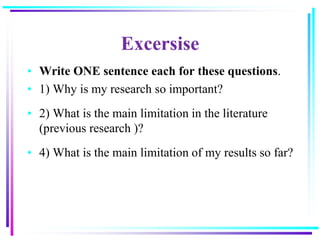
Excersise
• Write ONE sentence each for these questions.
• 1) Why is my research so important?
• 2) What is the main limitation in the literature
(previous research )?
• 4) What is the main limitation of my results so far?
Discussion and Conclusion
• What are your research limitations?
• Unfortunately, the sample size was small …
• Show the positive side of your limitations, and
highlight that other published papers also had their
limitations
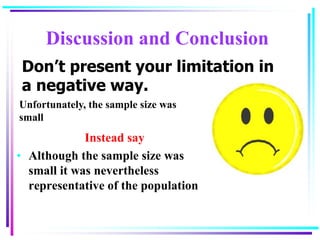
Don’t present your limitation in
a negative way.
Instead say
• Although the sample size was
small it was nevertheless
representative of the population
Discussion and Conclusion
Unfortunately, the sample size was
small
Exercise
• State the implications and possible applications
of your research.
• Talk also about future work.

1.Data Analysis discussion and conclusion

  • 1.
  • 2.
  • 3.
  • 4.
    Report structure 1. Titlepage 2. Abstract 3. Introduction 4. Related work 5. Method 6. Data analysis and Results 7. Discussion 8. Conclusion 9. References 10. Appendices
  • 5.
    Data Analysis • Technologicaladvances have made it possible for data to be collected and directly fed into computers, removing the possibility of human error. •Questionnaire results must be reported using tables and graphs • Avoid first-person pronoun • Use passive voice (It is shown / suggested that…)
  • 6.
    • Questionnaire resultsmust be reported using tables and graphs • Avoid first-person pronoun • Use passive voice (It is shown / suggested that…) Data Analysis
  • 7.
    Data analysis techniqueswere used in your study and why were they chosen. Such as in our study, we utilized a combination of descriptive statistics, inferential statistics, and regression analysis to thoroughly examine the factors affecting production and trading. Data Analysis
  • 8.
  • 9.
  • 10.
  • 11.
  • 12.
  • 13.
  • 15.
  • 16.
     Interpret themain findings of your study and discuss any patterns or trends observed .  To interpret and discuss the findings of a study on factors affecting the project, one would typically outline the key results from the data analysis, explain observed patterns or trends, and relate these findings to the broader context of development in the region.
  • 17.
    Highlighting your findings •Begina new paragraph •Use different language •If possible, use we and active form •Use shorter than normal sentences •Keep the paragraph short
  • 18.
  • 19.
    Discussion and Conclusion In Discussion / Conclusions it is essential to:Be clear what you did and what other authors have done  2) Highlight your unique contribution & discuss limitations of your findings  4) State what the applications and implications of your research are. Tie discussions to the literature and recommendations for practice.
  • 20.
    Discussion and Conclusion Compare your results with your initial hypotheses. Were there any surprising findings. In comparing the results of a study with initial hypotheses, it is crucial to reflect on whether the findings support, refute, or suggest modifications to the initial assumptions.
  • 21.
    Discussion and Conclusion Discussthe statistical significance of your results. What tests did you use to determine this significance.  When discussing the statistical significance of research results, it's important to consider the types of tests used and how they relate to the data and research questions
  • 22.
    Discussion and Conclusion Describehow you presented your results and explain why you chose these methods and Presenting research results effectively is crucial for communicating the significance and implications of your study. The methods chosen for presenting results depend on the nature of the data, the audience, and the research objectives
  • 23.
    Discussion and Conclusion Whatpractical implications do your findings have, and how do they contribute to the existing body of knowledge To effectively discuss the practical implications and contributions to the existing body of knowledge of a study's findings, it's important to clearly articulate how these results can be applied in real-world contexts and how they extend, challenge, or refine existing theories or practices.
  • 24.
    Discussion and Conclusion Identifythe limitations of your study and suggest areas for future research. Identifying the limitations of a study and suggesting areas for future research are crucial for demonstrating the rigor and transparency of the research process.
  • 25.
  • 27.
    Not making thedistinction clear between what YOU did and what OTHERS have done causes more confusion for the reader than any grammatical or vocabulary mistake Discussion and Conclusion
  • 28.
    Exercise • Describe onelimitation of your research, and counter any reason for this limitation Discussion and Conclusion
  • 29.
    • Don’t endyour Discussion or project proposal by talking about your limitations. • End with something very positive – this will be the reader’s final impression Discussion and Conclusion
  • 30.
    Excersise • Write ONEsentence each for these questions. • 1) Why is my research so important? • 2) What is the main limitation in the literature (previous research )? • 4) What is the main limitation of my results so far?
  • 31.
    Discussion and Conclusion •What are your research limitations? • Unfortunately, the sample size was small … • Show the positive side of your limitations, and highlight that other published papers also had their limitations
  • 32.
    Don’t present yourlimitation in a negative way. Instead say • Although the sample size was small it was nevertheless representative of the population Discussion and Conclusion Unfortunately, the sample size was small
  • 34.
    Exercise • State theimplications and possible applications of your research. • Talk also about future work.