The Discriminant
Given a quadratic equation, can youuse the
discriminant to determine the nature
of the roots?
What is the discriminant?
The discriminant is the expression b2
– 4ac.
The value of the discriminant can be used
to determine the number and type of roots
of a quadratic equation.
How have we previously used the discriminant?
We used the discriminant to determine
whether a quadratic polynomial could
be factored.
If the value of the discriminant for a
quadratic polynomial is a perfect square,
the polynomial can be factored.
During this presentation, we will complete a chart
that shows how the value of the discriminant
relates to the number and type of roots of a
quadratic equation.
Rather than simply memorizing the chart, think
About the value of b
2
– 4ac under a square root
and what that means in relation to the roots of
the equation.
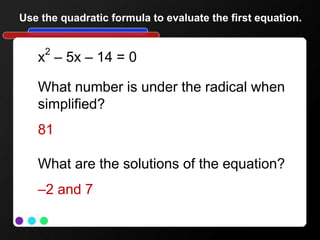
Use the quadratic formula to evaluate the first equation.
x2
– 5x – 14 = 0
What number is under the radical when
simplified?
81
What are the solutions of the equation?
–2 and 7
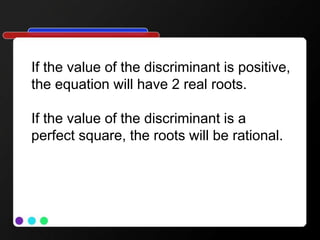
If the value of the discriminant is positive,
the equation will have 2 real roots.
If the value of the discriminant is a
perfect square, the roots will be rational.
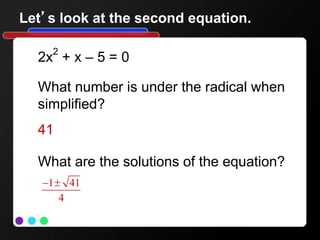
Let’s look at the second equation.
2x2
+ x – 5 = 0
What number is under the radical when
simplified?
41
What are the solutions of the equation?
1 41
4
 
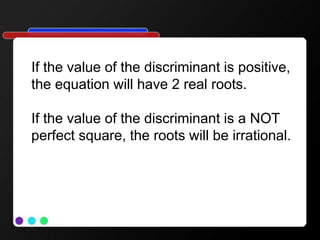
If the value of the discriminant is positive,
the equation will have 2 real roots.
If the value of the discriminant is a NOT
perfect square, the roots will be irrational.
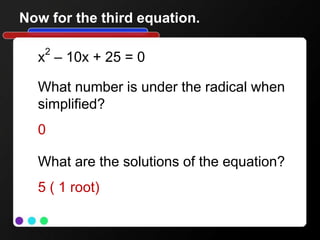
Now for the third equation.
x2
– 10x + 25 = 0
What number is under the radical when
simplified?
0
What are the solutions of the equation?
5 ( 1 root)
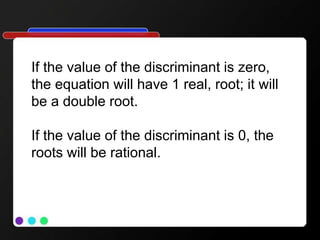
If the value of the discriminant is zero,
the equation will have 1 real, root; it will
be a double root.
If the value of the discriminant is 0, the
roots will be rational.
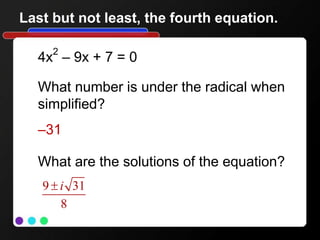
Last but not least, the fourth equation.
4x2
– 9x + 7 = 0
What number is under the radical when
simplified?
–31
What are the solutions of the equation?
9 31
8
i

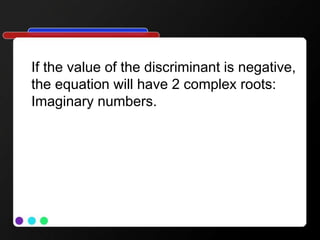
If the value of the discriminant is negative,
the equation will have 2 complex roots:
Imaginary numbers.
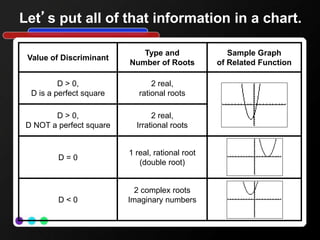
Let’s put all of that information in a chart.
Value of Discriminant
Type and
Number of Roots
Sample Graph
of Related Function
D > 0,
D is a perfect square
2 real,
rational roots
D > 0,
D NOT a perfect square
2 real,
Irrational roots
D = 0
1 real, rational root
(double root)
D < 0
2 complex roots
Imaginary numbers
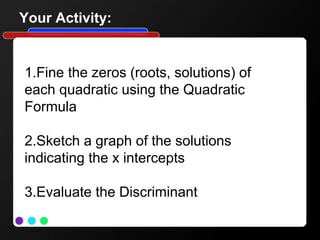
Your Activity:
1.Fine the zeros (roots, solutions) of
each quadratic using the Quadratic
Formula
2.Sketch a graph of the solutions
indicating the x intercepts
3.Evaluate the Discriminant
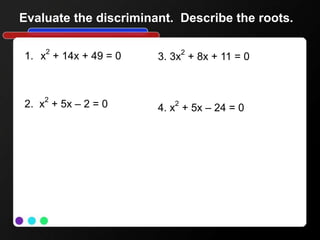
Evaluate the discriminant. Describe the roots.
1. x
2
+ 14x + 49 = 0
2. x
2
+ 5x – 2 = 0
3. 3x
2
+ 8x + 11 = 0
4. x
2
+ 5x – 24 = 0

discriminant.pptx

  • 1.
    The Discriminant Given aquadratic equation, can youuse the discriminant to determine the nature of the roots?
  • 2.
    What is thediscriminant? The discriminant is the expression b2 – 4ac. The value of the discriminant can be used to determine the number and type of roots of a quadratic equation.
  • 3.
    How have wepreviously used the discriminant? We used the discriminant to determine whether a quadratic polynomial could be factored. If the value of the discriminant for a quadratic polynomial is a perfect square, the polynomial can be factored.
  • 4.
    During this presentation,we will complete a chart that shows how the value of the discriminant relates to the number and type of roots of a quadratic equation. Rather than simply memorizing the chart, think About the value of b 2 – 4ac under a square root and what that means in relation to the roots of the equation.
  • 5.
    Use the quadraticformula to evaluate the first equation. x2 – 5x – 14 = 0 What number is under the radical when simplified? 81 What are the solutions of the equation? –2 and 7
  • 6.
    If the valueof the discriminant is positive, the equation will have 2 real roots. If the value of the discriminant is a perfect square, the roots will be rational.
  • 7.
    Let’s look atthe second equation. 2x2 + x – 5 = 0 What number is under the radical when simplified? 41 What are the solutions of the equation? 1 41 4  
  • 8.
    If the valueof the discriminant is positive, the equation will have 2 real roots. If the value of the discriminant is a NOT perfect square, the roots will be irrational.
  • 9.
    Now for thethird equation. x2 – 10x + 25 = 0 What number is under the radical when simplified? 0 What are the solutions of the equation? 5 ( 1 root)
  • 10.
    If the valueof the discriminant is zero, the equation will have 1 real, root; it will be a double root. If the value of the discriminant is 0, the roots will be rational.
  • 11.
    Last but notleast, the fourth equation. 4x2 – 9x + 7 = 0 What number is under the radical when simplified? –31 What are the solutions of the equation? 9 31 8 i 
  • 12.
    If the valueof the discriminant is negative, the equation will have 2 complex roots: Imaginary numbers.
  • 13.
    Let’s put allof that information in a chart. Value of Discriminant Type and Number of Roots Sample Graph of Related Function D > 0, D is a perfect square 2 real, rational roots D > 0, D NOT a perfect square 2 real, Irrational roots D = 0 1 real, rational root (double root) D < 0 2 complex roots Imaginary numbers
  • 14.
    Your Activity: 1.Fine thezeros (roots, solutions) of each quadratic using the Quadratic Formula 2.Sketch a graph of the solutions indicating the x intercepts 3.Evaluate the Discriminant
  • 15.
    Evaluate the discriminant.Describe the roots. 1. x 2 + 14x + 49 = 0 2. x 2 + 5x – 2 = 0 3. 3x 2 + 8x + 11 = 0 4. x 2 + 5x – 24 = 0