The Discriminant
Given a quadratic equation use the
discriminant to determine the nature
of the roots.
What is the discriminant?
The discriminant is the expression b2
– 4ac.
The value of the discriminant can be used
to determine the number and type of roots
of a quadratic equation.
How have we previously used the discriminant?
We used the discriminant to determine
whether a quadratic polynomial could
be factored.
If the value of the discriminant for a
quadratic polynomial is a perfect square,
the polynomial can be factored.
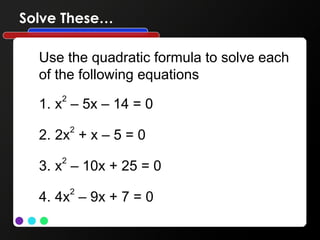
Solve These…
Use the quadratic formula to solve each
of the following equations
1. x2
– 5x – 14 = 0
2. 2x2
+ x – 5 = 0
3. x2
– 10x + 25 = 0
4. 4x2
– 9x + 7 = 0
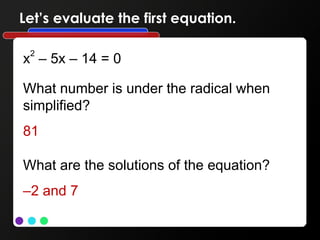
Let’s evaluate the first equation.
x2
– 5x – 14 = 0
What number is under the radical when
simplified?
81
What are the solutions of the equation?
–2 and 7
If the value of the discriminant is positive,
the equation will have 2 real roots.
If the value of the discriminant is a
perfect square, the roots will be rational.
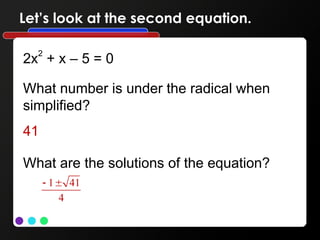
Let’s look at the second equation.
2x2
+ x – 5 = 0
What number is under the radical when
simplified?
41
What are the solutions of the equation?
1 41
4
 
If the value of the discriminant is positive,
the equation will have 2 real roots.
If the value of the discriminant is a NOT
perfect square, the roots will be irrational.
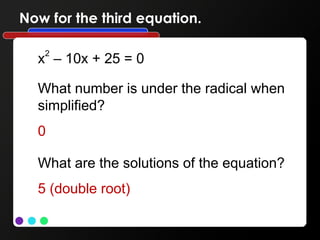
Now for the third equation.
x2
– 10x + 25 = 0
What number is under the radical when
simplified?
0
What are the solutions of the equation?
5 (double root)
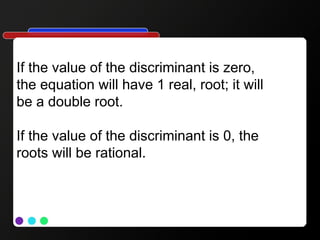
If the value of the discriminant is zero,
the equation will have 1 real, root; it will
be a double root.
If the value of the discriminant is 0, the
roots will be rational.
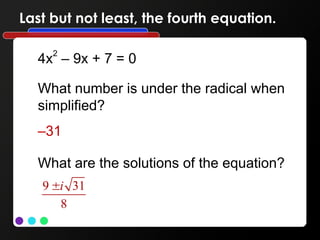
Last but not least, the fourth equation.
4x2
– 9x + 7 = 0
What number is under the radical when
simplified?
–31
What are the solutions of the equation?
9 31
8
i

If the value of the discriminant is negative,
the equation will have 2 complex roots;
they will be complex conjugates.
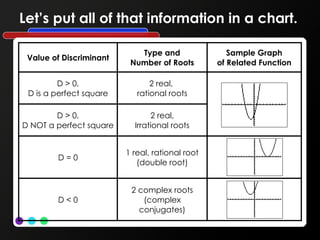
Let’s put all of that information in a chart.
Value of Discriminant
Type and
Number of Roots
Sample Graph
of Related Function
D > 0,
D is a perfect square
2 real,
rational roots
D > 0,
D NOT a perfect square
2 real,
Irrational roots
D = 0
1 real, rational root
(double root)
D < 0
2 complex roots
(complex
conjugates)
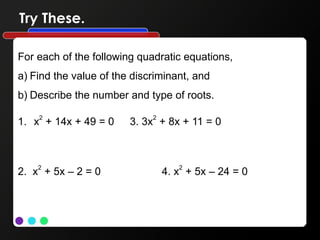
Try These.
For each of the following quadratic equations,
a) Find the value of the discriminant, and
b) Describe the number and type of roots.
1. x2
+ 14x + 49 = 0 3. 3x2
+ 8x + 11 = 0
2. x2
+ 5x – 2 = 0 4. x2
+ 5x – 24 = 0
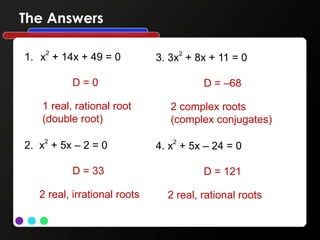
The Answers
1. x
2
+ 14x + 49 = 0
D = 0
1 real, rational root
(double root)
2. x2
+ 5x – 2 = 0
D = 33
2 real, irrational roots
3. 3x2
+ 8x + 11 = 0
D = –68
2 complex roots
(complex conjugates)
4. x2
+ 5x – 24 = 0
D = 121
2 real, rational roots
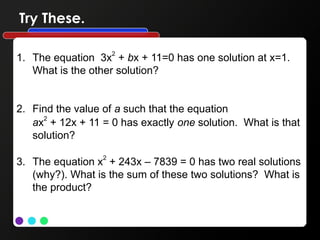
Try These.
1. The equation 3x
2
+ bx + 11=0 has one solution at x=1.
What is the other solution?
2. Find the value of a such that the equation
ax
2
+ 12x + 11 = 0 has exactly one solution. What is that
solution?
3. The equation x
2
+ 243x – 7839 = 0 has two real solutions
(why?). What is the sum of these two solutions? What is
the product?
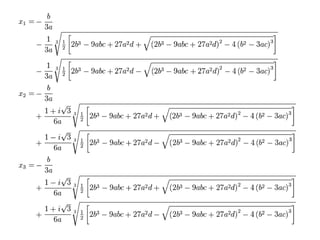
What about ax3
+bx2
+cx+d=0 ?

Discriminant the use and importance.pptx

  • 1.
    The Discriminant Given aquadratic equation use the discriminant to determine the nature of the roots.
  • 2.
    What is thediscriminant? The discriminant is the expression b2 – 4ac. The value of the discriminant can be used to determine the number and type of roots of a quadratic equation.
  • 3.
    How have wepreviously used the discriminant? We used the discriminant to determine whether a quadratic polynomial could be factored. If the value of the discriminant for a quadratic polynomial is a perfect square, the polynomial can be factored.
  • 4.
    Solve These… Use thequadratic formula to solve each of the following equations 1. x2 – 5x – 14 = 0 2. 2x2 + x – 5 = 0 3. x2 – 10x + 25 = 0 4. 4x2 – 9x + 7 = 0
  • 5.
    Let’s evaluate thefirst equation. x2 – 5x – 14 = 0 What number is under the radical when simplified? 81 What are the solutions of the equation? –2 and 7
  • 6.
    If the valueof the discriminant is positive, the equation will have 2 real roots. If the value of the discriminant is a perfect square, the roots will be rational.
  • 7.
    Let’s look atthe second equation. 2x2 + x – 5 = 0 What number is under the radical when simplified? 41 What are the solutions of the equation? 1 41 4  
  • 8.
    If the valueof the discriminant is positive, the equation will have 2 real roots. If the value of the discriminant is a NOT perfect square, the roots will be irrational.
  • 9.
    Now for thethird equation. x2 – 10x + 25 = 0 What number is under the radical when simplified? 0 What are the solutions of the equation? 5 (double root)
  • 10.
    If the valueof the discriminant is zero, the equation will have 1 real, root; it will be a double root. If the value of the discriminant is 0, the roots will be rational.
  • 11.
    Last but notleast, the fourth equation. 4x2 – 9x + 7 = 0 What number is under the radical when simplified? –31 What are the solutions of the equation? 9 31 8 i 
  • 12.
    If the valueof the discriminant is negative, the equation will have 2 complex roots; they will be complex conjugates.
  • 13.
    Let’s put allof that information in a chart. Value of Discriminant Type and Number of Roots Sample Graph of Related Function D > 0, D is a perfect square 2 real, rational roots D > 0, D NOT a perfect square 2 real, Irrational roots D = 0 1 real, rational root (double root) D < 0 2 complex roots (complex conjugates)
  • 14.
    Try These. For eachof the following quadratic equations, a) Find the value of the discriminant, and b) Describe the number and type of roots. 1. x2 + 14x + 49 = 0 3. 3x2 + 8x + 11 = 0 2. x2 + 5x – 2 = 0 4. x2 + 5x – 24 = 0
  • 15.
    The Answers 1. x 2 +14x + 49 = 0 D = 0 1 real, rational root (double root) 2. x2 + 5x – 2 = 0 D = 33 2 real, irrational roots 3. 3x2 + 8x + 11 = 0 D = –68 2 complex roots (complex conjugates) 4. x2 + 5x – 24 = 0 D = 121 2 real, rational roots
  • 16.
    Try These. 1. Theequation 3x 2 + bx + 11=0 has one solution at x=1. What is the other solution? 2. Find the value of a such that the equation ax 2 + 12x + 11 = 0 has exactly one solution. What is that solution? 3. The equation x 2 + 243x – 7839 = 0 has two real solutions (why?). What is the sum of these two solutions? What is the product?
  • 17.