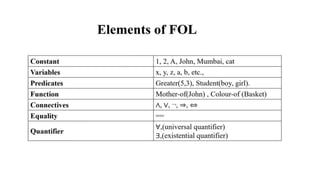
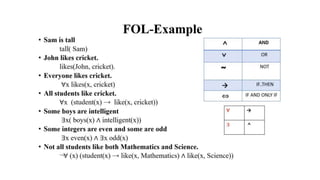
First order logic or Predicate
logic
Syntax
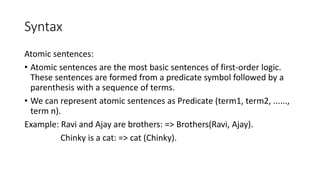
Atomic sentences:
• Atomic sentences are the most basic sentences of first-order logic.
These sentences are formed from a predicate symbol followed by a
parenthesis with a sequence of terms.
• We can represent atomic sentences as Predicate (term1, term2, ......,
term n).
Example: Ravi and Ajay are brothers: => Brothers(Ravi, Ajay).
Chinky is a cat: => cat (Chinky).
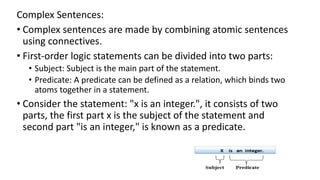
Complex Sentences:
• Complex sentences are made by combining atomic sentences
using connectives.
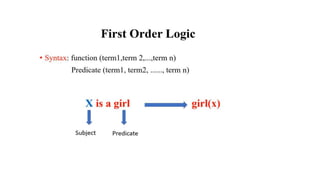
• First-order logic statements can be divided into two parts:
• Subject: Subject is the main part of the statement.
• Predicate: A predicate can be defined as a relation, which binds two
atoms together in a statement.
• Consider the statement: "x is an integer.", it consists of two
parts, the first part x is the subject of the statement and
second part "is an integer," is known as a predicate.
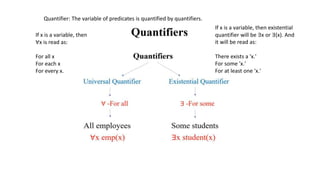
If x is a variable, then
∀x is read as:
For all x
For each x
For every x.
If x is a variable, then existential
quantifier will be ∃x or ∃(x). And
it will be read as:
There exists a 'x.'
For some 'x.'
For at least one 'x.'
Quantifier: The variable of predicates is quantified by quantifiers.
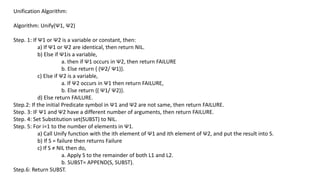
Unification Algorithm:
Algorithm: Unify(Ψ1, Ψ2)
Step. 1: If Ψ1 or Ψ2 is a variable or constant, then:
a) If Ψ1 or Ψ2 are identical, then return NIL.
b) Else if Ψ1is a variable,
a. then if Ψ1 occurs in Ψ2, then return FAILURE
b. Else return { (Ψ2/ Ψ1)}.
c) Else if Ψ2 is a variable,
a. If Ψ2 occurs in Ψ1 then return FAILURE,
b. Else return {( Ψ1/ Ψ2)}.
d) Else return FAILURE.
Step.2: If the initial Predicate symbol in Ψ1 and Ψ2 are not same, then return FAILURE.
Step. 3: IF Ψ1 and Ψ2 have a different number of arguments, then return FAILURE.
Step. 4: Set Substitution set(SUBST) to NIL.
Step. 5: For i=1 to the number of elements in Ψ1.
a) Call Unify function with the ith element of Ψ1 and ith element of Ψ2, and put the result into S.
b) If S = failure then returns Failure
c) If S ≠ NIL then do,
a. Apply S to the remainder of both L1 and L2.
b. SUBST= APPEND(S, SUBST).
Step.6: Return SUBST.

First order logic or Predicate logic.pptx

  • 1.
    First order logicor Predicate logic
  • 4.
    Syntax Atomic sentences: • Atomicsentences are the most basic sentences of first-order logic. These sentences are formed from a predicate symbol followed by a parenthesis with a sequence of terms. • We can represent atomic sentences as Predicate (term1, term2, ......, term n). Example: Ravi and Ajay are brothers: => Brothers(Ravi, Ajay). Chinky is a cat: => cat (Chinky).
  • 5.
    Complex Sentences: • Complexsentences are made by combining atomic sentences using connectives. • First-order logic statements can be divided into two parts: • Subject: Subject is the main part of the statement. • Predicate: A predicate can be defined as a relation, which binds two atoms together in a statement. • Consider the statement: "x is an integer.", it consists of two parts, the first part x is the subject of the statement and second part "is an integer," is known as a predicate.
  • 6.
    If x isa variable, then ∀x is read as: For all x For each x For every x. If x is a variable, then existential quantifier will be ∃x or ∃(x). And it will be read as: There exists a 'x.' For some 'x.' For at least one 'x.' Quantifier: The variable of predicates is quantified by quantifiers.
  • 13.
    Unification Algorithm: Algorithm: Unify(Ψ1,Ψ2) Step. 1: If Ψ1 or Ψ2 is a variable or constant, then: a) If Ψ1 or Ψ2 are identical, then return NIL. b) Else if Ψ1is a variable, a. then if Ψ1 occurs in Ψ2, then return FAILURE b. Else return { (Ψ2/ Ψ1)}. c) Else if Ψ2 is a variable, a. If Ψ2 occurs in Ψ1 then return FAILURE, b. Else return {( Ψ1/ Ψ2)}. d) Else return FAILURE. Step.2: If the initial Predicate symbol in Ψ1 and Ψ2 are not same, then return FAILURE. Step. 3: IF Ψ1 and Ψ2 have a different number of arguments, then return FAILURE. Step. 4: Set Substitution set(SUBST) to NIL. Step. 5: For i=1 to the number of elements in Ψ1. a) Call Unify function with the ith element of Ψ1 and ith element of Ψ2, and put the result into S. b) If S = failure then returns Failure c) If S ≠ NIL then do, a. Apply S to the remainder of both L1 and L2. b. SUBST= APPEND(S, SUBST). Step.6: Return SUBST.