1
Set Theory
Dr. Saurav Dash,
IIFT Kakinada Campus
2
What is a set?
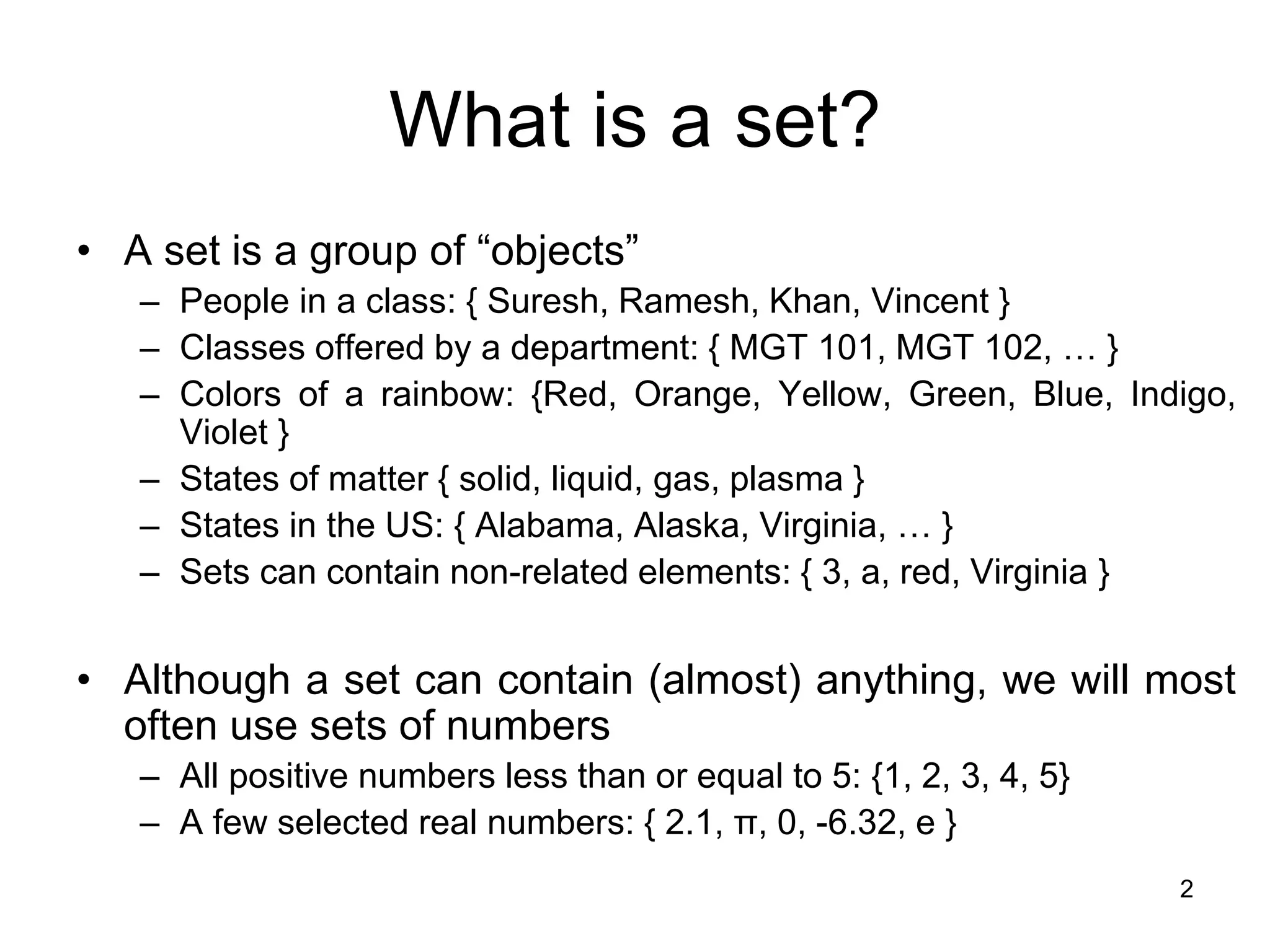
• A set is a group of “objects”
– People in a class: { Suresh, Ramesh, Khan, Vincent }
– Classes offered by a department: { MGT 101, MGT 102, … }
– Colors of a rainbow: {Red, Orange, Yellow, Green, Blue, Indigo,
Violet }
– States of matter { solid, liquid, gas, plasma }
– States in the US: { Alabama, Alaska, Virginia, … }
– Sets can contain non-related elements: { 3, a, red, Virginia }
• Although a set can contain (almost) anything, we will most
often use sets of numbers
– All positive numbers less than or equal to 5: {1, 2, 3, 4, 5}
– A few selected real numbers: { 2.1, π, 0, -6.32, e }
3
Set properties 1
• Order does not matter
– We often write them in order because it is
easier for humans to understand it that way
– {1, 2, 3, 4, 5} is equivalent to {3, 5, 2, 4, 1}
• Sets are notated with curly brackets
4
Set properties 2
• Sets do not have duplicate elements
– Consider the set of vowels in the alphabet.
• It makes no sense to list them as {a, a, a, e, i, o, o,
o, o, o, u}
• What we really want is just {a, e, i, o, u}
– Consider the list of students in this class
• Again, it does not make sense to list somebody
twice
• Note that a list is like a set, but order does
matter and duplicate elements are allowed
– We won’t be studying lists much in this class
5
Specifying a set 1
• Sets are usually represented by a capital
letter (A, B, S, etc.)
• Elements are usually represented by an
italic lower-case letter (a, x, y, etc.)
• Easiest way to specify a set is to list all the
elements: A = {1, 2, 3, 4, 5}
– Not always feasible for large or infinite sets
6
Specifying a set 2
• Can use an ellipsis (…): B = {0, 1, 2, 3, …}
– Can cause confusion. Consider the set C = {3, 5, 7,
…}. What comes next?
– If the set is all odd integers greater than 2, it is 9
– If the set is all prime numbers greater than 2, it is 11
• Can use set-builder notation
– D = {x | x is prime and x > 2}
– E = {x | x is odd and x > 2}
– The vertical bar means “such that”
– Thus, set D is read (in English) as: “all elements x
such that x is prime and x is greater than 2”
7
Specifying a set 3
• A set is said to “contain” the various
“members” or “elements” that make up the
set
– If an element a is a member of (or an element
of) a set S, we use then notation a  S
• 4  {1, 2, 3, 4}
– If an element is not a member of (or an
element of) a set S, we use the notation a  S
• 7  {1, 2, 3, 4}
• Virginia  {1, 2, 3, 4}
8
Often used sets
• N = {1, 2, 3, …} is the set of natural numbers
• Z = {…, -2, -1, 0, 1, 2, …} is the set of integers
• Z+ = {1, 2, 3, …} is the set of positive integers
(a.k.a whole numbers)
– Note that people disagree on the exact definitions of
whole numbers and natural numbers
• Q = {p/q | p  Z, q  Z, q ≠ 0} is the set of
rational numbers
– Any number that can be expressed as a fraction of
two integers (where the bottom one is not zero)
• R is the set of real numbers
9
The universal set 1
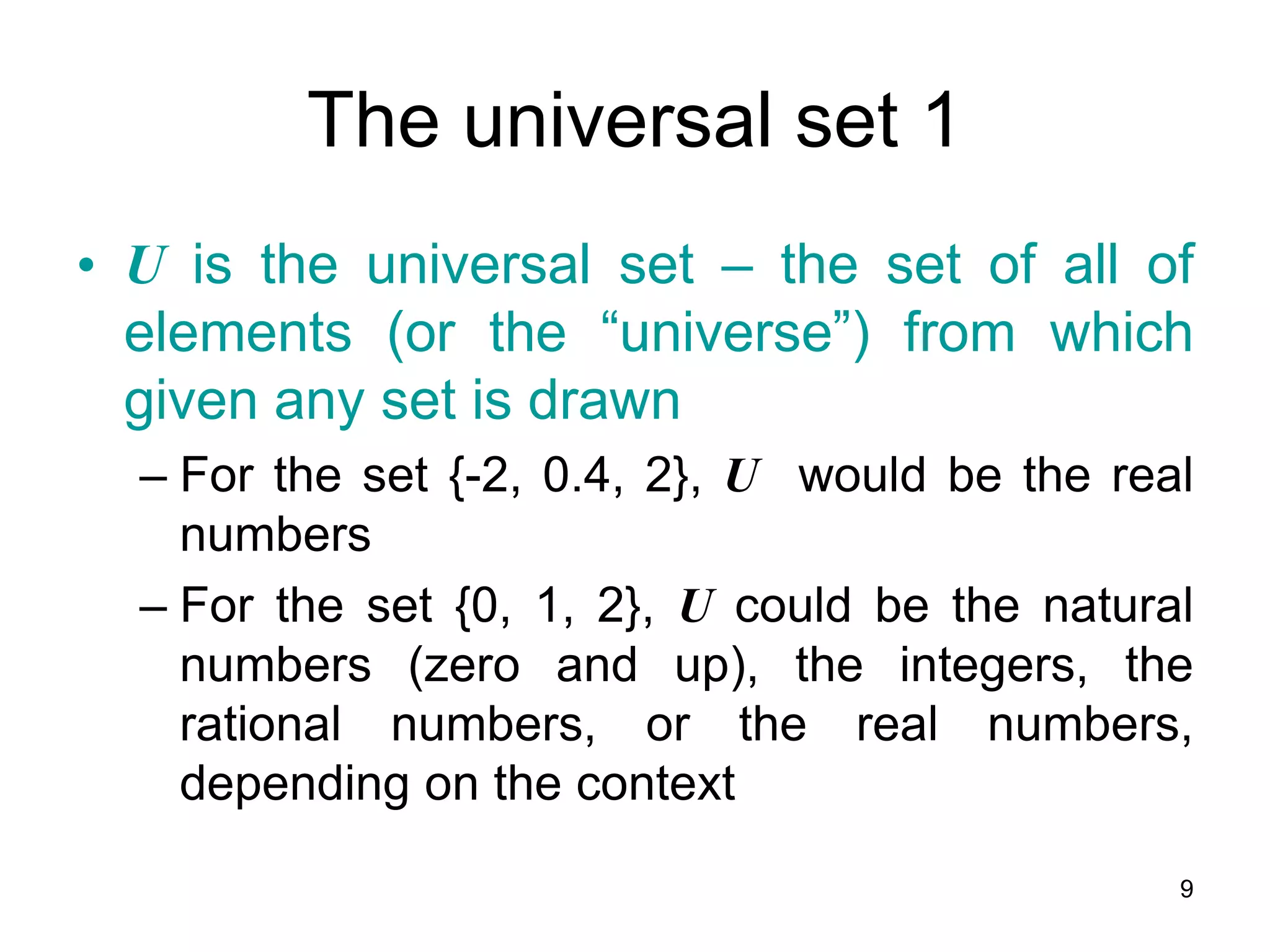
• U is the universal set – the set of all of
elements (or the “universe”) from which
given any set is drawn
– For the set {-2, 0.4, 2}, U would be the real
numbers
– For the set {0, 1, 2}, U could be the natural
numbers (zero and up), the integers, the
rational numbers, or the real numbers,
depending on the context
10
The universal set 2
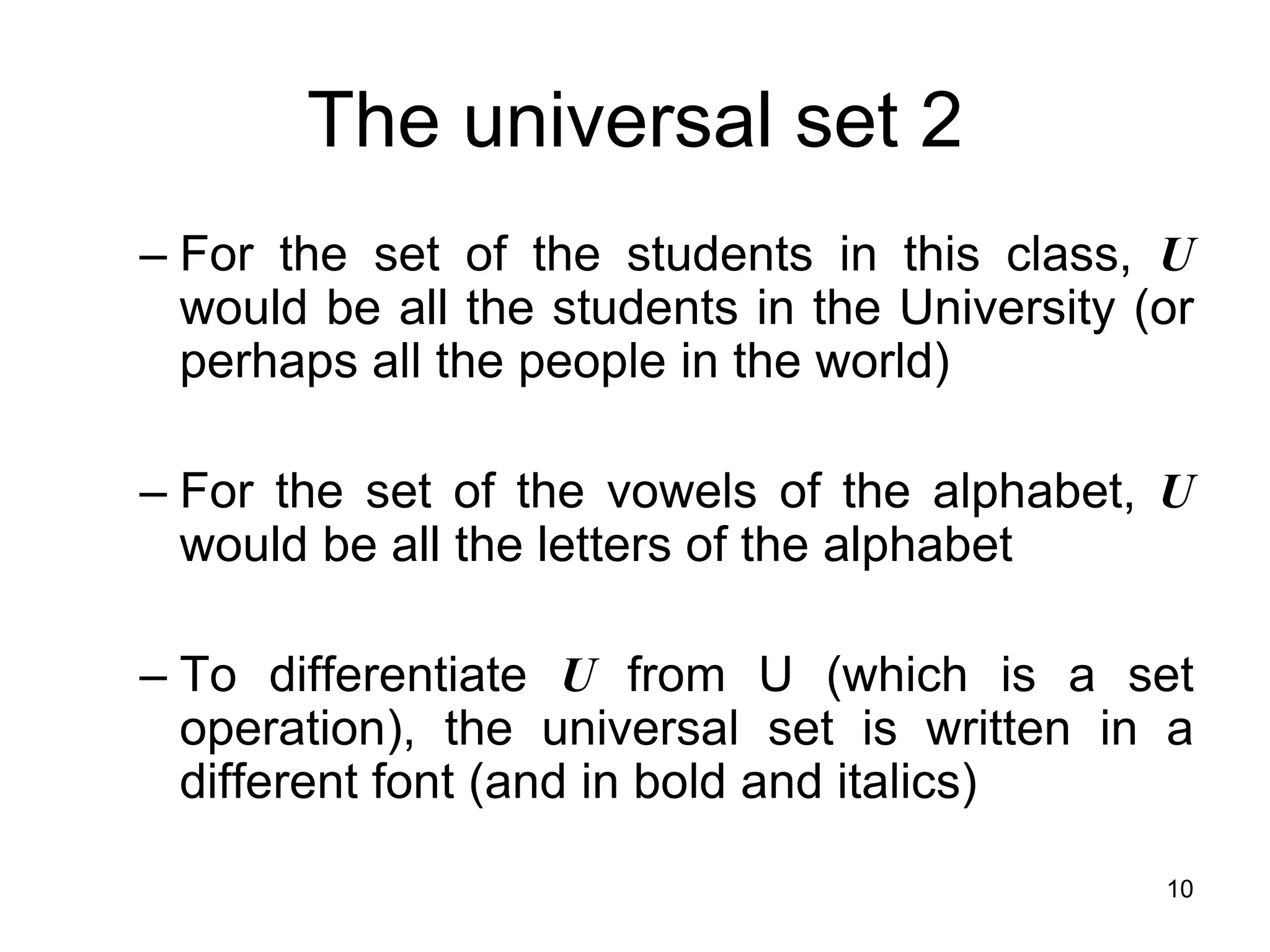
– For the set of the students in this class, U
would be all the students in the University (or
perhaps all the people in the world)
– For the set of the vowels of the alphabet, U
would be all the letters of the alphabet
– To differentiate U from U (which is a set
operation), the universal set is written in a
different font (and in bold and italics)
11
Venn diagrams
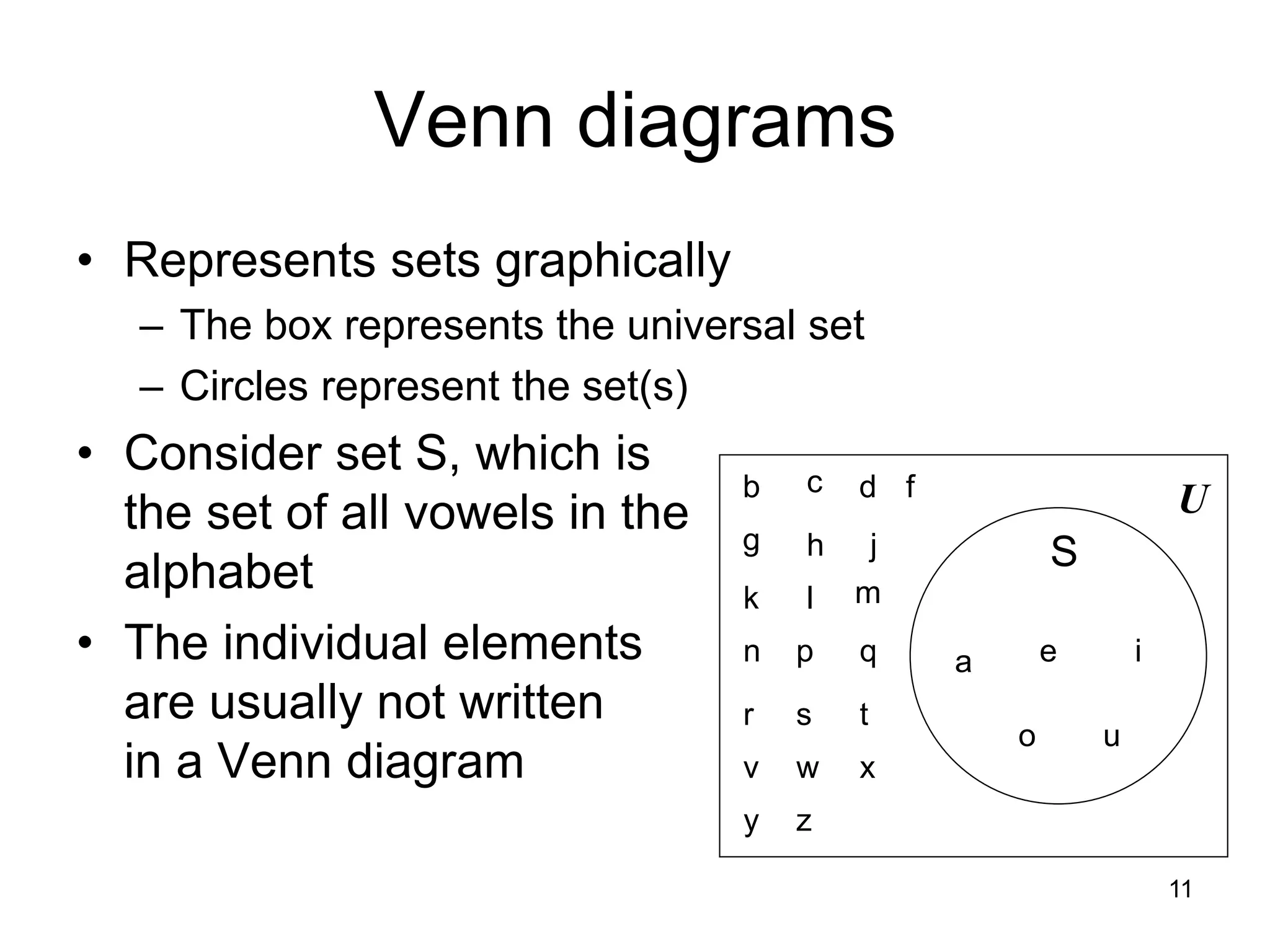
• Represents sets graphically
– The box represents the universal set
– Circles represent the set(s)
• Consider set S, which is
the set of all vowels in the
alphabet
• The individual elements
are usually not written
in a Venn diagram
a e i
o u
b c d f
g h j
k l m
n p q
r s t
v w x
y z
U
S
12
Sets of sets
• Sets can contain other sets
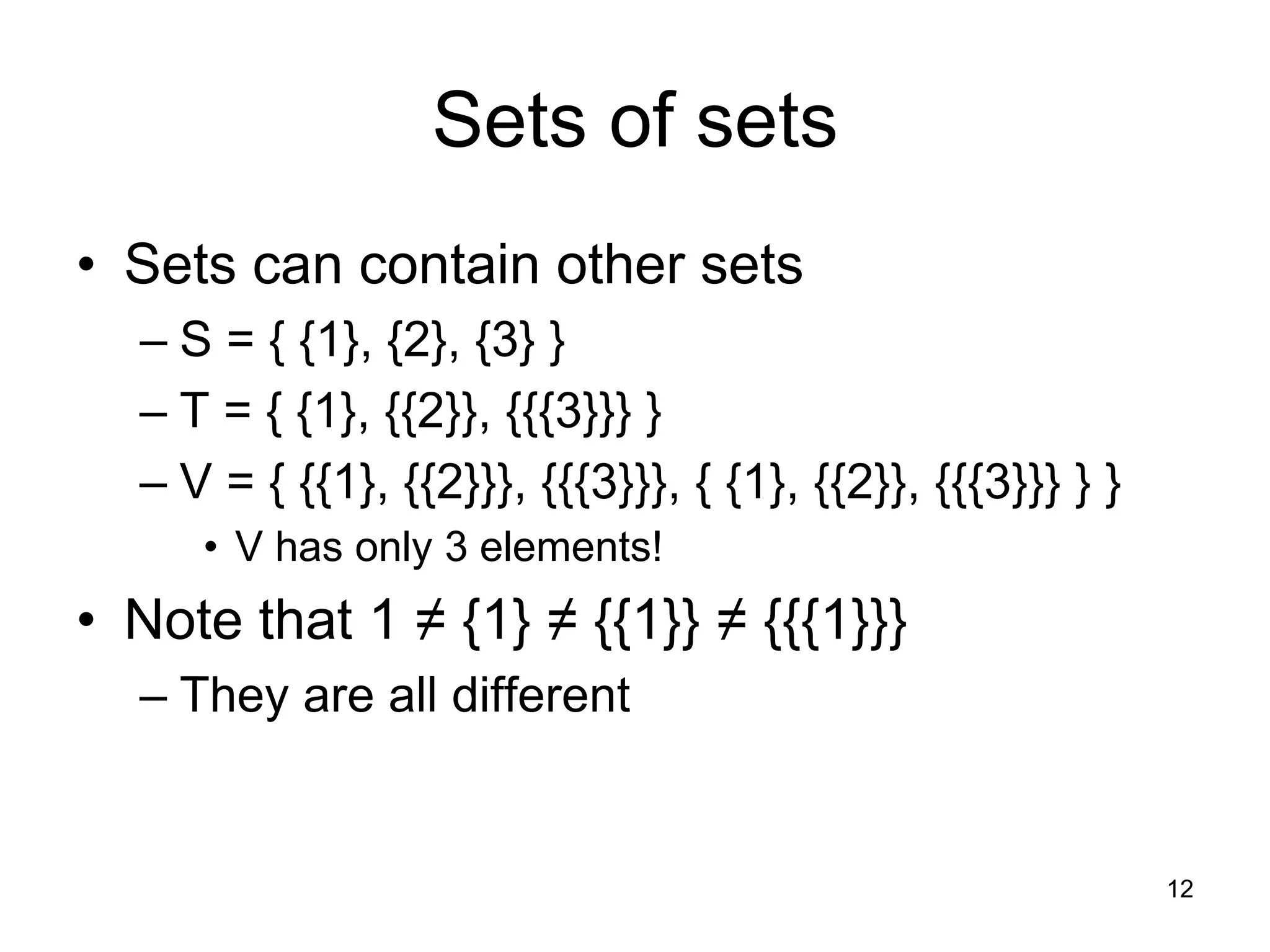
– S = { {1}, {2}, {3} }
– T = { {1}, {{2}}, {{{3}}} }
– V = { {{1}, {{2}}}, {{{3}}}, { {1}, {{2}}, {{{3}}} } }
• V has only 3 elements!
• Note that 1 ≠ {1} ≠ {{1}} ≠ {{{1}}}
– They are all different
13
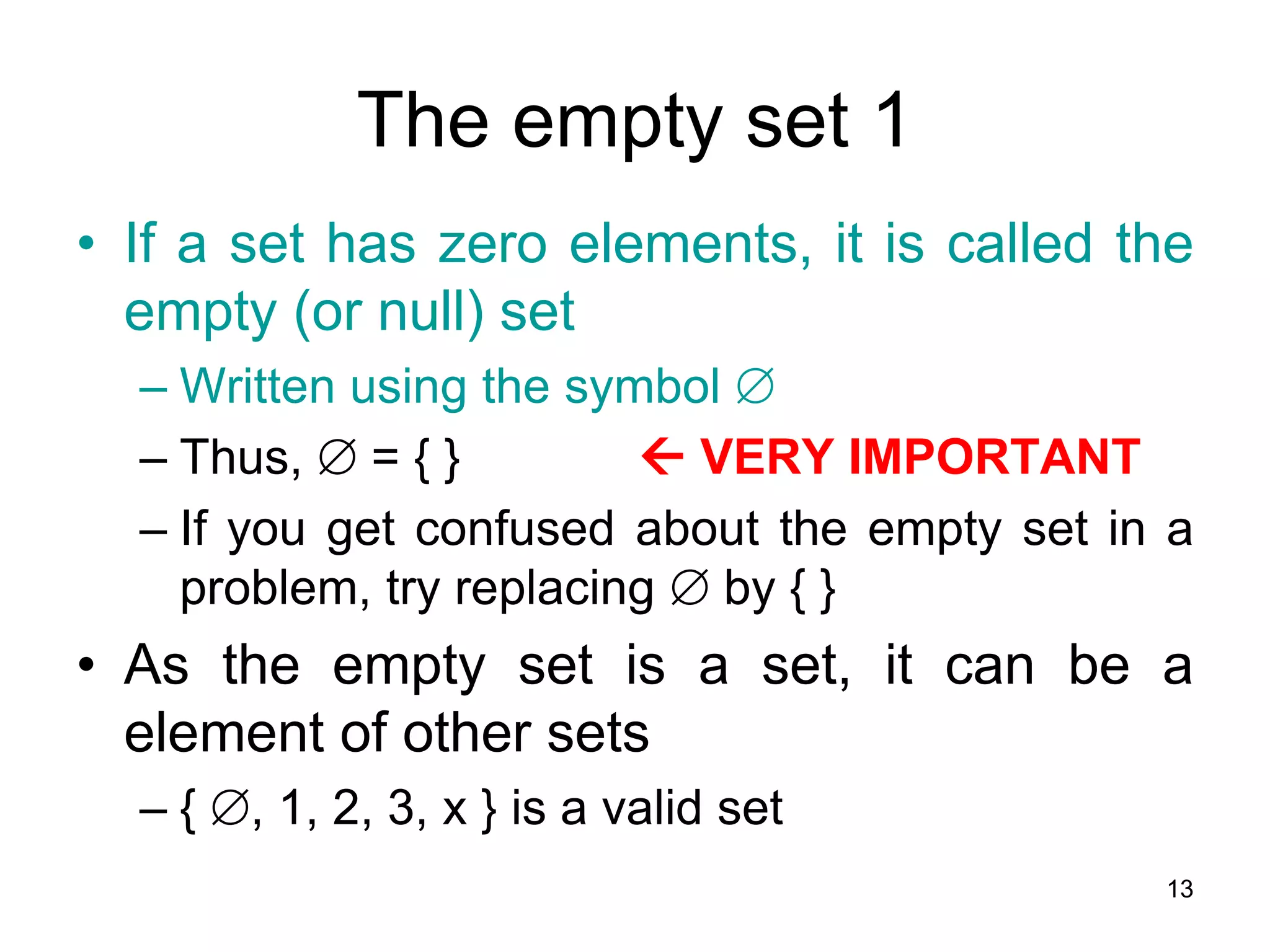
The empty set 1
• If a set has zero elements, it is called the
empty (or null) set
– Written using the symbol 
– Thus,  = { }  VERY IMPORTANT
– If you get confused about the empty set in a
problem, try replacing  by { }
• As the empty set is a set, it can be a
element of other sets
– { , 1, 2, 3, x } is a valid set
14
The empty set 1
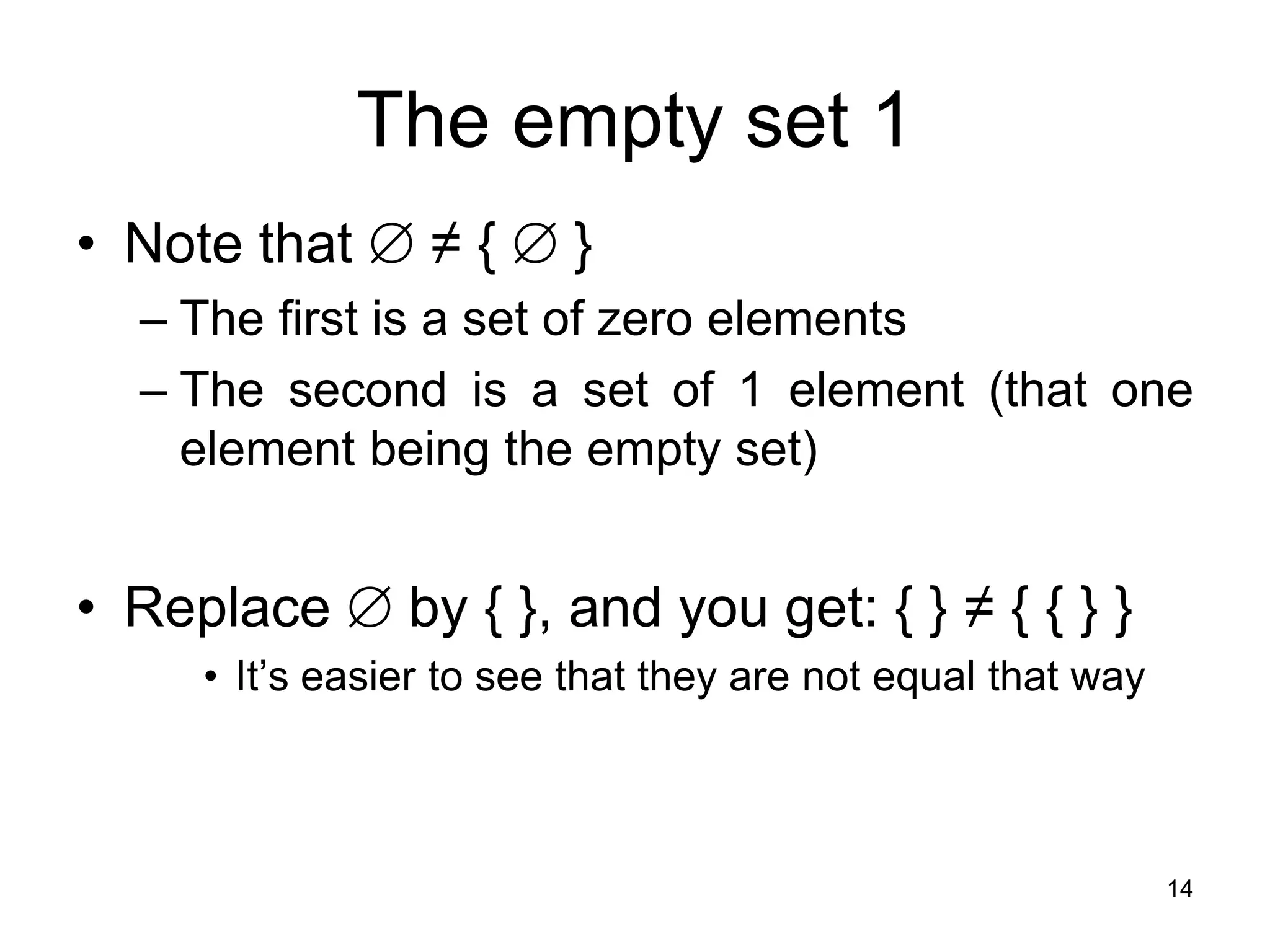
• Note that  ≠ {  }
– The first is a set of zero elements
– The second is a set of 1 element (that one
element being the empty set)
• Replace  by { }, and you get: { } ≠ { { } }
• It’s easier to see that they are not equal that way
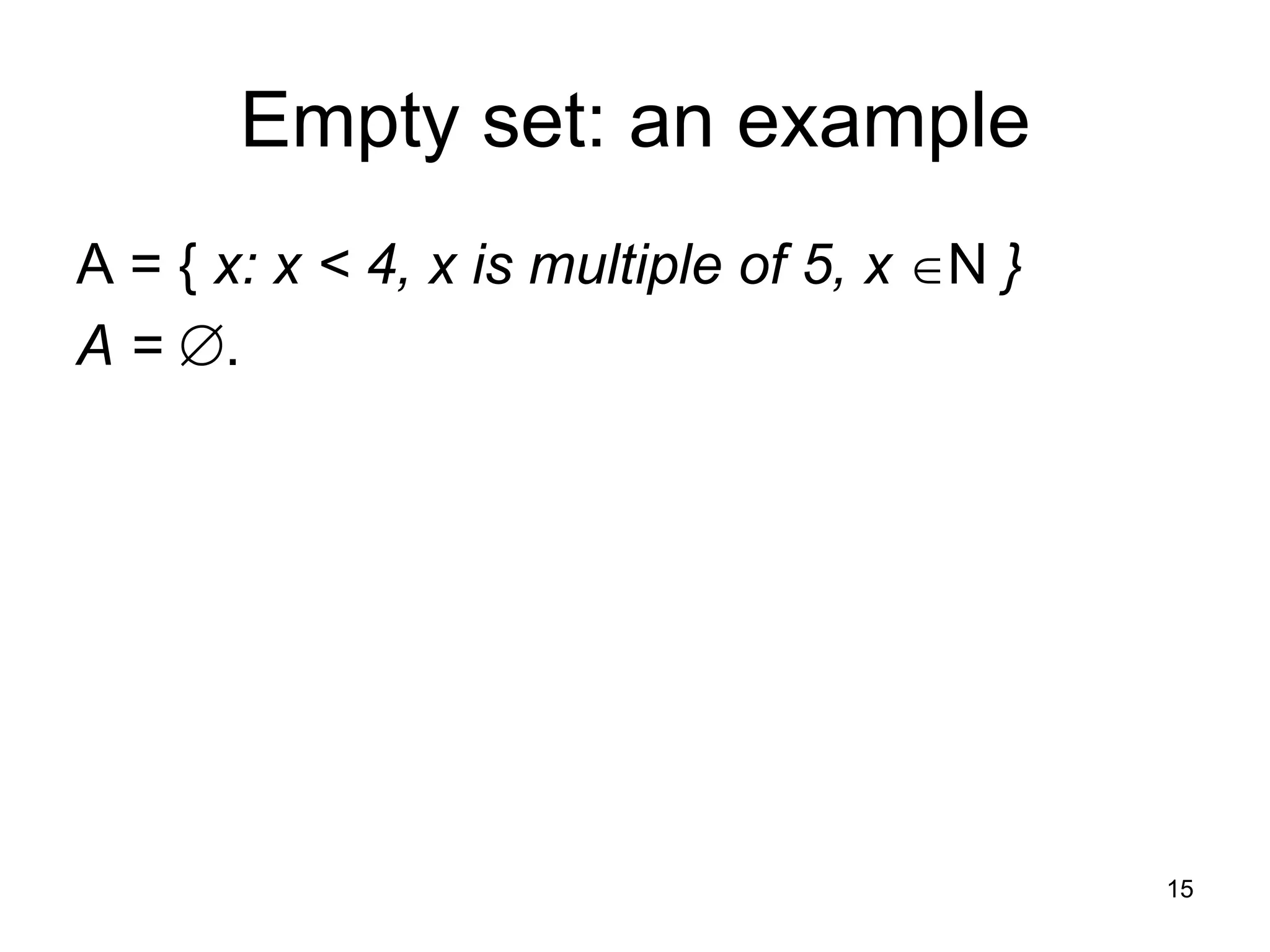
Empty set: an example
A = { x: x < 4, x is multiple of 5, x N }
A = .
15
16
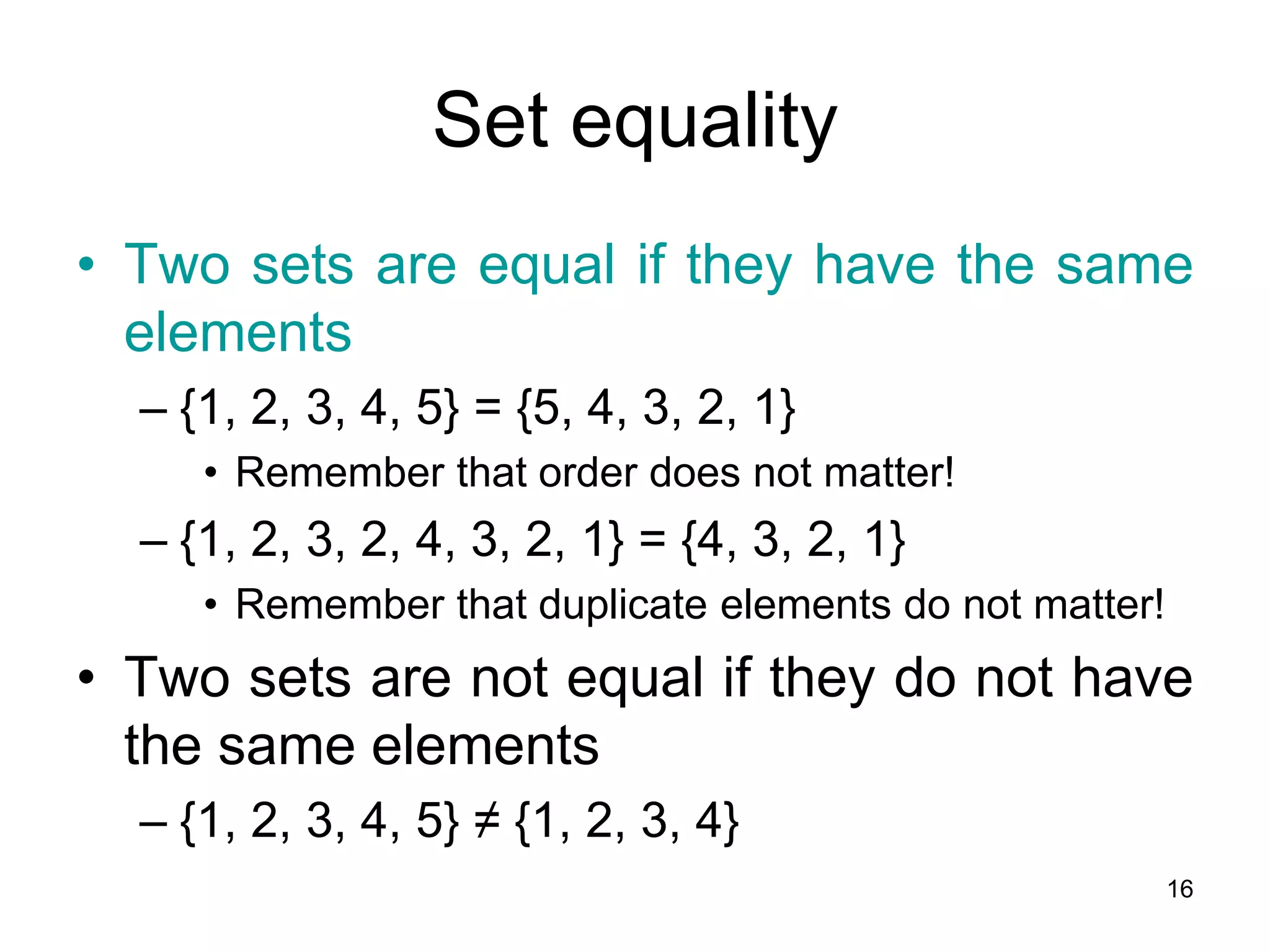
Set equality
• Two sets are equal if they have the same
elements
– {1, 2, 3, 4, 5} = {5, 4, 3, 2, 1}
• Remember that order does not matter!
– {1, 2, 3, 2, 4, 3, 2, 1} = {4, 3, 2, 1}
• Remember that duplicate elements do not matter!
• Two sets are not equal if they do not have
the same elements
– {1, 2, 3, 4, 5} ≠ {1, 2, 3, 4}
17
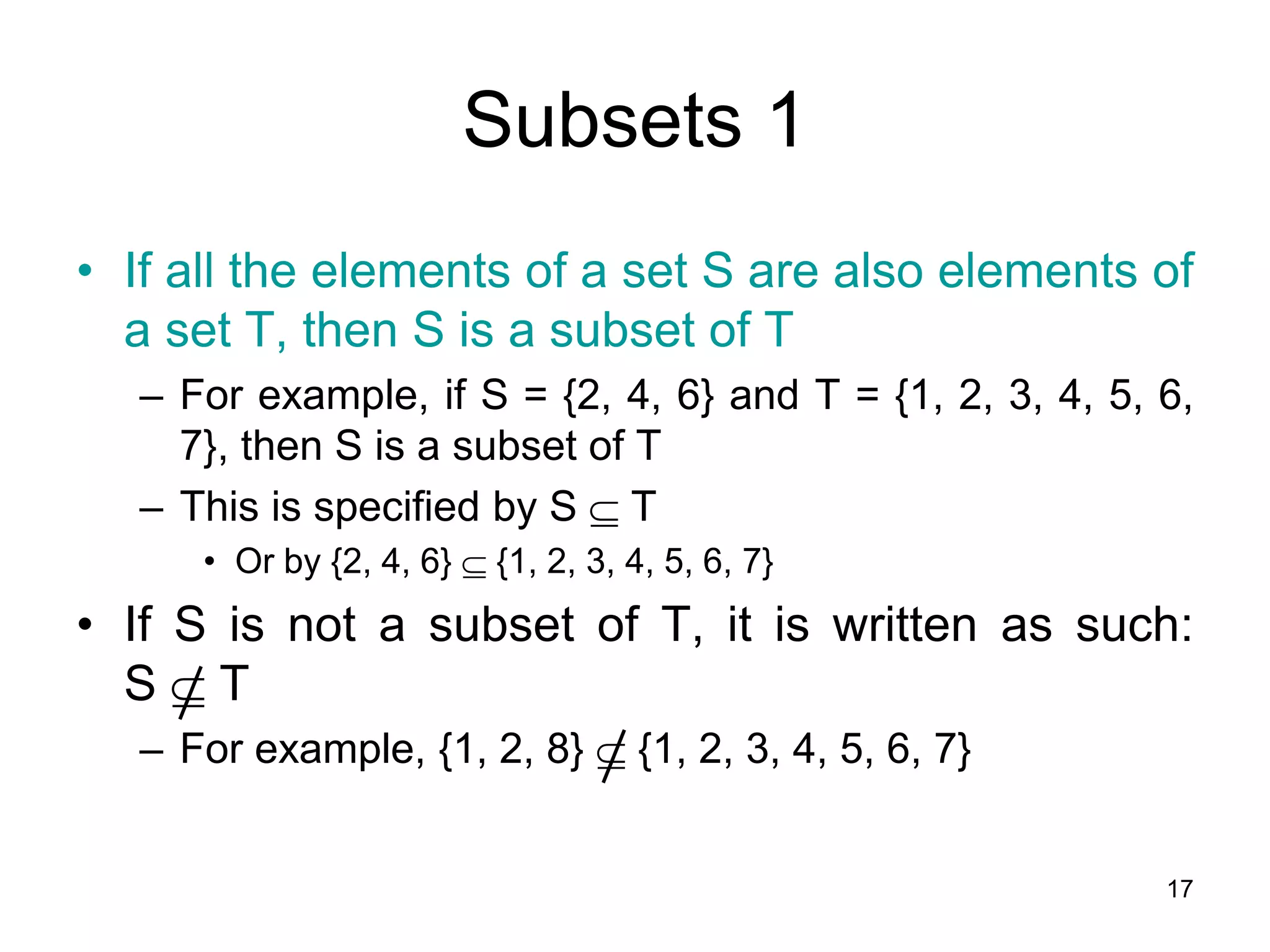
Subsets 1
• If all the elements of a set S are also elements of
a set T, then S is a subset of T
– For example, if S = {2, 4, 6} and T = {1, 2, 3, 4, 5, 6,
7}, then S is a subset of T
– This is specified by S  T
• Or by {2, 4, 6}  {1, 2, 3, 4, 5, 6, 7}
• If S is not a subset of T, it is written as such:
S  T
– For example, {1, 2, 8}  {1, 2, 3, 4, 5, 6, 7}
18
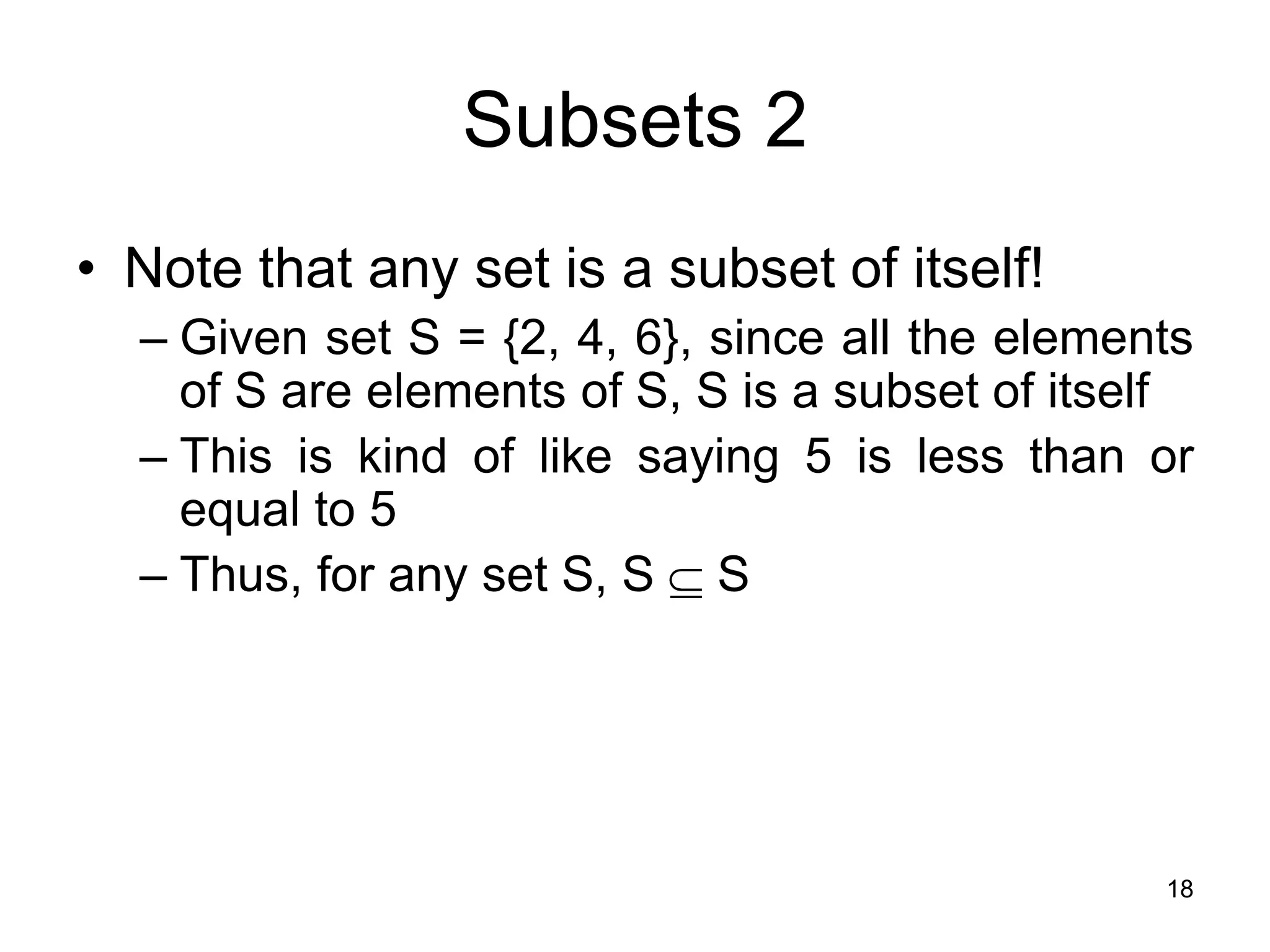
Subsets 2
• Note that any set is a subset of itself!
– Given set S = {2, 4, 6}, since all the elements
of S are elements of S, S is a subset of itself
– This is kind of like saying 5 is less than or
equal to 5
– Thus, for any set S, S  S
19
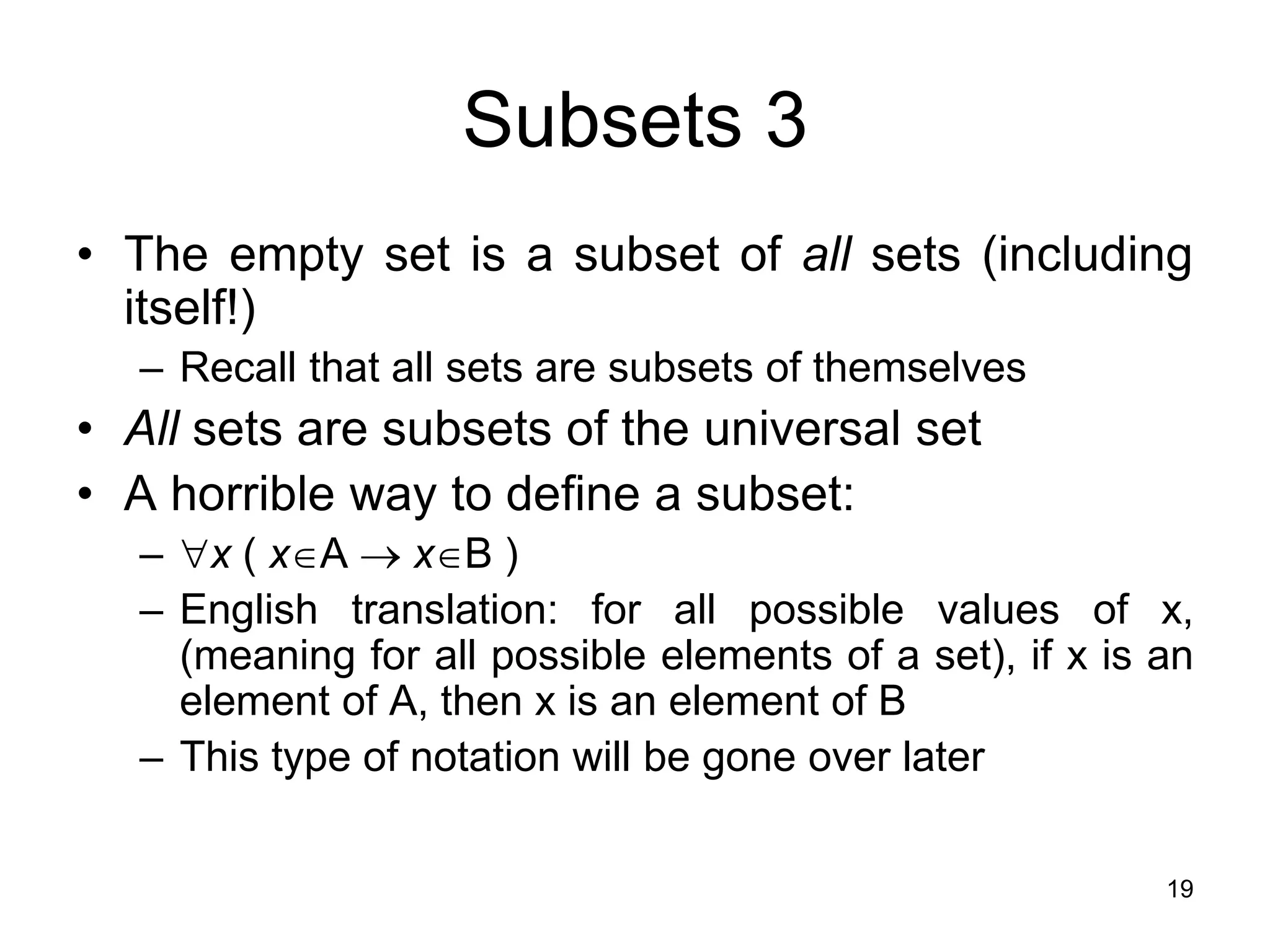
Subsets 3
• The empty set is a subset of all sets (including
itself!)
– Recall that all sets are subsets of themselves
• All sets are subsets of the universal set
• A horrible way to define a subset:
– x ( xA  xB )
– English translation: for all possible values of x,
(meaning for all possible elements of a set), if x is an
element of A, then x is an element of B
– This type of notation will be gone over later
20
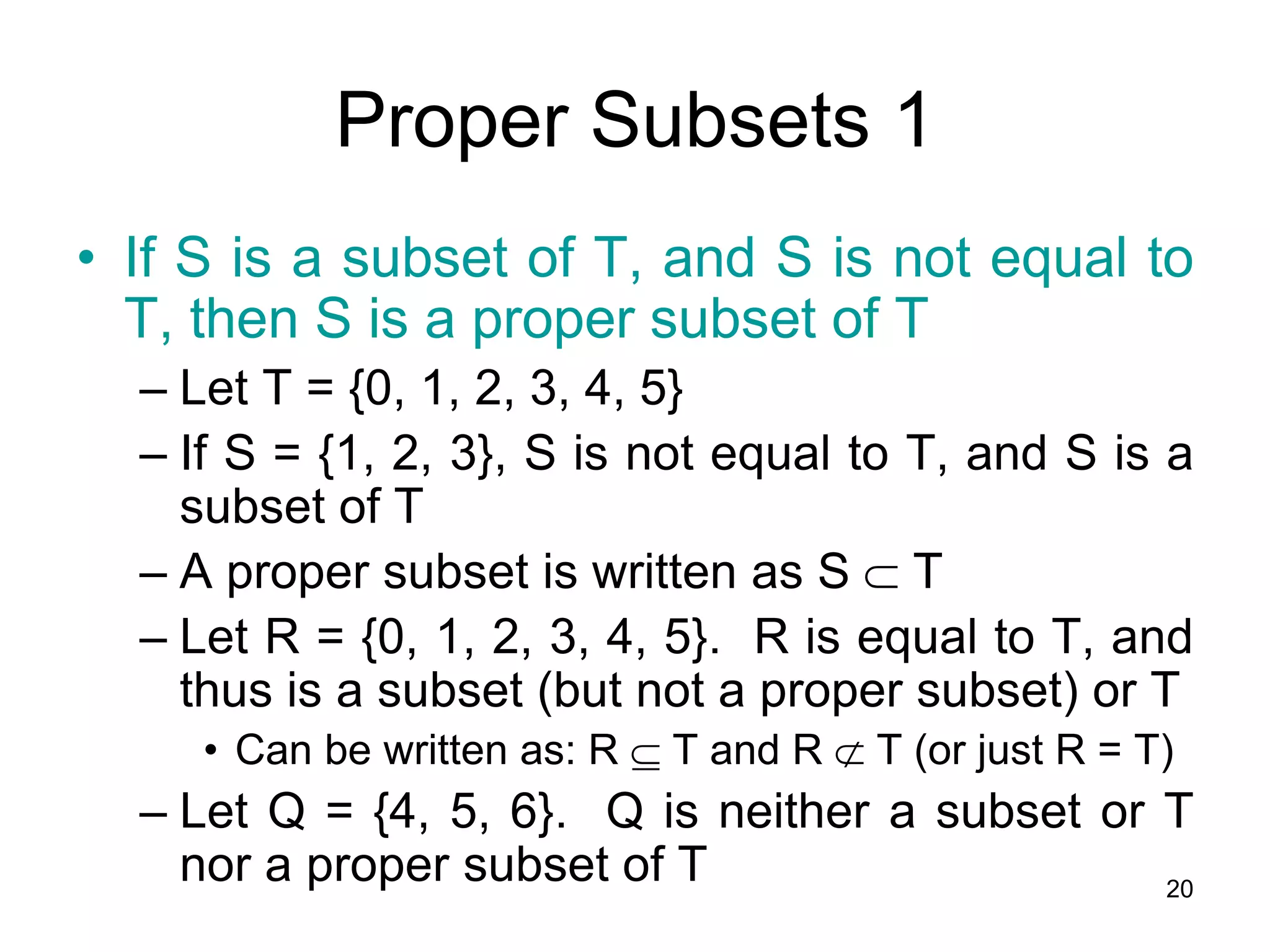
• If S is a subset of T, and S is not equal to
T, then S is a proper subset of T
– Let T = {0, 1, 2, 3, 4, 5}
– If S = {1, 2, 3}, S is not equal to T, and S is a
subset of T
– A proper subset is written as S  T
– Let R = {0, 1, 2, 3, 4, 5}. R is equal to T, and
thus is a subset (but not a proper subset) or T
• Can be written as: R  T and R  T (or just R = T)
– Let Q = {4, 5, 6}. Q is neither a subset or T
nor a proper subset of T
Proper Subsets 1
21
Proper Subsets 2
• The difference between “subset” and
“proper subset” is like the difference
between “less than or equal to” and “less
than” for numbers
• The empty set is a proper subset of all
sets other than the empty set (as it is
equal to the empty set)
22
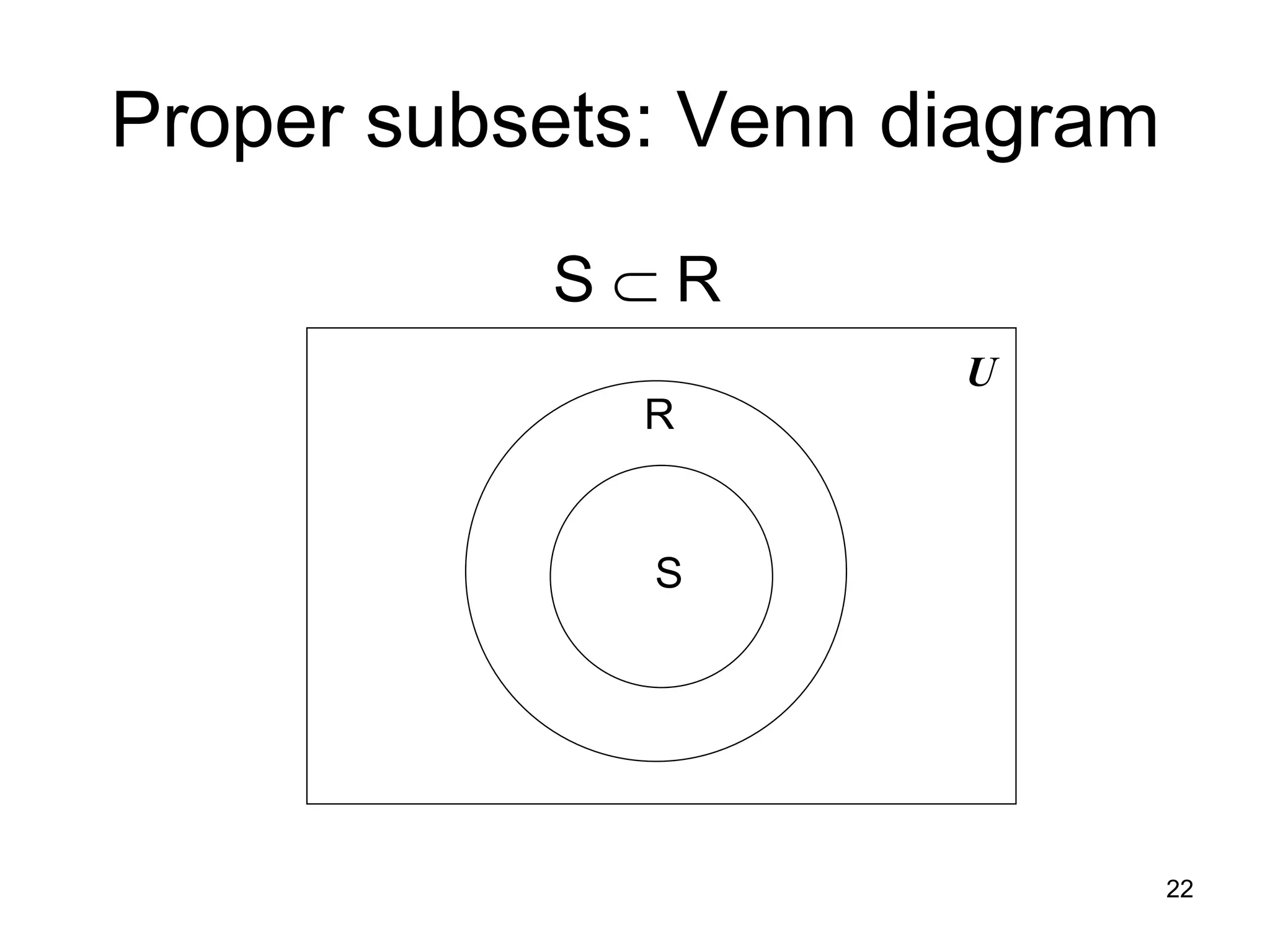
Proper subsets: Venn diagram
U
S
R
S  R
23
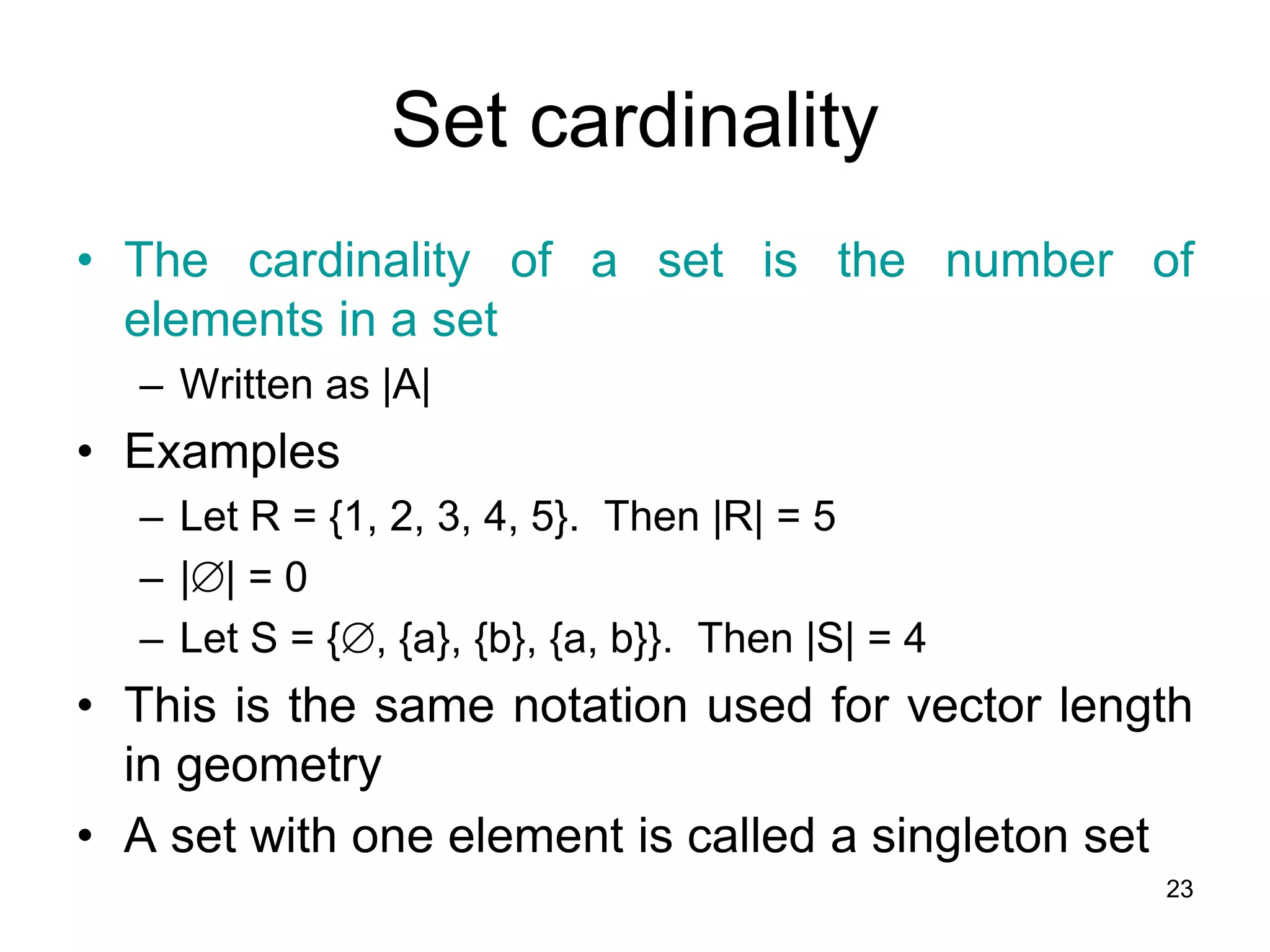
Set cardinality
• The cardinality of a set is the number of
elements in a set
– Written as |A|
• Examples
– Let R = {1, 2, 3, 4, 5}. Then |R| = 5
– || = 0
– Let S = {, {a}, {b}, {a, b}}. Then |S| = 4
• This is the same notation used for vector length
in geometry
• A set with one element is called a singleton set
24
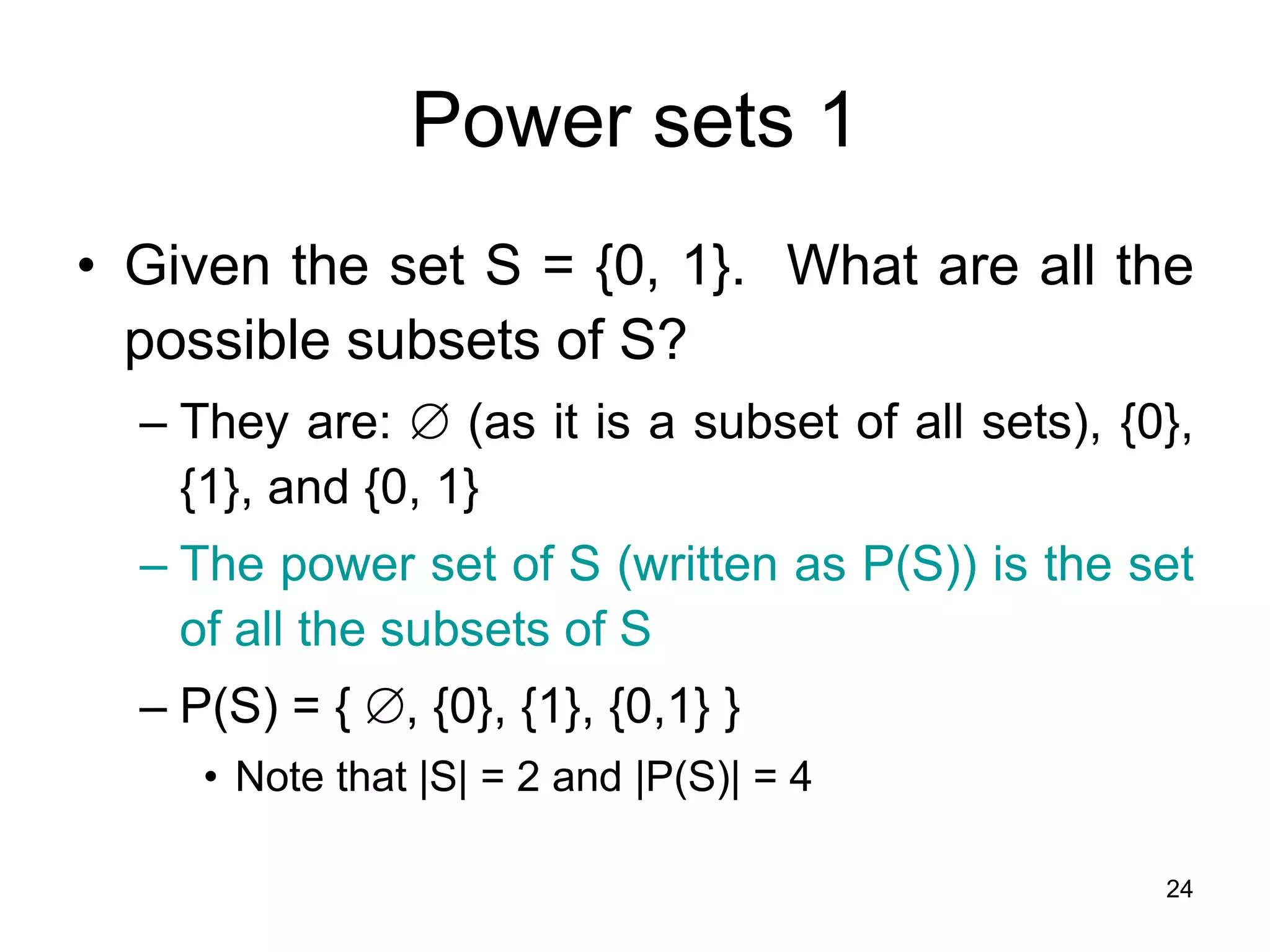
Power sets 1
• Given the set S = {0, 1}. What are all the
possible subsets of S?
– They are:  (as it is a subset of all sets), {0},
{1}, and {0, 1}
– The power set of S (written as P(S)) is the set
of all the subsets of S
– P(S) = { , {0}, {1}, {0,1} }
• Note that |S| = 2 and |P(S)| = 4
25
Power sets 2
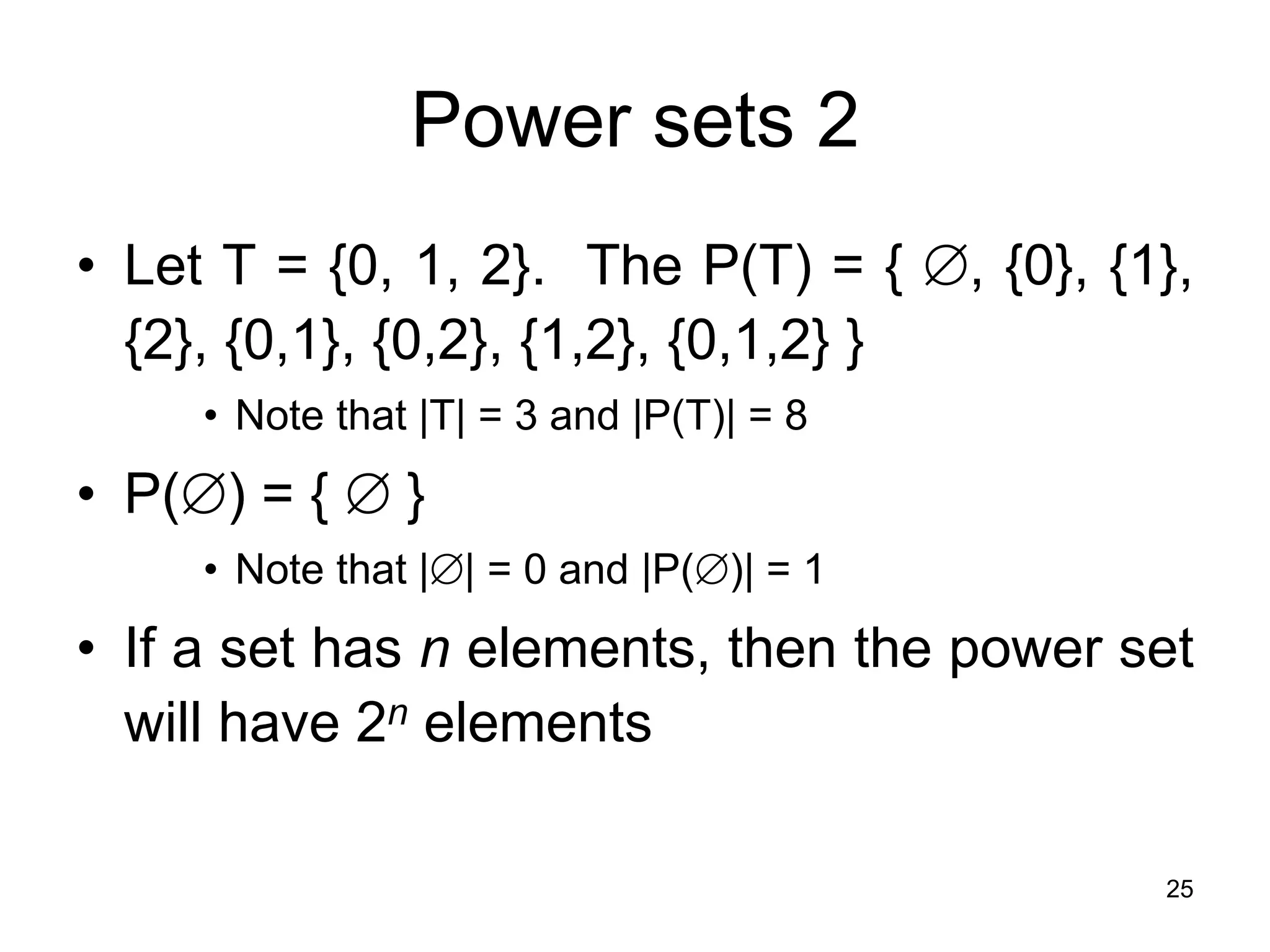
• Let T = {0, 1, 2}. The P(T) = { , {0}, {1},
{2}, {0,1}, {0,2}, {1,2}, {0,1,2} }
• Note that |T| = 3 and |P(T)| = 8
• P() = {  }
• Note that || = 0 and |P()| = 1
• If a set has n elements, then the power set
will have 2n elements
26
Tuples
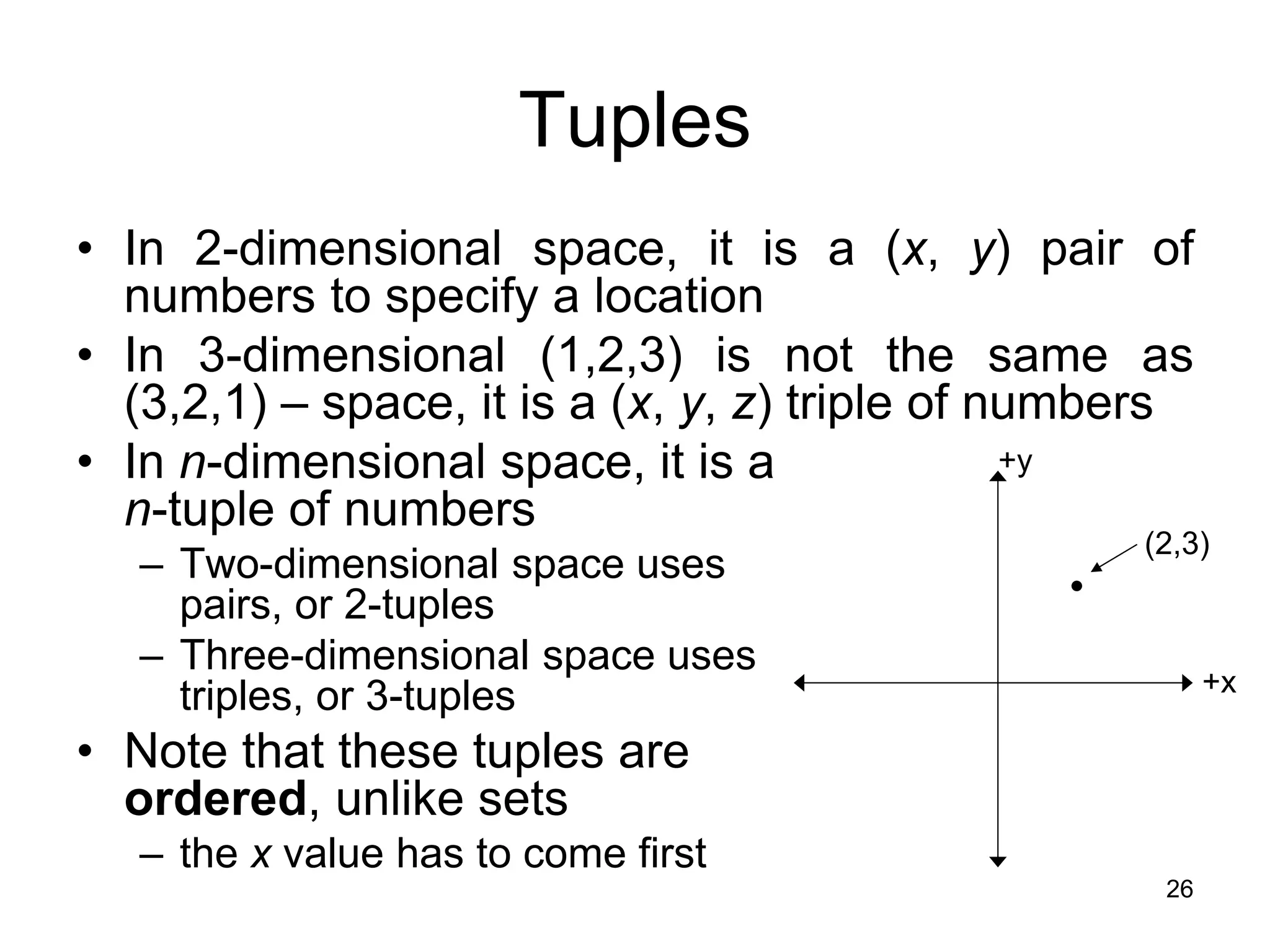
• In 2-dimensional space, it is a (x, y) pair of
numbers to specify a location
• In 3-dimensional (1,2,3) is not the same as
(3,2,1) – space, it is a (x, y, z) triple of numbers
• In n-dimensional space, it is a
n-tuple of numbers
– Two-dimensional space uses
pairs, or 2-tuples
– Three-dimensional space uses
triples, or 3-tuples
• Note that these tuples are
ordered, unlike sets
– the x value has to come first
+x
+y
(2,3)
27
Cartesian products 1
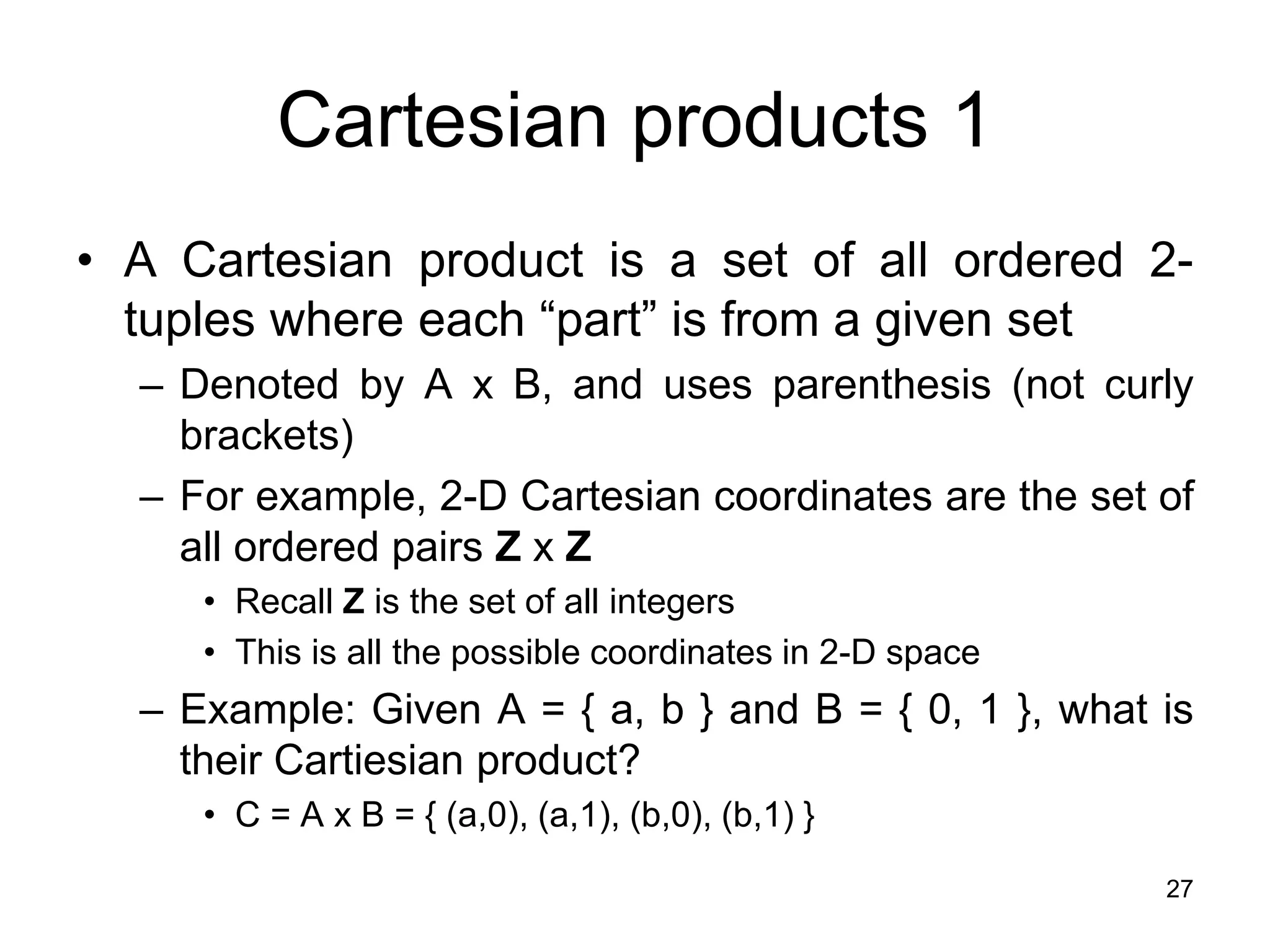
• A Cartesian product is a set of all ordered 2-
tuples where each “part” is from a given set
– Denoted by A x B, and uses parenthesis (not curly
brackets)
– For example, 2-D Cartesian coordinates are the set of
all ordered pairs Z x Z
• Recall Z is the set of all integers
• This is all the possible coordinates in 2-D space
– Example: Given A = { a, b } and B = { 0, 1 }, what is
their Cartiesian product?
• C = A x B = { (a,0), (a,1), (b,0), (b,1) }
28
Cartesian products 2
• Note that Cartesian products have only 2
parts in these examples (later examples
have more parts)
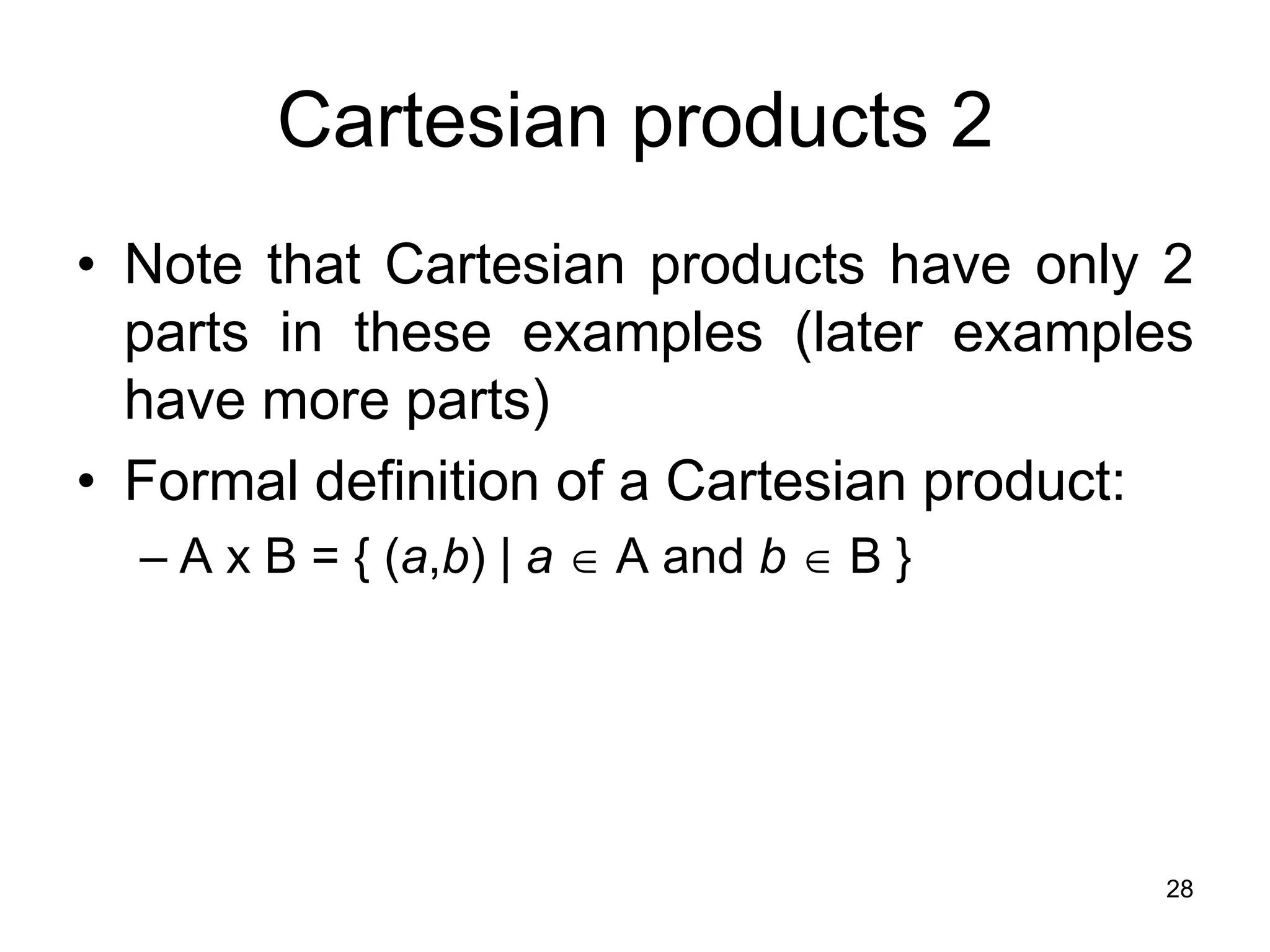
• Formal definition of a Cartesian product:
– A x B = { (a,b) | a  A and b  B }
29
Cartesian products 3
• All the possible grades in this class will be a
Cartesian product of the set S of all the students
in this class and the set G of all possible grades
– Let S = { Alice, Bob, Chris } and G = { A, B, C }
– D = { (Alice, A), (Alice, B), (Alice, C), (Bob, A), (Bob,
B), (Bob, C), (Chris, A), (Chris, B), (Chris, C) }
– The final grades will be a subset of this: { (Alice, C),
(Bob, B), (Chris, A) }
• Such a subset of a Cartesian product is called a relation
(more on this later in the course)
30
Cartesian products 4
• There can be Cartesian products on more
than two sets
• A 3-D coordinate is an element from the
Cartesian product of Z x Z x Z
31
Set Operations
32
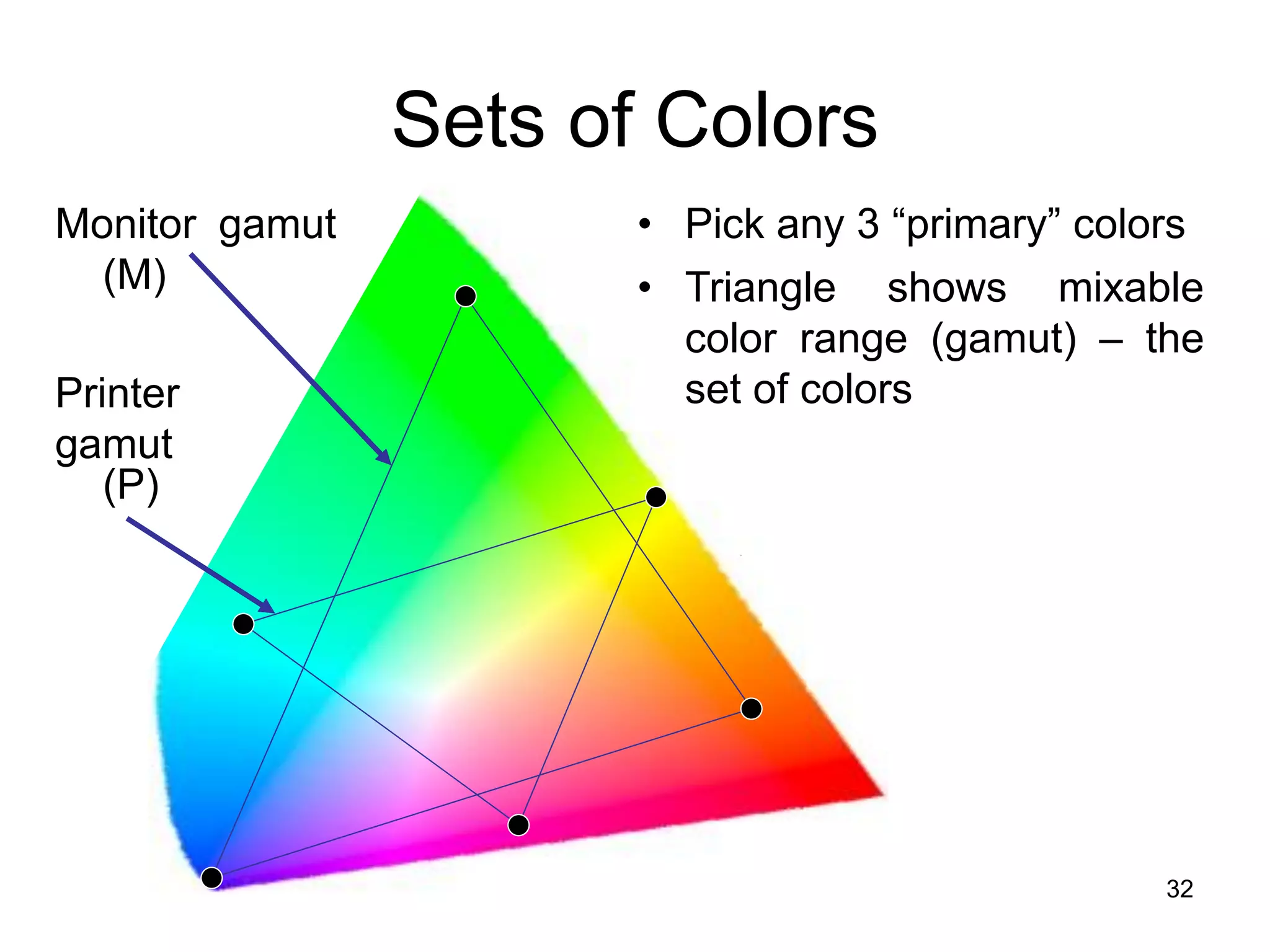
• Triangle shows mixable
color range (gamut) – the
set of colors
Sets of Colors
Monitor gamut
(M)
Printer
gamut
(P)
• Pick any 3 “primary” colors
33
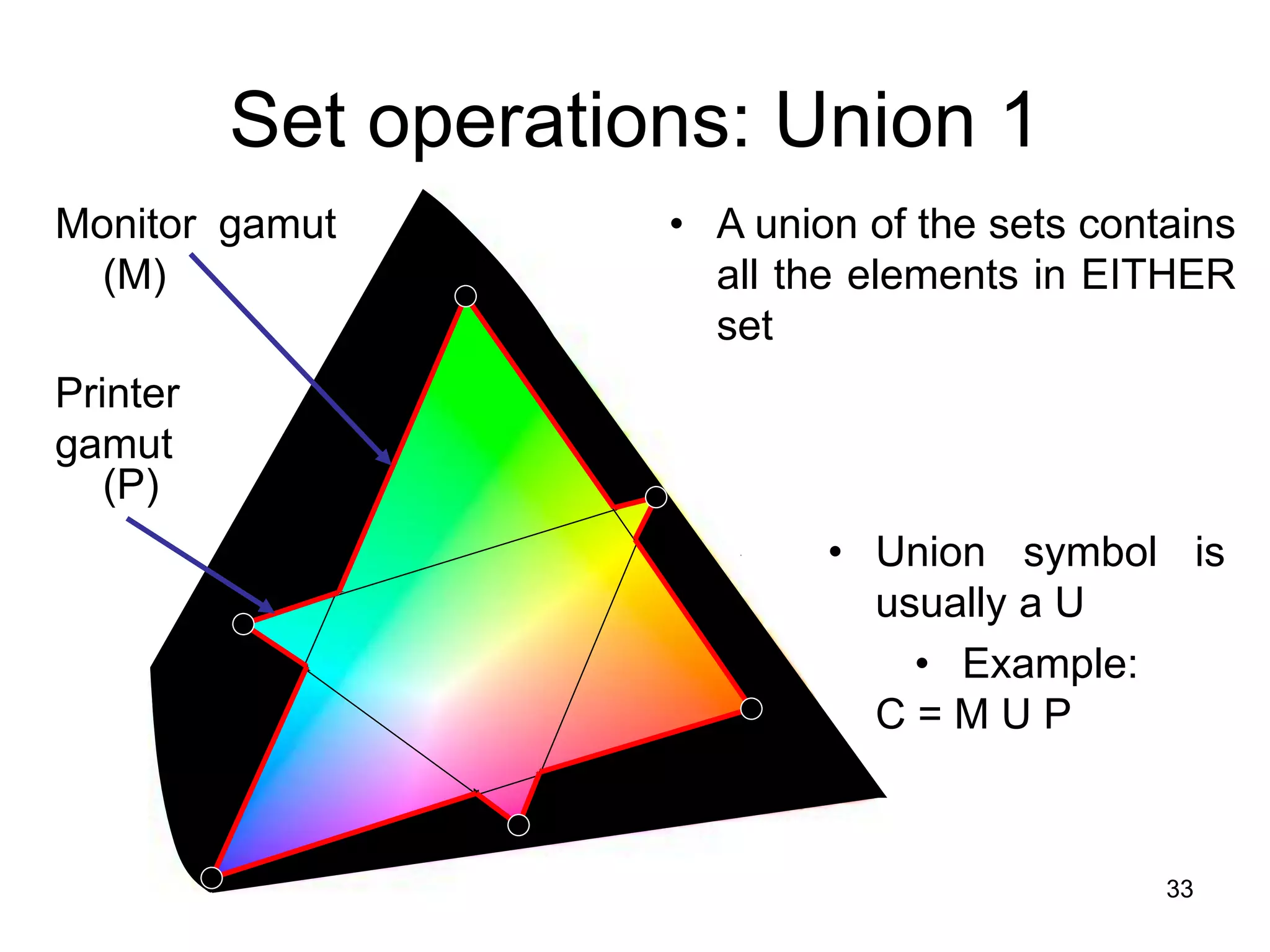
• A union of the sets contains
all the elements in EITHER
set
• Union symbol is
usually a U
• Example:
C = M U P
Monitor gamut
(M)
Printer
gamut
(P)
Set operations: Union 1
34
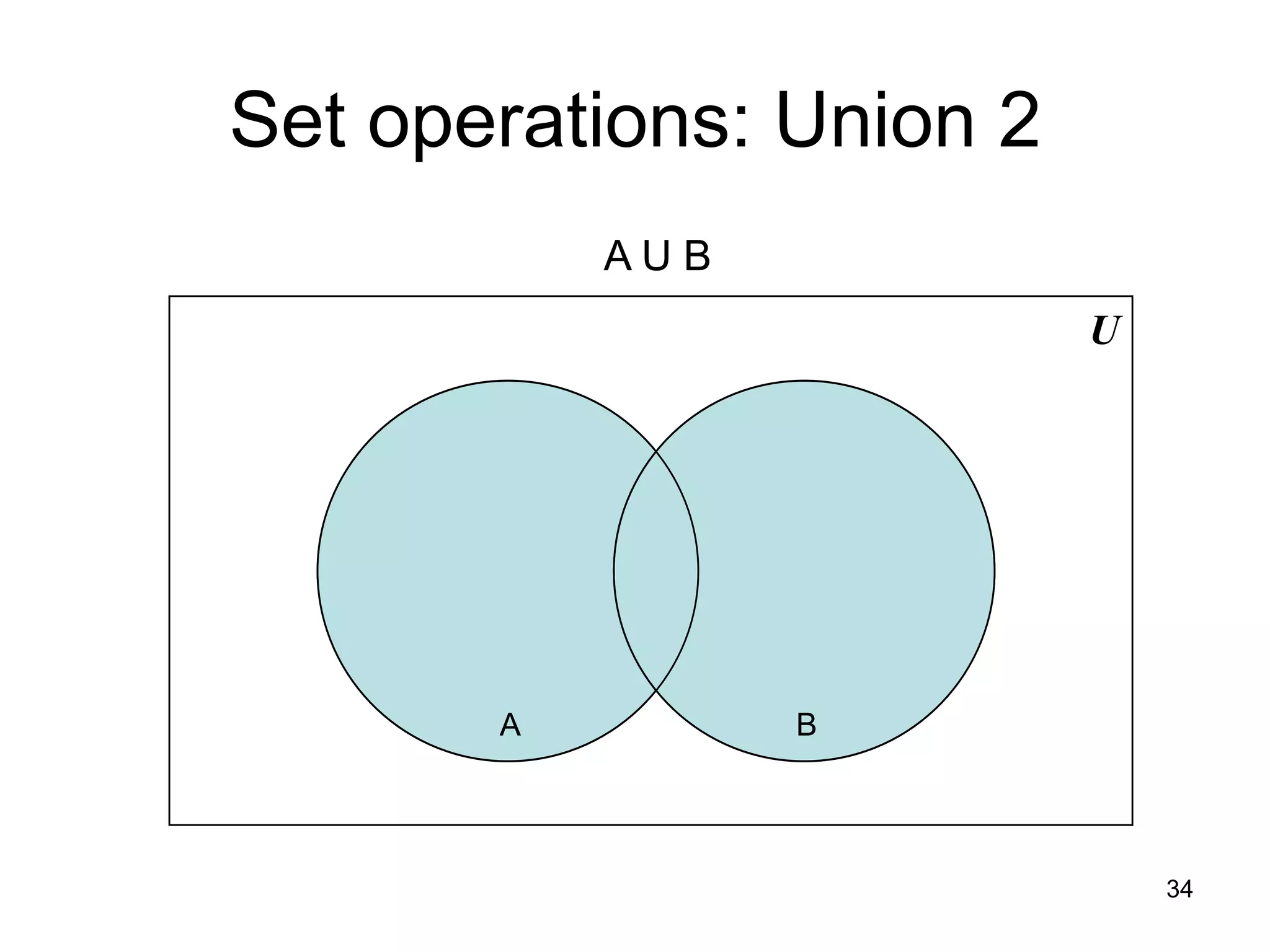
Set operations: Union 2
U
A B
A U B
35
Set operations: Union 3
• Formal definition for the union of two sets:
A U B = { x | x  A or x  B }
• Further examples
– {1, 2, 3} U {3, 4, 5} = {1, 2, 3, 4, 5}
– {New York, Washington} U {3, 4} = {New
York, Washington, 3, 4}
– {1, 2} U  = {1, 2}
36
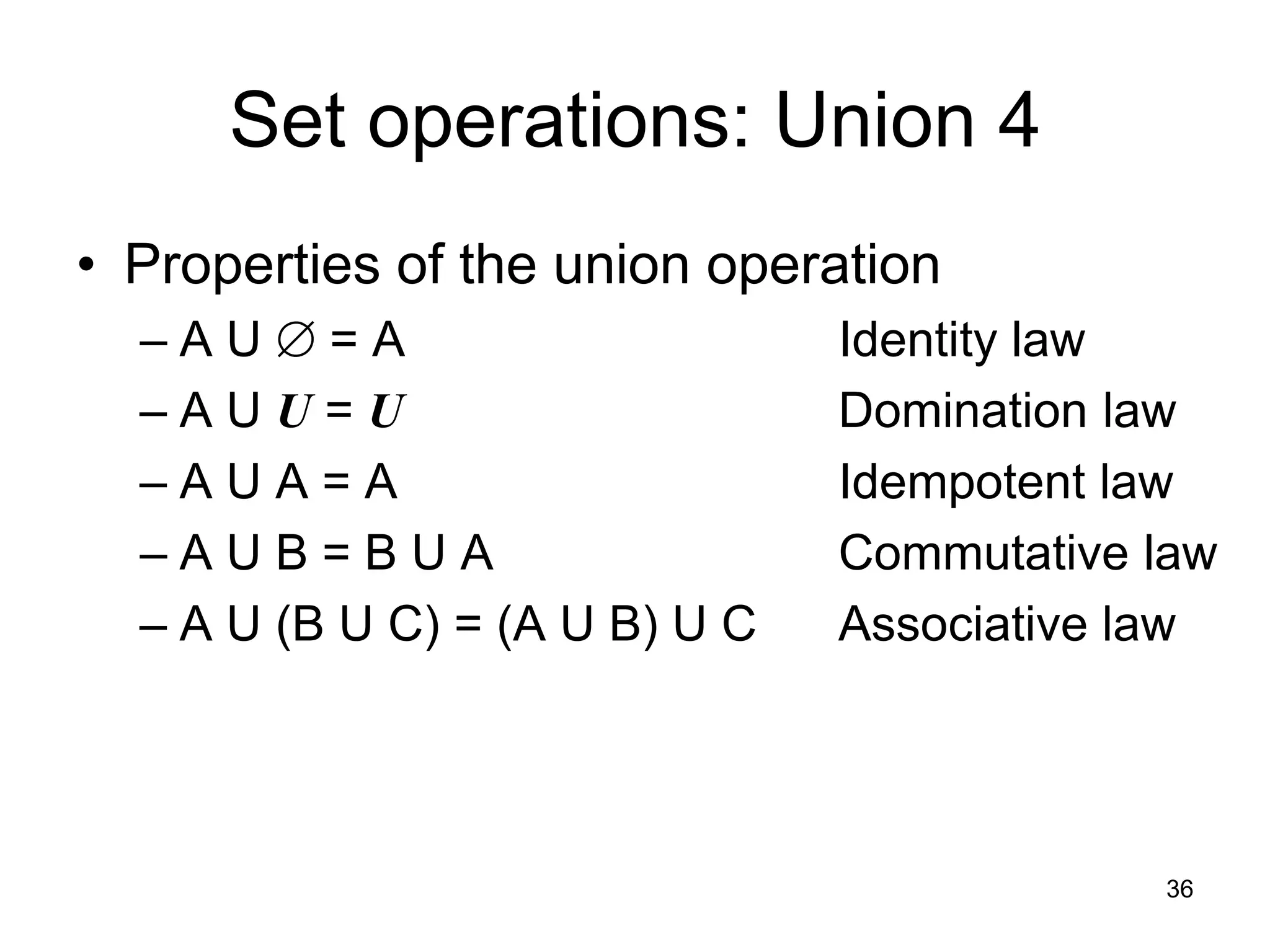
Set operations: Union 4
• Properties of the union operation
– A U  = A Identity law
– A U U = U Domination law
– A U A = A Idempotent law
– A U B = B U A Commutative law
– A U (B U C) = (A U B) U C Associative law
37
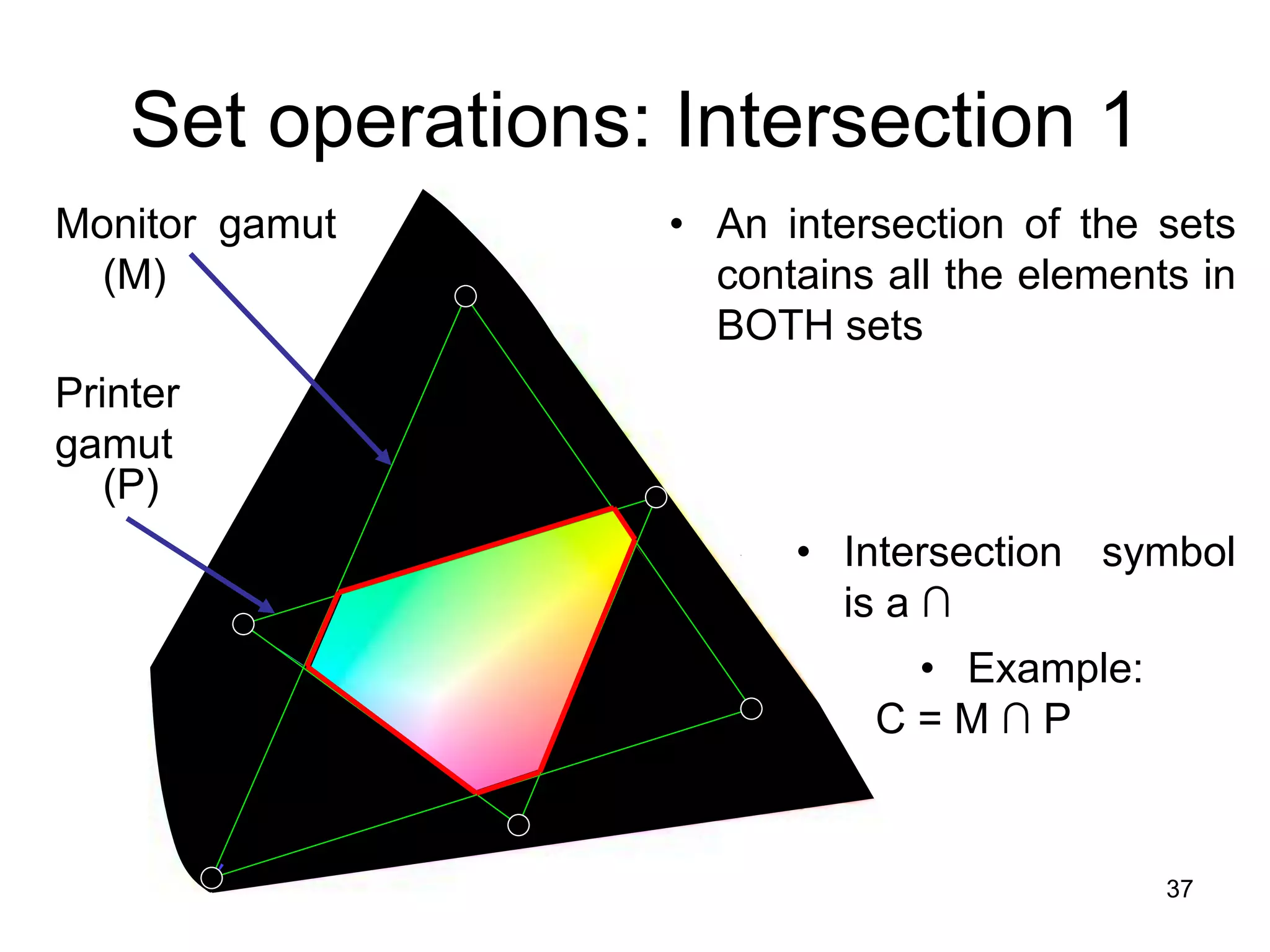
• An intersection of the sets
contains all the elements in
BOTH sets
• Intersection symbol
is a ∩
• Example:
C = M ∩ P
Monitor gamut
(M)
Printer
gamut
(P)
Set operations: Intersection 1
38
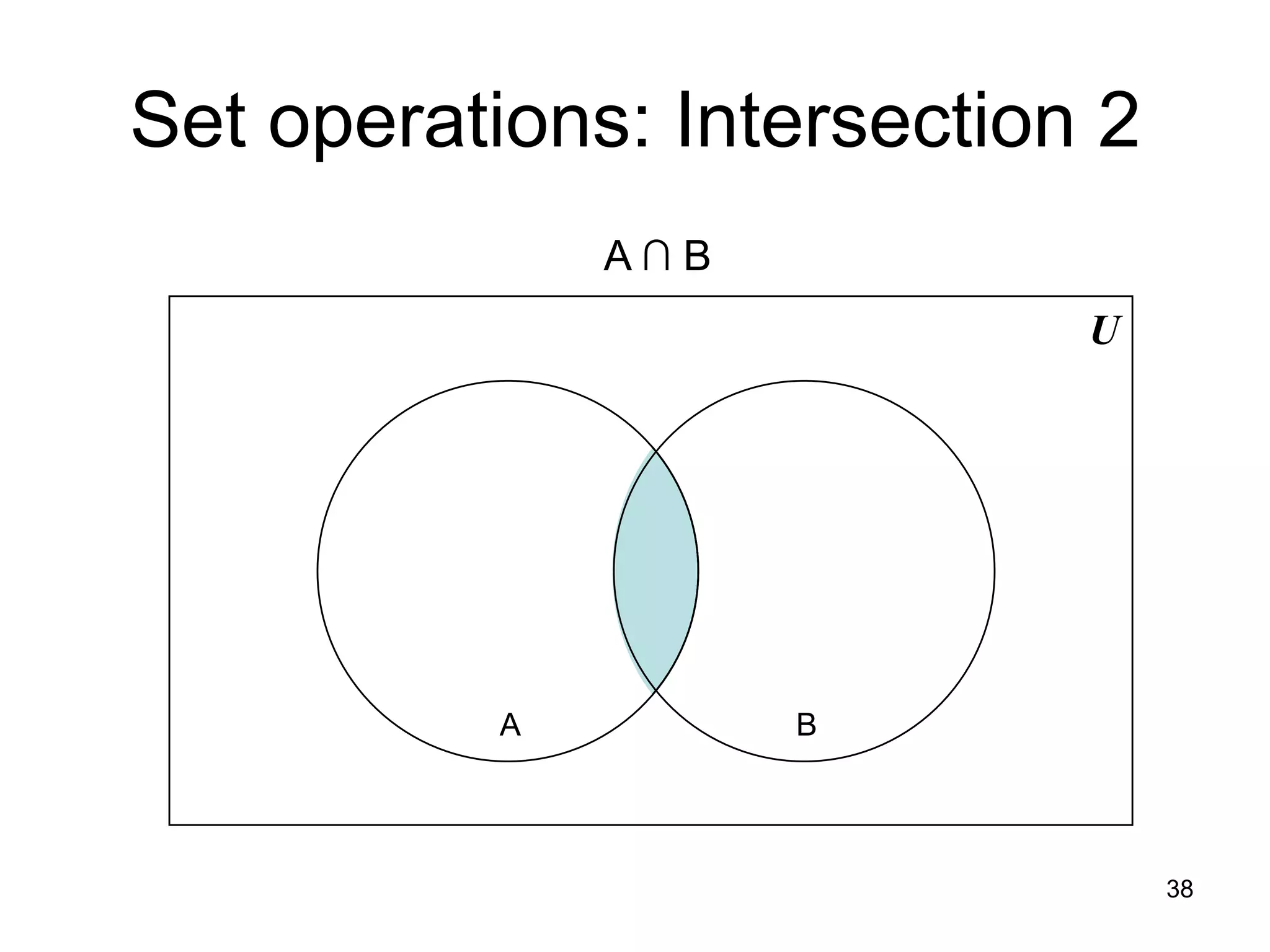
Set operations: Intersection 2
U
B
A
A ∩ B
39
Set operations: Intersection 3
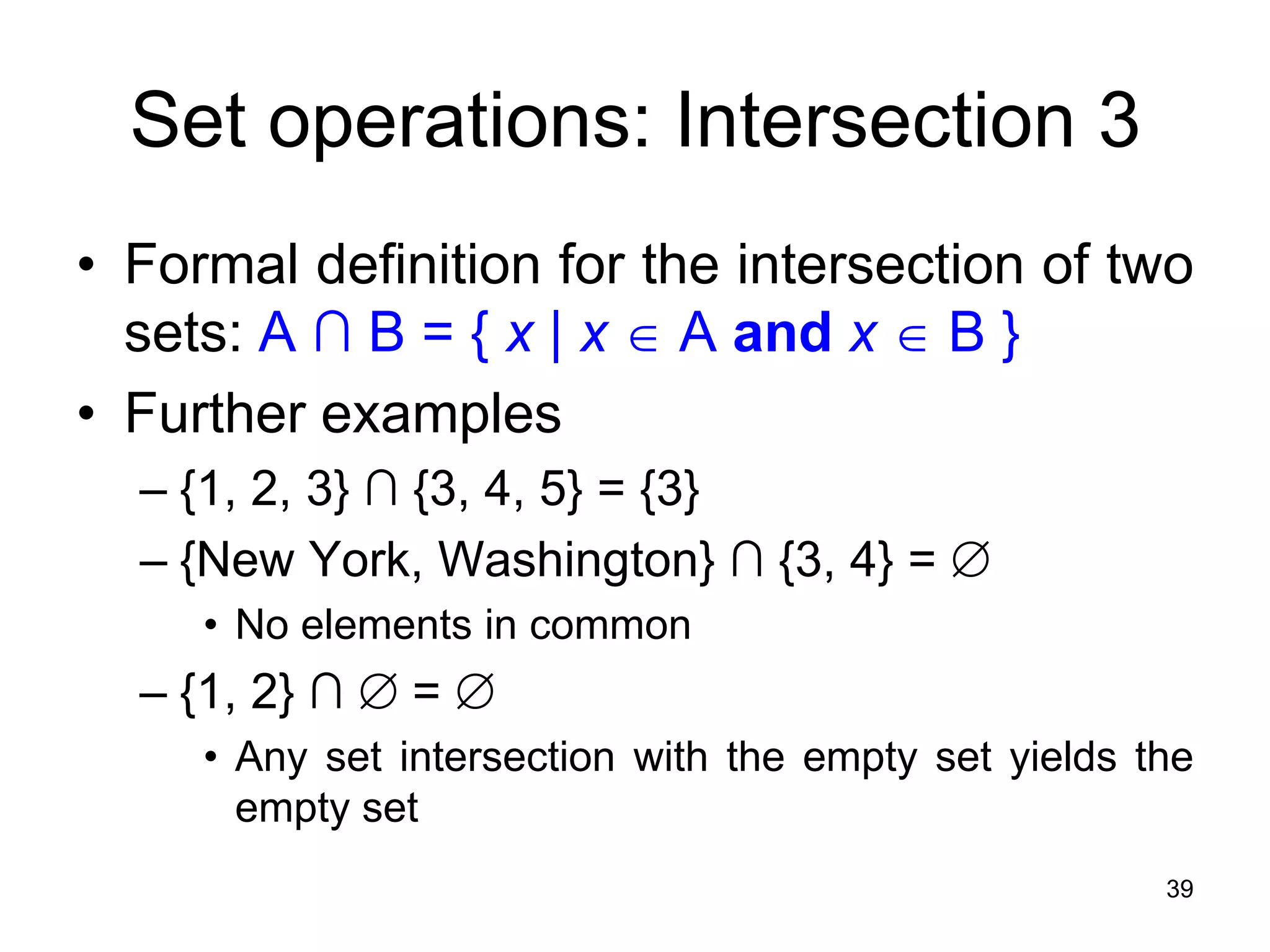
• Formal definition for the intersection of two
sets: A ∩ B = { x | x  A and x  B }
• Further examples
– {1, 2, 3} ∩ {3, 4, 5} = {3}
– {New York, Washington} ∩ {3, 4} = 
• No elements in common
– {1, 2} ∩  = 
• Any set intersection with the empty set yields the
empty set
40
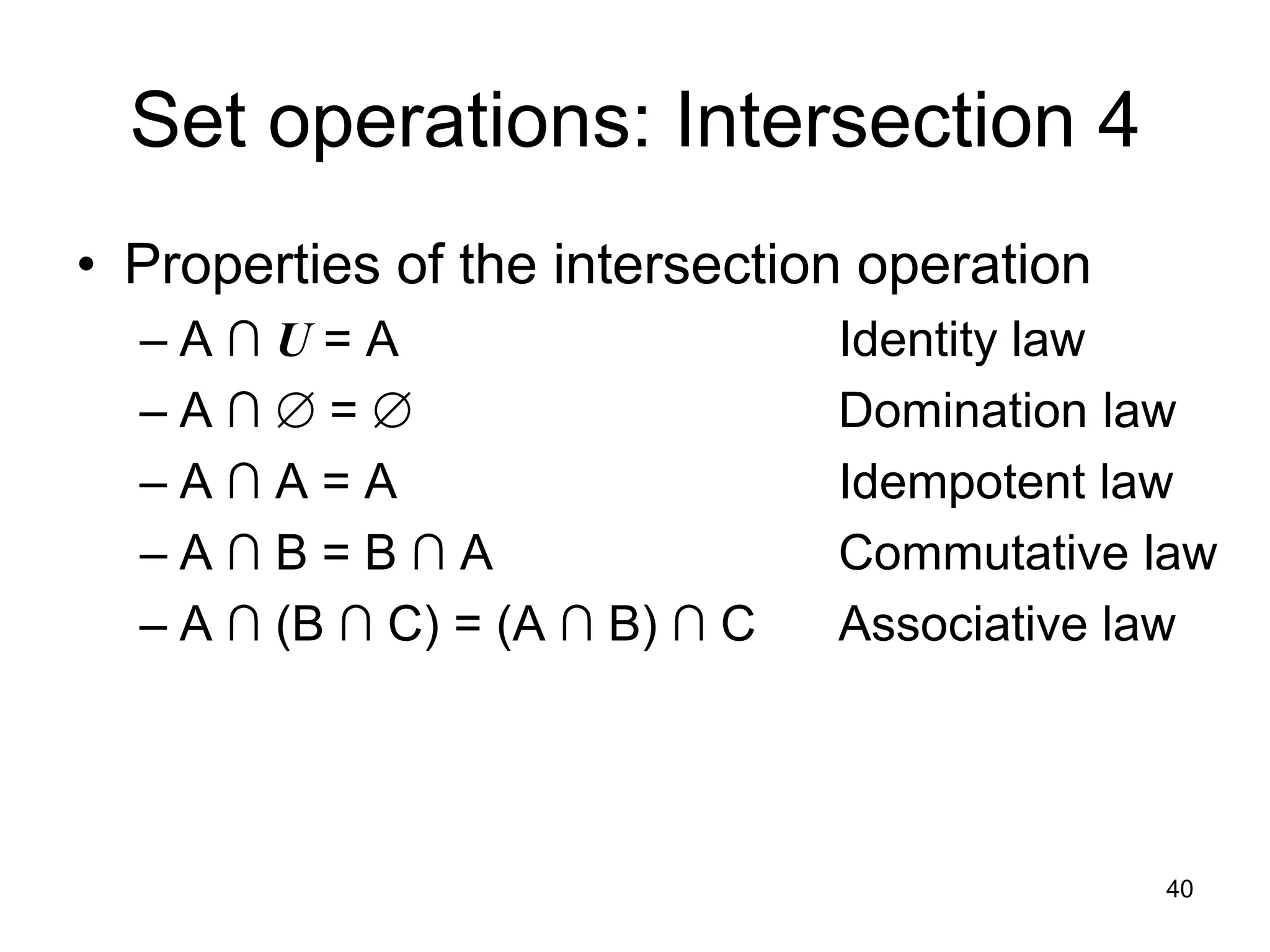
Set operations: Intersection 4
• Properties of the intersection operation
– A ∩ U = A Identity law
– A ∩  =  Domination law
– A ∩ A = A Idempotent law
– A ∩ B = B ∩ A Commutative law
– A ∩ (B ∩ C) = (A ∩ B) ∩ C Associative law
41
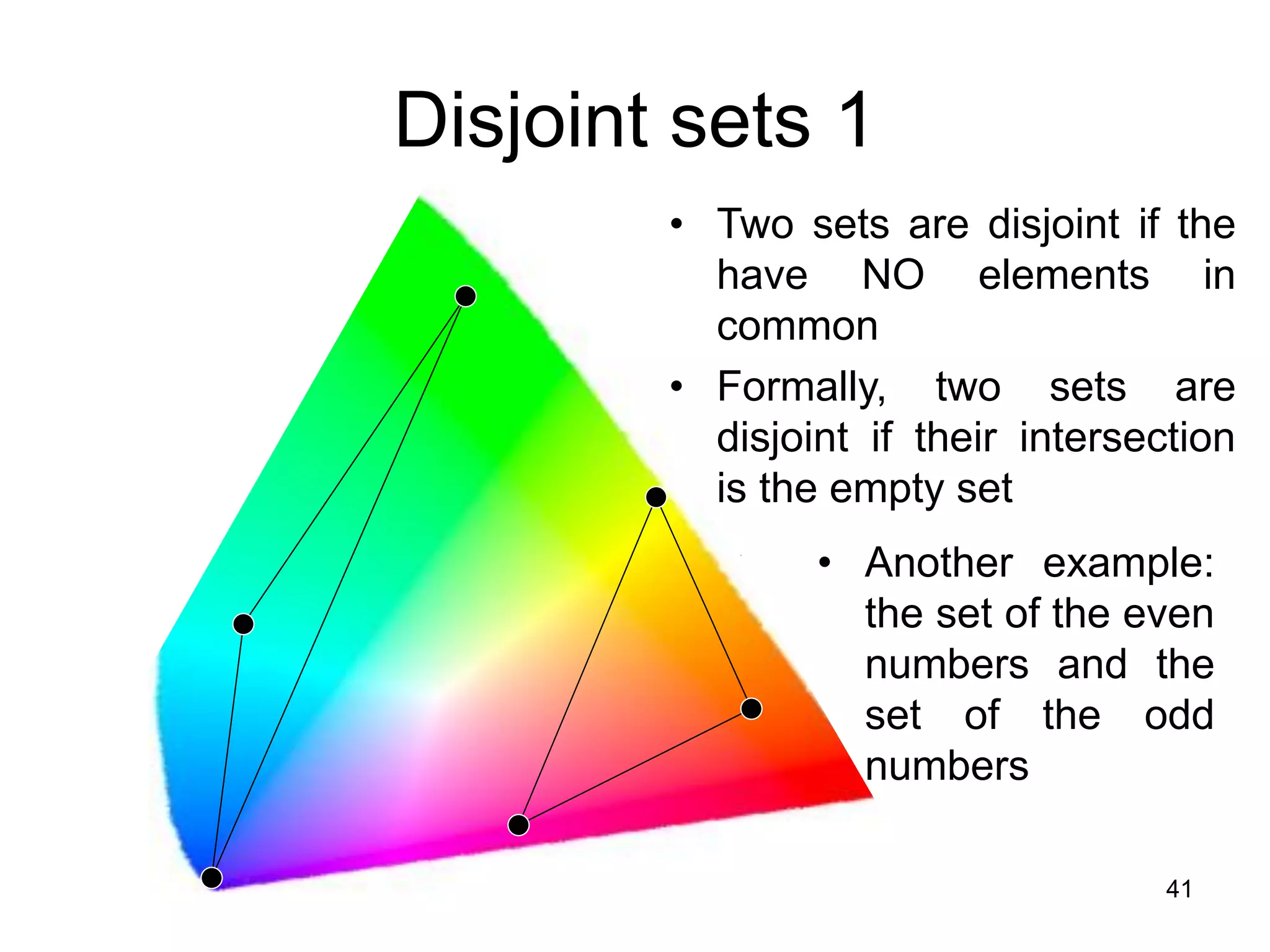
Disjoint sets 1
• Two sets are disjoint if the
have NO elements in
common
• Formally, two sets are
disjoint if their intersection
is the empty set
• Another example:
the set of the even
numbers and the
set of the odd
numbers
42
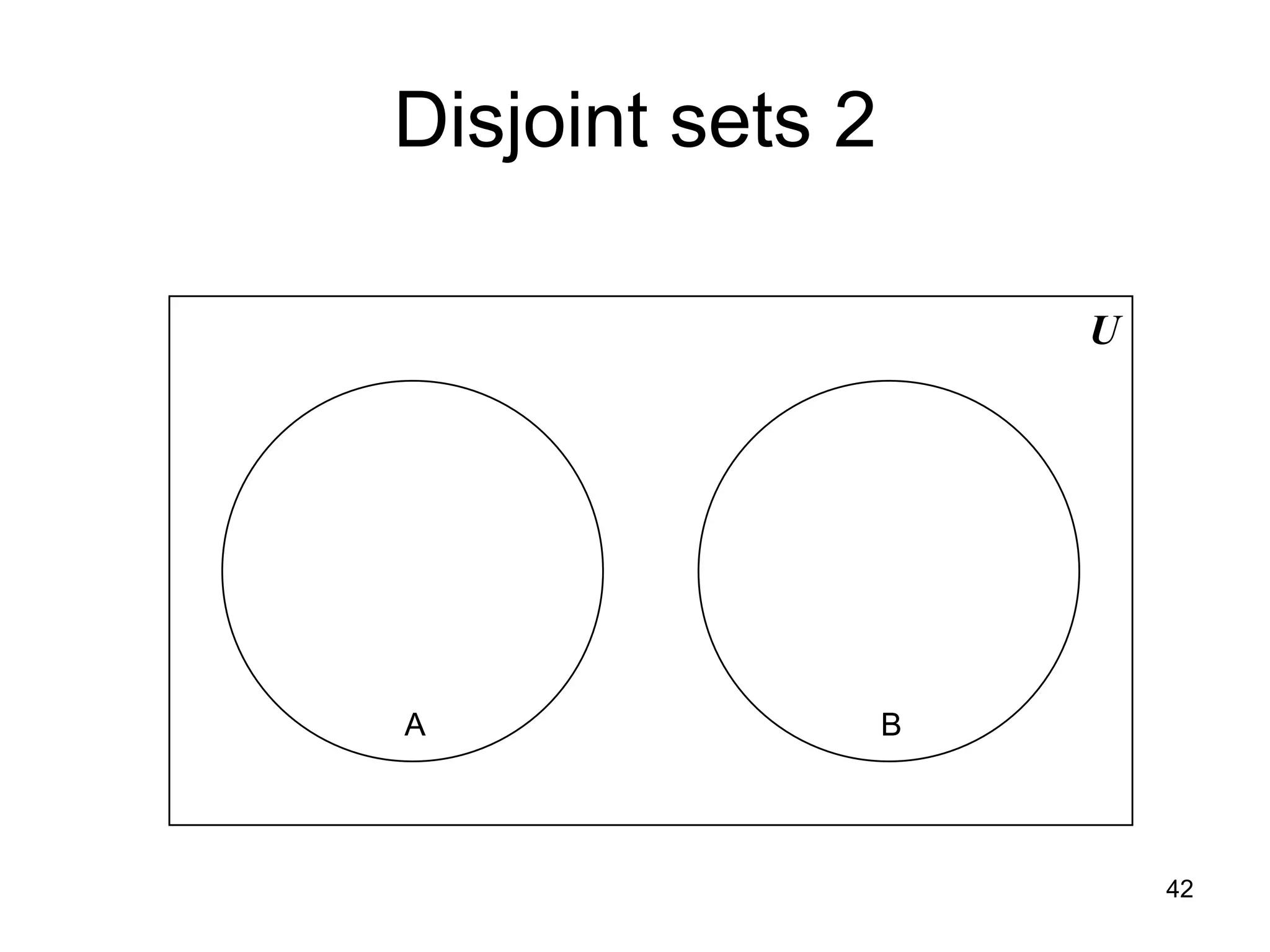
Disjoint sets 2
U
A B
43
Disjoint sets 3
• Formal definition for disjoint sets: two sets
are disjoint if their intersection is the empty
set
• Further examples
– {1, 2, 3} and {3, 4, 5} are not disjoint
– {New York, Washington} and {3, 4} are
disjoint
– {1, 2} and  are disjoint
• Their intersection is the empty set
–  and  are disjoint!
• Their intersection is the empty set
44
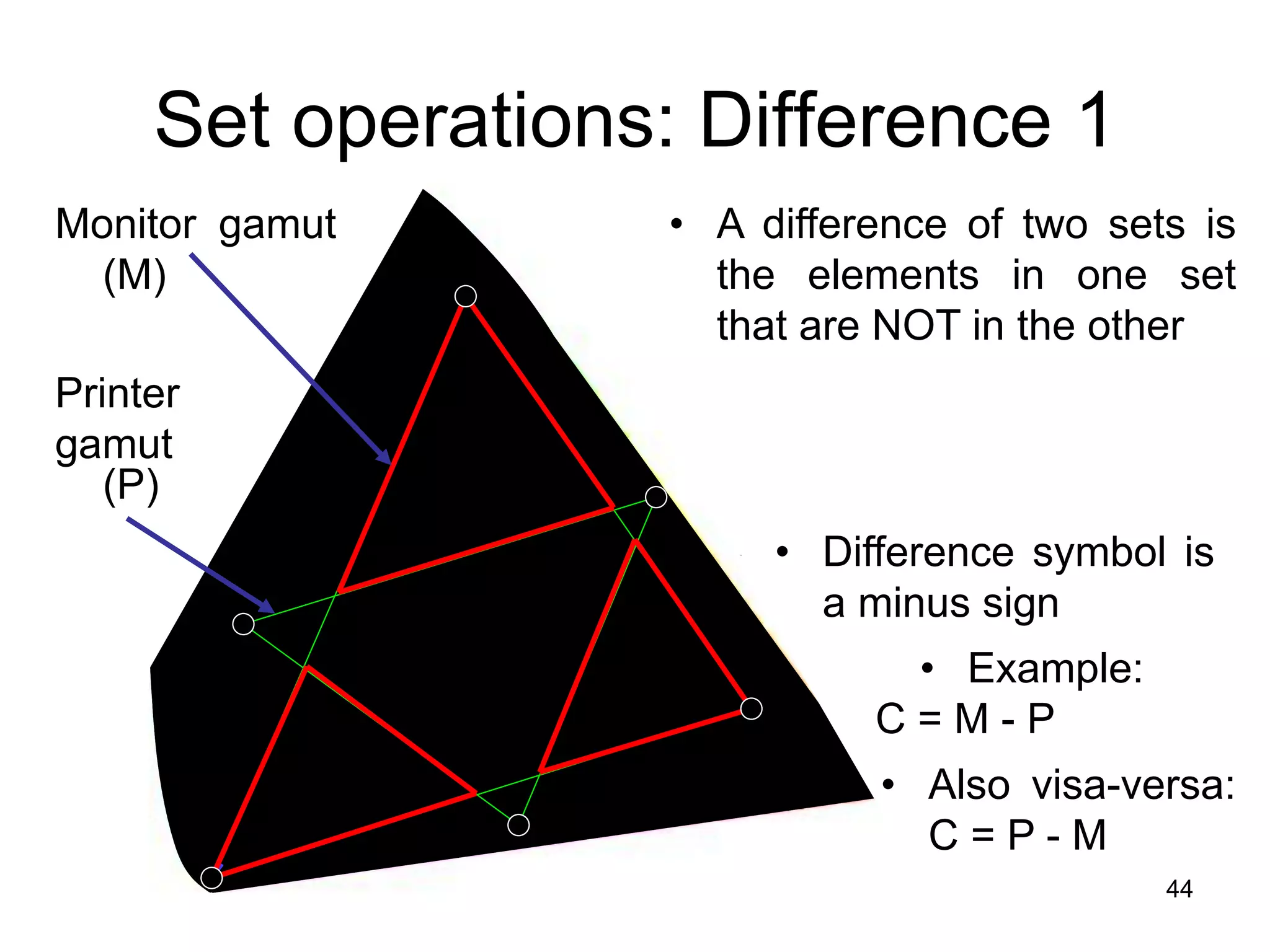
Set operations: Difference 1
• A difference of two sets is
the elements in one set
that are NOT in the other
• Difference symbol is
a minus sign
• Example:
C = M - P
Monitor gamut
(M)
Printer
gamut
(P)
• Also visa-versa:
C = P - M
45
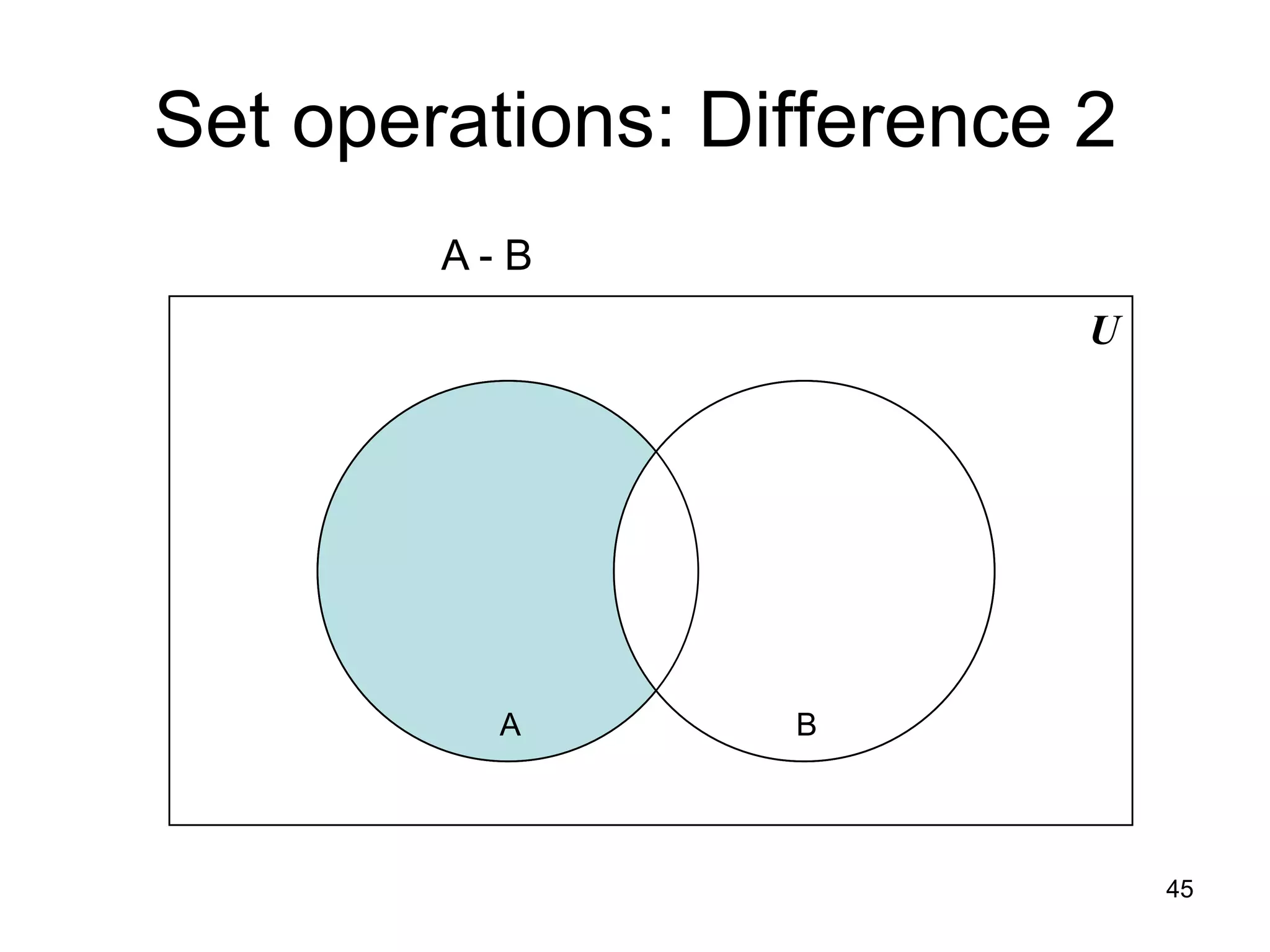
Set operations: Difference 2
U
A B
A - B
46
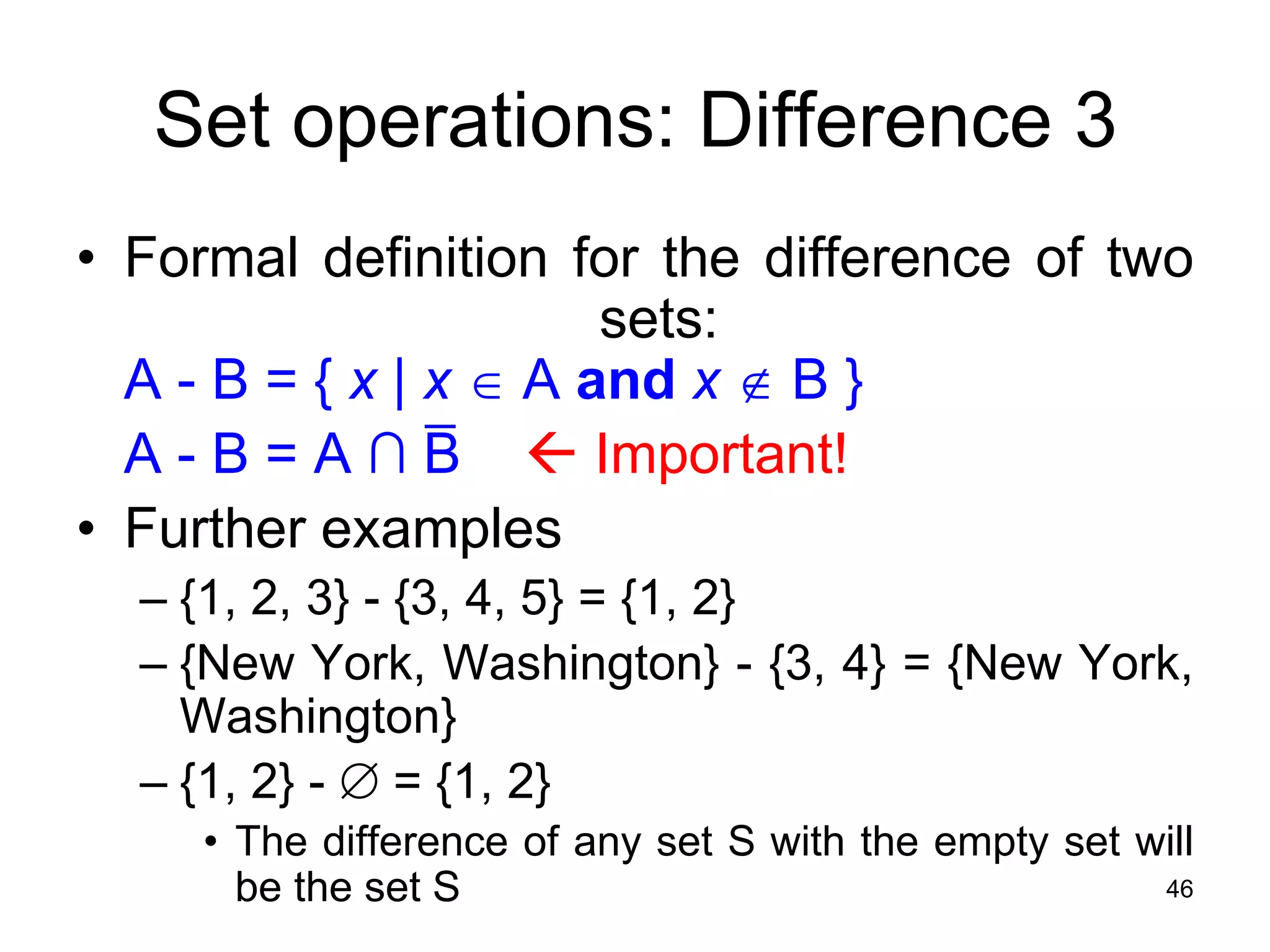
• Formal definition for the difference of two
sets:
A - B = { x | x  A and x  B }
A - B = A ∩ B  Important!
• Further examples
– {1, 2, 3} - {3, 4, 5} = {1, 2}
– {New York, Washington} - {3, 4} = {New York,
Washington}
– {1, 2} -  = {1, 2}
• The difference of any set S with the empty set will
be the set S
Set operations: Difference 3
_
47
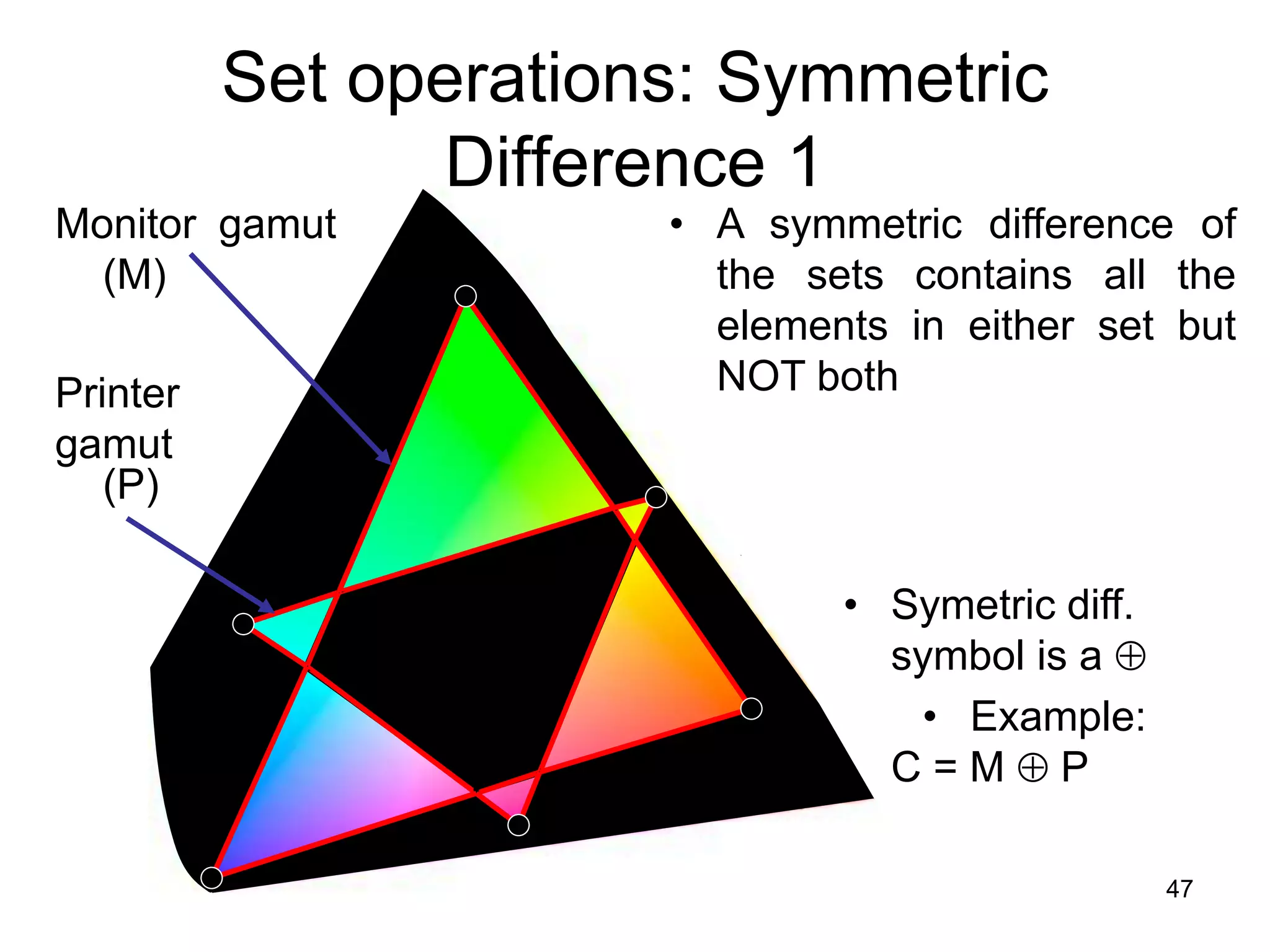
• A symmetric difference of
the sets contains all the
elements in either set but
NOT both
• Symetric diff.
symbol is a 
• Example:
C = M  P
Monitor gamut
(M)
Printer
gamut
(P)
Set operations: Symmetric
Difference 1
48
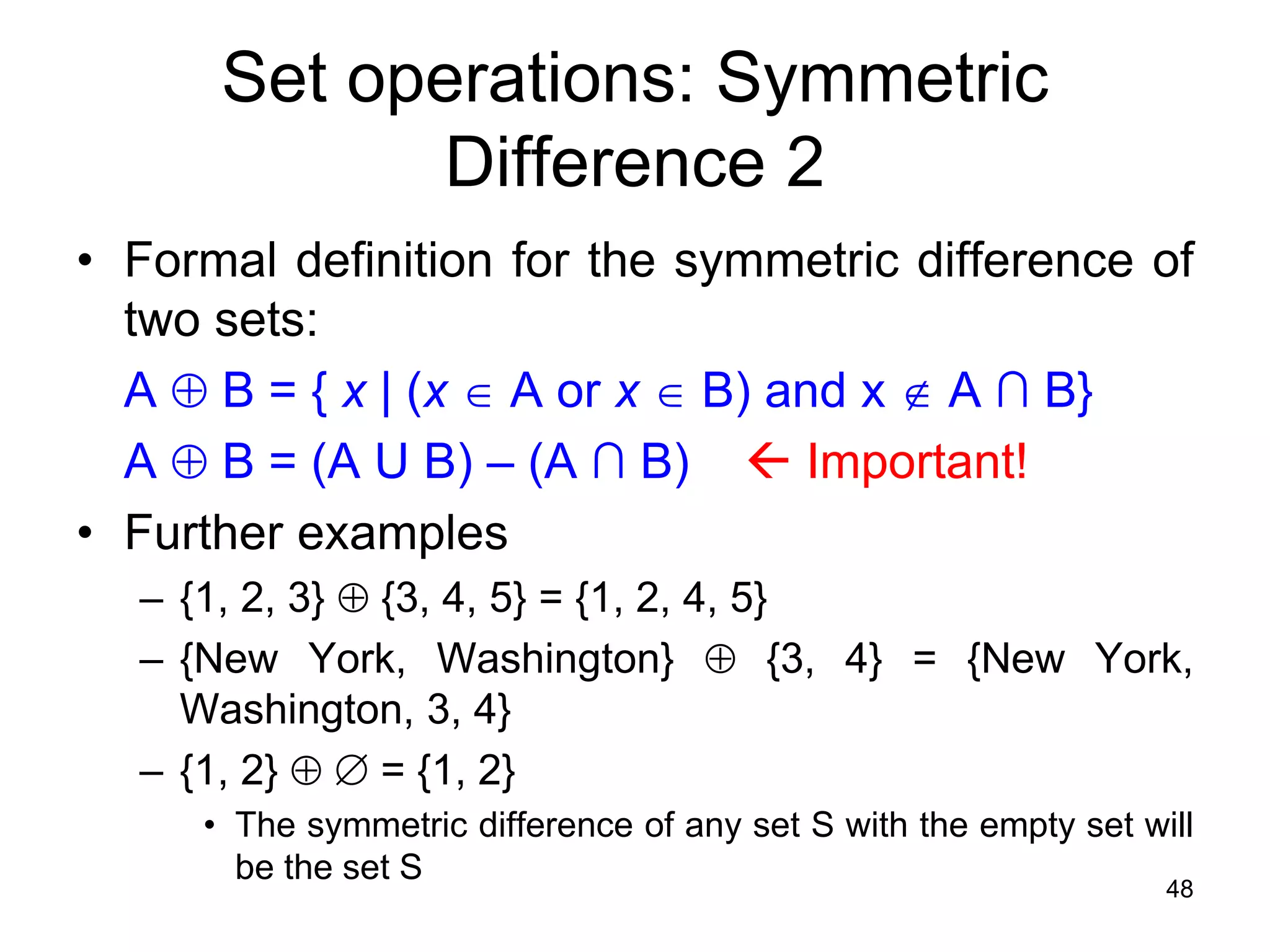
• Formal definition for the symmetric difference of
two sets:
A  B = { x | (x  A or x  B) and x  A ∩ B}
A  B = (A U B) – (A ∩ B)  Important!
• Further examples
– {1, 2, 3}  {3, 4, 5} = {1, 2, 4, 5}
– {New York, Washington}  {3, 4} = {New York,
Washington, 3, 4}
– {1, 2}   = {1, 2}
• The symmetric difference of any set S with the empty set will
be the set S
Set operations: Symmetric
Difference 2
49
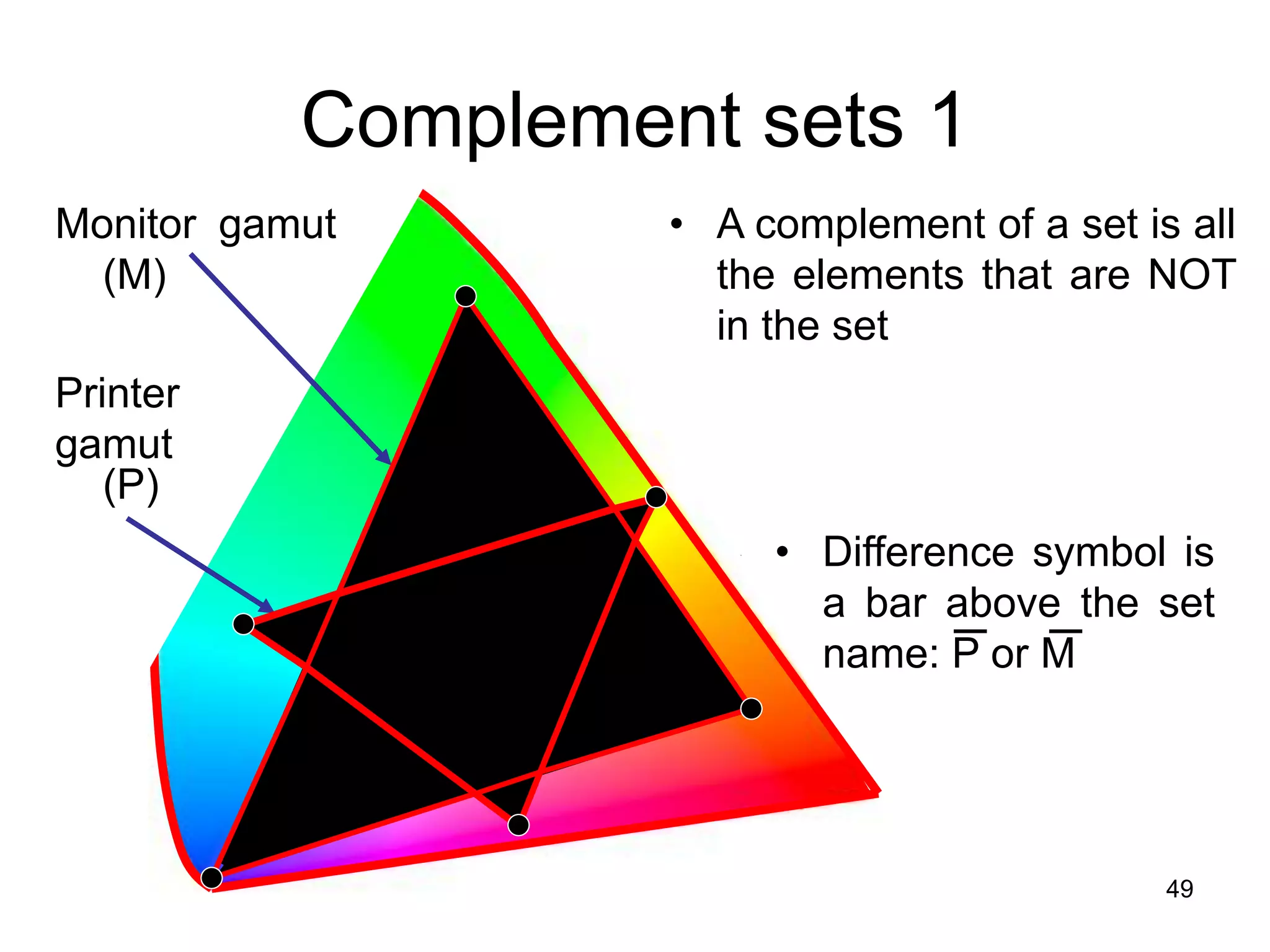
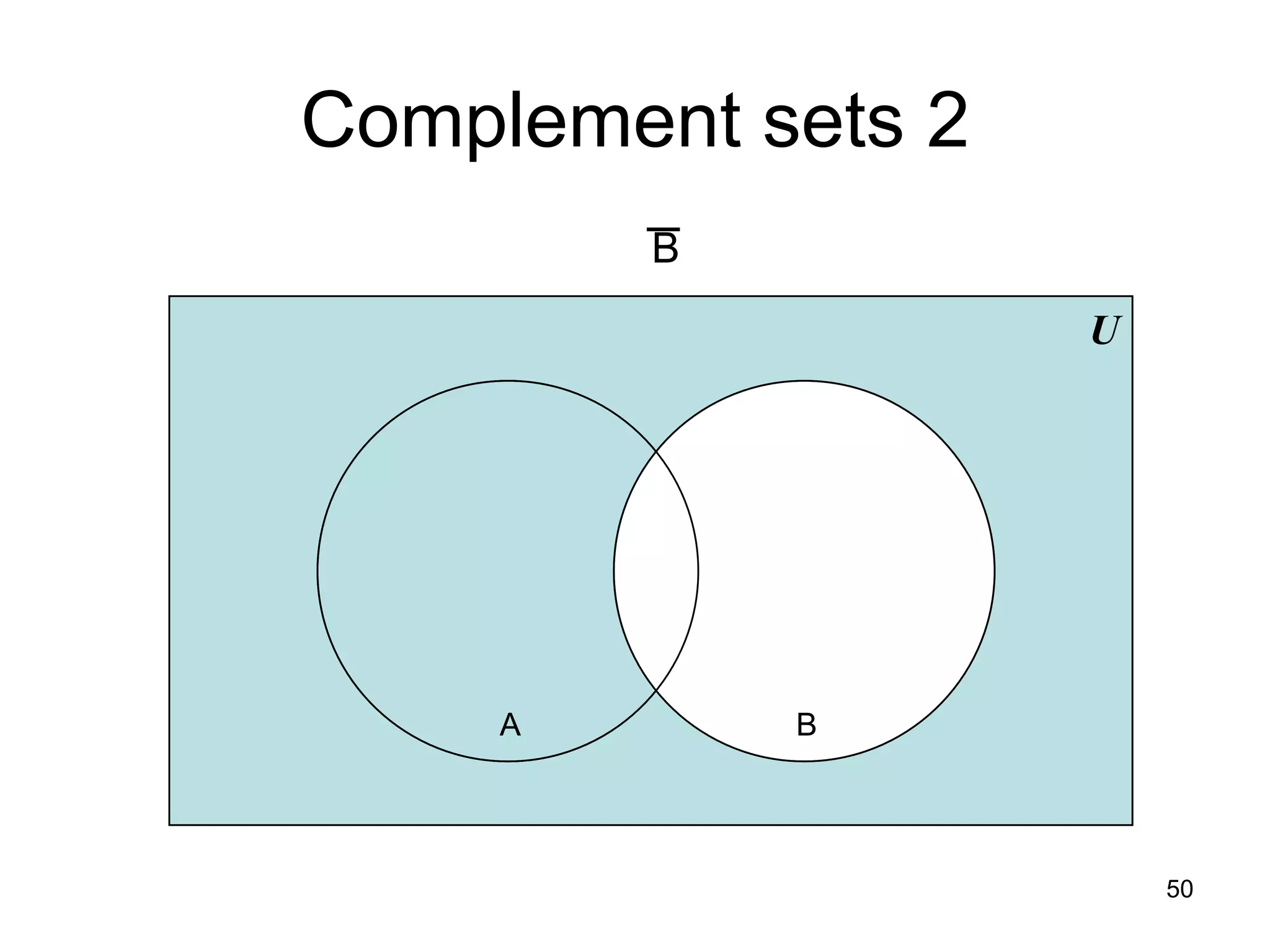
• A complement of a set is all
the elements that are NOT
in the set
• Difference symbol is
a bar above the set
name: P or M
_
_
Monitor gamut
(M)
Printer
gamut
(P)
Complement sets 1
50
Complement sets 2
U
A B
B
_
51
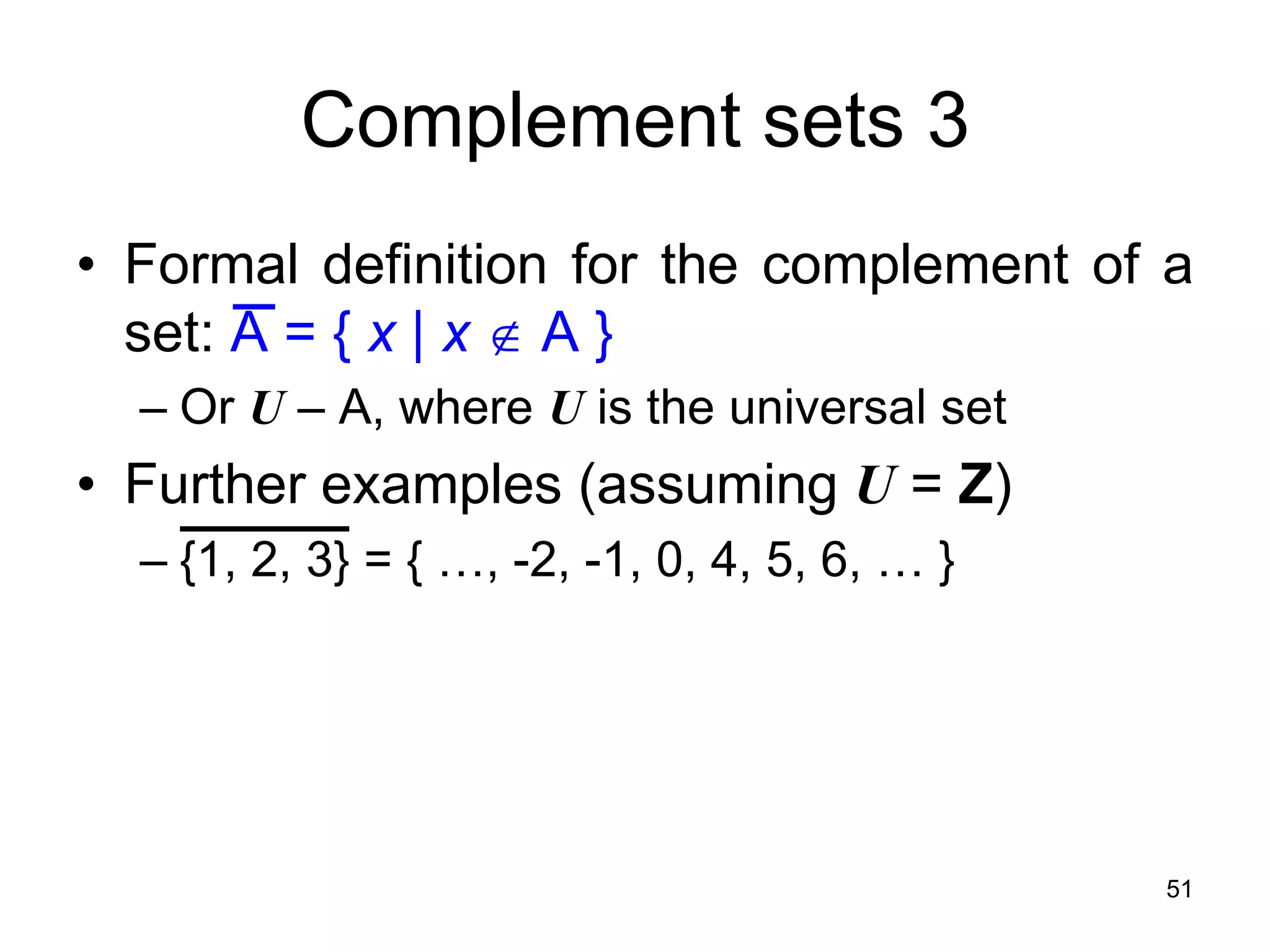
Complement sets 3
• Formal definition for the complement of a
set: A = { x | x  A }
– Or U – A, where U is the universal set
• Further examples (assuming U = Z)
– {1, 2, 3} = { …, -2, -1, 0, 4, 5, 6, … }
52
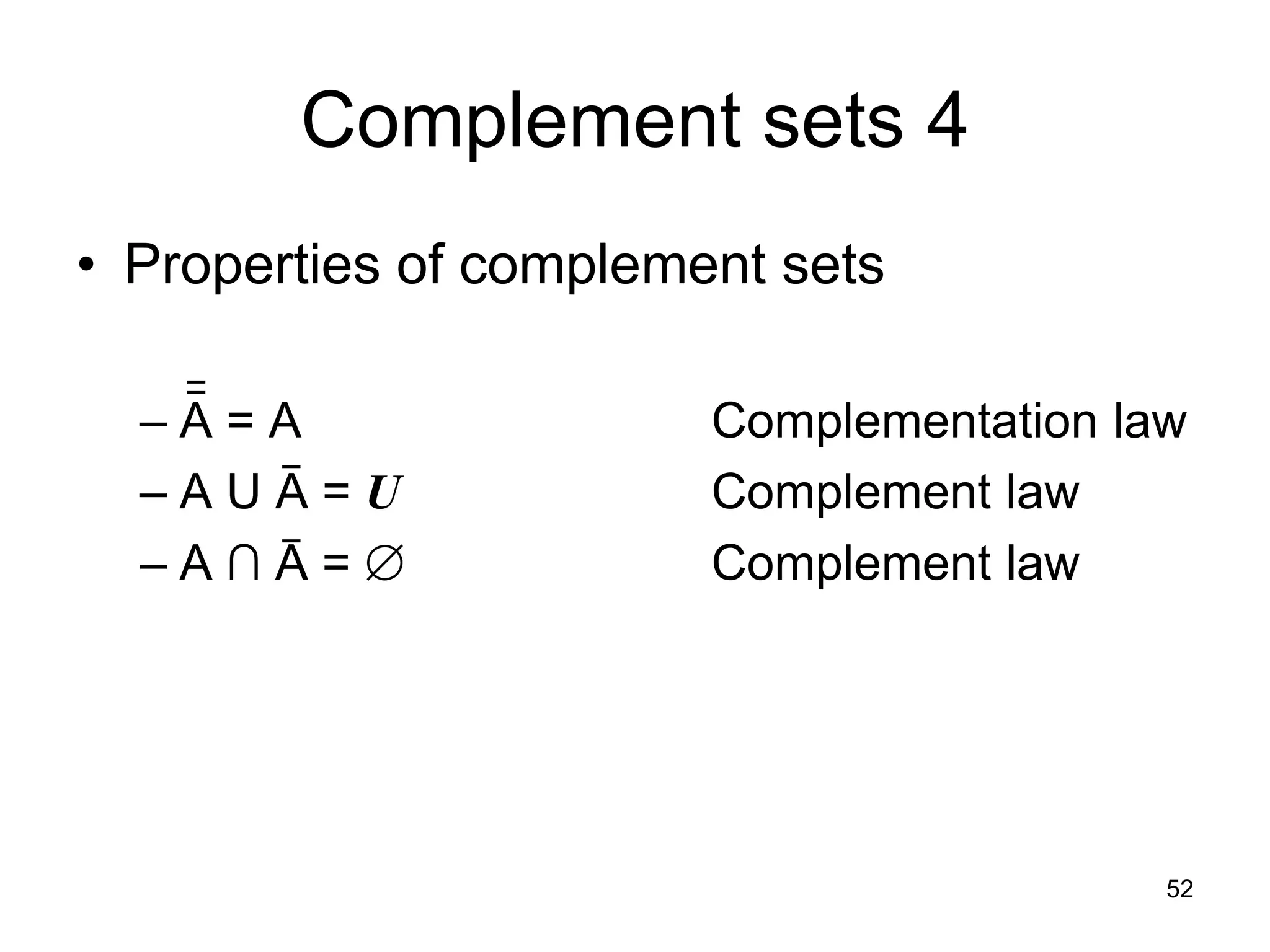
• Properties of complement sets
– A = A Complementation law
– A U A = U Complement law
– A ∩ A =  Complement law
Complement sets 4
¯
¯
¯
¯
53
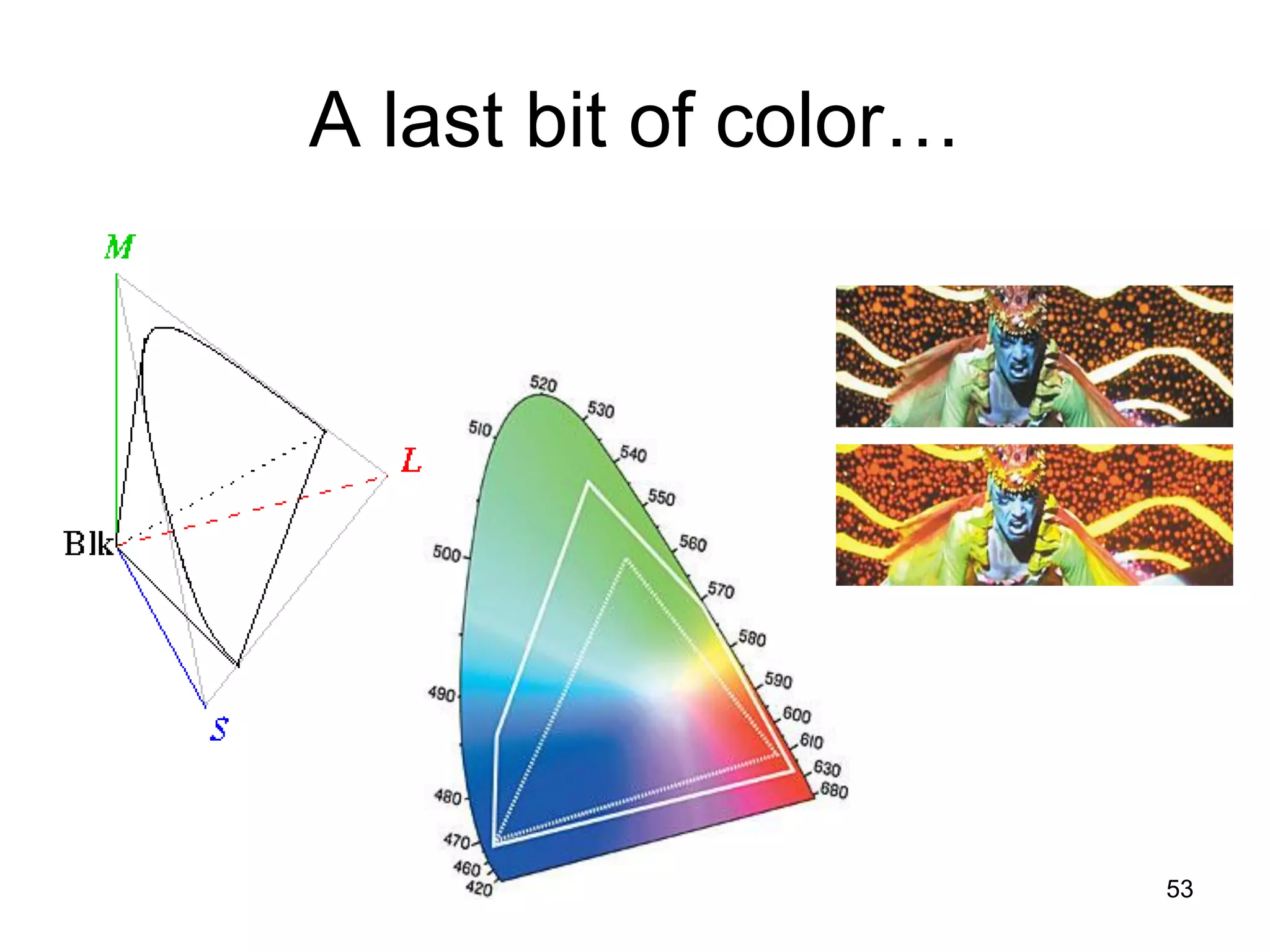
A last bit of color…
54
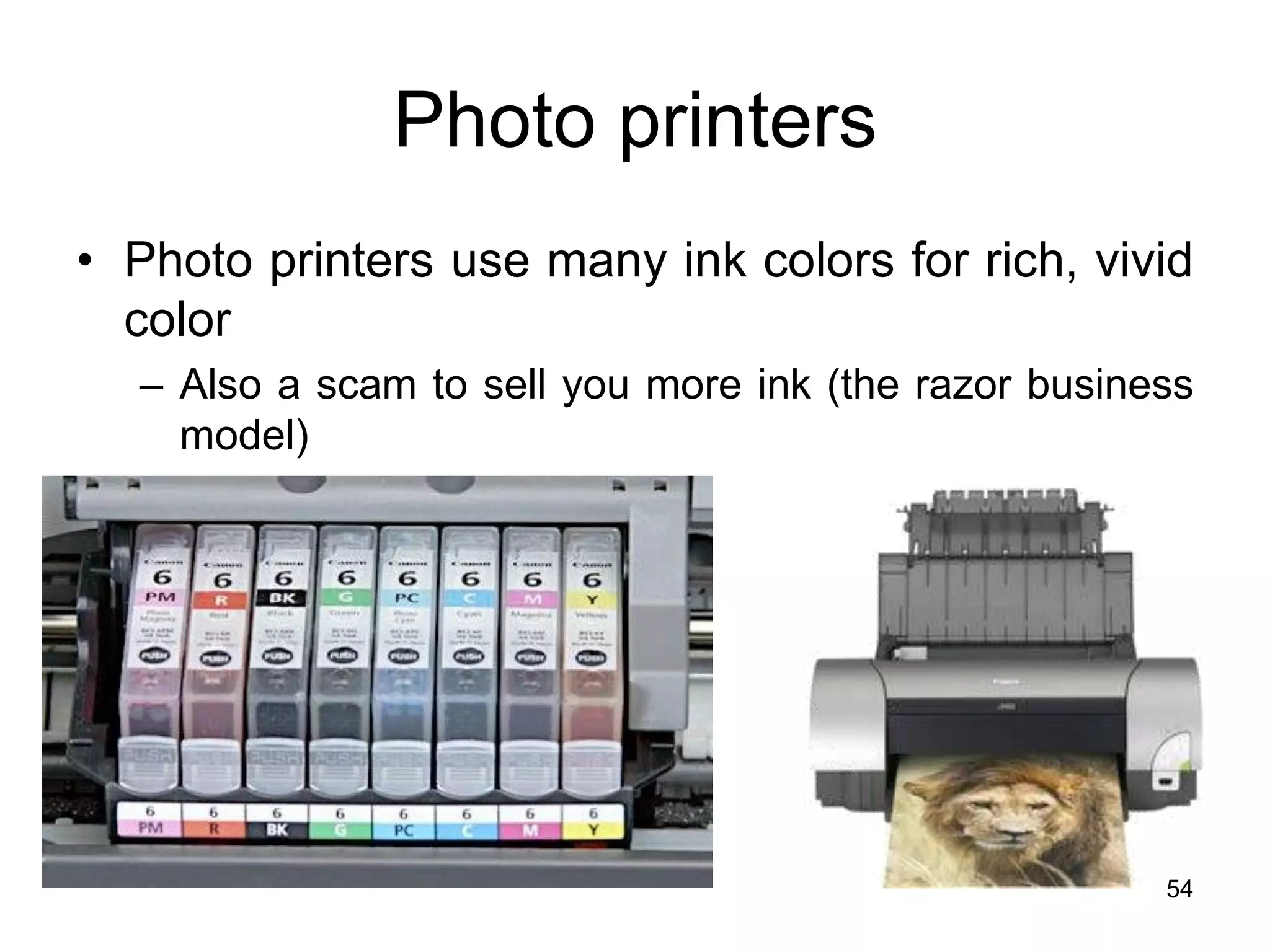
Photo printers
• Photo printers use many ink colors for rich, vivid
color
– Also a scam to sell you more ink (the razor business
model)
55
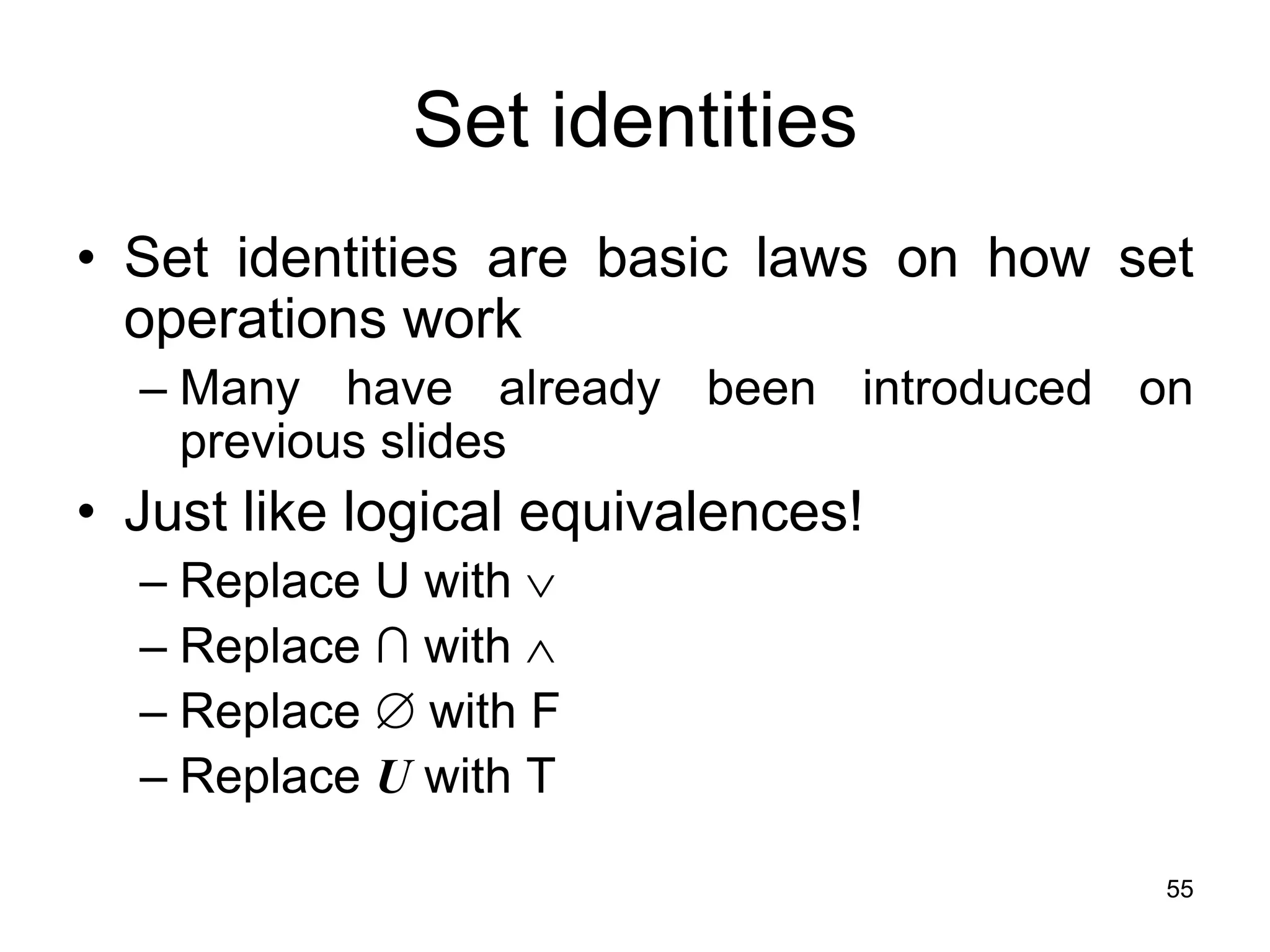
Set identities
• Set identities are basic laws on how set
operations work
– Many have already been introduced on
previous slides
• Just like logical equivalences!
– Replace U with 
– Replace ∩ with 
– Replace  with F
– Replace U with T
56
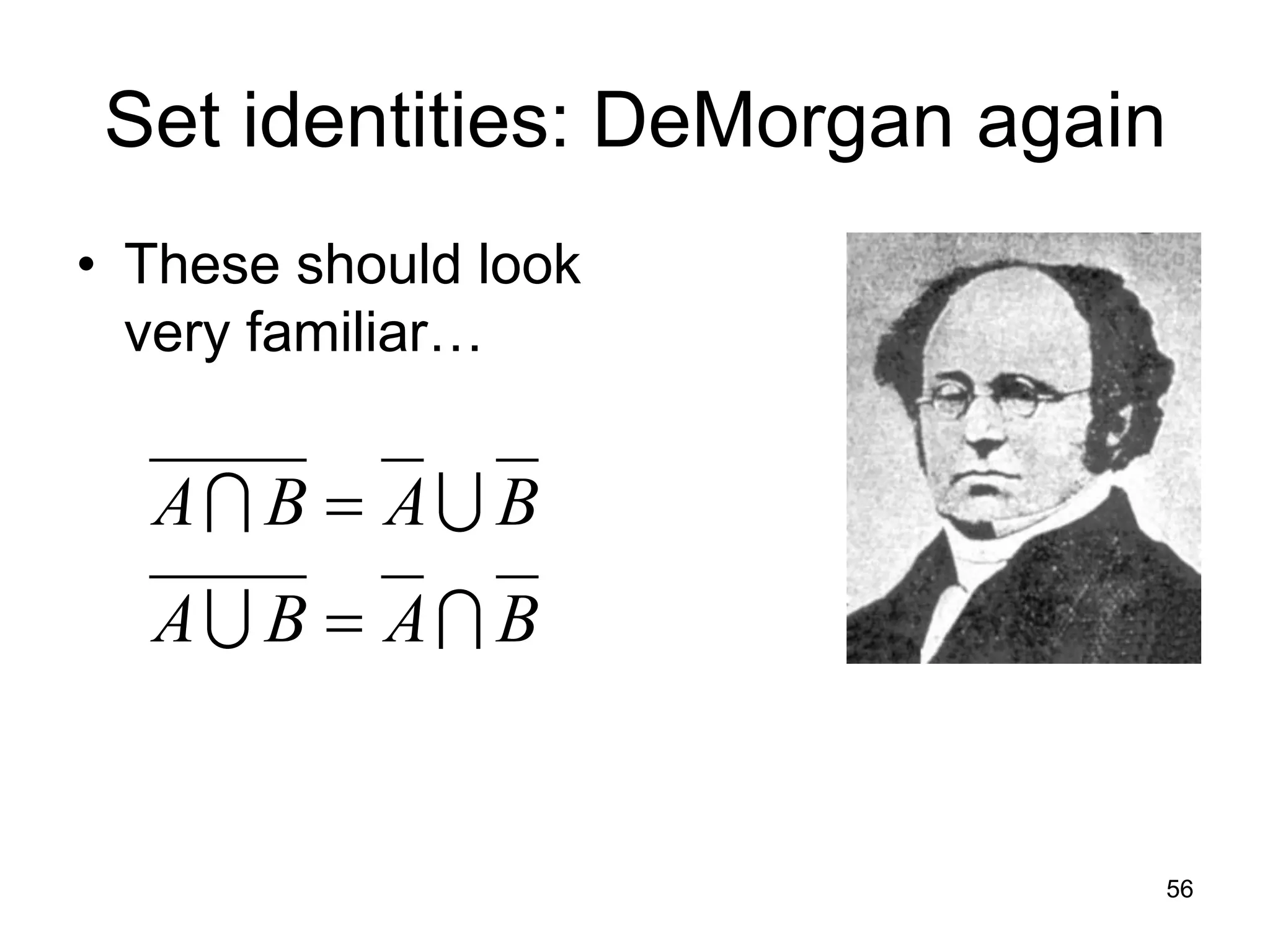
Set identities: DeMorgan again
B
A
B
A
B
A
B
A






• These should look
very familiar…

Set Theory.pdf

  • 1.
    1 Set Theory Dr. SauravDash, IIFT Kakinada Campus
  • 2.
    2 What is aset? • A set is a group of “objects” – People in a class: { Suresh, Ramesh, Khan, Vincent } – Classes offered by a department: { MGT 101, MGT 102, … } – Colors of a rainbow: {Red, Orange, Yellow, Green, Blue, Indigo, Violet } – States of matter { solid, liquid, gas, plasma } – States in the US: { Alabama, Alaska, Virginia, … } – Sets can contain non-related elements: { 3, a, red, Virginia } • Although a set can contain (almost) anything, we will most often use sets of numbers – All positive numbers less than or equal to 5: {1, 2, 3, 4, 5} – A few selected real numbers: { 2.1, π, 0, -6.32, e }
  • 3.
    3 Set properties 1 •Order does not matter – We often write them in order because it is easier for humans to understand it that way – {1, 2, 3, 4, 5} is equivalent to {3, 5, 2, 4, 1} • Sets are notated with curly brackets
  • 4.
    4 Set properties 2 •Sets do not have duplicate elements – Consider the set of vowels in the alphabet. • It makes no sense to list them as {a, a, a, e, i, o, o, o, o, o, u} • What we really want is just {a, e, i, o, u} – Consider the list of students in this class • Again, it does not make sense to list somebody twice • Note that a list is like a set, but order does matter and duplicate elements are allowed – We won’t be studying lists much in this class
  • 5.
    5 Specifying a set1 • Sets are usually represented by a capital letter (A, B, S, etc.) • Elements are usually represented by an italic lower-case letter (a, x, y, etc.) • Easiest way to specify a set is to list all the elements: A = {1, 2, 3, 4, 5} – Not always feasible for large or infinite sets
  • 6.
    6 Specifying a set2 • Can use an ellipsis (…): B = {0, 1, 2, 3, …} – Can cause confusion. Consider the set C = {3, 5, 7, …}. What comes next? – If the set is all odd integers greater than 2, it is 9 – If the set is all prime numbers greater than 2, it is 11 • Can use set-builder notation – D = {x | x is prime and x > 2} – E = {x | x is odd and x > 2} – The vertical bar means “such that” – Thus, set D is read (in English) as: “all elements x such that x is prime and x is greater than 2”
  • 7.
    7 Specifying a set3 • A set is said to “contain” the various “members” or “elements” that make up the set – If an element a is a member of (or an element of) a set S, we use then notation a  S • 4  {1, 2, 3, 4} – If an element is not a member of (or an element of) a set S, we use the notation a  S • 7  {1, 2, 3, 4} • Virginia  {1, 2, 3, 4}
  • 8.
    8 Often used sets •N = {1, 2, 3, …} is the set of natural numbers • Z = {…, -2, -1, 0, 1, 2, …} is the set of integers • Z+ = {1, 2, 3, …} is the set of positive integers (a.k.a whole numbers) – Note that people disagree on the exact definitions of whole numbers and natural numbers • Q = {p/q | p  Z, q  Z, q ≠ 0} is the set of rational numbers – Any number that can be expressed as a fraction of two integers (where the bottom one is not zero) • R is the set of real numbers
  • 9.
    9 The universal set1 • U is the universal set – the set of all of elements (or the “universe”) from which given any set is drawn – For the set {-2, 0.4, 2}, U would be the real numbers – For the set {0, 1, 2}, U could be the natural numbers (zero and up), the integers, the rational numbers, or the real numbers, depending on the context
  • 10.
    10 The universal set2 – For the set of the students in this class, U would be all the students in the University (or perhaps all the people in the world) – For the set of the vowels of the alphabet, U would be all the letters of the alphabet – To differentiate U from U (which is a set operation), the universal set is written in a different font (and in bold and italics)
  • 11.
    11 Venn diagrams • Representssets graphically – The box represents the universal set – Circles represent the set(s) • Consider set S, which is the set of all vowels in the alphabet • The individual elements are usually not written in a Venn diagram a e i o u b c d f g h j k l m n p q r s t v w x y z U S
  • 12.
    12 Sets of sets •Sets can contain other sets – S = { {1}, {2}, {3} } – T = { {1}, {{2}}, {{{3}}} } – V = { {{1}, {{2}}}, {{{3}}}, { {1}, {{2}}, {{{3}}} } } • V has only 3 elements! • Note that 1 ≠ {1} ≠ {{1}} ≠ {{{1}}} – They are all different
  • 13.
    13 The empty set1 • If a set has zero elements, it is called the empty (or null) set – Written using the symbol  – Thus,  = { }  VERY IMPORTANT – If you get confused about the empty set in a problem, try replacing  by { } • As the empty set is a set, it can be a element of other sets – { , 1, 2, 3, x } is a valid set
  • 14.
    14 The empty set1 • Note that  ≠ {  } – The first is a set of zero elements – The second is a set of 1 element (that one element being the empty set) • Replace  by { }, and you get: { } ≠ { { } } • It’s easier to see that they are not equal that way
  • 15.
    Empty set: anexample A = { x: x < 4, x is multiple of 5, x N } A = . 15
  • 16.
    16 Set equality • Twosets are equal if they have the same elements – {1, 2, 3, 4, 5} = {5, 4, 3, 2, 1} • Remember that order does not matter! – {1, 2, 3, 2, 4, 3, 2, 1} = {4, 3, 2, 1} • Remember that duplicate elements do not matter! • Two sets are not equal if they do not have the same elements – {1, 2, 3, 4, 5} ≠ {1, 2, 3, 4}
  • 17.
    17 Subsets 1 • Ifall the elements of a set S are also elements of a set T, then S is a subset of T – For example, if S = {2, 4, 6} and T = {1, 2, 3, 4, 5, 6, 7}, then S is a subset of T – This is specified by S  T • Or by {2, 4, 6}  {1, 2, 3, 4, 5, 6, 7} • If S is not a subset of T, it is written as such: S  T – For example, {1, 2, 8}  {1, 2, 3, 4, 5, 6, 7}
  • 18.
    18 Subsets 2 • Notethat any set is a subset of itself! – Given set S = {2, 4, 6}, since all the elements of S are elements of S, S is a subset of itself – This is kind of like saying 5 is less than or equal to 5 – Thus, for any set S, S  S
  • 19.
    19 Subsets 3 • Theempty set is a subset of all sets (including itself!) – Recall that all sets are subsets of themselves • All sets are subsets of the universal set • A horrible way to define a subset: – x ( xA  xB ) – English translation: for all possible values of x, (meaning for all possible elements of a set), if x is an element of A, then x is an element of B – This type of notation will be gone over later
  • 20.
    20 • If Sis a subset of T, and S is not equal to T, then S is a proper subset of T – Let T = {0, 1, 2, 3, 4, 5} – If S = {1, 2, 3}, S is not equal to T, and S is a subset of T – A proper subset is written as S  T – Let R = {0, 1, 2, 3, 4, 5}. R is equal to T, and thus is a subset (but not a proper subset) or T • Can be written as: R  T and R  T (or just R = T) – Let Q = {4, 5, 6}. Q is neither a subset or T nor a proper subset of T Proper Subsets 1
  • 21.
    21 Proper Subsets 2 •The difference between “subset” and “proper subset” is like the difference between “less than or equal to” and “less than” for numbers • The empty set is a proper subset of all sets other than the empty set (as it is equal to the empty set)
  • 22.
    22 Proper subsets: Venndiagram U S R S  R
  • 23.
    23 Set cardinality • Thecardinality of a set is the number of elements in a set – Written as |A| • Examples – Let R = {1, 2, 3, 4, 5}. Then |R| = 5 – || = 0 – Let S = {, {a}, {b}, {a, b}}. Then |S| = 4 • This is the same notation used for vector length in geometry • A set with one element is called a singleton set
  • 24.
    24 Power sets 1 •Given the set S = {0, 1}. What are all the possible subsets of S? – They are:  (as it is a subset of all sets), {0}, {1}, and {0, 1} – The power set of S (written as P(S)) is the set of all the subsets of S – P(S) = { , {0}, {1}, {0,1} } • Note that |S| = 2 and |P(S)| = 4
  • 25.
    25 Power sets 2 •Let T = {0, 1, 2}. The P(T) = { , {0}, {1}, {2}, {0,1}, {0,2}, {1,2}, {0,1,2} } • Note that |T| = 3 and |P(T)| = 8 • P() = {  } • Note that || = 0 and |P()| = 1 • If a set has n elements, then the power set will have 2n elements
  • 26.
    26 Tuples • In 2-dimensionalspace, it is a (x, y) pair of numbers to specify a location • In 3-dimensional (1,2,3) is not the same as (3,2,1) – space, it is a (x, y, z) triple of numbers • In n-dimensional space, it is a n-tuple of numbers – Two-dimensional space uses pairs, or 2-tuples – Three-dimensional space uses triples, or 3-tuples • Note that these tuples are ordered, unlike sets – the x value has to come first +x +y (2,3)
  • 27.
    27 Cartesian products 1 •A Cartesian product is a set of all ordered 2- tuples where each “part” is from a given set – Denoted by A x B, and uses parenthesis (not curly brackets) – For example, 2-D Cartesian coordinates are the set of all ordered pairs Z x Z • Recall Z is the set of all integers • This is all the possible coordinates in 2-D space – Example: Given A = { a, b } and B = { 0, 1 }, what is their Cartiesian product? • C = A x B = { (a,0), (a,1), (b,0), (b,1) }
  • 28.
    28 Cartesian products 2 •Note that Cartesian products have only 2 parts in these examples (later examples have more parts) • Formal definition of a Cartesian product: – A x B = { (a,b) | a  A and b  B }
  • 29.
    29 Cartesian products 3 •All the possible grades in this class will be a Cartesian product of the set S of all the students in this class and the set G of all possible grades – Let S = { Alice, Bob, Chris } and G = { A, B, C } – D = { (Alice, A), (Alice, B), (Alice, C), (Bob, A), (Bob, B), (Bob, C), (Chris, A), (Chris, B), (Chris, C) } – The final grades will be a subset of this: { (Alice, C), (Bob, B), (Chris, A) } • Such a subset of a Cartesian product is called a relation (more on this later in the course)
  • 30.
    30 Cartesian products 4 •There can be Cartesian products on more than two sets • A 3-D coordinate is an element from the Cartesian product of Z x Z x Z
  • 31.
  • 32.
    32 • Triangle showsmixable color range (gamut) – the set of colors Sets of Colors Monitor gamut (M) Printer gamut (P) • Pick any 3 “primary” colors
  • 33.
    33 • A unionof the sets contains all the elements in EITHER set • Union symbol is usually a U • Example: C = M U P Monitor gamut (M) Printer gamut (P) Set operations: Union 1
  • 34.
  • 35.
    35 Set operations: Union3 • Formal definition for the union of two sets: A U B = { x | x  A or x  B } • Further examples – {1, 2, 3} U {3, 4, 5} = {1, 2, 3, 4, 5} – {New York, Washington} U {3, 4} = {New York, Washington, 3, 4} – {1, 2} U  = {1, 2}
  • 36.
    36 Set operations: Union4 • Properties of the union operation – A U  = A Identity law – A U U = U Domination law – A U A = A Idempotent law – A U B = B U A Commutative law – A U (B U C) = (A U B) U C Associative law
  • 37.
    37 • An intersectionof the sets contains all the elements in BOTH sets • Intersection symbol is a ∩ • Example: C = M ∩ P Monitor gamut (M) Printer gamut (P) Set operations: Intersection 1
  • 38.
  • 39.
    39 Set operations: Intersection3 • Formal definition for the intersection of two sets: A ∩ B = { x | x  A and x  B } • Further examples – {1, 2, 3} ∩ {3, 4, 5} = {3} – {New York, Washington} ∩ {3, 4} =  • No elements in common – {1, 2} ∩  =  • Any set intersection with the empty set yields the empty set
  • 40.
    40 Set operations: Intersection4 • Properties of the intersection operation – A ∩ U = A Identity law – A ∩  =  Domination law – A ∩ A = A Idempotent law – A ∩ B = B ∩ A Commutative law – A ∩ (B ∩ C) = (A ∩ B) ∩ C Associative law
  • 41.
    41 Disjoint sets 1 •Two sets are disjoint if the have NO elements in common • Formally, two sets are disjoint if their intersection is the empty set • Another example: the set of the even numbers and the set of the odd numbers
  • 42.
  • 43.
    43 Disjoint sets 3 •Formal definition for disjoint sets: two sets are disjoint if their intersection is the empty set • Further examples – {1, 2, 3} and {3, 4, 5} are not disjoint – {New York, Washington} and {3, 4} are disjoint – {1, 2} and  are disjoint • Their intersection is the empty set –  and  are disjoint! • Their intersection is the empty set
  • 44.
    44 Set operations: Difference1 • A difference of two sets is the elements in one set that are NOT in the other • Difference symbol is a minus sign • Example: C = M - P Monitor gamut (M) Printer gamut (P) • Also visa-versa: C = P - M
  • 45.
  • 46.
    46 • Formal definitionfor the difference of two sets: A - B = { x | x  A and x  B } A - B = A ∩ B  Important! • Further examples – {1, 2, 3} - {3, 4, 5} = {1, 2} – {New York, Washington} - {3, 4} = {New York, Washington} – {1, 2} -  = {1, 2} • The difference of any set S with the empty set will be the set S Set operations: Difference 3 _
  • 47.
    47 • A symmetricdifference of the sets contains all the elements in either set but NOT both • Symetric diff. symbol is a  • Example: C = M  P Monitor gamut (M) Printer gamut (P) Set operations: Symmetric Difference 1
  • 48.
    48 • Formal definitionfor the symmetric difference of two sets: A  B = { x | (x  A or x  B) and x  A ∩ B} A  B = (A U B) – (A ∩ B)  Important! • Further examples – {1, 2, 3}  {3, 4, 5} = {1, 2, 4, 5} – {New York, Washington}  {3, 4} = {New York, Washington, 3, 4} – {1, 2}   = {1, 2} • The symmetric difference of any set S with the empty set will be the set S Set operations: Symmetric Difference 2
  • 49.
    49 • A complementof a set is all the elements that are NOT in the set • Difference symbol is a bar above the set name: P or M _ _ Monitor gamut (M) Printer gamut (P) Complement sets 1
  • 50.
  • 51.
    51 Complement sets 3 •Formal definition for the complement of a set: A = { x | x  A } – Or U – A, where U is the universal set • Further examples (assuming U = Z) – {1, 2, 3} = { …, -2, -1, 0, 4, 5, 6, … }
  • 52.
    52 • Properties ofcomplement sets – A = A Complementation law – A U A = U Complement law – A ∩ A =  Complement law Complement sets 4 ¯ ¯ ¯ ¯
  • 53.
    53 A last bitof color…
  • 54.
    54 Photo printers • Photoprinters use many ink colors for rich, vivid color – Also a scam to sell you more ink (the razor business model)
  • 55.
    55 Set identities • Setidentities are basic laws on how set operations work – Many have already been introduced on previous slides • Just like logical equivalences! – Replace U with  – Replace ∩ with  – Replace  with F – Replace U with T
  • 56.
    56 Set identities: DeMorganagain B A B A B A B A       • These should look very familiar…