CONCEPT OF DISCIPLINE
INTRODUCTION
Discipline is the practice of training people
to obey rules or a code of behaviour.
It originates from a latin word “DISCIPLINA” which means
INSTRUCTION. Thus, it means a systematic instruction given
to a disciple.
DERIVATIVE MEANING
Discipline in school means, ‘ORDER AND SYSTEM IN DOING
THINGS, REGULARITY AND OBEDIENCE TO COMMANDS’.
CONCEPT OF DISCIPLINE
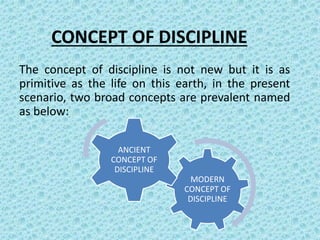
The concept of discipline is not new but it is as
primitive as the life on this earth, in the present
scenario, two broad concepts are prevalent named
as below:
MODERN
CONCEPT OF
DISCIPLINE
ANCIENT
CONCEPT OF
DISCIPLINE
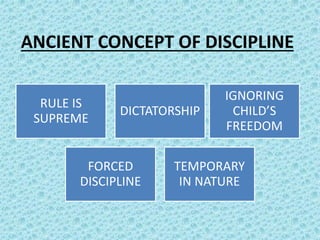
ANCIENT CONCEPT OF DISCIPLINE
RULE IS
SUPREME
DICTATORSHIP
IGNORING
CHILD’S
FREEDOM
FORCED
DISCIPLINE
TEMPORARY
IN NATURE
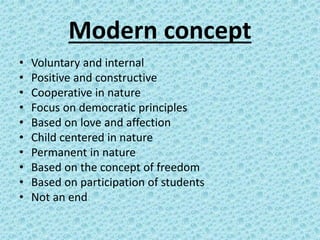
Modern concept
• Voluntary and internal
• Positive and constructive
• Cooperative in nature
• Focus on democratic principles
• Based on love and affection
• Child centered in nature
• Permanent in nature
• Based on the concept of freedom
• Based on participation of students
• Not an end
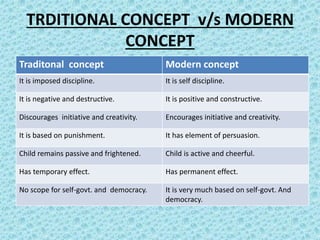
TRDITIONAL CONCEPT v/s MODERN
CONCEPT
Traditonal concept Modern concept
It is imposed discipline. It is self discipline.
It is negative and destructive. It is positive and constructive.
Discourages initiative and creativity. Encourages initiative and creativity.
It is based on punishment. It has element of persuasion.
Child remains passive and frightened. Child is active and cheerful.
Has temporary effect. Has permanent effect.
No scope for self-govt. and democracy. It is very much based on self-govt. And
democracy.
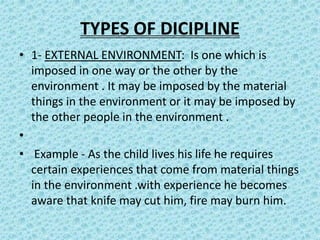
TYPES OF DICIPLINE
• 1- EXTERNAL ENVIRONMENT: Is one which is
imposed in one way or the other by the
environment . It may be imposed by the material
things in the environment or it may be imposed by
the other people in the environment .
•
• Example - As the child lives his life he requires
certain experiences that come from material things
in the environment .with experience he becomes
aware that knife may cut him, fire may burn him.
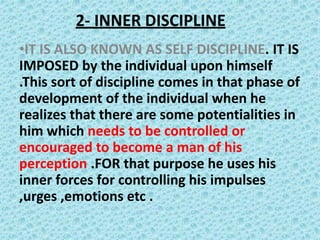
2- INNER DISCIPLINE
•IT IS ALSO KNOWN AS SELF DISCIPLINE. IT IS
IMPOSED by the individual upon himself
.This sort of discipline comes in that phase of
development of the individual when he
realizes that there are some potentialities in
him which needs to be controlled or
encouraged to become a man of his
perception .FOR that purpose he uses his
inner forces for controlling his impulses
,urges ,emotions etc .
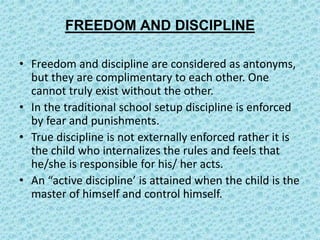
FREEDOM AND DISCIPLINE
• Freedom and discipline are considered as antonyms,
but they are complimentary to each other. One
cannot truly exist without the other.
• In the traditional school setup discipline is enforced
by fear and punishments.
• True discipline is not externally enforced rather it is
the child who internalizes the rules and feels that
he/she is responsible for his/ her acts.
• An “active discipline’ is attained when the child is the
master of himself and control himself.
▪ Children learn best in free
atmosphere and the true freedom
cannot exist without self discipline
▪ The child and the teacher work
together in a prepared environment
to build a community.
▪ The child learns to respect the rule,
choice is given for the child to choose
his own activities.The outcome of
this freedom is self discipline,
concentration and social interaction.
IMPORTANCE OF SCHOOL
DISCIPLINE
• Achievement of objectives
• Effective teaching
• Helping in development of personality
• School administration
• Proper use of potentiality
• Positive and constructive
• Training of self – control
• Training of self – respect
• Social need
• Democratic
Causes of Indiscipline
1)Personal causes
a) Physical and mental deformity
b) Complex of inferiority or superiority
c)Bad habits
2) Educational causes
a)Lack of moral education
b)Organisational drawbacks
Contd..
3) Social Causes
a) Unpleasant Environment
b) Bad Home Environment
c) Uneducated Parents
4) Political Causes
a) Involve students in party
Contd....
5) Psychological Causes
a) Punishment by teachers
b) Punishment by Parents
Recommendations of school
indiscipline committee (1960)
• Student should be admitted in the school on the
basis of qualification and merit
• Careful selection of teacher and vice chancellor
• Appropriate steps should be taken to bring close
contracts between teacher and student
• No corrupting influence from outside should be
allowed to enter in the university or college
• Student union should be encouraged very carefully
• Vocational and moral guidance should be provided
to students
Recommendations of the second
conference of vice chancellors
• Optimum size of an institution
• Improved teacher pupil ratio
• Setter working conditions for the students
• More work to students of arts faculty
• Most extra-curricular of trade unions which may
not assume the character of trade union
• Proper emoluments and conditions of work for
teachers
• Firm and immediate steps against breach of
discipline
• Introduction of religious and moral instruction

Discipline converted

  • 1.
  • 2.
    INTRODUCTION Discipline is thepractice of training people to obey rules or a code of behaviour. It originates from a latin word “DISCIPLINA” which means INSTRUCTION. Thus, it means a systematic instruction given to a disciple. DERIVATIVE MEANING Discipline in school means, ‘ORDER AND SYSTEM IN DOING THINGS, REGULARITY AND OBEDIENCE TO COMMANDS’.
  • 3.
    CONCEPT OF DISCIPLINE Theconcept of discipline is not new but it is as primitive as the life on this earth, in the present scenario, two broad concepts are prevalent named as below: MODERN CONCEPT OF DISCIPLINE ANCIENT CONCEPT OF DISCIPLINE
  • 4.
    ANCIENT CONCEPT OFDISCIPLINE RULE IS SUPREME DICTATORSHIP IGNORING CHILD’S FREEDOM FORCED DISCIPLINE TEMPORARY IN NATURE
  • 5.
    Modern concept • Voluntaryand internal • Positive and constructive • Cooperative in nature • Focus on democratic principles • Based on love and affection • Child centered in nature • Permanent in nature • Based on the concept of freedom • Based on participation of students • Not an end
  • 6.
    TRDITIONAL CONCEPT v/sMODERN CONCEPT Traditonal concept Modern concept It is imposed discipline. It is self discipline. It is negative and destructive. It is positive and constructive. Discourages initiative and creativity. Encourages initiative and creativity. It is based on punishment. It has element of persuasion. Child remains passive and frightened. Child is active and cheerful. Has temporary effect. Has permanent effect. No scope for self-govt. and democracy. It is very much based on self-govt. And democracy.
  • 7.
    TYPES OF DICIPLINE •1- EXTERNAL ENVIRONMENT: Is one which is imposed in one way or the other by the environment . It may be imposed by the material things in the environment or it may be imposed by the other people in the environment . • • Example - As the child lives his life he requires certain experiences that come from material things in the environment .with experience he becomes aware that knife may cut him, fire may burn him.
  • 8.
    2- INNER DISCIPLINE •ITIS ALSO KNOWN AS SELF DISCIPLINE. IT IS IMPOSED by the individual upon himself .This sort of discipline comes in that phase of development of the individual when he realizes that there are some potentialities in him which needs to be controlled or encouraged to become a man of his perception .FOR that purpose he uses his inner forces for controlling his impulses ,urges ,emotions etc .
  • 9.
    FREEDOM AND DISCIPLINE •Freedom and discipline are considered as antonyms, but they are complimentary to each other. One cannot truly exist without the other. • In the traditional school setup discipline is enforced by fear and punishments. • True discipline is not externally enforced rather it is the child who internalizes the rules and feels that he/she is responsible for his/ her acts. • An “active discipline’ is attained when the child is the master of himself and control himself.
  • 10.
    ▪ Children learnbest in free atmosphere and the true freedom cannot exist without self discipline ▪ The child and the teacher work together in a prepared environment to build a community. ▪ The child learns to respect the rule, choice is given for the child to choose his own activities.The outcome of this freedom is self discipline, concentration and social interaction.
  • 11.
    IMPORTANCE OF SCHOOL DISCIPLINE •Achievement of objectives • Effective teaching • Helping in development of personality • School administration • Proper use of potentiality • Positive and constructive • Training of self – control • Training of self – respect • Social need • Democratic
  • 12.
    Causes of Indiscipline 1)Personalcauses a) Physical and mental deformity b) Complex of inferiority or superiority c)Bad habits 2) Educational causes a)Lack of moral education b)Organisational drawbacks
  • 13.
    Contd.. 3) Social Causes a)Unpleasant Environment b) Bad Home Environment c) Uneducated Parents 4) Political Causes a) Involve students in party
  • 14.
    Contd.... 5) Psychological Causes a)Punishment by teachers b) Punishment by Parents
  • 15.
    Recommendations of school indisciplinecommittee (1960) • Student should be admitted in the school on the basis of qualification and merit • Careful selection of teacher and vice chancellor • Appropriate steps should be taken to bring close contracts between teacher and student • No corrupting influence from outside should be allowed to enter in the university or college • Student union should be encouraged very carefully • Vocational and moral guidance should be provided to students
  • 16.
    Recommendations of thesecond conference of vice chancellors • Optimum size of an institution • Improved teacher pupil ratio • Setter working conditions for the students • More work to students of arts faculty • Most extra-curricular of trade unions which may not assume the character of trade union • Proper emoluments and conditions of work for teachers • Firm and immediate steps against breach of discipline • Introduction of religious and moral instruction