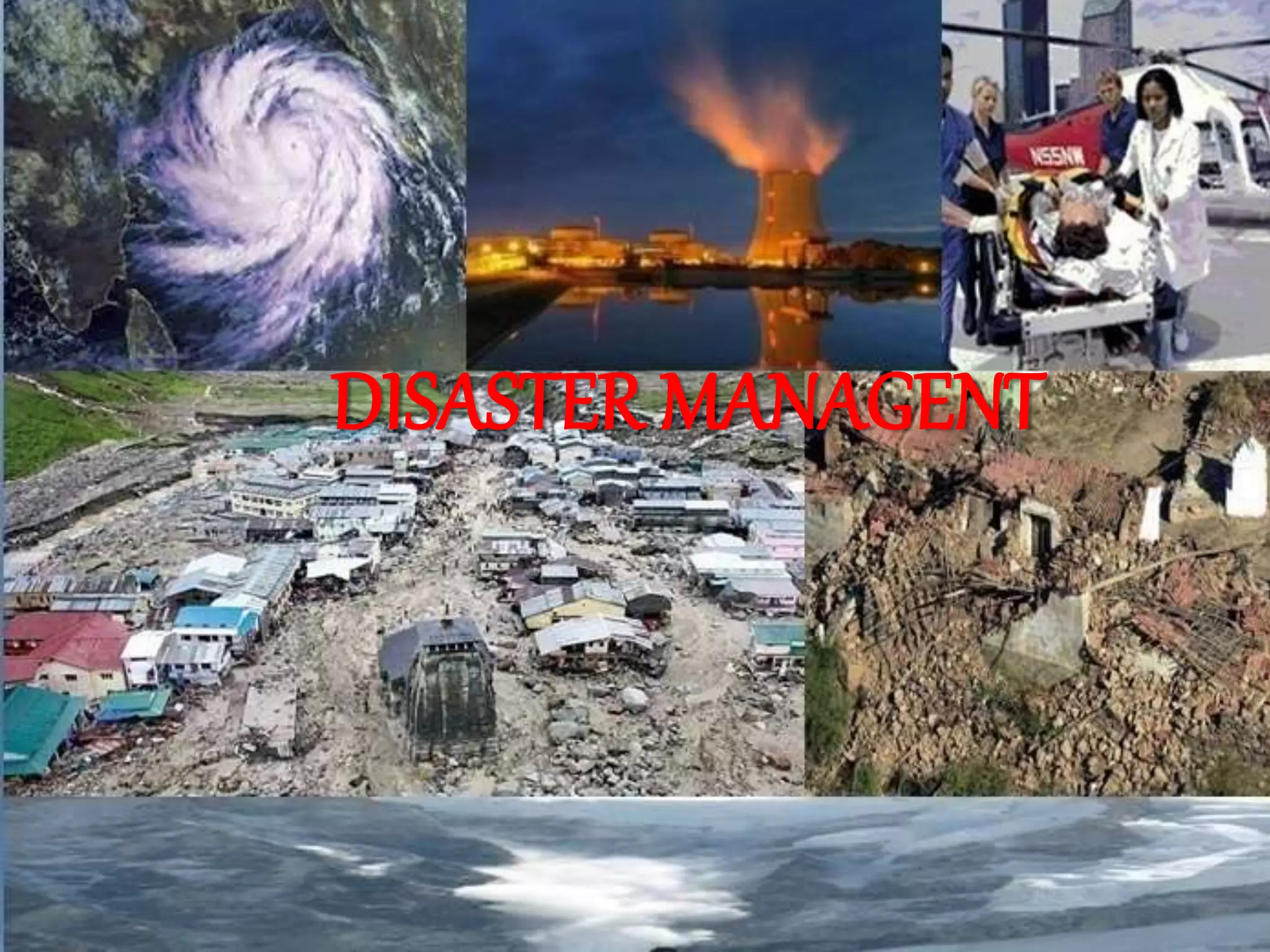
DISASTER MANAGENT
Introduction
•Disasters are as old as Mankind.
• The first description of Disaster and
its management comes from
mythological “Noah” and his ark.
• Similar Flood tales are widespread
in- Greek Mythology, Purina,
Mesopotamian stories, and many
cultures.
Etymology
Originated from Greek
dus = bad aster = star
Calamity due to position of a planet or a star.
Then evolved in Italian as disastro,
To become French désastre
.
DEFINITION
Any occurrence that causes damage, ecological
disruption, loss of human life, deterioration of
health and health services on a scale, sufficient to
warrant an extraordinary response from
outside the affected community or area.
(WHO)
A disaster can be defined as an occurrence either
nature or man made that causes human suffering
and creates human needs that victim cannot
alleviate without assistance.
(American Red Cross)
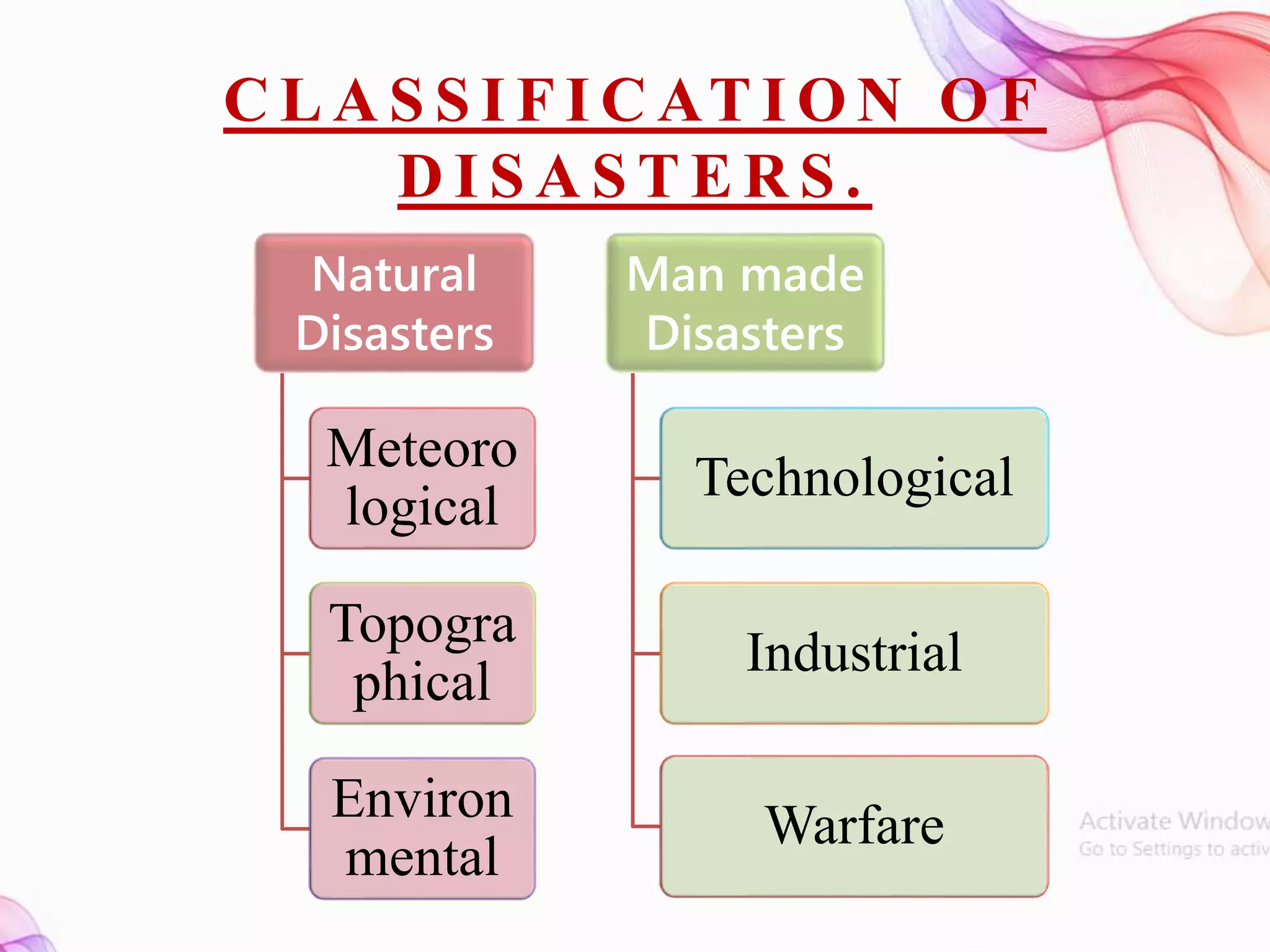
C L A S S I F I C AT I O N O F
D I S A S T E R S .
Natural
Disasters
Meteoro
logical
Topogra
phical
Environ
mental
Man made
Disasters
Technological
Industrial
Warfare
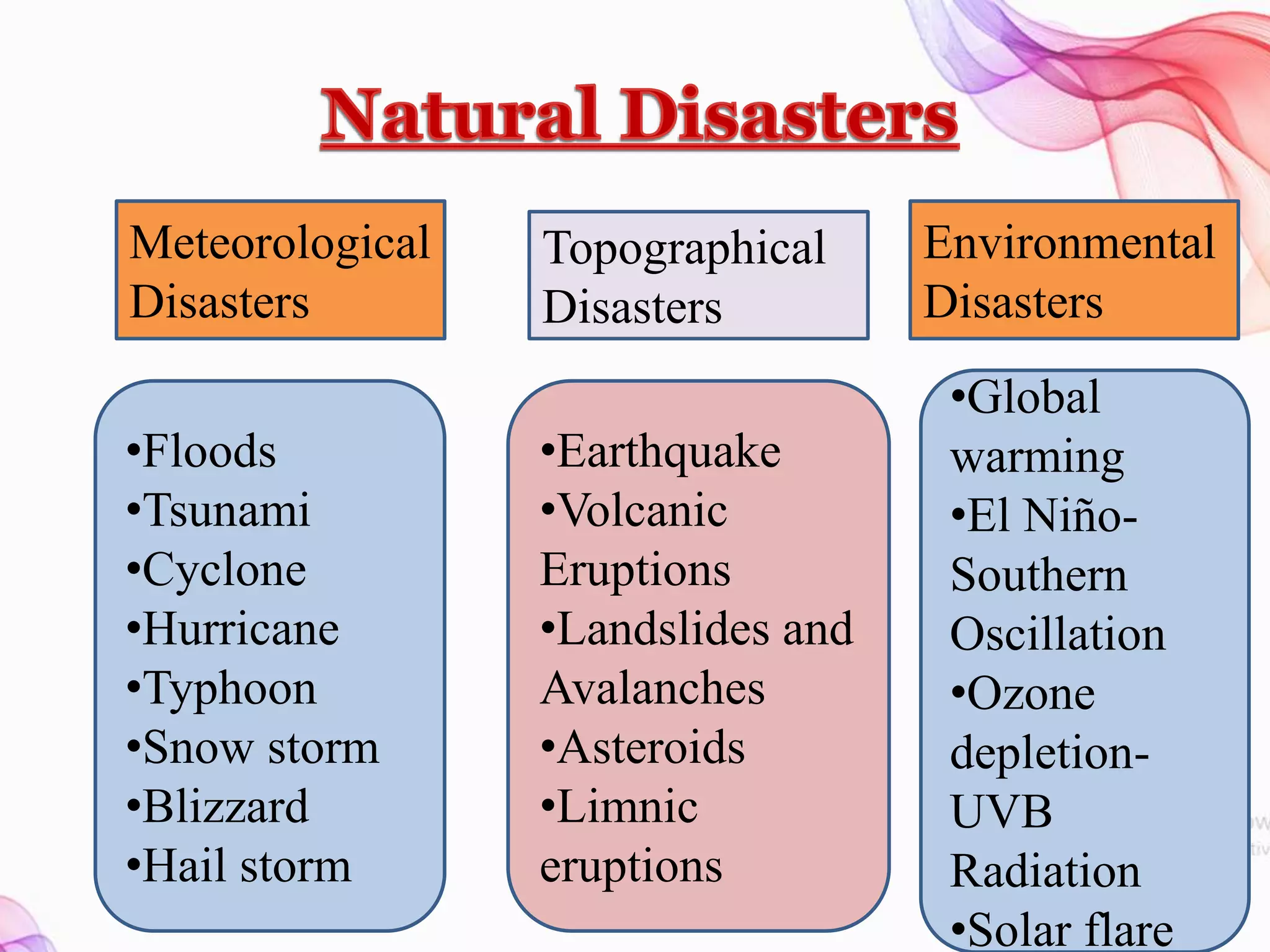
Meteorological
Disasters
•Floods
•Tsunami
•Cyclone
•Hurricane
•Typhoon
•Snow storm
•Blizzard
•Hail storm
Topographical
Disasters
•Earthquake
•Volcanic
Eruptions
•Landslides and
Avalanches
•Asteroids
•Limnic
eruptions
Environmental
Disasters
•Global
warming
•El Niño-
Southern
Oscillation
•Ozone
depletion-
UVB
Radiation
•Solar flare
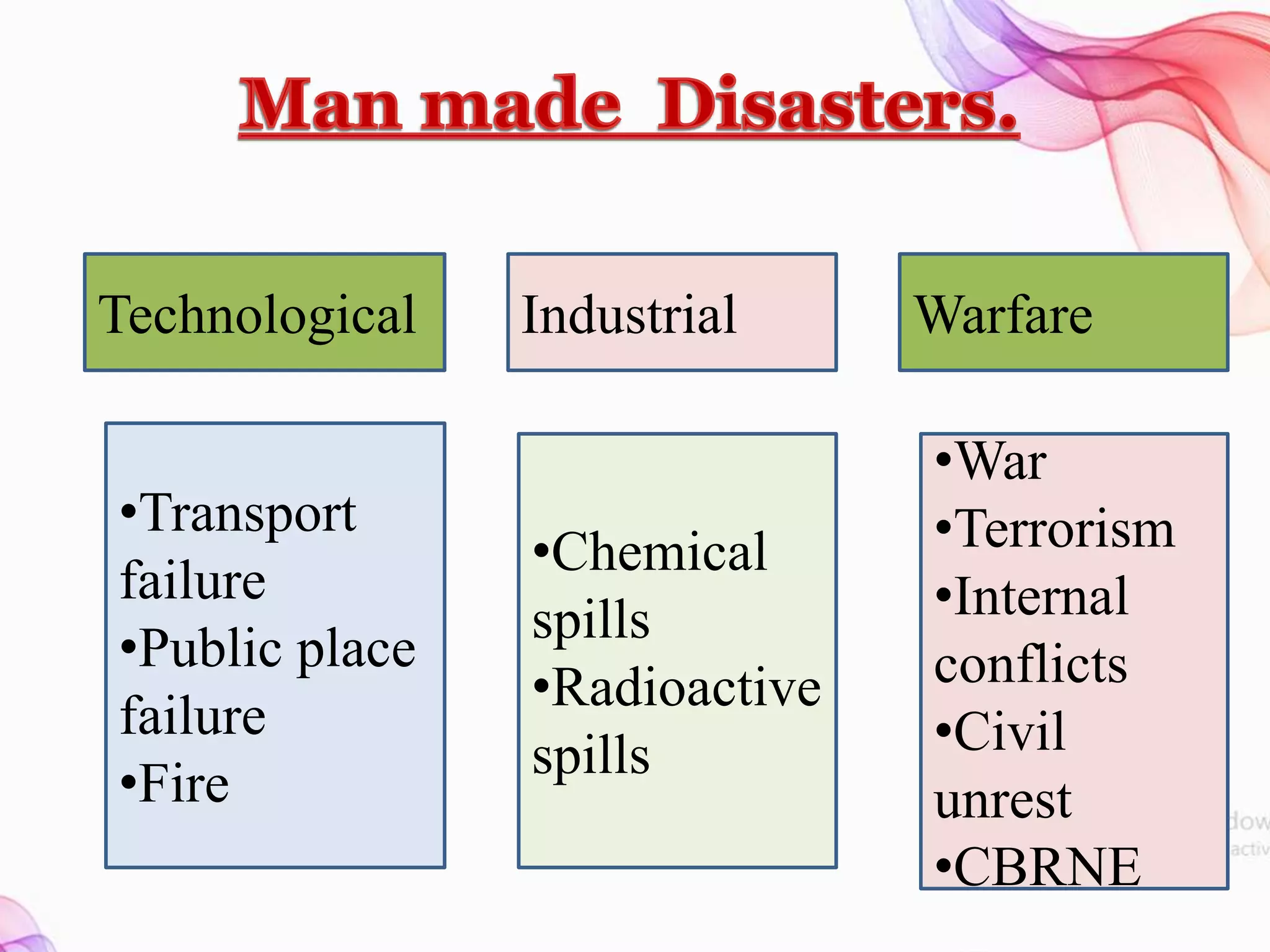
Technological Industrial Warfare
•Transport
failure
•Public place
failure
•Fire
•Chemical
spills
•Radioactive
spills
•War
•Terrorism
•Internal
conflicts
•Civil
unrest
•CBRNE
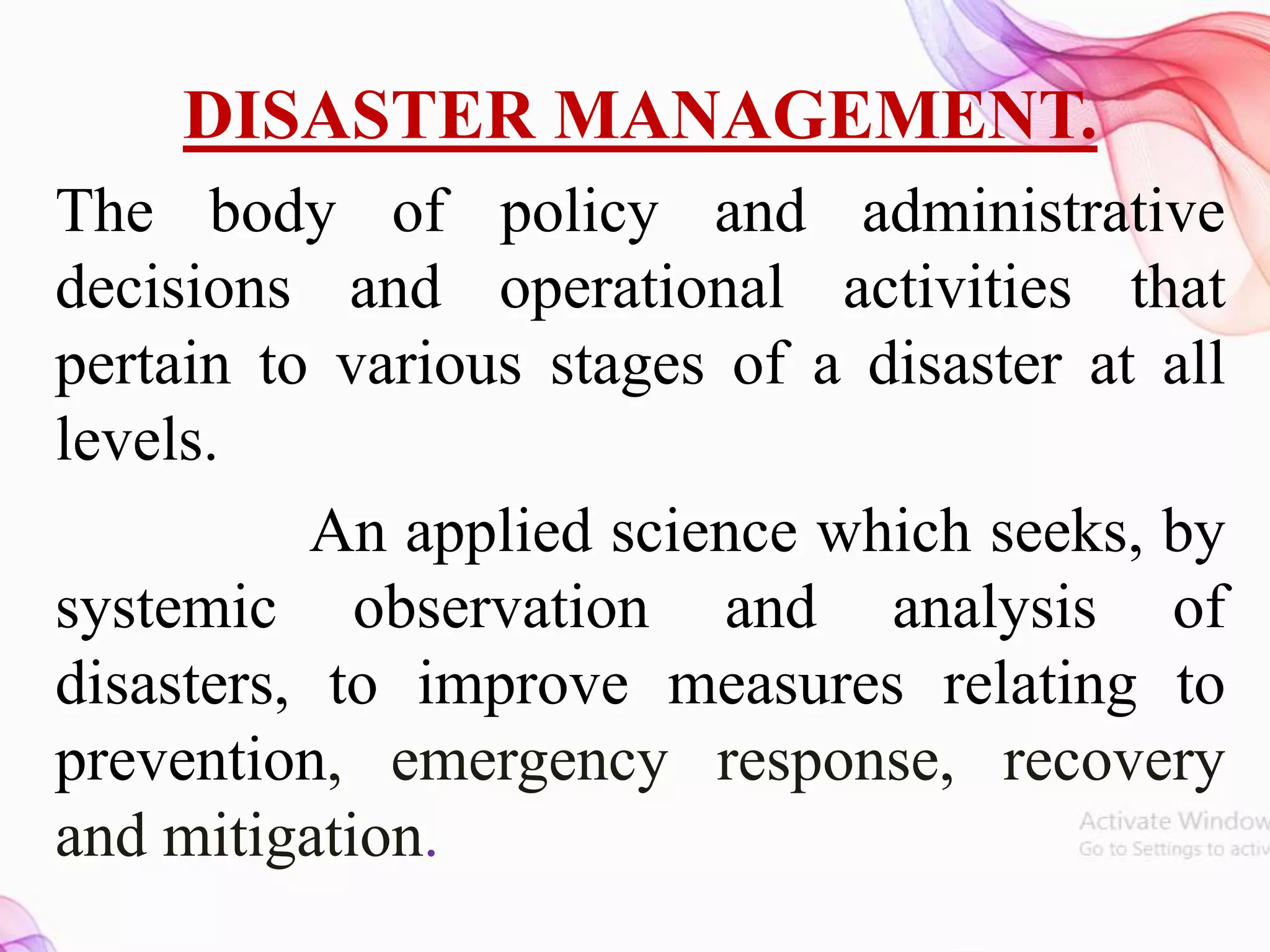
DISASTER MANAGEMENT.
The body of policy and administrative
decisions and operational activities that
pertain to various stages of a disaster at all
levels.
An applied science which seeks, by
systemic observation and analysis of
disasters, to improve measures relating to
prevention, emergency response, recovery
and mitigation.
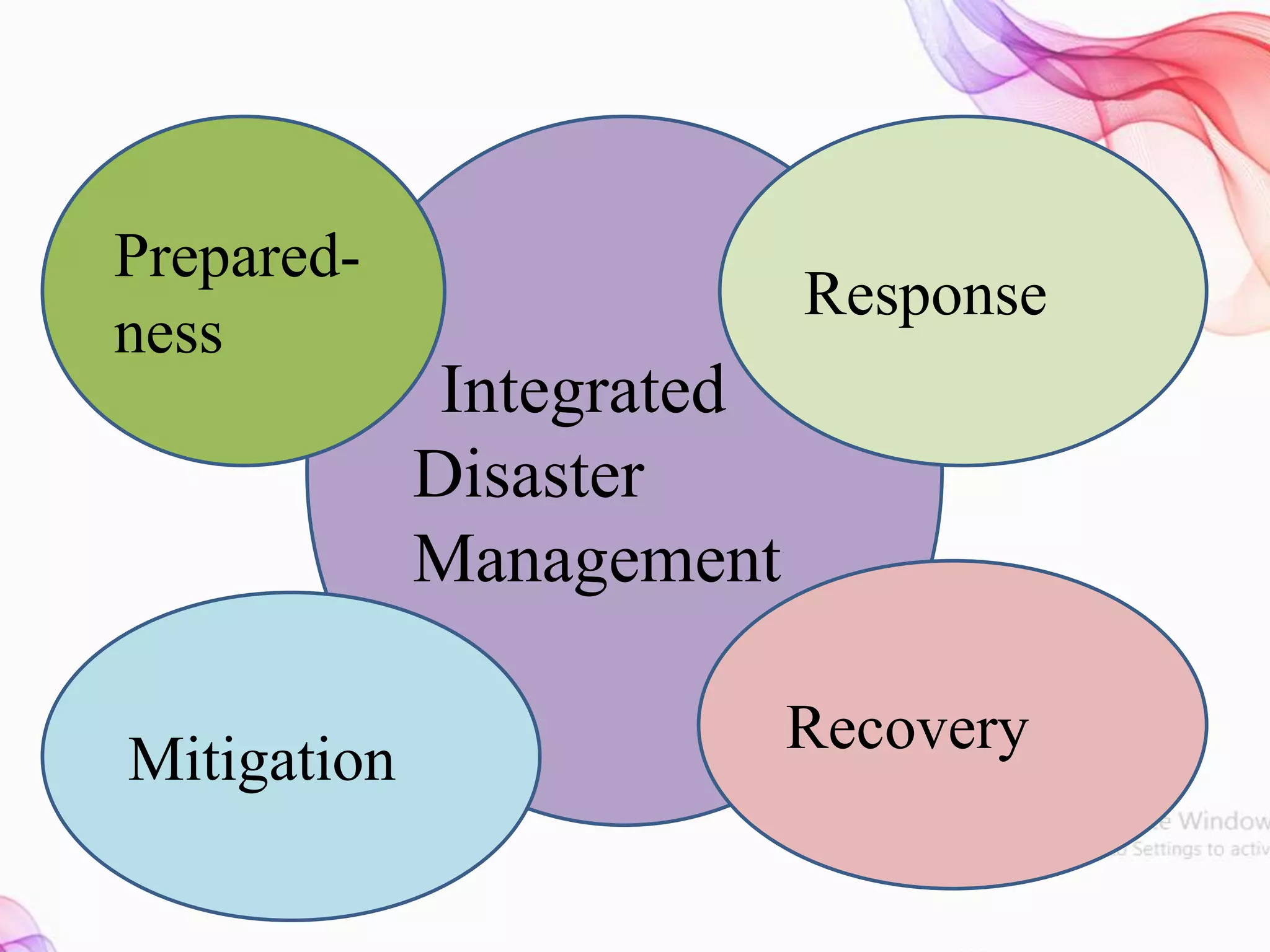
Integrated
Disaster
Management
Response
Recovery
Prepared-
ness
Mitigation
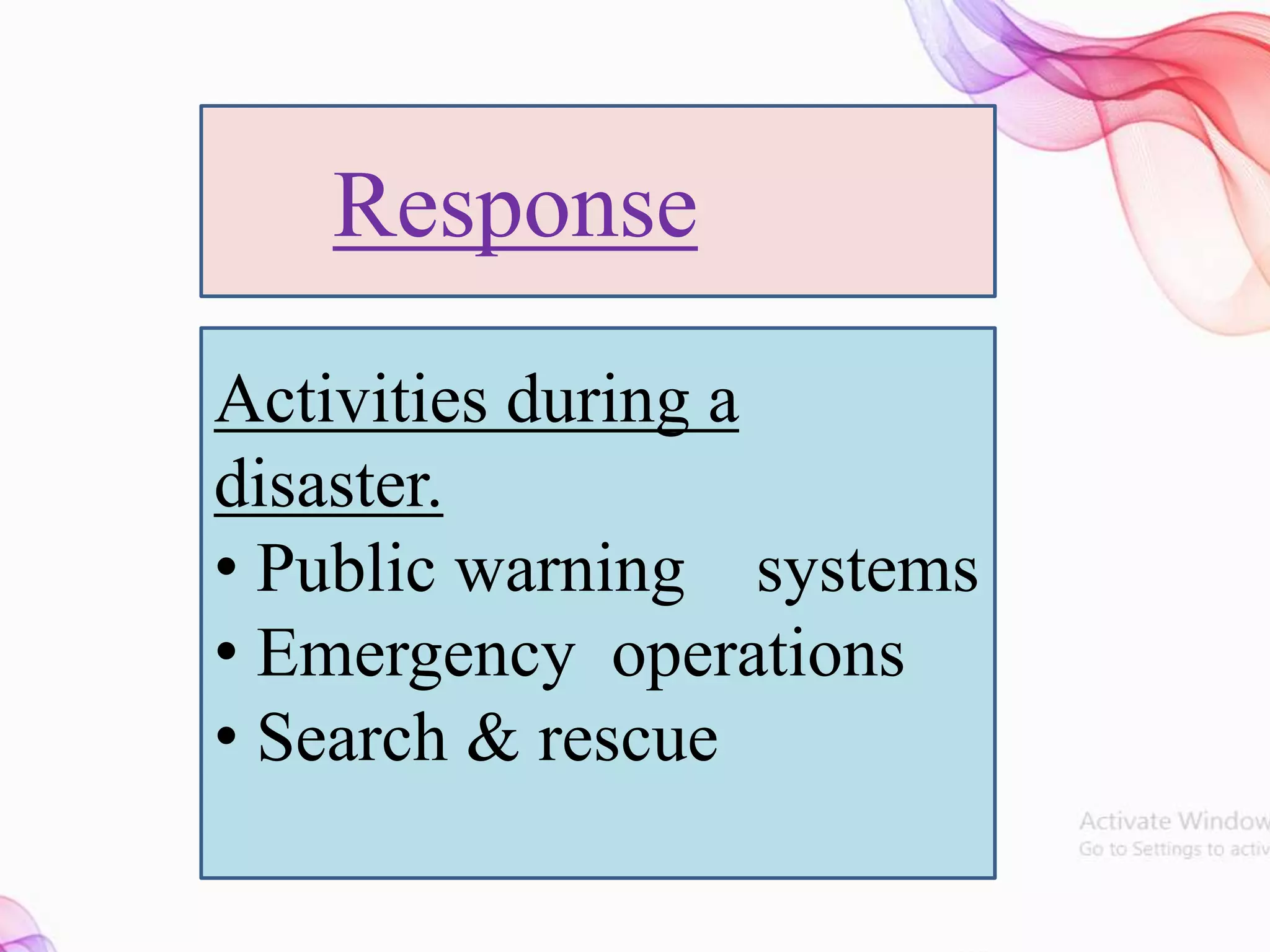
Response
Activities during a
disaster.
• Public warning systems
• Emergency operations
• Search & rescue
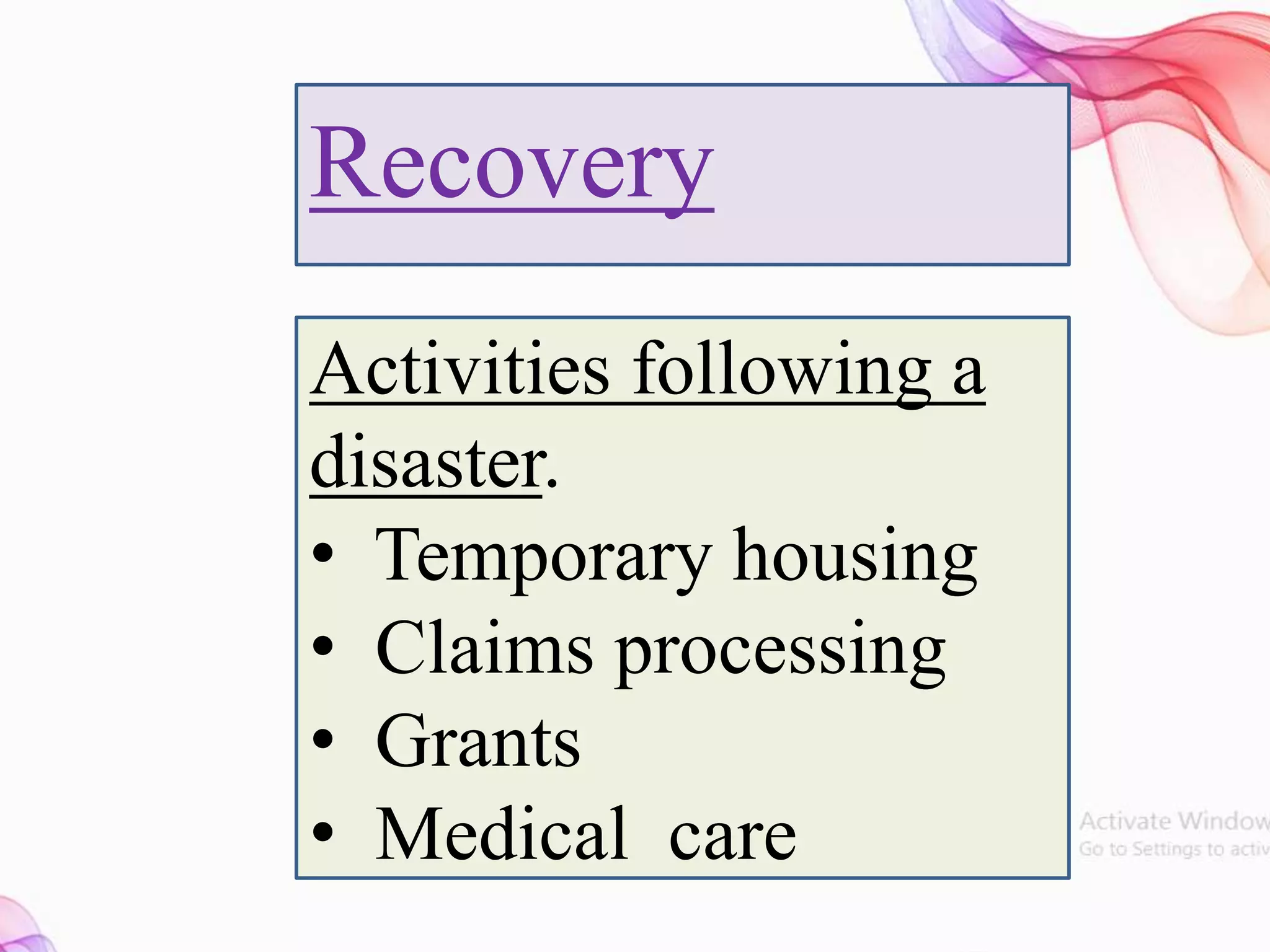
Recovery
Activities following a
disaster.
• Temporary housing
• Claims processing
• Grants
• Medical care
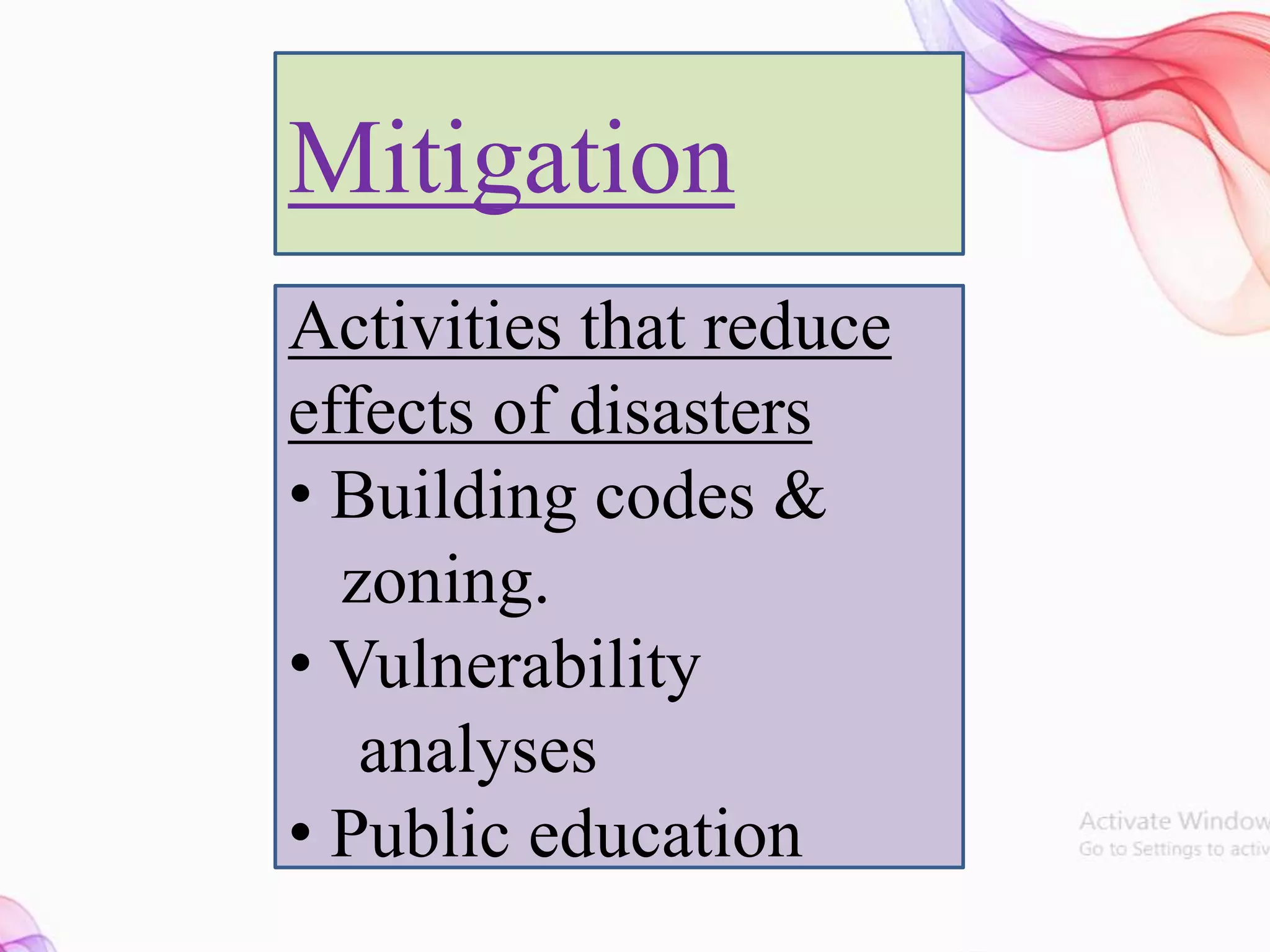
Mitigation
Activities that reduce
effects of disasters
• Building codes &
zoning.
• Vulnerability
analyses
• Public education
Prepared-ness
Activities prior to a
disaster.
• Preparedness plans
• Emergency exercises
• Training,
• Warning systems
PHASES OF DISASTER
MANAGEMENT.
Disaster Preparedness
Disaster Impact
Disaster Response
Disaster Recovery
Disaster Mitigation
Disaster preparedness - is ongoing
multisectoral activity.
Integral part of the national system responsible
for developing plans and programmes for
disaster management,
prevention,
mitigation,
response,
rehabilitation and
reconstruction.
Co-ordination of a variety of sectors to carry out-
 Evaluation of the risk.
 Adopt standards and regulations.
 Organize communication and response mechanism.
 Ensure all resources- ready and easily mobilized.
 Develop public education programmes.
 Coordinate information with news media.
 Disaster simulation exercises.
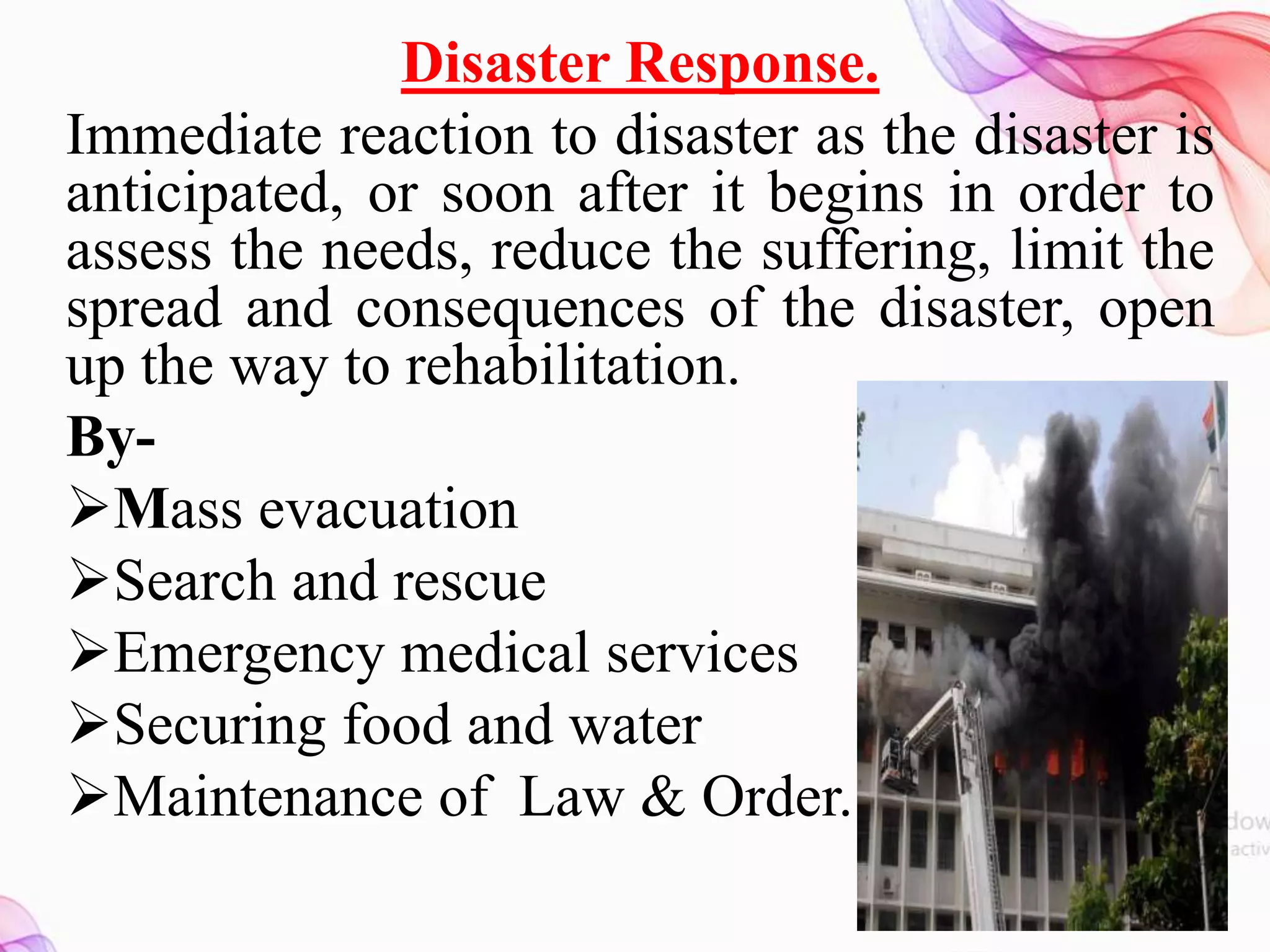
Disaster Response.
Immediate reaction to disaster as the disaster is
anticipated, or soon after it begins in order to
assess the needs, reduce the suffering, limit the
spread and consequences of the disaster, open
up the way to rehabilitation.
By-
Mass evacuation
Search and rescue
Emergency medical services
Securing food and water
Maintenance of Law & Order.
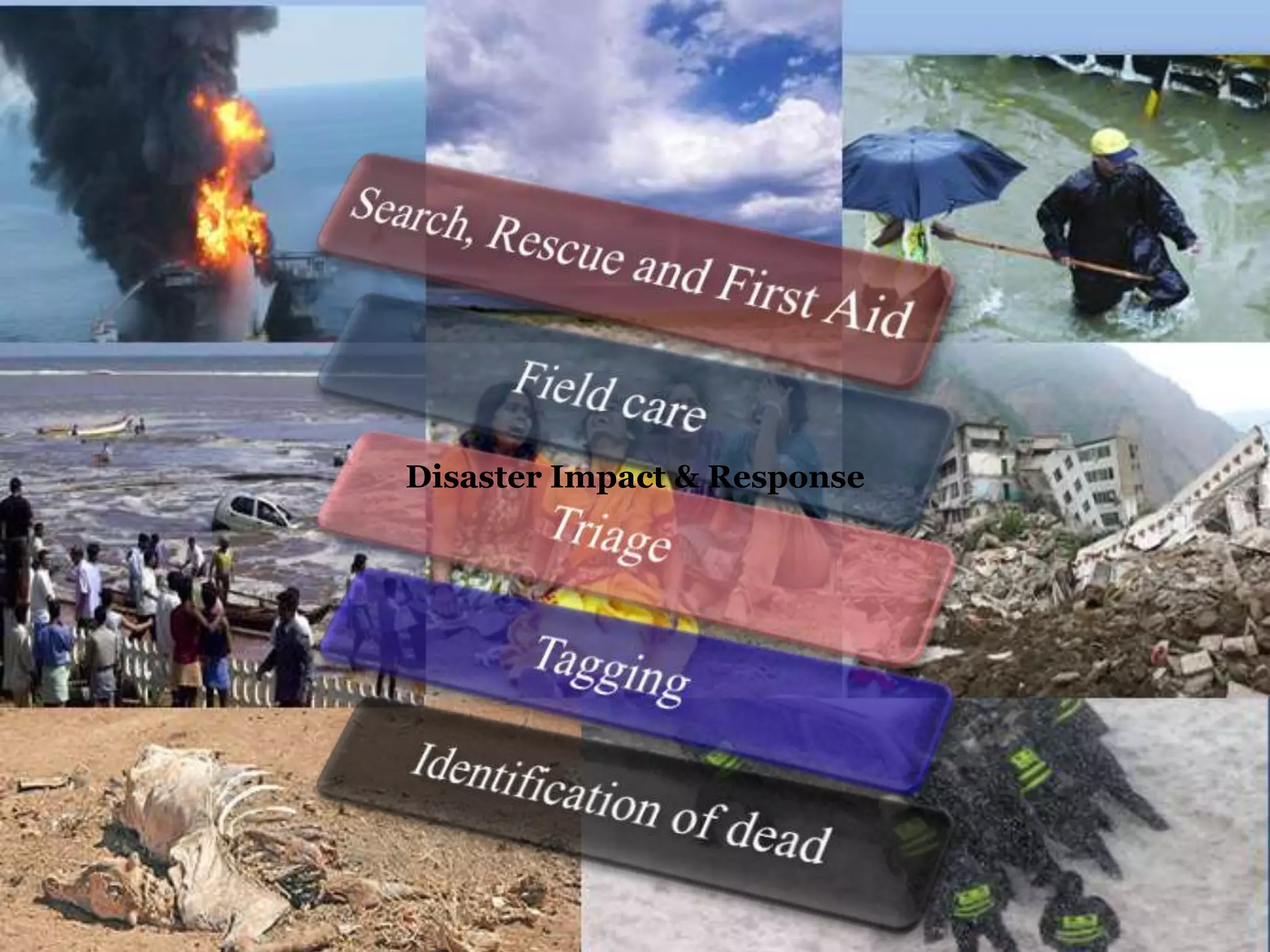
Disaster Impact & Response
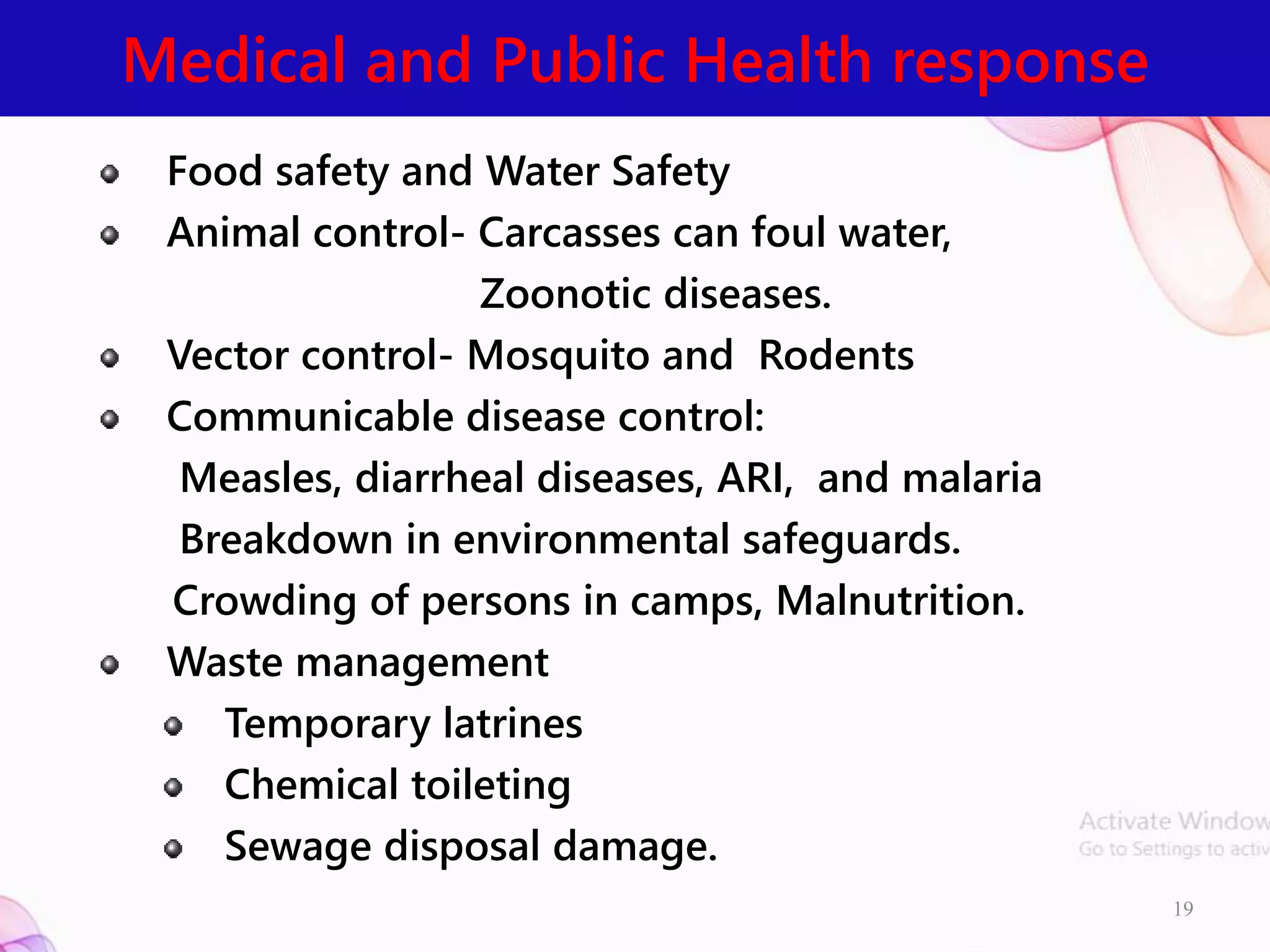
Medical and Public Health response
19
Food safety and Water Safety
Animal control- Carcasses can foul water,
Zoonotic diseases.
Vector control- Mosquito and Rodents
Communicable disease control:
Measles, diarrheal diseases, ARI, and malaria
Breakdown in environmental safeguards.
Crowding of persons in camps, Malnutrition.
Waste management
Temporary latrines
Chemical toileting
Sewage disposal damage.
Factors which may affect reactions
Disaster Related Factors
• Lack of warning
• Scope of the event
• Abrupt contrast of scene
• Personal loss or injury
• Type of disaster
• Traumatic stimuli
• Nature of the destructive
agent
• Human error
• Time of occurrence
• Lack of opportunity for
effective action
• Environment (temperature,
humidity, pollution…)
Host Related Factors
• Health
• Disabled, Invalid
• Medical problems
• Social
• Lack of support network-
Divorced, Widowed
• Cultural: language barriers
• Demographic
• Age: younger and older have
more difficulties
• Sex: more stress in women, but
more resilient
• Past History
• Traumatic events
• Mental illness or emotional
problems
20
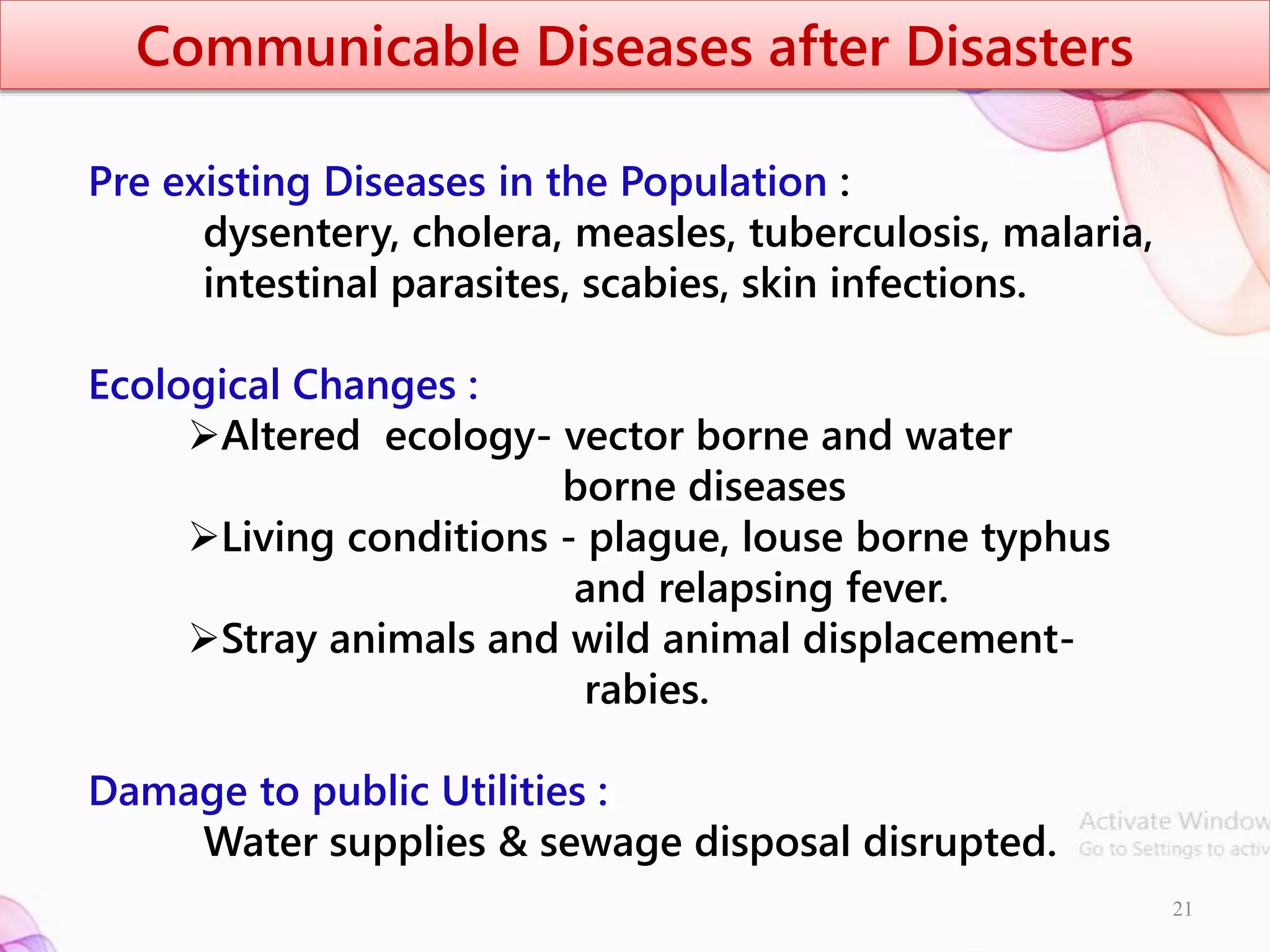
Communicable Diseases after Disasters
Pre existing Diseases in the Population :
dysentery, cholera, measles, tuberculosis, malaria,
intestinal parasites, scabies, skin infections.
Ecological Changes :
Altered ecology- vector borne and water
borne diseases
Living conditions - plague, louse borne typhus
and relapsing fever.
Stray animals and wild animal displacement-
rabies.
Damage to public Utilities :
Water supplies & sewage disposal disrupted.
21
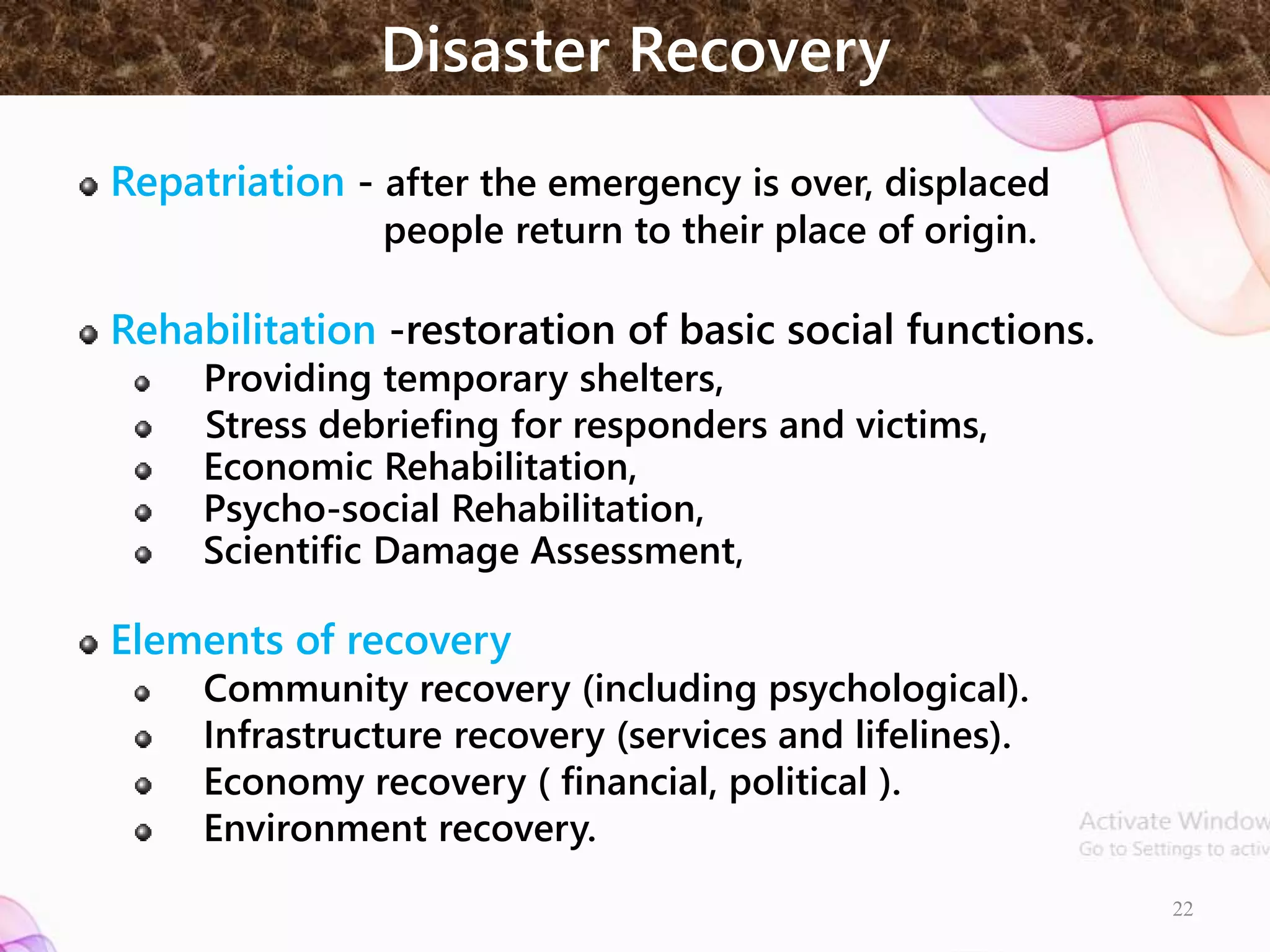
Disaster Recovery
Repatriation - after the emergency is over, displaced
people return to their place of origin.
Rehabilitation -restoration of basic social functions.
Providing temporary shelters,
Stress debriefing for responders and victims,
Economic Rehabilitation,
Psycho-social Rehabilitation,
Scientific Damage Assessment,
Elements of recovery
Community recovery (including psychological).
Infrastructure recovery (services and lifelines).
Economy recovery ( financial, political ).
Environment recovery.
22
Permanent reduction of risk of a disaster,
to limit impact on human suffering and economic
assets.
Primary mitigation - reducing hazard &
vulnerability.
Secondary mitigation- reducing effects of hazard.
Components:
Reducing hazard - protection against threat by
removing the cause of threat.
Reducing vulnerability - reducing the effect of
threat
Natural hazards are inevitable, reduce vulnerability.
23
Disaster Mitigation
24
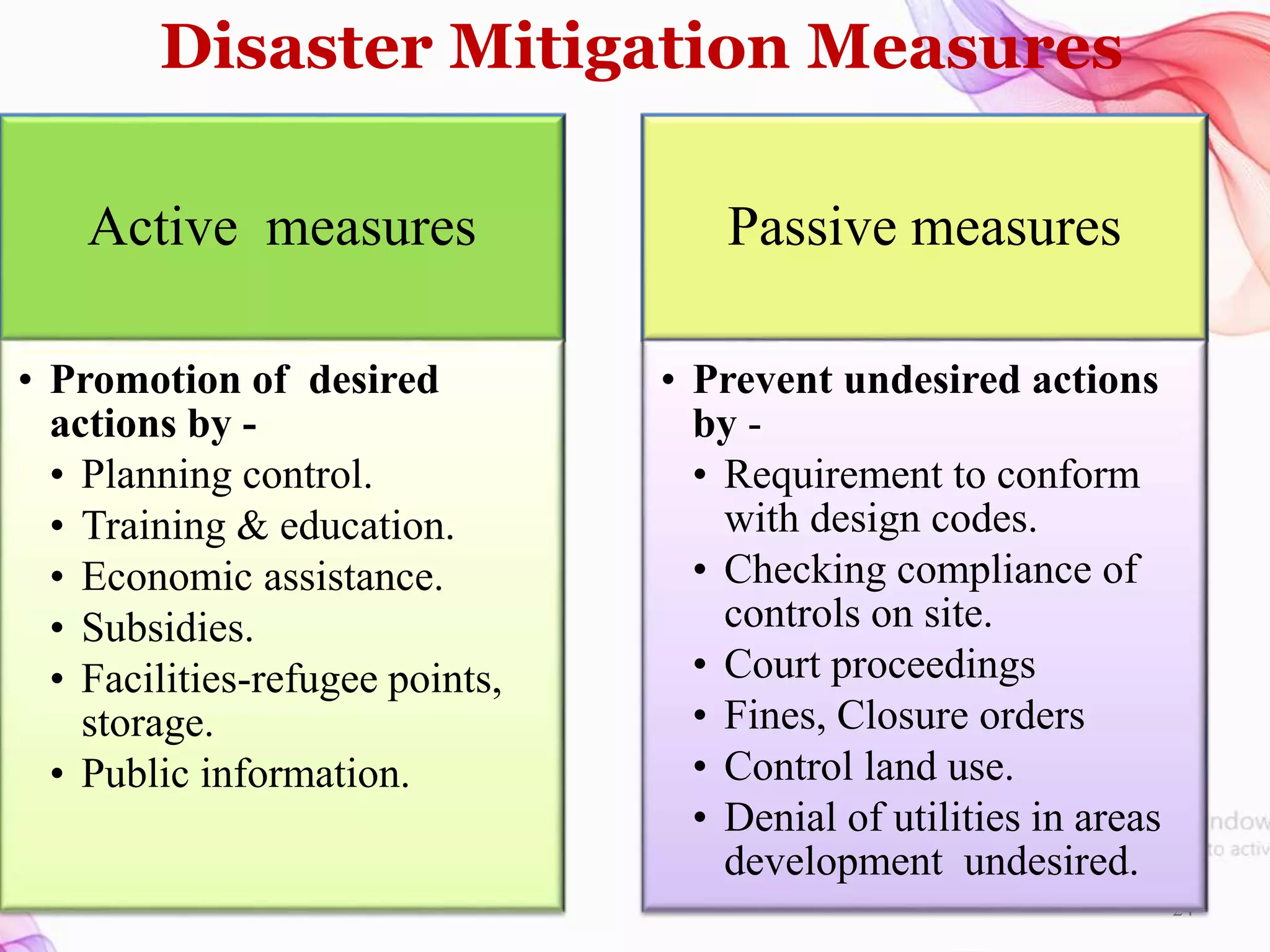
Active measures
• Promotion of desired
actions by -
• Planning control.
• Training & education.
• Economic assistance.
• Subsidies.
• Facilities-refugee points,
storage.
• Public information.
Passive measures
• Prevent undesired actions
by -
• Requirement to conform
with design codes.
• Checking compliance of
controls on site.
• Court proceedings
• Fines, Closure orders
• Control land use.
• Denial of utilities in areas
development undesired.
Disaster Mitigation Measures
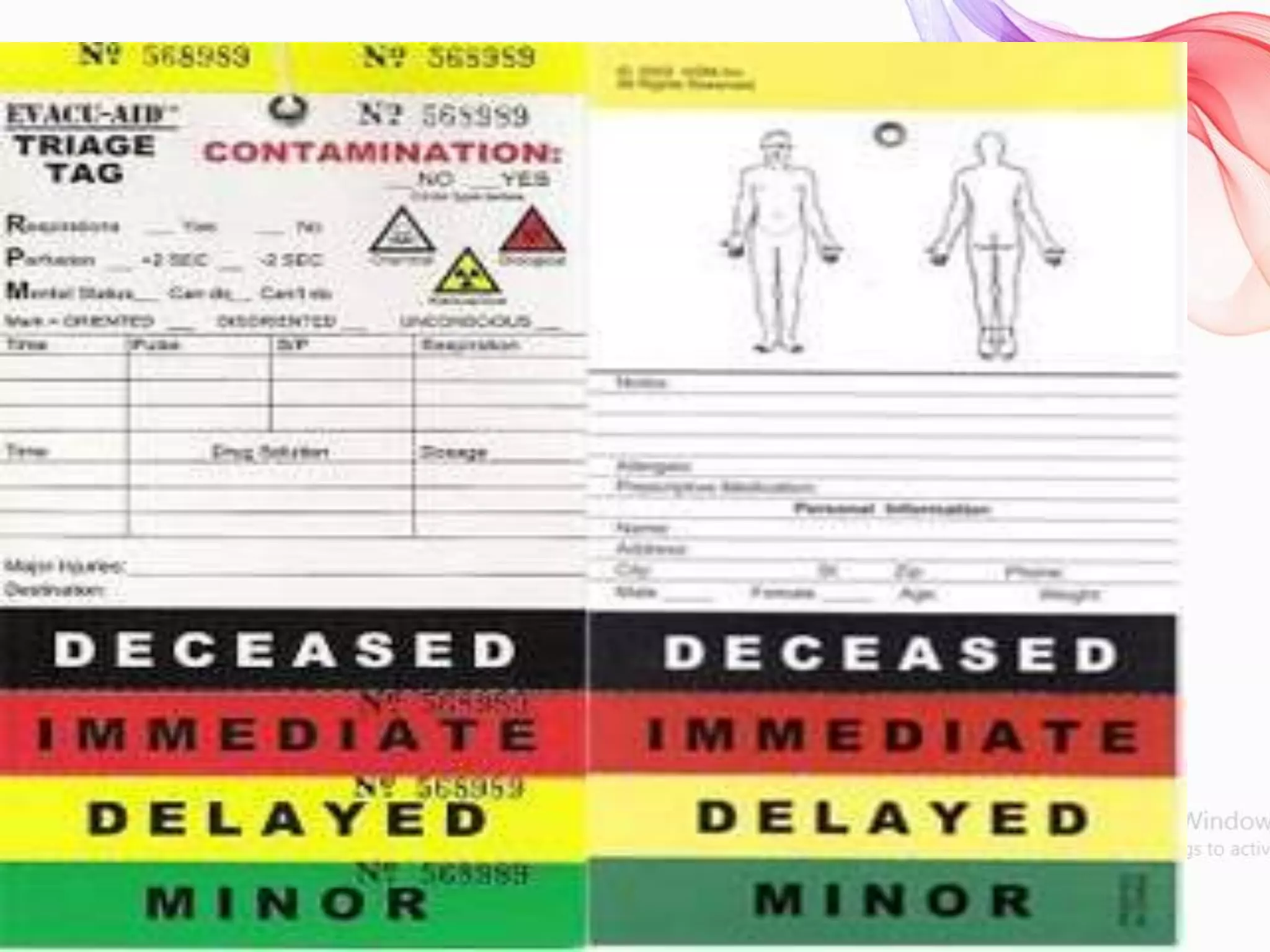
Triage.
•Golden hour
•Immediate or high priority:
•Delayed or medium priority:
•Minor or minimal or
ambulatory patients:
•Expectant or least priority:
•Colour code:
ROLE OF NURSE IN DISASTER
MANAGEMENT

Disaster that Define, Cause, Types, preparedness PPT V us in ANP.

  • 1.
  • 2.
    Introduction •Disasters are asold as Mankind. • The first description of Disaster and its management comes from mythological “Noah” and his ark. • Similar Flood tales are widespread in- Greek Mythology, Purina, Mesopotamian stories, and many cultures.
  • 3.
    Etymology Originated from Greek dus= bad aster = star Calamity due to position of a planet or a star. Then evolved in Italian as disastro, To become French désastre .
  • 4.
    DEFINITION Any occurrence thatcauses damage, ecological disruption, loss of human life, deterioration of health and health services on a scale, sufficient to warrant an extraordinary response from outside the affected community or area. (WHO) A disaster can be defined as an occurrence either nature or man made that causes human suffering and creates human needs that victim cannot alleviate without assistance. (American Red Cross)
  • 5.
    C L AS S I F I C AT I O N O F D I S A S T E R S . Natural Disasters Meteoro logical Topogra phical Environ mental Man made Disasters Technological Industrial Warfare
  • 6.
    Meteorological Disasters •Floods •Tsunami •Cyclone •Hurricane •Typhoon •Snow storm •Blizzard •Hail storm Topographical Disasters •Earthquake •Volcanic Eruptions •Landslidesand Avalanches •Asteroids •Limnic eruptions Environmental Disasters •Global warming •El Niño- Southern Oscillation •Ozone depletion- UVB Radiation •Solar flare
  • 7.
    Technological Industrial Warfare •Transport failure •Publicplace failure •Fire •Chemical spills •Radioactive spills •War •Terrorism •Internal conflicts •Civil unrest •CBRNE
  • 8.
    DISASTER MANAGEMENT. The bodyof policy and administrative decisions and operational activities that pertain to various stages of a disaster at all levels. An applied science which seeks, by systemic observation and analysis of disasters, to improve measures relating to prevention, emergency response, recovery and mitigation.
  • 9.
  • 10.
    Response Activities during a disaster. •Public warning systems • Emergency operations • Search & rescue
  • 11.
    Recovery Activities following a disaster. •Temporary housing • Claims processing • Grants • Medical care
  • 12.
    Mitigation Activities that reduce effectsof disasters • Building codes & zoning. • Vulnerability analyses • Public education
  • 13.
    Prepared-ness Activities prior toa disaster. • Preparedness plans • Emergency exercises • Training, • Warning systems
  • 14.
    PHASES OF DISASTER MANAGEMENT. DisasterPreparedness Disaster Impact Disaster Response Disaster Recovery Disaster Mitigation
  • 15.
    Disaster preparedness -is ongoing multisectoral activity. Integral part of the national system responsible for developing plans and programmes for disaster management, prevention, mitigation, response, rehabilitation and reconstruction.
  • 16.
    Co-ordination of avariety of sectors to carry out-  Evaluation of the risk.  Adopt standards and regulations.  Organize communication and response mechanism.  Ensure all resources- ready and easily mobilized.  Develop public education programmes.  Coordinate information with news media.  Disaster simulation exercises.
  • 17.
    Disaster Response. Immediate reactionto disaster as the disaster is anticipated, or soon after it begins in order to assess the needs, reduce the suffering, limit the spread and consequences of the disaster, open up the way to rehabilitation. By- Mass evacuation Search and rescue Emergency medical services Securing food and water Maintenance of Law & Order.
  • 18.
  • 19.
    Medical and PublicHealth response 19 Food safety and Water Safety Animal control- Carcasses can foul water, Zoonotic diseases. Vector control- Mosquito and Rodents Communicable disease control: Measles, diarrheal diseases, ARI, and malaria Breakdown in environmental safeguards. Crowding of persons in camps, Malnutrition. Waste management Temporary latrines Chemical toileting Sewage disposal damage.
  • 20.
    Factors which mayaffect reactions Disaster Related Factors • Lack of warning • Scope of the event • Abrupt contrast of scene • Personal loss or injury • Type of disaster • Traumatic stimuli • Nature of the destructive agent • Human error • Time of occurrence • Lack of opportunity for effective action • Environment (temperature, humidity, pollution…) Host Related Factors • Health • Disabled, Invalid • Medical problems • Social • Lack of support network- Divorced, Widowed • Cultural: language barriers • Demographic • Age: younger and older have more difficulties • Sex: more stress in women, but more resilient • Past History • Traumatic events • Mental illness or emotional problems 20
  • 21.
    Communicable Diseases afterDisasters Pre existing Diseases in the Population : dysentery, cholera, measles, tuberculosis, malaria, intestinal parasites, scabies, skin infections. Ecological Changes : Altered ecology- vector borne and water borne diseases Living conditions - plague, louse borne typhus and relapsing fever. Stray animals and wild animal displacement- rabies. Damage to public Utilities : Water supplies & sewage disposal disrupted. 21
  • 22.
    Disaster Recovery Repatriation -after the emergency is over, displaced people return to their place of origin. Rehabilitation -restoration of basic social functions. Providing temporary shelters, Stress debriefing for responders and victims, Economic Rehabilitation, Psycho-social Rehabilitation, Scientific Damage Assessment, Elements of recovery Community recovery (including psychological). Infrastructure recovery (services and lifelines). Economy recovery ( financial, political ). Environment recovery. 22
  • 23.
    Permanent reduction ofrisk of a disaster, to limit impact on human suffering and economic assets. Primary mitigation - reducing hazard & vulnerability. Secondary mitigation- reducing effects of hazard. Components: Reducing hazard - protection against threat by removing the cause of threat. Reducing vulnerability - reducing the effect of threat Natural hazards are inevitable, reduce vulnerability. 23 Disaster Mitigation
  • 24.
    24 Active measures • Promotionof desired actions by - • Planning control. • Training & education. • Economic assistance. • Subsidies. • Facilities-refugee points, storage. • Public information. Passive measures • Prevent undesired actions by - • Requirement to conform with design codes. • Checking compliance of controls on site. • Court proceedings • Fines, Closure orders • Control land use. • Denial of utilities in areas development undesired. Disaster Mitigation Measures
  • 25.
    Triage. •Golden hour •Immediate orhigh priority: •Delayed or medium priority: •Minor or minimal or ambulatory patients: •Expectant or least priority: •Colour code:
  • 27.
    ROLE OF NURSEIN DISASTER MANAGEMENT