Definition
2
Disaster -
Any occurrence that causes
damage, ecological disruption,
loss of human life,
deterioration of health and health services
on a scale, sufficient to warrant an extraordinary
response from outside the affected community or
area.(WHO)
A disaster can be defined as an occurrence
either nature or man made that causes human
suffering and creates human needs that victim cannot
alleviate without assistance.
(American Red Cross)
C l a s s i f i c a t i o n o f D i s a s t e r s
Natural
Disasters
Meteorological
T
opographical
Environmental
Man made
Disasters
T
echnological
Industrial
Warfare
3
Meteorological
Disasters
• Floods
• Tsunami
• Cyclone
• Hurricane
• Typhoon
• Snow storm
• Hail storm
T
opographical
Disasters
• Earthquake
• Volcanic
Eruptions
• Landslides
• Asteroids
• Limnic
eruptions
Environmental
Disasters
• Global
warming
• Ozone
depletion-
UVB
Radiation
• Solar flare
4
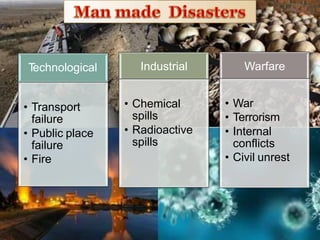
T
echnological
• Transport
failure
• Public place
failure
• Fire
Industrial
• Chemical
spills
• Radioactive
spills
Warfare
• War
• Terrorism
• Internal
conflicts
• Civil unrest
5
Disaster Management
6
The body of policy and administrative decisions and
operational activities that pertain to various stages of a
disaster at all levels.
An applied science which seeks, by systemic
observation and analysis of disasters, to improve
measures relating to prevention, emergency
response, recovery and mitigation.
Including all aspects of planning for, and
responding to disasters, including both pre and post
disaster activities.
Disaster Management
7
A continuous and integrated process of
planning, organizing, coordinating and implementing
measures which are necessary or expedient for-
● Prevention of danger or threat of any disaster.
● Reduction of risk of any disaster or its severity or
consequences.
● Capacity-building.
● Preparedness to deal with any disaster.
● Prompt response to any threatening disaster situation
or disaster.
● Assessing the severity or magnitude of effects of any
disaster.
● Evacuation, rescue and relief.
● Rehabilitation and reconstruction.
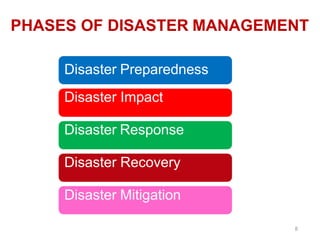
PHASES OF DISASTER MANAGEMENT
Disaster Preparedness
Disaster Impact
Disaster Response
Disaster Recovery
Disaster Mitigation
8
Disaster Preparedness
9
Disaster preparedness - is ongoing multisectoral activity.
Integral part of the national system responsible for
developing plans and programmes for
disaster management,
prevention,
mitigation,
response,
rehabilitation and
reconstruction.
Disaster Preparedness
10
Co-ordination of a variety of sectors to carry out-
 Evaluation of the risk.
 Adopt standards and regulations.
 Organize communication and response mechanism.
 Ensure all resources- ready and easily mobilized.
 Develop public education programmes.
 Coordinate information with news media.
 Disaster simulation exercises.
Medical Preparedness &
Mass Casualty Management
Developing and capacity building of medical team for
Trauma & psycho-social care,
Mass casualty management and Triage.
Determine casualty handling capacity of all hospitals.
Formulate appropriate treatment procedures.
Involvement of private hospitals.
Mark would be care centers that can function as a
medical units.
Identify structural integrity and approach routes.
11
Disaster Response
Immediate reaction to disaster as the disaster is
anticipated, or soon after it begins in order to assess the
needs, reduce the suffering, spread and
of the disaster,
limit
open
the
up the way to
consequences
rehabilitation.
By-
 Mass evacuation
 Search and rescue
 Emergency medical services
 Securing food and water
 Maintenance of Law & Order
12
Disaster Impact & Response
13
Medical and Public Health response
14
• Pre-hospital emergency services -
 Linkage to govt. incident command system.
 External medical services and extrication workers.
 Search and Rescue teams.
•Assessment of immediate health needs.
• Identification of medical & health resources.
• Temporary field treatment
Prompt and proper treatment to save lives.
Medical and Public Health response
Food safety and Water Safety
Animal control- Carcasses can foul water,
Zoonotic diseases.
Vector control- Mosquito and Rodents
Communicable disease control:
Measles, diarrheal diseases, and malaria
Breakdown in environmental safeguards.
Crowding of persons in camps, Malnutrition.
Waste management
Temporary latrines
Chemical toileting
Sewage disposal damage.
16
Medical and Public Health response
Management of hazardous agent exposure
Particular matter
Also Infectious agents if hospital or scientific
laboratories damaged
Mental health
Specialized psychological triage and treatment
significant in terrorism.
Information
Behavioral Contagion handling
Risk communication
17
Consequences of Disaster
Health -
Physical – Entanglement, Injuries, Disabilities,
Coma ,Death.
Psychological- Cognitive, Behavioral, Social.
Structural Damage – to variable extent.
Ecological- Changes in eco system.
Economical-Financial losses.
18
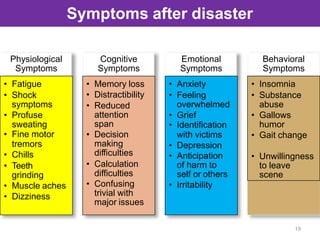
Symptoms after disaster
Physiological
Symptoms
• Fatigue
• Shock
symptoms
• Profuse
sweating
• Fine motor
tremors
• Chills
• Teeth
grinding
• Muscle aches
• Dizziness
Cognitive
Symptoms
• Memory loss
• Distractibility
• Reduced
attention
span
• Decision
making
difficulties
• Calculation
difficulties
• Confusing
trivial with
major issues
Emotional
Symptoms
• Anxiety
• Feeling
overwhelmed
• Grief
• Identification
with victims
• Depression
• Anticipation
of harm to
self or others
• Irritability
Behavioral
Symptoms
• Insomnia
• Substance
abuse
• Gallows
humor
• Gait change
• Unwillingness
to leave
scene
19
Communicable Diseases after Disasters
20
Pre existing Diseases in the Population :
dysentery, cholera, measles, tuberculosis, malaria,
intestinal parasites, scabies, skin infections.
Ecological Changes :
Altered ecology- vector borne and water
borne diseases
Living conditions - plague, louse borne typhus
and relapsing fever.
Stray animals and wild animal displacement-
rabies.
Damage to public Utilities :
Water supplies & sewage disposal disrupted.
Communicable Diseases after Disasters
21
Population Movements :
 Introduction of new disease or vector.
 In settlements - diarrheal diseases , measles, viral
hepatitis, whooping cough, malaria etc.
Interruption in Public Health Services :
Disruption of curative and preventive services.
Interrupted vector control - malaria, dengue
Interrupted immunization - measles, whooping
cough, and diphtheria.
Altered Individual Resistance to diseases :
Malnutrition increases susceptibility to diseases .
Diseases after Man Made Disasters
22
 Will depend upon particular exposure type.
 Symptoms and diseases differ widely.
 Spectrum may range from simple non fatal injuries to
chromosomal defects.
 Again technology that is capable of producing mass
destruction weapons and developments in bio-
technology leading to invention of deadly bio-attack
organisms ,is of ever growing concern for world .
Other Public Health Impacts of Disasters
Sexual violence
Rape, Exploitation & Sexual violence
Causes: Separation of women from family
Weakened social structures
Increased aggressive behavior
Human right violations
Torture of civilian
Physical and psychological harms
Sex trafficking
Child labour
Denial of basic needs
23
Mental Health Impact of Disasters
Post traumatic stress disorder
Stage one- Adrenergic surge.
Stage two- Helplessness and a loss of self-control.
Stage three - Despondency and demoralization.
Children -Developmental age is more important
Preschoolers- Increased arousal, fear.
School-age children- reckless ,psychosomatic signs.
Adolescents- some partake in rescue and recovery,
regression & withdrawal possible.
Elderly - increased risk for physical injury, than mental.
24
Rescue workers in Disaster
Secondary victims of a disaster.
Stress reactions seen in non-professionals.
More emotional trauma if involved in a failed rescue
attempts (especially if children are involved).
Inexperienced body handlers become more sensitive.
19 August is observed as World Humanitarian Day in
honour of aid workers, who lost their lives.
25
Reconstruction
Rebuilding homes.
Permanently repairing and rebuilding infrastructures.
Elements -
Owner Driven Reconstruction.
Speedy Reconstruction.
Linking Reconstruction with Safe Development.
26
Areas of Concern
27
 Activating an Early Warning System network and its
close monitoring.
 Mechanisms for integrating the scientific, technological
and administrative agencies for effective disaster
management.
 Terrestrial communication links which collapse in the
event of a rapid onset disaster.
 Vulnerability of critical infrastructures (power supply,
communication, water supply, transport, etc.) to disaster
events
Areas of Concern
28
 Funding : Primacy of relief as disaster response.
 Preparedness and Mitigation very often ignored.
 Lack of integrated efforts to collect and compile data,
information and local knowledge on disaster history and
traditional response patterns.
 Need for standardized efforts in compiling and
interpreting geo-spatial data, satellite imagery and early
warning signals.
 Weak areas - continue to be forecasting, modeling, risk
prediction, simulation and scenario analysis, etc.
Areas of Concern
29
 Absence of a national level, state level, and district level
directory of experts and inventory of resources.
 Lack of properly structured of National Disaster Management
Plan, and State level and district level disaster management
plans.
 Sustainability of efforts
 Effective Inter Agency Co-ordination and Standard Operating
Procedures for stakeholder groups, especially critical first
responder agencies.
 Lack of emergency medicine, critical care medicine, first aid
facilities.
30

disaster management and disaster control.pptx

  • 2.
    Definition 2 Disaster - Any occurrencethat causes damage, ecological disruption, loss of human life, deterioration of health and health services on a scale, sufficient to warrant an extraordinary response from outside the affected community or area.(WHO) A disaster can be defined as an occurrence either nature or man made that causes human suffering and creates human needs that victim cannot alleviate without assistance. (American Red Cross)
  • 3.
    C l as s i f i c a t i o n o f D i s a s t e r s Natural Disasters Meteorological T opographical Environmental Man made Disasters T echnological Industrial Warfare 3
  • 4.
    Meteorological Disasters • Floods • Tsunami •Cyclone • Hurricane • Typhoon • Snow storm • Hail storm T opographical Disasters • Earthquake • Volcanic Eruptions • Landslides • Asteroids • Limnic eruptions Environmental Disasters • Global warming • Ozone depletion- UVB Radiation • Solar flare 4
  • 5.
    T echnological • Transport failure • Publicplace failure • Fire Industrial • Chemical spills • Radioactive spills Warfare • War • Terrorism • Internal conflicts • Civil unrest 5
  • 6.
    Disaster Management 6 The bodyof policy and administrative decisions and operational activities that pertain to various stages of a disaster at all levels. An applied science which seeks, by systemic observation and analysis of disasters, to improve measures relating to prevention, emergency response, recovery and mitigation. Including all aspects of planning for, and responding to disasters, including both pre and post disaster activities.
  • 7.
    Disaster Management 7 A continuousand integrated process of planning, organizing, coordinating and implementing measures which are necessary or expedient for- ● Prevention of danger or threat of any disaster. ● Reduction of risk of any disaster or its severity or consequences. ● Capacity-building. ● Preparedness to deal with any disaster. ● Prompt response to any threatening disaster situation or disaster. ● Assessing the severity or magnitude of effects of any disaster. ● Evacuation, rescue and relief. ● Rehabilitation and reconstruction.
  • 8.
    PHASES OF DISASTERMANAGEMENT Disaster Preparedness Disaster Impact Disaster Response Disaster Recovery Disaster Mitigation 8
  • 9.
    Disaster Preparedness 9 Disaster preparedness- is ongoing multisectoral activity. Integral part of the national system responsible for developing plans and programmes for disaster management, prevention, mitigation, response, rehabilitation and reconstruction.
  • 10.
    Disaster Preparedness 10 Co-ordination ofa variety of sectors to carry out-  Evaluation of the risk.  Adopt standards and regulations.  Organize communication and response mechanism.  Ensure all resources- ready and easily mobilized.  Develop public education programmes.  Coordinate information with news media.  Disaster simulation exercises.
  • 11.
    Medical Preparedness & MassCasualty Management Developing and capacity building of medical team for Trauma & psycho-social care, Mass casualty management and Triage. Determine casualty handling capacity of all hospitals. Formulate appropriate treatment procedures. Involvement of private hospitals. Mark would be care centers that can function as a medical units. Identify structural integrity and approach routes. 11
  • 12.
    Disaster Response Immediate reactionto disaster as the disaster is anticipated, or soon after it begins in order to assess the needs, reduce the suffering, spread and of the disaster, limit open the up the way to consequences rehabilitation. By-  Mass evacuation  Search and rescue  Emergency medical services  Securing food and water  Maintenance of Law & Order 12
  • 13.
    Disaster Impact &Response 13
  • 14.
    Medical and PublicHealth response 14 • Pre-hospital emergency services -  Linkage to govt. incident command system.  External medical services and extrication workers.  Search and Rescue teams. •Assessment of immediate health needs. • Identification of medical & health resources. • Temporary field treatment Prompt and proper treatment to save lives.
  • 16.
    Medical and PublicHealth response Food safety and Water Safety Animal control- Carcasses can foul water, Zoonotic diseases. Vector control- Mosquito and Rodents Communicable disease control: Measles, diarrheal diseases, and malaria Breakdown in environmental safeguards. Crowding of persons in camps, Malnutrition. Waste management Temporary latrines Chemical toileting Sewage disposal damage. 16
  • 17.
    Medical and PublicHealth response Management of hazardous agent exposure Particular matter Also Infectious agents if hospital or scientific laboratories damaged Mental health Specialized psychological triage and treatment significant in terrorism. Information Behavioral Contagion handling Risk communication 17
  • 18.
    Consequences of Disaster Health- Physical – Entanglement, Injuries, Disabilities, Coma ,Death. Psychological- Cognitive, Behavioral, Social. Structural Damage – to variable extent. Ecological- Changes in eco system. Economical-Financial losses. 18
  • 19.
    Symptoms after disaster Physiological Symptoms •Fatigue • Shock symptoms • Profuse sweating • Fine motor tremors • Chills • Teeth grinding • Muscle aches • Dizziness Cognitive Symptoms • Memory loss • Distractibility • Reduced attention span • Decision making difficulties • Calculation difficulties • Confusing trivial with major issues Emotional Symptoms • Anxiety • Feeling overwhelmed • Grief • Identification with victims • Depression • Anticipation of harm to self or others • Irritability Behavioral Symptoms • Insomnia • Substance abuse • Gallows humor • Gait change • Unwillingness to leave scene 19
  • 20.
    Communicable Diseases afterDisasters 20 Pre existing Diseases in the Population : dysentery, cholera, measles, tuberculosis, malaria, intestinal parasites, scabies, skin infections. Ecological Changes : Altered ecology- vector borne and water borne diseases Living conditions - plague, louse borne typhus and relapsing fever. Stray animals and wild animal displacement- rabies. Damage to public Utilities : Water supplies & sewage disposal disrupted.
  • 21.
    Communicable Diseases afterDisasters 21 Population Movements :  Introduction of new disease or vector.  In settlements - diarrheal diseases , measles, viral hepatitis, whooping cough, malaria etc. Interruption in Public Health Services : Disruption of curative and preventive services. Interrupted vector control - malaria, dengue Interrupted immunization - measles, whooping cough, and diphtheria. Altered Individual Resistance to diseases : Malnutrition increases susceptibility to diseases .
  • 22.
    Diseases after ManMade Disasters 22  Will depend upon particular exposure type.  Symptoms and diseases differ widely.  Spectrum may range from simple non fatal injuries to chromosomal defects.  Again technology that is capable of producing mass destruction weapons and developments in bio- technology leading to invention of deadly bio-attack organisms ,is of ever growing concern for world .
  • 23.
    Other Public HealthImpacts of Disasters Sexual violence Rape, Exploitation & Sexual violence Causes: Separation of women from family Weakened social structures Increased aggressive behavior Human right violations Torture of civilian Physical and psychological harms Sex trafficking Child labour Denial of basic needs 23
  • 24.
    Mental Health Impactof Disasters Post traumatic stress disorder Stage one- Adrenergic surge. Stage two- Helplessness and a loss of self-control. Stage three - Despondency and demoralization. Children -Developmental age is more important Preschoolers- Increased arousal, fear. School-age children- reckless ,psychosomatic signs. Adolescents- some partake in rescue and recovery, regression & withdrawal possible. Elderly - increased risk for physical injury, than mental. 24
  • 25.
    Rescue workers inDisaster Secondary victims of a disaster. Stress reactions seen in non-professionals. More emotional trauma if involved in a failed rescue attempts (especially if children are involved). Inexperienced body handlers become more sensitive. 19 August is observed as World Humanitarian Day in honour of aid workers, who lost their lives. 25
  • 26.
    Reconstruction Rebuilding homes. Permanently repairingand rebuilding infrastructures. Elements - Owner Driven Reconstruction. Speedy Reconstruction. Linking Reconstruction with Safe Development. 26
  • 27.
    Areas of Concern 27 Activating an Early Warning System network and its close monitoring.  Mechanisms for integrating the scientific, technological and administrative agencies for effective disaster management.  Terrestrial communication links which collapse in the event of a rapid onset disaster.  Vulnerability of critical infrastructures (power supply, communication, water supply, transport, etc.) to disaster events
  • 28.
    Areas of Concern 28 Funding : Primacy of relief as disaster response.  Preparedness and Mitigation very often ignored.  Lack of integrated efforts to collect and compile data, information and local knowledge on disaster history and traditional response patterns.  Need for standardized efforts in compiling and interpreting geo-spatial data, satellite imagery and early warning signals.  Weak areas - continue to be forecasting, modeling, risk prediction, simulation and scenario analysis, etc.
  • 29.
    Areas of Concern 29 Absence of a national level, state level, and district level directory of experts and inventory of resources.  Lack of properly structured of National Disaster Management Plan, and State level and district level disaster management plans.  Sustainability of efforts  Effective Inter Agency Co-ordination and Standard Operating Procedures for stakeholder groups, especially critical first responder agencies.  Lack of emergency medicine, critical care medicine, first aid facilities.
  • 30.