Presented By:
Ms. Ranjana Prasad
SCHOOL HEALTH PROGRAMME
CHRISTIAN TRAINING COLLEGE,
LUCKNOW
INTRODUCTION
• Schoolhealthprogrammeisanimportantaspectof
community health.Itispossibleto increase thehealth
level of communityandachieve growthin the health of
futuregenerationthroughschool health service.
DEFINITION OF SCHOOL HEALTH
• School health refers to a state of complete physical, mental, social and
spiritual well being and not merely the absence of disease or infirmity
amongpupils,teachersandotherschoolpersonnel-k.k.gilani
DEFINITION OF SCHOOL HEALTH SERVICES
• Schoolhealthservicerefersto needbasedcomprehensiveservicerendered
to pupils,teachersandotherpersonnelintheschoolto promote,protect their
health,preventandcontroldiseaseandmaintaintheirhealth.-k.k. gulani
AIM
• The ultimate aim of schoolhealthprogrammeisto
promote, protect and maintainhealth of schoolchildren
and reducemorbidityandmortalityin them.
OBJECTIVES OF SCHOOL HEALTH
PROGRAMME
• The promotion of positive health
• The prevention of diseases
• Early diagnosis, treatment and follow up of defects
• Awakeninghealthconsciousnessinchildren
• The provision of healthful environment.
GOALS OF SCHOOL HEALTH
PROGRAMME
• Topreparetheyoungergenerationto adoptmeasuresto remainhealthysoas
to helpthemto makethebestuseof educationalfacilities,to utilizeleisurein
productiveandconstructivemanner,to enjoyrecreationandto develop
concernforothers
• To help the younger generation become healthy and useful citizen who will
be able to perform their role effectively for the welfare of themselves, their
familiesandthecommunityatlargeandcountryasawhole.
NEED FOR SCHOOL HEALTH
PROGRAMME
• Schoolchildrenconstituteavitalandsubstantialsegmentof population.
• Schoolchildrenarevulnerablesectionof populationbyvirtueof theirphysical,
mental,emotionalandsocialgrowthanddevelopmentduringthis period.
• Schoolchildrenareexpressedto variousstressfulsituations.
• Childrencomingto schoolbelongto differentsocioeconomicandcultural
backgroundwhichaffecttheirhealthandnutritionalstatusandrequirehelpand
guidance in promoting, protecting and maintaining their helath and nutritional status.
• Childreninschoolageareproneto getspecifichealth problems.
PRINCIPLES OF SCHOOL HEALTH
PROGRAMME
• Itis based onhealthneeds of school children
• Itisplannedinco-ordinationwithschoolhealthpersonnel,
parentsandcommunitypeople.
• Itemphasizeonhealtheducationto promote,protect,improve
and maintainhealth of childrenandstaff.
• Itemphasizeonpromotiveandpreventive,aspects.
• Itemphasizeonhealtheducationto promote,protect,
improve and maintainhealth of childrenandstaff.
• Itemphasizeonlearningthroughactiveanddesirable
participation.
• Itisanongoingandcontinuousprogram.
• Ithas an effective system of recordkeepingand
reporting.
COMPONENTS OF SCHOOL HEALTH
PROGRAMME
• Health appraisal of schoolchildren and schoolpersonnel
• Remedialmeasuresandfollowup
• Prevention of communicable disease
• Healthfulschoolenvironment
• Nutritional service
• Firstaidandemergencycare
• Mental health
• Dental health
• Eye health
• Health education
• Education of thehandicappedchildren
• Maintenance anduse of schoolhealth records
1. Health appraisal of schoolchildrenandschoolpersonnel
 Periodicalmedicalexaminationof schoolchildren,teacher,healthpersonnel.
 Medicalexaminationonentry-4years
 Routinephysicalexaminationneedsto be done.
 Clinicalexaminationfor nutritionaldeficiency,examinationoffaeces.
 Tuberculintesting/screeningfor Hansen'sannualtestingof vision,regularand
quarterlywt/htchecking.
 Dailymorninginspectionbytheteachersunusuallyflushedface,rashes,spots,
signsof acutecold,coughingandsneezing,sorethroat,rigidneck,nausea,
vomiting,wateryeyes,headache,chills,fever,etc.
2. Remedial measures and follow up
 Following the regular examination, respective referral
services.
 Special clinics should be conducted in the health
units.
 Specialist should be employed in schools for the
same.
 Referral hospital must provide for beds for children
who are admitted and provide relevant treatment.
3. Preventive of communicable diseases
 Protection of all school going children against preventable
disease by immunization according to the National
Immunization Schedule.
4. Healthful school environment
 An optimal school environment, location, building and
equipment's are important pre-requisites for a school health.
 A good school environment promotes physical, social and
emotional health of the pupils.
 School should serve as exemplary place to reflect sanitation.
5. Nutritional services
 Good nutrition is very essential not only for optimal health growth and
development of the school child but also for his/her educational achievement.
 A nutritious mid-day meal for children in the school is considered as apractical
solution to combat malnutrition in children.
6. First aid and emergency care
 The school must have an arrangement for providing first aid and emergency care
to children who get injured or sick at the school.
 The teachers should receive adequate training during teacher training programor
in service training programs to prepare themselves to carry out this obligation.
7. Mental health
 The mental health of the child affects his physical health and the learning process.
 Juvenile delinquency, maladjustment and drug addiction are becoming problems among school
children. so, teachers need to plan and organize well-balanced curricular activities so that
students are not over burdened and have sufficient relaxation and recreation, etc.
8. Dental health
 School children usually suffer from dental diseases and defects.
 School health should incorporate dental health components too.
 Dental hygienist and dentist are to be employed.
 During the dental check up should focus on prophylactic cleansing and dental hygiene
classes.
9. Eye health services
 Teachers are in key position to detect reflective errors, refer for treatment for
squints, amblyopia and to detect eye infections.
 Vitamin A administration could bedone.
10. Health education
 Health education is very important for school children as it creates awareness,
gives knowledge regarding health matter, gives knowledge regarding health
matter, develops motivation and promotes change in health behavior and health
attitudes.
 Health education content areas include personal hygiene, environmentalhealth,
nutrition, prevention and control of communicable and non-communicable
diseases.
11. Education of handicapped children
Every child irrespective of the disability, should be
encouraged to become productive and self supporting.
12. School health records
The schools have cumulative health records providing
pertinent information and serves as tool to evaluate the
school health services.
NATURE AND SCOPE
• It is an integral part of community health. It is that phase of community health and
family health service that promotes the well-being of the children and his education
for healthy living.
• It canbeapowerfulinfluencefor shapinghealthbehavior.Thereisaunique
opportunityto promote,maintainandimprovehealthandwell-beingsinceteacher
reachmostpeopleearlyinlife,whereattitudesandvaluesaremostreadily developed.
• Schoolhealthserviceisapersonalhealthservice.It stressestheroleof thechildas a
"changeagentfor community".A childhasgreatercapacityto observe,learn,
experimentandthentransferknowledgeto others.
• School health helps to impart information of health habits and practices of
healthful living throughout school life, which are very important during the
formativeperiodof one's life.
• Schoolhealthprogramhelptheyoungergenerationbecomehealthyand
usefulcitizenwhowillbeableto performtheirroleeffectivelyfor the
welfareof themselves,theirfamilies, etc
Medical inspection
 Regular periodical appraisal of health of school children is very necessary to identify the
deviation from normal body parts and systems. It requires complete physical and medical
check-ups.
 Initial medical inspection should be done at the time of entry of the child which includes history
taking, physical and medical examination.
 Physical examination includes observation of child from head to toe, measurement of
height, weight, arm and chest circumference.
 Testing of vision,hearing and speech,observations such as vital signs as pulse, respiratory rate
and temperature.
 A routine examination of blood, urine and stool should be carried out. Screening for
tuberculosis should be done at the tuberculosis clinic
 A minimum of three health check-ups need to be carried out at
i)on school entry at the age of 5-6yrs
ii)on passing out from primary school at the age of 10-11 years.
iii) iii)on passing out from middle school at the age of 13-14 years.
Immunization
 Immunization of children against specific communicable
diseases is necessary to prevent the occurrence of diseases
like tuberculosis, diphtheria, tetanus, measles and polio.
 Immunization schedule is complete by the time the child is 5-6
years old.
 A proper record of immunization should be maintained as
part of comprehensive health record which should be
handed over to the child at the time of leaving school
Maintinence of School health Records
*It is essential to maintain complete, accurate and continuous records of school
children.
*Such health records are very useful in monitoring the health status of the children
*They are used for
i) identification and personal aspect
ii)findings of physical and medical examination
iii)findings of physical and medical examination
iv)findings of routine examination and screening
v)services rendered and the progress
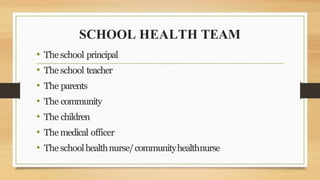
SCHOOL HEALTH TEAM
• Theschool principal
• Theschool teacher
• The parents
• The community
• The children
• Themedical officer
• Theschoolhealthnurse/communityhealthnurse
ROLE OF NURSE
• Administrator
• Educationist
• Service provider
• Researcher
• Initiationandimplementation
• Liaison activities
• Co-ordination
• Evaluation
• Trainingandguidance
THANK YOU

SCHOOL HEALTH PROGRAMME.pptx

  • 1.
    Presented By: Ms. RanjanaPrasad SCHOOL HEALTH PROGRAMME CHRISTIAN TRAINING COLLEGE, LUCKNOW
  • 2.
    INTRODUCTION • Schoolhealthprogrammeisanimportantaspectof community health.Itispossibletoincrease thehealth level of communityandachieve growthin the health of futuregenerationthroughschool health service.
  • 3.
    DEFINITION OF SCHOOLHEALTH • School health refers to a state of complete physical, mental, social and spiritual well being and not merely the absence of disease or infirmity amongpupils,teachersandotherschoolpersonnel-k.k.gilani DEFINITION OF SCHOOL HEALTH SERVICES • Schoolhealthservicerefersto needbasedcomprehensiveservicerendered to pupils,teachersandotherpersonnelintheschoolto promote,protect their health,preventandcontroldiseaseandmaintaintheirhealth.-k.k. gulani
  • 4.
    AIM • The ultimateaim of schoolhealthprogrammeisto promote, protect and maintainhealth of schoolchildren and reducemorbidityandmortalityin them.
  • 5.
    OBJECTIVES OF SCHOOLHEALTH PROGRAMME • The promotion of positive health • The prevention of diseases • Early diagnosis, treatment and follow up of defects • Awakeninghealthconsciousnessinchildren • The provision of healthful environment.
  • 6.
    GOALS OF SCHOOLHEALTH PROGRAMME • Topreparetheyoungergenerationto adoptmeasuresto remainhealthysoas to helpthemto makethebestuseof educationalfacilities,to utilizeleisurein productiveandconstructivemanner,to enjoyrecreationandto develop concernforothers • To help the younger generation become healthy and useful citizen who will be able to perform their role effectively for the welfare of themselves, their familiesandthecommunityatlargeandcountryasawhole.
  • 7.
    NEED FOR SCHOOLHEALTH PROGRAMME • Schoolchildrenconstituteavitalandsubstantialsegmentof population. • Schoolchildrenarevulnerablesectionof populationbyvirtueof theirphysical, mental,emotionalandsocialgrowthanddevelopmentduringthis period. • Schoolchildrenareexpressedto variousstressfulsituations. • Childrencomingto schoolbelongto differentsocioeconomicandcultural backgroundwhichaffecttheirhealthandnutritionalstatusandrequirehelpand guidance in promoting, protecting and maintaining their helath and nutritional status. • Childreninschoolageareproneto getspecifichealth problems.
  • 8.
    PRINCIPLES OF SCHOOLHEALTH PROGRAMME • Itis based onhealthneeds of school children • Itisplannedinco-ordinationwithschoolhealthpersonnel, parentsandcommunitypeople. • Itemphasizeonhealtheducationto promote,protect,improve and maintainhealth of childrenandstaff. • Itemphasizeonpromotiveandpreventive,aspects.
  • 9.
    • Itemphasizeonhealtheducationto promote,protect, improveand maintainhealth of childrenandstaff. • Itemphasizeonlearningthroughactiveanddesirable participation. • Itisanongoingandcontinuousprogram. • Ithas an effective system of recordkeepingand reporting.
  • 10.
    COMPONENTS OF SCHOOLHEALTH PROGRAMME • Health appraisal of schoolchildren and schoolpersonnel • Remedialmeasuresandfollowup • Prevention of communicable disease • Healthfulschoolenvironment • Nutritional service • Firstaidandemergencycare • Mental health
  • 11.
    • Dental health •Eye health • Health education • Education of thehandicappedchildren • Maintenance anduse of schoolhealth records
  • 12.
    1. Health appraisalof schoolchildrenandschoolpersonnel  Periodicalmedicalexaminationof schoolchildren,teacher,healthpersonnel.  Medicalexaminationonentry-4years  Routinephysicalexaminationneedsto be done.  Clinicalexaminationfor nutritionaldeficiency,examinationoffaeces.  Tuberculintesting/screeningfor Hansen'sannualtestingof vision,regularand quarterlywt/htchecking.  Dailymorninginspectionbytheteachersunusuallyflushedface,rashes,spots, signsof acutecold,coughingandsneezing,sorethroat,rigidneck,nausea, vomiting,wateryeyes,headache,chills,fever,etc.
  • 13.
    2. Remedial measuresand follow up  Following the regular examination, respective referral services.  Special clinics should be conducted in the health units.  Specialist should be employed in schools for the same.  Referral hospital must provide for beds for children who are admitted and provide relevant treatment.
  • 14.
    3. Preventive ofcommunicable diseases  Protection of all school going children against preventable disease by immunization according to the National Immunization Schedule. 4. Healthful school environment  An optimal school environment, location, building and equipment's are important pre-requisites for a school health.  A good school environment promotes physical, social and emotional health of the pupils.  School should serve as exemplary place to reflect sanitation.
  • 15.
    5. Nutritional services Good nutrition is very essential not only for optimal health growth and development of the school child but also for his/her educational achievement.  A nutritious mid-day meal for children in the school is considered as apractical solution to combat malnutrition in children. 6. First aid and emergency care  The school must have an arrangement for providing first aid and emergency care to children who get injured or sick at the school.  The teachers should receive adequate training during teacher training programor in service training programs to prepare themselves to carry out this obligation.
  • 16.
    7. Mental health The mental health of the child affects his physical health and the learning process.  Juvenile delinquency, maladjustment and drug addiction are becoming problems among school children. so, teachers need to plan and organize well-balanced curricular activities so that students are not over burdened and have sufficient relaxation and recreation, etc. 8. Dental health  School children usually suffer from dental diseases and defects.  School health should incorporate dental health components too.  Dental hygienist and dentist are to be employed.  During the dental check up should focus on prophylactic cleansing and dental hygiene classes.
  • 17.
    9. Eye healthservices  Teachers are in key position to detect reflective errors, refer for treatment for squints, amblyopia and to detect eye infections.  Vitamin A administration could bedone. 10. Health education  Health education is very important for school children as it creates awareness, gives knowledge regarding health matter, gives knowledge regarding health matter, develops motivation and promotes change in health behavior and health attitudes.  Health education content areas include personal hygiene, environmentalhealth, nutrition, prevention and control of communicable and non-communicable diseases.
  • 18.
    11. Education ofhandicapped children Every child irrespective of the disability, should be encouraged to become productive and self supporting. 12. School health records The schools have cumulative health records providing pertinent information and serves as tool to evaluate the school health services.
  • 19.
    NATURE AND SCOPE •It is an integral part of community health. It is that phase of community health and family health service that promotes the well-being of the children and his education for healthy living. • It canbeapowerfulinfluencefor shapinghealthbehavior.Thereisaunique opportunityto promote,maintainandimprovehealthandwell-beingsinceteacher reachmostpeopleearlyinlife,whereattitudesandvaluesaremostreadily developed. • Schoolhealthserviceisapersonalhealthservice.It stressestheroleof thechildas a "changeagentfor community".A childhasgreatercapacityto observe,learn, experimentandthentransferknowledgeto others.
  • 20.
    • School healthhelps to impart information of health habits and practices of healthful living throughout school life, which are very important during the formativeperiodof one's life. • Schoolhealthprogramhelptheyoungergenerationbecomehealthyand usefulcitizenwhowillbeableto performtheirroleeffectivelyfor the welfareof themselves,theirfamilies, etc
  • 21.
    Medical inspection  Regularperiodical appraisal of health of school children is very necessary to identify the deviation from normal body parts and systems. It requires complete physical and medical check-ups.  Initial medical inspection should be done at the time of entry of the child which includes history taking, physical and medical examination.  Physical examination includes observation of child from head to toe, measurement of height, weight, arm and chest circumference.  Testing of vision,hearing and speech,observations such as vital signs as pulse, respiratory rate and temperature.  A routine examination of blood, urine and stool should be carried out. Screening for tuberculosis should be done at the tuberculosis clinic  A minimum of three health check-ups need to be carried out at i)on school entry at the age of 5-6yrs ii)on passing out from primary school at the age of 10-11 years. iii) iii)on passing out from middle school at the age of 13-14 years.
  • 22.
    Immunization  Immunization ofchildren against specific communicable diseases is necessary to prevent the occurrence of diseases like tuberculosis, diphtheria, tetanus, measles and polio.  Immunization schedule is complete by the time the child is 5-6 years old.  A proper record of immunization should be maintained as part of comprehensive health record which should be handed over to the child at the time of leaving school
  • 23.
    Maintinence of Schoolhealth Records *It is essential to maintain complete, accurate and continuous records of school children. *Such health records are very useful in monitoring the health status of the children *They are used for i) identification and personal aspect ii)findings of physical and medical examination iii)findings of physical and medical examination iv)findings of routine examination and screening v)services rendered and the progress
  • 24.
    SCHOOL HEALTH TEAM •Theschool principal • Theschool teacher • The parents • The community • The children • Themedical officer • Theschoolhealthnurse/communityhealthnurse
  • 25.
    ROLE OF NURSE •Administrator • Educationist • Service provider • Researcher • Initiationandimplementation • Liaison activities • Co-ordination • Evaluation • Trainingandguidance
  • 26.