DISASTER MANAGEMENT
M A D E BY
J A N I S H S I K R I
9 T H
1
2
DISASTER &
MANAGEMENT
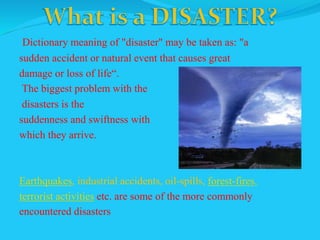
Dictionary meaning of "disaster" may be taken as: "a
sudden accident or natural event that causes great
damage or loss of life“.
The biggest problem with the
disasters is the
suddenness and swiftness with
which they arrive.
Earthquakes, industrial accidents, oil-spills, forest-fires,
terrorist activities etc. are some of the more commonly
encountered disasters
Some types of disasters are as
follows:
Natural disasters: These are primary natural disasters
 Earthquake
 Volcanoes
 Floods
 Tornados
 Tsunami [MY TOPIC]
Man Made : These are mostly caused due to certain
human activities.
 Nuclear Leaks
 Chemical Leaks
 Oil spills
India and Natural Disasters
India is one of the most disaster prone countries in the world.
Over 65% land area vulnerable to earthquakes;
70% of land under cultivation prone to drought;
5% of land (40 million hectares) to floods;
8% of land (8,000 km coastline) to cyclones.
A Major Disaster occurs every 2-3 years;
50 million people affected annually
1 million houses damaged annually along with human, social and
other losses
During 1985-2003, the annual average damage due to natural
disasters has been estimated at 70 million USD
Source: Ministry of Agriculture, GOI: BMTPC, Ministry of Urban Development, GOI
8
The 2004 Indian Ocean
earthquake was an
undersea earthquake that
occurred at 00:58:53 UTC
on December 26, 2004,
with an epicentre off the
west coast of Sumatra,
Indonesia. The earthquake
was caused by subduction
and triggered a series of
devastating tsunamis
along the coasts of most
landmasses bordering the
Indian Ocean.
9
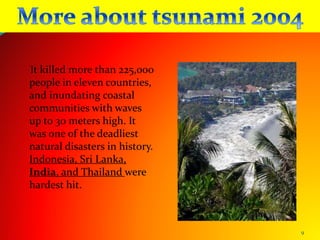
It killed more than 225,000
people in eleven countries,
and inundating coastal
communities with waves
up to 30 meters high. It
was one of the deadliest
natural disasters in history.
Indonesia, Sri Lanka,
India, and Thailand were
hardest hit.
10
With a magnitude of between 9.1 and 9.3, it is the second
largest earthquake ever recorded on a seismograph. This
earthquake had the longest duration of faulting ever
observed, between 8.3 and 10 minutes. Since 1900 the
only earthquakes recorded with a greater
magnitude were the 1960 Great Chilean
Earthquake (magnitude 9.5) and the 1964 Good
Friday Earthquake in Prince William Sound (9.2).
11
Why most people did not get a
warning?
Scientists didn’t warn people to go away
because maybe they were not sure about
the earthquake and then the people
discuss badly their names and it could
cause to them, an unemployment.
The countries would have lack of
tourism.
Because of other country’ s benefits.
12
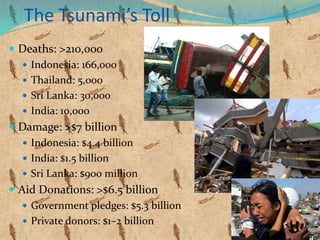
The Tsunami’s Toll
 Deaths: >210,000
 Indonesia: 166,000
 Thailand: 5,000
 Sri Lanka: 30,000
 India: 10,000
 Damage: >$7 billion
 Indonesia: $4.4 billion
 India: $1.5 billion
 Sri Lanka: $900 million
 Aid Donations: >$6.5 billion
 Government pledges: $5.3 billion
 Private donors: $1–2 billion
TSUNAMI
WHAT IS A TSUNAMI…?
A tsunami is a wave train, or series of waves, generated in a
body of water by an impulsive disturbance that vertically
displaces the water column. Earthquakes, landslides, volcanic
eruptions, explosions, and even the impact of cosmic bodies, such
as meteorites, can generate tsunamis.
The following are natural signs of tsunami:
Feel the earth shake. A large undersea earthquake may be felt
prior to tsunami by an ongoing shaking of the ground in coastal
regions. However, you may not feel an earthquake if the source is
far away.
See the ocean drop. As tsunami approach the shoreline, the sea
level may, but not always, recede/drop dramatically before
returning as a fast-moving wall of water.
Hear an unusual roaring sound. A roaring sound may precede
the arrival of tsunami.
14
DURING TSUNAMI:
Climb to higher ground as soon as warning of a
tsunami is released
Stay away from the beach - if you can see the
wave, you are too close to escape it.
Do not assume that one wave means the danger
is over - the next wave may be larger than the
first.
Stay out of the area and do not return until
authorities say it is safe to do so
15
AFTER TSUNAMI:
Help injured or trapped persons and give first aid
where appropriate.
Stay out of damaged buildings.
Shovel mud while it is still moist to give walls and
floors an opportunity to dry.
Enter home with caution, checking for electrical
shorts and live wires
The Myths
It Can’t Happen to Us.
The Nature’s forces are so Deadly
the Victims will Die anyway.
There is Nothing We Can Do.
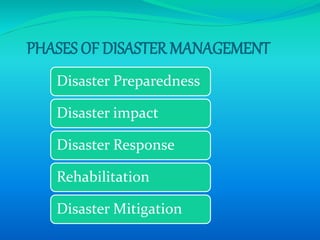
PHASES OF DISASTER MANAGEMENT
Disaster Preparedness
Disaster impact
Disaster Response
Rehabilitation
Disaster Mitigation
Disaster Management Cycle
RESPONSE
 Response measures are usually those which are taken
immediately prior to and following disaster impact.
 Typical measures include :
 Implementation of plans
 Activation of the counter-disaster system
 Search and Rescue
 Provision of emergency food, shelter, medical assistance etc.
 Survey and assessment
 Evacuation measures
Recovery
 Recovery is the process by which communities and the
nation are assisted in returning to their proper level of
functioning following a disaster.
 Three main categories of activity are normally regarded as
coming within the recovery segment:
 Restoration
 Reconstruction
 Rehabilitation
21
PREVENTION & MITIGATION
 Prevention : Action within this segment is designed to impede
the occurrence of a disaster event and/or prevent such an
occurrence having harmful effects on communities or key
installations.
 Mitigation : Action within this segment usually takes the form of
specific programs intended to reduce the effects of disaster on a
nation or community. For instance, some countries regard the
development and application of building codes (which can reduce
damage and loss in the event of earthquakes and cyclones) as
being in the category of mitigation.
Disaster preparedness
Preparedness should be in the form of money,
manpower and materials
 Evaluation from past experiences about risk
 Location of disaster prone areas
 Organization of communication, information and
warning system
 Ensuring co-ordination and response mechanisms
 Development of public education programme
 Co-ordination with media
 National & international relations
 Keeping stock of foods, drug and other essential
commodities.
23
Conclusions
• The Tsunami caused by the Sumatra EQ killed
>300,000 people because there was no
Warning System.
 Source region for Sumatra Tsunami extends
from Banda Aceh through the Nicobar Islands.
 We need a method for estimating size of great
earthquakes within a time frame useful to the
Tsunami Warning System.
24
What can be done to reduce the loss of life and
damage if another tsunami occurs in the same area?
 Inform to all people the fact.
 Go somewhere safer.
 Go to a high place to protect yourself from the
flooding.
 Example: on the roof of your house, or to a high
mountain.
25
26
THANK YOU 

Disaster management

  • 1.
    DISASTER MANAGEMENT M AD E BY J A N I S H S I K R I 9 T H 1
  • 2.
  • 3.
    Dictionary meaning of"disaster" may be taken as: "a sudden accident or natural event that causes great damage or loss of life“. The biggest problem with the disasters is the suddenness and swiftness with which they arrive. Earthquakes, industrial accidents, oil-spills, forest-fires, terrorist activities etc. are some of the more commonly encountered disasters
  • 4.
    Some types ofdisasters are as follows: Natural disasters: These are primary natural disasters  Earthquake  Volcanoes  Floods  Tornados  Tsunami [MY TOPIC] Man Made : These are mostly caused due to certain human activities.  Nuclear Leaks  Chemical Leaks  Oil spills
  • 5.
    India and NaturalDisasters India is one of the most disaster prone countries in the world. Over 65% land area vulnerable to earthquakes; 70% of land under cultivation prone to drought; 5% of land (40 million hectares) to floods; 8% of land (8,000 km coastline) to cyclones. A Major Disaster occurs every 2-3 years; 50 million people affected annually 1 million houses damaged annually along with human, social and other losses During 1985-2003, the annual average damage due to natural disasters has been estimated at 70 million USD Source: Ministry of Agriculture, GOI: BMTPC, Ministry of Urban Development, GOI
  • 8.
    8 The 2004 IndianOcean earthquake was an undersea earthquake that occurred at 00:58:53 UTC on December 26, 2004, with an epicentre off the west coast of Sumatra, Indonesia. The earthquake was caused by subduction and triggered a series of devastating tsunamis along the coasts of most landmasses bordering the Indian Ocean.
  • 9.
    9 It killed morethan 225,000 people in eleven countries, and inundating coastal communities with waves up to 30 meters high. It was one of the deadliest natural disasters in history. Indonesia, Sri Lanka, India, and Thailand were hardest hit.
  • 10.
    10 With a magnitudeof between 9.1 and 9.3, it is the second largest earthquake ever recorded on a seismograph. This earthquake had the longest duration of faulting ever observed, between 8.3 and 10 minutes. Since 1900 the only earthquakes recorded with a greater magnitude were the 1960 Great Chilean Earthquake (magnitude 9.5) and the 1964 Good Friday Earthquake in Prince William Sound (9.2).
  • 11.
    11 Why most peopledid not get a warning? Scientists didn’t warn people to go away because maybe they were not sure about the earthquake and then the people discuss badly their names and it could cause to them, an unemployment. The countries would have lack of tourism. Because of other country’ s benefits.
  • 12.
    12 The Tsunami’s Toll Deaths: >210,000  Indonesia: 166,000  Thailand: 5,000  Sri Lanka: 30,000  India: 10,000  Damage: >$7 billion  Indonesia: $4.4 billion  India: $1.5 billion  Sri Lanka: $900 million  Aid Donations: >$6.5 billion  Government pledges: $5.3 billion  Private donors: $1–2 billion
  • 13.
    TSUNAMI WHAT IS ATSUNAMI…? A tsunami is a wave train, or series of waves, generated in a body of water by an impulsive disturbance that vertically displaces the water column. Earthquakes, landslides, volcanic eruptions, explosions, and even the impact of cosmic bodies, such as meteorites, can generate tsunamis. The following are natural signs of tsunami: Feel the earth shake. A large undersea earthquake may be felt prior to tsunami by an ongoing shaking of the ground in coastal regions. However, you may not feel an earthquake if the source is far away. See the ocean drop. As tsunami approach the shoreline, the sea level may, but not always, recede/drop dramatically before returning as a fast-moving wall of water. Hear an unusual roaring sound. A roaring sound may precede the arrival of tsunami.
  • 14.
    14 DURING TSUNAMI: Climb tohigher ground as soon as warning of a tsunami is released Stay away from the beach - if you can see the wave, you are too close to escape it. Do not assume that one wave means the danger is over - the next wave may be larger than the first. Stay out of the area and do not return until authorities say it is safe to do so
  • 15.
    15 AFTER TSUNAMI: Help injuredor trapped persons and give first aid where appropriate. Stay out of damaged buildings. Shovel mud while it is still moist to give walls and floors an opportunity to dry. Enter home with caution, checking for electrical shorts and live wires
  • 16.
    The Myths It Can’tHappen to Us. The Nature’s forces are so Deadly the Victims will Die anyway. There is Nothing We Can Do.
  • 17.
    PHASES OF DISASTERMANAGEMENT Disaster Preparedness Disaster impact Disaster Response Rehabilitation Disaster Mitigation
  • 18.
  • 19.
    RESPONSE  Response measuresare usually those which are taken immediately prior to and following disaster impact.  Typical measures include :  Implementation of plans  Activation of the counter-disaster system  Search and Rescue  Provision of emergency food, shelter, medical assistance etc.  Survey and assessment  Evacuation measures
  • 20.
    Recovery  Recovery isthe process by which communities and the nation are assisted in returning to their proper level of functioning following a disaster.  Three main categories of activity are normally regarded as coming within the recovery segment:  Restoration  Reconstruction  Rehabilitation
  • 21.
    21 PREVENTION & MITIGATION Prevention : Action within this segment is designed to impede the occurrence of a disaster event and/or prevent such an occurrence having harmful effects on communities or key installations.  Mitigation : Action within this segment usually takes the form of specific programs intended to reduce the effects of disaster on a nation or community. For instance, some countries regard the development and application of building codes (which can reduce damage and loss in the event of earthquakes and cyclones) as being in the category of mitigation.
  • 22.
    Disaster preparedness Preparedness shouldbe in the form of money, manpower and materials  Evaluation from past experiences about risk  Location of disaster prone areas  Organization of communication, information and warning system  Ensuring co-ordination and response mechanisms  Development of public education programme  Co-ordination with media  National & international relations  Keeping stock of foods, drug and other essential commodities.
  • 23.
    23 Conclusions • The Tsunamicaused by the Sumatra EQ killed >300,000 people because there was no Warning System.  Source region for Sumatra Tsunami extends from Banda Aceh through the Nicobar Islands.  We need a method for estimating size of great earthquakes within a time frame useful to the Tsunami Warning System.
  • 24.
    24 What can bedone to reduce the loss of life and damage if another tsunami occurs in the same area?  Inform to all people the fact.  Go somewhere safer.  Go to a high place to protect yourself from the flooding.  Example: on the roof of your house, or to a high mountain.
  • 25.
  • 26.