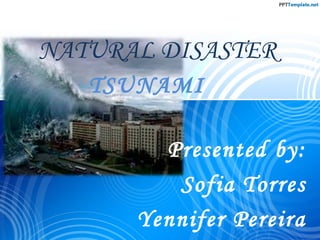
NATURAL DISASTER
TSUNAMI
Presented by:
Sofia Torres
Yennifer Pereira
That is a tsunami
A tsunami is a series of waves from the ocean that
sends large waves of water that sometimes reach
heights of 30.5 metres, towards the interior. These
walls of water can cause widespread destruction
when they hit the coast.
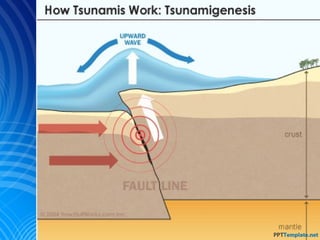
These breathtaking waves are usually caused by
great submarine earthquakes at edges of tectonic
plate. When the floor of the ocean at a plate edge
rises or drops suddenly, displaces water that are on
it and throws in the form of undulating waves that
will become a tsunami.
Slide Title
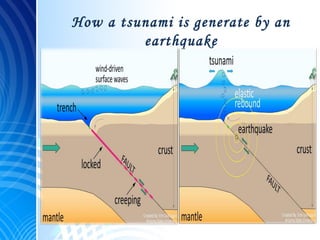
How a tsunami is generate by an
earthquake
How a tsunami is generate by an
earthquake
• On the Earth, these tecthonic plates are
constantly in motion, moving along each other
at a speed of 1 to 2 inches (2.5 to 5 centimeters)
per year. The movement occurs most
dramatically along fault lines (where the pie
is cut). These motions can produce earthquakes
and volcanism, which, when they occur at the
bottom of the ocean, are two possible sources of
tsunamis.
How Tsunamis Work
• Think of a pie cut into eight slices. The piecrust
would be the lithosphere and the hot, sticky pie
filling underneath would be the asthenosphere. On
the Earth, these plates are constantly in motion,
moving along each other at a speed of 1 to 2 inches
(2.5 to 5 centimeters) per year. The movement occurs
most dramatically along fault lines (where the
pie is cut). These motions can produce earthquakes
and volcanism which, when they occur at the
bottom of the ocean, are two possible sources of
tsunamis
Did you know?
When you finish your PowerPoint
presentation, you can upload it to:
SlideOnline.com
Congratulations
You can use this free PowerPoint template for
your own presentations. Follow us on Twitter
@ppttemplatenet
PPTTemplate.net
Download More Free PowerPoint TemplatesDownload More Free PowerPoint Templates
And now what?
You can safely delete this slide, but please consider to read below:
Where the disaster is
most common
Where the disaster is most
common
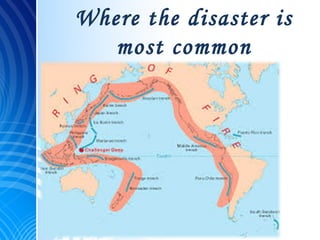
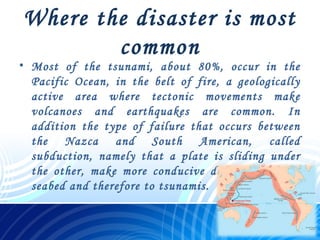
• Most of the tsunami, about 80%, occur in the
Pacific Ocean, in the belt of fire, a geologically
active area where tectonic movements make
volcanoes and earthquakes are common. In
addition the type of failure that occurs between
the Nazca and South American, called
subduction, namely that a plate is sliding under
the other, make more conducive deformity of the
seabed and therefore to tsunamis.
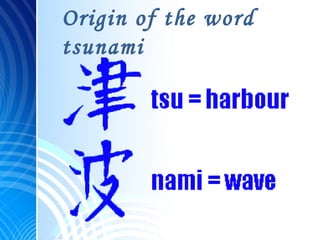
Origin of the word
tsunami
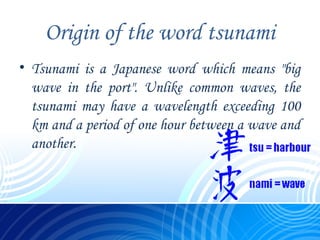
Origin of the word tsunami
• Tsunami is a Japanese word which means "big
wave in the port". Unlike common waves, the
tsunami may have a wavelength exceeding 100
km and a period of one hour between a wave and
another.
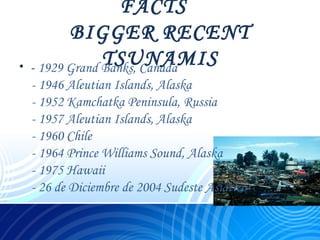
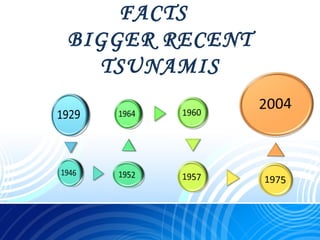
FACTS
BIGGER RECENT
TSUNAMIS• - 1929 Grand Banks, Canada  
- 1946 Aleutian Islands, Alaska  
- 1952 Kamchatka Peninsula, Russia  
- 1957 Aleutian Islands, Alaska  
- 1960 Chile  
- 1964 Prince Williams Sound, Alaska   
- 1975 Hawaii  
- 26 de Diciembre de 2004 Sudeste Asiático 
FACTS
BIGGER RECENT
TSUNAMIS
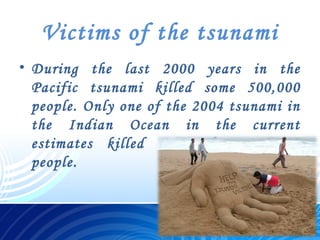
Victims of the tsunami
• During the last 2000 years in the
Pacific tsunami killed some 500,000
people. Only one of the 2004 tsunami in
the Indian Ocean in the current
estimates killed more than 280,000
people.
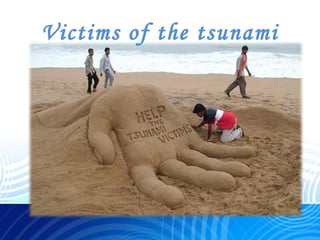
Victims of the tsunami
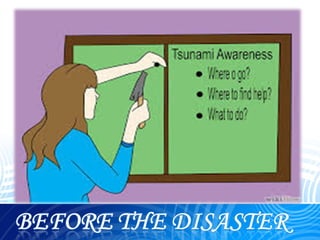
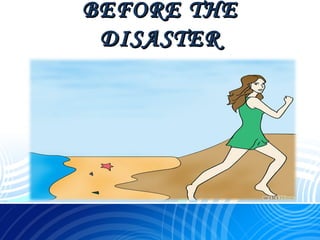
BEFORE THEBEFORE THE
DISASTERDISASTER
• 1.Find out if you live in high-risk areas
and locate possible evacuation routes
and safe sites.
2. Know the warning signs.
3. Gather your family to define in a
participatory manner in the event of a
tsunami emergency plan.
4. Train your family and coworkers, in
how to act in case of emergency
BEFORE THEBEFORE THE
DISASTERDISASTER
You should buy :
• *First aid kit.
* Radio and extra batteries.
* Flashlight with spare bulb and
batteries.
* Pito.
* Reserve of food and water, frequently
checking the expiration date and your
state.
* Plastic for the weather.
You should do during the disaster
• 1.Keep calm. Do not quit running, avoid the
panic.
2. Activate your emergency plan, follow the
evacuation routes previously established. 
3. Use the battery-operated radio to learn more
about the situation and follow the
recommendations of the relief agencies. This
attentive to warning system previously
established. But don't depend on this to evacuate,
you can fail by an earthquake before, remember
the warning signs and evacuate.
You should n’t do during the disaster
• You shouldn’t wait for the alert, go
immediately to a site high, it may be
that after the earthquake sells the
tsunami. 
• Don't walk away from his family and
stay in a safe place
• Do not stand close to the beach and try
not to miss the calm
You Should do after the tsunami
• 1.If you are trapped, warn by shouts, noise,
whistles or if possible by cell phone.
2. Check if you are working the phones and
cell phones and only use it for short periods.
3.Check the recommendations given by the
local committees for the prevention and
attention of disasters.
4.After the tsunami, the affected area is
flooded, so it should have the same care,
especially against wastes and dangerous
animals, those who seek refuge also in
Highlands.

Tsunamis presentation

  • 1.
  • 2.
    That is atsunami A tsunami is a series of waves from the ocean that sends large waves of water that sometimes reach heights of 30.5 metres, towards the interior. These walls of water can cause widespread destruction when they hit the coast. These breathtaking waves are usually caused by great submarine earthquakes at edges of tectonic plate. When the floor of the ocean at a plate edge rises or drops suddenly, displaces water that are on it and throws in the form of undulating waves that will become a tsunami.
  • 3.
  • 4.
    How a tsunamiis generate by an earthquake
  • 5.
    How a tsunamiis generate by an earthquake • On the Earth, these tecthonic plates are constantly in motion, moving along each other at a speed of 1 to 2 inches (2.5 to 5 centimeters) per year. The movement occurs most dramatically along fault lines (where the pie is cut). These motions can produce earthquakes and volcanism, which, when they occur at the bottom of the ocean, are two possible sources of tsunamis.
  • 6.
    How Tsunamis Work •Think of a pie cut into eight slices. The piecrust would be the lithosphere and the hot, sticky pie filling underneath would be the asthenosphere. On the Earth, these plates are constantly in motion, moving along each other at a speed of 1 to 2 inches (2.5 to 5 centimeters) per year. The movement occurs most dramatically along fault lines (where the pie is cut). These motions can produce earthquakes and volcanism which, when they occur at the bottom of the ocean, are two possible sources of tsunamis
  • 7.
    Did you know? Whenyou finish your PowerPoint presentation, you can upload it to: SlideOnline.com Congratulations You can use this free PowerPoint template for your own presentations. Follow us on Twitter @ppttemplatenet PPTTemplate.net Download More Free PowerPoint TemplatesDownload More Free PowerPoint Templates And now what? You can safely delete this slide, but please consider to read below:
  • 8.
    Where the disasteris most common
  • 9.
    Where the disasteris most common • Most of the tsunami, about 80%, occur in the Pacific Ocean, in the belt of fire, a geologically active area where tectonic movements make volcanoes and earthquakes are common. In addition the type of failure that occurs between the Nazca and South American, called subduction, namely that a plate is sliding under the other, make more conducive deformity of the seabed and therefore to tsunamis.
  • 10.
    Origin of theword tsunami
  • 11.
    Origin of theword tsunami • Tsunami is a Japanese word which means "big wave in the port". Unlike common waves, the tsunami may have a wavelength exceeding 100 km and a period of one hour between a wave and another.
  • 12.
    FACTS BIGGER RECENT TSUNAMIS• -1929 Grand Banks, Canada   - 1946 Aleutian Islands, Alaska   - 1952 Kamchatka Peninsula, Russia   - 1957 Aleutian Islands, Alaska   - 1960 Chile   - 1964 Prince Williams Sound, Alaska    - 1975 Hawaii   - 26 de Diciembre de 2004 Sudeste Asiático 
  • 13.
  • 14.
    Victims of thetsunami • During the last 2000 years in the Pacific tsunami killed some 500,000 people. Only one of the 2004 tsunami in the Indian Ocean in the current estimates killed more than 280,000 people.
  • 15.
  • 17.
    BEFORE THEBEFORE THE DISASTERDISASTER •1.Find out if you live in high-risk areas and locate possible evacuation routes and safe sites. 2. Know the warning signs. 3. Gather your family to define in a participatory manner in the event of a tsunami emergency plan. 4. Train your family and coworkers, in how to act in case of emergency
  • 18.
  • 19.
    You should buy: • *First aid kit. * Radio and extra batteries. * Flashlight with spare bulb and batteries. * Pito. * Reserve of food and water, frequently checking the expiration date and your state. * Plastic for the weather.
  • 20.
    You should doduring the disaster • 1.Keep calm. Do not quit running, avoid the panic. 2. Activate your emergency plan, follow the evacuation routes previously established.  3. Use the battery-operated radio to learn more about the situation and follow the recommendations of the relief agencies. This attentive to warning system previously established. But don't depend on this to evacuate, you can fail by an earthquake before, remember the warning signs and evacuate.
  • 21.
    You should n’tdo during the disaster • You shouldn’t wait for the alert, go immediately to a site high, it may be that after the earthquake sells the tsunami.  • Don't walk away from his family and stay in a safe place • Do not stand close to the beach and try not to miss the calm
  • 22.
    You Should doafter the tsunami • 1.If you are trapped, warn by shouts, noise, whistles or if possible by cell phone. 2. Check if you are working the phones and cell phones and only use it for short periods. 3.Check the recommendations given by the local committees for the prevention and attention of disasters. 4.After the tsunami, the affected area is flooded, so it should have the same care, especially against wastes and dangerous animals, those who seek refuge also in Highlands.

Editor's Notes

  • #8 Download free PowerPoint templates from http://ppttemplate.net/ - Later, you can also upload your finished presentations for free to http://slideonline.com/