LECTURE:04 Industrialization & Sustainability   M. A. Kamal, Ph.D Director General National Academy for Planning and Development
Out Line 1. Introduction 2. Sustainable industrialization 3. Necessity of Industrialization 4. Classification of Industries 5. Challenge for industry 6. Critical issues for industrialization 7. The Sustainable Industrialization Triangle 8. Innovation path 9. The sustainable industrialization process 10.  Global trends and issues: Industrialization 11. Global transformation of industrialization 12. Technical Progress & sustainability 13. Development & foreign borrowing 14. Industrial Sustainability: Key Learning Principles 15. Conclusion 16. Farewell Call
1. Introduction 1.1 "To be, or not to be" -- that is the age-old  question, and civilization today faces its own  dire version of it. As the negative social and  ecological effects of 150 years of  industrialization are becoming impossible to  ignore, people are asking whether we can  maintain our standards of living in future.
2. Sustainable industrialization 2.1 Sustainable industrialisation is a long-term  process of transformation towards a desired  vision of an industrialised economy. 2.2 It contributes to wealth creation, social  development and environmental sustainability.
3. Necessity of Industrialization 3.1 Applying technological progress  3.2 Driving and diffusing innovation 3.3 Developing new skills and attitudes 3.4 Stimulating modern services 3.5 Internationalizing economies
4.1 Resource-based industries ( processed food, wood,  leather, refined petroleum & rubber products); 4.2 Low technology industries (textiles, garments, footwear,  furniture, glassware, toys); 4.3 Medium technology industries (automotive industry,  chemicals, metal products, machinery) 4.4 High technology industries (electronics,  pharmaceuticals,  biotechnology, precision instruments,  aerospace ). 4. Classification of Industries
Industrial  Environmental  Impacts are  affecting  all spheres  of life: provide affordable products  with minimal environmental degradation  5.  Challenge for industry Air  Soil Biodiversity Water Marine &  Ground  Water Climate  Change
6.1 POPULATION OF EARTH i) 2011 POPULATION ~ 6.93 billion Ii) Population may reach in 2050, ~ 10 billion iii) Today, The richest 20% of population (1.2 billion)  Consume 75% of energy and resources iv) Median member of top 20% consumes 20 x that of  median member of poorest  50% of population   6. Critical issues for industrialization
6.2.2   Consumable Energy (nuclear) i) Fission power plants exist, fusion plants not yet.  ii) Brings 10 billion people up to top 20% lifestyle? Need 8,000 additional uranium plants Exhaust all uranium fuel in 10 years iii) If we use breeder reactors  Uranium then adds plutonium and thorium to fuel cycle Uranium will last 700 years (2x life of coal) 6. Critical issues for industrialization 6.2 Crises of Energy 6.2.1   Consumable Energy (fossil) i)  Oil Consumption 3x faster than discovery ii)  Brings all people up to top 20% lifestyle? iii) Exhaust coal, oil, shale, natural gas by 2050
6.2.3 RENEWABLE ENERGY   i) Solar power density = 1.36 kW/m 2 Exo-atmospheric incident power density ii) Solar Electric costs 10X fossil electric Price competition due to tax credits today Large Solar Plant reduces Biomass Large Solar Plant does not harvest Carbon iii) Water power is developed in US Produces 1 to 6% of energy in US iv) Wind power is developing  Capable of ~ 1 to 12% of US base load Hawaii now has wind capacity = 20% of base load Peak capacity unusable due to inability to control  v) Off Peak Storage remains a challenge 6. Critical issues for industrialization
6.2.4  Crises of Resources i) Need Mineral Resources ii) Need productive land on earth iii) Additional land needed for disposal iv) Need money 6. Critical issues for industrialization
7. The Sustainable Industrialization Triangle Industrial innovation Wealth Creation Social development Environmental sustainability
8.1  Innovation path R&D Design Assembly and Manufacturing Distribution Marketing Source: Ministry of Industry and Trade of Malaysia (1996) Value added by worker
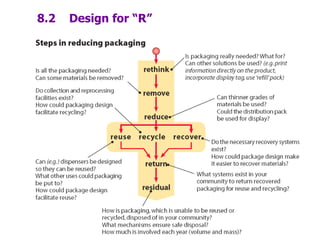
8.2 Design for “R”
High Tech 8.3 The industrial innovation path Medium Tech Low Tech Resource based Low value added segments High value added segments
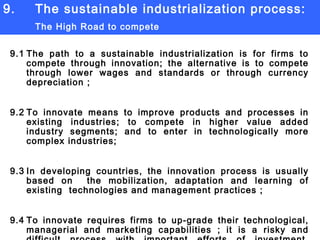
9. The sustainable industrialization process:  The High Road to compete 9.1 The path to a sustainable industrialization is for firms to compete through innovation; the alternative is to compete through lower wages and standards or through currency depreciation ; 9.2 To innovate means to improve products and processes in existing industries; to compete in higher value added industry segments; and to enter in technologically more complex industries; 9.3 In developing countries, the innovation process is usually based on  the mobilization, adaptation and learning of existing  technologies and management practices ; 9.4 To innovate requires firms to up-grade their technological, managerial and marketing capabilities ; it is a risky and difficult process with important efforts of investment, research and  learning;
10. Global trends and issues: Industrialization 10.1 Very high level of wealth creation and improvement in quality  of life  during the last 50 years but not everywhere and not for everybody.  10.2 Globalization of financial, trade, investment and knowledge flows 10.3 Rapid and accelerating technological progress with many  applications  for product and process technologies: ICT;  biotechnology; new  materials; fuel cells; nano technologies etc… 10.4 Emergence of a global network society and new consumption  patterns 10.5 Global governance with new international treaties, regulations and  standards ( trade, quality, labor, environment, intellectual property  rights, etc..) and new actors (global corporations, civil society, media) 10.6 However, alarming and unsustainable trends: poverty, environment,  social development, economic marginalization,
11. Global transformation of industrialization 11.1 Globalization of product markets  and research  characterized by complexity, uncertainties and changes.  11.2 New and difficult challenges for sustainable  industrialization: environment, social issues, poverty. 11.3 key factors of success : price, innovation, quality,  flexibility, understanding and addressing local markets 11.4 New managerial and organizational processes and systems  to design, produce and distribute products 11.5 New concept of industry: not only production but also  design,, marketing, distribution and recycling 11.7 Globalization of value chains governed by MNCs and  localization of the segments in specialized and localized  clusters of firms which offer unique competitive  advantages. 11.8 Rapid transformations of the world industrial map with the  emergence of new and dynamic industrial centers in  developing countries.
12. Technical Progress & sustainability 12.1 Technical Progress : Technological Progress (TC) is a term that is used to describe the overall process of invention, innovation and diffusion of technology or processes. The term is redundant with technological development, technological achievement, and technological change. In essence TP is the invention of a technology (or a process), the continuous process of improving a technology (in which it often becomes cheaper) and its diffusion throughout industry or society
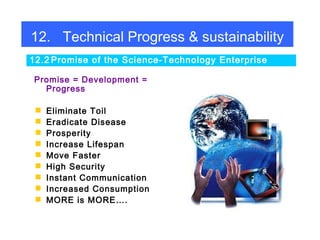
12. Technical Progress & sustainability Promise = Development = Progress Eliminate Toil  Eradicate Disease Prosperity Increase Lifespan Move Faster High Security Instant Communication Increased Consumption MORE is MORE…. 12.2 Promise of the Science-Technology Enterprise
12.3 Price  of the Science-Technology Enterprise i) Price = Impacts = Consequences ii) Risks to Human Health Endocrine Disruption Cancer Injury  Poisoning Cognitive Impairment iii) Urban sprawl iv) Inequity  v) Social Strife & War 12. Technical Progress & sustainability
12.4  Inequities of the Science-Technology Enterprise   Marland, G., T.A. Boden, and R. J. Andres. 2003. "Global, Regional, and National CO 2  Emissions." In  Trends: A Compendium of Data on Global Change.  Carbon Dioxide Information Analysis Center, Oak Ridge National Laboratory, U.S. Department of Energy, Oak Ridge, Tenn., U.S.A. Retrieved from  http://www.globalwarmingart.com/wiki/Image:Global_Carbon_Emission_by_Type_png 12. Technical Progress & sustainability
12.5 Technological Activity Exceeds:   Nature’s Regenerative Capacity Ricoh .(2007). Pursuing the Ideal Society (Three P's BalanceTM) [Image].  Retrieved from  http:// www.ricoh.com/environment/management/earth.html Environmental Price Exhaustion of Resources Water Petroleum Forests Biodegradation Extinction  Deforestation Ozone Depletion  Acid Deposition Desertification Eutrophication 12. Technical Progress & sustainability
12.6 Striking a Balance:  Between Technological Activity and the Environment Ricoh .(2007). Pursuing the Ideal Society (Three P's BalanceTM) [Image].  Retrieved from  http:// www.ricoh.com/environment/management/earth.html Changing the way we… Design & Engineer  DfE & DfR Benign Design Produce Reduce rate of extracting & harvesting materials Increase efficiency Eliminate waste, emissions, & toxics Consume & Use Use local Reduce, Reuse Dispose  Recover & Reclaim Recycle, Rot & Compost 12. Technical Progress & sustainability
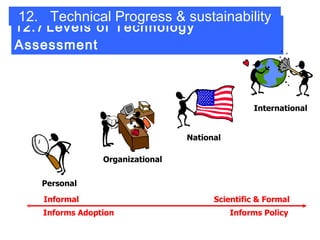
12.7 Levels of Technology Assessment Personal Organizational National International Informs Policy Informs Adoption Scientific & Formal Informal 12. Technical Progress & sustainability
13. Development & foreign borrowing 13.1 Foreign Borrowing has increased considerably in  recent  years owing to expenditure on large  infrastructure  development  projects, the financing  of imports and loan  repayments.  13.2 Foreign borrowing can assist in resolving constraints  in foreign resources for development. It is a useful  means of supplementing inadequate domestic savings  for investment and undertaking large infrastructure  projects that could enhance economic development  over time. Incurring foreign debt of a reasonable  extent for developmental objectives is an economic  strategy for developing countries.  13.3 Foreign borrowing can assist countries stabilise their  external finances and enhance economic growth.
What are we teaching in technology education? 14. Industrial Sustainability: Key Learning & Principles
14.1 Systemic Nature : Systems are interrelated and interconnected, therefore  human  activities inevitably impact other systems in unexpected ways. 14.2 Equity and social justice : Access to the elements required for survival on  this planet is an innate human right. All humans, including those  generations to  come, are entitled to clean air, water, land, housing,  food, and health services. 14.3 Pollution and Toxics : Pollution and the production of toxics degrades  human and environmental health, therefore the production of waste,  pollution, and toxics should be eliminated or controlled.  14.4 Precautionary Principle : Technological innovations creates threats  and risks to human health and the environment, precautionary  measures should be taken even if some cause and effect  relationships are not fully established scientifically. The proponent  of a technological innovation should bear the “burden of proof“ for  presenting evidence of harmlessness. If this is not forthcoming,  then a "no action policy” should be adopted. 14.5 Stewardship : All businesses, industries, governments, NGOs, & individuals  have important responsibilities for the integrity of life-supporting systems. Maintain the integrity of systems Consume and use responsibly Protect and restore ecosystems Protect human health, vulnerable populations, and communities 14. Industrial Sustainability: Key Learning & Principles
14.6 Energy Efficiency Energy Intensity  is the amount of energy consumed per unit of service or activity. Embodied energy may be reduced by designing durable, adaptable products and buildings which are made from local, renewable materials. Embodied Energy : “Embodied energy is the total primary energy consumed during the life time of a product, ideally the boundaries would be set from the extraction of raw materials (inc fuels) to the end of the products lifetime (including energy from; manufacturing, transport, energy to manufacture capital equipment, heating & lighting of factory...etc), this boundary condition is known as Cradle to Grave” ( Jones, 2007 ).  Environmental Burden: Renewability : Production activities should minimize the use of materials which do not regenerate at the same rate at which they are consumed, including from fossil fuels, minerals, long-lived plants, and declining populations of animals. 14. Industrial Sustainability: Key Learning & Principles
15.1 Industrialization without sustainability  has been known to cost the society in  increasing inequality, poor living  conditions for  the poor, supposed  scarcity of resources, etc.. 15.2 In the future, mankind will look to  achieve sustainability in all aspects of  life, not so much because we will want  to, but because we will need to. 15. Conclusion
16. Farewell Call “Rates of use of renewable resources do not exceed regeneration rates;  rates of use of nonrenewable resources do not exceed rates of  development of renewable substitutes;    rates of pollution emission do not exceed assimilative  capacities of the environment.” Herman Daly (1996)
Thank you  for your attention

Industrialization & sustainability(L4)

  • 1.
    LECTURE:04 Industrialization &Sustainability M. A. Kamal, Ph.D Director General National Academy for Planning and Development
  • 2.
    Out Line 1.Introduction 2. Sustainable industrialization 3. Necessity of Industrialization 4. Classification of Industries 5. Challenge for industry 6. Critical issues for industrialization 7. The Sustainable Industrialization Triangle 8. Innovation path 9. The sustainable industrialization process 10. Global trends and issues: Industrialization 11. Global transformation of industrialization 12. Technical Progress & sustainability 13. Development & foreign borrowing 14. Industrial Sustainability: Key Learning Principles 15. Conclusion 16. Farewell Call
  • 3.
    1. Introduction 1.1"To be, or not to be" -- that is the age-old question, and civilization today faces its own dire version of it. As the negative social and ecological effects of 150 years of industrialization are becoming impossible to ignore, people are asking whether we can maintain our standards of living in future.
  • 4.
    2. Sustainable industrialization2.1 Sustainable industrialisation is a long-term process of transformation towards a desired vision of an industrialised economy. 2.2 It contributes to wealth creation, social development and environmental sustainability.
  • 5.
    3. Necessity ofIndustrialization 3.1 Applying technological progress 3.2 Driving and diffusing innovation 3.3 Developing new skills and attitudes 3.4 Stimulating modern services 3.5 Internationalizing economies
  • 6.
    4.1 Resource-based industries( processed food, wood, leather, refined petroleum & rubber products); 4.2 Low technology industries (textiles, garments, footwear, furniture, glassware, toys); 4.3 Medium technology industries (automotive industry, chemicals, metal products, machinery) 4.4 High technology industries (electronics, pharmaceuticals, biotechnology, precision instruments, aerospace ). 4. Classification of Industries
  • 7.
    Industrial Environmental Impacts are affecting all spheres of life: provide affordable products with minimal environmental degradation 5. Challenge for industry Air Soil Biodiversity Water Marine & Ground Water Climate Change
  • 8.
    6.1 POPULATION OFEARTH i) 2011 POPULATION ~ 6.93 billion Ii) Population may reach in 2050, ~ 10 billion iii) Today, The richest 20% of population (1.2 billion) Consume 75% of energy and resources iv) Median member of top 20% consumes 20 x that of median member of poorest 50% of population 6. Critical issues for industrialization
  • 9.
    6.2.2 Consumable Energy (nuclear) i) Fission power plants exist, fusion plants not yet. ii) Brings 10 billion people up to top 20% lifestyle? Need 8,000 additional uranium plants Exhaust all uranium fuel in 10 years iii) If we use breeder reactors Uranium then adds plutonium and thorium to fuel cycle Uranium will last 700 years (2x life of coal) 6. Critical issues for industrialization 6.2 Crises of Energy 6.2.1 Consumable Energy (fossil) i) Oil Consumption 3x faster than discovery ii) Brings all people up to top 20% lifestyle? iii) Exhaust coal, oil, shale, natural gas by 2050
  • 10.
    6.2.3 RENEWABLE ENERGY i) Solar power density = 1.36 kW/m 2 Exo-atmospheric incident power density ii) Solar Electric costs 10X fossil electric Price competition due to tax credits today Large Solar Plant reduces Biomass Large Solar Plant does not harvest Carbon iii) Water power is developed in US Produces 1 to 6% of energy in US iv) Wind power is developing Capable of ~ 1 to 12% of US base load Hawaii now has wind capacity = 20% of base load Peak capacity unusable due to inability to control v) Off Peak Storage remains a challenge 6. Critical issues for industrialization
  • 11.
    6.2.4 Crisesof Resources i) Need Mineral Resources ii) Need productive land on earth iii) Additional land needed for disposal iv) Need money 6. Critical issues for industrialization
  • 12.
    7. The SustainableIndustrialization Triangle Industrial innovation Wealth Creation Social development Environmental sustainability
  • 13.
    8.1 Innovationpath R&D Design Assembly and Manufacturing Distribution Marketing Source: Ministry of Industry and Trade of Malaysia (1996) Value added by worker
  • 14.
  • 15.
    High Tech 8.3The industrial innovation path Medium Tech Low Tech Resource based Low value added segments High value added segments
  • 16.
    9. The sustainableindustrialization process: The High Road to compete 9.1 The path to a sustainable industrialization is for firms to compete through innovation; the alternative is to compete through lower wages and standards or through currency depreciation ; 9.2 To innovate means to improve products and processes in existing industries; to compete in higher value added industry segments; and to enter in technologically more complex industries; 9.3 In developing countries, the innovation process is usually based on the mobilization, adaptation and learning of existing technologies and management practices ; 9.4 To innovate requires firms to up-grade their technological, managerial and marketing capabilities ; it is a risky and difficult process with important efforts of investment, research and learning;
  • 17.
    10. Global trendsand issues: Industrialization 10.1 Very high level of wealth creation and improvement in quality of life during the last 50 years but not everywhere and not for everybody. 10.2 Globalization of financial, trade, investment and knowledge flows 10.3 Rapid and accelerating technological progress with many applications for product and process technologies: ICT; biotechnology; new materials; fuel cells; nano technologies etc… 10.4 Emergence of a global network society and new consumption patterns 10.5 Global governance with new international treaties, regulations and standards ( trade, quality, labor, environment, intellectual property rights, etc..) and new actors (global corporations, civil society, media) 10.6 However, alarming and unsustainable trends: poverty, environment, social development, economic marginalization,
  • 18.
    11. Global transformationof industrialization 11.1 Globalization of product markets and research characterized by complexity, uncertainties and changes. 11.2 New and difficult challenges for sustainable industrialization: environment, social issues, poverty. 11.3 key factors of success : price, innovation, quality, flexibility, understanding and addressing local markets 11.4 New managerial and organizational processes and systems to design, produce and distribute products 11.5 New concept of industry: not only production but also design,, marketing, distribution and recycling 11.7 Globalization of value chains governed by MNCs and localization of the segments in specialized and localized clusters of firms which offer unique competitive advantages. 11.8 Rapid transformations of the world industrial map with the emergence of new and dynamic industrial centers in developing countries.
  • 19.
    12. Technical Progress& sustainability 12.1 Technical Progress : Technological Progress (TC) is a term that is used to describe the overall process of invention, innovation and diffusion of technology or processes. The term is redundant with technological development, technological achievement, and technological change. In essence TP is the invention of a technology (or a process), the continuous process of improving a technology (in which it often becomes cheaper) and its diffusion throughout industry or society
  • 20.
    12. Technical Progress& sustainability Promise = Development = Progress Eliminate Toil Eradicate Disease Prosperity Increase Lifespan Move Faster High Security Instant Communication Increased Consumption MORE is MORE…. 12.2 Promise of the Science-Technology Enterprise
  • 21.
    12.3 Price of the Science-Technology Enterprise i) Price = Impacts = Consequences ii) Risks to Human Health Endocrine Disruption Cancer Injury Poisoning Cognitive Impairment iii) Urban sprawl iv) Inequity v) Social Strife & War 12. Technical Progress & sustainability
  • 22.
    12.4 Inequitiesof the Science-Technology Enterprise Marland, G., T.A. Boden, and R. J. Andres. 2003. "Global, Regional, and National CO 2 Emissions." In Trends: A Compendium of Data on Global Change. Carbon Dioxide Information Analysis Center, Oak Ridge National Laboratory, U.S. Department of Energy, Oak Ridge, Tenn., U.S.A. Retrieved from http://www.globalwarmingart.com/wiki/Image:Global_Carbon_Emission_by_Type_png 12. Technical Progress & sustainability
  • 23.
    12.5 Technological ActivityExceeds: Nature’s Regenerative Capacity Ricoh .(2007). Pursuing the Ideal Society (Three P's BalanceTM) [Image]. Retrieved from http:// www.ricoh.com/environment/management/earth.html Environmental Price Exhaustion of Resources Water Petroleum Forests Biodegradation Extinction Deforestation Ozone Depletion Acid Deposition Desertification Eutrophication 12. Technical Progress & sustainability
  • 24.
    12.6 Striking aBalance: Between Technological Activity and the Environment Ricoh .(2007). Pursuing the Ideal Society (Three P's BalanceTM) [Image]. Retrieved from http:// www.ricoh.com/environment/management/earth.html Changing the way we… Design & Engineer DfE & DfR Benign Design Produce Reduce rate of extracting & harvesting materials Increase efficiency Eliminate waste, emissions, & toxics Consume & Use Use local Reduce, Reuse Dispose Recover & Reclaim Recycle, Rot & Compost 12. Technical Progress & sustainability
  • 25.
    12.7 Levels ofTechnology Assessment Personal Organizational National International Informs Policy Informs Adoption Scientific & Formal Informal 12. Technical Progress & sustainability
  • 26.
    13. Development &foreign borrowing 13.1 Foreign Borrowing has increased considerably in recent years owing to expenditure on large infrastructure development projects, the financing of imports and loan repayments. 13.2 Foreign borrowing can assist in resolving constraints in foreign resources for development. It is a useful means of supplementing inadequate domestic savings for investment and undertaking large infrastructure projects that could enhance economic development over time. Incurring foreign debt of a reasonable extent for developmental objectives is an economic strategy for developing countries. 13.3 Foreign borrowing can assist countries stabilise their external finances and enhance economic growth.
  • 27.
    What are weteaching in technology education? 14. Industrial Sustainability: Key Learning & Principles
  • 28.
    14.1 Systemic Nature: Systems are interrelated and interconnected, therefore human activities inevitably impact other systems in unexpected ways. 14.2 Equity and social justice : Access to the elements required for survival on this planet is an innate human right. All humans, including those generations to come, are entitled to clean air, water, land, housing, food, and health services. 14.3 Pollution and Toxics : Pollution and the production of toxics degrades human and environmental health, therefore the production of waste, pollution, and toxics should be eliminated or controlled. 14.4 Precautionary Principle : Technological innovations creates threats and risks to human health and the environment, precautionary measures should be taken even if some cause and effect relationships are not fully established scientifically. The proponent of a technological innovation should bear the “burden of proof“ for presenting evidence of harmlessness. If this is not forthcoming, then a "no action policy” should be adopted. 14.5 Stewardship : All businesses, industries, governments, NGOs, & individuals have important responsibilities for the integrity of life-supporting systems. Maintain the integrity of systems Consume and use responsibly Protect and restore ecosystems Protect human health, vulnerable populations, and communities 14. Industrial Sustainability: Key Learning & Principles
  • 29.
    14.6 Energy EfficiencyEnergy Intensity is the amount of energy consumed per unit of service or activity. Embodied energy may be reduced by designing durable, adaptable products and buildings which are made from local, renewable materials. Embodied Energy : “Embodied energy is the total primary energy consumed during the life time of a product, ideally the boundaries would be set from the extraction of raw materials (inc fuels) to the end of the products lifetime (including energy from; manufacturing, transport, energy to manufacture capital equipment, heating & lighting of factory...etc), this boundary condition is known as Cradle to Grave” ( Jones, 2007 ). Environmental Burden: Renewability : Production activities should minimize the use of materials which do not regenerate at the same rate at which they are consumed, including from fossil fuels, minerals, long-lived plants, and declining populations of animals. 14. Industrial Sustainability: Key Learning & Principles
  • 30.
    15.1 Industrialization withoutsustainability has been known to cost the society in increasing inequality, poor living conditions for the poor, supposed scarcity of resources, etc.. 15.2 In the future, mankind will look to achieve sustainability in all aspects of life, not so much because we will want to, but because we will need to. 15. Conclusion
  • 31.
    16. Farewell Call“Rates of use of renewable resources do not exceed regeneration rates; rates of use of nonrenewable resources do not exceed rates of development of renewable substitutes; rates of pollution emission do not exceed assimilative capacities of the environment.” Herman Daly (1996)
  • 32.
    Thank you for your attention

Editor's Notes

  • #22 The heightened prominence of the science-technology enterprise creates an unparallel phenomenon where humans BOTH profit from its opportunities and pay the price for the risks, dangers, and undesirable impacts of technology adoption and diffusion.
  • #26 In a very general sense, TA might refer to any systematic activity that we use to inform technological decisions especially those decisions about the adoption or use of new technologies. These individual level activities might include research on alternative systems, comparison charts, and cost-benefit analyses. For example, a homeowner might research and predict the long range impacts of selecting different heating systems for installation in our homes. Should we invest in geothermal heating, gas or wood furnace, or solar thermal?