t
Tsunamis are giant waves caused
by earthquakes or volcanic
eruptions under the sea.
Out in the depths of the ocean ,
tsunami waves do not dramatically
increase in height. But as the
waves travel inland, they build up
to higher heights as the depth of
the ocean decreases
EARTHQUAKES
Most tsunami are caused by large earthquakes on the sea floor when slabs of rock move past each other
suddenly, causing the overlying water to move. The resulting waves move away from the source of the
earthquake event.
LANDSLIDES
Underwater landslides can cause tsunami as can terrestrial land which slumps into the ocean.
VOLCANIC ERUPTIONS
Less common are tsunami initiated by volcanic eruptions. These occur in several ways:
destructive collapse of coastal, island and underwater volcanoes which result in massive landslides
pyroclastic flows, which are dense mixtures of hot blocks, pumice, ash and gas, plunging down volcanic
slopes into the ocean and pushing water outwards
a caldera volcano collapsing after an eruption causing overlying water to drop suddenly.
1. Approximately 80% of tsunamisoccur in the PacificOcean's Ring of
Fire,where earthquakesand volcanoes are common.
2. A tsunamican reach speeds of 500 miles per hour, which is almost
the speed of a jet airplane.
3. Because of theirspeed, a tsunamicould cross the PacificOcean in
only one day.
4. The longwave-lengthof a tsunamiallows it to maintainits strength
as it moves toward shore.
5. As a tsunaminears the shore,it slows down, butit gains more height
and energy.
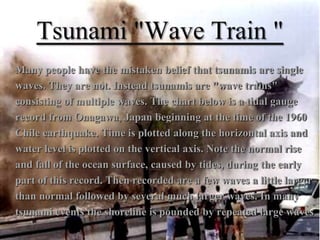
Many people have the mistaken belief that tsunamis are single
waves. They are not. Instead tsunamis are "wave trains"
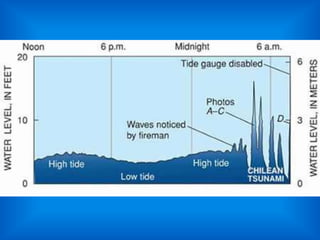
consisting of multiple waves. The chart below is a tidal gauge
record from Onagawa, Japan beginning at the time of the 1960
Chile earthquake. Time is plotted along the horizontal axis and
water level is plotted on the vertical axis. Note the normal rise
and fall of the ocean surface, caused by tides, during the early
part of this record. Then recorded are a few waves a little larger
than normal followed by several much larger waves. In many
tsunami events the shoreline is pounded by repeated large waves
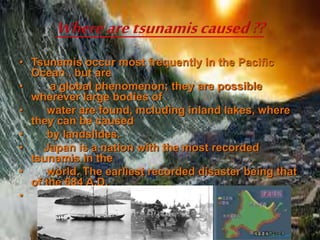
• Tsunamis occur most frequently in the Pacific
Ocean , but are
• a global phenomenon; they are possible
wherever large bodies of
• water are found, including inland lakes, where
they can be caused
• by landslides.
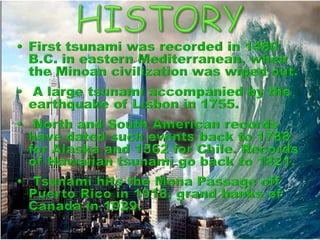
• Japan is a nation with the most recorded
tsunamis in the
• world. The earliest recorded disaster being that
of the 684 A.D.
•
• An earthquake is a natural tsunami warning. If you
feel a strong quake do not stay in a place where you
are exposed to a tsunami. If you hear of an
earthquake be aware of the possibility of a tsunami
and listen to the radio or television for additional
information.
• Many people were killed by the Indian Ocean
tsunami because they went down to the beach to
view the retreating ocean exposing the seafloor.
• Remember that a tsunami is a series of waves and
that the first wave may not be the most dangerous.
The danger from a tsunami can last for several
hours after the arrival of the first wave.
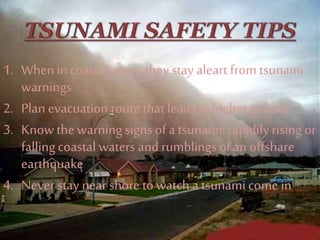
1. Whenin coastal areas, they stay aleart from tsunami
warnings
2. Plan evacuation route that leads to higherground
3. Know the warning signs of a tsunami: rapidilyrising or
fallingcoastal waters and rumblings ofan offshare
earthquake
4. Never stay near shore to watch a tsunami come in
• On the morning of Dec. 26, 2004, a
magnitude-9.1 earthquake whose
epicenter was located 160 km off
Indonesia's Sumatra coast, unleashed the
most powerful tsunami recorded in
history.
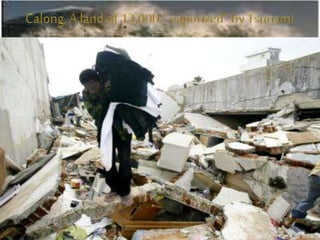
• It killed about 230,000 people in 14
countries.
• India lost more than 16,000 people as
villages were wiped out along its southern
coast and on the Andaman and Nicobar
Island chain.
• The Andaman and Nicobar islands have not left the tsunami
behind, only because the tsunami has not left them. Along with
its visible reminders like broken buildings and damaged roads,
the tsunami here is felt as well, like a twist in the heart.
• Questions about glasses half empty or half full are
meaningless. There is no glass anymore - life as it was,
tenuously linked by satellite telephones, stately ferries and one
civilian helicopter, will never be the same again. It is said
dignitaries looked around on some of the southern islands and
asked to see some damage.
• The tsunami has obliterated all trace of human life, leaving
behind nothing but silver sands and a virgin beach. It is a
terrifying paradise.
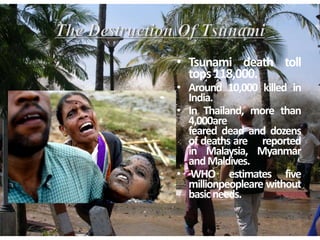
• Tsunami death toll
tops118,000.
• Around 10,000 killed in
India.
• In Thailand, more than
4,000are
feared dead and dozens
of deaths are reported
in Malaysia, Myanmar
andMaldives.
• WHO estimates five
millionpeopleare without
basicneeds.
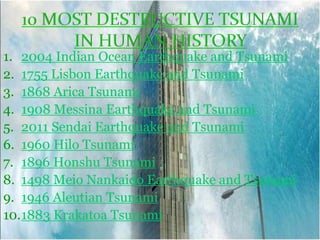
1. 2004 Indian Ocean Earthquake and Tsunami
2. 1755 Lisbon Earthquake and Tsunami
3. 1868 Arica Tsunami
4. 1908 Messina Earthquake and Tsunami
5. 2011 Sendai Earthquake and Tsunami
6. 1960 Hilo Tsunami
7. 1896 Honshu Tsunami
8. 1498 Meio Nankaido Earthquake and Tsunami
9. 1946 Aleutian Tsunami
10.1883 Krakatoa Tsunami
• Continue listening to a NOAA Weather Radio,
Coast Guard emergency frequency station, or
other reliable source for emergency information
• Help injured or trapped persons
• Use the telephone only for emergency calls
• Stay out of the building if waters remain around
it
• Examine walls, floors, doors, staircases, and
windows to make sure that the building is not
in danger of collapsing.
• Inspect foundations for cracks or other damage
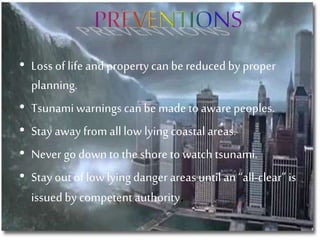
• Loss of life and property can be reduced by proper
planning.
• Tsunamiwarnings canbe made to aware peoples.
• Stay away from alllow lying coastal areas.
• Never go down to the shore to watch tsunami.
• Stay out oflow lying danger areas until an “all-clear” is
issuedby competent authority.
• Avoid building or living in buildings within several hundred
feet of the coastline. These areas are more likely to
experience damage from tsunamis, strong winds, or coastal
storms.
Make a list of items to bring inside in the event of a tsunami.
A list will help you remember anything that can be swept
away by tsunami waters.
• Elevate coastal homes. Most tsunami waves are less than 10
feet. Elevating your house will help reduce damage to your
property from most tsunamis.
• Follow flood preparedness precautions. Tsunamis are large
amounts of water that crash onto the coastline, creating
floods.
• Have an engineer check your home and advise about ways to
make it more resistant to tsunami water. There may be ways
to divert waves away from your property. Improperly built
walls could make your situation worse. Consult with a
professional for advice.
• Develop a Family Disaster Plan
• Learn about tsunami risk in your community
• If you are visiting an area at risk from tsunamis,
check with the hotel, motel, or campground
operators for tsunami evacuation information
• Plan an evacuation route from your home, school,
workplace, or any other place you'll be where
tsunamis present a risk.
• Practice your evacuation route
• Use a NOAA Weather Radio with a tone-alert
feature to keep you informed of local watches and
warnings.
• Discuss tsunami with your family
• Assemble a Disaster Supplies Kit
A tsunami can travel at
well over 970 kph (600
mph) in the open ocean - as
fast as a jet flies. It can
take only a few hours for a
tsunami to travel across an
entire ocean. A regular
wave (generated by the
THE TSUNAMI

THE TSUNAMI

  • 2.
  • 3.
    Tsunamis are giantwaves caused by earthquakes or volcanic eruptions under the sea. Out in the depths of the ocean , tsunami waves do not dramatically increase in height. But as the waves travel inland, they build up to higher heights as the depth of the ocean decreases
  • 4.
    EARTHQUAKES Most tsunami arecaused by large earthquakes on the sea floor when slabs of rock move past each other suddenly, causing the overlying water to move. The resulting waves move away from the source of the earthquake event. LANDSLIDES Underwater landslides can cause tsunami as can terrestrial land which slumps into the ocean. VOLCANIC ERUPTIONS Less common are tsunami initiated by volcanic eruptions. These occur in several ways: destructive collapse of coastal, island and underwater volcanoes which result in massive landslides pyroclastic flows, which are dense mixtures of hot blocks, pumice, ash and gas, plunging down volcanic slopes into the ocean and pushing water outwards a caldera volcano collapsing after an eruption causing overlying water to drop suddenly.
  • 5.
    1. Approximately 80%of tsunamisoccur in the PacificOcean's Ring of Fire,where earthquakesand volcanoes are common. 2. A tsunamican reach speeds of 500 miles per hour, which is almost the speed of a jet airplane. 3. Because of theirspeed, a tsunamicould cross the PacificOcean in only one day. 4. The longwave-lengthof a tsunamiallows it to maintainits strength as it moves toward shore. 5. As a tsunaminears the shore,it slows down, butit gains more height and energy.
  • 7.
    Many people havethe mistaken belief that tsunamis are single waves. They are not. Instead tsunamis are "wave trains" consisting of multiple waves. The chart below is a tidal gauge record from Onagawa, Japan beginning at the time of the 1960 Chile earthquake. Time is plotted along the horizontal axis and water level is plotted on the vertical axis. Note the normal rise and fall of the ocean surface, caused by tides, during the early part of this record. Then recorded are a few waves a little larger than normal followed by several much larger waves. In many tsunami events the shoreline is pounded by repeated large waves
  • 9.
    • Tsunamis occurmost frequently in the Pacific Ocean , but are • a global phenomenon; they are possible wherever large bodies of • water are found, including inland lakes, where they can be caused • by landslides. • Japan is a nation with the most recorded tsunamis in the • world. The earliest recorded disaster being that of the 684 A.D. •
  • 10.
    • An earthquakeis a natural tsunami warning. If you feel a strong quake do not stay in a place where you are exposed to a tsunami. If you hear of an earthquake be aware of the possibility of a tsunami and listen to the radio or television for additional information. • Many people were killed by the Indian Ocean tsunami because they went down to the beach to view the retreating ocean exposing the seafloor. • Remember that a tsunami is a series of waves and that the first wave may not be the most dangerous. The danger from a tsunami can last for several hours after the arrival of the first wave.
  • 11.
    1. Whenin coastalareas, they stay aleart from tsunami warnings 2. Plan evacuation route that leads to higherground 3. Know the warning signs of a tsunami: rapidilyrising or fallingcoastal waters and rumblings ofan offshare earthquake 4. Never stay near shore to watch a tsunami come in
  • 14.
    • On themorning of Dec. 26, 2004, a magnitude-9.1 earthquake whose epicenter was located 160 km off Indonesia's Sumatra coast, unleashed the most powerful tsunami recorded in history. • It killed about 230,000 people in 14 countries. • India lost more than 16,000 people as villages were wiped out along its southern coast and on the Andaman and Nicobar Island chain.
  • 16.
    • The Andamanand Nicobar islands have not left the tsunami behind, only because the tsunami has not left them. Along with its visible reminders like broken buildings and damaged roads, the tsunami here is felt as well, like a twist in the heart. • Questions about glasses half empty or half full are meaningless. There is no glass anymore - life as it was, tenuously linked by satellite telephones, stately ferries and one civilian helicopter, will never be the same again. It is said dignitaries looked around on some of the southern islands and asked to see some damage. • The tsunami has obliterated all trace of human life, leaving behind nothing but silver sands and a virgin beach. It is a terrifying paradise.
  • 17.
    • Tsunami deathtoll tops118,000. • Around 10,000 killed in India. • In Thailand, more than 4,000are feared dead and dozens of deaths are reported in Malaysia, Myanmar andMaldives. • WHO estimates five millionpeopleare without basicneeds.
  • 19.
    1. 2004 IndianOcean Earthquake and Tsunami 2. 1755 Lisbon Earthquake and Tsunami 3. 1868 Arica Tsunami 4. 1908 Messina Earthquake and Tsunami 5. 2011 Sendai Earthquake and Tsunami 6. 1960 Hilo Tsunami 7. 1896 Honshu Tsunami 8. 1498 Meio Nankaido Earthquake and Tsunami 9. 1946 Aleutian Tsunami 10.1883 Krakatoa Tsunami
  • 20.
    • Continue listeningto a NOAA Weather Radio, Coast Guard emergency frequency station, or other reliable source for emergency information • Help injured or trapped persons • Use the telephone only for emergency calls • Stay out of the building if waters remain around it • Examine walls, floors, doors, staircases, and windows to make sure that the building is not in danger of collapsing. • Inspect foundations for cracks or other damage
  • 21.
    • Loss oflife and property can be reduced by proper planning. • Tsunamiwarnings canbe made to aware peoples. • Stay away from alllow lying coastal areas. • Never go down to the shore to watch tsunami. • Stay out oflow lying danger areas until an “all-clear” is issuedby competent authority.
  • 22.
    • Avoid buildingor living in buildings within several hundred feet of the coastline. These areas are more likely to experience damage from tsunamis, strong winds, or coastal storms. Make a list of items to bring inside in the event of a tsunami. A list will help you remember anything that can be swept away by tsunami waters. • Elevate coastal homes. Most tsunami waves are less than 10 feet. Elevating your house will help reduce damage to your property from most tsunamis. • Follow flood preparedness precautions. Tsunamis are large amounts of water that crash onto the coastline, creating floods. • Have an engineer check your home and advise about ways to make it more resistant to tsunami water. There may be ways to divert waves away from your property. Improperly built walls could make your situation worse. Consult with a professional for advice.
  • 23.
    • Develop aFamily Disaster Plan • Learn about tsunami risk in your community • If you are visiting an area at risk from tsunamis, check with the hotel, motel, or campground operators for tsunami evacuation information • Plan an evacuation route from your home, school, workplace, or any other place you'll be where tsunamis present a risk. • Practice your evacuation route • Use a NOAA Weather Radio with a tone-alert feature to keep you informed of local watches and warnings. • Discuss tsunami with your family • Assemble a Disaster Supplies Kit
  • 24.
    A tsunami cantravel at well over 970 kph (600 mph) in the open ocean - as fast as a jet flies. It can take only a few hours for a tsunami to travel across an entire ocean. A regular wave (generated by the