Disaster Management
in India
SOP-15
Ann Maria Mathew
Antony Dexter D’Morris
Deepam S S
Satheesh K V
Siyad Mohammed Iqbal
Vineesh D
Major Disasters in India
1984

Bhopal Gas Tragedy
2001 Gujarat earthquake
2004 Indian Ocean tsunami
2008 Mumbai attacks 
India’s Vulnerability to Disasters
57%

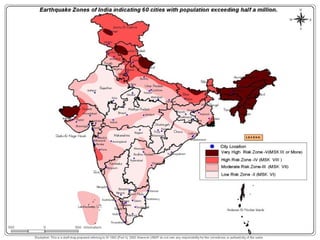
land is vulnerable to earthquakes. Of these,
12% is vulnerable to severe earthquakes.
68% land is vulnerable to drought.
12% land is vulnerable to floods.
8% land is vulnerable to cyclones.
Apart from natural disasters, some cities in
India are also vulnerable to chemical and
industrial disasters and man-made disasters.
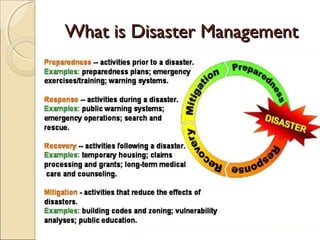
What is Disaster Management
GOI – NGO Disaster preparation and
Response Committee
 Chairman

– JS, (NDM), DAC

 Coordinator

– CARE India

 Members
 World

Vision of India
 SOS Children's Village India
 Ramakrishna Mission
 Plan international
 OXFAM India Trust
Contd…..
 Lutheran

World Service India
 Red Cross
 Catholic Relief Services
 CASA
 CARITAS India
 Voluntary Health association Of India
 Action Aid
 Action for Food Production-AFPRO
 Indo German Social Services Society
Disaster Management Centres in India
















Andhra Pradesh
Arunachal Pradesh
Assam
Bihar
Chhattisgarh
Delhi
Gujarat
Haryana
Himachal Pradesh
Jammu and Kashmir
Jharkhand
Karnataka
Kerala
Madhya Pradesh
Maharashtra
















Manipur
Meghalaya
Mizoram
Nagaland
Odisha
Punjab
Rajasthan
Sikkim
Tamil Nadu
Tezpur University, Assam
Tripura
Uttar Pradesh
Uttarakhand
West Bengal
Training programme of NIDM
Areas of Concern
 Activating

an Early Warning System network and its close
monitoring
 Mechanisms for integrating the scientific, technological and
administrative agencies for effective disaster management
 Terrestrial communication links which collapse in the
event of a rapid onset disaster
 Vulnerability of critical infrastructures (power supply,
communication, water supply, transport, etc.) to disaster
events
Contd…
 Funding

: Primacy of relief as disaster response.
 Preparedness and Mitigation very often ignored.
 Lack of integrated efforts to collect and compile data,
information and local knowledge on disaster history and
traditional response patterns.
 Need for standardized efforts in compiling and interpreting
geo-spatial data, satellite imagery and early warning signals.
 Weak areas continue to be forecasting, modeling, risk
prediction, simulation and scenario analysis, etc.
Contd…
 Absence

of a national level, state level, and district level
directory of experts and inventory of resources.
 Absence of a National Disaster Management Plan, and State
level and district level disaster management plans.
 Sustainability of efforts
 Effective Inter Agency Co-ordination and Standard
Operating Procedures for stakeholder groups, especially
critical first responder agencies.
 Emergency medicine, critical care medicine, triage, first aid
Nodal Agencies for Disaster Management














Floods : Ministry of Water Resources, CWC
Cyclones : Indian Meteorological Department
Earthquakes : Indian Meteorological Department
Epidemics : Ministry of Health and Family Welfare
Avian Flu: Ministry of Health, Ministry of Environment,
Ministry of Agriculture and Animal Husbandry
Chemical Disasters : Ministry of Environment and Forests
Industrial Disasters : Ministry of Labour
Rail Accidents : Ministry of Railways
Air Accidents : Ministry of Civil Aviation
Fire : Ministry of Home Affairs
Nuclear Incidents : Department of Atomic Energy
Mine Disasters : Department of Mines
Dynamics of Disasters
There

is a high probability or a low probability
for an event happening somewhere sometime
soon…
The unpredictability of disaster events and the
high risk and vulnerability profiles make it
imperative to strengthen disaster preparedness,
mitigation and enforcement of guidelines,
building codes and restrictions on construction
of buildings in flood-prone areas and storm
surge prone coastal areas.
New Directions for Disaster
Management in India
The

National Disaster Management Authority
(NDMA) has been set up as the apex body for
Disaster Management in India, with the Prime
Minister as its Chairman.
Disaster Management Authorities will be set up
at the State and District Levels to be headed by
the Chief Ministers and Collectors/Zilla
Parishad Chairmen respectively.
A

New Directions for Disaster
Management in India

National Disaster Mitigation Fund will be administerd
by NDMA. States and districts will administer mitigation
funds.
 A National Disaster Response Fund will be administerd
by NDMA through the National Executive Committee.
States and Districts will administer state Disaster
Response Fund and Disaster Response Fund
respectively.
 8 Battalions of National Disaster Response Force
(NDRF) are being trained and deployed with CSSR and
MFR equipments and tools in eight strategic locations.
 A National Disaster Management Policy and National
Disaster Response Plan will also be drawn up.
Lessons Learnt
Be

Prepared : Preparedness and Mitigation
is bound to yield more effective returns
than distributing relief after a disaster.
Create a Culture of Preparedness and
Prevention.
Evolve a code of conduct for all stakeholders
Future Directions
Encourage

and consolidate knowledge networks
Mobilise and train disaster volunteers for more
effective preparedness, mitigation and response
(NSS, NCC, Scouts and Guides, NYK, Civil
Defence, Homeguards)
Increased capacity building leads to faster
vulnerability reduction.
Learn from best practices in disaster
preparedness, mitigation and disaster response
Future Directions
 Mobilising

stakeholder participation of Self Help Groups,
Women’s Groups, Youth Groups, Panchayati Raj
Institutions
 Anticipatory Governance: Simulation exercises, Mock
drills and Scenario Analysis
 Indigenous knowledge systems and coping practices
 Living with Risk: Community Based Disaster Risk
Management
 Inclusive, participatory, gender sensitive, child friendly,
eco-friendly and disabled friendly disaster management
 Technology driven but people owned
 Knowledge Management: Documentation and
dissemination of good practices
 Public Private Partnership
Invest in Preparedness
Investments

in Preparedness and Prevention
(Mitigation) will yield sustainable results,
rather than spending money on relief after a
disaster.
Most disasters are predictable, especially in
their seasonality and the disaster-prone areas
which are vulnerable.
Communities must be involved in disaster
preparedness.
Best Practices
On

12 November, 1970 a major cyclone hit the
coastal belt of Bangladesh at 223 km/hr. with a
storm surge of six to nine meters height, killing an
estimated 500,000 people.
Due to the Cyclone Preparedness Program, the
April 1991 cyclone with wind speed of 225 km/hr.
killed only 138,000 people even though the coastal
population had doubled by that time.
In May 1994, in a similar cyclone with a wind speed
of 250 km/hr. only 127 people lost their lives.
In May 1997, in a cyclone with wind speed of 200
km/hr. only 111 people lost their lives.
New possibilities
National

Urban Renewal Mission for 70 cities:
recent experience of “unprecedented” extreme
weather conditions in a few major metros and
megacities
100,000 Rural Knowledge Centres
( IT Kiosks): Need for Spatial e-Governance for
informed decision making in disaster-prone
areas: before, during and after disasters
Disaster Reduction Day
NIDM

observed "Disaster Reduction
Day" on the 12th October
Rallies and special lectures were
organized in the universities and colleges
to mark the initiatives of awareness for
disaster reduction amongst youth &
children
Children's Colour Activity Book for
Disaster Preparedness
FOR

INFORMATION ON DISASTERS
DIAL TOLL FREE No. 1070
(or)

Log

on to http://www.ndmindia.nic.in
Disastermgmtfinal 111204073413-phpapp01

Disastermgmtfinal 111204073413-phpapp01

  • 1.
    Disaster Management in India SOP-15 AnnMaria Mathew Antony Dexter D’Morris Deepam S S Satheesh K V Siyad Mohammed Iqbal Vineesh D
  • 2.
    Major Disasters inIndia 1984 Bhopal Gas Tragedy 2001 Gujarat earthquake 2004 Indian Ocean tsunami 2008 Mumbai attacks 
  • 3.
    India’s Vulnerability toDisasters 57% land is vulnerable to earthquakes. Of these, 12% is vulnerable to severe earthquakes. 68% land is vulnerable to drought. 12% land is vulnerable to floods. 8% land is vulnerable to cyclones. Apart from natural disasters, some cities in India are also vulnerable to chemical and industrial disasters and man-made disasters.
  • 7.
    What is DisasterManagement
  • 8.
    GOI – NGODisaster preparation and Response Committee  Chairman – JS, (NDM), DAC  Coordinator – CARE India  Members  World Vision of India  SOS Children's Village India  Ramakrishna Mission  Plan international  OXFAM India Trust
  • 9.
    Contd…..  Lutheran World ServiceIndia  Red Cross  Catholic Relief Services  CASA  CARITAS India  Voluntary Health association Of India  Action Aid  Action for Food Production-AFPRO  Indo German Social Services Society
  • 10.
    Disaster Management Centresin India                Andhra Pradesh Arunachal Pradesh Assam Bihar Chhattisgarh Delhi Gujarat Haryana Himachal Pradesh Jammu and Kashmir Jharkhand Karnataka Kerala Madhya Pradesh Maharashtra               Manipur Meghalaya Mizoram Nagaland Odisha Punjab Rajasthan Sikkim Tamil Nadu Tezpur University, Assam Tripura Uttar Pradesh Uttarakhand West Bengal
  • 11.
  • 12.
    Areas of Concern Activating an Early Warning System network and its close monitoring  Mechanisms for integrating the scientific, technological and administrative agencies for effective disaster management  Terrestrial communication links which collapse in the event of a rapid onset disaster  Vulnerability of critical infrastructures (power supply, communication, water supply, transport, etc.) to disaster events
  • 13.
    Contd…  Funding : Primacyof relief as disaster response.  Preparedness and Mitigation very often ignored.  Lack of integrated efforts to collect and compile data, information and local knowledge on disaster history and traditional response patterns.  Need for standardized efforts in compiling and interpreting geo-spatial data, satellite imagery and early warning signals.  Weak areas continue to be forecasting, modeling, risk prediction, simulation and scenario analysis, etc.
  • 14.
    Contd…  Absence of anational level, state level, and district level directory of experts and inventory of resources.  Absence of a National Disaster Management Plan, and State level and district level disaster management plans.  Sustainability of efforts  Effective Inter Agency Co-ordination and Standard Operating Procedures for stakeholder groups, especially critical first responder agencies.  Emergency medicine, critical care medicine, triage, first aid
  • 15.
    Nodal Agencies forDisaster Management              Floods : Ministry of Water Resources, CWC Cyclones : Indian Meteorological Department Earthquakes : Indian Meteorological Department Epidemics : Ministry of Health and Family Welfare Avian Flu: Ministry of Health, Ministry of Environment, Ministry of Agriculture and Animal Husbandry Chemical Disasters : Ministry of Environment and Forests Industrial Disasters : Ministry of Labour Rail Accidents : Ministry of Railways Air Accidents : Ministry of Civil Aviation Fire : Ministry of Home Affairs Nuclear Incidents : Department of Atomic Energy Mine Disasters : Department of Mines
  • 16.
    Dynamics of Disasters There isa high probability or a low probability for an event happening somewhere sometime soon… The unpredictability of disaster events and the high risk and vulnerability profiles make it imperative to strengthen disaster preparedness, mitigation and enforcement of guidelines, building codes and restrictions on construction of buildings in flood-prone areas and storm surge prone coastal areas.
  • 17.
    New Directions forDisaster Management in India The National Disaster Management Authority (NDMA) has been set up as the apex body for Disaster Management in India, with the Prime Minister as its Chairman. Disaster Management Authorities will be set up at the State and District Levels to be headed by the Chief Ministers and Collectors/Zilla Parishad Chairmen respectively.
  • 18.
    A New Directions forDisaster Management in India National Disaster Mitigation Fund will be administerd by NDMA. States and districts will administer mitigation funds.  A National Disaster Response Fund will be administerd by NDMA through the National Executive Committee. States and Districts will administer state Disaster Response Fund and Disaster Response Fund respectively.  8 Battalions of National Disaster Response Force (NDRF) are being trained and deployed with CSSR and MFR equipments and tools in eight strategic locations.  A National Disaster Management Policy and National Disaster Response Plan will also be drawn up.
  • 19.
    Lessons Learnt Be Prepared :Preparedness and Mitigation is bound to yield more effective returns than distributing relief after a disaster. Create a Culture of Preparedness and Prevention. Evolve a code of conduct for all stakeholders
  • 20.
    Future Directions Encourage and consolidateknowledge networks Mobilise and train disaster volunteers for more effective preparedness, mitigation and response (NSS, NCC, Scouts and Guides, NYK, Civil Defence, Homeguards) Increased capacity building leads to faster vulnerability reduction. Learn from best practices in disaster preparedness, mitigation and disaster response
  • 21.
    Future Directions  Mobilising stakeholderparticipation of Self Help Groups, Women’s Groups, Youth Groups, Panchayati Raj Institutions  Anticipatory Governance: Simulation exercises, Mock drills and Scenario Analysis  Indigenous knowledge systems and coping practices  Living with Risk: Community Based Disaster Risk Management  Inclusive, participatory, gender sensitive, child friendly, eco-friendly and disabled friendly disaster management  Technology driven but people owned  Knowledge Management: Documentation and dissemination of good practices  Public Private Partnership
  • 22.
    Invest in Preparedness Investments inPreparedness and Prevention (Mitigation) will yield sustainable results, rather than spending money on relief after a disaster. Most disasters are predictable, especially in their seasonality and the disaster-prone areas which are vulnerable. Communities must be involved in disaster preparedness.
  • 23.
    Best Practices On 12 November,1970 a major cyclone hit the coastal belt of Bangladesh at 223 km/hr. with a storm surge of six to nine meters height, killing an estimated 500,000 people. Due to the Cyclone Preparedness Program, the April 1991 cyclone with wind speed of 225 km/hr. killed only 138,000 people even though the coastal population had doubled by that time. In May 1994, in a similar cyclone with a wind speed of 250 km/hr. only 127 people lost their lives. In May 1997, in a cyclone with wind speed of 200 km/hr. only 111 people lost their lives.
  • 24.
    New possibilities National Urban RenewalMission for 70 cities: recent experience of “unprecedented” extreme weather conditions in a few major metros and megacities 100,000 Rural Knowledge Centres ( IT Kiosks): Need for Spatial e-Governance for informed decision making in disaster-prone areas: before, during and after disasters
  • 25.
    Disaster Reduction Day NIDM observed"Disaster Reduction Day" on the 12th October Rallies and special lectures were organized in the universities and colleges to mark the initiatives of awareness for disaster reduction amongst youth & children Children's Colour Activity Book for Disaster Preparedness
  • 26.
    FOR INFORMATION ON DISASTERS DIALTOLL FREE No. 1070 (or) Log on to http://www.ndmindia.nic.in