
Collaborative
Planning Model
Planning Theory
Piter Biswas
piterbiswas11@gmail.com
COLLABORATION
As well as the concepts for collaboration via team
working noted above, a key aspect of this ontology
has been to make explicit the concepts needed to
represent the collaboration of problem solving
across different levels and functional units. The
ontology addresses this by having two fundamental
entities:
• goals, representing problems to be solved
• plans (and tasks) representing the solutions to the
problems.
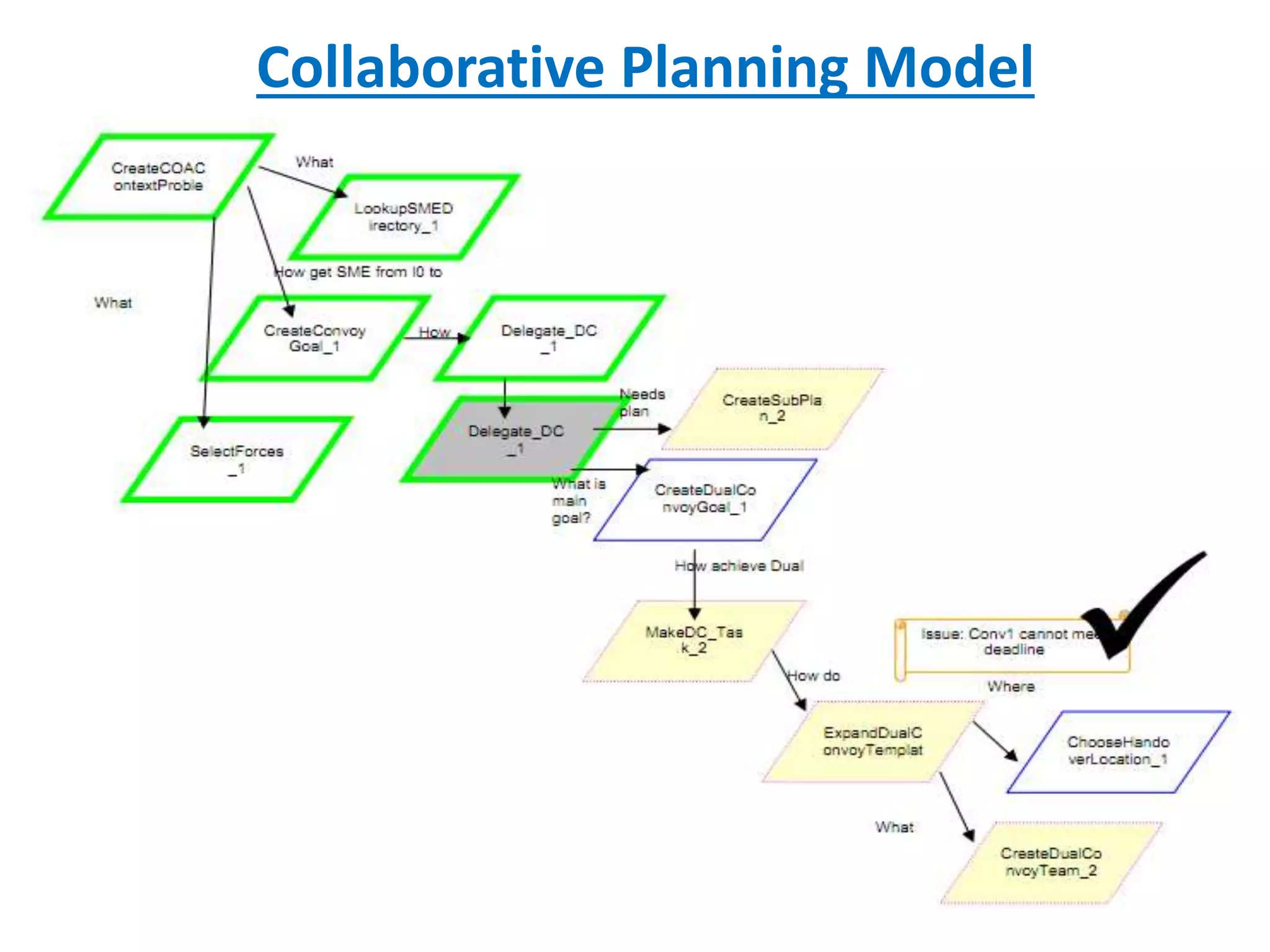
Collaborative Planning Model
People engage in dialogues for a reason. Their intentions
guide their behavior and their conversational partners'
recognition of those intentions aids in the latter's
understanding of their utterances.
The dialogue contains two subtask sub dialogues; the
dialogue in a correction sub dialogue; and the dialogue in
two knowledge precondition sub dialogues. The names of
the sub dialogue types are suggestive of a conversational
participant's reason for engaging in them. Although these
reasons are diverse, the dialogues all exhibit a common
structural regularity; the recognition of this structure is
crucial for discourse processing.
Continue…….
Intuitive analyses of the sample dialogues serve to illustrate
this point. Before presenting these analyses, however, we
first introduce some terminology that will be used
throughout the paper.
A discourse is composed of discourse segments much as a
sentence is composed of constituent phrases.
The segmental structure of the sample dialogues is indicated
by the bold rule grouping utterances into segments. Whereas
the term discourse segment applies to all types of discourse,
the term sub dialogue is reserved for segments that occur
within dialogues.
Collaborative Planning Workshop
Self-Assessment
WHAT DID I LEARN?
The purposes of this workshop
Look at your questions
Did we meet the purpose of the
workshop?
Did we answer your questions?
What did you learn well enough to
teach someone else?
What are your “new” questions?
Purpose of the Workshop
Explore the Essential Elements of PYP
Create and understand Central Ideas
Illuminate Central Ideas through Lines of
Inquiry
Write authentic assessment
Use the elements of PYP throughout the
workshop as you would in the classroom
Learn through and about inquiry
The Shared Plan Definitions
Discourses are fundamentally examples of collaborative
behavior. The participants in a discourse work together to
satisfy various of their individual and joint needs. Thus, to
be sufficient to underlie discourse theory, a theory of
actions, plans, and plan recognition must deal adequately
with collaboration.
Shared Plans are more complex than individual plans in
several ways. First, the group of agents involved in a Shared
Plan must have mutual belief of a recipe for action. Second,
they must designate a single agent or subgroup of agents to
perform each sub act in their recipe. Third, the agents
involved in a Shared Plan must have commitments toward
their own actions, as well as those of their partners.
Identifying Parameters
An agent must also be able to identify the parameters of
an act o~ to be able to perform it. The ability to identify
an object is highly context dependent. The relation is
used to represent that an agent can identify a parameter
for some purpose. For that to be the case, the agent must
have a description of the parameter such that is of the
appropriate sort.
The definitions of the Shared Plan ability operators
include three components. The definitions of these
operators now state that for an agent to be able to
perform an act it must (i) have a recipe (ii) be able to
identify the parameters and (iii) be able to satisfy the
constraints of its recipe.
Reasoning with Shared Plans
In more traditional plan-based approaches to natural
language processing, reasoning about plans is focused on
reasoning about actions. In these models, actions are
represented using operators derived from STRIPS and
NOAH. Such operators include: a header, specifying the
action and its parameters; a precondition list, specifying
the conditions that must be true for the action to be
performed; 8 a body, specifying how the action is to be
performed; and an effects list, specifying the conditions
that will hold after the action is performed. Under these
models, reasoning about plans involves reasoning
according to rules that derive from the components of the
plan operators. The corresponding rule for plan
construction states.
Collaborative Planning Model
FUTURE WORK
The work reported is the initial ontology and reasoning
model of the Collaborative Planning Model, undertaken
during the IPP task. Further work is required including:
• the general refining and filling out of details in the
ontology, based upon feedback, and hopefully usage of
the ontology on different ITA tasks,
• the specific working out of more team working logic
and the corresponding ontology definitions, based
upon a deeper understanding of the logic of belief and
team maintenance propositions, and the experience of
other tasks working on team working approaches,
Continue…….
• the analysis of more realistic military examples, and
military doctrines, with a view to characterizing the
differences in doctrines, the motivations for such
differences, and the further defining of the Doctrine
entities,
• the input of cognitive factors to the plan
representation,
• the standardization of the reasoning across different
plan entities to permit assumption based reasoning
and replanning,
• the better use of OWL reasoning tools,
• the further develop of ontology tools, including the
validation, input and diagramming of ontology.
Resources
Barth, Roland. Restructuring Schools: Some Questions for Teachers and
Principals. San Francisco: Jossey-Bass,1991.
Bishop, A.P.,Bertram, B.C.,Lunsford, K.J. & al. Supporting Community Inquiry with
Digital Resources. Journal Of Digital Information, 5 (3:) 2004.
Buzzeo, Toni. “Collaborating to Meet Standards: Teacher -Library Media
Specialists Partners for K-6”.Ohio: Linworth, 2002.
DuFour, Richard. http://www.allthingsplc.info (online) March, 2008
 DuFour, Richard and Robert Eaker. “Professional Learning Communities at Work”.
Virginia :Solution Tree: 1998.
Erickson, Lynn. Concept-Based Curriculum and Instruction: Teaching Beyond the
Facts.” California : Corwin Press: 2002.
Gibbs, Jeanne. “Tribes: A New Way of Learning and Being Together”. California:
Center Source, 2001.
Hughes, Marcia and James Bradford Terrell. “The Emotionally Intelligent Team”.
San Francisco : Jossey-Bass, 2007.
Kanter, R. The Turnaround Solution. 2004
Katzenbach, J.R., & Smith, D.K. The wisdom of teams: Creating the high
performance organization. Boston, MA: Harvard Business School Press, 1993.
“Leading Teams.” Boston : Harvard Business School Press, 2006.
 “Making It Happen.” International Baccalaureate.
Resources
Montiel-Overall, Patricia. “Towards a Theory of Collaboration for Teachers and
Librarians”. American Association of School Librarians, 2002.
Robbins Harvey and Michael Finlay. “The New Why Teams Don’t Work.” San
Francisco :BK Publishers, 1995.
 Patterson, Kerry, Joseph Greeny, Ron McMillan and Al Switzler. “Crucial
Conversations: Tools for Talking When Stakes are High”. New York : MsGraw Hill,
2002.
“ Running Meetings.” Boston : Harvard Business School Press, 2006.
Schrage, Michael. “Shared Minds”. Random House: New York, 1990.
Tuckman, Bruce. “Forming-storming-norming-performing”. 1970.
Urbanski, A (1992) as quoted by Dunklee,, Dennis. “If You Want to Lead Not Just
Manage”. California: Corwin Press, 2002.
Tomlinson, Carol Ann and Jay McTighe. “ Integrating Differentiated Instruction
and Understanding by Design”. Virginia: Association for Supervision and
Curriculum Development, 2006.
“What Work Requires of Schools: A SCANS Report for America 2000”.
U.S.Department of Labor, June 1991, pp. xvii-xviii.
Wndover, Robert . The Center for Generational Studies. http://ww
w.gentrends.com/
Wiggins, and McTIghe. “ Understanding by Design”. Prentice Hall; Expanded
2nd edition, 2005.
Conclusion
In this power point presentation, we have
developed a computational model for
recognizing the intentional structure of a
discourse and using that structure in
discourse processing. Shared-Plans are used
both to represent the components of
intentional structure segment purposes and
their interrelationships, and to reason about
the use of intentional structure in utterance
interpretation.
Thank You………

Collaborative Planning Model

  • 1.
  • 2.
    COLLABORATION As well asthe concepts for collaboration via team working noted above, a key aspect of this ontology has been to make explicit the concepts needed to represent the collaboration of problem solving across different levels and functional units. The ontology addresses this by having two fundamental entities: • goals, representing problems to be solved • plans (and tasks) representing the solutions to the problems.
  • 3.
    Collaborative Planning Model Peopleengage in dialogues for a reason. Their intentions guide their behavior and their conversational partners' recognition of those intentions aids in the latter's understanding of their utterances. The dialogue contains two subtask sub dialogues; the dialogue in a correction sub dialogue; and the dialogue in two knowledge precondition sub dialogues. The names of the sub dialogue types are suggestive of a conversational participant's reason for engaging in them. Although these reasons are diverse, the dialogues all exhibit a common structural regularity; the recognition of this structure is crucial for discourse processing.
  • 4.
    Continue……. Intuitive analyses ofthe sample dialogues serve to illustrate this point. Before presenting these analyses, however, we first introduce some terminology that will be used throughout the paper. A discourse is composed of discourse segments much as a sentence is composed of constituent phrases. The segmental structure of the sample dialogues is indicated by the bold rule grouping utterances into segments. Whereas the term discourse segment applies to all types of discourse, the term sub dialogue is reserved for segments that occur within dialogues.
  • 5.
    Collaborative Planning Workshop Self-Assessment WHATDID I LEARN? The purposes of this workshop Look at your questions Did we meet the purpose of the workshop? Did we answer your questions? What did you learn well enough to teach someone else? What are your “new” questions?
  • 6.
    Purpose of theWorkshop Explore the Essential Elements of PYP Create and understand Central Ideas Illuminate Central Ideas through Lines of Inquiry Write authentic assessment Use the elements of PYP throughout the workshop as you would in the classroom Learn through and about inquiry
  • 7.
    The Shared PlanDefinitions Discourses are fundamentally examples of collaborative behavior. The participants in a discourse work together to satisfy various of their individual and joint needs. Thus, to be sufficient to underlie discourse theory, a theory of actions, plans, and plan recognition must deal adequately with collaboration. Shared Plans are more complex than individual plans in several ways. First, the group of agents involved in a Shared Plan must have mutual belief of a recipe for action. Second, they must designate a single agent or subgroup of agents to perform each sub act in their recipe. Third, the agents involved in a Shared Plan must have commitments toward their own actions, as well as those of their partners.
  • 8.
    Identifying Parameters An agentmust also be able to identify the parameters of an act o~ to be able to perform it. The ability to identify an object is highly context dependent. The relation is used to represent that an agent can identify a parameter for some purpose. For that to be the case, the agent must have a description of the parameter such that is of the appropriate sort. The definitions of the Shared Plan ability operators include three components. The definitions of these operators now state that for an agent to be able to perform an act it must (i) have a recipe (ii) be able to identify the parameters and (iii) be able to satisfy the constraints of its recipe.
  • 9.
    Reasoning with SharedPlans In more traditional plan-based approaches to natural language processing, reasoning about plans is focused on reasoning about actions. In these models, actions are represented using operators derived from STRIPS and NOAH. Such operators include: a header, specifying the action and its parameters; a precondition list, specifying the conditions that must be true for the action to be performed; 8 a body, specifying how the action is to be performed; and an effects list, specifying the conditions that will hold after the action is performed. Under these models, reasoning about plans involves reasoning according to rules that derive from the components of the plan operators. The corresponding rule for plan construction states.
  • 10.
  • 11.
    FUTURE WORK The workreported is the initial ontology and reasoning model of the Collaborative Planning Model, undertaken during the IPP task. Further work is required including: • the general refining and filling out of details in the ontology, based upon feedback, and hopefully usage of the ontology on different ITA tasks, • the specific working out of more team working logic and the corresponding ontology definitions, based upon a deeper understanding of the logic of belief and team maintenance propositions, and the experience of other tasks working on team working approaches,
  • 12.
    Continue……. • the analysisof more realistic military examples, and military doctrines, with a view to characterizing the differences in doctrines, the motivations for such differences, and the further defining of the Doctrine entities, • the input of cognitive factors to the plan representation, • the standardization of the reasoning across different plan entities to permit assumption based reasoning and replanning, • the better use of OWL reasoning tools, • the further develop of ontology tools, including the validation, input and diagramming of ontology.
  • 13.
    Resources Barth, Roland. RestructuringSchools: Some Questions for Teachers and Principals. San Francisco: Jossey-Bass,1991. Bishop, A.P.,Bertram, B.C.,Lunsford, K.J. & al. Supporting Community Inquiry with Digital Resources. Journal Of Digital Information, 5 (3:) 2004. Buzzeo, Toni. “Collaborating to Meet Standards: Teacher -Library Media Specialists Partners for K-6”.Ohio: Linworth, 2002. DuFour, Richard. http://www.allthingsplc.info (online) March, 2008  DuFour, Richard and Robert Eaker. “Professional Learning Communities at Work”. Virginia :Solution Tree: 1998. Erickson, Lynn. Concept-Based Curriculum and Instruction: Teaching Beyond the Facts.” California : Corwin Press: 2002. Gibbs, Jeanne. “Tribes: A New Way of Learning and Being Together”. California: Center Source, 2001. Hughes, Marcia and James Bradford Terrell. “The Emotionally Intelligent Team”. San Francisco : Jossey-Bass, 2007. Kanter, R. The Turnaround Solution. 2004 Katzenbach, J.R., & Smith, D.K. The wisdom of teams: Creating the high performance organization. Boston, MA: Harvard Business School Press, 1993. “Leading Teams.” Boston : Harvard Business School Press, 2006.  “Making It Happen.” International Baccalaureate.
  • 14.
    Resources Montiel-Overall, Patricia. “Towardsa Theory of Collaboration for Teachers and Librarians”. American Association of School Librarians, 2002. Robbins Harvey and Michael Finlay. “The New Why Teams Don’t Work.” San Francisco :BK Publishers, 1995.  Patterson, Kerry, Joseph Greeny, Ron McMillan and Al Switzler. “Crucial Conversations: Tools for Talking When Stakes are High”. New York : MsGraw Hill, 2002. “ Running Meetings.” Boston : Harvard Business School Press, 2006. Schrage, Michael. “Shared Minds”. Random House: New York, 1990. Tuckman, Bruce. “Forming-storming-norming-performing”. 1970. Urbanski, A (1992) as quoted by Dunklee,, Dennis. “If You Want to Lead Not Just Manage”. California: Corwin Press, 2002. Tomlinson, Carol Ann and Jay McTighe. “ Integrating Differentiated Instruction and Understanding by Design”. Virginia: Association for Supervision and Curriculum Development, 2006. “What Work Requires of Schools: A SCANS Report for America 2000”. U.S.Department of Labor, June 1991, pp. xvii-xviii. Wndover, Robert . The Center for Generational Studies. http://ww w.gentrends.com/ Wiggins, and McTIghe. “ Understanding by Design”. Prentice Hall; Expanded 2nd edition, 2005.
  • 15.
    Conclusion In this powerpoint presentation, we have developed a computational model for recognizing the intentional structure of a discourse and using that structure in discourse processing. Shared-Plans are used both to represent the components of intentional structure segment purposes and their interrelationships, and to reason about the use of intentional structure in utterance interpretation.
  • 16.