
When  Disaster  Strikes
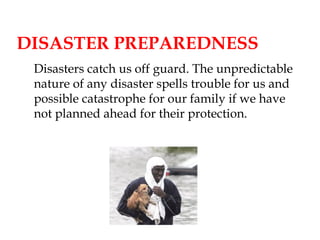
DISASTER PREPAREDNESS Disasters catch us off guard. The unpredictable nature of any disaster spells trouble for us and possible catastrophe for our family if we have not planned ahead for their protection.
Type of disasters: Fire Tornado Hurricane Flood Thunderstorm Earthquake Volcano Hazardous Material
Fire Each year, more than 4,000 Americans die and more than 25,000 are  injured in fires, many of which could be prevented.  To protect yourself, it is important to understand the basic  characteristics of fire. Fire spreads quickly; there is no time to  gather valuables or make a phone call. In just two minutes, a fire  can become life-threatening. In five minutes, a residence can be  engulfed in flames.
What to do in case of a Fire: Evacuate the premises Immediately!
Thunderstorm    and lightning Severe Thunderstorm Warning is issued when severe weather has  been reported by spotters or indicated by radar. Warnings indicate  imminent danger to life and property to those in the path of the  storm. All thunderstorms are dangerous. Every thunderstorm produces  lightning. In the United States, an average of 300 people are injured  and 80 people are killed each year by lightning.
What to do before a Thunderstorm Remove dead trees and branches that could break. Secure objects that could blow away or cause damage.  Go indoors and close window blinds, shades and curtains. Avoid showering or bathing. Plumbing and bathroom fixtures can  conduct electricity. Unplug appliances and other electrical items such as computers. Power  surges from lightning can cause serious damage. Remember the 30/30 lightning safety rule: Go indoors if after seeing  lightning you cannot count to 30 before hearing another thunder.  Stay indoors for 30 minutes after hearing the last clap of thunder.
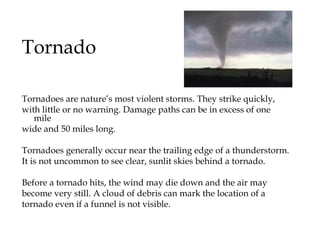
Tornado Tornadoes are nature’s most violent storms. They strike quickly,  with little or no warning. Damage paths can be in excess of one mile  wide and 50 miles long.  Tornadoes generally occur near the trailing edge of a thunderstorm.  It is not uncommon to see clear, sunlit skies behind a tornado. Before a tornado hits, the wind may die down and the air may  become very still. A cloud of debris can mark the location of a  tornado even if a funnel is not visible.
What to do Before a Tornado   Listen to the radio or television newscasts for the latest information. Look for approaching storms and danger signs:  Dark, often greenish sky  Large hail  A large, dark, low-lying cloud (particularly if rotating)  Loud roar, similar to a freight train.  Bring your animals in the house.  Go to the center of an interior room on the lowest level (closet, interior  hallway) away from corners, windows, doors, and outside walls. Put  as many walls as possible between you and the outside.
Hurricane A severe tropical cyclone with wind speeds in excess of 75 mph. As  they move ashore, they bring high winds, tornadoes, torrential rains,  and flooding. The intensity of a landfalling hurricane is expressed in terms of  categories that relate wind speeds and potential damage.  A Category 4 hurricane would have winds between 131 and 155 mph  and, on the average, would usually be expected to cause 100 times the  damage of the Category 1 storm. Depending on circumstances, less  intense storms may still be strong enough to produce damage,  particularly in areas that have not prepared in advance.
What to do in case of a hurricane The best and safest thing to do when there is a hurricane approaching is to evacuate. Listen to the news and follow evacuation instructions Make sure you have a full tank of gas If you do not own a car, make arrangements with family members, a friend or local government  Turn water and electricity off Each family member should pack a small bag with essential items Grab your Emergency Bag Leave as soon as possible
If you are unable to evacuate Secure your home. Close all interior doors—secure and brace external doors and windows. Secure outdoor objects (lawn furniture, trash cans, garden equipment)   Bring your pets inside  Stay indoors during the hurricane and away from windows and glass doors.  Take refuge in a small interior room, closet, or hallway on the lowest level. Listen to the radio or TV for information. Turn the refrigerator thermostat to its coldest setting Ensure a supply of water. Fill the bathtub and other large containers with water.  Avoid using the phone, except for serious emergencies.
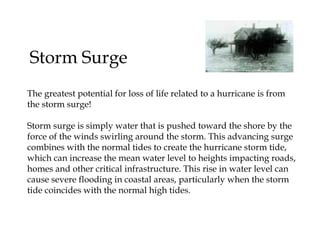
Storm Surge  The greatest potential for loss of life related to a hurricane is from  the storm surge! Storm surge is simply water that is pushed toward the shore by the  force of the winds swirling around the storm. This advancing surge  combines with the normal tides to create the hurricane storm tide,  which can increase the mean water level to heights impacting roads,  homes and other critical infrastructure. This rise in water level can  cause severe flooding in coastal areas, particularly when the storm  tide coincides with the normal high tides.
Floods Floods are one of the most common hazards in the United States. Flood effects can be local, impacting a neighborhood or community, or very large, affecting entire river basins and multiple states. However, all floods are not alike. Some floods develop slowly, sometimes over a period of days. But flash floods can develop quickly,  sometimes in just a few minutes and without any visible signs of rain.
Flash floods often have a dangerous wall of roaring water that carries  rocks, mud, and other debris and can sweep away most things in its  path. Overland flooding occurs outside a defined river or stream, such  as when a levee is breached, but still can be destructive. Flooding can  also occur when a dam breaks, producing effects similar to flash floods. If there is any possibility of a flash flood, move immediately to higher ground.  Do not wait for instructions to move.   If you must evacuate: Turn off utilities at the main switches or valves.  Disconnect electrical appliances. Do not touch electrical equipment if you are  wet or standing in water.  Do not walk through moving water. If you have to walk in water, walk where  the water is not moving. Use a stick to check the firmness of the ground in front of you.  Flash Flood
Six inches of water will reach the bottom of most passenger cars causing loss of control and possible stalling.  A foot of water will float many vehicles.  Two feet of rushing water can carry away most vehicles including sport utility vehicles and pick-ups.  Do not drive into flooded areas. If floodwaters rise around your car, abandon the car and move to higher ground.  Driving Flood Facts:
Earthquake Earthquakes strike suddenly, violently, and without warning at any  time of the day or night. If an earthquake occurs in a populated area, it  may cause many deaths and injuries and extensive property damage. Although there are no guarantees of safety during an earthquake,  identifying potential hazards ahead of time and advance planning can  save lives and significantly reduce injuries and property damage.
What to do after an Earthquake Make sure your family members are in a safe place. Stay away from damaged areas.   Help injured or trapped persons. Give first aid where appropriate. Do not move seriously injured persons unless they are in immediate danger of further injury.  If you smell gas or hear blowing or hissing noise, open a window and quickly leave the building. If possible, turn off the gas at the main valve. Do not use the phone. Look for electrical system damage. If you see sparks or broken or frayed wires, or if you smell hot insulation, turn off the electricity at the main fuse box or circuit breaker.  If you live in coastal areas be aware of possible tsunamis,   also known as seismic sea waves (mistakenly called "tidal waves").
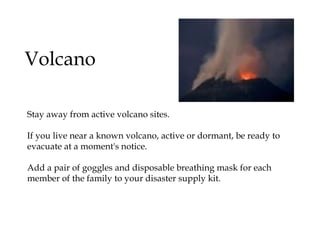
Volcano Stay away from active volcano sites. If you live near a known volcano, active or dormant, be ready to evacuate at a moment's notice. Add a pair of goggles and disposable breathing mask for each member of the family to your disaster supply kit.
Hazardous Material Chemicals are found everywhere. They are shipped daily on the  nation's highways, railroads, waterways, and pipelines. If used or  released improperly, they can be hazardous to humans, animals and  the environment. Hazards can occur during production, storage, transportation, use, or  disposal. You and your community are at risk if a chemical is used  unsafely or released in harmful amounts into the environment where  you live, work, or play. Hazardous materials in various forms can cause death, serious injury,  long-lasting health effects, and damage to buildings, homes, and other  property.
What to do During a Hazardous Materials Incident Listen to the news If you have time, minimize contamination in the house by closing all windows, shutting all vents, and turning off attic fans. If asked to evacuate, do so immediately. Take pre-assembled disaster supplies  Follow the routes recommended by the authorities  Stay at least ½ mile from the disaster area (8-10 blocks) Seek a shelter in a closed room
Most emergency situations are handled locally, but when there is a major incident, help may be needed from other jurisdictions, the state, the federal government, as well as shelters and private organizations.
Before disaster strikes Whether you are an individual,  a family, a business or  a municipal entity,  it is very important to have an  emergency plan in case a disaster occurs.
Planning ahead is crucial and an important part of being prepared.   Have a family meeting. Discuss the types of disasters that are most likely to happen. Explain what to do in each case.  Find the safe places in your home for each type of disaster.  Pick a meeting place outside the home. Determine the best escape routes from your home. Prepare a disaster kit.
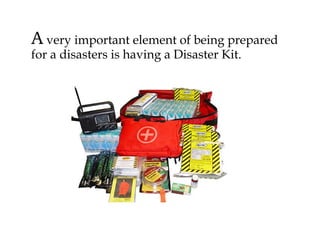
A  very important element of being prepared for a disasters is having a Disaster Kit.
Emergency Disaster Kit You will need the following supplies when you leave your home;  put them all together in a bag or a large container in advance: Flashlight with plenty of extra batteries  Battery-powered radio with extra batteries  First aid kit  Prescription medications in their original bottle Eyeglasses (with a copy of the prescription)  Water (at least one gallon per person; more is better)  Foods that do not require refrigeration or cooking  Items that infants and elderly household members may require  Change of clothes for each household member  Sleeping bag or bedroll and pillow for each household member  Checkbook, cash, and credit cards  Map of the area
Food Preparing for emergencies doesn’t need to be expensive if you plan ahead and buy small quantities at a time.  Make a list of foods that have a long shelf-life and will not spoil, do not require cooking and can be easily stored.
First Aid Kit Take a minute to check your family’s first aid kit and note any depleted items.  Don’t have one?  Assemble a first aid kit for your home and keep one in each vehicle.
Evacuation Evacuation plans must be well thought out and properly planned.  The main purpose is to eliminate danger and ensure the safety of your family.  It is important to assess the overall situation, evaluate potential risks, determine immediate needs and activate available resources.  When planning an evacuation, know where you will be going and the best route there.
If you are in an area that is being evacuated : Listen to a local radio or television station and follow the instructions of local emergency officials.  Evacuate immediately if told to do so by authorities.  Wear long pants, a long-sleeved shirt, and sturdy shoes.  Take you emergency disaster kit. Take your pets with you when you leave. Lock your home .  Use travel routes specified by local authorities.
Sheltering Taking shelter is a critical element in protecting yourself.  In some cases you may take shelter in your home, sometimes you may be at your workplace, and in case of an evacuation, you might have to find a a temporary shelter set up. You must stay in your shelter until local authorities say it's okay to leave.
Disaster Recovery Disaster Recovery is the longest stage of disaster, lasting from a period of days to many years, depending on the scale of the disaster.  The very broad range of recovery activities might include rebuilding homes and businesses, replacing lost or damaged goods and equipment, dealing with lost revenue for individuals, businesses and nonprofits, as well as addressing the emotional damage that disasters create.
The key to a successful recovery is:  Advance Planning
Thank  You

Disaster Preparedness English

  • 1.
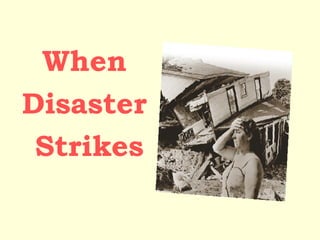
    When Disaster Strikes
  • 2.
    DISASTER PREPAREDNESS Disasterscatch us off guard. The unpredictable nature of any disaster spells trouble for us and possible catastrophe for our family if we have not planned ahead for their protection.
  • 3.
    Type of disasters:Fire Tornado Hurricane Flood Thunderstorm Earthquake Volcano Hazardous Material
  • 4.
    Fire Each year,more than 4,000 Americans die and more than 25,000 are injured in fires, many of which could be prevented. To protect yourself, it is important to understand the basic characteristics of fire. Fire spreads quickly; there is no time to gather valuables or make a phone call. In just two minutes, a fire can become life-threatening. In five minutes, a residence can be engulfed in flames.
  • 5.
    What to doin case of a Fire: Evacuate the premises Immediately!
  • 6.
    Thunderstorm and lightning Severe Thunderstorm Warning is issued when severe weather has been reported by spotters or indicated by radar. Warnings indicate imminent danger to life and property to those in the path of the storm. All thunderstorms are dangerous. Every thunderstorm produces lightning. In the United States, an average of 300 people are injured and 80 people are killed each year by lightning.
  • 7.
    What to dobefore a Thunderstorm Remove dead trees and branches that could break. Secure objects that could blow away or cause damage. Go indoors and close window blinds, shades and curtains. Avoid showering or bathing. Plumbing and bathroom fixtures can conduct electricity. Unplug appliances and other electrical items such as computers. Power surges from lightning can cause serious damage. Remember the 30/30 lightning safety rule: Go indoors if after seeing lightning you cannot count to 30 before hearing another thunder. Stay indoors for 30 minutes after hearing the last clap of thunder.
  • 8.
    Tornado Tornadoes arenature’s most violent storms. They strike quickly, with little or no warning. Damage paths can be in excess of one mile wide and 50 miles long. Tornadoes generally occur near the trailing edge of a thunderstorm. It is not uncommon to see clear, sunlit skies behind a tornado. Before a tornado hits, the wind may die down and the air may become very still. A cloud of debris can mark the location of a tornado even if a funnel is not visible.
  • 9.
    What to doBefore a Tornado Listen to the radio or television newscasts for the latest information. Look for approaching storms and danger signs: Dark, often greenish sky Large hail A large, dark, low-lying cloud (particularly if rotating) Loud roar, similar to a freight train. Bring your animals in the house. Go to the center of an interior room on the lowest level (closet, interior hallway) away from corners, windows, doors, and outside walls. Put as many walls as possible between you and the outside.
  • 10.
    Hurricane A severetropical cyclone with wind speeds in excess of 75 mph. As they move ashore, they bring high winds, tornadoes, torrential rains, and flooding. The intensity of a landfalling hurricane is expressed in terms of categories that relate wind speeds and potential damage. A Category 4 hurricane would have winds between 131 and 155 mph and, on the average, would usually be expected to cause 100 times the damage of the Category 1 storm. Depending on circumstances, less intense storms may still be strong enough to produce damage, particularly in areas that have not prepared in advance.
  • 11.
    What to doin case of a hurricane The best and safest thing to do when there is a hurricane approaching is to evacuate. Listen to the news and follow evacuation instructions Make sure you have a full tank of gas If you do not own a car, make arrangements with family members, a friend or local government Turn water and electricity off Each family member should pack a small bag with essential items Grab your Emergency Bag Leave as soon as possible
  • 12.
    If you areunable to evacuate Secure your home. Close all interior doors—secure and brace external doors and windows. Secure outdoor objects (lawn furniture, trash cans, garden equipment) Bring your pets inside Stay indoors during the hurricane and away from windows and glass doors. Take refuge in a small interior room, closet, or hallway on the lowest level. Listen to the radio or TV for information. Turn the refrigerator thermostat to its coldest setting Ensure a supply of water. Fill the bathtub and other large containers with water. Avoid using the phone, except for serious emergencies.
  • 13.
    Storm Surge The greatest potential for loss of life related to a hurricane is from the storm surge! Storm surge is simply water that is pushed toward the shore by the force of the winds swirling around the storm. This advancing surge combines with the normal tides to create the hurricane storm tide, which can increase the mean water level to heights impacting roads, homes and other critical infrastructure. This rise in water level can cause severe flooding in coastal areas, particularly when the storm tide coincides with the normal high tides.
  • 14.
    Floods Floods areone of the most common hazards in the United States. Flood effects can be local, impacting a neighborhood or community, or very large, affecting entire river basins and multiple states. However, all floods are not alike. Some floods develop slowly, sometimes over a period of days. But flash floods can develop quickly, sometimes in just a few minutes and without any visible signs of rain.
  • 15.
    Flash floods oftenhave a dangerous wall of roaring water that carries rocks, mud, and other debris and can sweep away most things in its path. Overland flooding occurs outside a defined river or stream, such as when a levee is breached, but still can be destructive. Flooding can also occur when a dam breaks, producing effects similar to flash floods. If there is any possibility of a flash flood, move immediately to higher ground. Do not wait for instructions to move. If you must evacuate: Turn off utilities at the main switches or valves. Disconnect electrical appliances. Do not touch electrical equipment if you are wet or standing in water. Do not walk through moving water. If you have to walk in water, walk where the water is not moving. Use a stick to check the firmness of the ground in front of you. Flash Flood
  • 16.
    Six inches ofwater will reach the bottom of most passenger cars causing loss of control and possible stalling. A foot of water will float many vehicles. Two feet of rushing water can carry away most vehicles including sport utility vehicles and pick-ups. Do not drive into flooded areas. If floodwaters rise around your car, abandon the car and move to higher ground. Driving Flood Facts:
  • 17.
    Earthquake Earthquakes strikesuddenly, violently, and without warning at any time of the day or night. If an earthquake occurs in a populated area, it may cause many deaths and injuries and extensive property damage. Although there are no guarantees of safety during an earthquake, identifying potential hazards ahead of time and advance planning can save lives and significantly reduce injuries and property damage.
  • 18.
    What to doafter an Earthquake Make sure your family members are in a safe place. Stay away from damaged areas. Help injured or trapped persons. Give first aid where appropriate. Do not move seriously injured persons unless they are in immediate danger of further injury. If you smell gas or hear blowing or hissing noise, open a window and quickly leave the building. If possible, turn off the gas at the main valve. Do not use the phone. Look for electrical system damage. If you see sparks or broken or frayed wires, or if you smell hot insulation, turn off the electricity at the main fuse box or circuit breaker. If you live in coastal areas be aware of possible tsunamis, also known as seismic sea waves (mistakenly called "tidal waves").
  • 19.
    Volcano Stay awayfrom active volcano sites. If you live near a known volcano, active or dormant, be ready to evacuate at a moment's notice. Add a pair of goggles and disposable breathing mask for each member of the family to your disaster supply kit.
  • 20.
    Hazardous Material Chemicalsare found everywhere. They are shipped daily on the nation's highways, railroads, waterways, and pipelines. If used or released improperly, they can be hazardous to humans, animals and the environment. Hazards can occur during production, storage, transportation, use, or disposal. You and your community are at risk if a chemical is used unsafely or released in harmful amounts into the environment where you live, work, or play. Hazardous materials in various forms can cause death, serious injury, long-lasting health effects, and damage to buildings, homes, and other property.
  • 21.
    What to doDuring a Hazardous Materials Incident Listen to the news If you have time, minimize contamination in the house by closing all windows, shutting all vents, and turning off attic fans. If asked to evacuate, do so immediately. Take pre-assembled disaster supplies Follow the routes recommended by the authorities Stay at least ½ mile from the disaster area (8-10 blocks) Seek a shelter in a closed room
  • 22.
    Most emergency situationsare handled locally, but when there is a major incident, help may be needed from other jurisdictions, the state, the federal government, as well as shelters and private organizations.
  • 23.
    Before disaster strikesWhether you are an individual, a family, a business or a municipal entity, it is very important to have an emergency plan in case a disaster occurs.
  • 24.
    Planning ahead iscrucial and an important part of being prepared. Have a family meeting. Discuss the types of disasters that are most likely to happen. Explain what to do in each case. Find the safe places in your home for each type of disaster. Pick a meeting place outside the home. Determine the best escape routes from your home. Prepare a disaster kit.
  • 25.
    A veryimportant element of being prepared for a disasters is having a Disaster Kit.
  • 26.
    Emergency Disaster KitYou will need the following supplies when you leave your home; put them all together in a bag or a large container in advance: Flashlight with plenty of extra batteries Battery-powered radio with extra batteries First aid kit Prescription medications in their original bottle Eyeglasses (with a copy of the prescription) Water (at least one gallon per person; more is better) Foods that do not require refrigeration or cooking Items that infants and elderly household members may require Change of clothes for each household member Sleeping bag or bedroll and pillow for each household member Checkbook, cash, and credit cards Map of the area
  • 27.
    Food Preparing foremergencies doesn’t need to be expensive if you plan ahead and buy small quantities at a time. Make a list of foods that have a long shelf-life and will not spoil, do not require cooking and can be easily stored.
  • 28.
    First Aid KitTake a minute to check your family’s first aid kit and note any depleted items. Don’t have one? Assemble a first aid kit for your home and keep one in each vehicle.
  • 29.
    Evacuation Evacuation plansmust be well thought out and properly planned. The main purpose is to eliminate danger and ensure the safety of your family. It is important to assess the overall situation, evaluate potential risks, determine immediate needs and activate available resources. When planning an evacuation, know where you will be going and the best route there.
  • 30.
    If you arein an area that is being evacuated : Listen to a local radio or television station and follow the instructions of local emergency officials. Evacuate immediately if told to do so by authorities. Wear long pants, a long-sleeved shirt, and sturdy shoes. Take you emergency disaster kit. Take your pets with you when you leave. Lock your home . Use travel routes specified by local authorities.
  • 31.
    Sheltering Taking shelteris a critical element in protecting yourself. In some cases you may take shelter in your home, sometimes you may be at your workplace, and in case of an evacuation, you might have to find a a temporary shelter set up. You must stay in your shelter until local authorities say it's okay to leave.
  • 32.
    Disaster Recovery DisasterRecovery is the longest stage of disaster, lasting from a period of days to many years, depending on the scale of the disaster. The very broad range of recovery activities might include rebuilding homes and businesses, replacing lost or damaged goods and equipment, dealing with lost revenue for individuals, businesses and nonprofits, as well as addressing the emotional damage that disasters create.
  • 33.
    The key toa successful recovery is: Advance Planning
  • 34.