A SEMINAR BY
SABARINATH C D
B TECH CHEMICAL ENGG.
The climate deal brokered in Paris has been hailed from all quarters as a groundbreaking
document - managing to bring on board 195 nations for a blueprint to successfully cut
down on emissions.
INDIA’S CLIMATE PLEDGE
 India has announced its pledge to cut greenhouse gas (GHG) emissions intensity by
33 to 35 percent based on 2005 levels by 2030
 a strong target and makes clean energy a centerpiece for economic growth.
 Jawaharlal Nehru National Solar Mission (NSM) and set a target of 100 gigawatts
(GW) in installed solar energy capacity by 2022.
 To achieve about 40 percent cumulative electric power installed capacity from non-
fossil fuel based energy resources by 2030 with the help of transfer of technology
and low cost international finance including from Green Climate Fund (GCF).
INTRODUCTION
Paris Climate Summit 2015
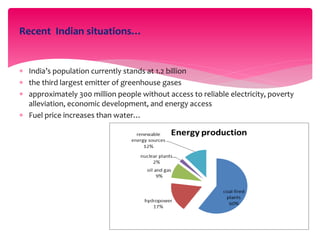
Recent Indian situations…
 India’s population currently stands at 1.2 billion
 the third largest emitter of greenhouse gases
 approximately 300 million people without access to reliable electricity, poverty
alleviation, economic development, and energy access
 Fuel price increases than water…
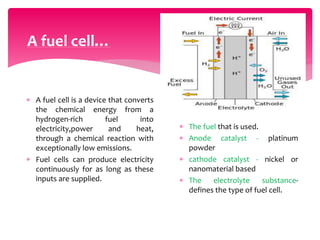
 A fuel cell is a device that converts
the chemical energy from a
hydrogen-rich fuel into
electricity,power and heat,
through a chemical reaction with
exceptionally low emissions.
 Fuel cells can produce electricity
continuously for as long as these
inputs are supplied.
 The fuel that is used.
 Anode catalyst - platinum
powder
 cathode catalyst - nickel or
nanomaterial based
 The electrolyte substance-
defines the type of fuel cell.
A fuel cell…
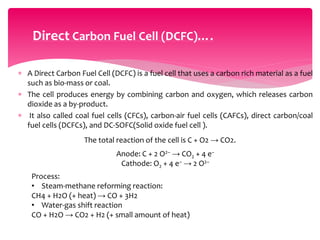
 A Direct Carbon Fuel Cell (DCFC) is a fuel cell that uses a carbon rich material as a fuel
such as bio-mass or coal.
 The cell produces energy by combining carbon and oxygen, which releases carbon
dioxide as a by-product.
 It also called coal fuel cells (CFCs), carbon-air fuel cells (CAFCs), direct carbon/coal
fuel cells (DCFCs), and DC-SOFC(Solid oxide fuel cell ).
Direct Carbon Fuel Cell (DCFC)….
The total reaction of the cell is C + O2 → CO2.
Anode: C + 2 O2− → CO2 + 4 e−
Cathode: O2 + 4 e− → 2 O2−
Process:
• Steam-methane reforming reaction:
CH4 + H2O (+ heat) → CO + 3H2
• Water-gas shift reaction
CO + H2O → CO2 + H2 (+ small amount of heat)
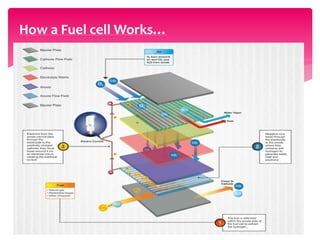
How a Fuel cell Works…
MW Class Sub-MW Class Micro CHP Mobile
Technology
Carbonate
(MCFC)
Phosphoric Acid
(PAFC)
Solid Oxide
(SOFC)
PEM / SOFC Polymer Electrolyte Membrane (PEM)
System size
range
300kW – 2.8MW 400kW up to 200 kW < 10 kW up to 100 kW
Typical
Application
Utilities, large
universities,
industrial –
baseload
Commercial
buildings –
baseload
Commercial
buildings –
baseload
Residential and
small commercial
Transportation
Fuel
Natural gas,
Biogas, others
Natural gas Natural gas Natural gas Hydrogen
Advantages
High efficiency,
scalable, fuel
flexible & CHP
CHP High efficiency
Load following &
CHP
Load following & low temperature
Electrical
efficiency
43%-47% (higher
w/ turbine or
organic rankine
cycle)
40% – 42% 50% – 60% 25% – 35% 25% – 35%
Combined
Heat & Power
(CHP)
Steam, hot
water, chilling &
bottoming cycles
Hot water,
chilling
Depends on
technology used
Suitable for
facility heating
No, which is an advantage for transportation
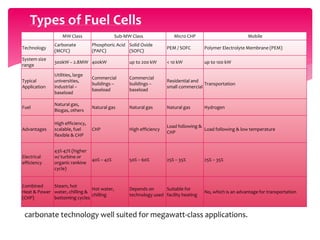
carbonate technology well suited for megawatt-class applications.
Types of Fuel Cells
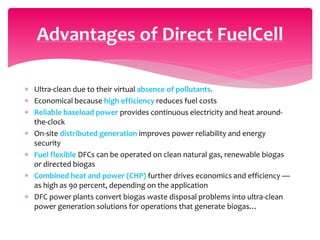
 Ultra-clean due to their virtual absence of pollutants.
 Economical because high efficiency reduces fuel costs
 Reliable baseload power provides continuous electricity and heat around-
the-clock
 On-site distributed generation improves power reliability and energy
security
 Fuel flexible DFCs can be operated on clean natural gas, renewable biogas
or directed biogas
 Combined heat and power (CHP) further drives economics and efficiency —
as high as 90 percent, depending on the application
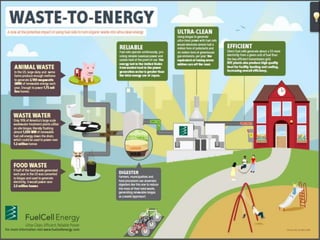
 DFC power plants convert biogas waste disposal problems into ultra-clean
power generation solutions for operations that generate biogas…
Advantages of Direct FuelCell
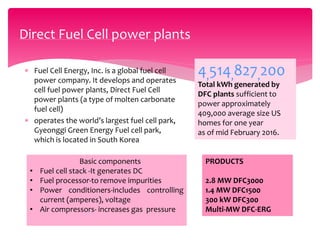
 Fuel Cell Energy, Inc. is a global fuel cell
power company. It develops and operates
cell fuel power plants, Direct Fuel Cell
power plants (a type of molten carbonate
fuel cell)
 operates the world’s largest fuel cell park,
Gyeonggi Green Energy Fuel cell park,
which is located in South Korea
Direct Fuel Cell power plants
4,514,827,200
Total kWh generated by
DFC plants sufficient to
power approximately
409,000 average size US
homes for one year
as of mid February 2016.
PRODUCTS
2.8 MW DFC3000
1.4 MW DFC1500
300 kW DFC300
Multi-MW DFC-ERG
Basic components
• Fuel cell stack -It generates DC
• Fuel processor-to remove impurities
• Power conditioners-includes controlling
current (amperes), voltage
• Air compressors- increases gas pressure
 Advanced technology programs have also been focused on developing fuel
processing approaches that allow the use of DFC power systems with logistics
fuels (fuels used for ships, aircrafts or remote bases), such as jet fuels and diesel
fuels.
 Alternative Fuels
 Hydrogen Co-Production
 Carbon Capture
 Solid Oxide Fuel Cell (SOFC)
Advanced Technologies
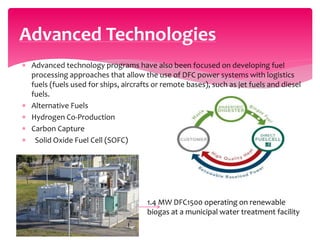
1.4 MW DFC1500 operating on renewable
biogas at a municipal water treatment facility
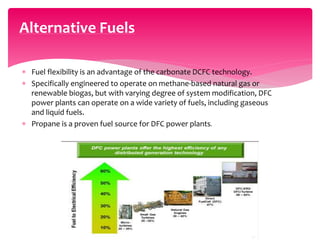
 Fuel flexibility is an advantage of the carbonate DCFC technology.
 Specifically engineered to operate on methane-based natural gas or
renewable biogas, but with varying degree of system modification, DFC
power plants can operate on a wide variety of fuels, including gaseous
and liquid fuels.
 Propane is a proven fuel source for DFC power plants.
Alternative Fuels
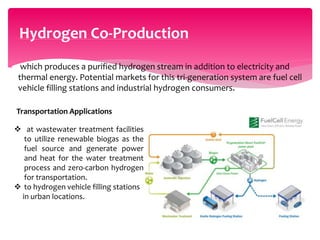
 which produces a purified hydrogen stream in addition to electricity and
thermal energy. Potential markets for this tri-generation system are fuel cell
vehicle filling stations and industrial hydrogen consumers.
Hydrogen Co-Production
Transportation Applications
 at wastewater treatment facilities
to utilize renewable biogas as the
fuel source and generate power
and heat for the water treatment
process and zero-carbon hydrogen
for transportation.
 to hydrogen vehicle filling stations
in urban locations.
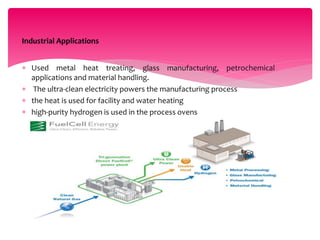
 Used metal heat treating, glass manufacturing, petrochemical
applications and material handling.
 The ultra-clean electricity powers the manufacturing process
 the heat is used for facility and water heating
 high-purity hydrogen is used in the process ovens
Industrial Applications
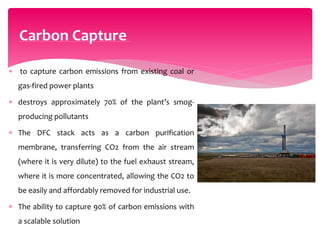
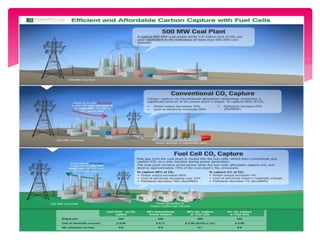
 to capture carbon emissions from existing coal or
gas-fired power plants
 destroys approximately 70% of the plant’s smog-
producing pollutants
 The DFC stack acts as a carbon purification
membrane, transferring CO2 from the air stream
(where it is very dilute) to the fuel exhaust stream,
where it is more concentrated, allowing the CO2 to
be easily and affordably removed for industrial use.
 The ability to capture 90% of carbon emissions with
a scalable solution
Carbon Capture
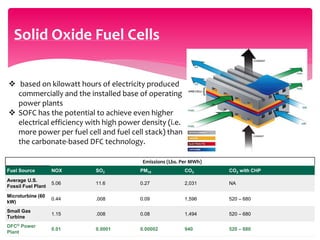
Emissions (Lbs. Per MWh)
Fuel Source NOX SO2 PM10 CO2 CO2 with CHP
Average U.S.
Fossil Fuel Plant
5.06 11.6 0.27 2,031 NA
Microturbine (60
kW)
0.44 .008 0.09 1,596 520 – 680
Small Gas
Turbine
1.15 .008 0.08 1,494 520 – 680
DFC® Power
Plant
0.01 0.0001 0.00002 940 520 – 680
Solid Oxide Fuel Cells
 based on kilowatt hours of electricity produced
commercially and the installed base of operating
power plants
 SOFC has the potential to achieve even higher
electrical efficiency with high power density (i.e.
more power per fuel cell and fuel cell stack) than
the carbonate-based DFC technology.
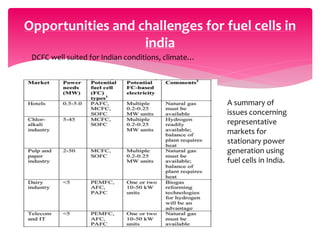
 DCFC well suited for Indian conditions, climate…
Opportunities and challenges for fuel cells in
india
A summary of
issues concerning
representative
markets for
stationary power
generation using
fuel cells in India.
 Several economic and environmental drivers are motivating developing
countries like India to evaluate fuel cells
 The development of new fuel cell that is cost-effective, suited to local
needs, and employs region-specific and opportunity fuels should be
commercially successful
 DCFC is well suited for Indian conditions…
CONCLUSION
 T.S.R. Prasada Rao and Uday T. Turaga,( 2003), OPPORTUNITIES AND CHALLENGES FOR FUEL CELLS IN
INDIA, Prepr. Pap.-Am. Chem. Soc., Div. Fuel Chem. 2003, 48(2),795-796.
 WWW. FUEL CELL ENERGY.COM
 Giddey, S; Badwal SPS; Kulkarni A; Munnings C (2012). "A comprehensive review of direct carbon fuel
cell technology". Progress in energy and combustion science 38 (3): 360–399.
doi:10.1016/j.pecs.2012.01.003.
 Munnings, C.; Kulkarni, A.; Giddey, S.; Badwal, S.P.S. (August 2014). "Biomass to power conversion in a
direct carbon fuel cell". International Journal of Hydrogen Energy 39 (23): 12377–12385.
doi:10.1016/j.ijhydene.2014.03.255.
 "Fuel Cell Basics: Applications". Fuel Cells 2000. Accessed 2 August 2011.
 Emissions Database for Global Atmospheric Research, “GHG (CO_2, CH_4, N_2O, F-gases) emission
time series 1990-2012 per region/country,”http://edgar.jrc.ec.europa.eu/overview.php?v=GHGts1990-
2012 (accessed October 28, 2015). If counting the European Union, India is the fourth largest emitter.
REFERENCES

DIRECT CARBON FUEL CELLS

  • 1.
    A SEMINAR BY SABARINATHC D B TECH CHEMICAL ENGG.
  • 2.
    The climate dealbrokered in Paris has been hailed from all quarters as a groundbreaking document - managing to bring on board 195 nations for a blueprint to successfully cut down on emissions. INDIA’S CLIMATE PLEDGE  India has announced its pledge to cut greenhouse gas (GHG) emissions intensity by 33 to 35 percent based on 2005 levels by 2030  a strong target and makes clean energy a centerpiece for economic growth.  Jawaharlal Nehru National Solar Mission (NSM) and set a target of 100 gigawatts (GW) in installed solar energy capacity by 2022.  To achieve about 40 percent cumulative electric power installed capacity from non- fossil fuel based energy resources by 2030 with the help of transfer of technology and low cost international finance including from Green Climate Fund (GCF). INTRODUCTION Paris Climate Summit 2015
  • 3.
    Recent Indian situations… India’s population currently stands at 1.2 billion  the third largest emitter of greenhouse gases  approximately 300 million people without access to reliable electricity, poverty alleviation, economic development, and energy access  Fuel price increases than water…
  • 4.
     A fuelcell is a device that converts the chemical energy from a hydrogen-rich fuel into electricity,power and heat, through a chemical reaction with exceptionally low emissions.  Fuel cells can produce electricity continuously for as long as these inputs are supplied.  The fuel that is used.  Anode catalyst - platinum powder  cathode catalyst - nickel or nanomaterial based  The electrolyte substance- defines the type of fuel cell. A fuel cell…
  • 5.
     A DirectCarbon Fuel Cell (DCFC) is a fuel cell that uses a carbon rich material as a fuel such as bio-mass or coal.  The cell produces energy by combining carbon and oxygen, which releases carbon dioxide as a by-product.  It also called coal fuel cells (CFCs), carbon-air fuel cells (CAFCs), direct carbon/coal fuel cells (DCFCs), and DC-SOFC(Solid oxide fuel cell ). Direct Carbon Fuel Cell (DCFC)…. The total reaction of the cell is C + O2 → CO2. Anode: C + 2 O2− → CO2 + 4 e− Cathode: O2 + 4 e− → 2 O2− Process: • Steam-methane reforming reaction: CH4 + H2O (+ heat) → CO + 3H2 • Water-gas shift reaction CO + H2O → CO2 + H2 (+ small amount of heat)
  • 6.
    How a Fuelcell Works…
  • 7.
    MW Class Sub-MWClass Micro CHP Mobile Technology Carbonate (MCFC) Phosphoric Acid (PAFC) Solid Oxide (SOFC) PEM / SOFC Polymer Electrolyte Membrane (PEM) System size range 300kW – 2.8MW 400kW up to 200 kW < 10 kW up to 100 kW Typical Application Utilities, large universities, industrial – baseload Commercial buildings – baseload Commercial buildings – baseload Residential and small commercial Transportation Fuel Natural gas, Biogas, others Natural gas Natural gas Natural gas Hydrogen Advantages High efficiency, scalable, fuel flexible & CHP CHP High efficiency Load following & CHP Load following & low temperature Electrical efficiency 43%-47% (higher w/ turbine or organic rankine cycle) 40% – 42% 50% – 60% 25% – 35% 25% – 35% Combined Heat & Power (CHP) Steam, hot water, chilling & bottoming cycles Hot water, chilling Depends on technology used Suitable for facility heating No, which is an advantage for transportation carbonate technology well suited for megawatt-class applications. Types of Fuel Cells
  • 8.
     Ultra-clean dueto their virtual absence of pollutants.  Economical because high efficiency reduces fuel costs  Reliable baseload power provides continuous electricity and heat around- the-clock  On-site distributed generation improves power reliability and energy security  Fuel flexible DFCs can be operated on clean natural gas, renewable biogas or directed biogas  Combined heat and power (CHP) further drives economics and efficiency — as high as 90 percent, depending on the application  DFC power plants convert biogas waste disposal problems into ultra-clean power generation solutions for operations that generate biogas… Advantages of Direct FuelCell
  • 9.
     Fuel CellEnergy, Inc. is a global fuel cell power company. It develops and operates cell fuel power plants, Direct Fuel Cell power plants (a type of molten carbonate fuel cell)  operates the world’s largest fuel cell park, Gyeonggi Green Energy Fuel cell park, which is located in South Korea Direct Fuel Cell power plants 4,514,827,200 Total kWh generated by DFC plants sufficient to power approximately 409,000 average size US homes for one year as of mid February 2016. PRODUCTS 2.8 MW DFC3000 1.4 MW DFC1500 300 kW DFC300 Multi-MW DFC-ERG Basic components • Fuel cell stack -It generates DC • Fuel processor-to remove impurities • Power conditioners-includes controlling current (amperes), voltage • Air compressors- increases gas pressure
  • 11.
     Advanced technologyprograms have also been focused on developing fuel processing approaches that allow the use of DFC power systems with logistics fuels (fuels used for ships, aircrafts or remote bases), such as jet fuels and diesel fuels.  Alternative Fuels  Hydrogen Co-Production  Carbon Capture  Solid Oxide Fuel Cell (SOFC) Advanced Technologies 1.4 MW DFC1500 operating on renewable biogas at a municipal water treatment facility
  • 12.
     Fuel flexibilityis an advantage of the carbonate DCFC technology.  Specifically engineered to operate on methane-based natural gas or renewable biogas, but with varying degree of system modification, DFC power plants can operate on a wide variety of fuels, including gaseous and liquid fuels.  Propane is a proven fuel source for DFC power plants. Alternative Fuels
  • 13.
     which producesa purified hydrogen stream in addition to electricity and thermal energy. Potential markets for this tri-generation system are fuel cell vehicle filling stations and industrial hydrogen consumers. Hydrogen Co-Production Transportation Applications  at wastewater treatment facilities to utilize renewable biogas as the fuel source and generate power and heat for the water treatment process and zero-carbon hydrogen for transportation.  to hydrogen vehicle filling stations in urban locations.
  • 14.
     Used metalheat treating, glass manufacturing, petrochemical applications and material handling.  The ultra-clean electricity powers the manufacturing process  the heat is used for facility and water heating  high-purity hydrogen is used in the process ovens Industrial Applications
  • 15.
     to capturecarbon emissions from existing coal or gas-fired power plants  destroys approximately 70% of the plant’s smog- producing pollutants  The DFC stack acts as a carbon purification membrane, transferring CO2 from the air stream (where it is very dilute) to the fuel exhaust stream, where it is more concentrated, allowing the CO2 to be easily and affordably removed for industrial use.  The ability to capture 90% of carbon emissions with a scalable solution Carbon Capture
  • 17.
    Emissions (Lbs. PerMWh) Fuel Source NOX SO2 PM10 CO2 CO2 with CHP Average U.S. Fossil Fuel Plant 5.06 11.6 0.27 2,031 NA Microturbine (60 kW) 0.44 .008 0.09 1,596 520 – 680 Small Gas Turbine 1.15 .008 0.08 1,494 520 – 680 DFC® Power Plant 0.01 0.0001 0.00002 940 520 – 680 Solid Oxide Fuel Cells  based on kilowatt hours of electricity produced commercially and the installed base of operating power plants  SOFC has the potential to achieve even higher electrical efficiency with high power density (i.e. more power per fuel cell and fuel cell stack) than the carbonate-based DFC technology.
  • 18.
     DCFC wellsuited for Indian conditions, climate… Opportunities and challenges for fuel cells in india A summary of issues concerning representative markets for stationary power generation using fuel cells in India.
  • 19.
     Several economicand environmental drivers are motivating developing countries like India to evaluate fuel cells  The development of new fuel cell that is cost-effective, suited to local needs, and employs region-specific and opportunity fuels should be commercially successful  DCFC is well suited for Indian conditions… CONCLUSION
  • 20.
     T.S.R. PrasadaRao and Uday T. Turaga,( 2003), OPPORTUNITIES AND CHALLENGES FOR FUEL CELLS IN INDIA, Prepr. Pap.-Am. Chem. Soc., Div. Fuel Chem. 2003, 48(2),795-796.  WWW. FUEL CELL ENERGY.COM  Giddey, S; Badwal SPS; Kulkarni A; Munnings C (2012). "A comprehensive review of direct carbon fuel cell technology". Progress in energy and combustion science 38 (3): 360–399. doi:10.1016/j.pecs.2012.01.003.  Munnings, C.; Kulkarni, A.; Giddey, S.; Badwal, S.P.S. (August 2014). "Biomass to power conversion in a direct carbon fuel cell". International Journal of Hydrogen Energy 39 (23): 12377–12385. doi:10.1016/j.ijhydene.2014.03.255.  "Fuel Cell Basics: Applications". Fuel Cells 2000. Accessed 2 August 2011.  Emissions Database for Global Atmospheric Research, “GHG (CO_2, CH_4, N_2O, F-gases) emission time series 1990-2012 per region/country,”http://edgar.jrc.ec.europa.eu/overview.php?v=GHGts1990- 2012 (accessed October 28, 2015). If counting the European Union, India is the fourth largest emitter. REFERENCES