Dirac – Delta Function
&
It’s Properties
Presented by –
Mayur P. Sangole
M.Sc (Physics)
RTM Nagpur University,
Nagpur
Why We Need Dirac – Delta Function?
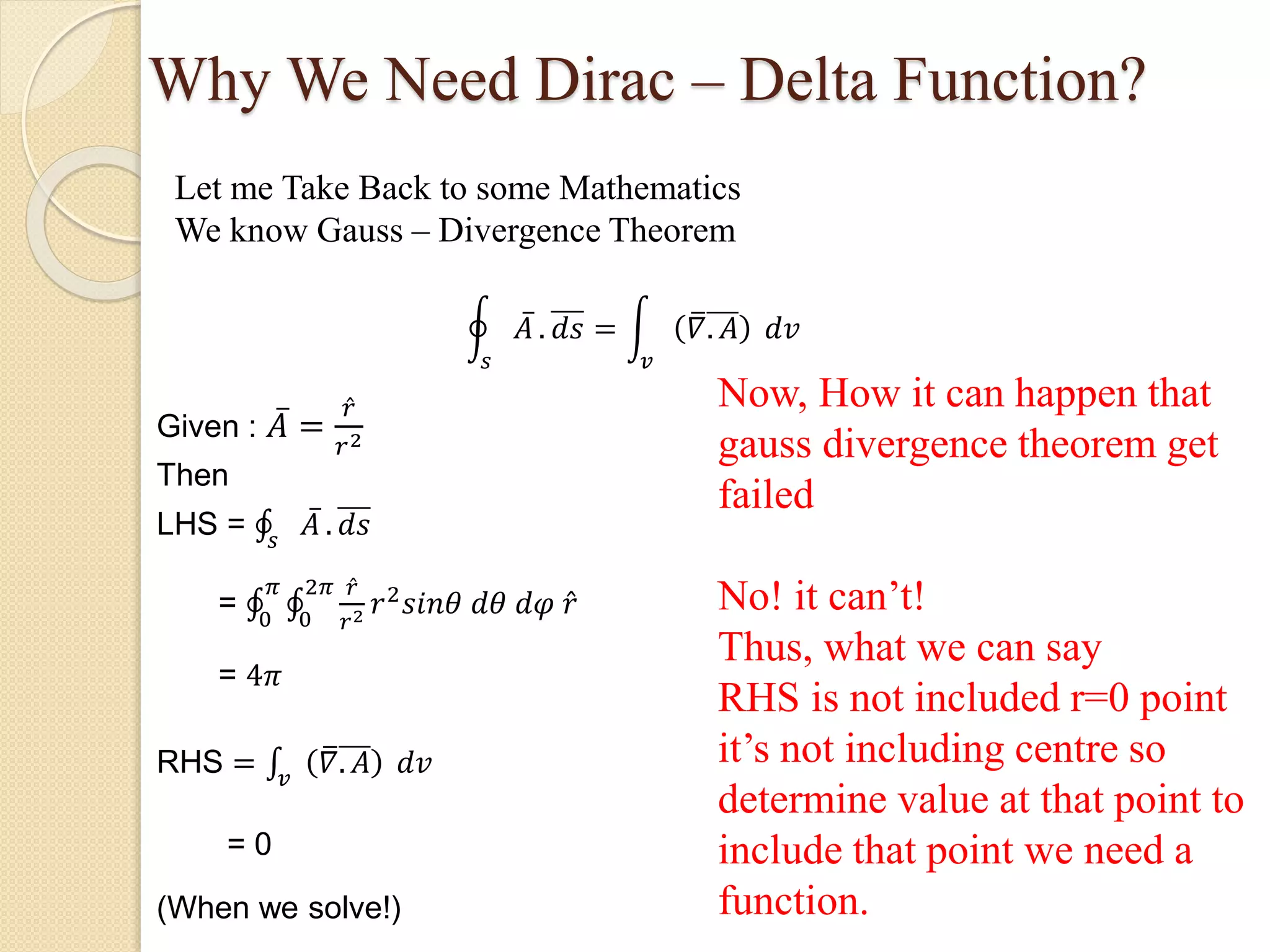
Let me Take Back to some Mathematics
We know Gauss – Divergence Theorem
Given : 𝐴 =
𝑟
𝑟2
Then
LHS = 𝑠
𝐴 . 𝑑𝑠
= 0
𝜋
0
2𝜋 𝑟
𝑟2 𝑟2𝑠𝑖𝑛𝜃 𝑑𝜃 𝑑𝜑 𝑟
= 4𝜋
RHS = 𝑣
𝛻. 𝐴 𝑑𝑣
= 0
(When we solve!)
𝑠
𝐴 . 𝑑𝑠 =
𝑣
𝛻. 𝐴 𝑑𝑣
Now, How it can happen that
gauss divergence theorem get
failed
No! it can’t!
Thus, what we can say
RHS is not included r=0 point
it’s not including centre so
determine value at that point to
include that point we need a
function.
Why We Need Dirac – Delta Function?
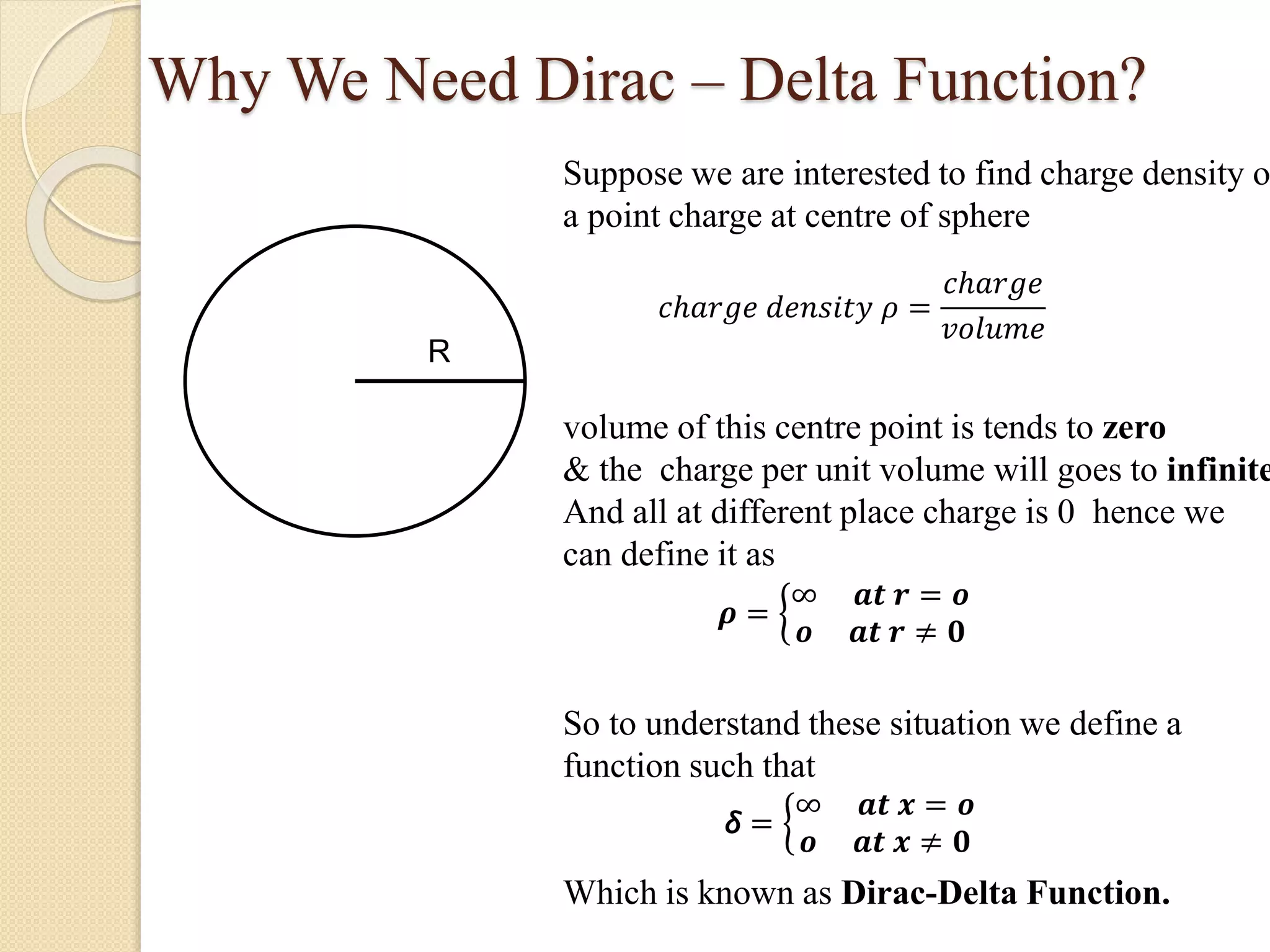
R
Suppose we are interested to find charge density o
a point charge at centre of sphere
volume of this centre point is tends to zero
& the charge per unit volume will goes to infinite
And all at different place charge is 0 hence we
can define it as
So to understand these situation we define a
function such that
Which is known as Dirac-Delta Function.
𝑐ℎ𝑎𝑟𝑔𝑒 𝑑𝑒𝑛𝑠𝑖𝑡𝑦 𝜌 =
𝑐ℎ𝑎𝑟𝑔𝑒
𝑣𝑜𝑙𝑢𝑚𝑒
𝝆 =
∞ 𝒂𝒕 𝒓 = 𝒐
𝒐 𝒂𝒕 𝒓 ≠ 𝟎
δ =
∞ 𝒂𝒕 𝒙 = 𝒐
𝒐 𝒂𝒕 𝒙 ≠ 𝟎
Why We Need Dirac – Delta Function?
Now you may have question why I’m relating
Dirac – Delta Function to Electrodynamics
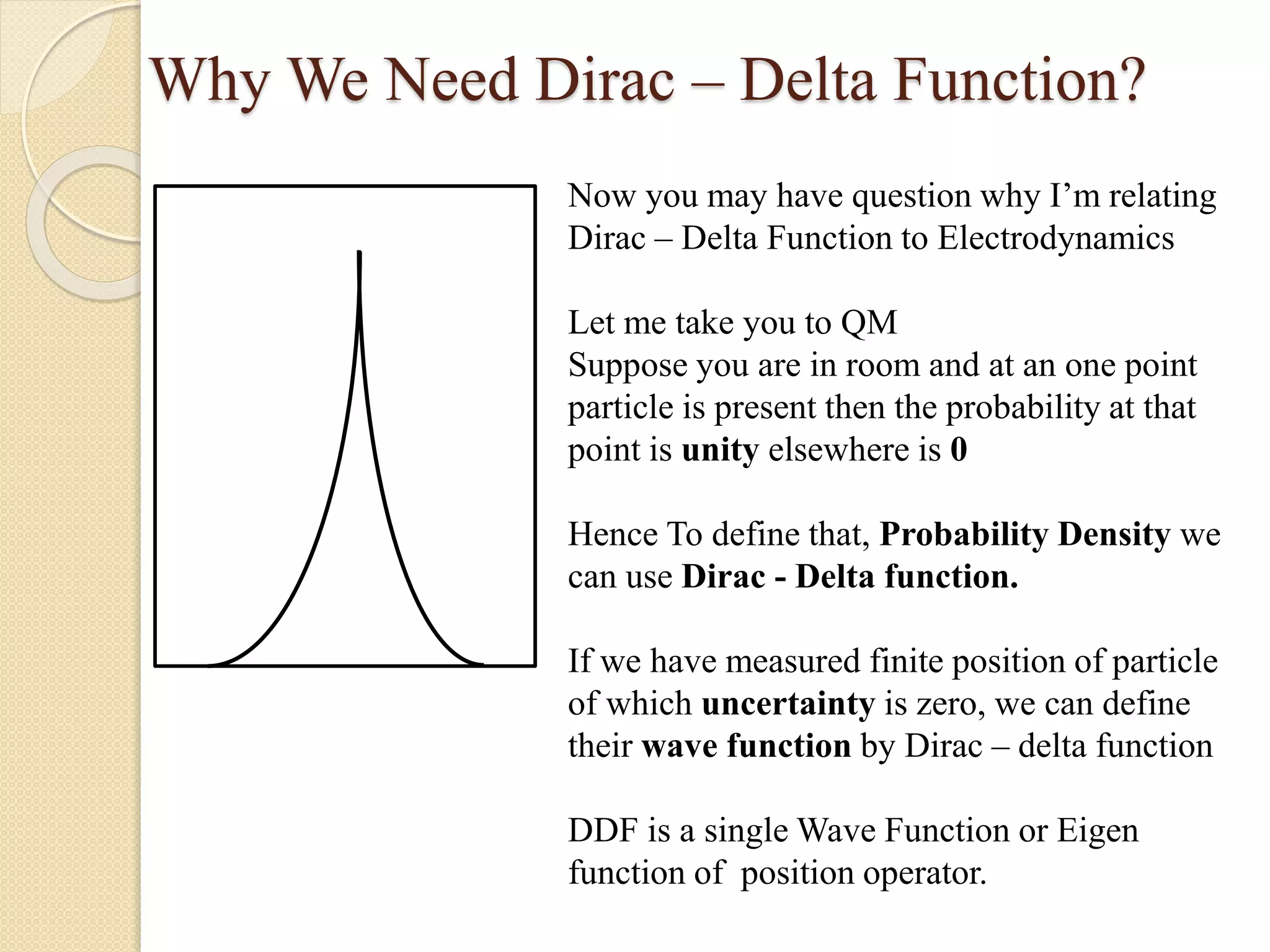
Let me take you to QM
Suppose you are in room and at an one point
particle is present then the probability at that
point is unity elsewhere is 0
Hence To define that, Probability Density we
can use Dirac - Delta function.
If we have measured finite position of particle
of which uncertainty is zero, we can define
their wave function by Dirac – delta function
DDF is a single Wave Function or Eigen
function of position operator.
Dirac – Delta Function
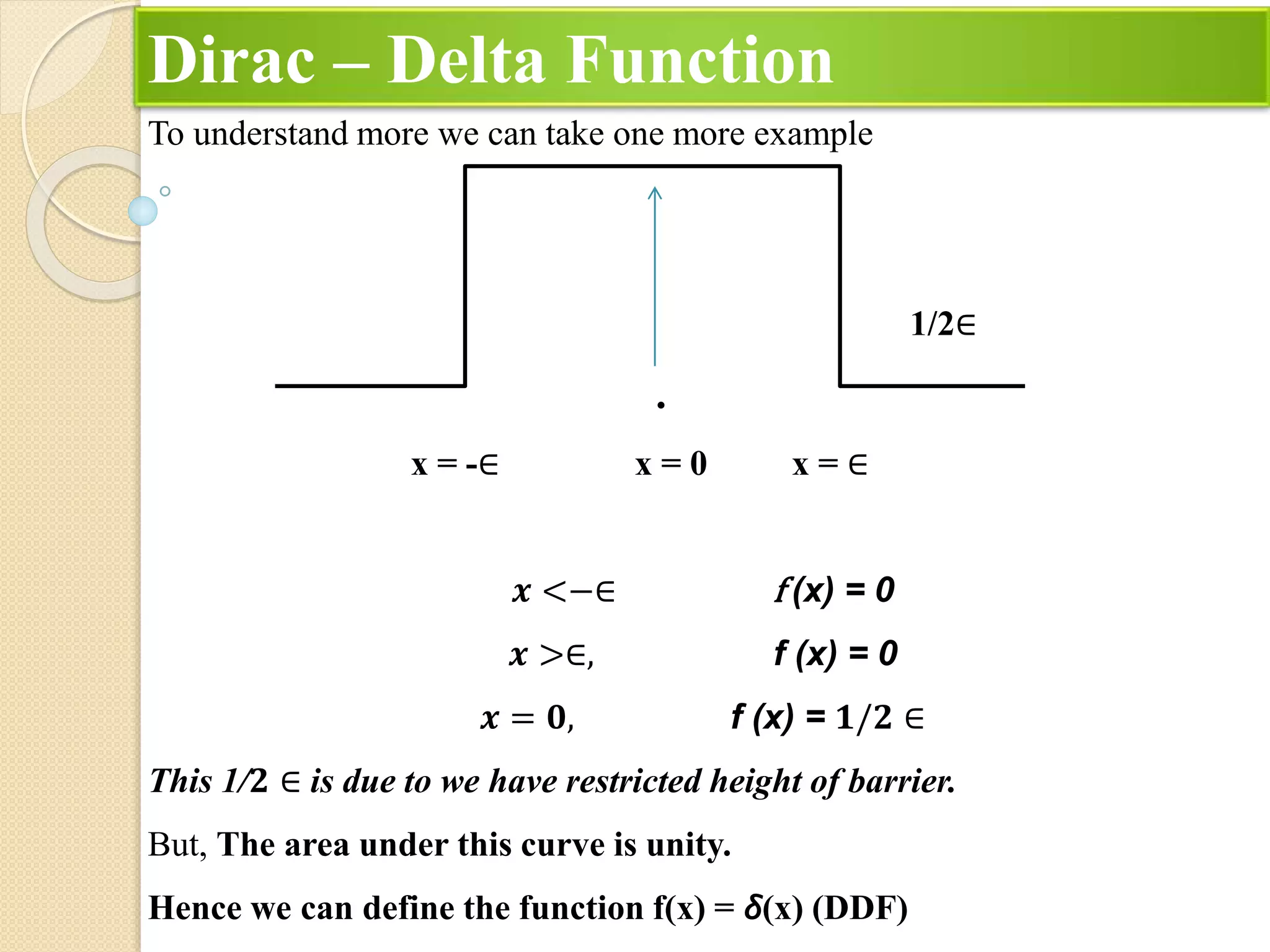
To understand more we can take one more example
1/2∈
.
x = -∈ x = 0 x = ∈
𝒙 <−∈ f (x) = 0
𝒙 >∈, f (x) = 0
𝒙 = 𝟎, f (x) = 𝟏/𝟐 ∈
This 1/𝟐 ∈ is due to we have restricted height of barrier.
But, The area under this curve is unity.
Hence we can define the function f(x) = δ(x) (DDF)
Dirac – Delta Function
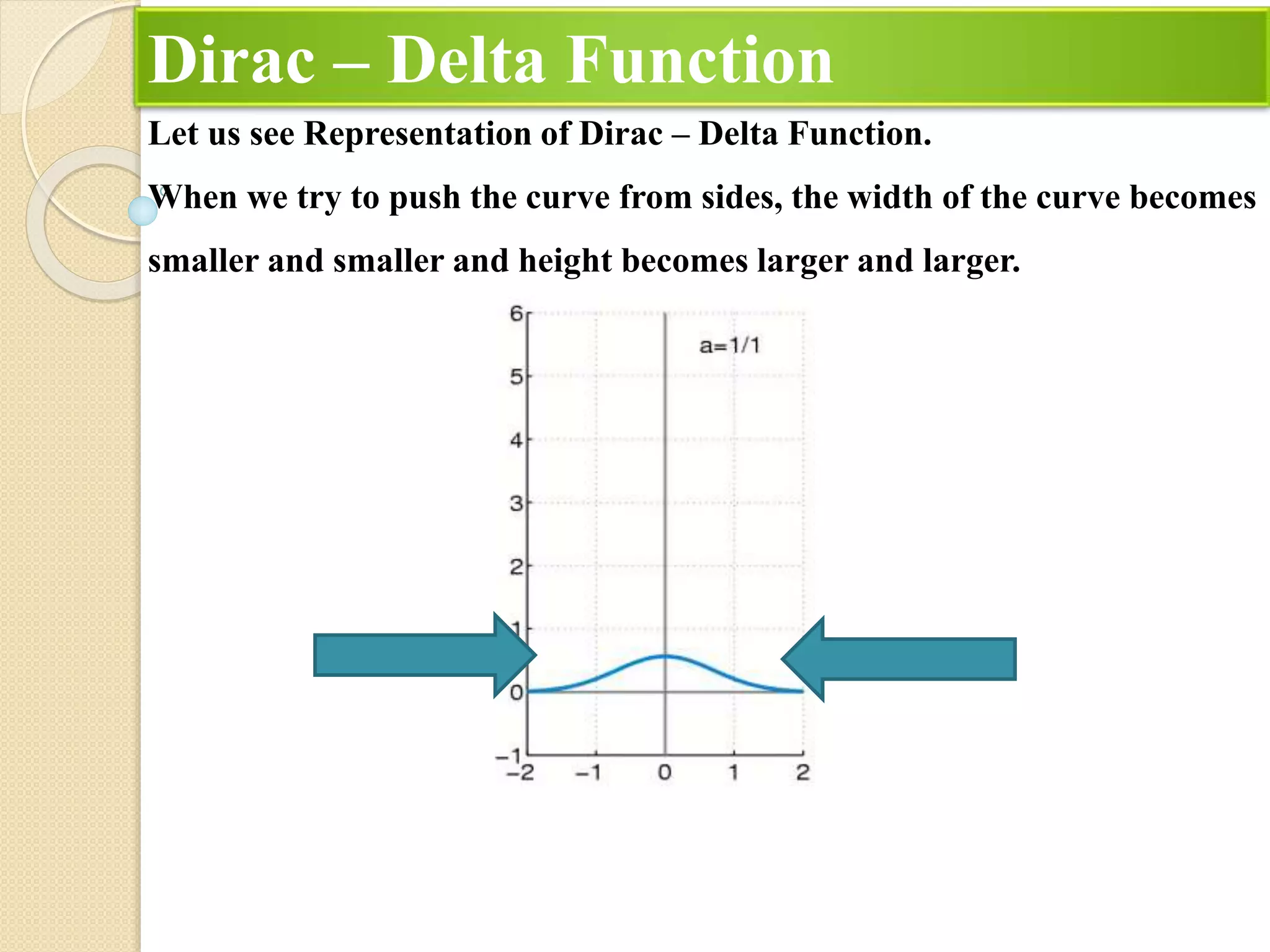
Let us see Representation of Dirac – Delta Function.
When we try to push the curve from sides, the width of the curve becomes
smaller and smaller and height becomes larger and larger.
Properties of Dirac – Delta Function
1. −∞
∞
δ 𝒙 𝒅𝒙 = 𝟏 (Area under the curve =1)
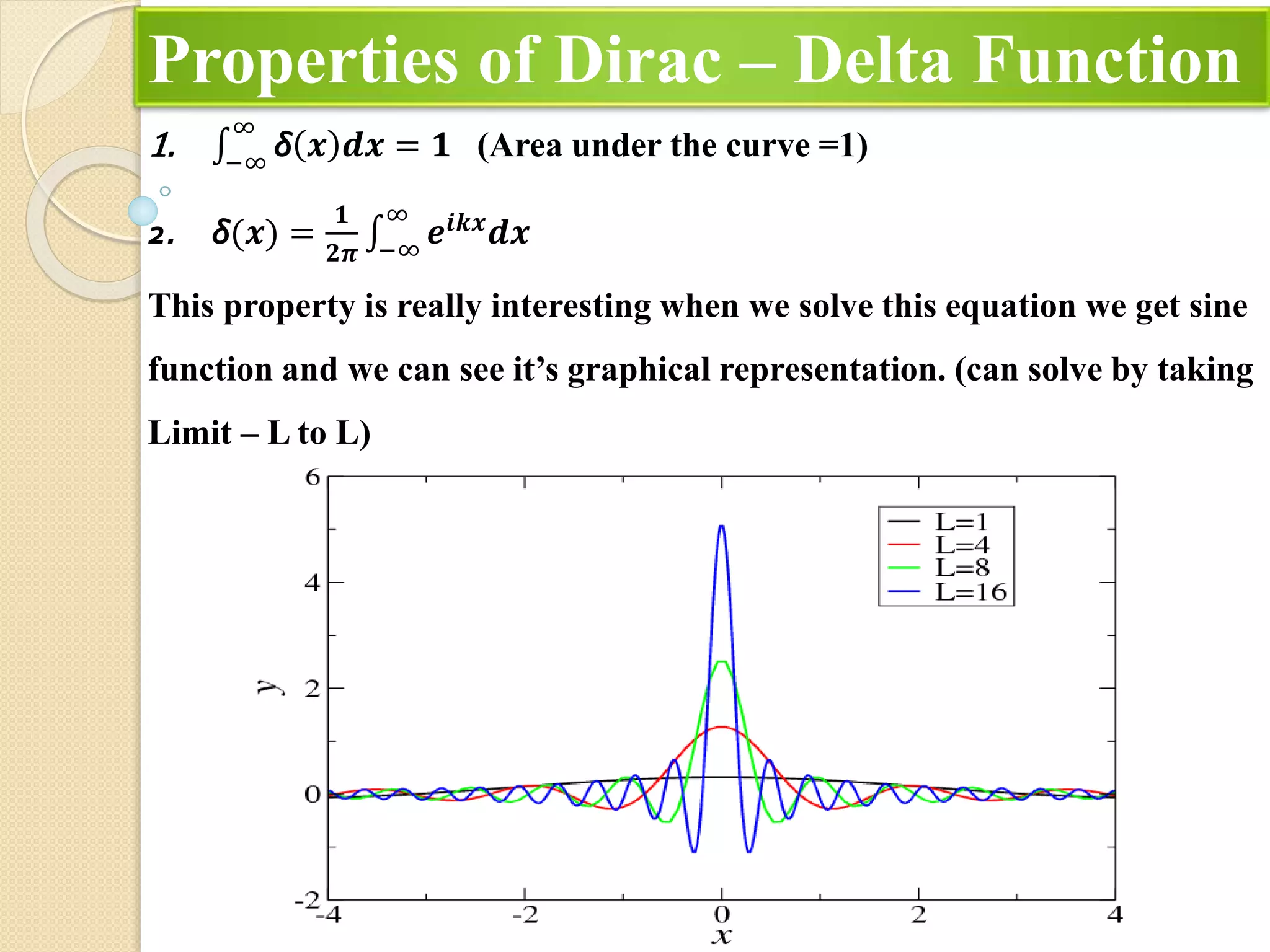
2. δ(𝒙) =
𝟏
𝟐𝝅 −∞
∞
𝒆𝒊𝒌𝒙𝒅𝒙
This property is really interesting when we solve this equation we get sine
function and we can see it’s graphical representation. (can solve by taking
Limit – L to L)
Properties of Dirac – Delta Function
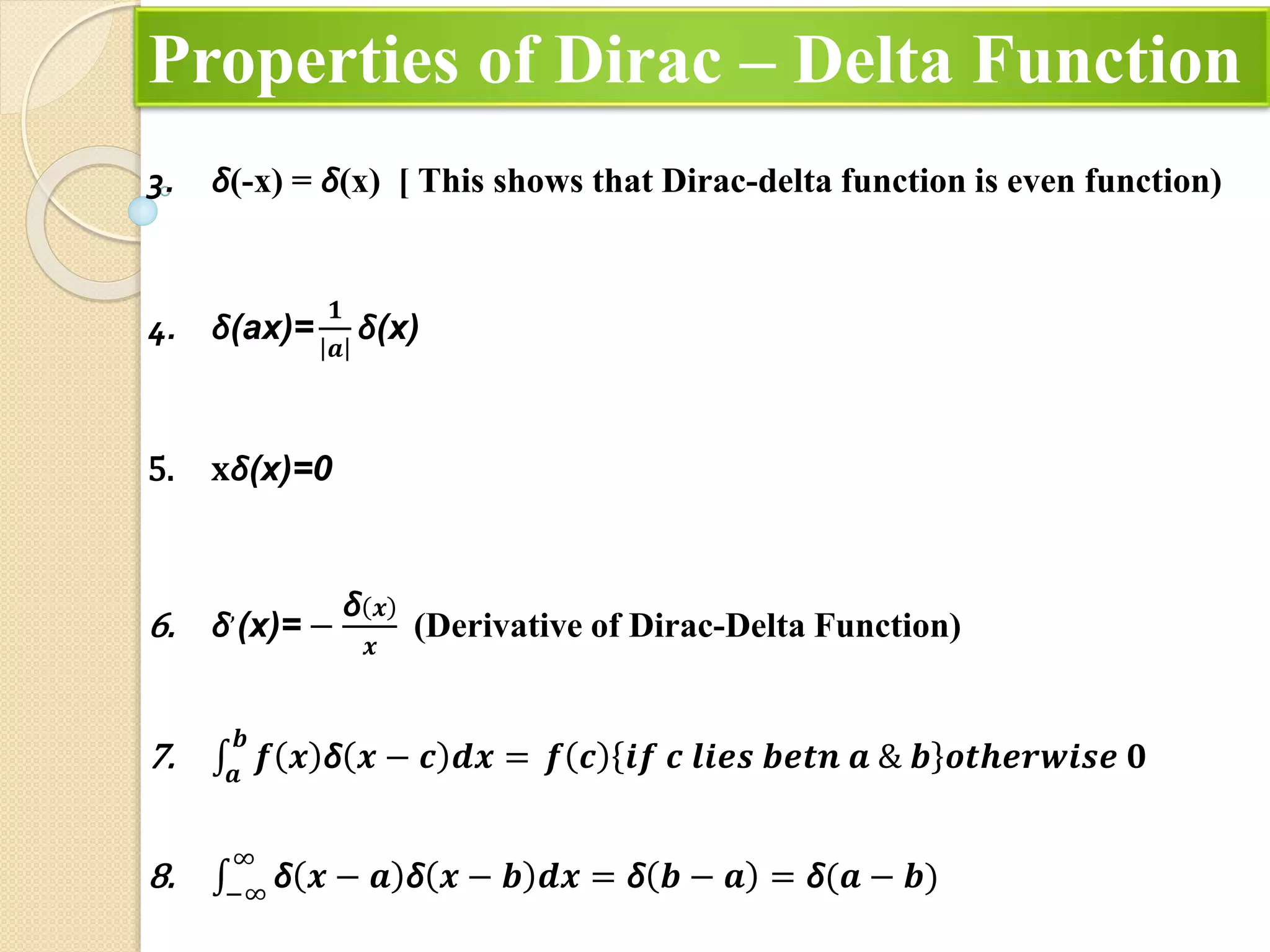
3. δ(-x) = δ(x) [ This shows that Dirac-delta function is even function)
4. δ(ax)=
𝟏
𝒂
δ(x)
5. 𝐱δ(x)=0
6. δ,
(x)= −
δ 𝒙
𝒙
(Derivative of Dirac-Delta Function)
7. 𝒂
𝒃
𝒇 𝒙 δ 𝒙 − 𝒄 𝒅𝒙 = 𝒇 𝒄 𝒊𝒇 𝒄 𝒍𝒊𝒆𝒔 𝒃𝒆𝒕𝒏 𝒂 & 𝒃 𝒐𝒕𝒉𝒆𝒓𝒘𝒊𝒔𝒆 𝟎
8. −∞
∞
δ 𝒙 − 𝒂 δ 𝒙 − 𝒃 𝒅𝒙 = δ 𝒃 − 𝒂 = δ(𝒂 − 𝒃)
Properties of Dirac – Delta Function
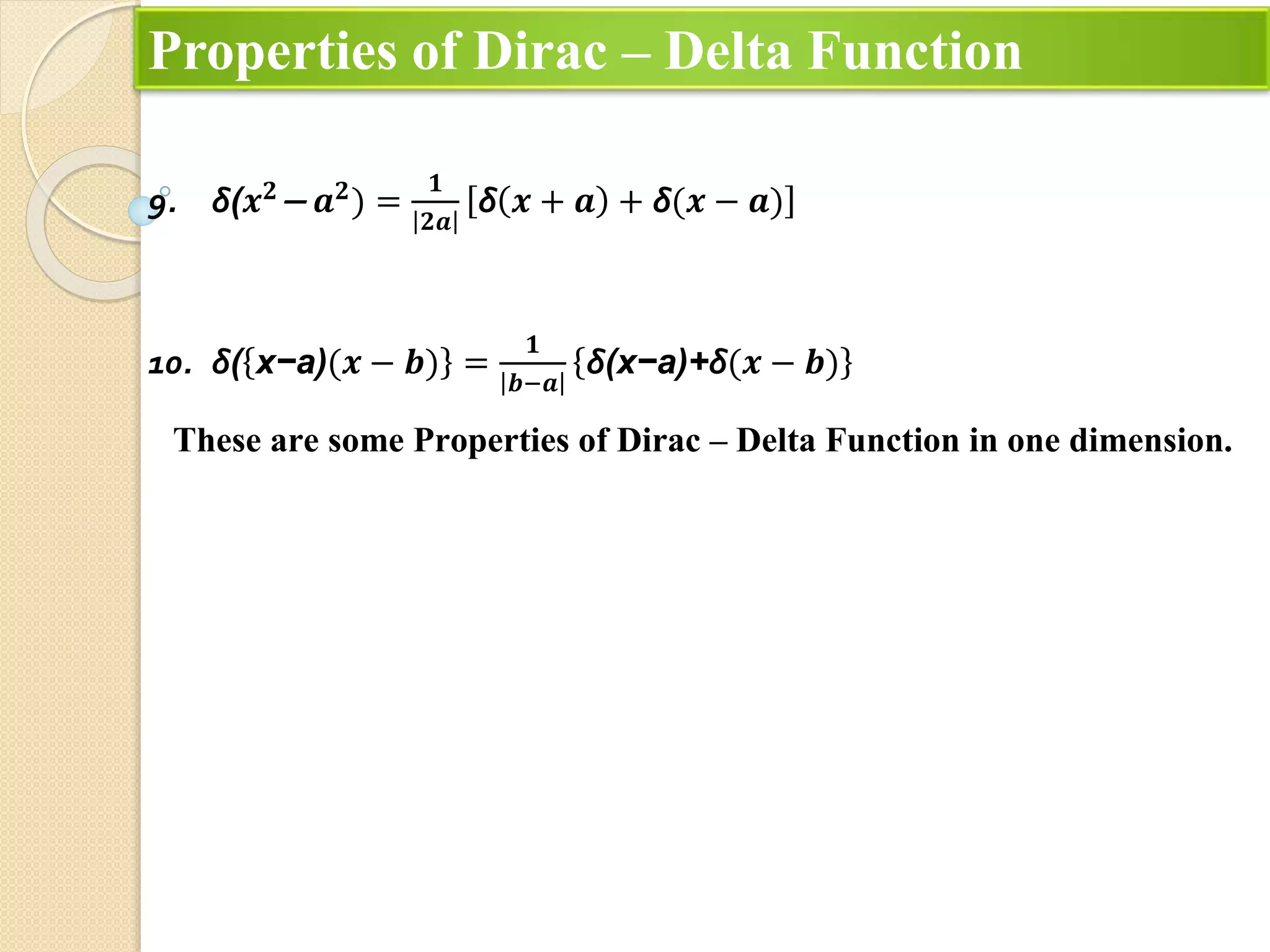
9. δ(𝒙𝟐− 𝒂𝟐) =
𝟏
𝟐𝒂
δ 𝒙 + 𝒂 + δ(𝒙 − 𝒂)
10. δ( x−a)(𝒙 − 𝒃) =
𝟏
𝒃−𝒂
δ(x−a)+δ(𝒙 − 𝒃)
These are some Properties of Dirac – Delta Function in one dimension.
Properties of Dirac – Delta Function (3D)
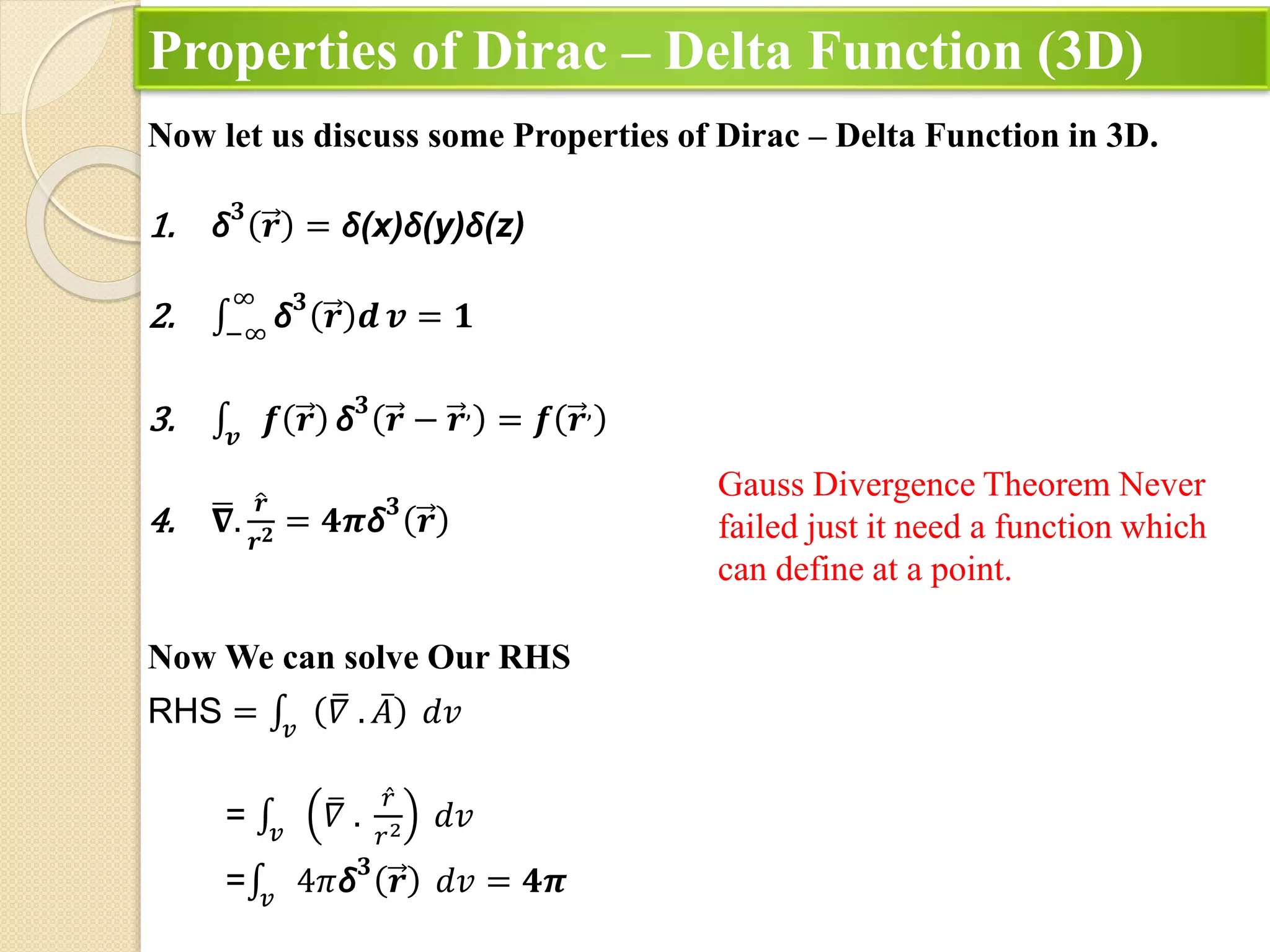
Now let us discuss some Properties of Dirac – Delta Function in 3D.
1. δ𝟑
𝒓 = δ(x)δ(y)δ(z)
2. −∞
∞
δ𝟑
𝒓 𝒅 𝒗 = 𝟏
3. 𝒗
𝒇 𝒓 δ𝟑
𝒓 − 𝒓,
= 𝒇 𝒓,
4. 𝛁.
𝒓
𝒓𝟐 = 𝟒𝝅δ𝟑
𝒓
Now We can solve Our RHS
RHS = 𝑣
𝛻 . 𝐴 𝑑𝑣
= 𝑣
𝛻 .
𝑟
𝑟2 𝑑𝑣
= 𝑣
4𝜋δ𝟑
𝒓 𝑑𝑣 = 𝟒𝝅
Gauss Divergence Theorem Never
failed just it need a function which
can define at a point.
References
1. All about the Dirac Delta Function a general published in
Resonance aug-2003
2. Introduction to Quantum Mechanics by David J. Griffith
(Second Edition)
3. Quantum Mechanics Concepts and Application by N.
Zettili (second Edition)
Dirac – Delta Function

Dirac – Delta Function

  • 1.
    Dirac – DeltaFunction & It’s Properties Presented by – Mayur P. Sangole M.Sc (Physics) RTM Nagpur University, Nagpur
  • 2.
    Why We NeedDirac – Delta Function? Let me Take Back to some Mathematics We know Gauss – Divergence Theorem Given : 𝐴 = 𝑟 𝑟2 Then LHS = 𝑠 𝐴 . 𝑑𝑠 = 0 𝜋 0 2𝜋 𝑟 𝑟2 𝑟2𝑠𝑖𝑛𝜃 𝑑𝜃 𝑑𝜑 𝑟 = 4𝜋 RHS = 𝑣 𝛻. 𝐴 𝑑𝑣 = 0 (When we solve!) 𝑠 𝐴 . 𝑑𝑠 = 𝑣 𝛻. 𝐴 𝑑𝑣 Now, How it can happen that gauss divergence theorem get failed No! it can’t! Thus, what we can say RHS is not included r=0 point it’s not including centre so determine value at that point to include that point we need a function.
  • 3.
    Why We NeedDirac – Delta Function? R Suppose we are interested to find charge density o a point charge at centre of sphere volume of this centre point is tends to zero & the charge per unit volume will goes to infinite And all at different place charge is 0 hence we can define it as So to understand these situation we define a function such that Which is known as Dirac-Delta Function. 𝑐ℎ𝑎𝑟𝑔𝑒 𝑑𝑒𝑛𝑠𝑖𝑡𝑦 𝜌 = 𝑐ℎ𝑎𝑟𝑔𝑒 𝑣𝑜𝑙𝑢𝑚𝑒 𝝆 = ∞ 𝒂𝒕 𝒓 = 𝒐 𝒐 𝒂𝒕 𝒓 ≠ 𝟎 δ = ∞ 𝒂𝒕 𝒙 = 𝒐 𝒐 𝒂𝒕 𝒙 ≠ 𝟎
  • 4.
    Why We NeedDirac – Delta Function? Now you may have question why I’m relating Dirac – Delta Function to Electrodynamics Let me take you to QM Suppose you are in room and at an one point particle is present then the probability at that point is unity elsewhere is 0 Hence To define that, Probability Density we can use Dirac - Delta function. If we have measured finite position of particle of which uncertainty is zero, we can define their wave function by Dirac – delta function DDF is a single Wave Function or Eigen function of position operator.
  • 5.
    Dirac – DeltaFunction To understand more we can take one more example 1/2∈ . x = -∈ x = 0 x = ∈ 𝒙 <−∈ f (x) = 0 𝒙 >∈, f (x) = 0 𝒙 = 𝟎, f (x) = 𝟏/𝟐 ∈ This 1/𝟐 ∈ is due to we have restricted height of barrier. But, The area under this curve is unity. Hence we can define the function f(x) = δ(x) (DDF)
  • 6.
    Dirac – DeltaFunction Let us see Representation of Dirac – Delta Function. When we try to push the curve from sides, the width of the curve becomes smaller and smaller and height becomes larger and larger.
  • 7.
    Properties of Dirac– Delta Function
  • 8.
    Properties of Dirac– Delta Function 1. −∞ ∞ δ 𝒙 𝒅𝒙 = 𝟏 (Area under the curve =1) 2. δ(𝒙) = 𝟏 𝟐𝝅 −∞ ∞ 𝒆𝒊𝒌𝒙𝒅𝒙 This property is really interesting when we solve this equation we get sine function and we can see it’s graphical representation. (can solve by taking Limit – L to L)
  • 9.
    Properties of Dirac– Delta Function 3. δ(-x) = δ(x) [ This shows that Dirac-delta function is even function) 4. δ(ax)= 𝟏 𝒂 δ(x) 5. 𝐱δ(x)=0 6. δ, (x)= − δ 𝒙 𝒙 (Derivative of Dirac-Delta Function) 7. 𝒂 𝒃 𝒇 𝒙 δ 𝒙 − 𝒄 𝒅𝒙 = 𝒇 𝒄 𝒊𝒇 𝒄 𝒍𝒊𝒆𝒔 𝒃𝒆𝒕𝒏 𝒂 & 𝒃 𝒐𝒕𝒉𝒆𝒓𝒘𝒊𝒔𝒆 𝟎 8. −∞ ∞ δ 𝒙 − 𝒂 δ 𝒙 − 𝒃 𝒅𝒙 = δ 𝒃 − 𝒂 = δ(𝒂 − 𝒃)
  • 10.
    Properties of Dirac– Delta Function 9. δ(𝒙𝟐− 𝒂𝟐) = 𝟏 𝟐𝒂 δ 𝒙 + 𝒂 + δ(𝒙 − 𝒂) 10. δ( x−a)(𝒙 − 𝒃) = 𝟏 𝒃−𝒂 δ(x−a)+δ(𝒙 − 𝒃) These are some Properties of Dirac – Delta Function in one dimension.
  • 11.
    Properties of Dirac– Delta Function (3D) Now let us discuss some Properties of Dirac – Delta Function in 3D. 1. δ𝟑 𝒓 = δ(x)δ(y)δ(z) 2. −∞ ∞ δ𝟑 𝒓 𝒅 𝒗 = 𝟏 3. 𝒗 𝒇 𝒓 δ𝟑 𝒓 − 𝒓, = 𝒇 𝒓, 4. 𝛁. 𝒓 𝒓𝟐 = 𝟒𝝅δ𝟑 𝒓 Now We can solve Our RHS RHS = 𝑣 𝛻 . 𝐴 𝑑𝑣 = 𝑣 𝛻 . 𝑟 𝑟2 𝑑𝑣 = 𝑣 4𝜋δ𝟑 𝒓 𝑑𝑣 = 𝟒𝝅 Gauss Divergence Theorem Never failed just it need a function which can define at a point.
  • 12.
    References 1. All aboutthe Dirac Delta Function a general published in Resonance aug-2003 2. Introduction to Quantum Mechanics by David J. Griffith (Second Edition) 3. Quantum Mechanics Concepts and Application by N. Zettili (second Edition)