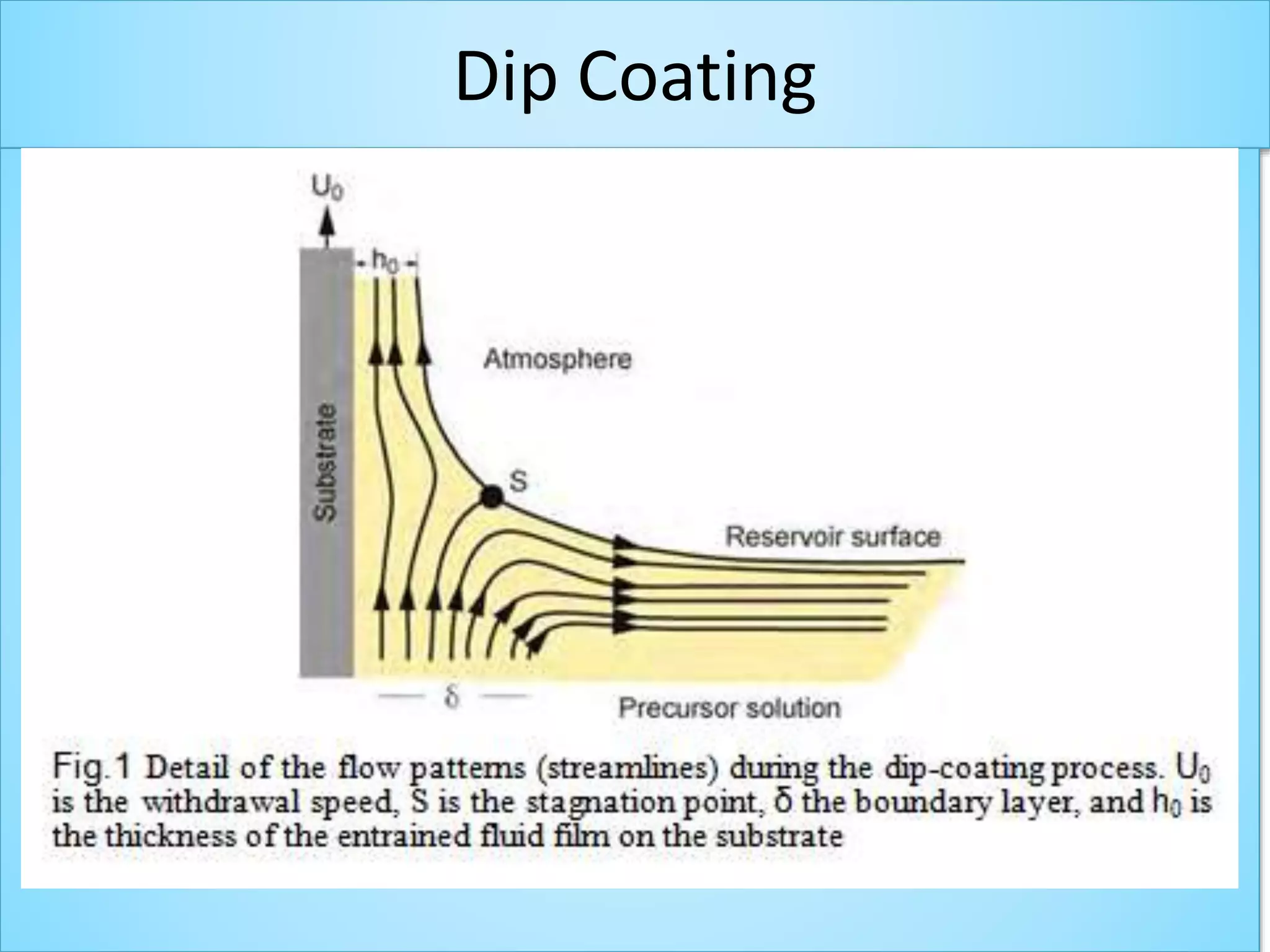
Dip coating is a process used to prepare porous ceramic membranes by immersing a substrate into a precursor solution, removing it, and allowing the coating to dry. It is an old commercially applied coating technique dating back to a 1939 patent. Key steps to forming defect-free membranes include using a homogeneous support, cleaning the substrate, sufficiently deaerating the solution, avoiding thick coatings, and keeping the environment particle-free. The dip coating process involves three stages: immersion for wetting, deposition and drainage as the substrate is withdrawn, and evaporation of the solvent to form the dried coating layer. Withdrawal speed and other forces determine the thickness of the coated layer.

![Dip Coating
Introduction
“Dip Coating refers to the immersing of a substrate
into a tank containing precursor solution, removing
the piece from the tank, and allowing it to drain.”
It is widely used for the preparation of porous
ceramic membranes.[1]](https://image.slidesharecdn.com/mukhtiar-160619223313/75/dip-coating-3-2048.jpg)

![Dip Coating
Steps to form defect-free membranes[2]:
A homogenous support
Substrate cleaning and filtration
Sufficient de-aeration of sol/suspension
Not too thick coating which results in drying
shrinkage and tensile stress
Avoid dust and other foreign particulates in air or
coating fluids](https://image.slidesharecdn.com/mukhtiar-160619223313/75/dip-coating-5-2048.jpg)
![Dip Coating
Process
The process may be separated into three important technical
stages[3]:
Immersion & dwell time: The substrate is immersed into the
precursor solution at a constant speed followed by a certain
dwell time in order to leave sufficient interaction time of the
substrate with the coating solution for complete wetting.
Deposition & Drainage: By pulling the substrate upward at a
constant speed a thin layer of precursor solution is entrained, i.e.
film deposition. Excess liquid will drain from the surface.](https://image.slidesharecdn.com/mukhtiar-160619223313/75/dip-coating-6-2048.jpg)

![Dip Coating
References:
[1] Geffcken W, Berger E (1939) Verfahren zur Anderung des Reflexionsvermogen
Gla¨ser. Deutsches Reichspatent, assigned to Jenaer Glaswerk Schott & Gen.,
Jena 736 41
[2] Scriven LE (1988) Physics and application of dip-coating and spin-coating In:
Brinker CJ Clark DE, Ulrich DR (eds) Better ceramics through chemistry III,
vol 121, Materials Research
[3] Grosso D (2011) How to exploit the full potential of the dip-coating process to
better control film formation. J Mater Chem 21:17033–17038](https://image.slidesharecdn.com/mukhtiar-160619223313/75/dip-coating-10-2048.jpg)


![Thin_Film_Technology_introduction[1]](https://cdn.slidesharecdn.com/ss_thumbnails/1b4496c8-2102-411b-8465-a3dd3f398327-150205034538-conversion-gate02-thumbnail.jpg?width=640&height=640&fit=bounds)


