SUPER CAPACITOR
Seminar done by
A.KALYANI
15KD5A0401
ELECTRONICS AND COMMUNICATION
ENGGINEERING
(Approved by AICTE&Affiliated by JNTUK)
ABSTRACT
• Super capacitor is also known as electric double-layer
capacitor(EDLC),Super capacitor or ultra-capacitor is an electro chemical
capacitor with relatively high energy density. Super capacitor technology is
based on the electric double layer phenomenon that has been understood
for over a hundred years. the main application is in the field of automation
the specific power of the super capacitor and its high life time (1 million of
cycles )makes it very attractive for the start –up of the automobiles.
WHAT IS “CAPACITOR”?
• A capacitor is a passive two-terminal electrical component used to store
energy in an electric field.
• when there is a potential difference across the conductors, a static electric
field develops across the dielectric , causing positive charge to collect on
the one plate and negative charge on the other plate. Energy is stored in the
form of electro static field .
WHAT IS SUPER CAPACITOR?
• Super capacitors are energy
storages having similarities with
both batteries and conventional
capacitors.
• Unlike batteries, SC’s store
electrical energy , not chemical
energy.
• Ultra capacitors are also known as double –layer capacitor or super
capacitors.
HISTORY OF SUPER CAPACITORS
• In 1957 H.Becker developed a “Low voltage electrolytic capacitor with
porous carbon electrodes”.
• That capacitor came to known as Super capacitor as it stored very high
amount of energy.
SPECIAL CHARACTRISTICS OF ‘SC’
• Important characteristics of a super capacitor
• Super capacitors can be fully charged and discharged in seconds.
• Almost linear voltage curves enables very accurate state of charge (SOC)
estimations.
• SC’s can be charged and discharged even up to a million times.
• SC’s have very low energy densities when compared to batteries.
• SC’s have very high self-discharge when compared to batteries.
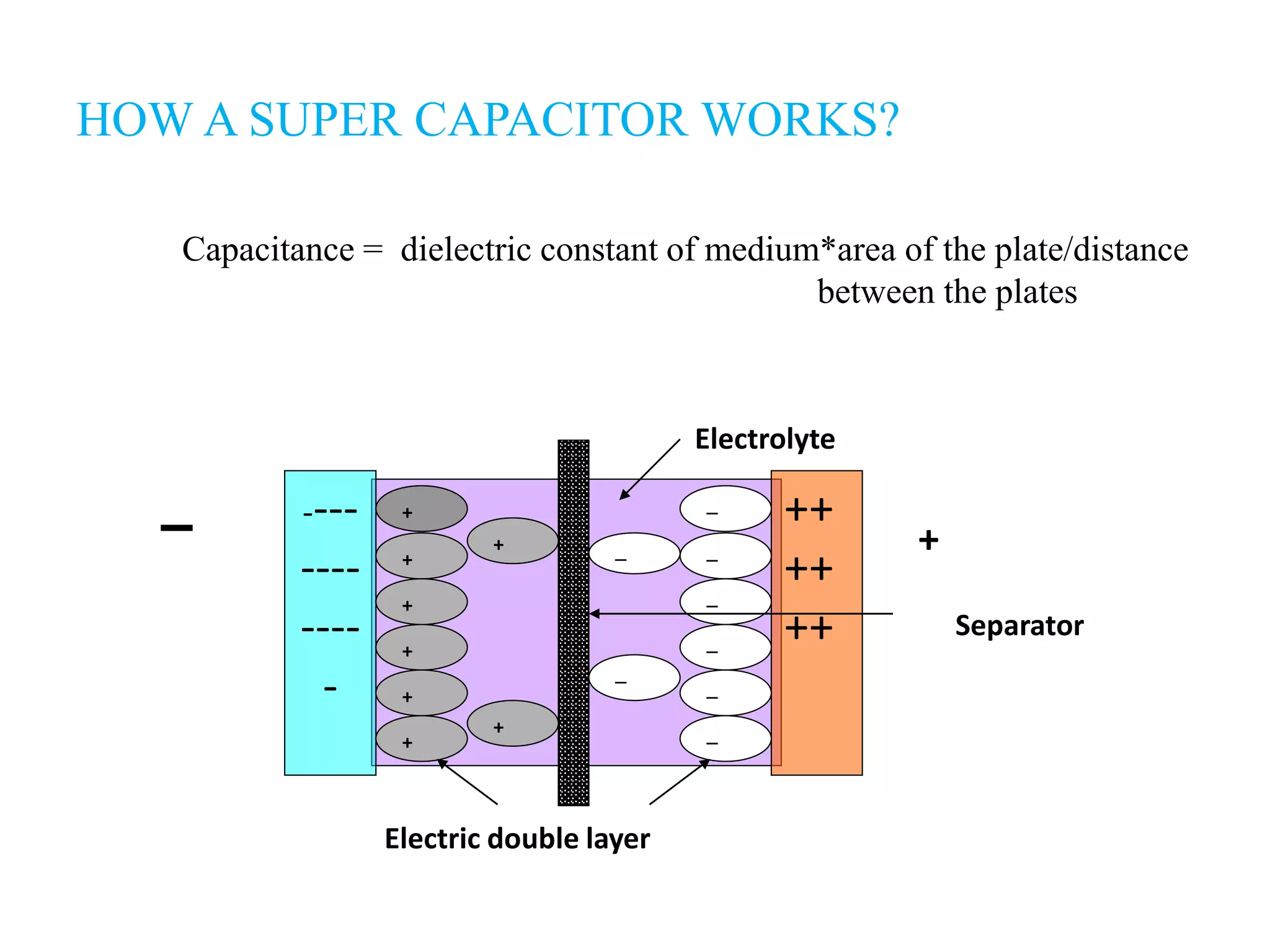
HOW A SUPER CAPACITOR WORKS?
Capacitance = dielectric constant of medium*area of the plate/distance
between the plates
----
----
----
-
++
++
++
+
+








+
+
+
+
+
+
Electrolyte
Separator
Electric double layer
▬
+
DIFFERENCE BETWEEN CAPACITOR AND SUPER
CAPSCITOR
DEFINITION:
•In Capacitors, energy is stored in their
electric field.
ENERGY DENSITY:
•Comparatively low.
DIELECTRIC MATERIALS:
•Like ceramic, aluminum oxide are used for
the separation of the electrodes.
COST:
•Comparatively cheap.
DEFINITION:
•A Super capacitor tends to differ from an
ordinary capacitor due to its very high
capacitance.
ENERGY DENSITY:
•Comparatively very high.
DIELECTRIC MATERIALS:
•Like ceramic, aluminum oxide are used
for the separation of the electrodes.
COST:
•Comparatively expensive.
CAPACITOR. VS SUPER CAPACITOR
APPLICATIONS IN PUBLIC TRANSPORT
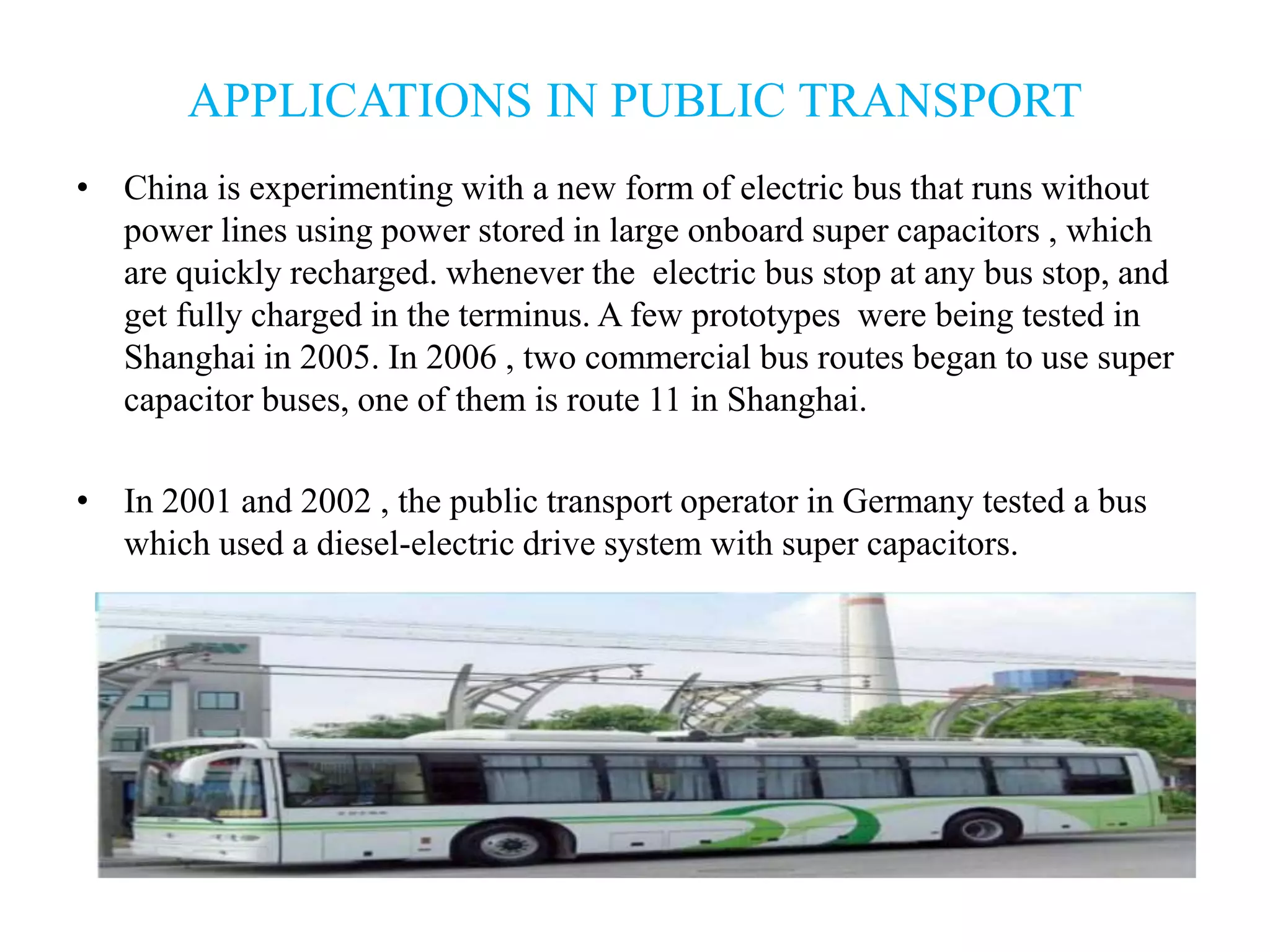
• China is experimenting with a new form of electric bus that runs without
power lines using power stored in large onboard super capacitors , which
are quickly recharged. whenever the electric bus stop at any bus stop, and
get fully charged in the terminus. A few prototypes were being tested in
Shanghai in 2005. In 2006 , two commercial bus routes began to use super
capacitor buses, one of them is route 11 in Shanghai.
• In 2001 and 2002 , the public transport operator in Germany tested a bus
which used a diesel-electric drive system with super capacitors.
FEATURES
• Such energy storage has several advantages relative to batteries.
• Very high rates of charge and discharge.
• Little degradation over hundreds of thousands of cycles.
• High cycle efficiency (95% or more).
ADVANTAGES
• Long life: It works for large number of cycles .
• Rapid charging: it takes a second to charge completely.
• Low cost: it is less expensive as compared to electrochemical battery.
• High power storage: it stores huge amount of energy in a small volume.
• Faster release: Release the energy much faster than battery.
DISADVANTAGES
• Low energy density.
• Have high self-discharge as compared to battery.
• Individual cells have voltages.
• High cost.
APPLICATIONS
• In start up mechanism for automobiles.
• Used in diesel engine start up in submarines and tanks.
• Public transport in electric bus.
• Power source for laptops , flash in cameras.
• Voltage stabilizers.
CONCLUSION
• Super capacitors may be used where high power or energy storage is
required.
• Super capacitor can be used widely because of their long life and short
charging time.
• On the other hand it has limitations due to its high cost, self discharge.
REFERENCES
• Conway , B.E. (1999). Electrochemical Super capacitors : Scientific
Fundamentals and Technological Applications.
• Burke, A. (2000). “Ultra capacitors: why, how, and where is the
technology.”
• Katz, R. and M. Carlen (2000). “Principles and applications of
electrochemical Capacitors.
• Chu, A. and P. Brats (2002). “Comparison of commercial super
capacitors and high power.
Kalyaniallu (1)

Kalyaniallu (1)

  • 1.
    SUPER CAPACITOR Seminar doneby A.KALYANI 15KD5A0401
  • 2.
  • 3.
    ABSTRACT • Super capacitoris also known as electric double-layer capacitor(EDLC),Super capacitor or ultra-capacitor is an electro chemical capacitor with relatively high energy density. Super capacitor technology is based on the electric double layer phenomenon that has been understood for over a hundred years. the main application is in the field of automation the specific power of the super capacitor and its high life time (1 million of cycles )makes it very attractive for the start –up of the automobiles.
  • 4.
    WHAT IS “CAPACITOR”? •A capacitor is a passive two-terminal electrical component used to store energy in an electric field. • when there is a potential difference across the conductors, a static electric field develops across the dielectric , causing positive charge to collect on the one plate and negative charge on the other plate. Energy is stored in the form of electro static field .
  • 5.
    WHAT IS SUPERCAPACITOR? • Super capacitors are energy storages having similarities with both batteries and conventional capacitors. • Unlike batteries, SC’s store electrical energy , not chemical energy. • Ultra capacitors are also known as double –layer capacitor or super capacitors.
  • 6.
    HISTORY OF SUPERCAPACITORS • In 1957 H.Becker developed a “Low voltage electrolytic capacitor with porous carbon electrodes”. • That capacitor came to known as Super capacitor as it stored very high amount of energy.
  • 7.
    SPECIAL CHARACTRISTICS OF‘SC’ • Important characteristics of a super capacitor • Super capacitors can be fully charged and discharged in seconds. • Almost linear voltage curves enables very accurate state of charge (SOC) estimations. • SC’s can be charged and discharged even up to a million times. • SC’s have very low energy densities when compared to batteries. • SC’s have very high self-discharge when compared to batteries.
  • 8.
    HOW A SUPERCAPACITOR WORKS? Capacitance = dielectric constant of medium*area of the plate/distance between the plates ---- ---- ---- - ++ ++ ++ + +         + + + + + + Electrolyte Separator Electric double layer ▬ +
  • 9.
    DIFFERENCE BETWEEN CAPACITORAND SUPER CAPSCITOR DEFINITION: •In Capacitors, energy is stored in their electric field. ENERGY DENSITY: •Comparatively low. DIELECTRIC MATERIALS: •Like ceramic, aluminum oxide are used for the separation of the electrodes. COST: •Comparatively cheap. DEFINITION: •A Super capacitor tends to differ from an ordinary capacitor due to its very high capacitance. ENERGY DENSITY: •Comparatively very high. DIELECTRIC MATERIALS: •Like ceramic, aluminum oxide are used for the separation of the electrodes. COST: •Comparatively expensive. CAPACITOR. VS SUPER CAPACITOR
  • 10.
    APPLICATIONS IN PUBLICTRANSPORT • China is experimenting with a new form of electric bus that runs without power lines using power stored in large onboard super capacitors , which are quickly recharged. whenever the electric bus stop at any bus stop, and get fully charged in the terminus. A few prototypes were being tested in Shanghai in 2005. In 2006 , two commercial bus routes began to use super capacitor buses, one of them is route 11 in Shanghai. • In 2001 and 2002 , the public transport operator in Germany tested a bus which used a diesel-electric drive system with super capacitors.
  • 11.
    FEATURES • Such energystorage has several advantages relative to batteries. • Very high rates of charge and discharge. • Little degradation over hundreds of thousands of cycles. • High cycle efficiency (95% or more).
  • 12.
    ADVANTAGES • Long life:It works for large number of cycles . • Rapid charging: it takes a second to charge completely. • Low cost: it is less expensive as compared to electrochemical battery. • High power storage: it stores huge amount of energy in a small volume. • Faster release: Release the energy much faster than battery.
  • 13.
    DISADVANTAGES • Low energydensity. • Have high self-discharge as compared to battery. • Individual cells have voltages. • High cost.
  • 14.
    APPLICATIONS • In startup mechanism for automobiles. • Used in diesel engine start up in submarines and tanks. • Public transport in electric bus. • Power source for laptops , flash in cameras. • Voltage stabilizers.
  • 15.
    CONCLUSION • Super capacitorsmay be used where high power or energy storage is required. • Super capacitor can be used widely because of their long life and short charging time. • On the other hand it has limitations due to its high cost, self discharge.
  • 16.
    REFERENCES • Conway ,B.E. (1999). Electrochemical Super capacitors : Scientific Fundamentals and Technological Applications. • Burke, A. (2000). “Ultra capacitors: why, how, and where is the technology.” • Katz, R. and M. Carlen (2000). “Principles and applications of electrochemical Capacitors. • Chu, A. and P. Brats (2002). “Comparison of commercial super capacitors and high power.