
CAPABILITY
DESIGN & DATA
SOURCINGACCENTURE FINANCE & RISK
TABLE OF CONTENTS
2Copyright © 2017 Accenture. All rights reserved.
SUMMARY 03
HIGH PERFORMANCE FINANCIAL
REPORTING FRAMEWORK
04
FINANCIAL REPORTING PROCESS
CAPABILITY MODEL
05
ACCENTURE REGULATORY
REPORTING OFFERINGS
06
DATA CLASSIFICATION 07
WHAT IS CAPABILITY DESIGN VS
DATA SOURCING
08
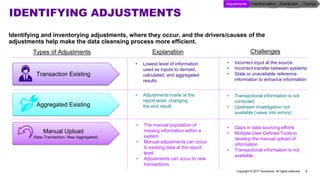
IDENTIFYING ADJUSTMENTS 09
CLEANSING PROCESS 10
WHAT IS THE TRANSFORMATION
PROCESS
11
TRANSFORMATION
DOCUMENTATION
12
WHAT IS THE DISTRIBUTION
PROCESS
13
DATA SET ORDERING & REPORT
DISTRIBUTION
14
WHAT IS DRIVING CHANGE 15
MANAGEMENT OF CHANGE FROM
SOURCE & REPORT
16
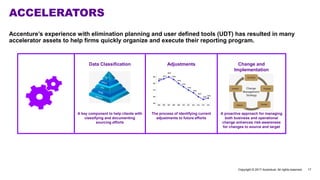
ACCELERATORS 17
SUMMARY
Copyright © 2017 Accenture. All rights reserved. 3
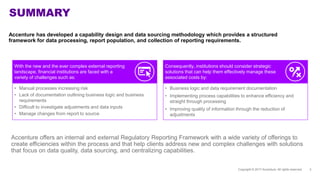
Accenture has developed a capability design and data sourcing methodology which provides a structured
framework for data processing, report population, and collection of reporting requirements.
With the new and the ever complex external reporting
landscape, financial institutions are faced with a
variety of challenges such as:
Consequently, institutions should consider strategic
solutions that can help them effectively manage these
associated costs by:
• Manual processes increasing risk
• Lack of documentation outlining business logic and business
requirements
• Difficult to investigate adjustments and data inputs
• Manage changes from report to source
• Business logic and data requirement documentation
• Implementing process capabilities to enhance efficiency and
straight through processing
• Improving quality of information through the reduction of
adjustments
Accenture offers an internal and external Regulatory Reporting Framework with a wide variety of offerings to
create efficiencies within the process and that help clients address new and complex challenges with solutions
that focus on data quality, data sourcing, and centralizing capabilities.
Note: Please see Legend slide for definition of acronyms
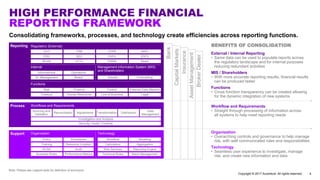
HIGH PERFORMANCE FINANCIAL
REPORTING FRAMEWORK
Consolidating frameworks, processes, and technology create efficiencies across reporting functions.
External / Internal Reporting
• Same data can be used to populate reports across
the regulatory landscape and for internal purposes
reducing redundant activities
MIS / Shareholders
• With more accurate reporting results, financial results
can be produced faster
Functions
• Cross function transparency can be created allowing
for the dynamic integration of new systems
BrokerDealer
AssetManagement
Insurance
CapitalMarkets
Bank
Reporting Regulatory (External)
OCC
FDIC
NCUA
FRB
SEC
CFTC
CFPB
FHFA
FINRA
NAIC
ESFS
Basel
Functions
Risk
Treasury
Finance
Human Resources
Control
Line of Business
External Data (Market)
Legal
Workflow and Requirements
• Straight through processing of information across
all systems to help meet reporting needs
Organization
• Overarching controls and governance to help manage
risk, with well communicated roles and responsibilities
Technology
• Seamless user experience to investigate, manage
risk, and create new information and data
BENEFITS OF CONSOLIDATION
Internal Management Information System (MIS)
and Shareholders
Informational
Sr. Management
Operations
Board Actuals Forecasting
Support Organization Technology
Workflow ModelingPolicy
Training
RCSA
Procedures
Resource Location
Audit
Business Rules Performance Metrics
Calculators Aggregation
Web Services Reporting Engine
Technical Rules Batch Management
Process Workflows and Requirements
Sourcing and
Validation
Reconciliation Adjustments Transformation Distribution
Data
Management
Investigation and Analysis
Security / Audit / Controls
Copyright © 2017 Accenture. All rights reserved. 4
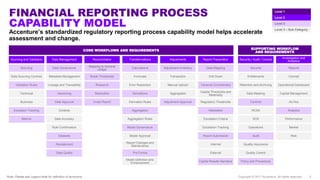
FINANCIAL REPORTING PROCESS
CAPABILITY MODEL
Level 1
Level 2
Level 3
Level 3 – Sub Category
Accenture’s standardized regulatory reporting process capability model helps accelerate
assessment and change.
CORE WORKFLOWS AND REQUIREMENTS SUPPORTING WORKFLOW
AND REQUIREMENTS
Security / Audit / Control
Investigation and
Analytics
Sourcing and Validation AdjustmentsData Management TransformationsReconciliation Report Preparation
CannedEntitlementsData Sourcing Controls TransactionMetadata Management Formulas Drill Down
Data Masking Capital ManagementTechnical Aggregated
Capital Thresholds and
Materiality
Quality Assurance
Report Changes and
Maintenance
Internal
Quality ControlExternal
Ad HocBusiness Derivation Rules Regulatory Thresholds
SOX PerformanceData Accuracy Aggregation Rules Escalation Criteria
Operations MarketRule Confirmation Escalation Tracking
Retention and Archiving Operational DashboardManual UploadLineage and Traceability Error Resolution
RiskModel Approval
RCSAControls
Model Definition and
Enhancement
Break Thresholds
Versioning DerivationsResolution
Restatement
Data Quality Pro Forma
ControlsAdjustment ApprovalData Approval Cross Report
Metrics
Model Governance
Security ReportsSourcing Adjustment InventoryData Governance Calculations
Mapping to General
Ledger
Data Mapping
Validation Rules Research Variance Commentary
AuditDatasets Report Submission
AnalyticsException Tracking Aggregation Attestation
Policy and ProceduresCapital Results Narrative
5Copyright © 2017 Accenture. All rights reserved.Note: Please see Legend slide for definition of acronyms
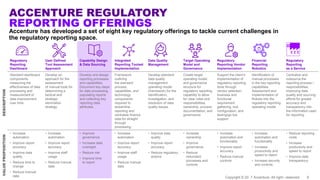
ACCENTURE REGULATORY
REPORTING OFFERINGS
Accenture has developed a set of eight key regulatory offerings to tackle current challenges in
the regulatory reporting space.
Copyright © 2017 Accenture. All rights reserved. 6
DESCRIPTIONVALUEPROPOSITION
Regulatory
Reporting
Dashboard
User Defined
Tool Assessment
Approach
Capability Design
& Data Sourcing
Integrated
Reporting Toolset
Implementation
Data Quality
Management
Target Operating
Model and
Governance
Regulatory
Reporting Vendor
Implementation
Financial
Reporting
Robotics
Regulatory
Reporting
as a Service
Standard dashboard
components
measuring the
effectiveness of data
processing and
measurement of
data improvement
over time.
Develop an
approach for the
assessment
of manual tools for
determining a
tactical and
strategic
elimination
strategy.
Develop and design
reporting processes
and capabilities.
Document key steps
for data processing,
populating reports
and collecting key
reporting data
attributes.
Framework
outlining
the standard
process,
capabilities, and
technology
components
required to
streamline
reporting and
centralize finance
data for straight
through
processing.
Develop standard
data quality
management
operating model
(framework) for the
identification,
investigation, and
resolution of data
quality issues.
Create target
operating model
and governance
structure for
regulatory reporting
capability to allow
for clear roles and
responsibilities,
ownership, process
documentation, and
governance.
Support the client’s
implementation of
regulatory reporting
tools through
vendor selection,
business and
functional
requirement
gathering, tool
configuration, and
testing/go live
support.
Identification of
manual processes
in the key reporting
capabilities.
Assessment and
implementation of
Robots into the
regulatory reporting
operating model.
Centralize and
outsource the
reporting process /
responsibilities,
improving data
quality and sourcing
efforts for greater
accuracy and
transparency into
the information used
for reporting.
• Increase
automation
• Improve report
accuracy
• Improve data
quality
• Reduce time to
change
• Reduce manual
data
• Increase
automation
• Improve report
accuracy
• Improve staff
usage
• Reduce manual
data
• Improve
governance
• Increase data
oversight
• Reduce risk
• Improve time
to report
• Increase
automation
• Improve report
accuracy
• Improve staff
usage
• Reduce manual
data
• Improve data
quality
• Improve report
accuracy
• Reduce regulatory
actions
• Increase
ownership
• Improve
governance
• Reduce
redundant
processes and
controls
• Increase
automation and
functionality
• Improve report
accuracy
• Reduce manual
controls
• Increase
automation and
functionality
• Increase
productivity and
speed to report
• Increase security
and controls
• Reduce reporting
costs
• Increase
productivity and
speed to report
• Improve data
transparency
Descriptive element whose value is determined through
logic statement with multiple input elements.
Examples of Derived Elements
• Indicators
• Flags
• Identifiers
The use of one or many calculated, derived, referenced,
core data to filter and categorize information into target
outputs and desired results.
Examples of Aggregated Results
• Reporting line items
• Dashboard outputs
Measure element whose value is determined through
mathematical operation between multiple input
elements.
Examples of Calculated Data
• Dollar outcomes
• Statistical outcomes
• Metrics
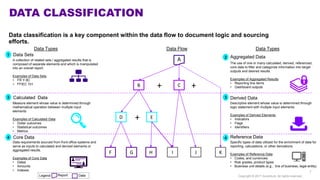
DATA CLASSIFICATION
Copyright © 2017 Accenture. All rights reserved.
7
A collection of related sets / aggregated results that is
composed of separate elements and which is manipulated
into an overall report.
Examples of Data Sets
• FR Y-9C
• FFIEC 101
Specific types of data utilized for the enrichment of data for
reporting, calculations, or other derivations.
Examples of Reference Data
• Codes, and currencies
• Risk grades, product types
• Business unit details (e.g., line of business, legal entity)
Data requirements sourced from front office systems and
serve as inputs to calculated and derived elements or
aggregated results.
Examples of Core Data
• Dates
• Amounts
• Indexes
A
D
CB
E
GF H JI K
Data Sets Aggregated Data
Calculated Data Derived Data
Core Data Reference Data
+ +
+
Data FlowData Types Data Types
1
2
3 3
4 4
Data classification is a key component within the data flow to document logic and sourcing
efforts.
Legend: Report Data
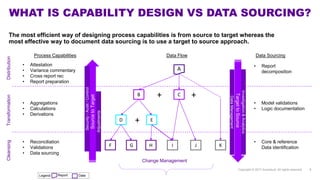
WHAT IS CAPABILITY DESIGN VS DATA SOURCING?
Copyright © 2017 Accenture. All rights reserved. 8
A
D
CB
E
GF H JI K
+ +
+
Data FlowProcess Capabilities Data Sourcing
• Attestation
• Variance commentary
• Cross report rec
• Report preparation
• Aggregations
• Calculations
• Derivations
• Reconciliation
• Validations
• Data sourcing
DistributionTransformationCleansing
SourcetoTarget
Adjustments
Security/Audit/Control
TargettoSource
Investigation&Analytics
DataManagement
Change Management
• Report
decomposition
• Core & reference
Data identification
• Model validations
• Logic documentation
The most efficient way of designing process capabilities is from source to target whereas the
most effective way to document data sourcing is to use a target to source approach.
Legend: Report Data
Change
IDENTIFYING ADJUSTMENTS
• Adjustments made at the
report level, changing
the end result
• Lowest level of information
used as inputs to derived,
calculated, and aggregated
results
Types of Adjustments Explanation
Transaction Existing
Manual Upload
(New Transaction, New Aggregated)
Aggregated Existing
• Gaps in data sourcing efforts
• Multiple User Defined Tools to
develop the manual upload of
information
• Transactional information is not
available
• Transactional information is not
corrected
• Upstream investigation not
available (views into errors)
• Incorrect input at the source
• Incorrect transfer between systems
• Stale or unavailable reference
information to enhance information
• The manual population of
missing information within a
system
• Manual adjustments can occur
to existing data at the report
level
• Adjustments can occur to new
transactions
Challenges
Copyright © 2017 Accenture. All rights reserved. 9
Identifying and inventorying adjustments, where they occur, and the drivers/causes of the
adjustments help make the data cleansing process more efficient.
DistributionTransformationAdjustments
CLEANSING PROCESS
Copyright © 2017 Accenture. All rights reserved. 10
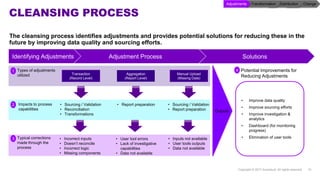
The cleansing process identifies adjustments and provides potential solutions for reducing these in the
future by improving data quality and sourcing efforts.
SolutionsAdjustment ProcessIdentifying Adjustments
• Report preparation• Sourcing / Validation
• Reconciliation
• Transformations
Transaction
(Record Level)
Aggregation
(Report Level)
Manual Upload
(Missing Data)
• Incorrect inputs
• Doesn’t reconcile
• Incorrect logic
• Missing components
• User tool errors
• Lack of investigative
capabilities
• Data not available
Types of adjustments
utilized
Impacts to process
capabilities
Typical corrections
made through the
process
• Sourcing / Validation
• Report preparation
• Inputs not available
• User tools outputs
• Data not available
Outputs
1
2
3
• Improve data quality
• Improve sourcing efforts
• Improve investigation &
analytics
• Dashboard (for monitoring
progress)
• Elimination of user tools
4 Potential Improvements for
Reducing Adjustments
ChangeDistributionTransformationAdjustments
WHAT IS THE TRANSFORMATION PROCESS?
Copyright © 2017 Accenture. All rights reserved. 11
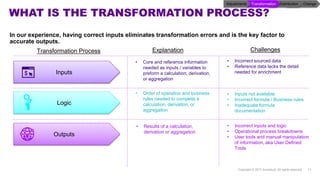
In our experience, having correct inputs eliminates transformation errors and is the key factor to
accurate outputs.
• Order of operation and business
rules needed to complete a
calculation, derivation, or
aggregation
• Core and reference information
needed as inputs / variables to
preform a calculation, derivation,
or aggregation
Transformation Process Explanation
Inputs
Outputs
Logic
• Incorrect inputs and logic
• Operational process breakdowns
• User tools and manual manipulation
of information, aka User Defined
Tools
• Inputs not available
• Incorrect formula / Business rules
• Inadequate formula
documentation
• Incorrect sourced data
• Reference data lacks the detail
needed for enrichment
• Results of a calculation,
derivation or aggregation
Challenges
ChangeDistributionTransformationAdjustments
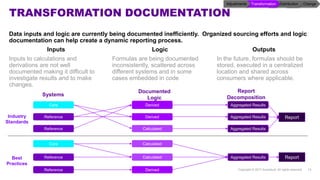
Inputs
Inputs to calculations and
derivations are not well
documented making it difficult to
investigate results and to make
changes.
TRANSFORMATION DOCUMENTATION
Outputs
In the future, formulas should be
stored, executed in a centralized
location and shared across
consumers where applicable.
Logic
Formulas are being documented
inconsistently, scattered across
different systems and in some
cases embedded in code
Copyright © 2017 Accenture. All rights reserved. 12
Data inputs and logic are currently being documented inefficiently. Organized sourcing efforts and logic
documentation can help create a dynamic reporting process.
Systems
Best
Practices
Industry
Standards
Core
Reference
Core
Reference
Reference
Reference
Calculated
Derived
Derived
Calculated
Aggregated Results
Aggregated Results
Aggregated Results
Calculated
Derived
Aggregated Results
Documented
Logic
Report
Report
Report
Decomposition
ChangeDistributionTransformationAdjustments
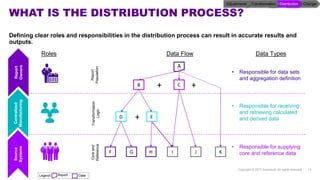
WHAT IS THE DISTRIBUTION PROCESS?
Defining clear roles and responsibilities in the distribution process can result in accurate results and
outputs.
Copyright © 2017 Accenture. All rights reserved. 13
A
D
CB
E
GF H JI K
+ +
+
Data FlowRoles Data Types
Report
Owners
Centralized
Manufacturing
Source
Systems
Coreand
Reference
Transformation
Logic
Report
Population
• Responsible for data sets
and aggregation definition
• Responsible for receiving
and retrieving calculated
and derived data
• Responsible for supplying
core and reference data
ChangeDistributionTransformationAdjustments
Legend: Report Data
Report DistributionData Set Ordering
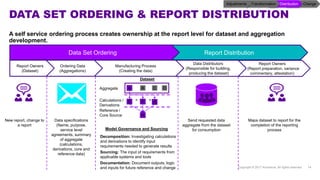
DATA SET ORDERING & REPORT DISTRIBUTION
Copyright © 2017 Accenture. All rights reserved. 14
A self service ordering process creates ownership at the report level for dataset and aggregation
development.
Data specifications
(Name, purpose,
service level
agreements, summary
of aggregate
(calculations,
derivations, core and
reference data)
New report, change to
a report
A C DB
E GF
Aggregate
Calculations /
Derivations
Dataset
H
Reference /
Core Source
Decomposition: Investigating calculations
and derivations to identify input
requirements needed to generate results
Sourcing: The input of requirements from
applicable systems and tools
Model Governance and Sourcing
Send requested data
aggregate from the dataset
for consumption
+ +
Documentation: Document outputs, logic
and inputs for future reference and change
Report Owners
(Report preparation, variance
commentary, attestation)
Data Distributors
(Responsible for building,
producing the dataset)
Manufacturing Process
(Creating the data)
Ordering Data
(Aggregations)
Report Owners
(Dataset)
Maps dataset to report for the
completion of the reporting
process
ChangeDistributionTransformationAdjustments
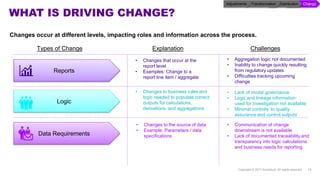
WHAT IS DRIVING CHANGE?
Copyright © 2017 Accenture. All rights reserved. 15
• Changes to business rules and
logic needed to populate correct
outputs for calculations,
derivations, and aggregations
• Changes that occur at the
report level
• Examples: Change to a
report line item / aggregate
Types of Change Explanation
Reports
Data Requirements
Logic
• Communication of change
downstream is not available
• Lack of documented traceability and
transparency into logic calculations
and business needs for reporting
• Lack of model governance
• Logic and lineage information
used for investigation not available
• Minimal controls to quality
assurance and control outputs
• Aggregation logic not documented
• Inability to change quickly resulting
from regulatory updates
• Difficulties tracking upcoming
change
• Changes to the source of data
• Example: Parameters / data
specifications
Challenges
Changes occur at different levels, impacting roles and information across the process.
ChangeDistributionTransformationAdjustments
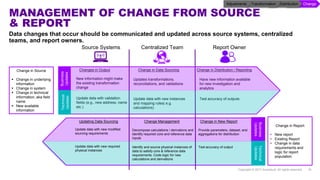
MANAGEMENT OF CHANGE FROM SOURCE
& REPORT
Copyright © 2017 Accenture. All rights reserved. 16
Data changes that occur should be communicated and updated across source systems, centralized
teams, and report owners.
Source Systems Centralized Team Report Owner
Change in Source
 Change in underlying
information
 Change in system
 Change in technical
information, aka field
name
 New available
information
Business
Updates
Change in Data Sourcing
New information might make
the existing transformation
change
Update data with validation
fields (e.g., new address, name
etc.)
Changes in Output
Updates transformations,
reconciliations, and validations
Update data with new instances
and mapping rules( e.g.
calculations)
Change in Distribution / Reporting
Have new information available
for new investigation and
analytics
Test accuracy of outputs
Change in New Report
Provide parameters, dataset, and
aggregations for distribution
Test accuracy of output
Change Management
Identify and source physical instances of
data to satisfy core & reference data
requirements. Code logic for new
calculations and derivations
Decompose calculations / derivations and
identify required core and reference data
inputs
Updating Data Sourcing
Update data with new required
physical instances
Update data with new modified
sourcing requirements
Change in Report
• New report
• Existing Report
• Change in data
requirements and
logic for report
population
Technical
Updates
Business
Updates
Technical
Updates
ChangeDistributionTransformationAdjustments
ACCELERATORS
Copyright © 2017 Accenture. All rights reserved. 17
AdjustmentsData Classification Change and
Implementation
A key component to help clients with
classifying and documenting
sourcing efforts
The process of identifying current
adjustments to future efforts
A proactive approach for managing
both business and operational
change enhances risk-awareness
for changes to source and target
Accenture’s experience with elimination planning and user defined tools (UDT) has resulted in many
accelerator assets to help firms quickly organize and execute their reporting program.
REGULATORY REPORTING OFFERING OVERVIEW
ACCENTURE CONTACTS
Copyright © 2017 Accenture. All rights reserved. 18
Samantha Regan
Accenture Finance & Risk
1345 Avenue of the Americas
New York, NY 10105
samantha.regan@accenture.com
Aisha Kafati
Accenture Finance & Risk
800 Boylston Street, Suite 2300
Boston, MA 02199
aisha.kafati@accenture.com
Brian Stefka
Accenture Finance & Risk
5221 North O'Connor Blvd., Suite 1400
Irving, TX 75039
brian.stefka@accenture.com
Charles Babcock
Accenture Finance & Risk
1345 Avenue of the Americas
New York, NY 10105
charles.babcock@accenture.com
Albert Janer
Accenture Finance & Risk
1345 Avenue of Americas
New York, NY 10105
albert.janer.becerra@accenture.com
Mark M. Lee
Accenture Finance & Risk
1345 Avenue of the Americas
New York, NY 10105
mark.m.lee@accenture.com
Brittni Daniels
Accenture Finance & Risk
1345 Avenue of the Americas
New York, NY 10105
brittni.daniels@accenture.com
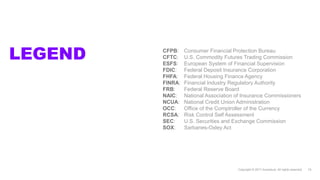
LEGEND
Copyright © 2017 Accenture. All rights reserved. 19
CFPB: Consumer Financial Protection Bureau
CFTC: U.S. Commodity Futures Trading Commission
ESFS: European System of Financial Supervision
FDIC: Federal Deposit Insurance Corporation
FHFA: Federal Housing Finance Agency
FINRA: Financial Industry Regulatory Authority
FRB: Federal Reserve Board
NAIC: National Association of Insurance Commissioners
NCUA: National Credit Union Administration
OCC: Office of the Comptroller of the Currency
RCSA: Risk Control Self Assessment
SEC: U.S. Securities and Exchange Commission
SOX: Sarbanes-Oxley Act
.
Accenture, its logo, and High Performance Delivered are trademarks of Accenture.
ABOUT ACCENTURE
Accenture is a leading global professional
services company, providing a broad range of
services and solutions in strategy, consulting,
digital, technology and operations. Combining
unmatched experience and specialized skills
across more than 40 industries and all business
functions—underpinned by the world’s largest
delivery network —Accenture works at the
intersection of business and technology to help
clients improve their performance and create
sustainable value for their stakeholders. With
more than 425,000 people serving clients in
more than 120 countries, Accenture drives
innovation to improve the way the world works
and lives. Visit us at www.accenture.com
DISCLAIMER
This presentation is intended for general
informational purposes only and does not take
into account the reader’s specific circumstances,
and may not reflect the most current
developments. Accenture disclaims, to the fullest
extent permitted by applicable law, any and all
liability for the accuracy and completeness of the
information in this presentation and for any acts
or omissions made based on such information.
Accenture does not provide legal, regulatory,
audit, or tax advice. Readers are responsible for
obtaining such advice from their own legal
counsel or other licensed professionals.
Copyright © 2017 Accenture All rights reserved. 20

Capability Design & Data Sourcing

  • 1.
  • 2.
    TABLE OF CONTENTS 2Copyright© 2017 Accenture. All rights reserved. SUMMARY 03 HIGH PERFORMANCE FINANCIAL REPORTING FRAMEWORK 04 FINANCIAL REPORTING PROCESS CAPABILITY MODEL 05 ACCENTURE REGULATORY REPORTING OFFERINGS 06 DATA CLASSIFICATION 07 WHAT IS CAPABILITY DESIGN VS DATA SOURCING 08 IDENTIFYING ADJUSTMENTS 09 CLEANSING PROCESS 10 WHAT IS THE TRANSFORMATION PROCESS 11 TRANSFORMATION DOCUMENTATION 12 WHAT IS THE DISTRIBUTION PROCESS 13 DATA SET ORDERING & REPORT DISTRIBUTION 14 WHAT IS DRIVING CHANGE 15 MANAGEMENT OF CHANGE FROM SOURCE & REPORT 16 ACCELERATORS 17
  • 3.
    SUMMARY Copyright © 2017Accenture. All rights reserved. 3 Accenture has developed a capability design and data sourcing methodology which provides a structured framework for data processing, report population, and collection of reporting requirements. With the new and the ever complex external reporting landscape, financial institutions are faced with a variety of challenges such as: Consequently, institutions should consider strategic solutions that can help them effectively manage these associated costs by: • Manual processes increasing risk • Lack of documentation outlining business logic and business requirements • Difficult to investigate adjustments and data inputs • Manage changes from report to source • Business logic and data requirement documentation • Implementing process capabilities to enhance efficiency and straight through processing • Improving quality of information through the reduction of adjustments Accenture offers an internal and external Regulatory Reporting Framework with a wide variety of offerings to create efficiencies within the process and that help clients address new and complex challenges with solutions that focus on data quality, data sourcing, and centralizing capabilities.
  • 4.
    Note: Please seeLegend slide for definition of acronyms HIGH PERFORMANCE FINANCIAL REPORTING FRAMEWORK Consolidating frameworks, processes, and technology create efficiencies across reporting functions. External / Internal Reporting • Same data can be used to populate reports across the regulatory landscape and for internal purposes reducing redundant activities MIS / Shareholders • With more accurate reporting results, financial results can be produced faster Functions • Cross function transparency can be created allowing for the dynamic integration of new systems BrokerDealer AssetManagement Insurance CapitalMarkets Bank Reporting Regulatory (External) OCC FDIC NCUA FRB SEC CFTC CFPB FHFA FINRA NAIC ESFS Basel Functions Risk Treasury Finance Human Resources Control Line of Business External Data (Market) Legal Workflow and Requirements • Straight through processing of information across all systems to help meet reporting needs Organization • Overarching controls and governance to help manage risk, with well communicated roles and responsibilities Technology • Seamless user experience to investigate, manage risk, and create new information and data BENEFITS OF CONSOLIDATION Internal Management Information System (MIS) and Shareholders Informational Sr. Management Operations Board Actuals Forecasting Support Organization Technology Workflow ModelingPolicy Training RCSA Procedures Resource Location Audit Business Rules Performance Metrics Calculators Aggregation Web Services Reporting Engine Technical Rules Batch Management Process Workflows and Requirements Sourcing and Validation Reconciliation Adjustments Transformation Distribution Data Management Investigation and Analysis Security / Audit / Controls Copyright © 2017 Accenture. All rights reserved. 4
  • 5.
    FINANCIAL REPORTING PROCESS CAPABILITYMODEL Level 1 Level 2 Level 3 Level 3 – Sub Category Accenture’s standardized regulatory reporting process capability model helps accelerate assessment and change. CORE WORKFLOWS AND REQUIREMENTS SUPPORTING WORKFLOW AND REQUIREMENTS Security / Audit / Control Investigation and Analytics Sourcing and Validation AdjustmentsData Management TransformationsReconciliation Report Preparation CannedEntitlementsData Sourcing Controls TransactionMetadata Management Formulas Drill Down Data Masking Capital ManagementTechnical Aggregated Capital Thresholds and Materiality Quality Assurance Report Changes and Maintenance Internal Quality ControlExternal Ad HocBusiness Derivation Rules Regulatory Thresholds SOX PerformanceData Accuracy Aggregation Rules Escalation Criteria Operations MarketRule Confirmation Escalation Tracking Retention and Archiving Operational DashboardManual UploadLineage and Traceability Error Resolution RiskModel Approval RCSAControls Model Definition and Enhancement Break Thresholds Versioning DerivationsResolution Restatement Data Quality Pro Forma ControlsAdjustment ApprovalData Approval Cross Report Metrics Model Governance Security ReportsSourcing Adjustment InventoryData Governance Calculations Mapping to General Ledger Data Mapping Validation Rules Research Variance Commentary AuditDatasets Report Submission AnalyticsException Tracking Aggregation Attestation Policy and ProceduresCapital Results Narrative 5Copyright © 2017 Accenture. All rights reserved.Note: Please see Legend slide for definition of acronyms
  • 6.
    ACCENTURE REGULATORY REPORTING OFFERINGS Accenturehas developed a set of eight key regulatory offerings to tackle current challenges in the regulatory reporting space. Copyright © 2017 Accenture. All rights reserved. 6 DESCRIPTIONVALUEPROPOSITION Regulatory Reporting Dashboard User Defined Tool Assessment Approach Capability Design & Data Sourcing Integrated Reporting Toolset Implementation Data Quality Management Target Operating Model and Governance Regulatory Reporting Vendor Implementation Financial Reporting Robotics Regulatory Reporting as a Service Standard dashboard components measuring the effectiveness of data processing and measurement of data improvement over time. Develop an approach for the assessment of manual tools for determining a tactical and strategic elimination strategy. Develop and design reporting processes and capabilities. Document key steps for data processing, populating reports and collecting key reporting data attributes. Framework outlining the standard process, capabilities, and technology components required to streamline reporting and centralize finance data for straight through processing. Develop standard data quality management operating model (framework) for the identification, investigation, and resolution of data quality issues. Create target operating model and governance structure for regulatory reporting capability to allow for clear roles and responsibilities, ownership, process documentation, and governance. Support the client’s implementation of regulatory reporting tools through vendor selection, business and functional requirement gathering, tool configuration, and testing/go live support. Identification of manual processes in the key reporting capabilities. Assessment and implementation of Robots into the regulatory reporting operating model. Centralize and outsource the reporting process / responsibilities, improving data quality and sourcing efforts for greater accuracy and transparency into the information used for reporting. • Increase automation • Improve report accuracy • Improve data quality • Reduce time to change • Reduce manual data • Increase automation • Improve report accuracy • Improve staff usage • Reduce manual data • Improve governance • Increase data oversight • Reduce risk • Improve time to report • Increase automation • Improve report accuracy • Improve staff usage • Reduce manual data • Improve data quality • Improve report accuracy • Reduce regulatory actions • Increase ownership • Improve governance • Reduce redundant processes and controls • Increase automation and functionality • Improve report accuracy • Reduce manual controls • Increase automation and functionality • Increase productivity and speed to report • Increase security and controls • Reduce reporting costs • Increase productivity and speed to report • Improve data transparency
  • 7.
    Descriptive element whosevalue is determined through logic statement with multiple input elements. Examples of Derived Elements • Indicators • Flags • Identifiers The use of one or many calculated, derived, referenced, core data to filter and categorize information into target outputs and desired results. Examples of Aggregated Results • Reporting line items • Dashboard outputs Measure element whose value is determined through mathematical operation between multiple input elements. Examples of Calculated Data • Dollar outcomes • Statistical outcomes • Metrics DATA CLASSIFICATION Copyright © 2017 Accenture. All rights reserved. 7 A collection of related sets / aggregated results that is composed of separate elements and which is manipulated into an overall report. Examples of Data Sets • FR Y-9C • FFIEC 101 Specific types of data utilized for the enrichment of data for reporting, calculations, or other derivations. Examples of Reference Data • Codes, and currencies • Risk grades, product types • Business unit details (e.g., line of business, legal entity) Data requirements sourced from front office systems and serve as inputs to calculated and derived elements or aggregated results. Examples of Core Data • Dates • Amounts • Indexes A D CB E GF H JI K Data Sets Aggregated Data Calculated Data Derived Data Core Data Reference Data + + + Data FlowData Types Data Types 1 2 3 3 4 4 Data classification is a key component within the data flow to document logic and sourcing efforts. Legend: Report Data
  • 8.
    WHAT IS CAPABILITYDESIGN VS DATA SOURCING? Copyright © 2017 Accenture. All rights reserved. 8 A D CB E GF H JI K + + + Data FlowProcess Capabilities Data Sourcing • Attestation • Variance commentary • Cross report rec • Report preparation • Aggregations • Calculations • Derivations • Reconciliation • Validations • Data sourcing DistributionTransformationCleansing SourcetoTarget Adjustments Security/Audit/Control TargettoSource Investigation&Analytics DataManagement Change Management • Report decomposition • Core & reference Data identification • Model validations • Logic documentation The most efficient way of designing process capabilities is from source to target whereas the most effective way to document data sourcing is to use a target to source approach. Legend: Report Data
  • 9.
    Change IDENTIFYING ADJUSTMENTS • Adjustmentsmade at the report level, changing the end result • Lowest level of information used as inputs to derived, calculated, and aggregated results Types of Adjustments Explanation Transaction Existing Manual Upload (New Transaction, New Aggregated) Aggregated Existing • Gaps in data sourcing efforts • Multiple User Defined Tools to develop the manual upload of information • Transactional information is not available • Transactional information is not corrected • Upstream investigation not available (views into errors) • Incorrect input at the source • Incorrect transfer between systems • Stale or unavailable reference information to enhance information • The manual population of missing information within a system • Manual adjustments can occur to existing data at the report level • Adjustments can occur to new transactions Challenges Copyright © 2017 Accenture. All rights reserved. 9 Identifying and inventorying adjustments, where they occur, and the drivers/causes of the adjustments help make the data cleansing process more efficient. DistributionTransformationAdjustments
  • 10.
    CLEANSING PROCESS Copyright ©2017 Accenture. All rights reserved. 10 The cleansing process identifies adjustments and provides potential solutions for reducing these in the future by improving data quality and sourcing efforts. SolutionsAdjustment ProcessIdentifying Adjustments • Report preparation• Sourcing / Validation • Reconciliation • Transformations Transaction (Record Level) Aggregation (Report Level) Manual Upload (Missing Data) • Incorrect inputs • Doesn’t reconcile • Incorrect logic • Missing components • User tool errors • Lack of investigative capabilities • Data not available Types of adjustments utilized Impacts to process capabilities Typical corrections made through the process • Sourcing / Validation • Report preparation • Inputs not available • User tools outputs • Data not available Outputs 1 2 3 • Improve data quality • Improve sourcing efforts • Improve investigation & analytics • Dashboard (for monitoring progress) • Elimination of user tools 4 Potential Improvements for Reducing Adjustments ChangeDistributionTransformationAdjustments
  • 11.
    WHAT IS THETRANSFORMATION PROCESS? Copyright © 2017 Accenture. All rights reserved. 11 In our experience, having correct inputs eliminates transformation errors and is the key factor to accurate outputs. • Order of operation and business rules needed to complete a calculation, derivation, or aggregation • Core and reference information needed as inputs / variables to preform a calculation, derivation, or aggregation Transformation Process Explanation Inputs Outputs Logic • Incorrect inputs and logic • Operational process breakdowns • User tools and manual manipulation of information, aka User Defined Tools • Inputs not available • Incorrect formula / Business rules • Inadequate formula documentation • Incorrect sourced data • Reference data lacks the detail needed for enrichment • Results of a calculation, derivation or aggregation Challenges ChangeDistributionTransformationAdjustments
  • 12.
    Inputs Inputs to calculationsand derivations are not well documented making it difficult to investigate results and to make changes. TRANSFORMATION DOCUMENTATION Outputs In the future, formulas should be stored, executed in a centralized location and shared across consumers where applicable. Logic Formulas are being documented inconsistently, scattered across different systems and in some cases embedded in code Copyright © 2017 Accenture. All rights reserved. 12 Data inputs and logic are currently being documented inefficiently. Organized sourcing efforts and logic documentation can help create a dynamic reporting process. Systems Best Practices Industry Standards Core Reference Core Reference Reference Reference Calculated Derived Derived Calculated Aggregated Results Aggregated Results Aggregated Results Calculated Derived Aggregated Results Documented Logic Report Report Report Decomposition ChangeDistributionTransformationAdjustments
  • 13.
    WHAT IS THEDISTRIBUTION PROCESS? Defining clear roles and responsibilities in the distribution process can result in accurate results and outputs. Copyright © 2017 Accenture. All rights reserved. 13 A D CB E GF H JI K + + + Data FlowRoles Data Types Report Owners Centralized Manufacturing Source Systems Coreand Reference Transformation Logic Report Population • Responsible for data sets and aggregation definition • Responsible for receiving and retrieving calculated and derived data • Responsible for supplying core and reference data ChangeDistributionTransformationAdjustments Legend: Report Data
  • 14.
    Report DistributionData SetOrdering DATA SET ORDERING & REPORT DISTRIBUTION Copyright © 2017 Accenture. All rights reserved. 14 A self service ordering process creates ownership at the report level for dataset and aggregation development. Data specifications (Name, purpose, service level agreements, summary of aggregate (calculations, derivations, core and reference data) New report, change to a report A C DB E GF Aggregate Calculations / Derivations Dataset H Reference / Core Source Decomposition: Investigating calculations and derivations to identify input requirements needed to generate results Sourcing: The input of requirements from applicable systems and tools Model Governance and Sourcing Send requested data aggregate from the dataset for consumption + + Documentation: Document outputs, logic and inputs for future reference and change Report Owners (Report preparation, variance commentary, attestation) Data Distributors (Responsible for building, producing the dataset) Manufacturing Process (Creating the data) Ordering Data (Aggregations) Report Owners (Dataset) Maps dataset to report for the completion of the reporting process ChangeDistributionTransformationAdjustments
  • 15.
    WHAT IS DRIVINGCHANGE? Copyright © 2017 Accenture. All rights reserved. 15 • Changes to business rules and logic needed to populate correct outputs for calculations, derivations, and aggregations • Changes that occur at the report level • Examples: Change to a report line item / aggregate Types of Change Explanation Reports Data Requirements Logic • Communication of change downstream is not available • Lack of documented traceability and transparency into logic calculations and business needs for reporting • Lack of model governance • Logic and lineage information used for investigation not available • Minimal controls to quality assurance and control outputs • Aggregation logic not documented • Inability to change quickly resulting from regulatory updates • Difficulties tracking upcoming change • Changes to the source of data • Example: Parameters / data specifications Challenges Changes occur at different levels, impacting roles and information across the process. ChangeDistributionTransformationAdjustments
  • 16.
    MANAGEMENT OF CHANGEFROM SOURCE & REPORT Copyright © 2017 Accenture. All rights reserved. 16 Data changes that occur should be communicated and updated across source systems, centralized teams, and report owners. Source Systems Centralized Team Report Owner Change in Source  Change in underlying information  Change in system  Change in technical information, aka field name  New available information Business Updates Change in Data Sourcing New information might make the existing transformation change Update data with validation fields (e.g., new address, name etc.) Changes in Output Updates transformations, reconciliations, and validations Update data with new instances and mapping rules( e.g. calculations) Change in Distribution / Reporting Have new information available for new investigation and analytics Test accuracy of outputs Change in New Report Provide parameters, dataset, and aggregations for distribution Test accuracy of output Change Management Identify and source physical instances of data to satisfy core & reference data requirements. Code logic for new calculations and derivations Decompose calculations / derivations and identify required core and reference data inputs Updating Data Sourcing Update data with new required physical instances Update data with new modified sourcing requirements Change in Report • New report • Existing Report • Change in data requirements and logic for report population Technical Updates Business Updates Technical Updates ChangeDistributionTransformationAdjustments
  • 17.
    ACCELERATORS Copyright © 2017Accenture. All rights reserved. 17 AdjustmentsData Classification Change and Implementation A key component to help clients with classifying and documenting sourcing efforts The process of identifying current adjustments to future efforts A proactive approach for managing both business and operational change enhances risk-awareness for changes to source and target Accenture’s experience with elimination planning and user defined tools (UDT) has resulted in many accelerator assets to help firms quickly organize and execute their reporting program.
  • 18.
    REGULATORY REPORTING OFFERINGOVERVIEW ACCENTURE CONTACTS Copyright © 2017 Accenture. All rights reserved. 18 Samantha Regan Accenture Finance & Risk 1345 Avenue of the Americas New York, NY 10105 samantha.regan@accenture.com Aisha Kafati Accenture Finance & Risk 800 Boylston Street, Suite 2300 Boston, MA 02199 aisha.kafati@accenture.com Brian Stefka Accenture Finance & Risk 5221 North O'Connor Blvd., Suite 1400 Irving, TX 75039 brian.stefka@accenture.com Charles Babcock Accenture Finance & Risk 1345 Avenue of the Americas New York, NY 10105 charles.babcock@accenture.com Albert Janer Accenture Finance & Risk 1345 Avenue of Americas New York, NY 10105 albert.janer.becerra@accenture.com Mark M. Lee Accenture Finance & Risk 1345 Avenue of the Americas New York, NY 10105 mark.m.lee@accenture.com Brittni Daniels Accenture Finance & Risk 1345 Avenue of the Americas New York, NY 10105 brittni.daniels@accenture.com
  • 19.
    LEGEND Copyright © 2017Accenture. All rights reserved. 19 CFPB: Consumer Financial Protection Bureau CFTC: U.S. Commodity Futures Trading Commission ESFS: European System of Financial Supervision FDIC: Federal Deposit Insurance Corporation FHFA: Federal Housing Finance Agency FINRA: Financial Industry Regulatory Authority FRB: Federal Reserve Board NAIC: National Association of Insurance Commissioners NCUA: National Credit Union Administration OCC: Office of the Comptroller of the Currency RCSA: Risk Control Self Assessment SEC: U.S. Securities and Exchange Commission SOX: Sarbanes-Oxley Act
  • 20.
    . Accenture, its logo,and High Performance Delivered are trademarks of Accenture. ABOUT ACCENTURE Accenture is a leading global professional services company, providing a broad range of services and solutions in strategy, consulting, digital, technology and operations. Combining unmatched experience and specialized skills across more than 40 industries and all business functions—underpinned by the world’s largest delivery network —Accenture works at the intersection of business and technology to help clients improve their performance and create sustainable value for their stakeholders. With more than 425,000 people serving clients in more than 120 countries, Accenture drives innovation to improve the way the world works and lives. Visit us at www.accenture.com DISCLAIMER This presentation is intended for general informational purposes only and does not take into account the reader’s specific circumstances, and may not reflect the most current developments. Accenture disclaims, to the fullest extent permitted by applicable law, any and all liability for the accuracy and completeness of the information in this presentation and for any acts or omissions made based on such information. Accenture does not provide legal, regulatory, audit, or tax advice. Readers are responsible for obtaining such advice from their own legal counsel or other licensed professionals. Copyright © 2017 Accenture All rights reserved. 20

Editor's Notes

  • #19 Need headshot from Aisha