Digital Logic Design
Simplifying Logic Circuit
Samia Sultana
Lecturer
Dept. of Computer Science & Eng.
Varendra University, Bangladesh
Reference book: Digital Systems by Ronald
J. Tocci, Neal, Moss
4-1 Sum-of-Products Form
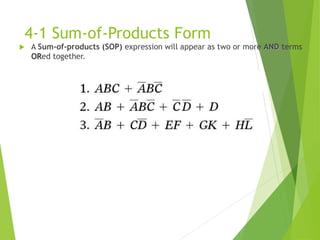
 A Sum-of-products (SOP) expression will appear as two or more AND terms
ORed together.
4-1 Sum-of-Products Form
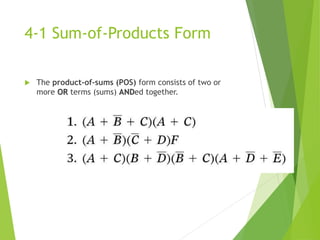
 The product-of-sums (POS) form consists of two or
more OR terms (sums) ANDed together.
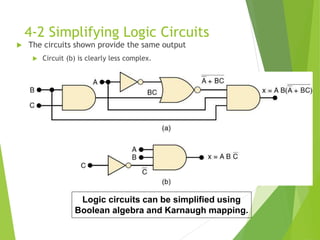
4-2 Simplifying Logic Circuits
 The circuits shown provide the same output
 Circuit (b) is clearly less complex.
Logic circuits can be simplified using
Boolean algebra and Karnaugh mapping.
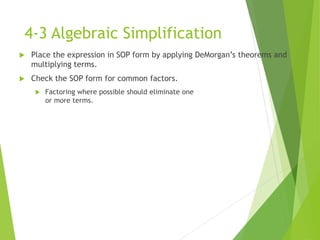
4-3 Algebraic Simplification
 Place the expression in SOP form by applying DeMorgan’s theorems and
multiplying terms.
 Check the SOP form for common factors.
 Factoring where possible should eliminate one
or more terms.
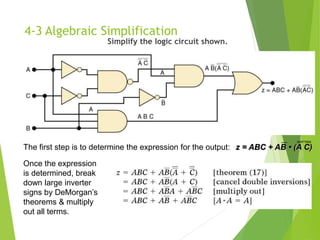
4-3 Algebraic Simplification
Simplify the logic circuit shown.
The first step is to determine the expression for the output: z = ABC + AB • (A C)
Once the expression
is determined, break
down large inverter
signs by DeMorgan’s
theorems & multiply
out all terms.
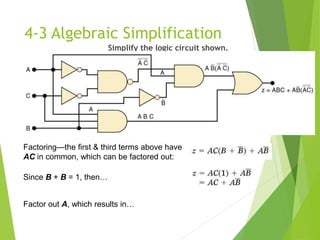
4-3 Algebraic Simplification
Simplify the logic circuit shown.
Factoring—the first & third terms above have
AC in common, which can be factored out:
Since B + B = 1, then…
Factor out A, which results in…
4-3 Algebraic Simplification
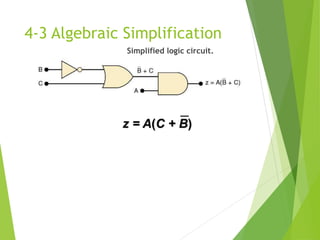
Simplified logic circuit.
z = A(C + B)
4-5 Karnaugh Map Method
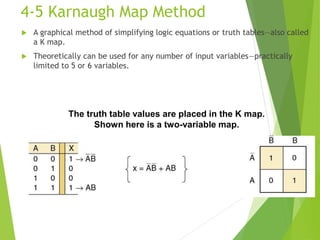
 A graphical method of simplifying logic equations or truth tables—also called
a K map.
 Theoretically can be used for any number of input variables—practically
limited to 5 or 6 variables.
The truth table values are placed in the K map.
Shown here is a two-variable map.
4-5 Karnaugh Map Method
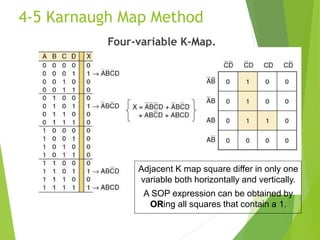
Four-variable K-Map.
Adjacent K map square differ in only one
variable both horizontally and vertically.
A SOP expression can be obtained by
ORing all squares that contain a 1.
4-5 Karnaugh Map Method
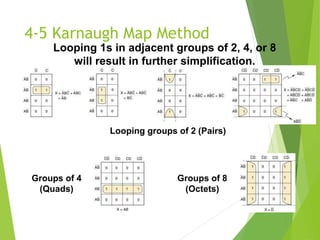
Looping 1s in adjacent groups of 2, 4, or 8
will result in further simplification.
Looping groups of 2 (Pairs)
Groups of 4
(Quads)
Groups of 8
(Octets)
4-5 Karnaugh Map Method
 When the largest possible groups have been looped,
only the common terms are placed
in the final expression.
 Looping may also be wrapped between top, bottom, and
sides.
4-5 Karnaugh Map Method Complete K map simplification process:
 Construct the K map, place 1s as indicated in the truth table.
 Loop 1s that are not adjacent to any other 1s.
 Loop 1s that are in pairs.
 Loop 1s in octets even if they have already been looped.
 Loop quads that have one or more 1s not already looped.
 Loop any pairs necessary to include 1st not already looped.
 Form the OR sum of terms generated by each loop.
When a variable appears in both complemented and
uncomplemented form within a loop, that variable
is eliminated from the expression.
Variables that are the same for all squares of
the loop must appear in the final expression.

Digital Logic Design-Lecture 5

  • 1.
    Digital Logic Design SimplifyingLogic Circuit Samia Sultana Lecturer Dept. of Computer Science & Eng. Varendra University, Bangladesh Reference book: Digital Systems by Ronald J. Tocci, Neal, Moss
  • 2.
    4-1 Sum-of-Products Form A Sum-of-products (SOP) expression will appear as two or more AND terms ORed together.
  • 3.
    4-1 Sum-of-Products Form The product-of-sums (POS) form consists of two or more OR terms (sums) ANDed together.
  • 4.
    4-2 Simplifying LogicCircuits  The circuits shown provide the same output  Circuit (b) is clearly less complex. Logic circuits can be simplified using Boolean algebra and Karnaugh mapping.
  • 5.
    4-3 Algebraic Simplification Place the expression in SOP form by applying DeMorgan’s theorems and multiplying terms.  Check the SOP form for common factors.  Factoring where possible should eliminate one or more terms.
  • 6.
    4-3 Algebraic Simplification Simplifythe logic circuit shown. The first step is to determine the expression for the output: z = ABC + AB • (A C) Once the expression is determined, break down large inverter signs by DeMorgan’s theorems & multiply out all terms.
  • 7.
    4-3 Algebraic Simplification Simplifythe logic circuit shown. Factoring—the first & third terms above have AC in common, which can be factored out: Since B + B = 1, then… Factor out A, which results in…
  • 8.
    4-3 Algebraic Simplification Simplifiedlogic circuit. z = A(C + B)
  • 9.
    4-5 Karnaugh MapMethod  A graphical method of simplifying logic equations or truth tables—also called a K map.  Theoretically can be used for any number of input variables—practically limited to 5 or 6 variables. The truth table values are placed in the K map. Shown here is a two-variable map.
  • 10.
    4-5 Karnaugh MapMethod Four-variable K-Map. Adjacent K map square differ in only one variable both horizontally and vertically. A SOP expression can be obtained by ORing all squares that contain a 1.
  • 11.
    4-5 Karnaugh MapMethod Looping 1s in adjacent groups of 2, 4, or 8 will result in further simplification. Looping groups of 2 (Pairs) Groups of 4 (Quads) Groups of 8 (Octets)
  • 12.
    4-5 Karnaugh MapMethod  When the largest possible groups have been looped, only the common terms are placed in the final expression.  Looping may also be wrapped between top, bottom, and sides.
  • 13.
    4-5 Karnaugh MapMethod Complete K map simplification process:  Construct the K map, place 1s as indicated in the truth table.  Loop 1s that are not adjacent to any other 1s.  Loop 1s that are in pairs.  Loop 1s in octets even if they have already been looped.  Loop quads that have one or more 1s not already looped.  Loop any pairs necessary to include 1st not already looped.  Form the OR sum of terms generated by each loop. When a variable appears in both complemented and uncomplemented form within a loop, that variable is eliminated from the expression. Variables that are the same for all squares of the loop must appear in the final expression.