The Power of Game
Based Learning
6-8th Grade School #6, Elizabeth NJ
Why Digital Games?
 1. Research
 Over the last decade dozens of books, articles, and essays
have proven to have positive benefits for digital games
 2. Disengagement for Traditional Instruction
 The “Digital Natives” now require multiple streams of
instruction, frequent quick interactions
 3. Popularity
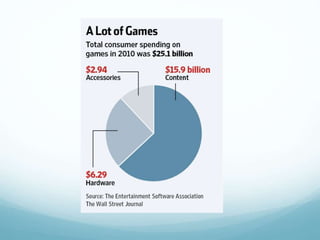
 The digital gaming industry is a $10 billion dollar industry
Hours Spent Playing Video
Games
Effects on Extracurricular
Activities
 try new activities in the comfort of their home
 learn about sport strategies and the rules of the game
 develops confidence in sport skills from winning virtual
victories and are more willing to try the actual sport
 raises confidence which reflect into the real game
Students are able to….
Guidance in the Digital Age
 When?
 With Whom?
 Under what conditions?
Three Important Questions to Consider:
Digital Guidance…
The Gate Keepers…
 Almost all games have parental controls
 These controls must be developed when the game is
first set up
 Parents/Teachers have the option to set a password
and settings
Purposeful Restrictions
 Use game ratings to determine appropriateness
 Decide who they can play/connect with online
 Restrict playing with strangers
 Time limits
 Mindful limits
Games Offer Other Parental
Features …
 Block: decide who children can play with
 Mute: eliminate the chat option
 Monitor: some games allow you to log in and check on
child’s account
 Speak Up: any uncomfortable interaction can be reported to
the game administrator
Games Offer Situated
Cognition
 Games Have:
 Well established principles
 Modules for learning
Students must:
 Directly relate to environment in the game and then learn and
demonstrate the skills
 Apply skills and practice within game
 Games are learned via modeling not direct instruction
Any learning done in a meaningful context has more
relevance to learning
What Makes a Game
Educational?
 Assimilation: using prior information to form a
hypothesis
 Accommodation: being able to realize the hypothesis
is wrong and create a new one
 Resolution: solve the problem
When games have these factors constantly embedded
it is said to be educational.
What Makes a Game Fun
Continued…
 Challenge and Strategy
 Different ways to win and earn points
 Element of Surprise
 Variations
 Replay Ability
 Playing the game with different outcomes each time
What Makes a Game
Educational?
 New information
 Educational information is provided in text or graphics
 Memorization
 Being able to recall events from previous stages in the
game
What Makes A Game
Educational Continued..
 Context and Cognition
 Putting new information into use
 Gender and Ethnic Balance
 Offers character gender options or language diversity
Types of Educational Games
 Management Games
 uses critical thinking and math skills to create a business
 Role Playing Games
 Based on exploration and quest completion
 Requires reading dialog, directions, inventory, maps, and
decision making
Game Types Continued..
 Strategy Games
 Includes skills most scientists use today
 Discovers how things work or don’t work
 Creating something new
 Replaying old history
Main Genre of Video Games
http://www.duelinganalogs.com/infographic/conceptual-map-of-the-main-genres-of-video-games/
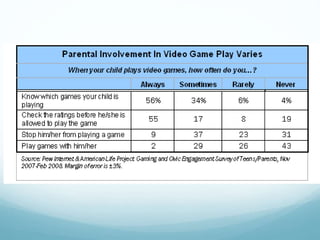
Parent Involvement
 Play Games With Your Child
 Create a family experience
 Connect no matter the location
 Don’t be Afraid to Say No
 Keep rating in mind for content
 Allow Your Child to Show/Tell About the Game
 Create projects using game characters to expand
learning
 Example: journal from characters perspective
Parent Involvement
Continued…
 Ask Questions
 Create conversation and dialog with children
 Ask higher order thinking questions using the characters
 “Can you relate these heroes to any others?
 Keep Gaming System in the Family Room
 Games now have clans
 Bonding
 Locations don’t matter connect via internet
Using Games as a Teaching
Tool…
 Perseverance
 Kids fail at games all the time but always try again
 Students can be reminded they can pick up and keep
trying just like in a game
 Acknowledging Achievement
 Video games praise children for a job well done activity
points, a bonus, or unlock secrets
 Working Together
 You must collaborate to solve problems
Using Games as a Teaching
Tool
 Healthy Competitiveness
 Independence
 Kids can figure out the game with subtle hints from the
game
 Piques Interest
 Students are exposed to historic cultures and worlds they
don’t know
 Prompts students to research further
 A drive to be better
Conclusion…
 Digital gaming has gained in popularity and has a large
market which can benefit education.
 Games can pique students’ interests in different histories
and topics they have not been exposed to before.
 Parents or teachers can set controls to ensure that students
are not exposed to questionable elements in the game.
 Virtual games can offer socialization opportunities.
 If selected appropriately, games can offer great educational
benefits.
Sources
 Gibson, Jayel. “Are Video Games Educational?” Feb 28, 2008. Education.com 2006. 6/15/15
http://setonworldwide.ecollege.com/re/DotNextLaunch.asp
courseid=11528617&userid=33963325&sessionid=cf6f141aeb&tabid=EfyQHCxeGuBX3yk83yCYr977N7eNKXoZ9kvbNiCr+yS
eNM+TAspoxA/3yda/fAx3&sessionFirstAuthStore=true&macid=L81l/FrPJaat5byiAfRyyMnTNkCAezhThQT5aGByvBaBY/rQMkl
imAWZn8OL2/o+hPw+c/oeQh0Lon+R+bCrJL//QAh3fcBNnKslfNDtxKwXjmN0PkpAHCfVQbhHXdybySwfwTxwNMOzXM25+eU
JNarcCR1ICP++GeNdoxwOBABhk68VAL+zFUcBcGBNT82wkB8fmGano3PUTAmnfRynjXWGrFlgoNvz3sBKZWpxhEM=
 Berkowicz, Jill and Myers, Ann. “Summertime Video Gaming” Education Week, June 17, 2015, Editorial Projects in
Education. 6/15/15
http://blogs.edweek.org/edweek/leadership_360/2014/06/summertime_video_gaming.html?qs=video+game+benefits
 “8 Ways Video Games Can be Educational” Education.com 2006. 6/15/15
 “Do Video Games Have Parental Controls?” Education.com 2006. http://www.education.com/facts/quickfacts-
video-games/videogames-parental-controls/
 Toporek, Bryan. “Sports-Related Video Games Linked to Children's Participation in Athletics” Education Week,
August 26, 2014. Editorial Projects in Education. 6/15/15
http://blogs.edweek.org/edweek/schooled_in_sports/2014/08/sports
related_video_games_linked_to_childrens_participation_in_athletics.html?qs=video+games

Digital games

  • 1.
    The Power ofGame Based Learning 6-8th Grade School #6, Elizabeth NJ
  • 2.
    Why Digital Games? 1. Research  Over the last decade dozens of books, articles, and essays have proven to have positive benefits for digital games  2. Disengagement for Traditional Instruction  The “Digital Natives” now require multiple streams of instruction, frequent quick interactions  3. Popularity  The digital gaming industry is a $10 billion dollar industry
  • 3.
  • 4.
    Effects on Extracurricular Activities try new activities in the comfort of their home  learn about sport strategies and the rules of the game  develops confidence in sport skills from winning virtual victories and are more willing to try the actual sport  raises confidence which reflect into the real game Students are able to….
  • 5.
    Guidance in theDigital Age  When?  With Whom?  Under what conditions? Three Important Questions to Consider:
  • 6.
    Digital Guidance… The GateKeepers…  Almost all games have parental controls  These controls must be developed when the game is first set up  Parents/Teachers have the option to set a password and settings
  • 7.
    Purposeful Restrictions  Usegame ratings to determine appropriateness  Decide who they can play/connect with online  Restrict playing with strangers  Time limits  Mindful limits
  • 8.
    Games Offer OtherParental Features …  Block: decide who children can play with  Mute: eliminate the chat option  Monitor: some games allow you to log in and check on child’s account  Speak Up: any uncomfortable interaction can be reported to the game administrator
  • 9.
    Games Offer Situated Cognition Games Have:  Well established principles  Modules for learning Students must:  Directly relate to environment in the game and then learn and demonstrate the skills  Apply skills and practice within game  Games are learned via modeling not direct instruction Any learning done in a meaningful context has more relevance to learning
  • 10.
    What Makes aGame Educational?  Assimilation: using prior information to form a hypothesis  Accommodation: being able to realize the hypothesis is wrong and create a new one  Resolution: solve the problem When games have these factors constantly embedded it is said to be educational.
  • 11.
    What Makes aGame Fun Continued…  Challenge and Strategy  Different ways to win and earn points  Element of Surprise  Variations  Replay Ability  Playing the game with different outcomes each time
  • 12.
    What Makes aGame Educational?  New information  Educational information is provided in text or graphics  Memorization  Being able to recall events from previous stages in the game
  • 13.
    What Makes AGame Educational Continued..  Context and Cognition  Putting new information into use  Gender and Ethnic Balance  Offers character gender options or language diversity
  • 14.
    Types of EducationalGames  Management Games  uses critical thinking and math skills to create a business  Role Playing Games  Based on exploration and quest completion  Requires reading dialog, directions, inventory, maps, and decision making
  • 15.
    Game Types Continued.. Strategy Games  Includes skills most scientists use today  Discovers how things work or don’t work  Creating something new  Replaying old history
  • 16.
    Main Genre ofVideo Games http://www.duelinganalogs.com/infographic/conceptual-map-of-the-main-genres-of-video-games/
  • 17.
    Parent Involvement  PlayGames With Your Child  Create a family experience  Connect no matter the location  Don’t be Afraid to Say No  Keep rating in mind for content  Allow Your Child to Show/Tell About the Game  Create projects using game characters to expand learning  Example: journal from characters perspective
  • 18.
    Parent Involvement Continued…  AskQuestions  Create conversation and dialog with children  Ask higher order thinking questions using the characters  “Can you relate these heroes to any others?  Keep Gaming System in the Family Room  Games now have clans  Bonding  Locations don’t matter connect via internet
  • 20.
    Using Games asa Teaching Tool…  Perseverance  Kids fail at games all the time but always try again  Students can be reminded they can pick up and keep trying just like in a game  Acknowledging Achievement  Video games praise children for a job well done activity points, a bonus, or unlock secrets
  • 21.
     Working Together You must collaborate to solve problems
  • 22.
    Using Games asa Teaching Tool  Healthy Competitiveness  Independence  Kids can figure out the game with subtle hints from the game  Piques Interest  Students are exposed to historic cultures and worlds they don’t know  Prompts students to research further  A drive to be better
  • 25.
    Conclusion…  Digital gaminghas gained in popularity and has a large market which can benefit education.  Games can pique students’ interests in different histories and topics they have not been exposed to before.  Parents or teachers can set controls to ensure that students are not exposed to questionable elements in the game.  Virtual games can offer socialization opportunities.  If selected appropriately, games can offer great educational benefits.
  • 26.
    Sources  Gibson, Jayel.“Are Video Games Educational?” Feb 28, 2008. Education.com 2006. 6/15/15 http://setonworldwide.ecollege.com/re/DotNextLaunch.asp courseid=11528617&userid=33963325&sessionid=cf6f141aeb&tabid=EfyQHCxeGuBX3yk83yCYr977N7eNKXoZ9kvbNiCr+yS eNM+TAspoxA/3yda/fAx3&sessionFirstAuthStore=true&macid=L81l/FrPJaat5byiAfRyyMnTNkCAezhThQT5aGByvBaBY/rQMkl imAWZn8OL2/o+hPw+c/oeQh0Lon+R+bCrJL//QAh3fcBNnKslfNDtxKwXjmN0PkpAHCfVQbhHXdybySwfwTxwNMOzXM25+eU JNarcCR1ICP++GeNdoxwOBABhk68VAL+zFUcBcGBNT82wkB8fmGano3PUTAmnfRynjXWGrFlgoNvz3sBKZWpxhEM=  Berkowicz, Jill and Myers, Ann. “Summertime Video Gaming” Education Week, June 17, 2015, Editorial Projects in Education. 6/15/15 http://blogs.edweek.org/edweek/leadership_360/2014/06/summertime_video_gaming.html?qs=video+game+benefits  “8 Ways Video Games Can be Educational” Education.com 2006. 6/15/15  “Do Video Games Have Parental Controls?” Education.com 2006. http://www.education.com/facts/quickfacts- video-games/videogames-parental-controls/  Toporek, Bryan. “Sports-Related Video Games Linked to Children's Participation in Athletics” Education Week, August 26, 2014. Editorial Projects in Education. 6/15/15 http://blogs.edweek.org/edweek/schooled_in_sports/2014/08/sports related_video_games_linked_to_childrens_participation_in_athletics.html?qs=video+games

Editor's Notes

  • #2 Powerpoint must include: a sense of urgency, suggestion of changes, changes that maximize digital ages resources, using digital age to meet and exceed goals, and effective instructional practice
  • #3 Pg. 1-2 Digital Based Learning It is Not Just for Digital Natives Define digital natives/inductive reasonig
  • #4 All these hours can improve education
  • #5 Especially effective with sports