Curso  2009-2010
BASIC VOCABULARY VOLANTE -  Shuttlecock RAQUETA -  Racket GOLPEAR –  To hit PARTIDO -  Match FALTA -  Fault BANDA -  Bounds RED -  Net JUGADA -  Rally JUGADOR QUE SACA SAQUE -  Server SAQUE -  Service DERECHAS -  Forehand REVES -  Backhand PAR -  Even IMPAR -  Odd RECEPTOR -  Receiver PUNTOS -  Points PISTA -  Court INDIVIDUAL -  Singles DOBLES -  Doubles
Badminton - Objective of the Game  The objective of the game is to pass the shuttlecock over the net;  Respecting the rules of the game;  Making him play in the opposing field;  Offensive and defensive actions;  To impede that the shuttlecock touches in own field;
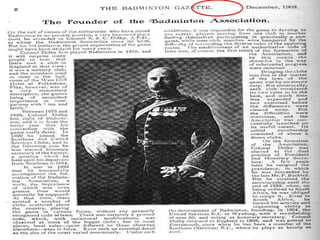
Historical Development of the  Game in the World Badminton was started in India with the name of “Poona” ( +- 1850 ). English officials in service in this country liked the game and they brought it to Europe. In the decade of 1870, a new version of the sport was played in the property of Badminton, belonging to the Duke of Beaufort's, in Gloucestershire, England. The first rules were printed in India in 1876.  This is how Badminton was Played during the early years.
 
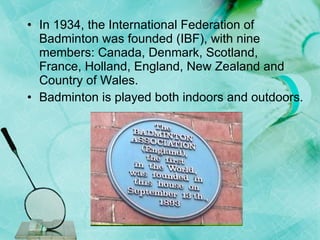
In 1934, the International Federation of Badminton was founded (IBF), with nine members: Canada, Denmark, Scotland, France, Holland, England, New Zealand and Country of Wales.  Badminton is played both indoors and outdoors.
Sport Overview Badminton is a physically demanding sport, requiring: strength endurance muscular power agility speed endurance anaerobic power capacity to rapidly accelerate   and decelerate For factors influencing performance
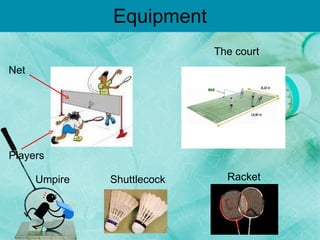
Equipment The court Net Racket Shuttlecock Players Umpire
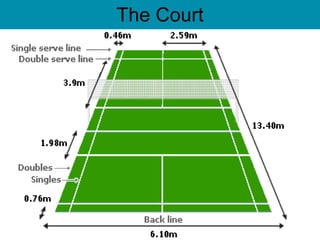
The Court
Net  Net Post Height Net Width
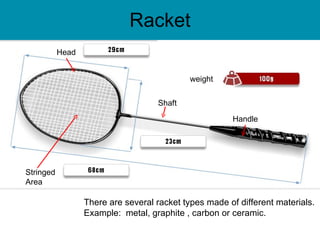
Racket There are several racket types made of different materials.  Example:  metal,  graphite  , carbon or ceramic. Handle Shaft Head weight Stringed Area
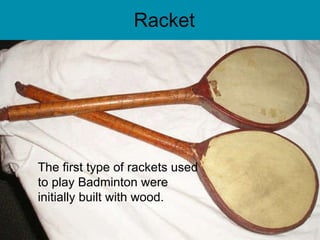
Racket The first type of rackets used to play Badminton were initially built with wood.
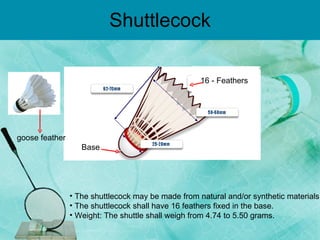
Shuttlecock 16 - Feathers  Base The shuttlecock may be made from natural and/or synthetic materials. The shuttlecock shall have 16 feathers fixed in the base. Weight: The shuttle shall weigh from 4.74 to 5.50 grams. goose feather 
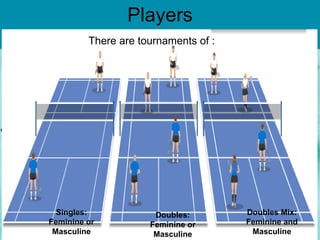
Players Doubles: Feminine or Masculine There are tournaments of : Doubles Mix: Feminine and Masculine Singles: Feminine or Masculine
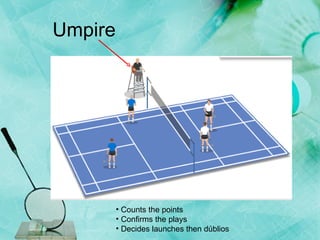
Umpire Counts the points Confirms the plays Decides launches then dúblios
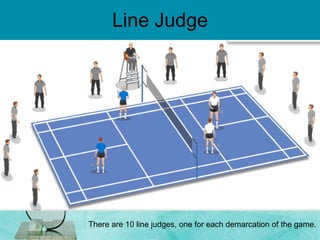
Line Judge There are 10 line judges, one for each demarcation of the game.
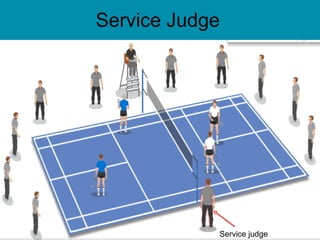
Service Judge Service judge
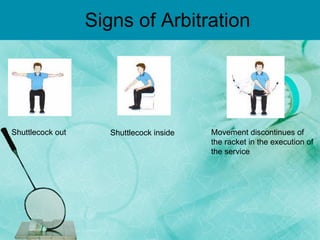
Signs of Arbitration  Shuttlecock out Shuttlecock inside Movement discontinues of the racket in the execution of the service
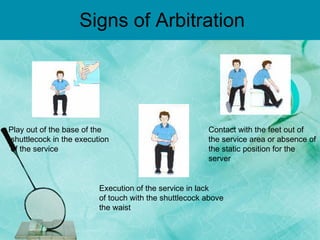
Signs of Arbitration  Play out of the base of the shuttlecock in the execution of the service Execution of the service in lack of touch with the shuttlecock above the waist Contact with the feet out of the service area or absence of the static position for the server
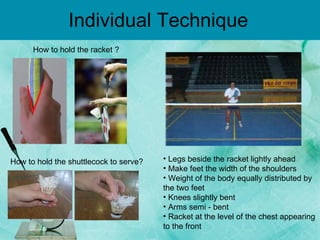
Individual Technique How to hold the racket ? How to hold the  shuttlecock  to serve? Legs beside the racket lightly ahead  Make feet the width of the shoulders  Weight of the body equally distributed by the two feet  Knees slightly bent  Arms semi - bent  Racket at the level of the chest appearing to the front
Techniques Forehands Backhands Smash Lob Push Drop-shot Drive Net-shots Clear shot Others
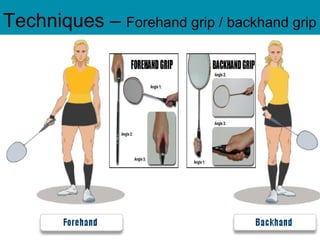
Techniques –  Forehand grip / backhand grip
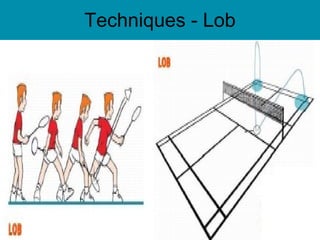
Techniques - Lob
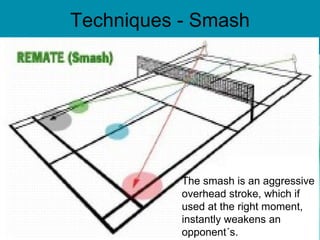
Techniques - Smash The smash is an aggressive overhead stroke, which if used at the right moment, instantly weakens an opponent´s.
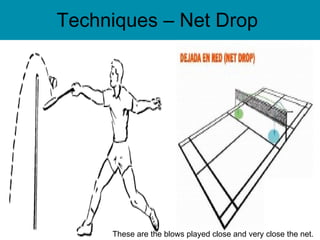
Techniques –  Net Drop  These are the blows played close and very close the net.
  Techniques - Drive
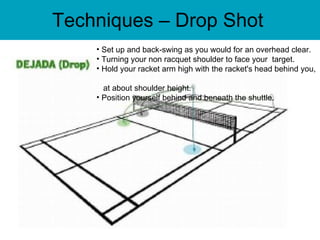
Techniques – Drop Shot Set up and back-swing as you would for an overhead clear. Turning your non racquet shoulder to face your  target.  Hold your racket arm high with the racket's head behind you,    at about shoulder height.  Position yourself behind and beneath the shuttle.
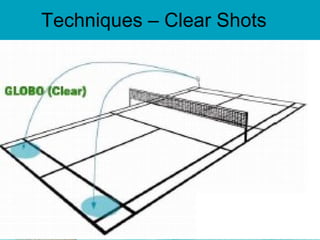
Techniques –  Clear Shots
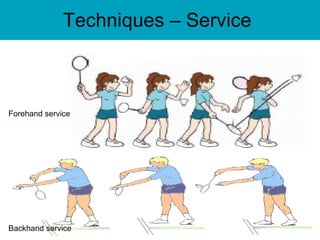
Techniques –  Service Forehand service Backhand service
Some Rules Services / Serve Score Systems Faults
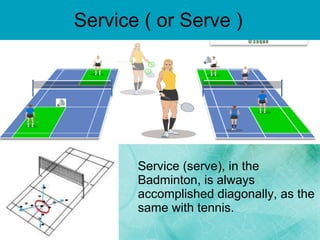
Service ( or Serve ) Service (serve), in the Badminton, is always accomplished diagonally, as the same with tennis.
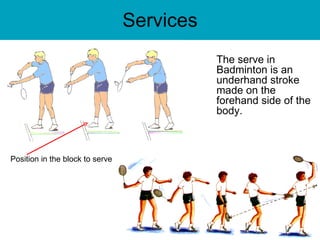
Services Position in the block to serve The serve in Badminton is an underhand stroke made on the forehand side of the body.
Services  – Trajectories Shuttlecock depends on the adopted tactics
Score Systems A match consists of the best of 3 games of 21 points. At 20 all, the side which gains a 2 point lead first, wins that game. At 29 all, the side scoring the 30th point, wins that game.
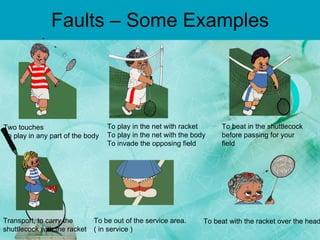
Faults – Some Examples Two touches To play in any part of the body To play in the net with racket  To play in the net with the body  To invade the opposing field To beat in the shuttlecock before passing for your field Transport, to carry the shuttlecock with the racket To be out of the service area. ( in service ) To beat with the racket over the head
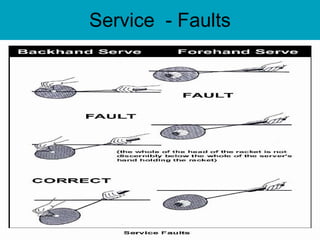
Service  - Faults
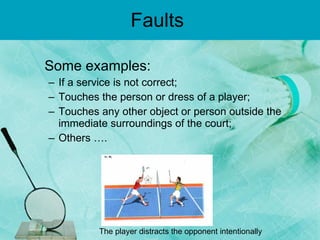
Faults  Some examples: If a service is not correct; Touches the person or dress of a player; Touches any other object or person outside the immediate surroundings of the court; Others …. The player distracts the opponent intentionally
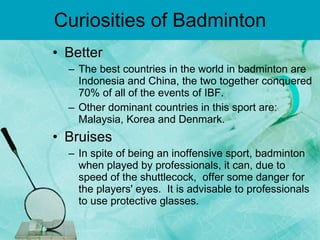
Curiosities of Badminton Better  The best countries in the world in badminton are Indonesia and China, the two together conquered 70% of all of the events of IBF. Other dominant countries in this sport are: Malaysia, Korea and Denmark. Bruises  In spite of being an inoffensive sport, badminton when played by professionals, it can, due to speed of the shuttlecock,  offer some danger for the players' eyes.  It is advisable to professionals  to use protective glasses.
Popularity   The popularity of badminton was proven during the premiere as an Olympic sport in Barcelona in 1992. Around 1.1 billion people watched the competitions on television.  Now, more than 130 countries are members of the International Federation of Badminton. Speed  Badminton is the fastest racket sport of the world demanding fast reflexes and great physical conditioning.  During a professional match the shuttlecock can reach the speed of  ± 260km/h!
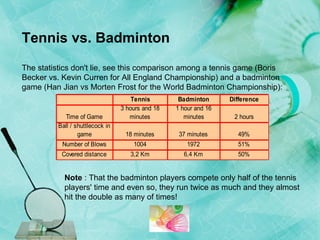
Tennis vs. Badminton  The statistics don't lie, see this comparison among a tennis game (Boris Becker vs. Kevin Curren for All England Championship) and a badminton game (Han Jian vs Morten Frost for the World Badminton Championship): Note  : That the badminton players compete only half of the tennis players' time and even so, they run twice as much and they almost hit the double as many of times!

Badminton Bilingüe

  • 1.
  • 2.
    BASIC VOCABULARY VOLANTE- Shuttlecock RAQUETA - Racket GOLPEAR – To hit PARTIDO - Match FALTA - Fault BANDA - Bounds RED - Net JUGADA - Rally JUGADOR QUE SACA SAQUE - Server SAQUE - Service DERECHAS - Forehand REVES - Backhand PAR - Even IMPAR - Odd RECEPTOR - Receiver PUNTOS - Points PISTA - Court INDIVIDUAL - Singles DOBLES - Doubles
  • 3.
    Badminton - Objectiveof the Game The objective of the game is to pass the shuttlecock over the net; Respecting the rules of the game; Making him play in the opposing field; Offensive and defensive actions; To impede that the shuttlecock touches in own field;
  • 4.
    Historical Development ofthe Game in the World Badminton was started in India with the name of “Poona” ( +- 1850 ). English officials in service in this country liked the game and they brought it to Europe. In the decade of 1870, a new version of the sport was played in the property of Badminton, belonging to the Duke of Beaufort's, in Gloucestershire, England. The first rules were printed in India in 1876. This is how Badminton was Played during the early years.
  • 5.
  • 6.
    In 1934, theInternational Federation of Badminton was founded (IBF), with nine members: Canada, Denmark, Scotland, France, Holland, England, New Zealand and Country of Wales. Badminton is played both indoors and outdoors.
  • 7.
    Sport Overview Badmintonis a physically demanding sport, requiring: strength endurance muscular power agility speed endurance anaerobic power capacity to rapidly accelerate and decelerate For factors influencing performance
  • 8.
    Equipment The courtNet Racket Shuttlecock Players Umpire
  • 9.
  • 10.
    Net NetPost Height Net Width
  • 11.
    Racket There areseveral racket types made of different materials. Example: metal, graphite , carbon or ceramic. Handle Shaft Head weight Stringed Area
  • 12.
    Racket The firsttype of rackets used to play Badminton were initially built with wood.
  • 13.
    Shuttlecock 16 -Feathers Base The shuttlecock may be made from natural and/or synthetic materials. The shuttlecock shall have 16 feathers fixed in the base. Weight: The shuttle shall weigh from 4.74 to 5.50 grams. goose feather 
  • 14.
    Players Doubles: Feminineor Masculine There are tournaments of : Doubles Mix: Feminine and Masculine Singles: Feminine or Masculine
  • 15.
    Umpire Counts thepoints Confirms the plays Decides launches then dúblios
  • 16.
    Line Judge Thereare 10 line judges, one for each demarcation of the game.
  • 17.
  • 18.
    Signs of Arbitration Shuttlecock out Shuttlecock inside Movement discontinues of the racket in the execution of the service
  • 19.
    Signs of Arbitration Play out of the base of the shuttlecock in the execution of the service Execution of the service in lack of touch with the shuttlecock above the waist Contact with the feet out of the service area or absence of the static position for the server
  • 20.
    Individual Technique Howto hold the racket ? How to hold the shuttlecock to serve? Legs beside the racket lightly ahead Make feet the width of the shoulders Weight of the body equally distributed by the two feet Knees slightly bent Arms semi - bent Racket at the level of the chest appearing to the front
  • 21.
    Techniques Forehands BackhandsSmash Lob Push Drop-shot Drive Net-shots Clear shot Others
  • 22.
    Techniques – Forehand grip / backhand grip
  • 23.
  • 24.
    Techniques - SmashThe smash is an aggressive overhead stroke, which if used at the right moment, instantly weakens an opponent´s.
  • 25.
    Techniques – Net Drop These are the blows played close and very close the net.
  • 26.
    Techniques- Drive
  • 27.
    Techniques – DropShot Set up and back-swing as you would for an overhead clear. Turning your non racquet shoulder to face your target. Hold your racket arm high with the racket's head behind you, at about shoulder height. Position yourself behind and beneath the shuttle.
  • 28.
    Techniques – Clear Shots
  • 29.
    Techniques – Service Forehand service Backhand service
  • 30.
    Some Rules Services/ Serve Score Systems Faults
  • 31.
    Service ( orServe ) Service (serve), in the Badminton, is always accomplished diagonally, as the same with tennis.
  • 32.
    Services Position inthe block to serve The serve in Badminton is an underhand stroke made on the forehand side of the body.
  • 33.
    Services –Trajectories Shuttlecock depends on the adopted tactics
  • 34.
    Score Systems Amatch consists of the best of 3 games of 21 points. At 20 all, the side which gains a 2 point lead first, wins that game. At 29 all, the side scoring the 30th point, wins that game.
  • 35.
    Faults – SomeExamples Two touches To play in any part of the body To play in the net with racket To play in the net with the body To invade the opposing field To beat in the shuttlecock before passing for your field Transport, to carry the shuttlecock with the racket To be out of the service area. ( in service ) To beat with the racket over the head
  • 36.
    Service -Faults
  • 37.
    Faults Someexamples: If a service is not correct; Touches the person or dress of a player; Touches any other object or person outside the immediate surroundings of the court; Others …. The player distracts the opponent intentionally
  • 38.
    Curiosities of BadmintonBetter The best countries in the world in badminton are Indonesia and China, the two together conquered 70% of all of the events of IBF. Other dominant countries in this sport are: Malaysia, Korea and Denmark. Bruises In spite of being an inoffensive sport, badminton when played by professionals, it can, due to speed of the shuttlecock, offer some danger for the players' eyes. It is advisable to professionals to use protective glasses.
  • 39.
    Popularity The popularity of badminton was proven during the premiere as an Olympic sport in Barcelona in 1992. Around 1.1 billion people watched the competitions on television. Now, more than 130 countries are members of the International Federation of Badminton. Speed Badminton is the fastest racket sport of the world demanding fast reflexes and great physical conditioning. During a professional match the shuttlecock can reach the speed of ± 260km/h!
  • 40.
    Tennis vs. Badminton The statistics don't lie, see this comparison among a tennis game (Boris Becker vs. Kevin Curren for All England Championship) and a badminton game (Han Jian vs Morten Frost for the World Badminton Championship): Note : That the badminton players compete only half of the tennis players' time and even so, they run twice as much and they almost hit the double as many of times!