Download to read offline
![IOSR Journal of Electronics and Communication Engineering (IOSR-JECE)
e-ISSN: 2278-2834,p- ISSN: 2278-8735.Volume 10, Issue 4, Ver. III (Jul - Aug .2015), PP 56-59
www.iosrjournals.org
DOI: 10.9790/2834-10435659 www.iosrjournals.org 56 | Page
Efficient Performance analysis of OFDM based DAB systems
Using Reed Solomon coding technique
Pooja Jain1
Sandhya Sharma2
1. M.Tech Scholar, ECE, Suresh Gyan Vihar University, Jaipur (India)
1. Associate professor,, ECE, Suresh Gyan Vihar University, Jaipur (India)
Abstract: DAB (digital audio broadcasting) is a radio system which is depends on EUREKA-147 project. This
project was designed by the Members of European Broadcasting Union (EBU). DAB System depends on
wireless communication. DAB channel estimation was designed by the OFDM technology that reduces co-
channel interference and multipath fading. In this paper we have analyzed bit error rate performance v/s signal
to noise ratio (BER v/s SNR).for DAB modes we done block coding with the help of MATLAB Simulink tool. In
this paper we use 16-QAM modulation technique and reed-Solomon convolution coding.
Keywords: DAB, OFDM, co-channel interference, multipath fading, BER, SNR, MATLAB and 16-QAM.
I. Introduction
Radio broadcasting is one of the most widespread electronic mass media comprising of hundreds of
programmer providers, thousands of HF transmitters and billions of radio receivers worldwide. The new digital
radio system Digital Audio Broadcasting (DAB) has the capability to replace the existing AM and FM audio
broadcast services in many parts of the World in near future. This was developed in the 1990s by the Eureka 147
DAB project. DAB is very well suited for mobile receivers and provides very high tolerance against multipath
reception and inter symbol interference (ISI). It allows use of single frequency networks (SFNs) for high
frequency efficiency. In several countries in Europe and overseas, broadcasting organizations, network
providers and receiver manufacturers are already implementing digital broadcasting services using the DAB
system. Perceptual audio coding (MPEG-2), Coded Orthogonal Frequency Division Multiplexing (COFDM),
provision for the multiplex of several programmers and data transmission protocols, are the new concepts of
digital radio broadcasting.
In this paper we proposed a reed-Solomon based channel coding technique for improve performance of
DAB system in different transmission channel.
In this paper we consider 16-QAM modulation technique and OFDM signal generator. For the DAB
block coding we use IFFT (inverse fast Fourier transform), FEC (forward error correction), and frequency
interleaving, fading or non-fading channels. Here DAB transmitter sides we use convolution encoding (reed-
Solomon) so must be required Viterbi decoder at receiver side.
II. Overview Of Dab System
Digital Audio Broadcasting (DAB) is a new digital radio system that delivers radio services from the
studio to the receiver. DAB is intended to deliver very high quality digital audio programmers and data services
to fixed, mobile and portable receivers which can use simple whip antennas.
DAB uses COFDM technology that makes it resistant to Multipath fading and inters symbol
interference (ISI). FM reception can be badly affected by shadowing [3] (i.e. the blocking or screening of the
signals by tall buildings and hills which lie in the direction of the transmitter) and by passive echoes (the arrival
at the receiver of delayed “multipath” signals which have been reflected from tall buildings and hills). DAB is
tolerant to all these types of interferences with the use of simple whip antenna.
The multipath effect like Doppler spread, diffraction, reflection etc., is absent in DAB since it employs
advanced digital techniques such as OFDM multicarrier modulation, rate-compatible punctured convolution
codes (RCPC) and time-frequency interleaving.
(A) Source coding:
Source coding of DAB specified MPEG-2 audio layer encoding. Audio coding system codes only
audio signal components that the ear will hear. This technique allows a bit rate reduction 768 Kbit/s down to
about 100 Kbit/s per mono channel, while preserving the subjective quality of the digital audio signal. DAB to
use spectrum more efficiently and delivering high quality sound to the listeners and receiver. All type coding is
used for data encryption, data decryption and data compression according to the sender and receiver.](https://image.slidesharecdn.com/i010435659-160805100837/85/I010435659-1-320.jpg)
![IOSR Journal of Electronics and Communication Engineering (IOSR-JECE)
e-ISSN: 2278-2834,p- ISSN: 2278-8735.Volume 10, Issue 4, Ver. III (Jul - Aug .2015), PP 56-59
www.iosrjournals.org
DOI: 10.9790/2834-10435659 www.iosrjournals.org 56 | Page
Efficient Performance analysis of OFDM based DAB systems
Using Reed Solomon coding technique
Pooja Jain1
Sandhya Sharma2
1. M.Tech Scholar, ECE, Suresh Gyan Vihar University, Jaipur (India)
1. Associate professor,, ECE, Suresh Gyan Vihar University, Jaipur (India)
Abstract: DAB (digital audio broadcasting) is a radio system which is depends on EUREKA-147 project. This
project was designed by the Members of European Broadcasting Union (EBU). DAB System depends on
wireless communication. DAB channel estimation was designed by the OFDM technology that reduces co-
channel interference and multipath fading. In this paper we have analyzed bit error rate performance v/s signal
to noise ratio (BER v/s SNR).for DAB modes we done block coding with the help of MATLAB Simulink tool. In
this paper we use 16-QAM modulation technique and reed-Solomon convolution coding.
Keywords: DAB, OFDM, co-channel interference, multipath fading, BER, SNR, MATLAB and 16-QAM.
I. Introduction
Radio broadcasting is one of the most widespread electronic mass media comprising of hundreds of
programmer providers, thousands of HF transmitters and billions of radio receivers worldwide. The new digital
radio system Digital Audio Broadcasting (DAB) has the capability to replace the existing AM and FM audio
broadcast services in many parts of the World in near future. This was developed in the 1990s by the Eureka 147
DAB project. DAB is very well suited for mobile receivers and provides very high tolerance against multipath
reception and inter symbol interference (ISI). It allows use of single frequency networks (SFNs) for high
frequency efficiency. In several countries in Europe and overseas, broadcasting organizations, network
providers and receiver manufacturers are already implementing digital broadcasting services using the DAB
system. Perceptual audio coding (MPEG-2), Coded Orthogonal Frequency Division Multiplexing (COFDM),
provision for the multiplex of several programmers and data transmission protocols, are the new concepts of
digital radio broadcasting.
In this paper we proposed a reed-Solomon based channel coding technique for improve performance of
DAB system in different transmission channel.
In this paper we consider 16-QAM modulation technique and OFDM signal generator. For the DAB
block coding we use IFFT (inverse fast Fourier transform), FEC (forward error correction), and frequency
interleaving, fading or non-fading channels. Here DAB transmitter sides we use convolution encoding (reed-
Solomon) so must be required Viterbi decoder at receiver side.
II. Overview Of Dab System
Digital Audio Broadcasting (DAB) is a new digital radio system that delivers radio services from the
studio to the receiver. DAB is intended to deliver very high quality digital audio programmers and data services
to fixed, mobile and portable receivers which can use simple whip antennas.
DAB uses COFDM technology that makes it resistant to Multipath fading and inters symbol
interference (ISI). FM reception can be badly affected by shadowing [3] (i.e. the blocking or screening of the
signals by tall buildings and hills which lie in the direction of the transmitter) and by passive echoes (the arrival
at the receiver of delayed “multipath” signals which have been reflected from tall buildings and hills). DAB is
tolerant to all these types of interferences with the use of simple whip antenna.
The multipath effect like Doppler spread, diffraction, reflection etc., is absent in DAB since it employs
advanced digital techniques such as OFDM multicarrier modulation, rate-compatible punctured convolution
codes (RCPC) and time-frequency interleaving.
(A) Source coding:
Source coding of DAB specified MPEG-2 audio layer encoding. Audio coding system codes only
audio signal components that the ear will hear. This technique allows a bit rate reduction 768 Kbit/s down to
about 100 Kbit/s per mono channel, while preserving the subjective quality of the digital audio signal. DAB to
use spectrum more efficiently and delivering high quality sound to the listeners and receiver. All type coding is
used for data encryption, data decryption and data compression according to the sender and receiver.](https://image.slidesharecdn.com/i010435659-160805100837/75/I010435659-1-2048.jpg)
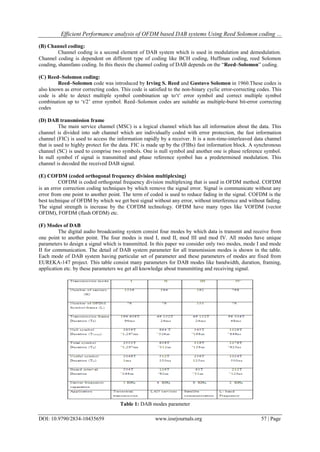
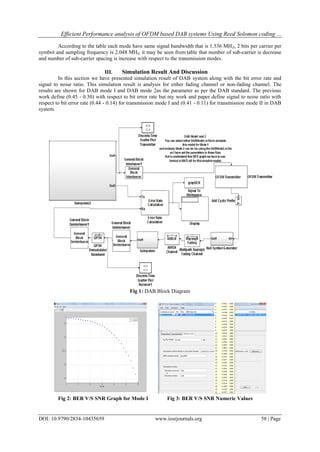
![Efficient Performance analysis of OFDM based DAB systems Using Reed Solomon coding …
DOI: 10.9790/2834-10435659 www.iosrjournals.org 59 | Page
Fig 4: BER V/S SNR Graph for Mode I Fig 5: BER V/S SNR Numeric Values
IV. Conclusion
The reason behind the lower complexity and less execution time is that, we have used Simulink and
some part we have designed in MATLAB. Use of Simulink instead of MATLAB reduces the code length and
therefore complexity also. In this paper we used with AWGN channel use Rayleigh fading channel and then
analysis the result. After the simulation I achieve my motive that if DAB signal have high signal to noise ratio
then we get low bit error rate of the same communication signal. The digital audio broadcasting system does not
provide high quality radio signal in wide areas.
The limitation of this research is that this system technology is also not capable to transmit and receive
the multi data services. In this the radio signal is also affected by the multipath propagation like building,
aircraft, vehicles any other obstacles etc. this system signal also suffers from inter symbol interferences and
fading.
The future works for this research is as a perfect working hardware for this DAB System can be
designed in future by the implementation work. A complete DAB system can be designed for all transmission
modes with the same techniques and parameters we have used for our thesis.
References
Journal Papers:
[1]. A. J Bower, "DIGITAL RADIO--The Eureka 147 DAB System," Electronic Engineering BBC, April 1998.
[2]. R P Singh and S D Sapre, Communication Systems, 2nd ed.: Tata McGraw-Hill Education Pvt. Ltd., 2007.
[3]. Kai-Sheng Yang, Chao-Tang Yu Yu-Pin Chang, "Improved Channel Codec Implementation and Performance Analysis of OFDM
based DAB Systems," in IWCMC 2006 - Proceedings of the 2006 International Wireless Communications and Mobile Computing
Conference, 84 2006, pp. 997-1001.
[4]. Brian Chen and Carl-Erik W. Sundberg, "An Integrated Error Correction and Detection System for Digital Audio Broadcasting," in
IEEE Transactions On Broadcasting, vol. vol. 46, March 2000, pp. 68-78.
[5]. Lukas M. Gaetzi and Malcolm O. J. Hawks ford, "Performance prediction of DAB modulation and transmission using Matlab
modeling," in IEEE International Symposium on Consumer Electronics – Proceedings, 2004, pp. 272-277.
Books:
[6]. ETSI., "Radio Broadcasting Systems; Digital Audio Broadcasting (DAB) to mobile, portable and fixed receivers," EN 300 401,
V1.3.3, (2001-05), April 2001.
Proceedings Papers:
[7]. F. Kozamernik, "Digital Audio Broadcasting – radio now and for the future," EBU Technical Review, no. 265 Autumn 1995.
[8]. Theses:
[9]. Petro Pesha Ernest, "DAB implementation in SDR," University of Stellenbosch, Master‟s thesis December 2005.
[10]. MATHWORKS.COM. [Online]. www.mathworks.com/Communications Toolbox/ Error Detection and Correction/ Block coding &
Convolution coding.
Chapters in Books:
[11]. Wolfgang Hoeg & Thomas Lauterbach, Digital Audio Broadcasting-Principles and Applications: John Wiley & Sons, Ltd.,](https://image.slidesharecdn.com/i010435659-160805100837/85/I010435659-4-320.jpg)

This document analyzes the performance of digital audio broadcasting (DAB) systems using orthogonal frequency division multiplexing (OFDM) and Reed Solomon coding. It discusses the components of a DAB system including source coding, channel coding using Reed Solomon codes, transmission frame structure, and coded OFDM. Simulation results show the bit error rate versus signal-to-noise ratio for DAB modes I and II, demonstrating lower bit error rates at higher signal-to-noise ratios when using Reed Solomon coding compared to previous work. The document concludes the analysis and discusses limitations and potential future work.


![[IJET-V1I2P5] Authors : Ms.Pallavi Dhok, Mr.Aditya Dhanvijay](https://cdn.slidesharecdn.com/ss_thumbnails/ijet-v1i2p5-150427134559-conversion-gate02-thumbnail.jpg?width=640&height=640&fit=bounds)


![Getting Started with Apache Spark: Big Data Made Simple [Free Meetup]](https://cdn.slidesharecdn.com/ss_thumbnails/apachesparkgettingstarted-260203175547-8361bcc3-thumbnail.jpg?width=640&height=640&fit=bounds)

