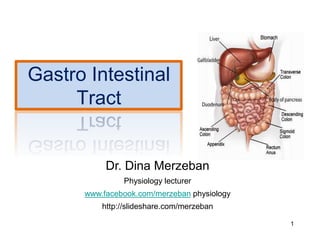
Gastro Intestinal
Tract
Dr. Dina Merzeban
Physiology lecturer
www.facebook.com/merzeban physiology
http://slideshare.com/merzeban
1
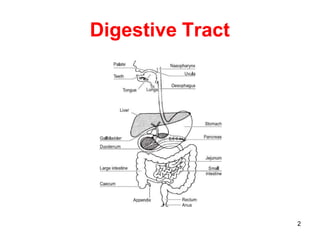
Digestive Tract
2
3
Functional anatomy of GIT
Important parts of digestive tract
1) Oral cavity 2) Pharynx
3) Oesophagus
4) Stomach
5) Small intestine (Duodenum, Jejunum & Ileum)
6) Large intestines (Caecum, ascending colon, transverse
colon, descending colon, iliac colon, sigmoid colon,
rectum & anus)
7) The salivary glands, liver & pancreas are also
developmentally associated with alimentary canal.
4
1) Oesophagus
• Extends from pharynx to cardiac orifice
of the stomach
Stomach
5
6
Stomach
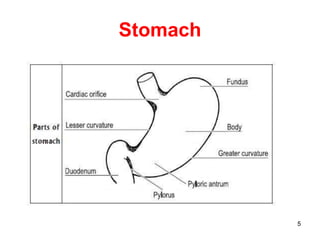
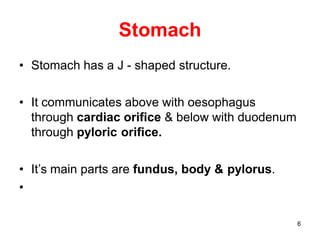
• Stomach has a J - shaped structure.
• It communicates above with oesophagus
through cardiac orifice & below with duodenum
through pyloric orifice.
• It’s main parts are fundus, body & pylorus.
•
7
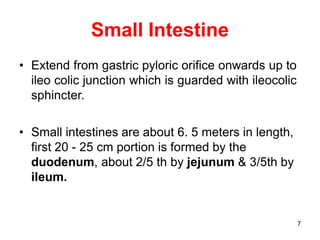
Small Intestine
• Extend from gastric pyloric orifice onwards up to
ileo colic junction which is guarded with ileocolic
sphincter.
• Small intestines are about 6. 5 meters in length,
first 20 - 25 cm portion is formed by the
duodenum, about 2/5 th by jejunum & 3/5th by
ileum.
Small Intestine Anatomy
8
9
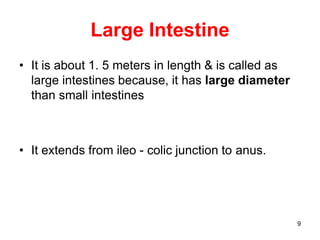
Large Intestine
• It is about 1. 5 meters in length & is called as
large intestines because, it has large diameter
than small intestines
• It extends from ileo - colic junction to anus.
Large Intestine Anatomy
10
11
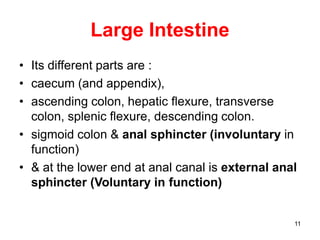
Large Intestine
• Its different parts are :
• caecum (and appendix),
• ascending colon, hepatic flexure, transverse
colon, splenic flexure, descending colon.
• sigmoid colon & anal sphincter (involuntary in
function)
• & at the lower end at anal canal is external anal
sphincter (Voluntary in function)
12
Important glands
in connection with digestion
1) Salivary glands
Salivary glands secrete saliva. 3 pairs of salivary glands
are
• submaxillary (submandibular)
• parotid gland
• sublingual glands
Anatomy of Salivary Glands
13
14
2) Pancreas
• It is an elongated gland; situated at posterior
wall of the abdomen.
• Pancreas secretes pancreatic juice & also it
has islets of Langerhans that secrete insulin
& glucagon.
• Pancreatic juice contains digestive enzymes
(trypsin, chymotrypsin(
Biliary Tract & Pancreas
15
Pancreas Anatomy
16
17
Liver
• It is an important & essential metabolic
organ of the body.
• The liver cells secrete bile.
• Bile is essential for digestion &
absorption of fats.
Liver Anatomy
18
Structure of Gall bladder
19
Liver ,Gall Bladder ,Pancreas
20
21
Gall bladder
• It stores & concentrates the bile
22
Functions of Liver
Formation of plasma proteins:Albumin,
prothrombin & fibrinogen
Stores iron, Vit. B12 & copper & thus
helps in the formation of red cells &
haemoglobin.
Stores Fat soluble vitamins, eg. - A, D, E
& K
23
Functions of Liver
 Manufactures Bile
• Bile is secreted continuously from the liver cells & stored
in the gall bladder.
• Bile contains water, pigments, fatty acids, phospholipids,
cholesterol & bile salts .
• Bile salts is important in emulsification of fats
24
Functions of Liver - 4
 Relation With Carbohydrate Metabolism
• Converts non glucose monosaccharides into
glucose.
• Converts lactic acid into glucose
• Stores carbohydrates in the form of
glycogen.
• Takes part in blood sugar regulation.
25
Functions of Liver
Manufactures fats from carbohydrates
synthesis of cholesterol .
Alcohol metabolism
• The liver is the main site of alcohol
metabolism.
• Alcohol may lead to alcoholic fatty liver
26
Functions of Liver
Relation With Protein Metabolism
• Synthesis of some amino acids
• Synthesis of Plasma proteins except
immune globulin.
• Formation of urea & uric acid formation.
27
Functions of Liver
Hormone Metabolism
• Inactivation of sex hormones
• Inactivation of insulin, glucageon, anti -
diuretic hormones (ADH) & anterior
pituitary tropic hormones
28
Functions of Liver - 12
•8) Excretory Functions
•Certain heavy metals are temporarily fixed
by the liver cells, which are then excreted
in the bile.
•Various toxins, bacteria & drugs are
excreted through bile.
•Cholesterol & bile pigments are excreted
in the bile.
29
Functions of Liver
Detoxicating & Protective Functions
• The liver is the site of detoxication of
different toxic substances either produced
in the body or taken along with food.
Gastric Secretion
30
31
Gastric Secretion
Secretions
1) HCL
2) Pepsinogen: digestion of protein
3) Intrinsic factor (IF): is essential for absorption
of Vit B12 factor
4) Mucin: Protects mucosa against acidity
Gastric Secretion - Functions
1) Function of HCL
1. Antiseptic
2. Provides acidic medium for action of
enzymes: Activation of pepsinogen
3. Iron & calcium absorption
32
33
Mucin prevents ulcer
• 6) Mucin is alkaline & sticky.
• It forms the buffer coat on gastric mucosa.
• In gastric mucosa rapid mitosis takes
place.
• The above 2 facts prevent ulceration
in stomach (Peptic ulcer)
• 99% of ulcers occur in duodenum because
there is no protective mechanism.
34
Mid Night Pain
• In duodenum ulcers mid night pain is
common (i.e. after 2 ½ to 3 hr. after eating
pain starts.
• That means when food comes in
duodenum from stomach pain starts.)
35
Gastric Emptying Time
Factors affecting gastric Emptying Time:
1) HCl :In hyper acidity patient gastric emptying time
is short.
2) Gastric movements (Emptying) are affected by
type of food:
• More acidic food - fast emptying time
• More carbohydrates or protein - faster emptying
time
• Fats delay Emptying Time
Regulation of Gastric Secretion
36
37
Investigations
• Barium meal X – ray
• Gastroscopy - by Gastroenterologist
38
Bile secretion
• Bile is formed in Liver &
• Stored in gall - bladder &
• Through the bile duct it enters into
duodenum
39
Bile -- Contents
• i) Bile salts
• ii( Bile pigments (Bilirubin)
• ii) Cholesterol ester
• iv) HCO3 , Na & K
40
Bile - Function
• Emulsification of fats
• (Big fat molecules are broken down into
smaller particles.)
• so surface area increases, so action of
Lipase becomes easier
Control of bile secretion &
expulsion of bile from Gall bladder
41
42
• Note - Bile does not contain any enzyme
• 1) But still it is very necessary for fat digestion (for
action of Lipase enzyme) by emulsification of fat
• 2) Pathologically - Gall stones can cause Obstructive
jaundice
• Gall stones are common in fat, fertile, female of forty
complaining of flatulence. (Remember as ‘5 F’)
43

Digestive system

  • 1.
    Gastro Intestinal Tract Dr. DinaMerzeban Physiology lecturer www.facebook.com/merzeban physiology http://slideshare.com/merzeban 1
  • 2.
  • 3.
    3 Functional anatomy ofGIT Important parts of digestive tract 1) Oral cavity 2) Pharynx 3) Oesophagus 4) Stomach 5) Small intestine (Duodenum, Jejunum & Ileum) 6) Large intestines (Caecum, ascending colon, transverse colon, descending colon, iliac colon, sigmoid colon, rectum & anus) 7) The salivary glands, liver & pancreas are also developmentally associated with alimentary canal.
  • 4.
    4 1) Oesophagus • Extendsfrom pharynx to cardiac orifice of the stomach
  • 5.
  • 6.
    6 Stomach • Stomach hasa J - shaped structure. • It communicates above with oesophagus through cardiac orifice & below with duodenum through pyloric orifice. • It’s main parts are fundus, body & pylorus. •
  • 7.
    7 Small Intestine • Extendfrom gastric pyloric orifice onwards up to ileo colic junction which is guarded with ileocolic sphincter. • Small intestines are about 6. 5 meters in length, first 20 - 25 cm portion is formed by the duodenum, about 2/5 th by jejunum & 3/5th by ileum.
  • 8.
  • 9.
    9 Large Intestine • Itis about 1. 5 meters in length & is called as large intestines because, it has large diameter than small intestines • It extends from ileo - colic junction to anus.
  • 10.
  • 11.
    11 Large Intestine • Itsdifferent parts are : • caecum (and appendix), • ascending colon, hepatic flexure, transverse colon, splenic flexure, descending colon. • sigmoid colon & anal sphincter (involuntary in function) • & at the lower end at anal canal is external anal sphincter (Voluntary in function)
  • 12.
    12 Important glands in connectionwith digestion 1) Salivary glands Salivary glands secrete saliva. 3 pairs of salivary glands are • submaxillary (submandibular) • parotid gland • sublingual glands
  • 13.
  • 14.
    14 2) Pancreas • Itis an elongated gland; situated at posterior wall of the abdomen. • Pancreas secretes pancreatic juice & also it has islets of Langerhans that secrete insulin & glucagon. • Pancreatic juice contains digestive enzymes (trypsin, chymotrypsin(
  • 15.
    Biliary Tract &Pancreas 15
  • 16.
  • 17.
    17 Liver • It isan important & essential metabolic organ of the body. • The liver cells secrete bile. • Bile is essential for digestion & absorption of fats.
  • 18.
  • 19.
  • 20.
    Liver ,Gall Bladder,Pancreas 20
  • 21.
    21 Gall bladder • Itstores & concentrates the bile
  • 22.
    22 Functions of Liver Formationof plasma proteins:Albumin, prothrombin & fibrinogen Stores iron, Vit. B12 & copper & thus helps in the formation of red cells & haemoglobin. Stores Fat soluble vitamins, eg. - A, D, E & K
  • 23.
    23 Functions of Liver Manufactures Bile • Bile is secreted continuously from the liver cells & stored in the gall bladder. • Bile contains water, pigments, fatty acids, phospholipids, cholesterol & bile salts . • Bile salts is important in emulsification of fats
  • 24.
    24 Functions of Liver- 4  Relation With Carbohydrate Metabolism • Converts non glucose monosaccharides into glucose. • Converts lactic acid into glucose • Stores carbohydrates in the form of glycogen. • Takes part in blood sugar regulation.
  • 25.
    25 Functions of Liver Manufacturesfats from carbohydrates synthesis of cholesterol . Alcohol metabolism • The liver is the main site of alcohol metabolism. • Alcohol may lead to alcoholic fatty liver
  • 26.
    26 Functions of Liver RelationWith Protein Metabolism • Synthesis of some amino acids • Synthesis of Plasma proteins except immune globulin. • Formation of urea & uric acid formation.
  • 27.
    27 Functions of Liver HormoneMetabolism • Inactivation of sex hormones • Inactivation of insulin, glucageon, anti - diuretic hormones (ADH) & anterior pituitary tropic hormones
  • 28.
    28 Functions of Liver- 12 •8) Excretory Functions •Certain heavy metals are temporarily fixed by the liver cells, which are then excreted in the bile. •Various toxins, bacteria & drugs are excreted through bile. •Cholesterol & bile pigments are excreted in the bile.
  • 29.
    29 Functions of Liver Detoxicating& Protective Functions • The liver is the site of detoxication of different toxic substances either produced in the body or taken along with food.
  • 30.
  • 31.
    31 Gastric Secretion Secretions 1) HCL 2)Pepsinogen: digestion of protein 3) Intrinsic factor (IF): is essential for absorption of Vit B12 factor 4) Mucin: Protects mucosa against acidity
  • 32.
    Gastric Secretion -Functions 1) Function of HCL 1. Antiseptic 2. Provides acidic medium for action of enzymes: Activation of pepsinogen 3. Iron & calcium absorption 32
  • 33.
    33 Mucin prevents ulcer •6) Mucin is alkaline & sticky. • It forms the buffer coat on gastric mucosa. • In gastric mucosa rapid mitosis takes place. • The above 2 facts prevent ulceration in stomach (Peptic ulcer) • 99% of ulcers occur in duodenum because there is no protective mechanism.
  • 34.
    34 Mid Night Pain •In duodenum ulcers mid night pain is common (i.e. after 2 ½ to 3 hr. after eating pain starts. • That means when food comes in duodenum from stomach pain starts.)
  • 35.
    35 Gastric Emptying Time Factorsaffecting gastric Emptying Time: 1) HCl :In hyper acidity patient gastric emptying time is short. 2) Gastric movements (Emptying) are affected by type of food: • More acidic food - fast emptying time • More carbohydrates or protein - faster emptying time • Fats delay Emptying Time
  • 36.
  • 37.
    37 Investigations • Barium mealX – ray • Gastroscopy - by Gastroenterologist
  • 38.
    38 Bile secretion • Bileis formed in Liver & • Stored in gall - bladder & • Through the bile duct it enters into duodenum
  • 39.
    39 Bile -- Contents •i) Bile salts • ii( Bile pigments (Bilirubin) • ii) Cholesterol ester • iv) HCO3 , Na & K
  • 40.
    40 Bile - Function •Emulsification of fats • (Big fat molecules are broken down into smaller particles.) • so surface area increases, so action of Lipase becomes easier
  • 41.
    Control of bilesecretion & expulsion of bile from Gall bladder 41
  • 42.
    42 • Note -Bile does not contain any enzyme • 1) But still it is very necessary for fat digestion (for action of Lipase enzyme) by emulsification of fat • 2) Pathologically - Gall stones can cause Obstructive jaundice • Gall stones are common in fat, fertile, female of forty complaining of flatulence. (Remember as ‘5 F’)
  • 43.