Ionic Basis of
ActionPotential
The Role of Voltage-Gated Channels
in Nerve Impulse Transmission
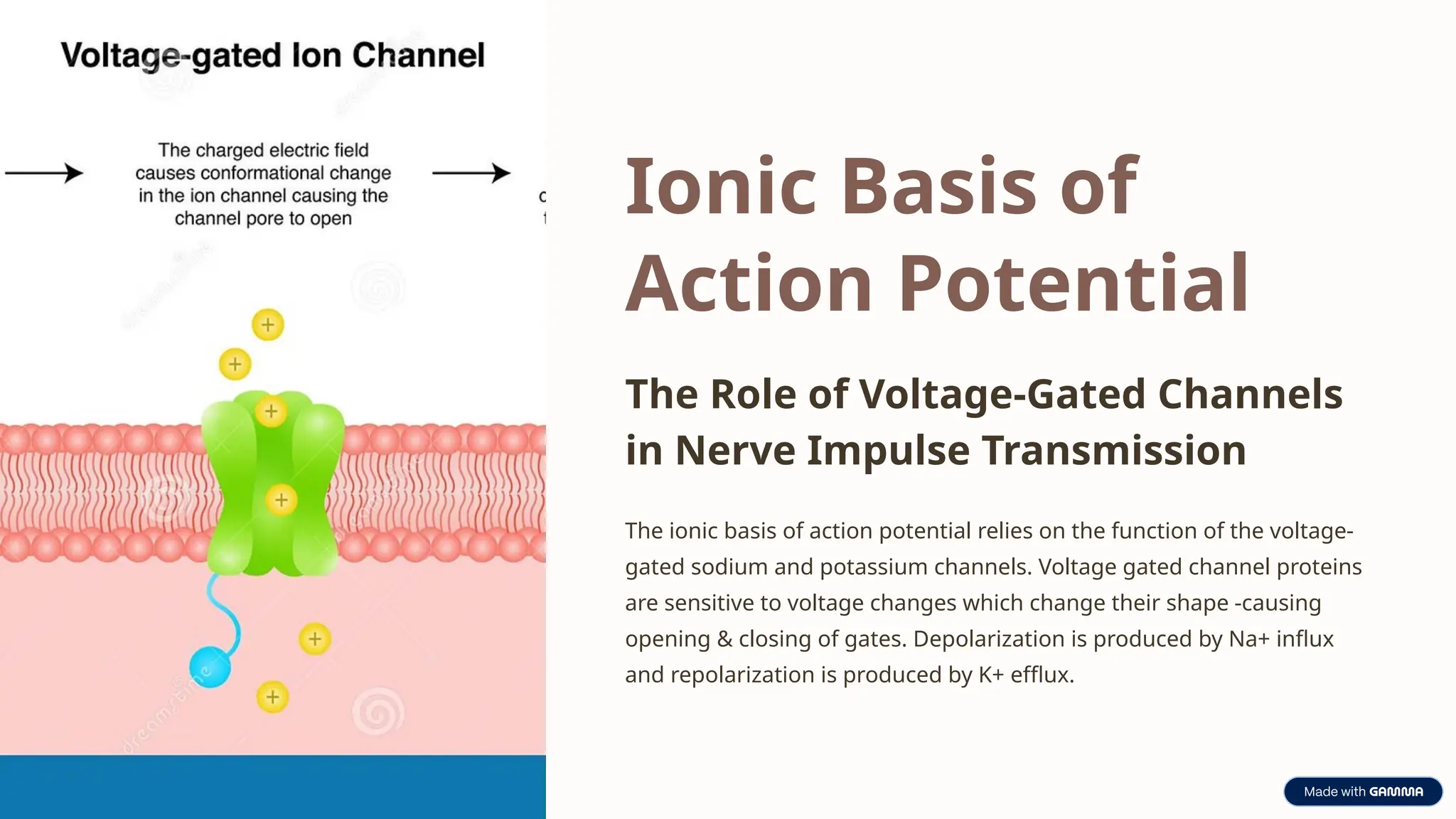
The ionic basis of action potential relies on the function of the voltage-
gated sodium and potassium channels. Voltage gated channel proteins
are sensitive to voltage changes which change their shape -causing
opening & closing of gates. Depolarization is produced by Na+ influx
and repolarization is produced by K+ efflux.
2.
Voltage-Gated Sodium
Channels: Structureand
Gates
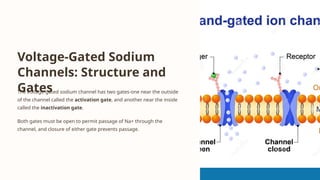
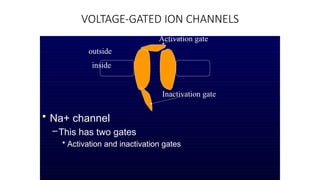
The voltage-gated sodium channel has two gates-one near the outside
of the channel called the activation gate, and another near the inside
called the inactivation gate.
Both gates must be open to permit passage of Na+ through the
channel, and closure of either gate prevents passage.
• When Na+channel opens
• Na+ influx will occur
• Membrane depolarises
• Rising level of voltage causes many channels to open
• This will cause further Na+ influx
• Thus there a positive feedback cycle
• It does not reach Na+ equilibrium potential (+60mV)
• Because Na+ channels inactivates after opening
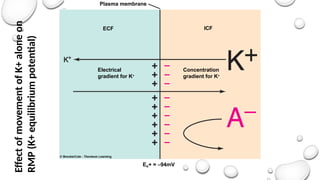
• Voltage-gated K+ channels open
• This will bring membrane towards K+ equilibrium
potential
8.
Initiation of actionpotential
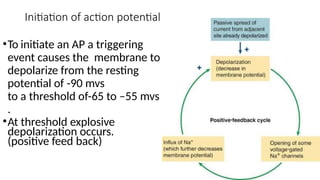
•To initiate an AP a triggering
event causes the membrane to
depolarize from the resting
potential of -90 mvs
to a threshold of-65 to –55 mvs
.
•At threshold explosive
depolarization occurs.
(positive feed back)
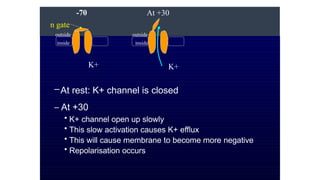
–At rest: K+channel is closed
– At +30
• K+ channel open up slowly
• This slow activation causes K+ efflux
• This will cause membrane to become more negative
• Repolarisation occurs
outside
inside
-70 At +30
K+ K+
n gate
outside
inside
11.
Basis of hyperpolarisation
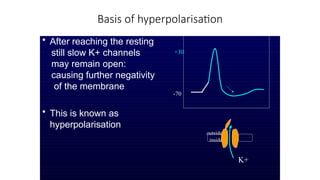
•After reaching the resting
still slow K+ channels
may remain open:
causing further negativity
of the membrane
• This is known as
hyperpolarisation
-70
+30
outside
inside
K+
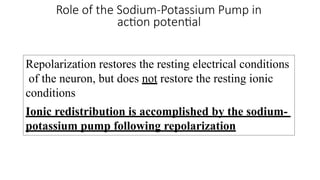
Role of theSodium-Potassium Pump in
action potential
Repolarization restores the resting electrical conditions
of the neuron, but does not restore the resting ionic
conditions
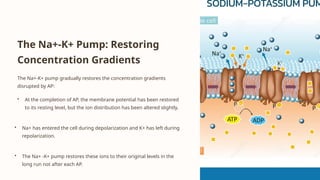
Ionic redistribution is accomplished by the sodium-
potassium pump following repolarization
14.
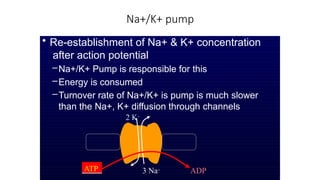
Na+/K+ pump
3 Na+
•Re-establishment of Na+ & K+ concentration
after action potential
–Na+/K+ Pump is responsible for this
–Energy is consumed
–Turnover rate of Na+/K+ is pump is much slower
than the Na+, K+ diffusion through channels
2 K+
ATP ADP
15.
Na+
and K+
concentrations donot change during an action potential
• Although during an action potential, large changes
take place in the membrane potential as a result of
Na+
entry into the cell and K+
exit from the cell
• Actual Na+
and K+
concentrations inside and outside of
the cell generally do not change
• This is because compared to the total number of Na+
and K+
ions in the intracellular and extracellular
solutions, only a small number moves across the
membrane during the action potential
16.
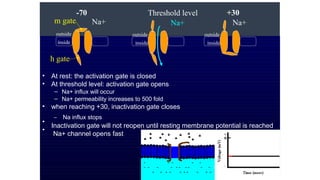
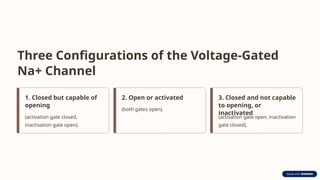
Three Configurations ofthe Voltage-Gated
Na+ Channel
1. Closed but capable of
opening
(activation gate closed,
inactivation gate open).
2. Open or activated
(both gates open).
3. Closed and not capable
to opening, or
inactivated
(activation gate open, inactivation
gate closed).
17.
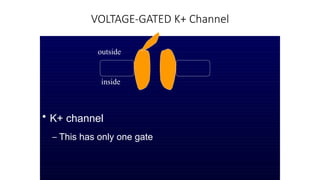
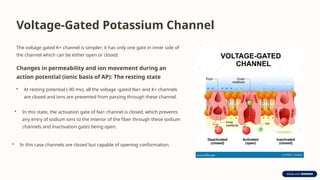
Voltage-Gated Potassium Channel
Thevoltage gated K+ channel is simpler; it has only one gate in inner side of
the channel which can be either open or closed.
Changes in permeability and ion movement during an
action potential (ionic basis of AP): The resting state
• At resting potential (-90 mv), all the voltage -gated Na+ and K+ channels
are closed and ions are prevented from passing through these channel.
• In this state, the activation gate of Na+ channel is closed, which prevents
any entry of sodium ions to the interior of the fiber through these sodium
channels and inactivation gates being open.
• In this case channels are closed but capable of opening conformation.
18.
Depolarization: The PositiveFeedback Cycle
When a membrane start to depolarize toward threshold as a result of triggering event the activation gates of some Na+
channels open.
Now both gates are open. This is called the activated state.
During this state, sodium ions
influx through the channel
downs its electro-concentration
gradient, increasing the sodium
permeability of the membrane.
The inward movement of
positively charged Na+
depolarizes the membrane
further.
This allows rapid inflow of
sodium ions, which causes a
further rise in the membrane
potential, thus opening still
more voltage-gated sodium
channels and allowing more
streaming of sodium ions to the
interior of the fiber.
19.
Threshold and PeakPotential
This process is a positive-feedback cycle that, once the feedback is strong enough, continues until all the voltage-gated
sodium channels have become activated (opened), when the threshold potential is reached (- 65).
Further inward movement of Na+ reverses the potential, with the inside becoming positive and the outside becoming
negative as the action potential peaks (+35).
Therefore, a sudden increase in the membrane potential in a large nerve fiber from -90 millivolts up to about -65
millivolts usually causes the explosive development of an action potential.
This level of -65 millivolts is said to be the threshold for stimulation.
20.
Repolarization: Restoring thePotential
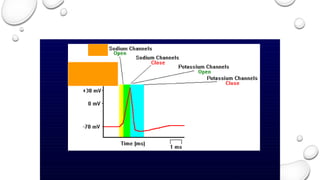
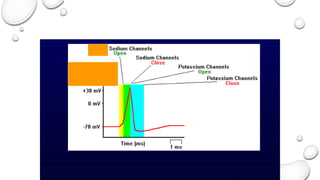
At the peak of action potential, the Na+ inactivation gates begin to close and the K+ gates open.
Because of the slight delay in opening of the potassium channels they open just at the same time that the sodium channels
are beginning to close by inactivation gate.
Na+ Inactivation
If Na+ channel inactivation did not
occur, the repolarization would be
slowed.
Speeding the Process
Thus, the decrease in sodium entry
to the cell and the simultaneous
increase in potassium exit from the
cell combine to speed the
repolarization process.
Restoring RMP
Continued outward movement of
K+ restores the resting membrane
potential, with the potential
reversing back.
21.
Hyperpolarization (Undershoot)
Further outwardmovement of K+ through the still open K+ gates briefly hyperpolarized the membrane. Then the K+ gates
close and the membrane returns to resting potential.
The After-Hyperpolarization
The voltage gated K+ channels are slow to close. As a result of this persistent increased permeability to K+ , more
K+ may leave than is necessary to bring the potential to resting.
This slight excessive K+ efflux makes the interior of the cell transiently even more negative than resting potential,
causing the after hyperpolarization.
22.
Role of InwardRectifier K+ Channels and Na+
Channel Recovery
Inward Rectifier K+ Channels
They are non- gated (leakage) channels, they tend to drive
the membrane potential from the hyperpolarized state to the
resting level as they drive K+ ions inward the nerve only in
cases of hyper-polarization.
Na+ Channel Recovery
Another important characteristic of the sodium channel
inactivation process is that the inactivation gate will not
reopen until the membrane potential returns to the original
resting membrane potential level.
Therefore, it is usually not possible for the sodium channels
to open again without first repolarize the nerve fiber.
As the potential returns to resting, the changing voltage
shifts the Na+ channels to their closed but capable of
opening conformation, now the channel is rest, ready to
respond to another stimulus.
23.
The Na+-K+ Pump:Restoring
Concentration Gradients
The Na+-K+ pump gradually restores the concentration gradients
disrupted by AP:
• At the completion of AP, the membrane potential has been restored
to its resting level, but the ion distribution has been altered slightly.
• Na+ has entered the cell during depolarization and K+ has left during
repolarization.
• The Na+ -K+ pump restores these ions to their original levels in the
long run not after each AP.