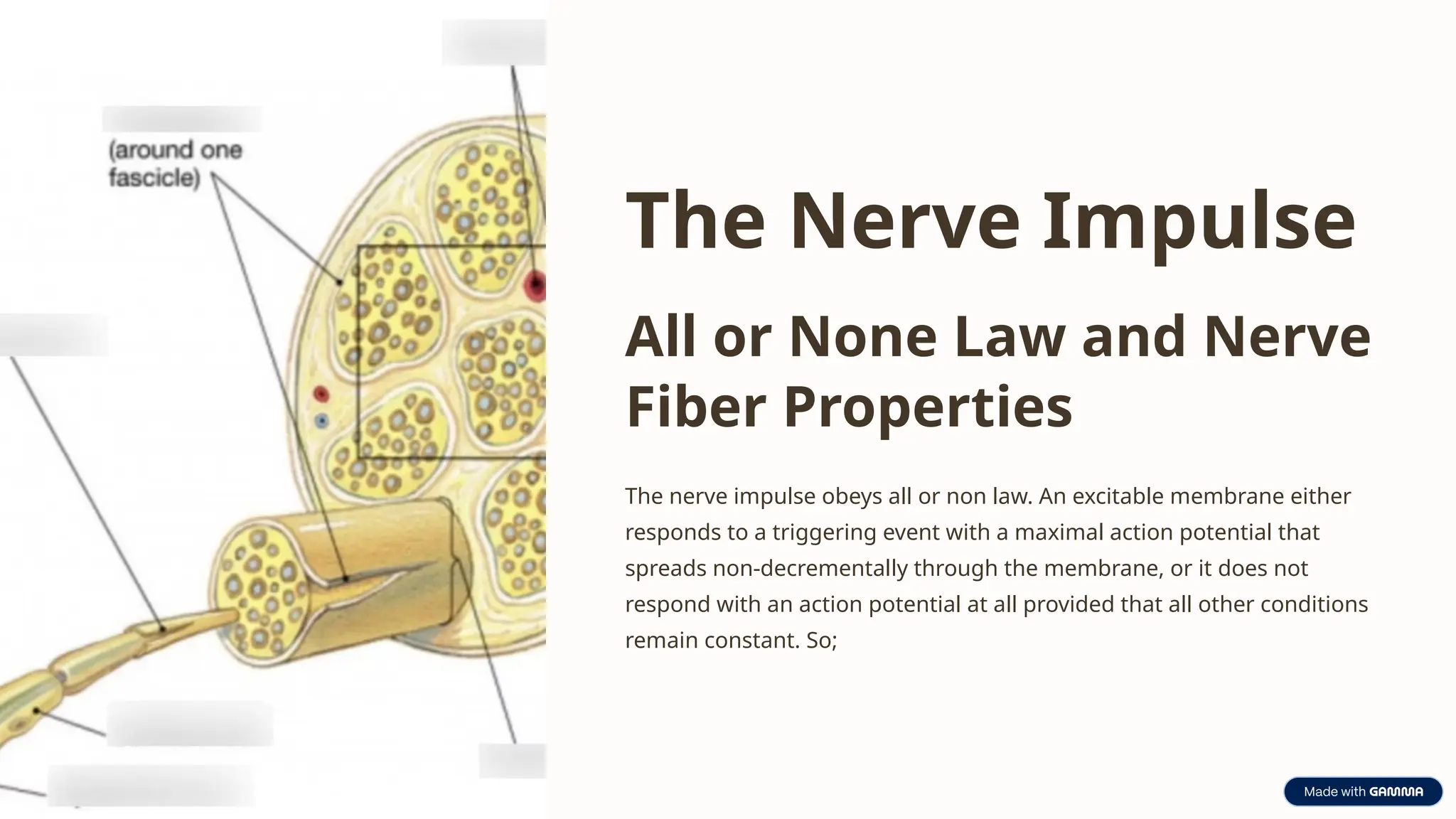
The Nerve Impulse
Allor None Law and Nerve
Fiber Properties
The nerve impulse obeys all or non law. An excitable membrane either
responds to a triggering event with a maximal action potential that
spreads non-decrementally through the membrane, or it does not
respond with an action potential at all provided that all other conditions
remain constant. So;
2.
Phases of actionpotential
•Depolarization
•Repolarization
•Hyperpolarization
3.
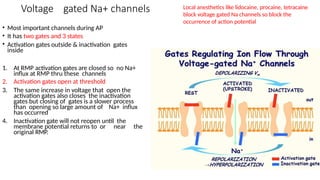
Voltage gated Na+channels
• Most important channels during AP
• It has two gates and 3 states
• Activation gates outside & inactivation gates
inside
1. At RMP activation gates are closed so no Na+
influx at RMP thru these channels
2. Activation gates open at threshold
3. The same increase in voltage that open the
activation gates also closes the inactivation
gates but closing of gates is a slower process
than opening so large amount of Na+ influx
has occurred
4. Inactivation gate will not reopen until the
membrane potential returns to or near the
original RMP.
Local anesthetics like lidocaine, procaine, tetracaine
block voltage gated Na channels so block the
occurrence of action potential
4.
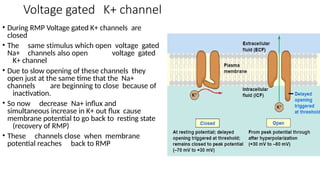
Voltage gated K+channel
• During RMP Voltage gated K+ channels are
closed
• The same stimulus which open voltage gated
Na+ channels also open voltage gated
K+ channel
• Due to slow opening of these channels they
open just at the same time that the Na+
channels are beginning to close because of
inactivation.
• So now decrease Na+ influx and
simultaneous increase in K+ out flux cause
membrane potential to go back to resting state
(recovery of RMP)
• These channels close when membrane
potential reaches back to RMP
5.
The Nerve Impulse
•Physico – chemical disturbance by a threshold
stimulus (or more) and propagated as a wave along
the nerve fiber.
• The accompanying changes:
1- Electrical changes.
2- Excitability changes.
3- Metabolic changes.
4- Thermal changes.
6.
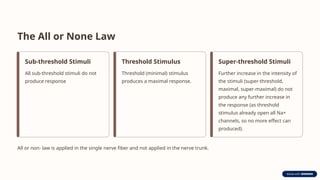
The All orNone Law
Sub-threshold Stimuli
All sub-threshold stimuli do not
produce response
Threshold Stimulus
Threshold (minimal) stimulus
produces a maximal response.
Super-threshold Stimuli
Further increase in the intensity of
the stimuli (super-threshold,
maximal, super-maximal) do not
produce any further increase in
the response (as threshold
stimulus already open all Na+
channels, so no more effect can
produced).
All or non- law is applied in the single nerve fiber and not applied in the nerve trunk.
7.
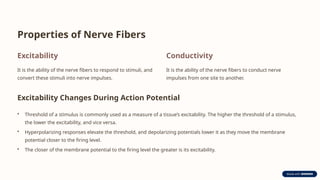
Properties of NerveFibers
Excitability
It is the ability of the nerve fibers to respond to stimuli, and
convert these stimuli into nerve impulses.
Conductivity
It is the ability of the nerve fibers to conduct nerve
impulses from one site to another.
Excitability Changes During Action Potential
• Threshold of a stimulus is commonly used as a measure of a tissue’s excitability. The higher the threshold of a stimulus,
the lower the excitability, and vice versa.
• Hyperpolarizing responses elevate the threshold, and depolarizing potentials lower it as they move the membrane
potential closer to the firing level.
• The closer of the membrane potential to the firing level the greater is its excitability.
8.
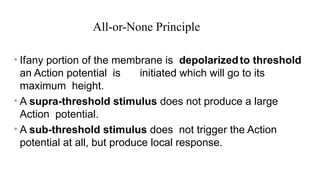
All-or-None Principle
• Ifanyportion of the membrane is depolarizedto threshold
an Action potential is initiated which will go to its
maximum height.
• A supra-threshold stimulus does not produce a large
Action potential.
• A sub-threshold stimulus does not trigger the Action
potential at all, but produce local response.
9.
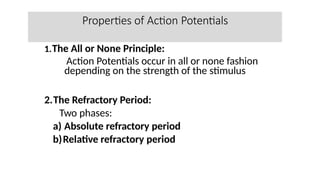
Properties of ActionPotentials
1.The All or None Principle:
Action Potentials occur in all or none fashion
depending on the strength of the stimulus
2.The Refractory Period:
Two phases:
a) Absolute refractory period
b)Relative refractory period
10.
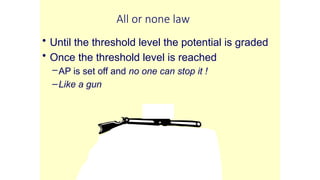
All or nonelaw
• Until the threshold level the potential is graded
• Once the threshold level is reached
–AP is set off and no one can stop it !
–Like a gun
11.
All or nonelaw
• The principle that the strength by which a nerve
or muscle fiber responds to a stimulus is not
dependent on the strength of the stimulus
• If the stimulus strength is above threshold, the
nerve or muscle fiber will give a complete
response or otherwise no response at all
12.
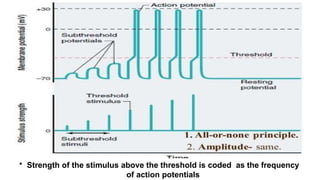
• Strength ofthe stimulus above the threshold is coded as the frequency
of action potentials
13.
Refractory period
(unresponsive orstubborn)
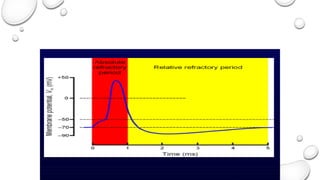
•A new action potential cannot occur in an
excitable membrane as long as the membrane is
still depolarized from the preceding action
potential.
15.
Absolute Refractory Period
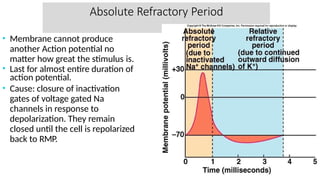
•Membrane cannot produce
another Action potential no
matter how great the stimulus is.
• Last for almost entire duration of
action potential.
• Cause: closure of inactivation
gates of voltage gated Na
channels in response to
depolarization. They remain
closed until the cell is repolarized
back to RMP.
16.
Refractory Period
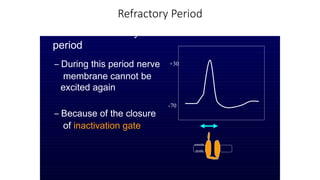
• Absoluterefractory
period
– During this period nerve
membrane cannot be
excited again
– Because of the closure
of inactivation gate
-70
+30
outside
inside
17.
Relative refractory period
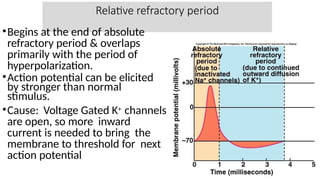
•Beginsat the end of absolute
refractory period & overlaps
primarily with the period of
hyperpolarization.
•Action potential can be elicited
by stronger than normal
stimulus.
•Cause: Voltage Gated K+ channels
are open, so more inward
current is needed to bring the
membrane to threshold for next
action potential
18.
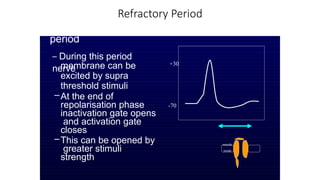
Refractory Period
• Relativerefractory
period
– During this period
nerve
membrane can be
excited by supra
threshold stimuli
–At the end of
repolarisation phase
inactivation gate opens
and activation gate
closes
–This can be opened by
greater stimuli
strength
-70
+30
outside
inside
19.
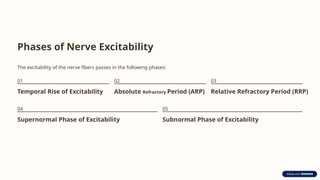
Phases of NerveExcitability
The excitability of the nerve fibers passes in the following phases:
01
Temporal Rise of Excitability
02
Absolute Refractory Period (ARP)
03
Relative Refractory Period (RRP)
04
Supernormal Phase of Excitability
05
Subnormal Phase of Excitability
20.
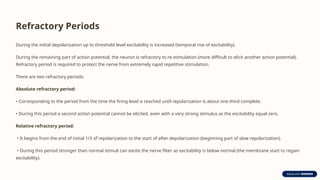
Refractory Periods
During theinitial depolarization up to threshold level excitability is increased (temporal rise of excitability).
During the remaining part of action potential, the neuron is refractory to re-stimulation (more difficult to elicit another action potential).
Refractory period is required to protect the nerve from extremely rapid repetitive stimulation.
There are two refractory periods:
Absolute refractory period:
• Corresponding to the period from the time the firing level is reached until repolarization is about one-third complete.
• During this period a second action potential cannot be elicited, even with a very strong stimulus as the excitability equal zero.
Relative refractory period:
• It begins from the end of initial 1/3 of repolarization to the start of after depolarization (beginning part of slow repolarization).
• During this period stronger than normal stimuli can excite the nerve fiber as excitability is below normal (the membrane start to regain
excitability).
21.
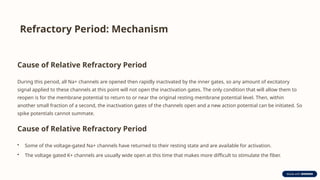
Refractory Period: Mechanism
Causeof Relative Refractory Period
During this period, all Na+ channels are opened then rapidly inactivated by the inner gates, so any amount of excitatory
signal applied to these channels at this point will not open the inactivation gates. The only condition that will allow them to
reopen is for the membrane potential to return to or near the original resting membrane potential level. Then, within
another small fraction of a second, the inactivation gates of the channels open and a new action potential can be initiated. So
spike potentials cannot summate.
Cause of Relative Refractory Period
• Some of the voltage-gated Na+ channels have returned to their resting state and are available for activation.
• The voltage gated K+ channels are usually wide open at this time that makes more difficult to stimulate the fiber.
22.
Value of RefractoryPeriod
Forward Movement: Action
potential only moves in forward
direction. Backward current flow
does not re-excite previously
activated area.
Frequency Limit: Refractory
period also limits frequency of
action potential. The longer the
refractory period, the greater
the delay before a new action
potential can be initiated and
the lower the frequency with
which a nerve cell can respond
to repeated or ongoing
stimulation.
Variability: Length of refractory
period varies for different types
of nerve fibers.
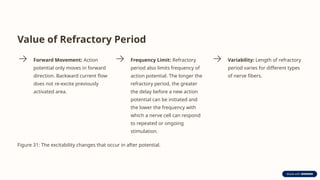
Figure 31: The excitability changes that occur in after potential.
23.
After Potentials andExcitability
Supernormal Period
• It is corresponding to after-depolarization (negative
after potential).
• It is due to reduced rate of K+ efflux caused by
accumulation of +ve charge on outer side as RMP is
reached.
• It is the period during which excitability is greater than
normal.
• An AP can be elicited by a slightly smaller stimulus than
normal (sub-threshold).
Subnormal Period
• It is corresponding to after-hyperpolarization (positive
after potential).
• It is due to delay closure of K+ channel causing excess
efflux of K+ .
• It is the period during which excitability is less than
normal (threshold for excitation is slightly higher than
normal).
• Stronger stimulus is needed to excite nerve.
24.
Factors Affecting NerveExcitability: Role of Na+
Any condition that affects on Na+ permeability will affect on depolarization and nerve excitability.
Membrane Stabilizers
Local anesthetics as cocaine decrease Na+ influx thus decrease excitability (block voltage gated Na+ channels)
thus nerve impulse fails to be produced.
Hyper-calcemia
Increase ionized Ca++ concentration in the ECF decreases the permeability of the membrane of nerve fiber to
Na+ and decrease the excitability.
Low Ionized Ca++ / Veratridine
Any condition that increases the permeability of the membrane of nerve fiber to Na+ cause the nerve to be
more excitable. Low ionized Ca++ concentration in the ECF and veratridine increase the permeability of the
membrane to Na+ increase excitability (rapidly depolarized).
Hypo-natremia
Decreasing the Na+ concentration in ECF reduces the size of the action potential but has little effect on the
resting membrane potential. The lack of much effect on the resting membrane potential would be predicted,
since the permeability of the membrane to Na+ at rest is relatively low.
Tetrodotoxin (TTX)
Block Na+ channel prevent AP and decrease excitability.
25.
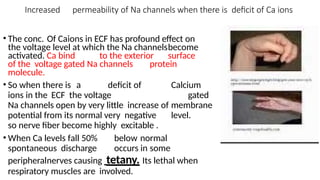
Increased permeability ofNa channels when there is deficit of Ca ions
• The conc. Of Caions in ECF has profound effect on
the voltage level at which the Na channelsbecome
activated. Ca bind to the exterior surface
of the voltage gated Na channels protein
molecule.
• So when there is a deficit of Calcium
ions in the ECF the voltage gated
Na channels open by very little increase of membrane
potential from its normal very negative level.
so nerve fiber become highly excitable .
• When Ca levels fall 50% below normal
spontaneous discharge occurs in some
peripheralnerves causing tetany. Its lethal when
respiratory muscles are involved.
26.
Effect of hypokalemiaon nerve and muscle
•Hypokalemia is decreased levels of K in blood
•Decreased K in blood causes the K concentration
gradient between ECF & ICF to increase which leads to
more negative RMP as more K leaks out of cell so
hyperpolarization occurs and membrane potential is far
away from threshold value so membrane is less
excitable
•Muscle weakness and pain
•Irregular heart beats
27.
Effect of hyperkalemiaon MP
•Hyperkalemia is increased levels of K in blood (above
5 mmol/lit)
•Elevated K in blood causes the K concentration
gradient between ECF & ICF to decrease which leads
to less negative RMP as less K leaks out of cell so
closer to threshold value so easily excitable but at
the same time prevent repolarization so Na channels
will not be activated so leading to muscle weakness
and paralysis and cardiac arrhythmias.
28.
Factors Affecting NerveExcitability: K+ and Na+-K+ Pump
Role of K+
Hypokalemia: This increase concentration gradient which
increases diffusion of K+ from inside to outside the nerve
fibers producing hyperpolarization and decreases
excitability. This occurs in a hereditary disease known as
familial periodic paralysis (the excitability of the nerves is
reduced; no nerve impulses and the person become
paralyzed). The condition is treated by IV administration of
K+ .
Hyperkalemia: Makes the resting membrane potential to
depolarized (increase diffusion of K+ from outside to inside)
and increase excitability.
Block of K+ channels: Tetra-ethyl-ammonium (TEA) is a
drug that selectively blocks only K+ channels. It prolongs
repolarization but no hyperpolarization.
Role Na+-K+ Pump
Prolonged blockade of Na+ K+ pump would decrease in the
resting membrane potential, action potential and a loss of
neuronal excitability.
Accommodation of Nerve Fiber
Gradual increase in intensity of a sub-threshold stimulus to
threshold level will give no response. As depolarization
become slow and balanced with repolarization so nothing
occur.
Explanation: Slow opening of Na+ channels with slow entry
of Na+ is balanced by: Closure of Na+ channels. Opening of
K+ channels.
29.
Importance of refractoryperiod
•Responsible for setting up limit on the frequency of
Action Potentials so prevents fatigue
•promotes one way propagation of action potential
because the membrane just behind the ongoing
action potential is refractory due to the inactivation
of the sodium channels
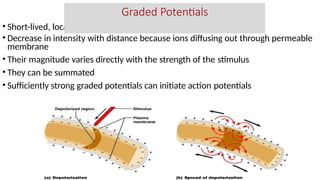
• Short-lived, localchanges in membrane potential
• Decrease in intensity with distance because ions diffusing out through permeable
membrane
• Their magnitude varies directly with the strength of the stimulus
• They can be summated
• Sufficiently strong graded potentials can initiate action potentials
Graded Potentials
32.
Action Potentials (APs)
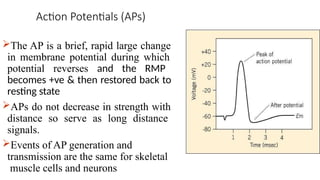
TheAP is a brief, rapid large change
in membrane potential during which
potential reverses and the RMP
becomes +ve & then restored back to
resting state
APs do not decrease in strength with
distance so serve as long distance
signals.
Events of AP generation and
transmission are the same for skeletal
muscle cells and neurons
33.
Summation of gradedpotential
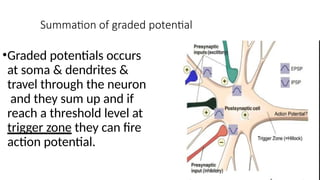
•Graded potentials occurs
at soma & dendrites &
travel through the neuron
and they sum up and if
reach a threshold level at
trigger zone they can fire
action potential.
34.
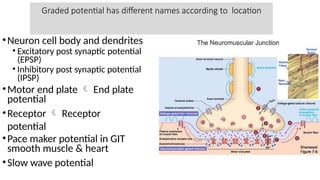
Graded potential hasdifferent names according to location
•Neuron cell body and dendrites
• Excitatory post synaptic potential
(EPSP)
• Inhibitory post synaptic potential
(IPSP)
•Motor end plate End plate
potential
•Receptor Receptor
potential
•Pace maker potential in GIT
smooth muscle & heart
•Slow wave potential
35.
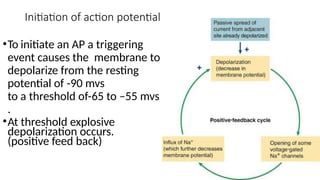
Initiation of actionpotential
•To initiate an AP a triggering
event causes the membrane to
depolarize from the resting
potential of -90 mvs
to a threshold of-65 to –55 mvs
.
•At threshold explosive
depolarization occurs.
(positive feed back)
36.
• Strength ofthe stimulus above the threshold is coded as the frequency
of action potentials